
Jerusalem is a city in the Southern Levant, on a plateau in the Judaean Mountains between the Mediterranean and the Dead Sea. It is one of the oldest cities in the world and is considered a holy city to the three major Abrahamic religions: Judaism, Christianity and Islam. Both Israel and Palestine claim Jerusalem as their capital city; Israel maintains its primary governmental institutions there, while Palestine ultimately foresees it as its seat of power. Neither claim is widely recognised internationally.
Throughout its long history, Jerusalem has been destroyed at least twice, besieged 23 times, captured and recaptured 44 times, and attacked 52 times. The part of Jerusalem called the City of David shows first signs of settlement in the 4th millennium BCE, in the shape of encampments of nomadic shepherds. During the Canaanite period (14th century BCE) Jerusalem was named as Urusalim on ancient Egyptian tablets, probably meaning "City of Shalem" after a Canaanite deity. During the Israelite period, significant construction activity in Jerusalem began in the 10th century BCE (Iron Age II), and by the 9th century BCE the city had developed into the religious and administrative centre of the Kingdom of Judah. In 1538 the city walls were rebuilt for a last time around Jerusalem under Suleiman the Magnificent of the Ottoman Empire. Today those walls define the Old City, which since the 19th century has been divided into four quarters—the Armenian, Christian, Jewish and Muslim quarters. The Old City became a World Heritage Site in 1981, and is on the List of World Heritage in Danger. Since 1860 Jerusalem has grown far beyond the Old City's boundaries. In 2024 Jerusalem had a population of 1,050,153. In 2022 60% were Jews and almost 40% were Palestinians. In 2020 the population was 951,100, of which Jews comprised 570,100 (59.9%), Muslims 353,800 (37.2%), Christians 16,300 (1.7%) and 10,800 unclassified (1.1%).
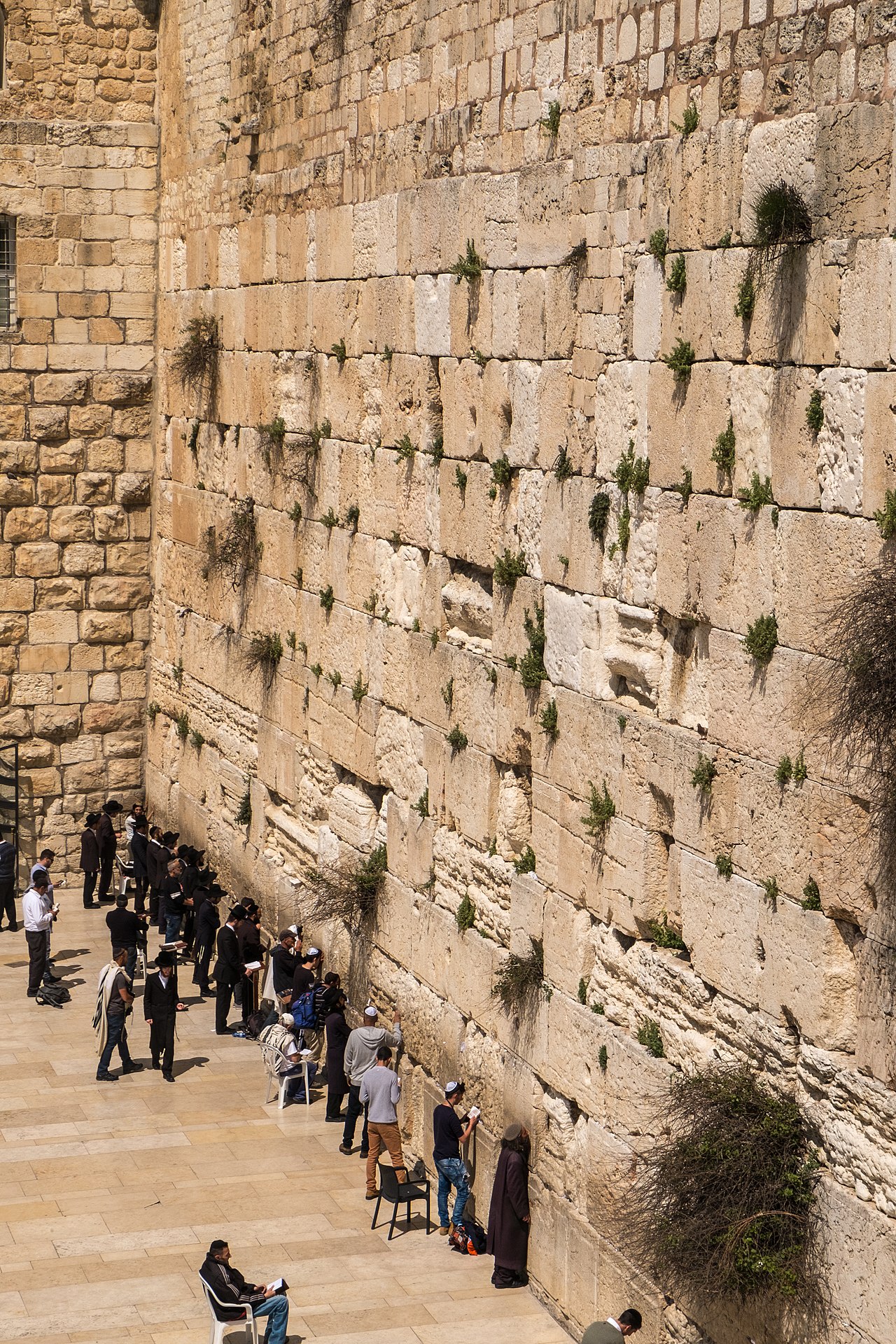
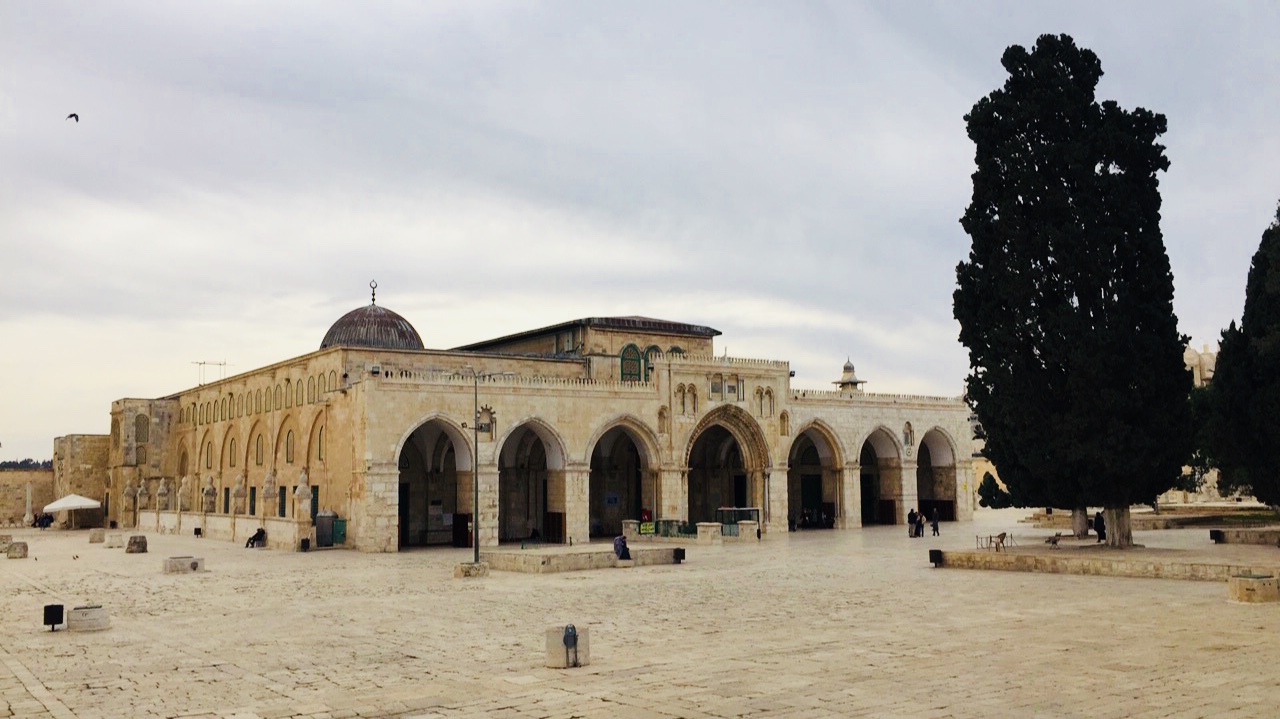
According to the Hebrew Bible, King David conquered the city from the Jebusites and established it as the capital of the United Kingdom of Israel, and his son King Solomon commissioned the building of the First Temple. Modern scholars argue that Israelites branched out of the Canaanite peoples and culture through the development of a distinct monolatrous—and later monotheistic—religion centred on El/Yahweh. These foundational events assumed central symbolic importance for the Jewish people. The sobriquet of holy city (Hebrew: עיר הקודש, romanised: 'Ir ha-Qodesh) was probably attached to Jerusalem in post-exilic times. The holiness of Jerusalem in Christianity, conserved in the Greek translation of the Hebrew Bible, which Christians adopted as the Old Testament, was reinforced by the New Testament account of Jesus's crucifixion and resurrection there. In Islam, Jerusalem is the third-holiest city, after Mecca and Medina. The city was the first standard direction for Muslim prayers, and in Islamic tradition, Muhammad made his Night Journey there in 621, ascending to heaven where he spoke to God, per the Quran. As a result, despite having an area of only 0.9 km2 (3⁄8 sq mi), the Old City is home to many sites of seminal religious importance, among them the Temple Mount with its Western Wall, Dome of the Rock and al-Aqsa Mosque, and the Church of the Holy Sepulchre.
At present, the status of Jerusalem remains one of the core issues in the Israeli–Palestinian conflict. Under the 1947 United Nations Partition Plan for Palestine, Jerusalem was to be "established as a corpus separatum under a special international regime" administered by the United Nations. During the 1948 Arab–Israeli War, West Jerusalem was among the areas incorporated into Israel, while East Jerusalem, including the Old City, was occupied and annexed by Jordan. Israel occupied East Jerusalem from Jordan during the 1967 Six-Day War and subsequently annexed it into the city's municipality, together with additional surrounding territory. One of Israel's Basic Laws, the 1980 Jerusalem Law, refers to Jerusalem as the country's undivided capital. All branches of the Israeli government are located in Jerusalem, including the Knesset (Israel's parliament), the residences of the prime minister and president, and the Supreme Court. The international community rejects the annexation as illegal and regards East Jerusalem as Palestinian territory occupied by Israel.
Etymology and names
Etymology
The name Jerusalem is variously etymologised to mean 'foundation of the god Shalem', from the Semitic root yry which can mean 'to found, to lay a cornerstone' and is used that way at least twice in the Hebrew Bible, in Job and Genesis. The god Shalem was thus the original tutelary deity of the Bronze Age city.
Shalim or Shalem was the name of the god of dusk in the Canaanite religion, whose name is based on the same root S-L-M from which the Hebrew word for "peace" is derived (Shalom in Hebrew, cognate with Arabic Salam). The name thus offered itself to etymologisations such as "The City of Peace", "Abode of Peace", "Dwelling of Peace" ("founded in safety"), or "Vision of Peace" in some Christian authors.

The ending -ayim indicates the dual, thus leading to the suggestion that the name Yerushalayim refers to the fact that the city initially sat on two hills.
Ancient Egyptian sources
The Execration Texts of the Middle Kingdom of Egypt (c. 19th century BCE), which refer to a city called rwšꜣlmm or ꜣwšꜣmm, variously transcribed as Rušalimum, or Urušalimum, may indicate Jerusalem. Alternatively, the Amarna letters of Abdi-Heba (1330s BCE), which reference an Úrušalim, may be the earliest mention of the city.
Hebrew Bible and Jewish sources
The form Yerushalem (Hebrew: ירושלם) or Yerushalayim (Hebrew: ירושלים) first appears in the Bible, in the Book of Joshua. Jerusalem is mentioned 669 times in the Hebrew Bible, while the term Zion appears 154 times as either a symbolic mention of Jerusalem or as a reference to the entire Land of Israel.

According to a Midrash, the name is a combination of two names united by God, Yireh ("the abiding place", the name given by Abraham to the place where he planned to sacrifice his son) and Shalem ("Place of Peace", the name given by high priest Shem). 2 Chronicles ascribes Mount Moriah, the traditional location of the Binding of Isaac, as the site where King Solomon built the First Temple.
Oldest written mention of Jerusalem
One of the earliest extra-biblical Hebrew writing of the word Jerusalem is dated to the sixth or seventh century BCE and was discovered in Khirbet Beit Lei near Beit Guvrin in 1961. The inscription states: "I am Yahweh thy God, I will accept the cities of Judah and I will redeem Jerusalem", or as other scholars suggest: "Yahweh is the God of the whole earth. The mountains of Judah belong to him, to the God of Jerusalem". An earlier example of the name appears in a papyrus from the 7th century BCE.
A papyrus fragment from the Judean Desert that has been interpreted as reading "from the king’s maidservant, from Naharata, jars of wine, to Jerusalem" was dated approximately to the seventh century BCE using a combination of palaeographic analysis of the script and radiocarbon dating.

In extra-biblical inscriptions, the earliest known example of the -ayim ending was discovered on a column about 3 km west of ancient Jerusalem, dated to the first century BCE.
Jebus, Zion, City of David
An ancient settlement of Jerusalem, founded as early as the Bronze Age on the hill above the Gihon Spring, was, according to the Bible, named Jebus. Called the "Fortress of Zion" (metsudat Zion), it was renamed as the "City of David", and was known by this name in antiquity. Another name, "Zion", initially referred to a distinct part of the city, a specific hill in Jerusalem, Mount Zion, located to the south of Mount Moriah (the Temple Mount). Over time, the term came to denote Jerusalem as a whole and, later, the biblical Land of Israel. The name is found in 2 Samuel (2 Sam 5:7), dated to approximately the mid-6th century BCE.
Greek, Roman and Byzantine names
In Greek and Latin the city's name was transliterated Hierosolyma/Hierosoluma (Greek: Ἱεροσόλυμα; in Greek hieròs, ἱερός, means holy), and was the term used by Matthew and Mark in their gospels instead of the Hebrew term.
Up until the 2010s the consensus among historians was that following Alexander the Great's conquest, Hierosoluma was set to be incorporated into the larger temple cities of the Seleucid kingdom, and to be Hellenised as Hierapolis. However, modern historians dispute this as a proper Ancient Greek translation for the polis would be similar to Hierolophos.
After the Bar Kokhba revolt (132–136 CE), the city was renamed Aelia Capitolina during the Roman period of its history. Named for the Roman emperor Hadrian and the deities of Rome, the name lasted until the Byzantine era.
Salem
The Biblical city "Salem" (שלם), said to be the kingdom of Melchizedek in Genesis 14, has traditionally been identified with Jerusalem, reflecting an early name of the city. Josephus, the early Aramaic translations of the relevant verse, as well as the Aramaic Apocryphon of Genesis of the Dead Sea Scrolls (1QapGen 22:13), all make this identification. Salem as an early name for Jerusalem is also indicated by the liturgical poetry in Psalms, which equates Salem with Zion, used as a synonym for Jerusalem.
Other early Hebrew sources, early Christian renderings of the verse and targumim, however, put Salem in Northern Israel near Shechem (Sichem), now Nablus, a city of some importance in early sacred Hebrew writing. Possibly the redactor of the Apocryphon of Genesis wanted to dissociate Melchizedek from the area of Shechem, which at the time was in possession of the Samaritans. However that may be, later Rabbinic sources also equate Salem with Jerusalem, mainly to link Melchizedek to later Temple traditions. Samaritan tradition, which consencrated Mount Gerizim over Jerusalem, referred to the later as Cursed Salem (Arur-Shalem ארור שלם).
Arabic names
Originally titled Bayt al-Maqdis, today, Jerusalem is most commonly known in Arabic as القُدس, transliterated as al-Quds and meaning "the holy" or "the holy sanctuary", cognate with Hebrew: הקדש, romanised: ha-qodesh. The name is possibly a shortened form of مدينة القُدس Madīnat al-Quds "city of the holy sanctuary" after the Hebrew nickname with the same meaning, Ir ha-Qodesh (עיר הקדש). The ق (Q) is pronounced either with a voiceless uvular plosive (/q/), as in Classical Arabic, or with a glottal stop (ʔ) as in Levantine Arabic. Official Israeli government policy mandates that أُورُشَلِيمَ, transliterated as Ūrušalīm, which is the name frequently used in Christian translations of the Bible into Arabic, be used as the Arabic language name for the city in conjunction with القُدس, giving أُورُشَلِيمَ-القُدس, Ūrušalīm-al-Quds. Palestinian Arab families who hail from this city are often called "Qudsi" (قُدسي) or "Maqdasi" (مقدسي), while Palestinian Muslim Jerusalemites may use these terms as a demonym.
History
Jerusalem is one of the world's oldest cities, with a history spanning over 5,000 years. Its origins trace back to around 3000 BCE, with the first settlement near the Gihon Spring. The city is first mentioned in Egyptian Execration texts around 2000 BCE as "Rusalimum." By the 17th century BCE Jerusalem had developed into a fortified city under Canaanite rule, with massive walls protecting its water system. During the Late Bronze Age Jerusalem became a vassal of Ancient Egypt, as documented in the Amarna letters.
The city's importance grew during the Israelite period, which began around 1000 BCE when King David captured Jerusalem and made it the capital of the United Kingdom of Israel. David's son King Solomon built the First Temple, establishing the city as a major religious centre. Following the kingdom's split, Jerusalem became the capital of the Kingdom of Judah until it was captured by the Neo-Babylonian Empire in 586 BCE. The Babylonians destroyed the First Temple, leading to the Babylonian exile of the Jewish population. After the Persian conquest of Babylon in 539 BCE, Cyrus the Great allowed the Jews to return from exile and rebuild the city and its temple, whose construction began c. 516 BCE, marking the start of the Second Temple period. Jerusalem fell under Hellenistic rule after the conquests of Alexander the Great in 332 BCE, leading to increasing cultural and political influence from Greece. The Hasmonean revolt in 164 BCE briefly restored Jewish sovereignty, with Jerusalem as the capital of an independent state.
In 63 BCE, Jerusalem was captured by Pompey and brought under the rule of the Roman Republic. The city was embellished by Herod the Great, who erected a series of supporting walls that allowed for the enlargement of the Temple Mount and the expansion of the Second Temple, making it one of the largest sanctuaries in the ancient world. Tensions between the Jews and the Roman Empire eventually escalated into the First Jewish Revolt, resulting in the siege and destruction of Jerusalem and the Second Temple in 70 CE. A few decades later, the city was rebuilt as the Roman colony Aelia Capitolina, dedicated to Jupiter, provoking the Bar Kokhba Revolt (132–136 CE). After the revolt's suppression, Jews were banned from the city. During the Byzantine period, Jerusalem gained prominence as a centre of Christian pilgrimage, especially after Constantine the Great supported the construction of the Church of the Holy Sepulchre. In 638 CE, Jerusalem was conquered by the Rashidun Caliphate, and under early Islamic rule, the Dome of the Rock and Al-Aqsa Mosque were built, solidifying its religious importance in Islam.
During the Crusades Jerusalem changed hands multiple times, being captured by the Crusaders in 1099 and recaptured by Saladin in 1187. It remained under Islamic control through the Ayyubid and Mamluk periods, until it became part of the Ottoman Empire in 1517. In the modern period Jerusalem was divided between Israel and Jordan after the 1948 Arab–Israeli War. Israel captured East Jerusalem during the Six-Day War in 1967, uniting the city under Israeli control. The status of Jerusalem remains a highly contentious issue, with both Israelis and Palestinians claiming it as their capital. Historiographically, the city's history is often interpreted through the lens of competing national narratives. Israeli scholars emphasise the ancient Jewish connection to the city, while Palestinian narratives highlight the city's broader historical and multicultural significance. Both perspectives influence contemporary discussions of Jerusalem's status and future.
Political status
From 1923 until 1948 Jerusalem served as the administrative capital of Mandatory Palestine.
In December 1949, Israeli prime minister David Ben-Gurion declared the area of West Jerusalem that it controlled as "Israel's eternal capital," a policy that was affirmed by the Knesset in January 1950. This policy was not recognised as such internationally because UN General Assembly Resolution 194 envisaged Jerusalem as an international city; the American government opposed the move and insisted that Israel's capital remain in Tel Aviv. As a result of the Six-Day War in 1967, the whole of Jerusalem came under Israeli control. On 27 June 1967, the government of Levi Eshkol extended Israeli law and jurisdiction to East Jerusalem, but agreed that administration of the Temple Mount compound would be maintained by the Jordanian waqf, under the Jordanian Ministry of Religious Endowments.
In 1988, the Israeli government ordered the closure of Orient House, home of the Arab Studies Society and headquarters of the Palestine Liberation Organization, for security reasons. The building reopened in 1992 as a Palestinian guesthouse. The Oslo Accords stated that the final status of Jerusalem would be determined by negotiations with the Palestinian Authority. The accords banned any official Palestinian presence in the city until a final peace agreement, but provided for the opening of a Palestinian trade office in East Jerusalem. The Palestinian Authority regards East Jerusalem as the capital of a future Palestinian state.
President Mahmoud Abbas has said that any agreement that did not include East Jerusalem as the capital of Palestine would be unacceptable. Israeli Prime Minister Benjamin Netanyahu has similarly stated that Jerusalem would remain the undivided capital of Israel. Due to its proximity to the city, especially the Temple Mount, Abu Dis, a Palestinian suburb of Jerusalem, has been proposed as the future capital of a Palestinian state by Israel. Israel has not incorporated Abu Dis within its security wall around Jerusalem. The Palestinian Authority has built a possible future parliament building for the Palestinian Legislative Council in the town, and its Jerusalem Affairs Offices are all located in Abu Dis.
International status
Most of the international community regards East Jerusalem, including the entire Old City, as part of the occupied Palestinian territories. The United States recognized Israeli control over all of Jerusalem in 2017. Until then neither part, West or East Jerusalem, was recognized as part of the territory of the State of Israel or the State of Palestine. The move was followed by additional states to recognizing West Jerusalem as part of Israel or East Jerusalem as part of a future State of Palestine. Under the United Nations Partition Plan for Palestine adopted by the General Assembly of the United Nations in 1947, Jerusalem was envisaged to become a corpus separatum administered by the United Nations for ten years, following which city residents would be able to "express by means of a referendum their wishes." In the war of 1948 the western part of the city was occupied by forces of the nascent state of Israel, while the eastern part was occupied by Jordan. The international community largely considers the legal status of Jerusalem to derive from the partition plan, and correspondingly most refuse to recognise Israeli sovereignty over the city.
Status under Israeli rule
Following the 1967 Six-Day War, Israel extended its jurisdiction and administration over East Jerusalem, establishing new municipal borders.
In 2010 Israel approved legislation giving Jerusalem the highest national priority status in Israel. The law prioritised construction throughout the city, and offered grants and tax benefits to residents to make housing, infrastructure, education, employment, business, tourism and cultural events more affordable. Communications Minister Moshe Kahlon said that the bill sent "a clear, unequivocal political message that Jerusalem will not be divided", and that "all those within the Palestinian and international community who expect the current Israeli government to accept any demands regarding Israel's sovereignty over its capital are mistaken and misleading".
The status of the city, and especially its holy places, remains a core issue in the Israeli–Palestinian conflict. The Israeli government has approved building plans in the Muslim Quarter of the Old City in order to expand the Jewish presence in East Jerusalem, while some Islamic leaders have made claims that Jews have no historical connection to Jerusalem, alleging that the 2,500-year-old Western Wall was constructed as part of a mosque. Palestinians regard Jerusalem as the capital of the State of Palestine, and the city's borders have been the subject of bilateral talks. A team of experts assembled by the then Israeli Prime Minister Ehud Barak in 2000 concluded that the city must be divided, since Israel had failed to achieve any of its national aims there.
However, Israeli Prime Minister Benjamin Netanyahu said in 2014 that "Jerusalem will never be divided". A poll conducted in June 2013 found that 74% of Israeli Jews reject the idea of a Palestinian capital in any portion of Jerusalem, though 72% of the public regarded it as a divided city. A poll conducted by the Palestinian Centre for Public Opinion and American Pechter Middle East Polls for the Council on Foreign Relations among East Jerusalem Arab residents in 2011 revealed that 39% of East Jerusalem Arab residents would prefer Israeli citizenship, while 31% opted for Palestinian citizenship. According to the poll 40% of Palestinian residents would prefer to leave their neighbourhoods if they would be placed under Palestinian rule.
Jerusalem as capital of Israel
On 5 December 1949 Israel's first prime minister, David Ben-Gurion, proclaimed Jerusalem as Israel's "eternal" and "sacred" capital, and eight days later specified that only the war had "compelled" the Israeli leadership "to establish the seat of Government in Tel Aviv", while "for the State of Israel there has always been and always will be one capital only—Jerusalem the Eternal", and that after the war, efforts had been ongoing for creating the conditions for "the Knesset... returning to Jerusalem." This indeed took place, and since the beginning of 1950 all branches of the Israeli government—legislative, judicial and executive—have resided there, except for the Ministry of Defense, which is located at HaKirya in Tel Aviv. At the time of Ben Gurion's proclamations and the ensuing Knesset vote of 24 January 1950, Jerusalem was divided between Israel and Jordan, and thus the proclamation only applied to West Jerusalem.
In July 1980 Israel passed the Jerusalem Law as Basic Law. The law declared Jerusalem the "complete and united" capital of Israel. The Jerusalem Law was condemned by the international community, which did not recognise Jerusalem as the capital of Israel. The United Nations Security Council passed Resolution 478 on 20 August 1980, which declared that the Jerusalem Law is "a violation of international law", is "null and void and must be rescinded forthwith". Member states were called upon to withdraw their diplomatic representation from Jerusalem.
Following the resolution, 22 of the 24 countries that previously had their embassy in (West) Jerusalem relocated them in Tel Aviv, where many embassies already resided prior to Resolution 478. Costa Rica and El Salvador followed in 2006. There are five embassies—United States, Guatemala, Honduras, Papua New Guinea and Kosovo—and two consulates located within the city limits of Jerusalem. Paraguay maintains an embassy in the Jerusalem District town of Mevaseret Zion, in addition to Bolivia whose embassy is now closed. There are a number of consulates-general located in Jerusalem, which work primarily either with Israel, or the Palestinian authorities.
In 1995 the United States Congress passed the Jerusalem Embassy Act, which required, subject to conditions, that its embassy be moved from Tel Aviv to Jerusalem. On 6 December 2017 the US president, Donald Trump, officially recognised Jerusalem as Israel's capital and announced his intention to move the American embassy to Jerusalem, reversing decades of United States policy on the issue. The move was criticised by many nations. A resolution condemning the US decision was supported by all the 14 other members of the UN Security Council, but was vetoed by the US on 18 December 2017. A subsequent resolution condemning the US decision was passed in the United Nations General Assembly. On 14 May 2018 the United States officially opened its embassy in Jerusalem, transforming its Tel Aviv location into a consulate. Due to the general lack of international recognition of Jerusalem as Israel's capital, some non-Israeli media outlets use Tel Aviv as a metonym for Israel.
In December 2017, US President Donald Trump made the decision to acknowledge Jerusalem as the capital of Israel and relocate the US embassy from Tel Aviv to that city. This decision faced significant opposition, particularly from leaders within the Arab and Muslim communities. The Palestinians assert that East Jerusalem should serve as the capital of their future state, and its status ought to be resolved through peace negotiations as outlined in the 1993 Israeli-Palestinian peace accords. Palestinian President Mahmoud Abbas remarked that Trump's action effectively negated the United States' position as a mediator in the peace process. Ismail Haniyeh, the head of the Islamist Hamas movement, urged for a new "intifada," or uprising. Turkish President Recep Tayyip Erdogan criticised the decision, stating it would "place the region in a ring of fire." Saudi Arabia's King Salman described it as "a clear provocation to Muslims globally." Egyptian President Abdel Fattah al-Sisi indicated that this decision would exacerbate the situation in the region. Iran warned that the decision would incite a "new intifada," labelling it a blatant infringement of international resolutions.
In April 2017 the Russian Ministry of Foreign Affairs announced it viewed Western Jerusalem as Israel's capital in the context of UN-approved principles which include the status of East Jerusalem as the capital of the future Palestinian state. On 15 December 2018 the Australian government officially recognised West Jerusalem as Israel's capital, but said their embassy in Tel Aviv would stay until a two-state resolution was settled. The decision was reversed in October 2022.
Government precinct and national institutions
The Kiryat HaLeom (national precinct) project is intended to house most government agencies and national cultural institutions. They are located in the Kiryat HaMemshala (government complex) in the Givat Ram neighbourhood. Some government buildings are located in Kiryat Menachem Begin. The city is home to the Knesset, the Supreme Court, the Bank of Israel, the National Headquarters of the Israel Police, the official residences of the president and the prime minister, the Cabinet, and all ministries except for the Ministry of Defense (which is located in central Tel Aviv's HaKirya district) and the Ministry of Agriculture and Rural Development (which is located in Rishon LeZion, in the wider Tel Aviv metropolitan area, near Beit Dagan).
Israeli settlements
Since its capture in 1967, the Israeli government has built 12 Israeli settlements in East Jerusalem, with a population amounting to 220,000 Israeli Jewish settlers as of 2019. The international community consider Israeli settlements to be illegal under international law.
Jerusalem as capital of Palestine
The Palestinian National Authority views East Jerusalem as occupied territory according to United Nations Security Council Resolution 242. The Palestinian Authority claims Jerusalem, including the Haram al-Sharif, as the capital of the State of Palestine, The PLO claims that West Jerusalem is also subject to permanent status negotiations. However, it has stated that it would be willing to consider alternative solutions, such as making Jerusalem an open city.
The PLO's position is that East Jerusalem, as defined by the pre-1967 municipal boundaries, shall be the capital of Palestine and West Jerusalem the capital of Israel, with each state enjoying full sovereignty over its respective part of the city and with its own municipality. A joint development council would be responsible for coordinated development. Orient House in East Jerusalem served as the headquarters of the PLO in the 1980s and 1990s. It was closed by Israel in 2001, two days after the Sbarro restaurant suicide bombing.