
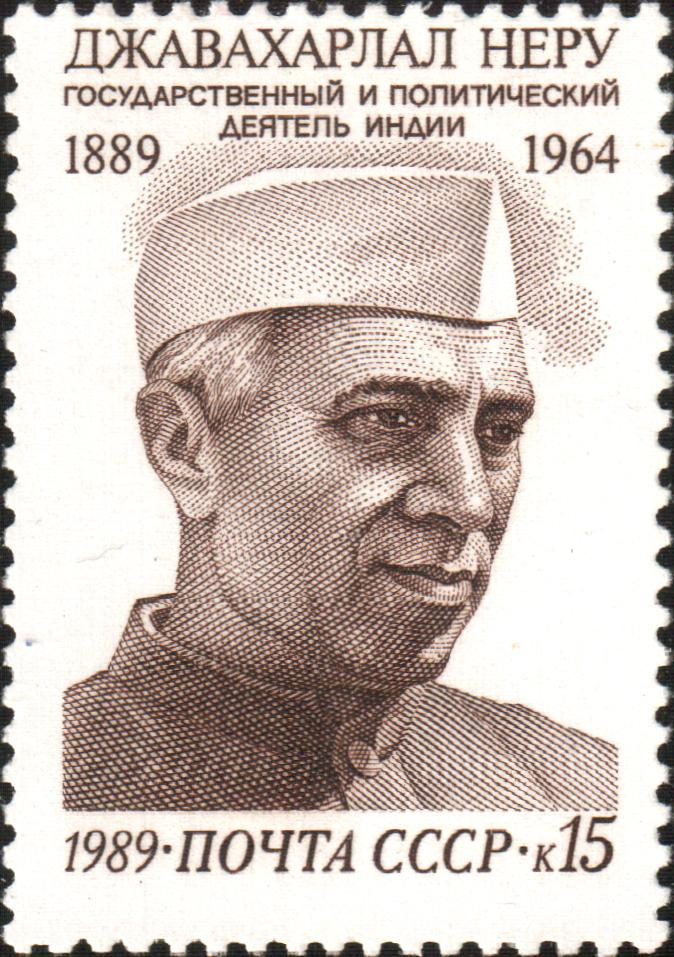
Jawaharlal Nehru (14 November 1889 – 27 May 1964) was an Indian anti-colonial nationalist, secular humanist, social democrat, Gandhian, and statesman who was a central figure in India during the middle of the 20th century. He is one of the founding fathers of modern India. Nehru was a principal leader of the Indian nationalist movement in the 1930s and 1940s. Upon India's independence in 1947, he served as the country's first and the longest serving prime minister in terms of time in office for 16 years 286 days. Nehru promoted parliamentary democracy, secularism, and science and technology during the 1950s, powerfully influencing India's arc as a modern nation. In international affairs, he steered India clear of the two blocs of the Cold War. A well-regarded author, he wrote books such as Letters from a Father to His Daughter (1929), An Autobiography (1936) and The Discovery of India (1946), that have been read around the world.
The son of Motilal Nehru, a prominent lawyer and Indian nationalist, Jawaharlal Nehru was educated in England—at Harrow School and Trinity College, Cambridge, and trained in the law at the Inner Temple. He became a barrister, returned to India, enrolled at the Allahabad High Court and gradually became interested in national politics, which eventually became a full-time occupation. He joined the Indian National Congress, rose to become the leader of a progressive faction during the 1920s, and eventually of the Congress, receiving the support of Mahatma Gandhi, who was to designate Nehru as his political heir. As Congress president in 1929, Nehru called for complete independence from the British Raj.
Nehru promoted the idea of the secular nation-state in the 1937 provincial elections, allowing the Congress to sweep the elections and form governments in several provinces. In September 1939, the Congress ministries resigned to protest Viceroy Lord Linlithgow's decision to join the war without consulting them. After the All India Congress Committee's Quit India Resolution of 8 August 1942, senior Congress leaders were imprisoned, and for a time, the organisation was suppressed. Nehru, who had reluctantly heeded Gandhi's call for immediate independence, and had desired instead to support the Allied war effort during World War II, came out of a lengthy prison term to a much altered political landscape. Under Muhammad Ali Jinnah, the Muslim League had come to dominate Muslim politics in the interim. In the 1946 provincial elections, Congress won the elections, but the League won all the seats reserved for Muslims, which the British interpreted as a clear mandate for Pakistan in some form. Nehru became the interim prime minister of India in September 1946 and the League joined his government with some hesitancy in October 1946.
Upon India's independence on 15 August 1947, Nehru gave a critically acclaimed speech, "Tryst with Destiny"; he was sworn in as the Dominion of India's prime minister and raised the Indian flag at the Red Fort in Delhi. On 26 January 1950, when India became a republic within the Commonwealth of Nations, Nehru became the Republic of India's first prime minister. He embarked on an ambitious economic, social, and political reform programme. Nehru promoted a pluralistic multi-party democracy. In foreign affairs, he led the establishment of the Non-Aligned Movement, a group of nations that did not seek membership in the two main ideological blocs of the Cold War. Under Nehru's leadership, the Congress dominated national and state-level politics and won elections in 1951, 1957 and 1962. He died in office from a heart attack in 1964. His birthday is celebrated as Children's Day in India.
Early life and career (1889–1912)
Birth and family background
Jawaharlal Nehru was born on 14 November 1889 in Allahabad in British India to mother Swarup Rani née Thussu (1868–1938) and father Motilal Nehru (1861–1931). Both parents belonged to the community of Kashmiri Pandits, or Brahmins originally from the Kashmir valley. Motilal, a self-made barrister of wealth, served as president of the Indian National Congress in 1919 and 1928. Swarup Rani, raised in a family settled in Lahore, was Motilal's second wife, the first having died in childbirth. Jawaharlal was the firstborn. Two sisters followed, the elder of which, Vijaya Lakshmi, became the first female president of the United Nations General Assembly. The younger, Krishna Hutheesing, became a noted writer, authoring several books on her brother.
Childhood
Nehru described his childhood as "sheltered and uneventful". He grew up in an atmosphere of privilege, which included life in the mansion Anand Bhavan in Allahabad. He was educated at home by private governesses and tutors. One of these was an Irishman, Ferdinand T. Brooks, who was interested in theosophy. The Irish Home Rule and Indian Home Rule leaguer Annie Besant initiated Jawaharlal into the Theosophical Society when he was thirteen. However, his interest in theosophy was not enduring, and he left the society shortly after Brooks departed as his tutor. Nehru was to write: "For nearly three years [Brooks] was with me and in many ways, he influenced me greatly".

Nehru's theosophical interests led him to study the Buddhist and Hindu scriptures. According to B. R. Nanda, these scriptures were Nehru's "first introduction to the religious and cultural heritage of [India]....[They] provided Nehru the initial impulse for [his] long intellectual quest which culminated...in The Discovery of India."
Youth
Nehru became an ardent nationalist during his youth. The Second Boer War and the Russo-Japanese War intensified his feelings. Of the latter he wrote, "[The] Japanese victories [had] stirred up my enthusiasm. ...Nationalistic ideas filled my mind. ... I mused of Indian freedom and Asiatic freedom from the thraldom of Europe." Later, in 1905, when he had begun his institutional schooling at Harrow, a leading school in England where he was nicknamed "Joe", G. M. Trevelyan's Garibaldi books, which he had received as prizes for academic merit, influenced him greatly. He viewed Garibaldi as a revolutionary hero. He wrote: "Visions of similar deeds in India came before, of [my] gallant fight for [Indian] freedom and in my mind, India and Italy got strangely mixed together."
Graduation
Nehru went to Trinity College, Cambridge, in October 1907 and graduated with an honours degree in natural science in 1910. During this period, he studied politics, economics, history and literature with interest. The writings of Bernard Shaw, H. G. Wells, John Maynard Keynes, Bertrand Russell, Lowes Dickinson and Meredith Townsend moulded much of his political and economic thinking.

After completing his degree in 1910, Nehru moved to London and studied law at the Inner Temple (one of the four Inns of Court to which English barristers must belong). During this time, he continued to study Fabian Society scholars including Beatrice Webb. He was called to the Bar in 1912.
Legal practice
After returning to India in August 1912, Nehru enrolled at the Allahabad High Court and tried to settle down as a barrister. His father was one of the wealthiest barristers in British India, with a monthly income exceeding Indian rupees 10,000 (£850). Although Nehru was expected to inherit the family's lucrative practice, he had little interest in his profession, and relished neither the practice of law nor the company of lawyers. His involvement in nationalist politics was to gradually replace his legal practice. In 1945–46, he was a member of the INA Defence Committee during the INA Trials, putting on a barrister's gown and appearing in court after over twenty-five years.
Nationalist movement (1912–1939)
Civil rights and home rule: 1912–1919
Nehru's father, Motilal, was an important moderate leader of the Indian National Congress. The moderates believed British rule was modernising, and sought reform and more participation in government in cooperation with British authorities. However, Nehru sympathised with the Congress radicals, who promoted Swaraj, Swadesh, and boycott. The two factions had split in 1907. After returning to India in 1912, Nehru attended the annual session of the Congress at Patna. The Congress was then considered a party of moderates and elites dominated by Gopal Krishna Gokhale, and Nehru was disconcerted by what he saw as "very much an English-knowing upper-class affair". However, Nehru agreed to raise funds for the ongoing Indian civil rights movement led by Mahatma Gandhi in South Africa. In 1916, Nehru married Kamala Kaul, who came from a Kashmiri Pandit family settled in Delhi. Their only daughter, Indira, was born in 1917. Kamala gave birth to a son in 1924, but the baby lived for only a few days.

The influence of moderates declined after Gokhale died in 1915. Several nationalist leaders banded together in 1916 under the leadership of Annie Besant and Bal Gangadhar Tilak to voice a demand for Swaraj or self-governance. Besant and Tilak formed separate Home Rule Leagues. Nehru joined both groups, but he worked primarily with Besant, with whom he had a close relationship since childhood. He became the secretary of Besant's Home Rule League. In June 1917, the British government arrested Besant. The Congress and other organisations threatened to launch protests if she was not freed. The government was forced to release Besant in September, but the protestors successfully negotiated further concessions.
Non-cooperation and afterwards: 1919–1929
Nehru met Gandhi for the first time in 1916 at the Lucknow session of the Congress, but he had been then dissuaded by his father from being drawn into Gandhi's satyagraha politics. 1919 marked the beginning of a strong wave of nationalist activity and subsequent government repression that included the Jallianwala Bagh killings. Motilal Nehru lost his belief in constitutional reform, and joined his son in accepting Gandhi's methods and paramount leadership of the Congress. In December 1919, Nehru's father was elected president of the Indian National Congress in what is regarded as "the first Gandhi Congress". During the non-cooperation movement launched by Gandhi in 1920, Nehru played an influential role in directing political activities in the United Provinces (now Uttar Pradesh) as provincial Congress secretary. He was imprisoned on 6 December 1921 on charges of anti-governmental activities, marking the first of eight periods of detention between 1921 and 1945, lasting over nine years in all. In 1923, Nehru was imprisoned in Nabha, a princely state, when he went there to see the struggle that was being waged by the Sikhs against the corrupt Mahants. He was released after his sentence was unconditionally suspended by the British administration under the criminal procedure code. By 1923, Nehru had emerged as a national figure of some stature. He was elected general secretary of the Congress, president of the United Provinces Congress, and mayor of Allahabad all in the same year.
The non-cooperation movement was halted in 1922 as a result of the Chauri Chaura incident. Nehru's two-year term as general secretary ended after 1925, and earlier that year he resigned as mayor of Allahabad due to his disillusionment with municipal politics. In 1926, Nehru left for Europe with his wife and daughter to seek treatment for his wife's tuberculosis diagnosis. While in Europe, he was invited to attend the Congress of oppressed nationalities in Brussels, Belgium. The meeting was called to coordinate and plan a common struggle against imperialism. Nehru represented India and was elected to the Executive Council of the League against Imperialism which was born at this meeting. He made a statement in favour of complete independence for India. Nehru's stay in Europe included a visit to the Soviet Union, which sparked his interest in Marxism and socialism. Appealed by its ideas but repelled by some of its tactics, he never completely agreed with Karl Marx's ideas. However, from that time on, the benchmark of his economic view remained Marxist, adapted, where necessary, to Indian circumstances. After returning to India in December 1927, Nehru was elected to another two-year term as Congress general secretary.

Declaration of independence
Nehru was one of the first leaders to demand that the Congress Party should resolve to make a complete and explicit break from all ties with the British Empire. The Madras session of Congress in 1927, approved his resolution for independence despite Gandhi's criticism. At that time, he formed the Independence for India League, a pressure group within the Congress. In 1928, Gandhi agreed to Nehru's demands and proposed a resolution that called for the British to grant Dominion status to India within two years. If the British failed to meet the deadline, the Congress would call upon all Indians to fight for complete independence. Nehru was one of the leaders who objected to the time given to the British—he pressed Gandhi to demand immediate actions from the British. Gandhi brokered a further compromise by reducing the time given from two years to one. The British rejected demands for Dominion status in 1929. Nehru assumed the presidency of the Congress party during the Lahore session on 29 December 1929 and introduced a successful resolution calling for complete independence. Nehru drafted the Indian Declaration of Independence, which stated:
We believe that it is the inalienable right of the Indian people, as of any other people, to have freedom and to enjoy the fruits of their toil and have the necessities of life, so that they may have full opportunities for growth. We believe also that if any government deprives a people of these rights and oppresses them the people have a further right to alter it or abolish it. The British government in India has not only deprived the Indian people of their freedom but has based itself on the exploitation of the masses, and has ruined India economically, politically, culturally, and spiritually. We believe, therefore, that India must sever the British connection and attain Purna Swaraj or complete independence.
At midnight on New Year's Eve 1929, Nehru hoisted the tricolour flag of India upon the banks of the Ravi in Lahore. A pledge of independence was read out, which included a readiness to withhold taxes. The massive gathering of the public attending the ceremony was asked if they agreed with it, and the majority of people were witnessed raising their hands in approval. 172 Indian members of central and provincial legislatures resigned in support of the resolution and in accordance with Indian public sentiment. The Congress asked the people of India to observe 26 January as Independence Day. Congress volunteers, nationalists, and the public hoisted the flag of India publicly across India. Plans for mass civil disobedience were also underway.

After the Lahore session of the Congress in 1929, Nehru gradually emerged as the paramount leader of the Indian independence movement. Gandhi stepped back into a more spiritual role. Although Gandhi did not explicitly designate Nehru as his political heir until 1942, as early as the mid-1930s, the country saw Nehru as the natural successor to Gandhi. In 1929, Nehru had already drafted the "Fundamental Rights and Economic Policy" resolution that set the government agenda for an independent India. The resolution was ratified in 1931 at the Karachi session chaired by Vallabhbhai Patel.
Salt March: 1930
Nehru and most of the Congress leaders were ambivalent initially to Gandhi's plan to begin civil disobedience with a satyagraha aimed at the British salt tax. After the protest had gathered steam, they realised the power of salt as a symbol. Nehru remarked about the unprecedented popular response, "It seemed as though a spring had been suddenly released". He was arrested on 14 April 1930 while on a train from Allahabad to Raipur. Earlier, after addressing a huge meeting and leading a vast procession, he had ceremoniously manufactured some contraband salt. He was charged with breach of the salt law and sentenced to six months of imprisonment at Central Jail.
He nominated Gandhi to succeed him as the Congress president during his absence in jail, but Gandhi declined, and Nehru nominated his father as his successor. With Nehru's arrest, the civil disobedience acquired a new tempo, and arrests, firing on crowds and lathi charges grew to be ordinary occurrences.
Salt satyagraha success
The salt satyagraha ("pressure for reform through passive resistance") succeeded in attracting world attention. Indian, British, and world opinion increasingly recognised the legitimacy of the claims by the Congress party for independence. Nehru considered the salt satyagraha the high-water mark of his association with Gandhi, and felt its lasting importance was in changing the attitudes of Indians:
Of course these movements exercised tremendous pressure on the British Government and shook the government machinery. But the real importance, to my mind, lay in the effect they had on our own people, and especially the village masses. ... Non-cooperation dragged them out of the mire and gave them self-respect and self-reliance. ... They acted courageously and did not submit so easily to unjust oppression; their outlook widened and they began to think a little in terms of India as a whole. ... It was a remarkable transformation and the Congress, under Gandhi's leadership, must have the credit for it.
In prison 1930–1935
On 11 October 1930, Nehru's detention ended, but he was back in jail in less than ten days for resuming the presidency of the banned Congress. On 26 January 1931, Nehru and other prisoners were released early by Lord Irwin, who was negotiating with Gandhi. His father died on 6 February 1931. Nehru was back in jail on 26 December 1931 after violating court orders not to leave Allahabad while leading a "no-rent" campaign to alleviate peasant distress. On 30 August 1933, Nehru was released from prison, but the government soon moved to detain him again. On 22 December 1933, the Home Secretary sent a memo to all local governments in India:
The Government of India regard him [Nehru] as by far the most dangerous element at large in India, and their view is that the time has come, in accordance with their general policy of taking steps at an early stage to prevent attempts to work up mass agitation, to take action against him.
He was arrested in Allahabad on 12 January 1934. In August 1934, he was briefly released for eleven days to attend to his wife's ailing health. In October, he was allowed to see her again, but he turned down an early release conditional on withdrawing from politics for the duration of his sentence.
Congress president, provincial elections: 1935–1939
In September 1935, Nehru's wife, Kamala, became terminally ill while receiving medical treatment in Badenweiler, Germany. Nehru was released from prison early on compassionate grounds, and moved his wife to a sanatorium in Lausanne, Switzerland, where she died on 28 February 1936. While in Europe, Nehru learned that he was elected as Congress president for the coming year. He returned to India in March 1936 and led the Congress response to the Government of India Act 1935. He condemned the Act as a "new charter of bondage" and a "machine with strong brakes but no engine". He initially wanted to boycott the 1937 provincial elections, but agreed to lead the election campaign after receiving vague assurances about abstentionism from the party leaders who wished to contest. Nehru hoped to treat the election campaign as a mass outreach programme.
During the campaign, Nehru was elected to another term as Congress president. The election manifesto, drafted largely by Nehru, attacked both the Act and the Communal Award that went with it. He campaigned against the Muslim League, and argued that Muslims could not be regarded as a separate nation. The Congress won most general seats, and the Muslim League fared poorly with Muslim electorates. After the elections, Nehru drafted a resolution against taking office, but there were many Congress leaders who wanted to assume power under the 1935 Act. The Congress Working Committee (CWC) under Gandhi passed a compromise resolution that authorised office acceptance, but reiterated that the fundamental objective of the Congress was the destruction of the 1935 Act.
Nehru was more popular than before with the public, but he found himself isolated at the CWC meetings due to the anti-socialist orientation of its membership. Gandhi had to personally intervene when a group of CWC members and Nehru threatened to resign and counter-resign their posts over disagreements. He became discontented with his role, especially after the death of his mother in January 1938. In February 1938, he did not stand for re-election as president, and was succeeded by Subash Chandra Bose. He left for Europe in June, stopping on the way at Alexandria, Egypt. While in Europe, Nehru became concerned with the possibility of another world war. At that time, he emphasised that, in the event of war, India's place was alongside the democracies, though he insisted India could only fight in support of Great Britain and France as a free country. After returning to India in December 1938, Nehru accepted Bose's offer to head the Planning Commission. In February 1939, he became president of the All India States Peoples Conference (AISPC), which was leading popular agitations in princely states. Nehru was not directly involved in the events that split the Congress during the Bose presidency, and unsuccessfully attempted to mediate.
Nationalist movement (1939–1947)
When World War II began, Viceroy Linlithgow unilaterally declared India a belligerent on the side of Britain, without consulting the elected Indian representatives. Nehru hurried back from a visit to China, announcing that, in a conflict between democracy and fascism, "our sympathies must inevitably be on the side of democracy, ... I should like India to play its full part and throw all her resources into the struggle for a new order".
After much deliberation, the Congress under Nehru informed the government that it would co-operate with the British but on certain conditions. First, Britain must give an assurance of full independence for India after the war and allow the election of a constituent assembly to frame a new constitution; second, although the Indian armed forces would remain under the British Commander-in-chief, Indians must be included immediately in the central government and given a chance to share power and responsibility. When Nehru presented Lord Linlithgow with these demands, he chose to reject them. A deadlock was reached: "The same old game is played again," Nehru wrote bitterly to Gandhi, "the background is the same, the various epithets are the same and the actors are the same and the results must be the same".
On 23 October 1939, the Congress condemned the Viceroy's attitude and called upon the Congress ministries in the various provinces to resign in protest. Before this crucial announcement, Nehru urged Jinnah and the Muslim League to join the protest, but Jinnah declined.
Civil disobedience, Lahore Resolution, August Offer: 1940
In March 1940, Muhammad Ali Jinnah passed what came to be known as the Pakistan Resolution, declaring that, "Muslims are a nation according to any definition of a nation, and they must have their homelands, their territory and their State." This state was to be known as Pakistan, meaning 'Land of the Pure'. Nehru angrily declared that "all the old problems ... pale into insignificance before the latest stand taken by the Muslim League leader in Lahore". Linlithgow made Nehru an offer on 8 October 1940, which stated that Dominion status for India was the objective of the British government. However, it referred neither to a date nor a method to accomplish this. Only Jinnah received something more precise: "The British would not contemplate transferring power to a Congress-dominated national government, the authority of which was denied by various elements in India's national life".
In October 1940, Gandhi and Nehru, abandoning their original stand of supporting Britain, decided to launch a limited civil disobedience campaign in which leading advocates of Indian independence were selected to participate one by one. Nehru was arrested and sentenced to four years imprisonment. On 15 January 1941, Gandhi stated:
Some say Jawaharlal and I were estranged. It will require much more than a difference of opinion to estrange us. We had differences from the time we became co-workers and yet I have said for some years and say so now that not Rajaji but Jawaharlal will be my successor. After spending a little more than a year in jail, Nehru was released, along with other Congress prisoners, three days before the bombing of Pearl Harbor in Hawaii.
Japan attacks India, Cripps' mission, Quit India: 1942
When the Japanese carried their attack through Burma (now Myanmar) to the borders of India in the spring of 1942, the British government, faced with this new military threat, decided to make some overtures to India, as Nehru had originally desired. Prime Minister Winston Churchill dispatched Sir Stafford Cripps, a member of the War Cabinet who was known to be politically close to Nehru and knew Jinnah, with proposals for a settlement of the constitutional problem. As soon as he arrived, he discovered that India was more deeply divided than he had imagined. Nehru, eager for a compromise, was hopeful; Gandhi was not. Jinnah had continued opposing the Congress: "Pakistan is our only demand, and by God, we will have it," he declared in the Muslim League newspaper Dawn. Cripps' mission failed as Gandhi would accept nothing less than independence. Relations between Nehru and Gandhi cooled over the latter's refusal to co-operate with Cripps, but the two later reconciled.
In 1942, Gandhi called on the British to leave India; Nehru, though reluctant to embarrass the allied war effort, had no alternative but to join Gandhi. Following the Quit India resolution passed by the Congress party in Bombay on 8 August 1942, the entire Congress working committee, including Gandhi and Nehru, was arrested and imprisoned. Most of the Congress working committee including Nehru, Abdul Kalam Azad, and Sardar Patel were incarcerated at the Ahmednagar Fort until 15 June 1945.
In prison 1943–1945
During the period when all the Congress leaders were in jail, the Muslim League under Jinnah grew in power. In April 1943, the League captured the governments of Bengal and, a month later, that of the North-West Frontier Province. In none of these provinces had the League previously had a majority—only the arrest of Congress members made it possible. With all the Muslim-dominated provinces except Punjab under Jinnah's control, the concept of a separate Muslim State was turning into a reality. However, by 1944, Jinnah's power and prestige were waning.
A general sympathy towards the jailed Congress leaders was developing among Muslims, and much of the blame for the disastrous Bengal famine of 1943–44 during which two million died had been laid on the shoulders of the province's Muslim League government. The numbers at Jinnah's meetings, once counted in thousands, soon numbered only a few hundred. In despair, Jinnah left the political scene for a stay in Kashmir. His prestige was restored unwittingly by Gandhi, who had been released from prison on medical grounds in May 1944 and had met Jinnah in Bombay in September. There, he offered the Muslim leader a plebiscite in the Muslim areas after the war to see whether they wanted to separate from the rest of India. Essentially, it was an acceptance of the principle of Pakistan—but not in so many words. Jinnah demanded that the exact words be used. Gandhi refused and the talks broke down. Jinnah, however, had greatly strengthened his own position and that of the League. The most influential member of the Congress had been seen to negotiate with him on equal terms.
Cabinet mission, Interim government 1946–1947
Nehru and his colleagues were released prior to the arrival of the British 1946 Cabinet Mission to India to propose plans for the transfer of power. The agreed plan in 1946 led to elections to the provincial assemblies. In turn, the members of the assemblies elected members of the Constituent Assembly. Congress won the majority of seats in the assembly and headed the interim government, with Nehru as the prime minister. The Muslim League joined the government later with Liaquat Ali Khan as the Finance member.
Prime Minister of India (1947–1964)
Nehru served as prime minister for 16 years, initially as the interim prime minister, then from 1947 as the prime minister of the Dominion of India and then from 1950 as the prime minister of the Republic of India.