
Janet Damita Jo Jackson (born May 16, 1966) is an American singer, songwriter, actress, and dancer. An influential figure in popular culture, she is known for her innovative works that incorporate socially conscious and sexually provocative themes, as well as her elaborate stage shows. Her sound and choreography became a catalyst in the growth of MTV, breaking American gender and racial barriers and enabling her rise to prominence. Lyrical content that concerned social issues and deeply felt experiences contributed to the appeal of Jackson's work to the youth audience.
The tenth and youngest child of the Jackson family, Jackson starred in multiple television shows throughout the 1970s and early 1980s, including Good Times, Diff'rent Strokes and Fame. After signing with A&M Records in 1982, Jackson achieved global stardom with the albums Control (1986) and Rhythm Nation 1814 (1989). These projects led to crossover success in popular music and influenced the development of the new jack swing fusion genre. In the 1990s, Jackson became one of the highest-paid musicians, signing two of the largest music deals of all time with Virgin Records. She cemented her sex symbol status with a leading role in the film Poetic Justice (1993) and the albums Janet (1993) and The Velvet Rope (1997).
Jackson achieved her tenth US number-one single with the title track from her seventh studio album, All for You (2001). Following the controversy surrounding her 2004 Super Bowl halftime show, Jackson experienced a career decline. She faced an industry blacklisting under the direction of Les Moonves, then-CEO of CBS, resulting in reduced radio airplay, televised promotion, and sales figures of her music catalog. The aftermath impacted the commercial performance of her eighth studio album, Damita Jo (2004). Over the next decades, Jackson continued to perform and release new music, including the studio albums 20 Y.O. (2006), Discipline (2008), and Unbreakable (2015). Her tenth concert tour, Together Again Tour (2023–2024), became the highest-grossing tour of her career.

Jackson is one of the best-selling music artists of all time, with estimated sales of over 100 million records. She holds the record for the most consecutive top-ten entries on the US Billboard Hot 100 by a female artist (18) and remains the only artist in the history of the chart to have seven singles from one album—Rhythm Nation 1814—peak within the top five positions. Billboard ranked her among the highest-charting musicians in history and the second-most successful artist of the 1990s. Her accolades include five Grammy Awards, 11 Billboard Music Awards, 11 American Music Awards, 10 MTV Video Music Awards and eight Guinness World Records entries. In 2019, she was inducted into the Rock and Roll Hall of Fame.
Life and career
1966–1985: Early life and career beginnings
Janet Damita Jo Jackson was born on May 16, 1966, in Gary, Indiana. She was the youngest of ten children in the Jackson family, a working-class African-American family living in a two-bedroom house on Jackson Street. Her mother, Katherine Esther Jackson (née Scruse), played clarinet, cello, and piano, had aspired to be a country-and-western performer, and worked part-time at Sears. Her father, Joseph Walter "Joe" Jackson, a former boxer, was a crane operator at U.S. Steel and played guitar with a local rhythm and blues band, the Falcons, to supplement the family's income. Janet's great-great-grandfather, July "Jack" Gale, was a US Army scout. Family lore held that he was also a Native American medicine man. Janet grew up with two sisters (Rebbie and La Toya) and six brothers (Jackie, Tito, Jermaine, Marlon, Michael and Randy). Another brother, Marlon's twin Brandon, died shortly after birth. The Jacksons were devout Jehovah's Witnesses, although Janet would later refrain from organized religion.
At a young age, Jackson's brothers began performing as the Jackson 5 in the Chicago-Gary area. In March 1969, they signed a record deal with Motown, and soon had their first number-one hit. The family then moved to the Encino neighborhood of Los Angeles. Jackson had initially desired to become a horse racing jockey or entertainment lawyer, with plans to support herself through acting. Despite this, she was anticipated to pursue a career in entertainment and considered the idea after recording herself in the studio.
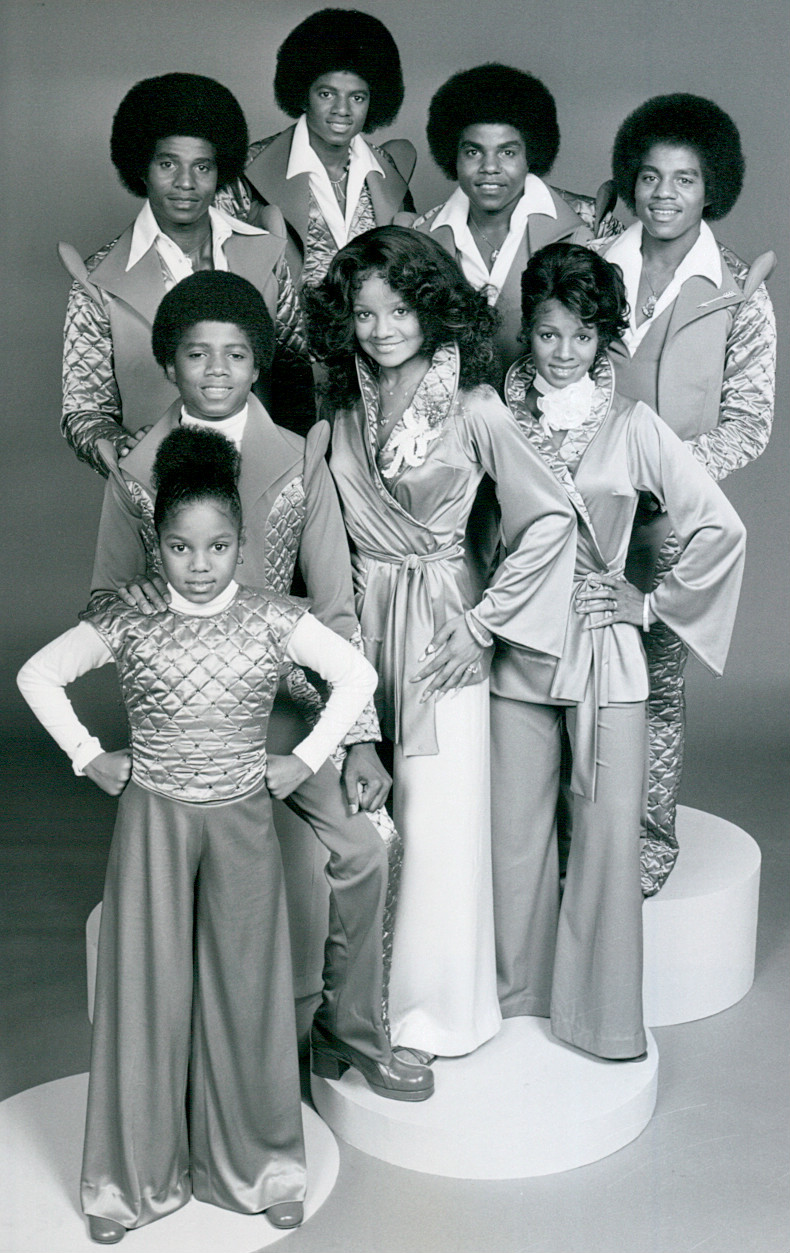
At age seven, Jackson and her sisters performed with the Jackson 5 for their revue at the MGM Casino on the Las Vegas Strip. A biography revealed her father, Joseph, was emotionally withdrawn and told her to address him solely by his first name as a child. She began acting in the variety show The Jacksons in 1976.
In 1977, she was selected to have a starring role as Penny Gordon Woods in the sitcom Good Times. She later starred in A New Kind of Family and later got a recurring role on Diff'rent Strokes, portraying Charlene Duprey from seasons three to six. Jackson also played the role of Cleo Hewitt during the fourth season of Fame, but expressed indifference towards the series, largely due to the emotional stress of her secret marriage to R&B singer James DeBarge. Jackson later elaborated on her time on the show in an interview with Anderson Cooper, revealing that the cast would occasionally play pranks on her, but she spoke fondly of them.
When Jackson was fifteen, her father and manager Joseph Jackson arranged a contract for her with A&M Records. Her debut album, Janet Jackson, was released in 1982. It was produced by Angela Winbush, René Moore, Bobby Watson of Rufus and Leon Sylvers III, and overseen by her father Joseph. It peaked at number 63 on the Billboard 200, and number six on the publication's R&B albums chart, receiving little promotion. The album appeared on the Billboard Top Black Albums of 1983, while Jackson herself was the highest-ranking female vocalist on the Billboard Year-End Black Album Artists.

At the 1983 American Music Awards, Jackson was seen wearing a hoop earring with a key attached to it. She explained that one of her chores at the Hayvenhurst family home was to clean the cages of the wild animals that Michael adopted. As she never used a keychain, she kept the cage key on a hoop earring. Since then, Jackson has worn variants of the hoop earring with key on her music videos and live performances. The hoop and key earring she used from 1987 to 1990 is currently on display at the National Museum of African American History and Culture.
Jackson's second album, Dream Street, was released two years later. Dream Street reached number 147 on the Billboard 200, and number 19 on the R&B albums chart. The lead single "Don't Stand Another Chance" peaked at number nine on Billboard's R&B singles chart. Both albums consisted primarily of bubblegum pop music.
1986–1988: Control
After her second album, Jackson terminated business affairs with her family, commenting "I just wanted to get out of the house, get out from under my father, which was one of the most difficult things that I had to do." Attempting a third album, Jackson teamed with producers Jimmy Jam and Terry Lewis. They set out to achieve crossover pop appeal, while also creating a strong foundation within the urban market. Within six weeks, Jackson and the duo crafted her third studio album, Control, released in February 1986. The album shot to number one on the Billboard 200, and was certified fivefold Platinum by the Recording Industry Association of America (RIAA), selling over ten million copies worldwide.

Control was declared "remarkably nervy and mature" for a teenage act, also considered "an alternative to the sentimental balladry" which permeated radio, likening Jackson to Donna Summer's position of "unwilling to accept novelty status and taking her own steps to rise above it." The album spawned five top five singles, "What Have You Done for Me Lately", "Nasty", "When I Think of You", "Control", and "Let's Wait Awhile", and a top 15 hit with "The Pleasure Principle". "When I Think of You" became her first number one hit on the Hot 100. Control received six Billboard Awards, including "Top Pop Singles Artist", and three Grammy nominations, such as Album of the Year. It also won three American Music Awards from twelve nominations.
At this point, Jackson was successfully "shaking off the experience of being a shadow Jackson child", becoming "an artist in her own right". The album's lyrical content included several themes of empowerment, inspired by an incident of sexual harassment, with Jackson recalling "the danger hit home when a couple of guys started stalking me on the street and instead of running to Jimmy or Terry for protection, I took a stand. I backed them down. That's how songs like 'Nasty' and 'What Have You Done for Me Lately' were born, out of a sense of self-defense."
Its innovative fusion of dance-pop and industrial music with hip-hop and R&B undertones influenced the development of the new jack swing genre by bridging the gap between the latter two styles. The accompanying music videos shot for the album's singles became popular on MTV, and obtained a then-unknown Paula Abdul a recording contract for her choreography work with Jackson. Billboard stated "[Jackson's] accessible sound and spectacularly choreographed videos were irresistible to MTV, and helped the channel evolve from rock programming to a broader, beat-driven musical mix."

In retrospect of her influence on the channel, Kyle Anderson of Entertainment Weekly commented: "The videos from Control were all over MTV, and Janet established herself as an instantly dominant pop figure talked about in the same sentences as Madonna and her older brother Michael." MTV's Meaghan Garvey asserted "it's hard to overstate the significance of Control, whether in terms of the pop landscape, the evolution of the music video as a vessel for promotion and expression, or Top 40 feminist anthems." She also argued "it's important to note that Control's self-actualization anthems were expressions of black female pride. Control spawned a whopping six videos—great ones, at that—which played an immeasurable role in the shift toward visible black pop."
1989–1992: Janet Jackson's Rhythm Nation 1814
Jackson released her fourth album, Rhythm Nation 1814, in September 1989. Although her record label desired a direct sequel to Control, Jackson chose to include a socially conscious theme among various musical styles. She stated, "I know an album or a song can't change the world. I just want my music and my dance to catch the audience's attention, and to hold it long enough for them to listen to the lyrics." The album's central theme of unity was developed in response to various crimes and tragedies reported in the media.
Peaking at number one on the Billboard 200, the album was certified sixfold Platinum by the RIAA and sold over 12 million copies worldwide. Rolling Stone observed Jackson's artistic growth shifted from "personal freedom to more universal concerns—injustice, illiteracy, crime, drugs—without missing a beat." The album was also considered "the exclamation point on her career", consisting of a "diverse collection of songs flowing with the natural talent Jackson possesses", which effectively "expanded Janet's range in every conceivable direction", being "more credibly feminine, more crucially masculine, more viably adult, more believably childlike." With singles "Miss You Much", "Rhythm Nation", "Escapade", "Alright", "Come Back to Me", "Black Cat" and "Love Will Never Do (Without You)", it became the only album to achieve seven top five singles on the Hot 100. Additionally, "Miss You Much", "Escapade", "Black Cat", and "Love Will Never Do (Without You)" made it the first album in history to produce number one hits in three separate calendar years.

Famous for its choreography and warehouse setting, the "Rhythm Nation" music video is considered one of the most iconic and popular in history, with Jackson's military ensemble also making her a fashion icon. The video for "Love Will Never Do (Without You)" is notable for being the first instance of Jackson's transition into sexual imagery and midriff-baring style, becoming her trademark. Rhythm Nation 1814 became the highest selling album of 1990, winning a record fifteen Billboard Awards. The full Rhythm Nation 1814 short film won a Grammy Award.
Jackson's Rhythm Nation World Tour 1990 became the most successful debut tour in history and set a record for the fastest sell-out of Japan's Tokyo Dome. She established the "Rhythm Nation Scholarship", donating funds from the tour to various educational programs. As Jackson began her tour, she was acknowledged for the cultural impact of her music. Joel Selvin of the San Francisco Chronicle wrote "the 23-year-old has been making smash hit records for four years, becoming a fixture on MTV and a major role model to teenage girls across the country", and William Allen, then-executive vice president of the United Negro College Fund, told the Los Angeles Times, "Jackson is a role model for all young people to emulate and the message she has gotten to the young people of this country through the lyrics of 'Rhythm Nation 1814' is having positive effects."
She also received a star on the Hollywood Walk of Fame in recognition of her impact on the recording industry and philanthropic endeavors. The massive success experienced by Jackson placed her in league with her brother Michael, Madonna, and Tina Turner for her achievements and influence. Ebony magazine remarked: "No individual or group has impacted the world of entertainment as have Michael and Janet Jackson," arguing that despite many imitators, few could surpass Jackson's "stunning style and dexterity".
With her recording contract under A&M Records fulfilled in 1991, she signed a multimillion-dollar deal with Virgin Records—estimated between thirty-two to fifty million dollars—making her the highest paid recording artist at the time. The recording contract also established her reputation as the "Queen of Pop". In 1992, Jackson provided guest vocals on Luther Vandross's "The Best Things in Life Are Free", becoming a top ten Billboard hit and reaching the top ten internationally.
1993–1996: Janet, Poetic Justice, and Design of a Decade
Jackson's fifth studio album, Janet, was released in May 1993. The record opened at number one on the Billboard 200, making Jackson the first female artist in the Nielsen SoundScan era to do so. Certified sixfold Platinum by the RIAA, it sold over 14 million copies worldwide.
Janet spawned five singles and four promotional singles, receiving various certifications worldwide. The lead single "That's the Way Love Goes" won the Grammy Award for Best R&B Song and topped the Billboard Hot 100 for eight consecutive weeks. "Again" reached number one for two weeks, while "If" and "Any Time, Any Place" peaked in the top four. "Because of Love" and "You Want This" charted within the top ten.
The album experimented with a diverse number of genres, including contemporary R&B, deep house, swing jazz, hip-hop, rock, and pop, with Billboard describing each as being "delivered with consummate skill and passion". Jackson took a larger role in songwriting and production than she did on her previous albums, explaining she found it necessary "to write all the lyrics and half of the melodies" while also speaking candidly about incorporating her sexuality into the album's content. Rolling Stone wrote "[a]s princess of America's black royal family, everything Janet Jackson does is important. Whether proclaiming herself in charge of her life, as she did on Control (1986), or commander in chief of a rhythm army dancing to fight society's problems (Rhythm Nation 1814, from 1989), she's influential. And when she announces her sexual maturity, as she does on her new album, Janet., it's a cultural moment."
In July 1993, Jackson made her film debut in Poetic Justice. While the film received mixed reviews, her performance was described as "beguiling" and "believably eccentric". Jackson's ballad "Again", which was written for the film, received Golden Globe and Academy Award nominations for "Best Original Song".
In September 1993, Jackson appeared topless on the cover of Rolling Stone, with her breasts covered anonymously by her then-husband, René Elizondo Jr. The photograph is the original version of the cropped image used on the Janet album cover, shot by Patrick Demarchelier. The Vancouver Sun reported, "Jackson, 27, remains clearly established as both role model and sex symbol; the Rolling Stone photo of Jackson ... became one of the most recognizable, and most lampooned, magazine covers."
The Janet World Tour launched in support of the studio album garnered criticism for Jackson's lack of vocal proficiency and spontaneity, but earned critical acclaim for her showmanship. It was described as erasing the line between "stadium-size pop music concerts and full-scale theatrical extravaganzas".
During this time, Janet was set to sign a multimillion-dollar deal with Coca-Cola when her brother Michael was immersed in a child sex abuse scandal, of which he denied any wrongdoing. She provided moral support, defending her brother, and denied abuse allegations regarding her parents made by her sister La Toya.
She collaborated with Michael on "Scream", the lead single from his album HIStory, released in 1995. The song was written by both siblings as a response to media scrutiny. It debuted at number five on the Hot 100 singles chart, becoming the first song ever to debut within the top five. Its music video, directed by Mark Romanek, was listed in Guinness World Records as the "Most Expensive Music Video Ever Made", costing $7 million. The clip won the 1996 Grammy Award for Best Short Form Music Video.
Jackson's first compilation album, Design of a Decade: 1986–1996, was released in 1995. It peaked at number three on the Billboard 200. The lead single, "Runaway", became the first song by a female artist to debut within the top ten of the Hot 100, reaching number three. Design of a Decade 1986–1996 was certified double Platinum by the RIAA.
Jackson's influence in pop music continued to garner acclaim, as The Boston Globe remarked "If you're talking about the female power elite in pop, you can't get much higher than Janet Jackson, Bonnie Raitt, Madonna and Yoko Ono. Their collective influence ... is beyond measure. And who could dispute that Janet Jackson now has more credibility than brother Michael?"
Jackson renewed her contract with Virgin Records for a reported $80 million the following year. The contract established her as the then highest-paid recording artist in history, surpassing the recording industry's then-unparalleled $60 million contracts earned by Michael Jackson and Madonna.
1997–1999: The Velvet Rope
Jackson began suffering from severe depression and anxiety, leading her to chronicle the experience in her sixth album, The Velvet Rope, released in October 1997. Jackson returned with a dramatic change in image, boasting vibrant red hair, nasal piercings, and tattoos. The album is primarily centered on the idea that everyone has an intrinsic need to belong. Aside from encompassing lyrics relating to social issues such as same-sex relationships, homophobia and domestic violence, it also contains themes of sadomasochism and is considered far more sexually explicit in nature than her previous release, Janet.
The record was hailed as "her most daring, elaborate and accomplished album" by The New York Times, while Billboard called it "the best American album of the year and the most empowering of her last five." The album debuted at number one on the Billboard 200 and was certified triple Platinum by the RIAA. It has sold over eight million copies worldwide.
The lead single "Got 'til It's Gone" was released in September 1997, featuring guest vocals from folk singer Joni Mitchell and rapper Q-Tip. The song's music video, depicting a pre-Apartheid celebration, won the Grammy Award for Best Short Form Music Video. "Together Again" became Jackson's eighth number-one hit on the Billboard Hot 100, placing her on par with Elton John, Diana Ross, and the Rolling Stones. It spent a record forty-six weeks on the Hot 100 and nineteen weeks on the United Kingdom's singles chart. It sold six million copies worldwide, becoming one of the best-selling singles of all time. "I Get Lonely" peaked at number three on the Hot 100, and received a Grammy nomination for Best Female R&B Vocal Performance. It was Jackson's eighteenth consecutive top ten hit, making her the only female artist to garner that achievement; and surpassed only by Elvis Presley and the Beatles.
Several other singles were released, including "Go Deep" and the ballad "Every Time", which was controversial for the nudity displayed in its music video. The album fully established Jackson as a gay icon for its themes regarding homosexuality and protesting homophobia. "Together Again", a "post-Aids pop song", and "Free Xone", considered "a paean to homosexuality" and an "anti-homophobia track", were praised for their lyrical context, in addition to Jackson's lesbian reinterpretation of Rod Stewart's "Tonight's the Night".
The Velvet Rope received an award for "Outstanding Music Album" at the 9th Annual GLAAD Media Awards and was honored by the National Black Lesbian and Gay Leadership Forum. A portion of the proceeds from "Together Again" were donated to the American Foundation for AIDS Research.
Jackson embarked on The Velvet Rope Tour, traveling to Europe, North America, Asia, Africa, New Zealand, and Australia. The tour received praise for its theatrics, choreography, and Jackson's vocal performance. It was likened to "the ambition and glamour of a Broadway musical", and exclaimed as "only fitting that the concert program credits her as the show's 'creator and director'".
The tour's HBO special, The Velvet Rope: Live in Madison Square Garden, garnered more than fifteen million viewers. It surpassed the ratings of all four major networks among viewers subscribed to the channel. The concert won an Emmy Award from four nominations. Jackson donated a portion of the tour's sales to America's Promise, an organization founded by Colin Powell to assist disenfranchised youth.
As the tour concluded, Jackson lent guest vocals to several collaborations, including Shaggy's "Luv Me, Luv Me", used for the film How Stella Got Her Groove Back, as well as "Girlfriend/Boyfriend" with Teddy Riley's group Blackstreet, and "What's It Gonna Be?!" with Busta Rhymes. The latter two music videos are both among the most expensive music videos ever produced, with "What's It Gonna Be?!" becoming a number-one hit on the Billboard Hip-Hop Singles and Hot Rap Tracks charts, reaching the top three of the Hot 100.
Jackson also contributed the ballad "God's Stepchild" to the Down in the Delta soundtrack. Jackson recorded a duet with Elton John titled "I Know the Truth", included on the soundtrack to Elton John and Tim Rice's Aida. At the 1999 World Music Awards, Jackson received the Legend Award for "outstanding contribution to the pop industry". Billboard ranked Jackson as the second most successful artist of the decade, behind Mariah Carey.
2000–2003: Nutty Professor II: The Klumps and All for You
In July 2000, Jackson appeared in her second film, Nutty Professor II: The Klumps, in the role of Professor Denise Gaines, opposite Eddie Murphy. Director Peter Segal stated "Janet Jackson was a natural fit, and an obvious choice." The film became her second to open at number one, grossing an estimated $170 million worldwide. Jackson's single "Doesn't Really Matter", used for the film's soundtrack, became her ninth number-one single on the Hot 100.
Preceding the release of her seventh album, MTV honored Jackson with the network's inaugural "MTV Icon" ceremony, honoring her "significant contributions to music, music video and pop culture while tremendously impacting the MTV Generation." The event paid tribute to Jackson's career and influence, including commentary from Britney Spears, Jennifer Lopez, Aaliyah, and Jessica Simpson, and performances by 'N Sync, Pink, Destiny's Child, Usher, Buckcherry, Mýa, Macy Gray, and Outkast. The American Music Awards also honored Jackson with the Award of Merit for "her finely crafted, critically acclaimed and socially conscious, multi-platinum albums".
Jackson's seventh album, All for You, was released in April 2001. It opened at number one on the Billboard 200 with 605,000 copies sold, the highest first-week sales of her career, and among the highest first-week sales by a female artist in history. The album was a return to an upbeat dance style, receiving generally positive reception. Jackson received praise for indulging in "textures as dizzying as a new infatuation", in contrast to other artists attempting to "match the angularity of hip-hop" and following trends. All for You was certified double Platinum by the RIAA.
The album's lead single, "All for You", debuted on the Hot 100 at number fourteen, setting a record for the highest debut by a single that was not commercially available. Jackson was titled "Queen of Radio" by MTV as the single made airplay history, being "added to every pop, rhythmic and urban radio station" within its first week. The song broke the overall airplay debut record with a first week audience of seventy million, debuting at number nine on the Radio Songs chart. It topped the Hot 100 for seven weeks, also reaching the top ten in eleven countries. The song received a Grammy Award for Best Dance Recording. "Someone to Call My Lover" peaked at number three on the Hot 100.
In July 2001, Jackson embarked on the All for You Tour, which was also broadcast on a concert special for HBO watched by twelve million viewers. The tour traveled throughout the United States and Japan, although European and Asian dates were required to be canceled following the September 11 terrorist attacks. The Los Angeles Times complimented Jackson's showmanship. Richard Harrington of The Washington Post said Jackson's performance surpassed her contemporaries, but Bob Massy of Spin thought her dancers "threw crisper moves" and her supporting singers were mixed nearly as high, though declared "Janet cast herself as the real entertainment." Jackson donated a portion of the tour's proceeds to the Boys & Girls Clubs of America.
The following year, Jackson began receiving media attention for her rumored relationships with Justin Timberlake, actor Matthew McConaughey, and record producer Jermaine Dupri.
2004–2005: Super Bowl XXXVIII controversy and Damita Jo
Jackson was chosen by the National Football League and MTV to perform at the Super Bowl XXXVIII halftime show in February 2004. She performed a medley of "All for You", "Rhythm Nation", and an excerpt of "The Knowledge" before performing "Rock Your Body" alongside surprise guest Justin Timberlake. As Timberlake sang the lyric "I'm gonna have you naked by the end of this song", he tore open her costume, exposing her right breast to 140 million viewers. The incident was referred to as "nipple gate" by the media.
Jackson issued an apology after the performance, saying that the incident was accidental and unintended, explaining that Timberlake was only meant to pull away a bustier and leave the red-lace bra intact. She commented, "I am really sorry if I offended anyone. That was truly not my intention ... MTV, CBS, the NFL had no knowledge of this whatsoever, and unfortunately, the whole thing went wrong in the end." Timberlake also issued an apology, calling the accident a "wardrobe malfunction". CBS, the NFL, and MTV denied any knowledge of the incident and all responsibility for it. The Federal Communications Commission heavily fined all companies involved and continued an investigation for eight years, ultimately losing its appeal for a $550,000 fine against CBS.
Following the incident, CBS permitted Timberlake to appear at the 46th Grammy Awards ceremony but did not allow Jackson to attend, forcing her to withdraw after being scheduled as a presenter. The controversy halted plans for Jackson to star in the biographical film of singer and activist Lena Horne, which was to be produced by ABC. Horne was reportedly displeased by the incident, but Jackson's representatives stated that she withdrew from the project willingly. A Mickey Mouse statue wearing Jackson's iconic "Rhythm Nation" outfit was mantled at Walt Disney World theme park the previous year to honor her legacy, but it was removed following her controversial performance.
Jackson's eighth studio album Damita Jo was released in March 2004, titled after her middle name. It debuted at number two on the Billboard 200. The album received mixed to positive reviews, praising the sonic innovation of selected songs and Jackson's vocal harmonies, while others criticized its frequent themes of carnality. However, several critics' reviews focused on the Super Bowl incident, rather than critiquing the album itself. It was certified Platinum by the RIAA within a month, and sold over three million copies worldwide.