
Impeachment is a process by which a legislative body or other legally constituted tribunal initiates charges against a public official for misconduct. Impeachment tends to be confined to ministerial officials as the unique nature of their positions may place ministers beyond the reach of the law to prosecute, or their misconduct is not codified into law as an offense except through the unique expectations of their high office. Both "peers and commoners" have been subject to the process, however.
From 1990 to 2020, there were at least 272 impeachment charges against 132 different heads of state in 63 countries. In Latin America, which includes almost 40% of the world's presidential systems, ten presidents from seven countries were removed from office by their national legislatures via impeachments or declarations of incapacity between 1978 and 2019.
Most democracies (with the notable exception of the United States) involve the courts (often a national constitutional court) in some way. National legislations differ regarding both the consequences and definition of impeachment, but the intent is nearly always to expeditiously vacate the office. Most commonly, an official is considered impeached after the commencement of the charges, and a trial of some kind is required to remove the official from office.

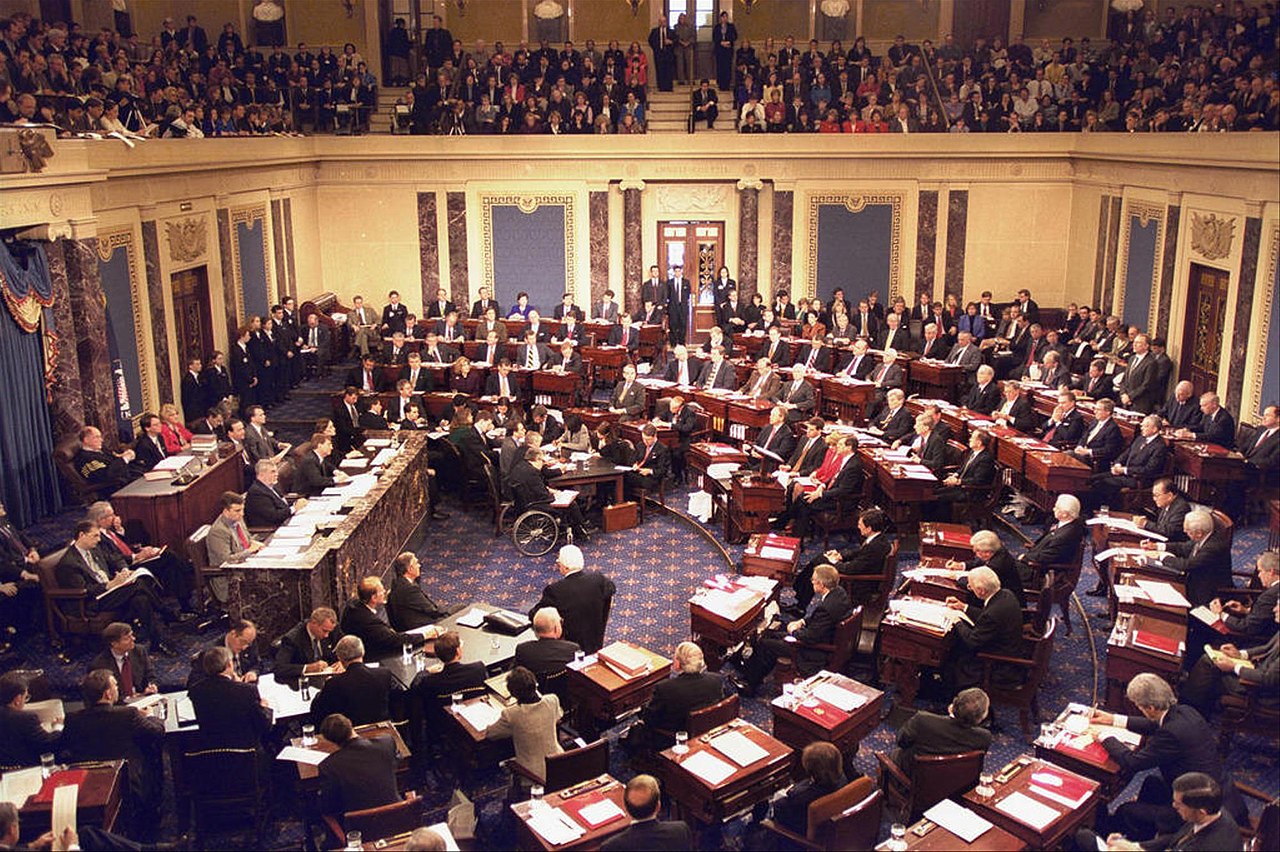
Impeachment is distinct from the motion of no confidence procedure available in some countries whereby a motion of censure can be used to remove a government and its ministers from office. Such a procedure is not applicable in countries with presidential forms of government like the United States. Because impeachment involves a departure from the normal constitutional procedures by which individuals achieve high office (election, ratification, or appointment) and because it generally requires a supermajority, it is usually reserved for those deemed to have committed serious abuses of their office. In the United States, for example, impeachment at the federal level is limited to those who may have committed "Treason, Bribery, or other high crimes and misdemeanors". Under the United States Constitution, the House of Representatives has the sole power of impeachments while the Senate has the sole power to try impeachments (i.e., to acquit or convict); the validity of an impeachment trial is a political question that is nonjusticiable (i.e., is not reviewable by the courts).
Etymology and history
The word "impeachment" likely derives from Old French empeechier from Latin word impedīre expressing the idea of catching or ensnaring by the 'foot' (pes, pedis), and has analogues in the modern French verb empêcher (to prevent) and the modern English impede. Medieval popular etymology also associated it (wrongly) with derivations from the Latin impetere (to attack).
The process was first used by the English "Good Parliament" against William Latimer, 4th Baron Latimer in the second half of the 14th century. Following the English example, the constitutions of Virginia (1776), Massachusetts (1780) and other states thereafter adopted the impeachment mechanism, but they restricted the punishment to removal of the official from office, in contrast to the English Parliament's broad power to punish impeachments.

In West Africa, rulers of the Ashanti Empire who violated any oaths taken during their enstoolment were destooled by Kingmakers. Reasons include punishing citizens arbitrarily or being exposed as corrupt. The process involved Kingmakers forcibly removing the sandals of the guilty party, then bumping his buttocks on the ground three times. Once destooled, a king automatically lost sanctity and honours as he could not exercise royal powers such as being chief administrator, judge, and military commander. Also withdrawn from him were the Golden Stool (a throne functionally equivalent to crowns), swords, and other regalia. While a deposed king no longer held custodianship of the realm, he remained a member of the royal family from which he was elected.
In Korea, the Goryeo dynasty installed Sahundae (司憲臺) in 983 AD, which oversaw the impeachment of officials.
In various jurisdictions
Brazil
In Brazil, as in most other Latin American countries, "impeachment" refers to the definitive removal from office. The president of Brazil may be provisionally removed from office by the Chamber of Deputies and then tried and definitely removed from office by the Federal Senate. The Brazilian Constitution requires that two-thirds of the Deputies vote in favor of the opening of the impeachment process of the president and that two-thirds of the senators vote for impeachment. State governors and municipal mayors can also be impeached by the respective legislative bodies. Article 2 of Law no. 1.079, from 10 April 1950, or "The Law of Impeachment", states that "The crimes defined in this law, even when simply attempted, are subject to the penalty of loss of office, with disqualification for up to five years for the exercise of any public function, to be imposed by the Federal Senate in proceedings against the president of the republic, ministers of state, ministers of the Supreme Federal Tribunal, or the attorney general."

Initiation: An accusation of a responsibility crime against the president may be brought by any Brazilian citizen; however, the president of the Chamber of Deputies holds prerogative to accept the charge, which if accepted will be read at the next session and reported to the president of the republic.
Extraordinary Committee: An extraordinary committee is established, consisting of members from each political party in proportion to their party's membership. The committee is responsible for assessing the need for impeachment proceedings. The president is given ten parliamentary sessions to present their defense. Following this, two legislative sessions are held to allow for the formulation of a legal opinion by a rapporteur regarding whether or not impeachment proceedings should be initiated and brought to trial in the Senate.
The rapporteur's opinion is subject to a vote within the committee. If the majority accepts the rapporteur's opinion, it is deemed adopted. However, if the majority rejects the rapporteur's opinion, the committee adopts an alternative opinion proposed by the majority. For instance, if the rapporteur recommends against impeachment but fails to secure majority support, the committee will adopt the opinion to proceed with impeachment. Conversely, if the rapporteur advises impeachment but does not obtain majority approval, the committee will adopt the opinion not to impeach.
If the committee vote is successful, the rapporteur's opinion is considered adopted, thereby determining the course of action regarding impeachment.
Chamber of Deputies: The chamber issues a call-out vote to accept the opinion of the committee, requiring a supermajority of two thirds in favor of an impeachment opinion (or a supermajority of two thirds against a dismissal opinion) of the committee, in order to authorize the Senate impeachment proceedings. The president is suspended (provisionally removed) from office as soon as the Senate receives and accepts from the Chamber of Deputies the impeachment charges and decides to proceed with a trial.
The Senate: The process in the Senate had been historically lacking in procedural guidance until 1992, when the Senate published in the Official Diary of the Union the step-by-step procedure of the Senate's impeachment process, which involves the formation of another special committee and closely resembles the lower house process, with time constraints imposed on the steps taken. The committee's opinion must be presented within 10 days, after which it is put to a call-out vote at the next session. The vote must proceed within a single session; the vote on President Rousseff took over 20 hours. A simple majority vote in the Senate begins formal deliberation on the complaint, immediately suspends the president from office, installs the vice president as acting president, and begins a 20-day period for written defense as well as up to 180-days for the trial. In the event the trial proceeds slowly and exceeds 180 days, the Brazilian Constitution determines that the president is entitled to return and stay provisionally in office until the trial comes to its decision.

Senate plenary deliberation: The committee interrogates the accused or their counsel, from which they have a right to abstain, and also a probative session which guarantees the accused rights to contradiction, or audiatur et altera pars, allowing access to the courts and due process of law under Article 5 of the constitution. The accused has 15 days to present written arguments in defense and answer to the evidence gathered, and then the committee shall issue an opinion on the merits within ten days. The entire package is published for each senator before a single plenary session issues a call-out vote, which shall proceed to trial on a simple majority and close the case otherwise.
Senate trial: A hearing for the complainant and the accused convenes within 48 hours of notification from deliberation, from which a trial is scheduled by the president of the Supreme Court no less than ten days after the hearing. The senators sit as judges, while witnesses are interrogated and cross-examined; all questions must be presented to the president of the Supreme Court, who, as prescribed in the Constitution, presides over the trial. The president of the Supreme Court allots time for debate and rebuttal, after which time the parties leave the chamber and the senators deliberate on the indictment. The president of the Supreme Court reads the summary of the grounds, the charges, the defense and the evidence to the Senate. The senators in turn issue their judgement. On conviction by a supermajority of two thirds, the president of the Supreme Court pronounces the sentence and the accused is immediately notified. If there is no supermajority for conviction, the accused is acquitted.
Upon conviction, the officeholder has his or her political rights revoked for eight years, which bars them from running for any office during that time.

Fernando Collor de Mello, the 32nd president of Brazil, resigned in 1992 amidst impeachment proceedings. Despite his resignation, the Senate nonetheless voted to convict him and bar him from holding any office for eight years, due to evidence of bribery and misappropriation.
In 2016, the Chamber of Deputies initiated an impeachment case against President Dilma Rousseff on allegations of budgetary mismanagement, a crime of responsibility under the Constitution. On 12 May 2016, after 20 hours of deliberation, the admissibility of the accusation was approved by the Senate with 55 votes in favor and 22 against (an absolute majority would have been sufficient for this step) and Vice President Michel Temer was notified to assume the duties of the president pending trial. On 31 August, 61 senators voted in favor of impeachment and 20 voted against it, thus achieving the 2⁄3 majority needed for Rousseff's definitive removal. A vote to disqualify her for five years was taken and failed (in spite of the Constitution not separating disqualification from removal) having less than two thirds in favor.
Croatia
The process of impeaching the president of Croatia can be initiated by a two-thirds majority vote in favor in the Sabor and is thereafter referred to the Constitutional Court, which must accept such a proposal with a two-thirds majority vote in favor in order for the president to be removed from office. This has never occurred in the history of the Republic of Croatia. In case of a successful impeachment motion a president's constitutional term of five years would be terminated and an election called within 60 days of the vacancy occurring. During the period of vacancy the presidential powers and duties would be carried out by the speaker of the Croatian Parliament in his/her capacity as Acting President of the Republic.
Czech Republic
In 2013, the constitution was changed. Since 2013, the process can be started by at least three-fifths of present senators, and must be approved by at least three-fifths of all members of the Chamber of Deputies within three months. Also, the President can be impeached for high treason (newly defined in the Constitution) or any serious infringement of the Constitution.
The process starts in the Senate of the Czech Republic which has the right to only impeach the president. After the approval by the Chamber of Deputies, the case is passed to the Constitutional Court of the Czech Republic, which has to decide the verdict against the president. If the Court finds the President guilty, then the President is removed from office and is permanently barred from being elected President of the Czech Republic again.
No Czech president has ever been impeached, though members of the Senate sought to impeach President Václav Klaus in 2013. This case was dismissed by the court, which reasoned that his mandate had expired. The Senate also proposed to impeach president Miloš Zeman in 2019 but the Chamber of Deputies did not vote on the issue in time and thus the case did not even proceed to the Court.
Denmark
In Denmark the possibility for current and former ministers being impeached was established with the Danish Constitution of 1849. Unlike many other countries Denmark does not have a Constitutional Court who would normally handle these types of cases. Instead Denmark has a special Court of Impeachment (In Danish: Rigsretten) which is called upon every time a current and former minister have been impeached. The role of the Impeachment Court is to process and deliver judgments against current and former ministers who are accused of unlawful conduct in office. The legal content of ministerial responsibility is laid down in the Ministerial Accountability Act which has its background in section 13 of the Danish Constitution, according to which the ministers' accountability is determined in more detail by law. In Denmark the normal practice in terms of impeachment cases is that it needs to be brought up in the Danish Parliament (Folketing) first for debate between the different members and parties in the parliament. After the debate the members of the Danish Parliament vote on whether a current or former minister needs to be impeached. If there is a majority in the Danish Parliament for an impeachment case against a current or former minister, an Impeachment Court is called into session. In Denmark the Impeachment Court consists of up to 15 Supreme Court judges and 15 parliament members appointed by the Danish Parliament. The members of the Impeachment Court in Denmark serve a six-year term in this position.
In 1995 the former Minister of Justice Erik Ninn-Hansen from the Conservative People's Party was impeached in connection with the Tamil Case. The case was centered around the illegal processing of family reunification applications. From September 1987 to January 1989 applications for family reunification of Tamil refugees from civil war-torn Sri Lanka were put on hold in violation of Danish and International law. On 22 June 1995, Ninn-Hansen was found guilty of violating paragraph five subsection one of the Danish Ministerial Responsibility Act which says: A minister is punished if he intentionally or through gross negligence neglects the duties incumbent on him under the constitution or legislation in general or according to the nature of his post. A majority of the judges in that impeachment case voted for former Ninn-Hansen to receive a suspended sentence of four months with one year of probation. The reason why the sentence was made suspended was especially in relation to Ninn-Hansen's personal circumstances, in particular, his health and age – Ninn-Hansen was 73 years old when the sentence was handed down. After the verdict, Ninn-Hansen complained to the European Court of Human Rights and complained, among other things, that the Court of Impeachment was not impartial. The European Court of Human Rights dismissed the complaint on 18 May 1999. As a direct result and consequence of this case, the Conservative-led government and Prime Minister at that time Poul Schlüter was forced to step down from power, after being deemed to have misled the Folketing in relation to the case.
In February 2021 the former Minister for Immigration and Integration Inger Støjberg at that time member of the Danish Liberal Party Venstre was impeached when it was discovered that she had possibly against both Danish and International law tried to separate couples in refugee centres in Denmark, as the wives of the couples were under legal age. According to a commission report Inger Støjberg had also lied in the Danish Parliament and failed to report relevant details to the Parliamentary Ombudsman The decision to initiate an impeachment case was adopted by the Danish Parliament with a 141–30 vote and decision (In Denmark 90 members of the parliament need to vote for impeachment before it can be implemented). On 13 December 2021 former Minister for Immigration and Integration Inger Støjberg was convicted by the special Court of Impeachment of separating asylum seeker families illegally according to Danish and international law and sentenced to 60 days in prison. The majority of the judges in the special Court of Impeachment (25 out of 26 judges) found that it had been proven that Inger Støjberg on 10 February 2016 decided that an accommodation scheme should apply without the possibility of exceptions, so that all asylum-seeking spouses and cohabiting couples where one was a minor aged 15–17, had to be separated and accommodated separately in separate asylum centers. On 21 December, a majority in the Folketing voted that the sentence means that she is no longer worthy of sitting in the Folketing and she therefore immediately lost her seat.
France
In France the comparable procedure is called destitution. The president of France can be impeached by the French Parliament for willfully violating the Constitution or the national laws. The process of impeachment is written in the 68th article of the French Constitution. Either the National Assembly or the Senate can begin the process. Then, the impeachment proposal must be transmitted to the other house, which must accept or reject the impeachment process within 15 days. After the upper and lower houses' agreement, they unite in joint session to form the High Court.
The High Court must decide whether or not to declare the removal from office of the president. The impeachment procedure in front of the National Assembly and the Senate, as well as the removal from office by the High Court require a majority of two thirds of the members of the House involved or of the High Court by secret ballot; no proxy voting is allowed.
Germany
The federal president of Germany can be impeached both by the Bundestag and by the Bundesrat for willfully violating federal law. Once the Bundestag or the Bundesrat impeaches the president, the Federal Constitutional Court decides whether the President is guilty as charged and, if this is the case, whether to remove him or her from office. The Federal Constitutional Court also has the power to remove federal judges from office for willfully violating core principles of the federal constitution or a state constitution. The impeachment procedure is regulated in Article 61 of the Basic Law for the Federal Republic of Germany.
There is no formal impeachment process for the chancellor of Germany; however, the Bundestag can replace the chancellor at any time by voting for a new chancellor (constructive vote of no confidence, Article 67 of the Basic Law).
There has never been an impeachment against the President so far. Constructive votes of no confidence against the chancellor occurred in 1972 and 1982, with only the second one being successful.
Hong Kong
The chief executive of Hong Kong can be impeached by the Legislative Council. A motion for investigation, initiated jointly by at least one-fourth of all the legislators charging the Chief Executive with "serious breach of law or dereliction of duty" and refusing to resign, shall first be passed by the council. An independent investigation committee, chaired by the chief justice of the Court of Final Appeal, will then carry out the investigation and report back to the council. If the Council find the evidence sufficient to substantiate the charges, it may pass a motion of impeachment by a two-thirds majority.
However, the Legislative Council does not have the power to actually remove the chief executive from office, as the chief executive is appointed by the Central People's Government (State Council of China). The council can only report the result to the Central People's Government for its decision.
Hungary
Article 13 of Hungary's Fundamental Law (constitution) provides for the process of impeaching and removing the president. The president enjoys immunity from criminal prosecution while in office, but may be charged with crimes committed during his term afterwards. Should the president violate the constitution while discharging his duties or commit a willful criminal offense, he may be removed from office. Removal proceedings may be proposed by the concurring recommendation of one-fifth of the 199 members of the country's unicameral Parliament. Parliament votes on the proposal by secret ballot, and if two thirds of all representatives agree, the president is impeached. Once impeached, the president's powers are suspended, and the Constitutional Court decides whether or not the President should be removed from office.
India
Article 361 of the Indian Constitution states that the President of India "shall not be answerable to any court" for violations of the Constitution committed during their term of office. Instead, Parliament has the authority to impeach the president if they believe the president has violated the Constitution. If the president is convicted and removed from office, Article 361 no longer applies, and the president loses their legal immunity; as such, if their activities were unlawful, they can now be tried in court. However, no president has faced impeachment proceedings. Hence, the provisions for impeachment have never been tested.
Parliament also has the authority to impeach judges, including the Chief Justice of the Supreme Court and High Courts.
Iran
Ireland
The Constitution of Ireland states the President of Ireland may be impeached for "stated misbehaviour". The president may not be otherwise removed from office or made answerable for his actions, although if five judges of the Supreme Court rule that he has become "permanently incapacitated" then a new presidential election must be held within 60 days and the Presidential Commission will deputise in the interim. Impeachment is controlled by the Oireachtas (parliament) with one house (Dáil or Seanad) preferring a charge and the other directing the ensuing investigation and final vote. The charge requires a motion signed by at least thirty members and consequent resolution supported by at least two-thirds of the total membership. The investigation may be made by the house itself or delegated to another "court, tribunal or body". The president is removed from office only if at least two-thirds of the total membership of the investigating house support an ensuing resolution that, not only has the charge been sustained, but also the misbehaviour was serious enough to render the president "unfit to continue in office".
As of January 2024 no impeachment of a president has ever taken place. The dignity of what is a largely ceremonial office is considered important, so it is likely that a president would resign from office long before undergoing formal conviction or impeachment. In 1976, after being criticised by a minister, Cearbhall Ó Dálaigh resigned "to protect the dignity and independence of the presidency as an institution", although there was no question of impeachment.
While the Constitution also states that Comptroller and Auditor General and justices of the superior courts can be removed from office for "stated misbehaviour", it does not describe this as impeachment and the requirement in each case is simple resolution by each house of the Oireachtas. The process is nevertheless informally called "impeachment".
Italy
In Italy, according to Article 90 of the Constitution, the President of Italy can be impeached through a majority vote of the Parliament in joint session for high treason and for attempting to overthrow the Constitution. If impeached, the president of the Republic is then tried by the Constitutional Court integrated with sixteen citizens older than forty chosen by lot from a list compiled by the Parliament every nine years.
Italian press and political forces made use of the term "impeachment" for the attempt by some members of parliamentary opposition to initiate the procedure provided for in Article 90 against Presidents Francesco Cossiga (1991), Giorgio Napolitano (2014) and Sergio Mattarella (2018).
Japan
By Article 78 of the Constitution of Japan, judges can be impeached. The voting method is specified by laws. The National Diet has two organs, namely 裁判官訴追委員会 (Saibankan sotsui iinkai) and 裁判官弾劾裁判所 (Saibankan dangai saibansho), which is established by Article 64 of the Constitution. The former has a role similar to prosecutor and the latter is analogous to Court. Seven judges were removed by them.
Liechtenstein
Members of the Liechtenstein Government can be impeached before the State Court for breaches of the Constitution or of other laws. As a hereditary monarchy the Sovereign Prince cannot be impeached as he "is not subject to the jurisdiction of the courts and does not have legal responsibility". The same is true of any member of the Princely House who exercises the function of head of state should the Prince be temporarily prevented or in preparation for the Succession.