
The Imjin War (Korean: 임진왜란; Hanja: 壬辰倭亂) was a series of two Japanese invasions of Korea: an initial invasion in 1592 also individually called the "Imjin War", a brief truce in 1596 between the conflicts, followed by a second invasion in 1597 called the Chŏngyu War (정유재란; 丁酉再亂). The conflict ended in 1598 with the withdrawal of Japanese forces from the Korean Peninsula after a military stalemate in Korea's southern provinces.
The invasions were launched by Toyotomi Hideyoshi to conquer Korea, and Japan quickly occupied large portions of the country. However, reinforcements from Ming China and disruption of Japanese supply fleets by the Joseon Navy forced the Japanese forces to withdraw from the northern provinces. Thereafter, Joseon civilian militias engaged in guerrilla warfare against the occupying Japanese forces, and supply difficulties hampered both sides. At that point, the conflict ground to a stalemate. The first phase of the conflict ended in 1596.
Japan invaded Korea again in 1597, and gained initial successes on land; similar to the previous campaign, the invading forces were later halted and withdrew to the peninsula's southern coastal regions. Ming and Joseon forces were unable to dislodge the Japanese from these positions. Both sides again became locked in a ten-month-long military stalemate. However, Toyotomi Hideyoshi later died and the Japanese were defeated at the Battle of Noryang, effectively ending the war. The invading forces were ordered to withdraw to Japan by the new governing Council of Five Elders soon thereafter. Peace negotiations between the parties followed, and continued for several years, ultimately resulting in the normalization of relations.
Names
In Korean, the first invasion (1592–1593) is called the "Japanese Disturbance of Imjin" (倭亂), where 1592 is an imjin year in the sexagenary cycle. The second invasion (1597–1598) is called the "Second War of Jeong-yu" (丁酉). Collectively, the invasions are referred to as the "Imjin War".
In Chinese, the wars are referred to as the "Wanli Korean Battle" (萬曆朝鮮之役) or the "Wanli Korean Expedition" (萬曆朝鮮征伐), after the reigning Chinese emperor.
In Japanese, the war is called Bunroku no eki (文禄の役). Bunroku refers to the Japanese era name spanning the period from 1592 to 1596. The second invasion is called Keichō no eki (慶長の役). The war was also called Kara iri (唐入り), "entry into Tang", the dynasty whose name is synonymous with China.

Background
Japan and Korea before the war
Both Ming China and Joseon Korea emerged during the 14th century after the fall of the Yuan dynasty, embraced Confucian social ideals, and faced similar threats – Jurchen people, who raided along the northern borders, and the wokou, who pillaged coastal villages and trade ships. Both had competing internal political factions, which would influence decisions made before and during the war.
In 1392, General Yi Sŏnggye led a coup to take power in Korea, and he ruled as Taejo of Joseon. The new regime received recognition from, and integration into, the tributary system of China. Within this tributary system, China assumed the role of a "big brother", while Korea maintained the highest position among the tributary states. Through this tributary relationship, Joseon and Ming shared a security alliance.
The system also included countries such as the Ryukyu Kingdom, Lan Xang, Đại Việt, and the Ayutthaya Kingdom, who likewise acted as "younger brother[s]" of China. In 1404, Ashikaga Yoshimitsu, recognized as "King of Japan" by China, had Japan enter the Chinese tributary system. His successor, Ashikaga Yoshimochi, left it in 1408. Membership in the tributary system was a prerequisite for any economic exchange with China; by exiting, Japan relinquished its trade relationship with China.
Hideyoshi's preparations
By the last decade of the 16th century, Toyotomi Hideyoshi had unified Japan. He rallied support in Japan as a man of relatively humble origins who owed his position to his military might. He sought military power to legitimize his rule and decrease his dependence on the imperial family. It is also suggested that Hideyoshi planned an invasion of China to fulfill the dreams of his late lord, Oda Nobunaga, and to keep his newly formed state united against a common enemy, mitigating the possible threat of civil disorder or rebellion posed by the large number of now-idle samurai and soldiers, and by ambitious daimyos who might have sought to usurp him.
As early as 1578, Hideyoshi, then fighting under Oda Nobunaga against Mōri Terumoto for control of the Chūgoku region, informed Terumoto of Nobunaga's plan to invade China. In 1585, Hideyoshi told the Portuguese Jesuit Father Gaspar Coelho of his wish to conquer all of East Asia. Hideyoshi asked Coelho to send a message to King Philip II of Spain, who was also King Philip I of Portugal, asking that he make his navy available to help Japan. However, Philip refused Hideyoshi, preferring not to upset China. Japan's legal tribute missions to China, and hence their right to trade with China, had ceased by the mid-16th century and was replaced by Sino-Japanese smuggler-pirates known as the wokou. Hideyoshi spoke not only of his desire to "slash his way" into Korea to invade China, but also the Philippines, and India.
Japan may have begun the construction of as many as 2,000 ships for an attack as early as 1586. To estimate the strength of the Korean military, Hideyoshi sent an assault force of 26 ships to the southern coast of Korea in 1587. On the diplomatic front, Hideyoshi helped to police trade routes against the wokou. Beginning in March 1591, the Kyushu daimyos and their labor forces constructed Nagoya Castle in modern-day Karatsu, Saga, as the center for the mobilization of the invasion forces.

Diplomatic dealings between Japan and Korea
In 1587, Hideyoshi sent his first envoy, Yutani Yasuhiro (柚谷康広), to Korea to re-establish diplomatic relations, which had been broken since a wokou raid in 1555. Hideyoshi hoped to use this as a foundation to induce the Korean court to join Japan in a war against China. However, due to Yasuhiro's warrior background and disdain for the Korean officials and their customs, he failed to receive the promise of future ambassadorial missions from Korea. Around May 1589, Hideyoshi's second embassy, consisting of Sō Yoshitoshi, Yanagawa Shigenobu (柳川調信), and Buddhist monk Genso (玄蘇), secured the promise of a Korean embassy to Japan in exchange for a group of Korean rebels which had taken refuge in Japan.
In 1587, Hideyoshi had ordered the adopted father of Yoshitoshi and the daimyo of Tsushima Island, Sō Yoshishige (宗義調), to offer the Joseon Dynasty an ultimatum of submission to Japan and participation in the conquest of China. If they did not accept, they would face the prospect of open war with Japan. However, as Tsushima Island enjoyed a special trading position as the single checkpoint to Korea for all Japanese ships and had permission from Korea to trade with as many as 50 of its own vessels, the Sō family had a vested interest in preventing conflict with Korea, and delayed the talks for nearly two years. Even when Hideyoshi reissued his order, Sō Yoshitoshi instead embarked on a campaign to the Korean court to improve relations between the two countries.
In April 1590, the Korean ambassadors, including Hwang Yun-gil and Kim Sŏngil, left for Kyoto, where they waited for two months while Hideyoshi was finishing his campaign against the Hojo clan. Upon his return, they exchanged ceremonial gifts and delivered the Korean king's letter to Hideyoshi. The Korean ambassadors later asked for Hideyoshi to write a reply to the Korean king, for which they waited 20 days at the port of Sakai. The letter, redrafted at the request of the ambassadors on the ground that it was too discourteous, invited Korea to submit to Japan and join in a war against China.

Upon the ambassadors' return, the Joseon court held serious discussions concerning Japan's invitation. Kim Sŏngil claimed that Hideyoshi's letter was nothing but a bluff. Moreover, the court, aware only that Japan was in turmoil with various clan armies fighting each other, substantially underrated the combined strength of the Japanese. Some, including King Seonjo, argued that Ming should be informed about the dealings with Japan, as failure to do so could make Ming suspect Korea's allegiance, but the court finally concluded to wait further until the appropriate course of action became definite. However, the Korean court mistakenly evaluated Hideyoshi's threats of invasions to be no better than the common wokou Japanese pirate raids. The Korean court handed to Shigenobu and Genso, Hideyoshi's third embassy, the Korean king's letter rebuking Hideyoshi for challenging the Chinese tributary system. Hideyoshi replied with another letter, but since it was not presented by a diplomat in person as expected by custom, the court ignored it.
Military
Korea was a manufacturing hub for cannons and ships during this era. Korean cannons were not adapted for effective use on land, and they used firearms of a less advanced design. On the other hand, Japanese small arms, particularly the tanegashima matchlock arquebuses, proved effective in land combat and sieges. This difference in weaponry contributed to a trend of Japanese dominance on land and Korean dominance at sea during the war.
As Japan had been at war since the mid-15th century, Hideyoshi was able to develop a professional army from a pool of 500,000 battle-hardened soldiers. While Japan's previous turmoil led Koreans to estimate Japan as an unlikely military threat, there was a new sense of unity among the different political factions in Japan, as indicated by the "sword hunt" in 1588. Along with the hunt came "The Separation Edict" in 1591, which effectively put an end to all Japanese wokou piracy by prohibiting the daimyos from supporting the pirates within their fiefs. The Koreans believed that Hideyoshi's invasion would be just an extension of the previous pirate raids that had been repelled.
Land forces
Japan
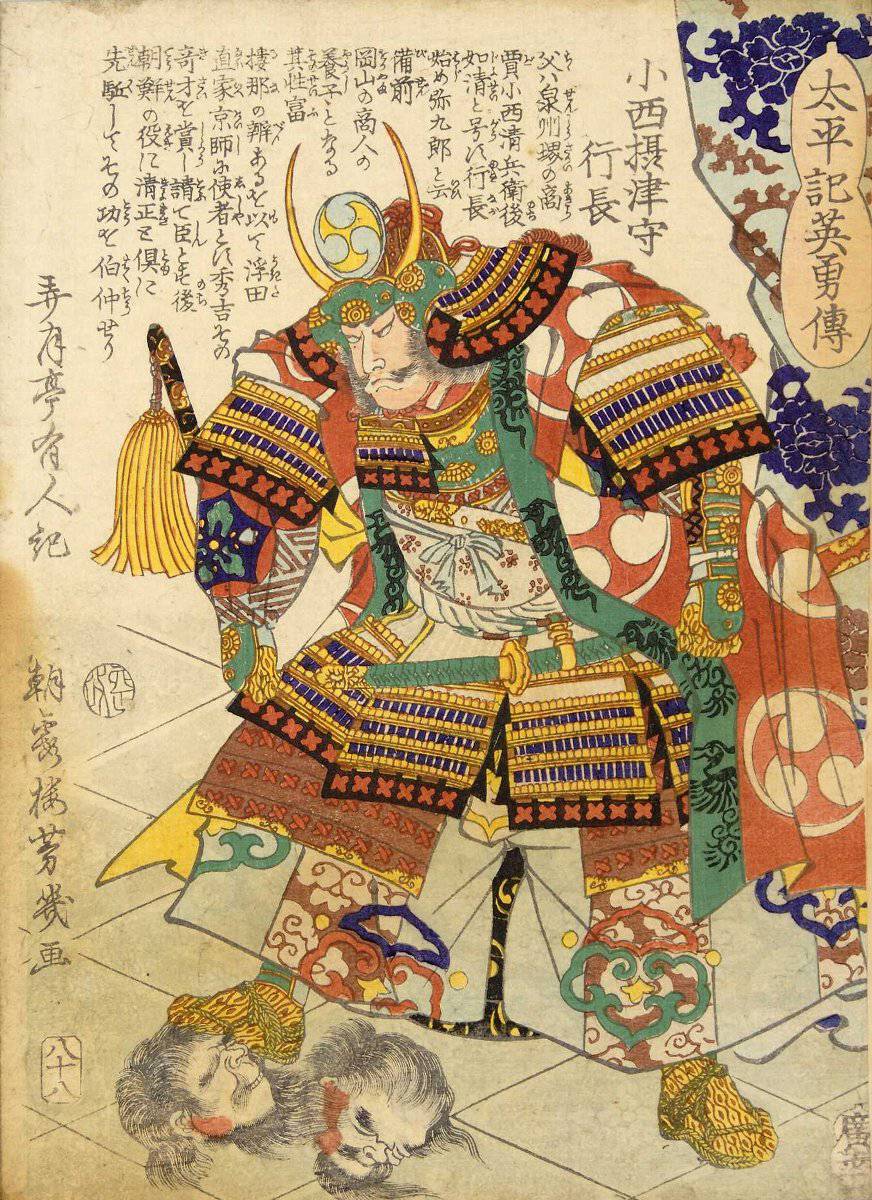
The samurai were at the core of the Japanese military. The standard samurai weapon by 1592 was the yari, a spear meant to stab, often with a cross-blade that allowed a samurai to pull his opponent from his horse. If a samurai wished to cut his opponent rather than stab, the weapons were the ōdachi, an extremely long sword with a huge handle, or the naginata, a polearm with very sharp curved blade. The most famous of all the samurai weapons was the katana, a sword described by British military historian Stephen Turnbull as "...the finest edged weapon in the history of warfare". Samurai never carried shields, and in lieu of them, the katana was used to deflect blows. By 1592, the armor of the samurai was lamellae made from iron or leather scales tied together which had been modified to include solid plate to help protect the samurai from bullets. Samurai on horseback would often dismount when engaged in action, acting as mounted infantry. While specialized firearms were used on horseback, most cavalrymen preferred the yari, but its use was limited by the increasing use of firearms by the Koreans and Chinese. Samurai engaged in psychological warfare by wearing iron masks into battle with a mustache made of horsehair and a "sinister grin" illustrated.
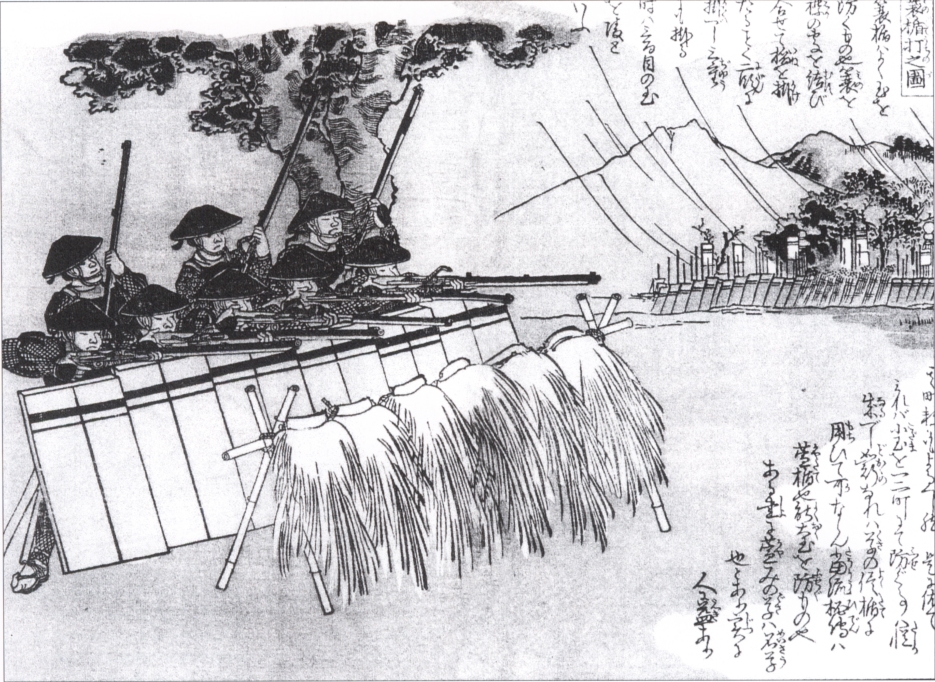
Most of the Japanese troops in Korea were ashigaru light infantry, usually conscripted peasants armed with either yari, tanegashima or bows called yumi. Unlike the samurai, ashigaru wore cheap suits of iron armour around their chests. Japanese arquebusiers fought in the European style. Men trained to fire their guns in formation to create a volley of fire, then to go down on their knees to reload, while the men behind them fired, and the cycle repeated.
Hideyoshi mobilized his army at Nagoya Castle, newly built for the sole purpose of housing the invasion forces and the reserves. None of the original structures remain, but the castle's ruined foundations survive in the formerly separate town of Chinzei, now part of the city of Karatsu in Saga Prefecture. 158,800 soldiers, laborers, and transport troops spread across nine divisions were prepared to take part in the invasion. Roughly a third of the force consisted of armed fighting units, while the remaining two thirds filled supporting roles. Another two divisions, with 21,500 between them, were held in reserve on Tsushima Island and Iki Island. The Japanese used a total of 320,000 troops throughout the war.
One daimyo whose military service quota has been preserved in a written record is Shimazu Yoshihiro, whose contribution consisted of:
600 samurai
300 flag bearers
1,500 arquebusier ashigaru
1,500 archer ashigaru
300 spearmen ashigaru
6,400 laborers and boatmen
Joseon
Joseon maintained a standing military structure known as the Five Military Commands (Owi, 오위; 五衛), as well as a regular army (Jeongbyeong, 정병; 正兵) composed of commoners subject to mandatory military service. However, due to a prolonged period of peace, an oversized bureaucracy, and the increasing prevalence of draft evasion through monetary means, it was discovered on the eve of war that the actual number of active soldiers was far lower than the figures recorded in official registers. During the first invasion, Joseon deployed a total of 84,500 regular troops throughout, assisted by 22,000 irregular volunteers. As the war dragged on into the following year, it was confirmed that approximately 170,000 troops had been mobilized for the conflict.
Light infantry protected their chests by wearing ŏmsimgap (엄심갑; 掩心甲), which was made of leather over a cloth robe that served a similar function to the gambeson. Scale armour was also used. However, P'aengbaesu (팽배수; 彭排手), heavy infantry specializing in melee combat, were the mainstay of early Joseon infantry, wearing chain mail or mail and plate armour and armed with a round shield and sword. They would respond to nomadic raids with shields and knives in mountain warfare, and in the plains, they formed shield walls to deter cavalry.
Kapsa (갑사; 甲士) were elite formations of noble origin. Their armor, tujŏng-gap (두정갑; 頭釘甲), was brigandine, popular in Manchuria and Mongolia at the time. Kapsa were required to have a certain amount of wealth to join, as they were expected to self-fund their operations, including by bringing their own horses. To cut costs, Joseon increased its reliance on kapsa, growing the lower ranks, and the number of kapsa increased to 14,000 by 1475. Alongside this, however, the standing army, which had a quota, was neglected, resulting in falsely stated troop figures just before the war.
The Koreans actively deployed their cavalry divisions in action, but terrain was often unsuitable for cavalry. Farmland tended to have many ditches, and were often barren and lacked grass essential for feeding horses. In addition, Japanese use of the arquebus at long range and in concentrated volleys reduced the effectiveness of cavalry. The Korean cavalrymen primarily used bows, and only secondarily swords and lances. Most cavalry action for the Koreans took place in the Battle of Chungju at the beginning of the war, where they were outnumbered and wiped out by Japanese infantry.
The standard Korean sword was the hwando, a curved sword shorter and lighter than its Japanese counterparts. A uniquely Korean weapon was the flail, consisting of a 1.5-metre-long (4.9 ft) red-painted hardwood stick acting as the handle for a chain attached to a shaft with iron nails. Joseon infantrymen often fought as archers, and a Japanese source from 1592 commented that Koreans were superior as soldiers to the Japanese only in archery, because their bows had a range of 450 metres (1,480 ft) against the 300 metres (980 ft) of Japanese archers.
Ming
The Ming Chinese army was the largest in Asia, with a total of around 845,000 troops; however, in 1592, the Imperial Army was engaged in wars with the Mongols and in crushing a rebellion in the northwest. Over the course of the war, the Ming sent a total of 166,700 troops, though Ming troops in Korea likely never numbered more than 80,000 at any given point. They also sent 17 million liang worth of silver and supplies to Korea.
The core of the Ming army was the infantry, divided into five sections; gunmen, swordsmen, archers with fire arrows, archers with ordinary arrows, and spearmen, backed up by the cavalry and artillery. The basic weapons for the Chinese infantry were the crossbow and the arquebus, while the cavalry were usually mounted archers. Early types of land mines and hand grenades were also used. Chinese infantry wore conical iron helmets and suits of armor made from leather or iron. During siege actions, Chinese deployed rattan shields and iron pavises (large shields).
Firearms
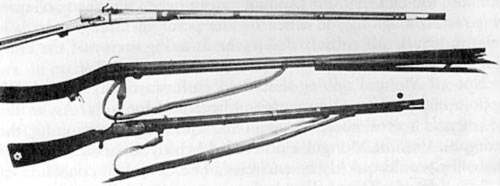
Since its introduction by Portuguese traders on the island of Tanegashima in 1543, the arquebus had become widely used in Japan. From the 1560s, tanegashima guns were produced on a scale of at least several thousand a year. By the late sixteenth century, Japan may have had more muskets than any other nation in the world, though bows were still used alongside them. In contrast, though both Korea and China had also been introduced to firearms similar to the Portuguese arquebus, most were older models. Korean soldiers would sometimes use hand cannons with a simple mechanism and either a gunstock or wooden shaft attached.
While tanegashima were superior to Korean bows in terms of penetration and range, they had a lower rate of fire. Accounts from the Annals of Joseon, essays, and diaries of Korean officials express that muskets alone could not ensure victory. Charges of Japanese troops with spears and swords were often more decisive than musketry. The Koreans were poorly trained in close combat, and lacked battlefield experience and discipline. The following words from a Korean military official named Yi Siŏn to the Korean king discusses this weakness:
The King asked him [Yi Siŏn], "You have already told me about the low accuracy of Japanese muskets. Why, then, are Korean armies having great problem with defeating them?"
[Yi Siŏn] then answered, "The Korean soldiers cower before the enemy and flee for their lives even before they have engaged the enemy. As for the commanders, they seldom leave their positions because they fear that they might be executed for deserting. However, there is a limit to executing deserting soldiers since there are so many of them. Truly, the Japanese aren't good musketeers, but they advance so rapidly that they appear right in front of the Koreans in the time Koreans can shoot only two arrows. It is said that Koreans are good archers, but they seldom hit the targets when the enemy is too far away, and are too scared to shoot when the enemy is near because they fear Japanese swords. Archery often becomes useless because Koreans, fearing the Japanese arme blanche, can barely shoot. The Japanese are reputed to be good swordsmen, but it is possible for Koreans to draw swords and hold their ground. However, the Koreans seldom do this and merely run for their lives."
However, another Korean official, Yu Sŏngnyong, claims that the Japanese arquebusiers had undeniable superiority over long distances, which (along with low discipline and combat experience of the Korean army) was the main cause of defeats:
In the 1592 invasion, everything was swept away. Within a fortnight or a month the cities and fortresses were lost, and everything in the eight directions had crumbled. Although it was [partly] due to there having been a century of peace and the people not being familiar with warfare that this happened, it was really because the Japanese had the use of muskets that could reach beyond several hundred paces, that always pierced what they struck, that came like the wind and the hail, and with which bows and arrows could not compare.
Today, the Japanese exclusively use muskets to attack fortifications. They can reach [the target] from several hundred paces away. Our country's bows and arrows cannot reach them. At any flat spot outside the walls, the Japanese will build earthen mounds and "flying towers." They look down into the fortifications and fire their bullets so that the people inside the fortifications cannot conceal themselves. In the end the fortifications are taken. One cannot blame [the defenders] for their situation.
The Japanese also saw arquebuses as crucial. A Japanese commander wrote home in 1592:
Please arrange to send us guns and ammunition. There is absolutely no use for spears. It is vital that you arrange somehow to obtain a number of guns. Furthermore, you should certainly see to it that those person departing [for Korea] understand this situation. The arrangements for guns should receive your closest attention.
The Japanese commander Asano Yoshinaga wrote home to his father:
When the troops come [to Korea] from the province of Kai, have them bring as many guns as possible, for no other equipment is needed. Give strict orders that all men, even the samurai, carry guns.
Artillery
Korean mainly used artillery in siege action and for defending castles. In a few instances, some irregular Korean units with government-supplied weapons fired explosive shells from mortars. The Koreans also made use of hwacha, two-wheeled carts carrying hole-filled boards fitted to carry either 100 steel-tipped rockets or 200 singijeon (rocket arrows) to be fired all at once. They were especially effective against dense formations of troops.
According to Turnbull, Chinese field artillery and siege cannon were the finest in the region. Chinese artillery was made from cast iron, and were divided into several types, the most important being the "great general cannon", large breech-loading cannon atop two-wheeled carts, shooting iron balls weighing about 10 kilograms, and the folang zhi (佛朗支), which was also breech-loading. The Chinese also employed the hu dun pao bombard, which was noted for being decisive in retaking Pyongyang.