
Hyder Ali (Haidar'alī; حيدرعلى; Kannada: [hɐi̯d̪ɐr ɐliː] c. 1720 – 7 December 1782) was the Sultan and de facto ruler of the Kingdom of Mysore in southern India. He distinguished himself as a soldier, eventually drawing the attention of Mysore's rulers. Rising to the post of Dalavayi (commander-in-chief) to Krishnaraja Wodeyar II, he came to dominate the titular monarch and the Mysore government. He became the de facto ruler of the Kingdom of Mysore as Sarvadhikari (Chief Minister) by 1761, and served as its primary military leader in intermittent conflicts against the East India Company during the First and Second Anglo–Mysore Wars.
He concluded an alliance with the French, and used the services of French workmen in raising his artillery and arsenal. His rule of Mysore was characterised by frequent warfare with his neighbours and rebellion within his territories. This was not unusual for the time, as much of the Indian subcontinent was then in turmoil. He left his eldest son, Tipu Sultan, an extensive kingdom bordered by the Krishna River in the north, the Eastern Ghats in the east and the Arabian Sea in the west.
He was known to Benjamin Franklin for his bravery.

Early life
The exact date of Hyder Ali's birth is not known with certainty. He was born to Fath Muhammad. Various historical sources provide dates ranging between 1717 and 1722 for his birth. His father, Fath Muhammad, was born in Kolar, and served as a commander of 50 men in the bamboo rocket artillery (mainly used for signalling) in the army of the Nawab of Carnatic. Fath Muhammad eventually entered the service of the Wodeyar Rajas of the Kingdom of Mysore, where he rose to become a powerful military commander. The Wodeyars awarded him Budikote as a jagir (land grant), where he then served as naik (Lord).
Hyder Ali was born in Budikote, modern day Kolar district, Karnataka; he was Fath Muhammad's fifth child, and the second by his third wife Razia Bibi, a sister of sufi pir Ibrahim Saheb whose ancestors were Arab Nawayath. According to some historians Fath Muhammad was also of Arab ancestry. According to this tradition, his paternal ancestors were also Nawayath Arabs from the Quraysh tribe, who arrived in India by sea and later came to southern India from Delhi during the reign of Muhammad Adil Shah, or settled in Punjab before moving to southern India. According to another set of historians, Hyder Ali was of Punjabi descent. As per this tradition, his father descended from a Sufi mystic Shah Bahlol through Muhammad Ali. Muhammad Ali was the husband of the daughter of the Banda Nawaz shrine's custodian in Gulbarga.
His early years are not well documented; he entered military service along with his brother Shahbaz after their father died in combat. Although Hyder Ali was from Mysore, his early loyalties were to the Nizam of Hyderabad, through whom Hyder Ali and his companions became Sepoys in the Deccan with partial investiture from the "Great Moghul" of that period. After serving for a number of years under the rulers of Arcot, they came to Srirangapatna, where Hyder's uncle served. He introduced them to Devaraja, the dalwai (chief minister, military leader, and Commander-in-chief) of Krishnaraja Wodeyar II, and Nanjaraja, Devaraja's brother, who also held important ministerial posts including sarvadhikari . Hyder and his brother were both given commands in the Mysorean army; Hyder served under Shahbaz, commanding 100 cavalry and 2,000 infantry.
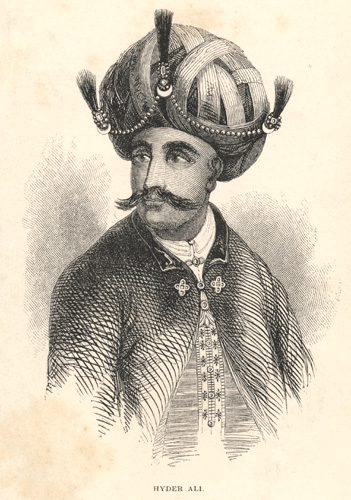
Rise to power
Carnatic Wars
In 1748, Qamar-ud-din Khan, Asaf Jah I, the longtime Nizam of Hyderabad, died. The struggle to succeed him is known as the Second Carnatic War. On one side was Nasir Jung, the Nizam and his protege Muhammad Ali, supported by the British, and on the other was Chanda Sahib and Nasir Jung's nephew Muzaffar Jung, supported by the French, vying to become the Nawab of Arcot. Both sides were supported by other local leaders.
Devaraja had started vesting more military authority in his brother, and in 1749 Nanjaraja marched the Mysorean army in support of Nasir Jung. The army went to Devanhalli, where the Mysoreans participated in the Siege of Devanahalli Fort. The fort was held by Muzaffar Jung's forces and the siege was conducted by the Marquis de Bussy. During the successful eight-month siege, Hyder Ali and his brother distinguished themselves, and were rewarded by Devaraja with enlarged commands.
In the wars against Hyder Ali in 1751 and during the siege of Tiruchirappalli in 1752, Thondaiman sent 400 cavalry and 3000 Kallar infantry to Tiruchirappalli to support the British and the Nawab of Arcot.

By 1755, Hyder Ali commanded 3,000 infantry and 1,500 cavalry, and was reported to be enriching himself on campaigns by plunder. In that year, he was also appointed Faujdar (military commander) of Dindigul. In this position, he first retained French advisers to organise and train his artillery companies. He is also known to have personally served alongside de Bussy, and is believed to have met both Muzaffar Jung and Chanda Shahib.
In these early wars he also came to dislike and mistrust Muhammed Ali Khan Wallajah, the Nawab of the Carnatic. In fact, Muhammed Ali Khan Wallajah and the Mysorean leaders were long at odds with each other, seeking territorial gains at the other's expense. Muhammad Ali Khan Wallajah had by then formed an alliance with the British, and he was accused by Hyder Ali in later years of effectively preventing him from making any sort of long-lasting alliances or agreements with the British.
Throughout the Carnatic Wars, Hyder Ali and his Mysore battalions served alongside French commanders such as Joseph Francois Dupleix, Count de Lally and de Bussy; he also assisted Chanda Sahib on various occasions. Hyder Ali supported the claims of Muzaffar Jung and later sided with Salabat Jung.

Skills
Early in his career, Hyder Ali retained, as one of his chief financial assistants, a Brahmin named Khande Rao. Hyder Ali, who was illiterate, was reported to be blessed with a prodigious memory and numerical acumen.
Hyder Ali could rival or outperform expert accountants with his great arithmetic skills and worked to develop a system, with Rao, that included checks and balances, so that all manner of income, including plunder of physical goods of all types, could be accounted for with little possibility of fraud or embezzlement.
This financial management may have played a role in Hyder Ali's rise in power.
Control of Srirangapatna
In 1757, Hyder Ali was called to Srirangapatna to support Devaraja against threats from Hyderabad and the Marathas. Upon his arrival, he found the Mysorean army in disarray and near mutiny over pay. While Devaraja bought his way out of the threats to Srirangapatna, Hyder Ali arranged for the army to be paid and arrested the ringleaders of the mutiny.
Campaigns against Calicut
In 1757, to resist the invasion of the Zamorin of Calicut – an East India Company ally at the time, the Palakkad Raja sought the help of Hyder Ali. Hyder Ali then led campaigns against the Zamorin of Calicut in the Malabar Coast of India. In 1766, Hyder Ali defeated the Zamorin of Kozhikode and absorbed Kozhikode into his state. The smaller princely states in northern and north-central parts of modern-day state of Kerala (Malabar region) including Kolathunadu, Kottayam, Kadathanadu, Kozhikode, Tanur, Valluvanad, and Palakkad were unified under the rulers of Mysore and were made a part of the larger Kingdom of Mysore. For his role in these activities, Hyder Ali was rewarded by Devaraja with the jaghir (regional governorship) of Bangalore.
Capture of Bangalore (1758)
In 1758, Hyder Ali successfully forced the Marathas to lift a siege of Bangalore. Hyder Ali's forces entered the city, thus capturing it.

By 1759, Hyder Ali was in command of the entire Mysorean army.
Siege of Channapatna (1759)
In the year 1759, Balaji Baji Rao launched a military expedition against Bangalore and Channapatna, with Gopal Hari and Anand Rao leading the forces. However, Hyder Ali managed to defeat the much larger Maratha army with a smaller force. As a result, Channapatna and the surrounding districts were incorporated into the Mysore territory.
Nawab of Mysore (1759)
The young King of Mysore, Krishnaraja Wodeyar II, rewarded Hyder Ali's performance by granting him the title of Fath Hyder Bahadur or Nawab Hyder Ali Khan. Hyder Ali is also known to be the first ruler of Mysore to be granted the title of Nawab; thus, it can be said that he was briefly the "Nawab of Mysore" by 1759.
Because of the ongoing conflicts with the Marathas, the Mysorean treasury was virtually bankrupted, prompting the queen mother to force into exile Nanjaraj, who had assumed the position of dalwai upon his brother's death in 1758. Hyder Ali was a beneficiary of this action, rising in influence in the court.
Deposition of Khande Rao
In 1760, the queen mother conspired with Khande Rao, who had gone into the raja's service, to oust Hyder Ali. He was precipitously forced out of Seringapatam, leaving his family, including his son Tipu Sultan, under house arrest.
The sudden departure left Hyder Ali with few resources. He may have been fortuitously aided at this time by the faraway Third Battle of Panipat, in which the Marathas suffered a major defeat on 14 January 1761. Because of this loss, the Marathas withdrew forces from Mysore and Hyder Ali's brother-in-law Makdum Ali chased them into Bidnur and Sunda.
Hyder Ali soon consolidated his strength by placing Mirza Sahib as the commander of Sira, a Sufi Pir Ibrahim Sahib (maternal uncle of Hyder Ali) in Bangalore and Amin Sahib, his cousin in Basnagar. Soon afterward, Hyder Ali marched alongside Makdum Ali's forces, which numbered about 6,000, along with the 3,000 men from his garrison at Bangalore, toward Seringapatam.
They clashed with Khande Rao's forces before reaching the capital. Khande Rao, with 11,000 men, won the battle, and Hyder Ali was forced to apply to the exiled Nanjaraj for support. Nanjaraj gave Hyder Ali command of his army and the title of Dalwai.
With this force, Hyder Ali again moved out against Khande Rao. Hyder Ali sent letters appearing to be from Nanjaraj to some of Khande Rao's commanders, confirming their agreement to hand Khande Rao over to Hyder Ali. Fearing a conspiracy, Khande Rao fled into Seringapatam.
After a minor battle against the now-leaderless army, Hyder Ali took over most of its remnants and surrounded Seringapatam. The ensuing negotiations left Hyder Ali in nearly complete military control of Mysore. Concessions that he extracted included the surrender of Khande Rao, who Hyder Ali imprisoned in Bangalore.
Ruler of Mysore
Hyder Ali became king of Mysore in 1761 after overthrowing the prime minister and making the king, Krishnaraja Wodeyar II, a prisoner in his own palace.
Hyder Ali formally styled himself Sultan Hyder Ali Khan in his correspondence with the Mughal Emperor Shah Alam II. Hyder Ali retained his title during the first Anglo-Mysore War that raged in 1766, and onwards.
He was very cautious in his diplomacy with the Nizam of Hyderabad, who was, according to an official Mughal firman, the sovereign of all Muslim-ruled territories in southern India.
The English and the Marathas continued to refer to Hyder Ali and later his son Tipu Sultan as "nabobs".
Expansion and alliances
Over the next few years Hyder expanded his territories to the north. Two key acquisitions were Sira, taken from the Marathas, and the kingdom of Bednore, where as a casus belli he agreed to support a claimant to its throne against usurpers. In 1763 he took its capital, Ikkeri, which included a large treasury. He renamed the capital Haidernagar, and began styling himself Hyder Ali Khan Bahadur, a title that had been bestowed on him by Salabat Jung as reward for his taking of Sira. He moved most of his family to Ikkeri, a natural fortress, in the hopes that it would "serve him for a safe refuge". He assumed the trappings of the ruler of Bednore, began issuing coins, and established a system of weights and measures. He made sure his son Tipu received a quality education, "employing learned tutors" and "appointing a suitable hand of attendants" to see to his upbringing. He cultivated a suspicion of foreigners, specifically refusing to allow the East India Company to have a resident at his court. His security, however, was not assured in Bednore: a bout of illness and a widespread conspiracy against him convinced him that it would not make an ideal capital for his domain, and he returned to Mysore.
The taking of Bednore included several ports on the Malabar coast, including Mangalore. Hyder used these ports to establish a small navy. The documentary record on the navy is fragmentary; Portuguese records indicate that the fleet was launched sometime between 1763 and 1765. It was apparently officered by Europeans, and its first admiral was an Englishman; by 1768 its admiral was a Mysorean cavalry officer named Ali Bey (or Lutf Ali Beg), apparently chosen by Hyder because he did not trust the European captains.
Hyder had amicable relations with the Christian population in Mangalore, which had long been under Portuguese influence and had a sizeable Roman Catholic population, and with Christians in general. He had a very close friendship with two Goan Catholic clergymen, Bishop Noronha and Fr. Joachim Miranda, and allowed a Protestant missionary to live at his court. Hyder's army also included Catholic soldiers, and he allowed Christians to build a church at Seringapatam, where French generals used to offer prayers and priests used to visit. Mangalorean historian A. L. P. D'Souza mentions that Hyder also had Christians in his administration. Pursuant to treaties concluded with the Portuguese, he also allowed Portuguese priests to settle disputes among Christians. However, many Mangaloreans (not just Christians) disliked him for the heavy tax burden he imposed on them.
Hyder Ali attacks the Maratha Confederacy
The Maratha Confederacy had just been routed at the Third Battle of Panipat by Ahmad Shah Durrani and the Mughals had been restored in the year 1761.
The Maratha Empire was very vulnerable and feeble to any attack and the Peshwa's power had been almost eliminated in all of Northern India.
At this point in his life Hyder Ali decided to go to war with the Marathas and put an end to the threat they posed to his power.
He therefore attacked the Maratha-aligned Rani of Bednore. She had appealed to the Nawab of Savanur for assistance when Hyder invaded. Hyder consequently threatened the Nawab, attempting to extort tribute from him. Failing in this, he overran that territory, reaching as far as Dharwad, north of the Tungabhadra River.
Since Savanur was a tributary of the Marathas, the Peshwa, Madhavrao I, countered with a strong force and defeated Hyder near Rattihalli and in decisive Battle of Jadi Hanwati . Following the victory the Marathas restored their power under the reign of Madhavrao Peshwa. The Maratha victory forced Hyder to retreat; he had to abandon Bednore, although he was able to remove its treasures to Seringapatam. Hyder paid 35 lakhs rupees in tribute to end the war, and returned most of his gains, although he did retain Sira.
In 1766 Hyder Ali returned to the Malabar, this time at the invitation of the raja of Cannanore, who sought independence from the Zamorin, the ruler of Calicut who held sway over Cannanore. Hyder also claimed a debt of tribute from the Zamorin, who had supported Hyder's opponents in earlier campaigns. After a difficult campaign, Hyder reached Calicut, where the Zamorin, after promising to make payment, failed to deliver. Hyder placed the Zamorin under house arrest and had his finance minister tortured. Fearing similar treatment, the Zamorin set fire to his palace and perished in the flames, ending Eradi dynastic rule of Calicut. After establishing control of Calicut, Hyder departed, but was forced to return several months later when the Nairs rebelled against the rule of his lieutenant, Reza Sahib. Hyder's response was harsh: after putting down the rebellion, many rebels were executed, and thousands of others were forcibly relocated to the Mysorean highlands.
Mysore's titular ruler Krishnaraja died in April 1766, while Hyder was in Malabar. Hyder had left orders that Krishnaraja's son Nanjaraja Wodeyar be invested should that happen, and he only later came to formally pay his respects to the new rajah. He took advantage of this opportunity to engage in a sort of house cleaning: the raja's palace was plundered, and its staff reduced to the point where virtually everyone employed there was also a spy for Hyder Ali.
First Anglo-Mysore War
After the Battle of Buxar, the British, led by Hector Monro, decided to support the Maratha Confederacy against the Shah Alam II, the Nawabs and Mysore.
As the power struggle between Mysore and the Peshwa continued it soon began to involve the British and other European trading companies.
Being himself a former ally of the French, Hyder Ali expected the support of the British against the Marathas, but such support never materialized.
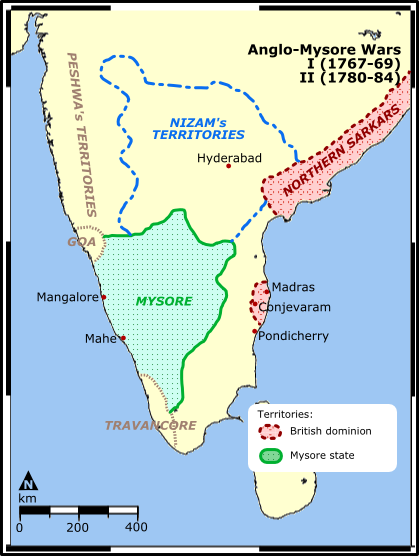
In 1766 Mysore began to become drawn into territorial and diplomatic disputes between the Nizam of Hyderabad and the East India Company, which had by then become the dominant European power on the Eastern Indian coast. The Nizam, seeking to deflect the company from their attempts to gain control of the Northern Circars, made overtures to Hyder Ali to launch an invasion of the Carnatic. Company representatives also appealed to Hyder Ali, but he rebuffed to them. The Nizam then ostensibly struck a deal with the Company administration in the Madras Presidency for their support, but apparently did so with the expectation that when Hyder Ali was prepared for war, the deal with the British would be broken. This diplomatic manoeuvring resulted in the start of the First Anglo-Mysore War in August 1767 when a company outpost at Changama was attacked by a combined Mysore-Hyderabad army under Hyder Ali's command. Despite significantly outnumbering the British force (British estimates place the allied army size at 70,000 to the British 7,000), the allies were repulsed with heavy losses. Hyder Ali moved on to capture Kaveripattinam after two days of siege, while the British commander at Changama, Colonel Joseph Smith, eventually retreated to Tiruvannamalai for supplies and reinforcements. There Hyder Ali was decisively repulsed on 26 September 1767. With the onset of the monsoon season, Hyder Ali opted to continue campaigning rather than adopting the usual practice of suspending operations because of the difficult conditions the weather created for armies. After over-running a few lesser outposts, he besieged Ambur in November 1767, forcing the British to resume campaigning. The British garrison commander refused large bribes offered by Hyder Ali in exchange for surrender, and the arrival of a relief column in early December forced Hyder Ali to lift the siege. He retreated northward, covering the movements of the Nizam's forces, but was disheartened when an entire corps of European cavalry deserted to the British. The failures of this campaign, combined with successful British advances in the Northern Circars and secret negotiations between the British and the Nizam Asaf Jah II, led to a split between Hyder Ali and the Nizam. The latter withdrew back to Hyderabad and eventually negotiated a new treaty with the British company in 1768. Hyder Ali, apparently seeking an end to the conflict, made peace overtures to the British, but was rebuffed.