
The Hope Diamond is a 45.52-carat (9.104 g; 0.3211 oz) blue diamond that has been famed for its great size and blue-violet color since the 17th century. It was extracted in the 17th century from the Kollur Mine in Andhra Pradesh, India. The gemstone's exceptional size has revealed new information about the formation of diamonds.
The Hope Diamond's recorded history begins in 1666, when the French gem merchant Jean-Baptiste Tavernier purchased the raw Golconda stone in India. After cutting the gem and renaming it "the French Blue" (Le bleu de France), Tavernier sold it to King Louis XIV of France in 1668. It was stolen in 1792, re-cut by persons unknown, and recovered after a lapse of years, appearing under the Hope name in an 1839 gem catalogue from the Hope banking family, from whom the diamond's name derives.
The Hope Diamond's last private owner was the American jeweler Harry Winston, who bought it in 1949 from the estate of the mining heiress and socialite Evalyn Walsh McLean. After exhibiting the diamond on tour for several years, Winston set it in a necklace and donated it in 1958 to the Smithsonian Institution's National Museum of Natural History in Washington, D.C., where it remains on permanent exhibition.
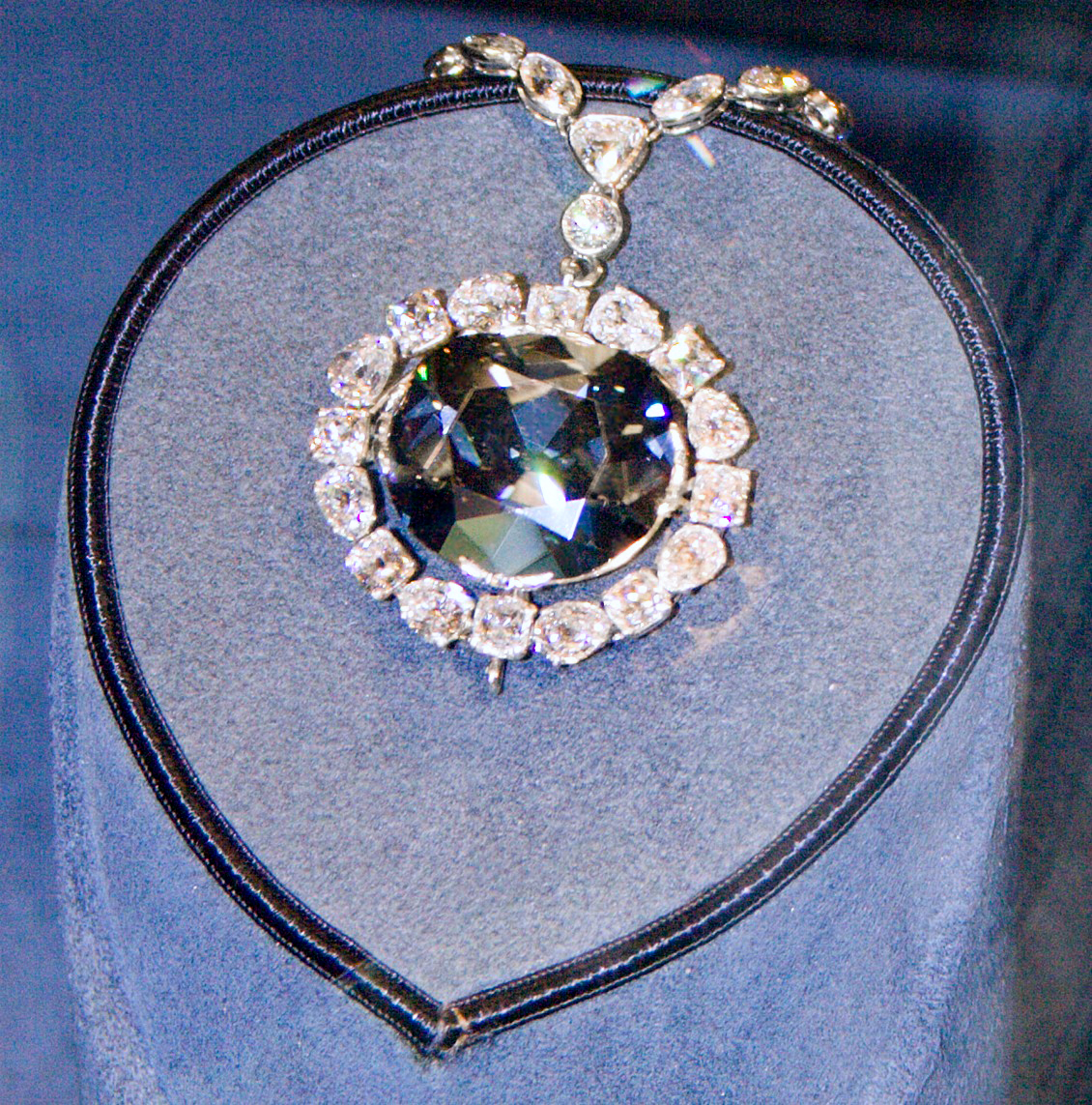
Classification
The Hope Diamond is a large, 45.52-carat (9.104 g; 0.3211 oz), deep-blue diamond, studded in a pendant Toison d ’or. It is a dark greyish-blue color under ordinary light due to trace amounts of boron within its crystal structure, and it exhibits a red phosphorescence under exposure to ultraviolet light. It is classified as a type IIb diamond.
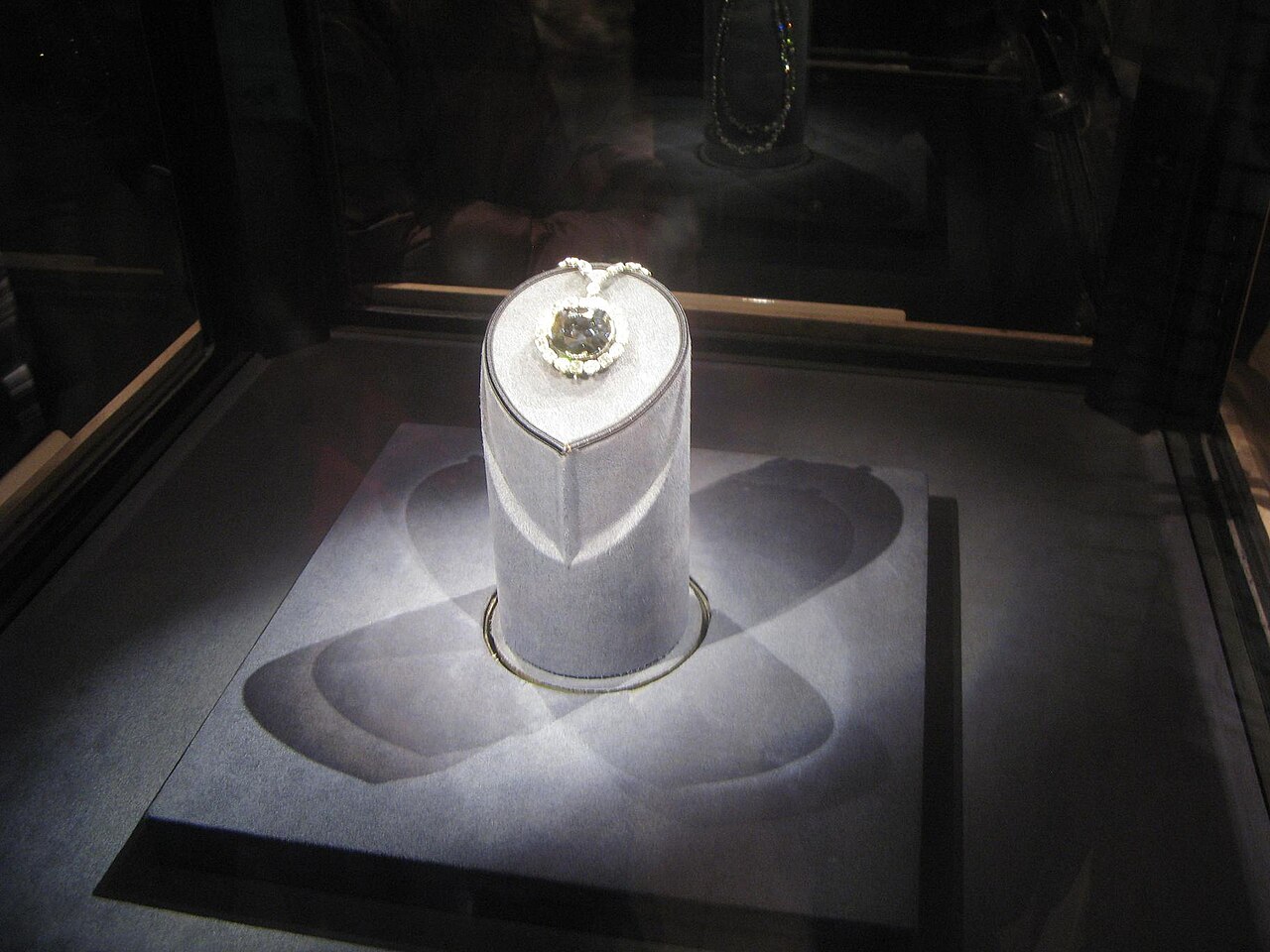
The Hope Diamond is currently housed in the National Gem and Mineral collection at the National Museum of Natural History in Washington, D.C. It has changed hands numerous times on its way from Hyderabad, India, to France, Great Britain, and the United States, where it is on public display. It has been described as the "most famous diamond in the world".
Physical properties
Weight: In December 1988, the Gemological Institute of America's laboratory determined the diamond to weigh 45.52 carats (9.104 g; 0.3211 oz).

Size and shape: The diamond has been compared in size and shape to a pigeon egg or a walnut that is pear-shaped. The length, width, and depth are 25.60 mm × 21.78 mm × 12.00 mm (1 in × 7/8 in × 15/32 in).
Color: It has been described as being a "fancy dark greyish-blue" as well as "dark blue in color," or having a "steely-blue" color. Blue diamonds similar to the Hope can be shown by colorimetric measurements to be grayer (lower in saturation) than blue sapphires. In 1996, the Gemological Institute of America examined the diamond and, using their proprietary scale, graded it fancy deep grayish blue.
Visually, the gray modifier (mask) is so dark (indigo) that it produces an "inky" effect, appearing almost blackish-blue in incandescent light. Current photographs of the Hope Diamond use high-intensity light sources that tend to maximize the brilliance of gemstones. In popular literature, many superlatives have been used to describe the Hope Diamond as a "superfine deep blue," often comparing it to the color of a fine sapphire—for example, "blue of the most beautiful blue sapphire" (Deulafait)—and describing its color as "a sapphire blue." Tavernier described it as a "beautiful violet".

Phosphorescence: The stone exhibits an unusually intense, brilliant red phosphorescence after exposure to short-wave ultraviolet light. This 'glow-in-the-dark' effect persists for some time after the light source has been switched off, and this strange quality may have helped fuel its reputation of being "cursed." The red glow is a phenomenon of blue diamonds that helps scientists "fingerprint" them, allowing them to distinguish real ones from artificial ones. The red glow occurs because of a mixture of boron and nitrogen in the stone.
Clarity: The clarity was determined to be VS1, with whitish graining present.
Cut: The cut was described as being "cushion antique brilliant with a faceted girdle and extra facets on the pavilion."

Chemical composition: In 2010, the diamond was removed from its setting to measure its chemical composition. After boring a hole one nanometer deep, preliminary experiments detected the presence of boron, hydrogen, and possibly nitrogen; the boron concentration varies from zero to eight parts per million. The boron is the cause of the stone's blue color.
Touch and feel: When the Associated Press reporter Ron Edmonds was allowed by Smithsonian officials to hold the gem in his hands in 2003, he wrote that the first thought that had come into his mind was, "Wow!" It was described as "cool to the touch." He wrote:
You cradle the 45.5-carat stone—about the size of a walnut and heavier than its translucence makes it appear—turning it from side to side as the light flashes from its facets, knowing it's the hardest natural material yet fearful of dropping it.

Hardness: Diamonds in general, including the Hope Diamond, are the hardest natural minerals known on Earth, but, because of weak planes in the bonds of a diamond's crystalline structure, the crystal can fracture along these planes if not handled correctly. These weak planes allow diamond cutters to split a rough uncut stone into smaller flawless parts before the process of faceting the stone takes place. Only a diamond can scratch another diamond, so, to be faceted, the uncut rough diamond is mounted in a holder, and then the flat surfaces or facets are ground into the surface of the stone using specially made metal wheels impregnated with diamond particles. These facets are ground and polished with ever finer grades/grits of diamond powder until they have a clear mirror surface, ultimately producing a gem that sparkles by refracting and reflecting light in different ways.
History
Geological beginnings
The Hope Diamond was formed deep within the Earth approximately 1.1 billion years ago. Like all diamonds, it was formed by carbon atoms strongly bonding together. The Hope Diamond was originally embedded in kimberlite and was later extracted and refined to form the current gem. The Hope Diamond contains trace amounts of boron atoms intermixed with the carbon structure, which results in the rare blue color of the diamond.
People typically think of the Hope Diamond as a historic gem, but... it's [important] as a rare scientific specimen that can provide vital insights into our knowledge of diamonds and how they are formed in the earth.
India
Several accounts, based on remarks written by French gem merchant Jean-Baptiste Tavernier, who obtained the gem in India in 1666, suggest that the gemstone originated in India, in the Kollur mine in the Guntur district of Andhra Pradesh (which, at the time, was part of the Golconda kingdom of the Qutb Shahi dynasty).
Tavernier's book, the Six Voyages (French: Les Six Voyages de J. B. Tavernier), contains sketches of several large diamonds that he sold to King Louis XIV, possibly in 1668 or 1669; a blue diamond is shown among these, and Tavernier mentions the mines at "Gani Coulour" (Kollur Mine) as a source of colored diamonds, but no direct mention of the stone is made. Historian Richard Kurin has built a highly speculative case for 1653 as the year of acquisition, but the most that can be said with certainty is that Tavernier obtained the blue diamond during one of his five voyages to India between the years 1640 and 1667. One report suggests he took 25 diamonds to Paris, including the large rock which became the Hope, and sold all of them to King Louis XIV. Another report suggested that in 1669, Tavernier sold this large blue diamond along with approximately one thousand other diamonds to King Louis XIV for 220,000 livres—the equivalent of 147 kilograms of pure gold.
In the historical novel, The French Blue, gemologist and historian Richard W. Wise proposes that the patent of nobility granted to Tavernier by Louis XIV was part of the payment for the Tavernier Blue. According to the theory, Jean-Baptiste Colbert (the King's Finance Minister at the time) regularly sold noble offices and titles for cash; an outright patent of nobility, according to Wise, was worth approximately 500,000 livres. That amount, plus the reported sale to the King, would have totaled about 720,000 livres, half the price of Tavernier's initial estimate for the gem. There has been controversy regarding the actual weight of the stone: Morel believed that the 112.1875-carat (22.43750 g; 0.791460 oz) stated in Tavernier's invoice would be in old French carats, thus 115.28 metric carats.
France
In 1678, Louis XIV commissioned the court jeweler Jean Pitau to recut the Tavernier Blue, resulting in a 67.125-carat (13.4250 g; 0.47355 oz) stone which royal inventories thereafter listed as the Blue Diamond of the Crown of France (French: diamant bleu de la Couronne de France). Later English-speaking historians have simply called it the French Blue. The king had the stone set on a cravat-pin.
According to one report, Louis ordered Pitau to "make him a piece to remember", and Pitau worked for two years, resulting in a "triangular-shaped 69-carat (13.8 g; 0.49 oz) gem the size of a pigeon's egg that took the breath away as it snared the light, reflecting it back in bluish-grey rays." It was set in gold and was supported by a ribbon for the neck which was worn by the king during ceremonies.
At the diamond's dazzling heart was a sun with seven facets—the sun being Louis' emblem, and seven being a number rich in meaning in biblical cosmology, indicating divinity and spirituality.
In 1749, Louis XIV's great-grandson, Louis XV, had the French Blue set into a more elaborate jeweled pendant for the Order of the Golden Fleece by court jeweler André Jacquemin. The assembled piece included a red spinel of 107-carat (21.4 g; 0.75 oz) carats shaped as a dragon breathing "covetous flames," as well as 83 red-painted diamonds and 112 yellow-painted diamonds to suggest a fleece shape.
The piece fell into disuse after the death of Louis XV. The diamond became the property of his grandson Louis XVI. whose wife, queen Marie Antoinette, used many of the French Crown Jewels for personal adornment by having the individual gems placed in new settings and combinations, but the French Blue remained in this pendant (except for a brief time in 1787, when the stone was removed for scientific study by Mathurin Jacques Brisson).
Theft, disappearance and concealment
On September 11, 1792, while Louis XVI and his family were imprisoned in the Square du Temple during the early stages of the French Revolution's Reign of Terror, a group of thieves broke into the Royal Storehouse—the Hôtel du Garde-Meuble de la Couronne (now Hôtel de la Marine)—stealing most of the Crown Jewels in a five-day looting spree. While many jewels were later recovered, including other pieces of the Order of the Golden Fleece, the French Blue was not among them, and it disappeared from history.
On January 21, 1793, Louis XVI was guillotined; Marie Antoinette was guillotined on October 16 of the same year. These beheadings are commonly cited as a result of the diamond's "curse," but the historical record suggests that Marie Antoinette had never worn the Golden Fleece pendant because it had been reserved for the exclusive use of the King.
A likely scenario is that the French Blue, sometimes also known as the Blue Diamond, was "swiftly smuggled to London" after being seized in 1792 in Paris. But the rock known as the French Blue was never seen again in its recorded form, since it almost certainly was recut during this decades-long period of anonymity, with the largest remaining piece becoming the Hope Diamond. One report suggested that the cut was a "butchered job" because it sheared off 23.5-carat (4.70 g; 0.166 oz) from the larger rock as well as hurting its "extraordinary luster."
It was long believed that the Hope Diamond had been cut from the French Blue, and confirmation came when a three-dimensional leaden model of the latter was rediscovered in the archives of the Paris National Museum of Natural History in 2005. Previously, the dimensions of the French Blue had been known only from two drawings made in 1749 and 1789; although the model differs slightly from the drawings in some details, these details are identical to features of the Hope Diamond, allowing CAD technology to digitally reconstruct the French Blue around the recut stone.
The leaden model revealed 20 unknown facets on the back of the French Blue. It also confirmed that the diamond had undergone a rather rough recut that removed the three points and reduced the thickness by a few millimeters. The Sun King's blue diamond became unrecognizable and the baroque style of the original cut was definitely lost.
Historians suggested that one burglar, Cadet Guillot, took several jewels, including the French Blue and the Côte-de-Bretagne spinel, to Le Havre and then to London, where the French Blue was cut into two pieces.
Morel adds that in 1796, Guillot attempted to resell the Côte-de-Bretagne in France but was forced to relinquish it to fellow thief Lancry de la Loyelle, who put Guillot into debtors' prison.
In a contrasting report, the historian Richard Kurin speculated that the "theft" of the French Crown Jewels was in fact engineered by the revolutionary leader Georges Danton as part of a plan to bribe an opposing military commander, Duke Karl Wilhelm of Brunswick. When under attack by Napoleon in 1805, Karl Wilhelm may have had the French Blue recut to disguise its identity; in this form, the stone could have come to Great Britain in 1806, when his family fled there to join his daughter Caroline of Brunswick. Although Caroline was the wife of the Prince Regent (later King George IV), she lived apart from her husband, and financial straits sometimes forced her to quietly sell her own jewels to support her household. Caroline's nephew, Duke Karl Friedrich, was later known to possess a 13.75-carat (2.750 g; 0.0970 oz) blue diamond which was widely thought to be another piece of the French Blue.
This smaller diamond's present whereabouts are unknown. A 2010 three-dimensional reconstruction of the French Blue from an authenticated leaden cast of the jewel fits too tightly around the Hope Diamond to allow for the existence of a sister stone of that size and concluded that there could be no significant offcuts from refastening the French Blue into the Hope Diamond.
United Kingdom
A blue diamond with the same shape, size, and color as the Hope Diamond was recorded by John Francillon as in the possession of the London diamond merchant Daniel Eliason in September 1812, the earliest point when the history of the Hope Diamond can be definitively fixed. This date was just two days after 20 years anniversary of the French Blue theft, just as the statute of limitations for the crime had taken effect. However, a second, less definitive report claims that the Hope Diamond's "authentic history" can only be traced back to 1830. The jewel was a "massive blue stone of 45.54-carat (9.108 g; 0.3213 oz)" and weighed 177 gr (11.5 g) (4 gr (0.26 g) = 1 carat).
While the diamond had disappeared for two decades, there were questions whether this diamond now in Great Britain was exactly the same one as had belonged to the French kings. Scientific investigation in 2008 confirmed "beyond reasonable doubt" that the Hope Diamond and that owned by the kings of France were, indeed, the same gemstone.
There are conflicting reports about what happened to the diamond during these years. Eliason's diamond may have been acquired by George IV, possibly through Caroline of Brunswick; however, there is no record of the ownership in the Royal Archives at Windsor, although some secondary evidence exists in the form of contemporary writings and artwork, and George IV tended to mix up the Crown property of the Crown jewels with family heirlooms and his own personal property.
A source at the Smithsonian suggested there were "several references" suggesting that George had indeed owned the diamond. After his death in 1830, it has been alleged that some of this mixed collection was stolen by George's last mistress, Elizabeth Conyngham, and some of his personal effects were discreetly liquidated to cover the many debts he had left behind him. Another report states that the king's debts were "so enormous" that the diamond was probably sold through "private channels". In either case, the blue diamond was not retained by the British royal family.
The stone was later reported to have been acquired by a rich London banker named Thomas Hope, for either US$65,000 or $90,000. It has been suggested that Eliason may have been a "front" for Hope, acting not as a diamond merchant venturing money on his own account, but rather as an agent to acquire the diamond for the banker. In 1839, the Hope Diamond appeared in a published catalog of the gem collection of his brother Henry Philip Hope, members of the Anglo-Dutch banking family Hope & Co.
The stone was set in a fairly simple medallion surrounded by many smaller white diamonds, which he sometimes lent to Louisa de la Poer Beresford, the widow of his brother, Thomas Hope, for society balls. After falling into the ownership of the Hope family, the stone came to be known as the "Hope Diamond".
Henry Philip Hope died in 1839, the same year as the publication of his collection catalog. His three nephews, the sons of Thomas and Louisa, fought in court for ten years over his inheritance, and ultimately the collection was split up. The oldest nephew, Henry Thomas Hope, received eight of the most valuable gems, including the Hope Diamond. It was displayed in the Great Exhibition of London in 1851 and at the 1855 Exposition Universelle in Paris, but was usually kept in a bank vault. In 1861, Henry Thomas Hope's only child, Henrietta, married Henry Pelham-Clinton (and later Duke of Newcastle).
When Hope died on December 4, 1862, his wife Anne Adele inherited the gem, but she feared that the profligate lifestyle of her son-in-law might cause him to sell the Hope properties. Upon Adele's death in 1884, the entire Hope estate, including the Hope Diamond, was entrusted to Henrietta's younger son, Henry Francis Pelham-Clinton, on the condition that he add the name of "Hope" to his own surnames when he reached the age of legal majority.
As Lord Francis Hope, this grandson received his legacy in 1887. However, he had only a life interest in his inheritance, meaning that he could not sell any part of it without court permission.
In 1894, Lord Francis Hope met the American concert hall singer May Yohé, who has been described as "the sensation of two continents", and they were married the same year; one account suggests that Yohé wore the Hope Diamond on at least one occasion.
She later claimed that she had worn it at social gatherings and had an exact replica made for her performances, but her husband claimed otherwise. Lord Francis lived beyond his means, and this eventually caught up with him, leading to marriage troubles and financial reverses, and he found that he had to sell the diamond.
In 1896, his bankruptcy was discharged, but, as he could not sell the Hope Diamond without the court's permission, he was supported financially by his wife during these intervening years. In 1901, the financial situation had changed, and after a "long legal fight," he was given permission to sell the Hope Diamond by an order of the Master in Chancery to "pay off debts". But May Yohé ran off with a gentleman friend named Putnam Strong, who was a son of the former New York City mayor William L. Strong. Francis Hope and May Yohé were divorced in 1902.
Francis sold the diamond for £29,000 (£3.08 million today), to Adolph Weil, a London jewel merchant. Weil sold the stone in 1901 to the diamond dealer Simon Frankel, based in New York and/or London who took it to New York. One report stated that he had paid $250,000 ($9.7 million today). However, in New York it was evaluated to be worth $141,032 ($5.46 million today).
United States (1902–present)
Accounts vary about what happened to the diamond during the years 1902–1907; one account suggested that it lay in the William & Theodore safe during these years while the jewelers took it out periodically to show it to wealthy Americans; a rival account, probably invented to help add "mystery" to the Hope Diamond story, suggested that some persons had bought it but apparently sold it back to Frankel. There were reports in one story in The New York Times of several owners of the gem, perhaps who had bought it from Frankel and owned it temporarily who met with ill-fortune, but this report conflicts with the more likely possibility that the gem remained in the hands of the Frankel jewelry firm during these years. Like many jewelry firms, the Frankel business ran into financial difficulties during the depression of 1907 and referred to the gem as the "hoodoo diamond."
In 1908, Frankel sold the diamond for $400,000 ($14.33 million today) to a Salomon or Selim Habib, a wealthy Turkish diamond collector, reportedly on behalf of Sultan Abdulhamid of the Ottoman Empire; however, on June 24, 1909, the stone was included in an auction of Habib's assets to settle his own debts, and the auction catalog explicitly stated that the Hope Diamond was one of only two gems in the collection which had never been owned by the Sultan. A contrary report, however, suggested that Sultan Abdul Hamid did own the gem but ordered Habib to sell it when his throne "began to totter." Habib reportedly sold the stone in Paris in 1909 for $80,000 ($2.87 million today). The Parisian jewel merchant Simon Rosenau bought the Hope Diamond for 400,000 francs and resold it in 1910 to Pierre Cartier for 550,000 francs. In 1910, it was offered for $150,000 ($5.18 million today), according to one report.
Pierre Cartier tried to sell the Hope Diamond to Washington, D.C., socialite Evalyn Walsh McLean and her husband in 1910. Cartier was a consummate salesman who used an understated presentation to entice Mrs. McLean. He described the gem's illustrious history to her while keeping it concealed underneath special wrapping paper. The suspense worked: McLean became impatient to the point where she suddenly requested to see the stone. She recalled later that Cartier "held before our eyes the Hope Diamond." Nevertheless, she initially rejected the offer. Cartier had it reset. She found the stone much more appealing in this new modern style. There were conflicting reports about the sale in The New York Times; one account suggested that the young McLean couple had agreed to purchase the diamond, but after having learned about its unfortunate supposed history, the couple had wanted to back out of the deal since they knew nothing of the "history of misfortunes that have beset its various owners."