
Gunpowder is the first explosive to have been created in the world. Popularly listed as one of the "Four Great Inventions" of China, it was invented during the late Tang dynasty (9th century) while the earliest recorded chemical formula for gunpowder dates to the Song dynasty (11th century). Knowledge of gunpowder spread rapidly throughout Eurasia, possibly as a result of the Mongol conquests during the 13th century, with written formulas for it appearing in the Middle East between 1240 and 1280 in a treatise by Hasan al-Rammah, and in Europe by 1267 in the Opus Majus by Roger Bacon. It was employed in warfare to some effect from at least the 10th century in weapons such as fire arrows, bombs, and the fire lance before the appearance of the gun in the 13th century. While the fire lance was eventually supplanted by the gun, other gunpowder weapons such as rockets and fire arrows continued to see use in China, Korea, India, and eventually to its use in the Middle East, Europe, and Africa. Bombs never ceased to develop and continued to progress into the modern day as grenades, mines, and other explosive devices. Gunpowder has also been used for non-military purposes such as fireworks for entertainment, or in explosives for mining and tunneling.
The evolution of guns led to the development of large artillery pieces, popularly known as bombards, during the 15th century, pioneered by states such as the Duchy of Burgundy. Firearms came to dominate early modern warfare in Europe by the 17th century. The gradual improvement of cannons firing heavier rounds for a greater impact against fortifications led to the invention of the star fort and the bastion in the Western world, where traditional city walls and castles were no longer suitable for defense. The use of gunpowder technology also spread throughout the Islamic world and to India, Korea, and Japan. The so-called Gunpowder Empires of the early modern period consisted of the Mughal Empire, Safavid Empire, and Ottoman Empire.
The use of gunpowder in warfare during the course of the 19th century diminished due to the invention of smokeless powder. Gunpowder is often referred to today as "black powder" to distinguish it from the propellant used in contemporary firearms.
Chinese beginnings
Gunpowder formula
Gunpowder was invented in China sometime during the first millennium AD. The earliest possible reference to gunpowder appeared in 142 AD during the Eastern Han dynasty when the alchemist Wei Boyang, also known as the "father of alchemy", wrote about a substance with gunpowder-like properties. He described a mixture of three powders that would "fly and dance" violently in his Cantong qi, otherwise known as the Book of the Kinship of Three, a Taoist text on the subject of alchemy. At this time, saltpeter was produced in Hanzhong, but would shift to Gansu and Sichuan later on. Wei Boyang is considered to be a semi-legendary figure meant to represent a "collective unity", and the Cantong qi was probably written in stages from the Han dynasty to 450 AD.
While it was almost certainly not their intention to create a weapon of war, Taoist alchemists continued to play a major role in gunpowder development due to their experiments with sulfur and saltpeter involved in searching for eternal life and ways to transmute one material into another. Historian Peter Lorge notes that despite the early association of gunpowder with Taoism, this may be a quirk of historiography and a result of the better preservation of texts associated with Taoism, rather than being a subject limited to only Taoists. The Taoist quest for the elixir of life attracted many powerful patrons, one of whom was Emperor Wu of Han. One of the resulting alchemical experiments involved heating 10% sulfur and 75% saltpeter to transform them.
The next reference to gunpowder occurred in the year 300 during the Jin dynasty (266–420). A Taoist philosopher by the name of Ge Hong wrote down the ingredients of gunpowder in his surviving works, collectively known as the Baopuzi ("The Master Who Embraces Simplicity"). The "Inner Chapters" (neipian) on Taoism contains records of his experiments to create gold with heated saltpeter, pine resin, and charcoal among other carbon materials, resulting in a purple powder and arsenic vapours. In 492, Taoist alchemists noted that saltpeter, one of the most important ingredients in gunpowder, burns with a purple flame, allowing for practical efforts at purifying the substance. During the Tang dynasty, alchemists used saltpeter in processing the "four yellow drugs" (sulfur, realgar, orpiment, arsenic trisulfide).
The first confirmed references to what can be considered gunpowder in China occurred more than three hundred years later during the Tang dynasty in two Taoist texts. The first in a formula contained in the Taishang Shengzu Jindan Mijue (太上聖祖金丹秘訣) in 808, and then about 50 years later in a text known as the Zhenyuan miaodao yaolüe (真元妙道要略). The first formula was a combination of six parts sulfur to six parts saltpeter to one part birthwort herb. The second text warned against an assortment of dangerous formulas, one of which corresponds with gunpowder: "Some have heated together sulfur, realgar (arsenic disulfide),
and saltpeter with honey; smoke [and flames] result, so that their hands and faces have been burnt, and even the whole house burned down." Alchemists called this discovery fire medicine ("huoyao" 火藥), and the term has continued to refer to gunpowder in China into the present day, a reminder of its heritage as a side result in the search for longevity increasing drugs. A book published in 1185 called Gui Dong (The Control of Spirits) also contains a story about a Tang dynasty alchemist whose furnace exploded, but it is not known if this was caused by gunpowder.
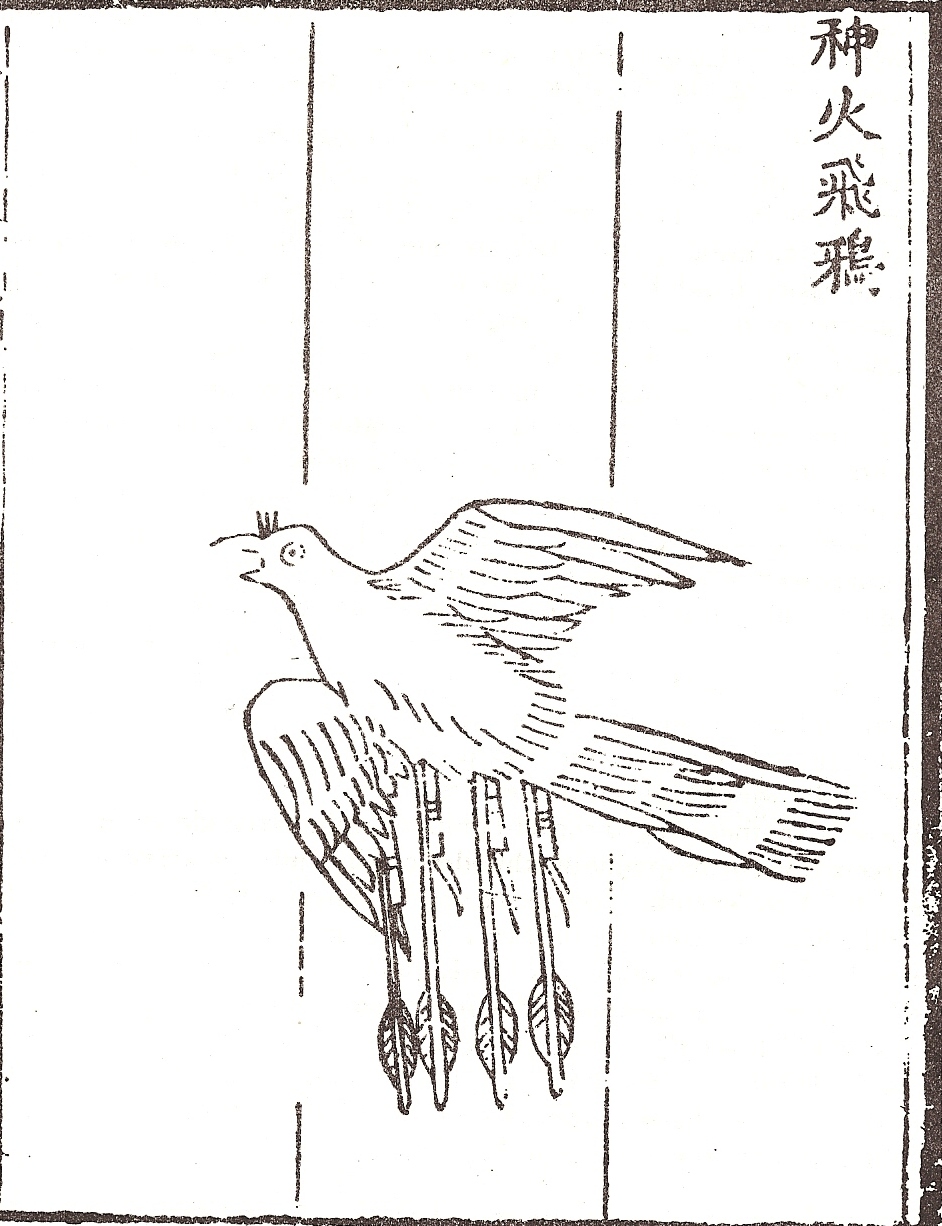
The earliest surviving chemical formula of gunpowder dates to 1044 in the form of the military manual Wujing Zongyao, also known in English as the Complete Essentials for the Military Classics, which contains a collection of entries on Chinese weaponry. However the 1044 edition has since been lost and the only currently extant copy is dated to 1510 during the Ming dynasty. The Wujing Zongyao served as a repository of antiquated or fanciful weaponry, and this applied to gunpowder as well, suggesting that it had already been weaponized long before the invention of what would today be considered conventional firearms. These types of gunpowder weapons had an assortment of odd names such as "flying incendiary club for subjugating demons", "caltrop fire ball", "ten-thousand fire flying sand magic bomb", "big bees nest", "burning heaven fierce fire unstoppable bomb", and "fire bricks" which released "flying swallows", "flying rats", "fire birds", and "fire oxen". Eventually they gave way and coalesced into a smaller number of dominant weapon types, notably gunpowder arrows, bombs, and early guns. This was most likely because some weapons were deemed too onerous or ineffective to deploy.

Fire arrows
The early gunpowder formula contained too little saltpeter (about 50%) to be explosive, but the mixture was highly flammable, and contemporary weapons reflected this in their deployment as mainly shock and incendiary weapons. One of the first, if not the first of these weapons was the fire arrow. The first possible reference to the use of fire arrows was by the Southern Wu in 904 during the siege of Yuzhang. An officer under Yang Xingmi by the name of Zheng Fan (鄭璠) ordered his troops to "shoot off a machine to let fire and burn the Longsha Gate", after which he and his troops dashed over the fire into the city and captured it, and he was promoted to Prime Minister Inspectorate for his efforts and the burns his body endured. A later account of this event corroborated with the report and explained that "by let fire (飛火) is meant things like firebombs and fire arrows." Arrows carrying gunpowder were possibly the most applicable form of gunpowder weaponry at the time. Early gunpowder may have only produced an effective flame when exposed to oxygen, thus the rush of air around the arrow in flight would have provided a suitably ample supply of reactants for the reaction.
Rockets
The first fire arrows were arrows strapped with gunpowder incendiaries, but they eventually became gunpowder propelled projectiles (rockets). It's not certain when this happened. According to the History of Song, in 969 two Song generals, Yue Yifang and Feng Jisheng (馮繼升), invented a variant fire arrow which used gunpowder tubes as propellants. These fire arrows were shown to the emperor in 970 when the head of a weapons manufacturing bureau sent Feng Jisheng to demonstrate the gunpowder arrow design, for which he was heavily rewarded. However Joseph Needham argues that rockets could not have existed before the 12th century, since the gunpowder formulas listed in the Wujing Zongyao are not suitable as rocket propellant. According to Stephen G. Haw, there is only slight evidence that rockets existed prior to 1200 and it is more likely they were not produced or used for warfare until the latter half of the 13th century. Rockets are recorded to have been used by the Song navy in a military exercise dated to 1245. Internal-combustion rocket propulsion is mentioned in a reference to 1264, recording that the 'ground-rat,' a type of firework, had frightened the Empress-Mother Gongsheng at a feast held in her honor by her son the Emperor Lizong.
In 975, the state of Wuyue sent to the Song dynasty a unit of soldiers skilled in the handling of fire arrows and in the same year, the Song used fire arrows to destroy the fleet of Southern Tang. In 994, the Liao dynasty attacked the Song and laid siege to Zitong with 100,000 troops. They were repelled with the aid of fire arrows. In 1000 a soldier by the name of Tang Fu (唐福) also demonstrated his own designs of gunpowder arrows, gunpowder pots (a proto-bomb which spews fire), and gunpowder caltrops, for which he was richly rewarded as well.
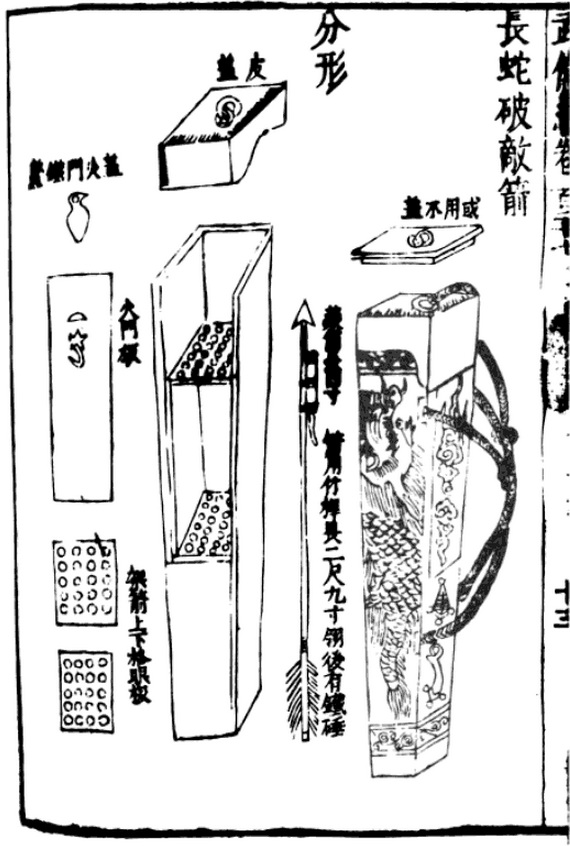
The imperial court took great interest in the progress of gunpowder developments and actively encouraged as well as disseminated military technology. For example, in 1002 a local militia man named Shi Pu (石普) showed his own versions of fireballs and gunpowder arrows to imperial officials. They were so astounded that the emperor and court decreed that a team would be assembled to print the plans and instructions for the new designs to promulgate throughout the realm. The Song court's policy of rewarding military innovators was reported to have "brought about a great number of cases of people presenting technology and techniques" (器械法式) according to the official History of Song. Production of gunpowder and fire arrows heavily increased in the 11th century as the court centralized the production process, constructing large gunpowder production facilities, hiring artisans, carpenters, and tanners for the military production complex in the capital of Kaifeng. One surviving source circa 1023 lists all the artisans working in Kaifeng while another notes that in 1083 the imperial court sent 100,000 gunpowder arrows to one garrison and 250,000 to another.
Evidence of gunpowder in the Liao dynasty and Western Xia is much sparser than in Song, but some evidence such as the Song decree of 1073 that all subjects were henceforth forbidden from trading sulfur and saltpeter across the Liao border, suggests that the Liao were aware of gunpowder developments to the south and coveted gunpowder ingredients of their own.
Explosives
Gunpowder bombs had been mentioned since the 11th century. In 1000 AD, the previously mentioned soldier, Tang Fu (唐福), demonstrated a design of a proto-bomb and other weaponry, and was rewarded for them. In the same year, Xu Dong wrote that trebuchets used bombs that were like "flying fire", suggesting that they were incendiaries. In the military text Wujing Zongyao of 1044, bombs such as the "ten-thousand fire flying sand magic bomb", "burning heaven fierce fire unstoppable bomb", and "thunderclap bomb" (pilipao) were mentioned. However detailed accounts of their use did not appear until the 12th century.

The Jurchen people of Manchuria united under Wanyan Aguda and established the Jin dynasty in 1115. Allying with the Song, they rose rapidly to the forefront of East Asian powers and defeated the Liao dynasty in a shockingly short span of time, destroying the 150-year balance of power between the Song, Liao, and Western Xia. Remnants of the Liao fled to the west and became known as the Qara Khitai, or Western Liao to the Chinese. In the east, the fragile Song-Jin alliance dissolved once the Jin saw how badly the Song army had performed against Liao forces. Realizing the weakness of Song, the Jin grew tired of waiting and captured all five of the Liao capitals themselves. They proceeded to make war on Song, initiating the Jin-Song Wars.
For the first time, two major powers would have access to equally formidable gunpowder weapons. Initially the Jin expected their campaign in the south to proceed smoothly given how poorly the Song had fared against the Liao. However they were met with stout resistance upon besieging Kaifeng in 1126 and faced the usual array of gunpowder arrows and fire bombs, but also a weapon called the "thunderclap bomb" (霹靂炮), which one witness wrote, "At night the thunderclap bombs were used, hitting the lines of the enemy well, and throwing them into great confusion. Many fled, screaming in fright." The thunderclap bomb was previously mentioned in the Wujing Zongyao, but this was the first recorded instance of its use. Its description in the text reads thus:
The thunderclap bomb contains a length of two or three internodes of dry bamboo with a diameter of 1.5 in. There must be no cracks, and the septa are to be retained to avoid any leakage. Thirty pieces of thin broken porcelain the size of iron coins are mixed with 3 or 4 lb of gunpowder, and packed around the bamboo tube. The tube is wrapped within the ball, but with about an inch or so protruding at each end. A (gun)powder mixture is then applied all over the outer surface of the ball.

Jin troops withdrew with a ransom of Song silk and treasure but returned several months later with their own gunpowder bombs manufactured by captured Song artisans. According to historian Wang Zhaochun, the account of this battle provided the "earliest truly detailed descriptions of the use of gunpowder weapons in warfare." Records show that the Jin used gunpowder arrows and trebuchets to hurl gunpowder bombs while the Song responded with gunpowder arrows, fire bombs, thunderclap bombs, and a new addition called the "molten metal bomb" (金汁炮). As the Jin account describes, when they attacked the city's Xuanhua Gate, their "fire bombs fell like rain, and their arrows were so numerous as to be uncountable." The Jin captured Kaifeng despite the appearance of the molten metal bomb and secured another 20,000 fire arrows for their arsenal.
The molten metal bomb appeared again in 1129 when Song general Li Yanxian (李彥仙) clashed with Jin forces while defending a strategic pass. The Jin assault lasted day and night without respite, using siege carts, fire carts, and sky bridges, but each assault was met with Song soldiers who "resisted at each occasion, and also used molten metal bombs. Wherever the gunpowder touched, everything would disintegrate without a trace." The molten metal bomb was likely an explosive that contained molten metal and gunpowder.
Fire lance
The Song relocated their capital to Hangzhou and the Jin followed. The fighting that ensued would see the first proto-gun, the fire lance, in action – with earliest confirmed employment by Song dynasty forces against the Jin in 1132 during the siege of De'an (modern Anlu, Hubei), Most Chinese scholars reject the appearance of the fire lance prior to the Jin-Song wars, but its first appearance in art with a silk banner painting from Dunhuang dates to the Five Dynasties and Ten Kingdoms period in the mid-10th century.
The siege of De'an marks an important transition and landmark in the history of gunpowder weapons as the fire medicine of the fire lances were described using a new word: "fire bomb medicine" (火炮藥), rather than simply "fire medicine." This could imply the use of a new more potent formula, or simply an acknowledgement of the specialized military application of gunpowder. Peter Lorge suggests that this "bomb powder" may have been corned, making it distinct from normal gunpowder. Evidence of gunpowder firecrackers also points to their appearance at roughly around the same time fire medicine was making its transition in the literary imagination.
Fire lances continued to be used as anti-personnel weapons into the Ming dynasty, and were even attached to battle carts on one situation in 1163. Song commander Wei Sheng constructed several hundred of these carts known as "at-your-desire-war-carts" (如意戰車), which contained fire lances protruding from protective covering on the sides. They were used to defend mobile trebuchets that hurled fire bombs. They were used as cavalry weapons by the 13th century.
Naval bombs
Gunpowder technology also spread to naval warfare and in 1129 Song decreed that all warships were to be fitted with trebuchets for hurling gunpowder bombs. Older gunpowder weapons such as fire arrows were also used. In 1159 a Song fleet of 120 ships caught a Jin fleet at anchor near Shijiu Island (石臼島) off the shore of Shandong peninsula. The Song commander "ordered that gunpowder arrows be shot from all sides, and wherever they struck, flames and smoke rose up in swirls, setting fire to several hundred vessels." Song forces took another victory in 1161 when Song paddle boats ambushed a Jin transport fleet, launched thunderclap bombs, and drowned the Jin force in the Yangtze.
The men inside them paddled fast on the treadmills, and the ships glided forwards as though they were flying, yet no one was visible on board. The enemy thought that they were made of paper. Then all of a sudden
a thunderclap bomb was let off: It was made with paper (carton) and filled with lime and sulphur. (Launched from trebuchets) these thunderclap bombs came dropping down from the air, and upon meeting the water exploded with a noise like thunder, the sulphur bursting into flames. The carton case rebounded and broke, scattering the lime to form a smoky fog which blinded the eyes of men and horses so that they could see nothing. Our ships then went forward to attack theirs, and their men and horses were all drowned, so that they were utterly defeated.
According to a minor military official by the name of Zhao Wannian (趙萬年), thunderclap bombs were used again to great effect by the Song during the Jin siege of Xiangyang in 1206–1207. Both sides had gunpowder weapons, but the Jin troops only used gunpowder arrows for destroying the city's moored vessels. The Song used fire arrows, fire bombs, and thunderclap bombs. Fire arrows and bombs were used to destroy Jin trebuchets. The thunderclap bombs were used on Jin soldiers themselves, causing foot soldiers and horsemen to panic and retreat. "We beat our drums and yelled from atop the city wall, and simultaneously fired our thunderclap missiles out from the city walls. The enemy cavalry was terrified and ran away." The Jin were forced to retreat and make camp by the riverside. In a rare occurrence, the Song made a successful offensive on Jin forces and conducted a night assault using boats. They were loaded with gunpowder arrows, thunderclap bombs, a thousand crossbowmen, five hundred infantry, and a hundred drummers. Jin troops were surprised in their encampment while asleep by loud drumming, followed by an onslaught of crossbow bolts, and then thunderclap bombs, which caused a panic of such magnitude that they were unable to even saddle themselves and trampled over each other trying to get away. Two to three thousand Jin troops were slaughtered along with eight to nine hundred horses.
Hard-shell explosives
Traditionally the inspiration for the development of the iron bomb is ascribed to the tale of a fox hunter named Iron Li. According to the story, around the year 1189 Iron Li developed a new method for hunting foxes which used a ceramic explosive to scare foxes into his nets. The explosive consisted of a ceramic bottle with a mouth, stuffed with gunpowder, and attached with a fuse. Explosive and net were placed at strategic points of places such as watering holes frequented by foxes, and when they got near enough, Iron Li would light the fuse, causing the ceramic bottle to explode and scaring the frightened foxes right into his nets. Although the veracity of this story is uncertain, the tradition holds that this ceramic bomb inspired the Jin to create an iron version.
The iron bomb made its first appearance in 1221 at the siege of Qizhou (in modern Hubei), and this time it would be the Jin who possessed the technological advantage. The Song commander Zhao Yurong (趙與褣) survived and was able to relay his account for posterity.
Qizhou was a major fortress city situated near the Yangtze and a 25 thousand strong Jin army advanced on it in 1221. News of the approaching army reached Zhao Yurong in Qizhou, and despite being outnumbered nearly eight to one, he decided to hold the city. Qizhou's arsenal consisted of some three thousand thunderclap bombs, twenty thousand "great leather bombs" (皮大炮), and thousands of gunpowder arrows and gunpowder crossbow bolts. While the formula for gunpowder had become potent enough to consider the Song bombs to be true explosives, they were unable to match the explosive power of the Jin iron bombs. Yurong describes the uneven exchange thus, "The barbaric enemy attacked the Northwest Tower with an unceasing flow of catapult projectiles from thirteen catapults. Each catapult shot was followed by an iron fire bomb [catapult shot], whose sound was like thunder. That day, the city soldiers in facing the catapult shots showed great courage as they maneuvered [our own] catapults, hindered by injuries from the iron fire bombs. Their heads, their eyes, their cheeks were exploded to bits, and only one half [of the face] was left." Jin artillerists were able to successfully target the command center itself: "The enemy fired off catapult stones ... nonstop day and night, and the magistrate's headquarters [帳] at the eastern gate, as well as my own quarters ..., were hit by the most iron fire bombs, to the point that they struck even on top of [my] sleeping quarters and [I] nearly perished! Some said there was a traitor. If not, how would they have known the way to strike at both of these places?"
Zhao was able to examine the new iron bombs himself and described thus, "In shape they are like gourds, but with a small mouth. They are made with pig iron, about two inches thick, and they cause the city's walls to shake." Houses were blown apart, towers battered, and defenders blasted from their placements. Within four weeks all four gates were under heavy bombardment. Finally the Jin made a frontal assault on the walls and scaled them, after which followed a merciless hunt for soldiers, officers, and officials of every level. Zhao managed an escape by clambering over the battlement and making a hasty retreat across the river, but his family remained in the city. Upon returning at a later date to search the ruins, he found that the "bones and skeletons were so mixed up that there was no way to tell who was who."
Hand cannon
The early fire lance, considered to be the ancestor of firearms, is not considered a true gun because it did not include projectiles, whereas a gun by definition uses "the explosive force of the gunpowder to propel a projectile from a tube: cannons, muskets, and pistols are typical examples.". Even later on when shrapnel such as ceramics and bits of iron were added to the fire lance, these didn't occlude the barrel, and were only swept along with the discharge rather than making use of windage, and so are referred to as "co-viatives."
In 1259 a type of "fire-emitting lance" (tuhuoqiang 突火槍) made an appearance and according to the History of Song: "It is made from a large bamboo tube, and inside is stuffed a pellet wad (子窠). Once the fire goes off it completely spews the rear pellet wad forth, and the sound is like a bomb that can be heard for five hundred or more paces." The pellet wad mentioned is possibly the first true bullet in recorded history depending on how bullet is defined, as it did occlude the barrel, unlike previous co-viatives used in the fire lance. Fire lances transformed from the "bamboo- (or wood- or paper-) barreled firearm to the metal-barreled firearm" to better withstand the explosive pressure of gunpowder. From there it branched off into several different gunpowder weapons known as "eruptors" in the late 12th and early 13th centuries, with different functions such as the "filling-the-sky erupting tube" which spewed out poisonous gas and porcelain shards, the "orifice-penetrating flying sand magic mist tube" (鑽穴飛砂神霧筒) which spewed forth sand and poisonous chemicals into orifices, and the more conventional "phalanx-charging fire gourd" which shot out lead pellets.
The earliest artistic depiction of what might be a hand cannon – a rock sculpture found among the Dazu Rock Carvings – is dated to 1128, much earlier than any recorded or precisely dated archaeological samples, so it is possible that the concept of a cannon-like firearm has existed since the 12th century. This has been challenged by others such as Liu Xu, Cheng Dong, and Benjamin Avichai Katz Sinvany. According to Liu, the weight of the cannon would have been too much for one person to hold, especially with just one arm, and points out that fire lances were being used a decade later at De'an. Cheng Dong believes that the figure depicted is actually a wind spirit letting air out of a bag rather than a cannon emitting a blast. Stephen Haw also considered the possibility that the item in question was a bag of air but concludes that it is a cannon because it was grouped with other weapon wielding sculptures. Sinvany believes in the wind bag interpretation and that the cannonball indentation was added later on.
Archaeological samples of the gun, specifically the hand cannon (huochong), have been dated starting from the 13th century. The oldest extant gun whose dating is unequivocal is the Xanadu Gun because it contains an inscription describing its date of manufacture corresponding to 1298. It is so called because it was discovered in the ruins of Xanadu, the Mongol summer palace in Inner Mongolia. The Xanadu Gun is 34.7 cm in length and weighs 6.2 kg. The design of the gun includes axial holes in its rear which some speculate could have been used in a mounting mechanism. Like most early guns it is small, weighing just over six kilograms and thirty-five centimeters in length. Although the Xanadu Gun is the most precisely dated gun from the 13th century, other extant samples with approximate dating likely predate it. The Heilongjiang hand cannon is dated a decade earlier to 1288, but the dating method is based on contextual evidence; the gun bears no inscription or era date. According to the History of Yuan, in 1287, a group of soldiers equipped with hand cannons led by the Jurchen commander Li Ting (李庭) attacked the rebel prince Nayan's camp. The History reports that the hand cannons not only "caused great damage," but also caused "such confusion that the enemy soldiers attacked and killed each other." The hand cannons were used again in the beginning of 1288. Li Ting's "gun-soldiers" or chongzu (銃卒) were able to carry the hand cannons "on their backs". The passage on the 1288 battle is also the first to coin the name chong (銃) for metal-barrel firearms. Chong was used instead of the earlier and more ambiguous term huo tong (fire tube; 火筒), which may refer to the tubes of fire lances, proto-cannons, or signal flares.
Another specimen, the Wuwei Bronze Cannon, was discovered in 1980 and may possibly be the oldest as well as largest cannon of the 13th century: a 100 centimeter 108 kilogram bronze cannon discovered in a cellar in Wuwei, Gansu containing no inscription, but has been dated by historians to the late Western Xia period between 1214 and 1227. The gun contained an iron ball about nine centimeters in diameter, which is smaller than the muzzle diameter at twelve centimeters, and 0.1 kilograms of gunpowder in it when discovered, meaning that the projectile might have been another co-viative. Ben Sinvany and Dang Shoushan believe that the ball used to be much larger prior to its highly corroded state at the time of discovery. While large in size, the weapon is noticeably more primitive than later Yuan dynasty guns, and is unevenly cast. A similar weapon was discovered not far from the discovery site in 1997, but much smaller in size at only 1.5 kg. Chen Bingying disputes this however, and argues there were no guns before 1259, while Dang Shoushan believes the Western Xia guns point to the appearance of guns by 1220, and Stephen Haw goes even further by stating that guns were developed as early as 1200. Sinologist Joseph Needham and renaissance siege expert Thomas Arnold provide a more conservative estimate of around 1280 for the appearance of the "true" cannon.
Whether or not any of these are correct, it seems likely that the gun was born sometime during the 13th century.
Use by the Mongols
The Mongols and their rise in world history as well as conflicts with both the Jin and Song played a key role in the evolution of gunpowder technology. Mongol aptitude in incorporating foreign experts extended to the Chinese, who provided artisans that followed Mongol armies willingly and unwillingly far into the west and even east, to Japan. Unfortunately textual evidence for this is scant as the Mongols left few documents. This lack of primary source documents has caused some historians and scholars such as Kate Raphael to doubt the Mongol's role in disseminating gunpowder throughout Eurasia. On the opposite side stand historians such as Tonio Andrade and Stephen Haw, who believe that the Mongol Empire not only used gunpowder weapons but deserves the moniker "the first gunpowder empire."
Conquest of the Jin dynasty
The first concerted Mongol invasion of Jin occurred in 1211 and total conquest was not accomplished until 1234. In 1232 the Mongols besieged the Jin capital of Kaifeng and deployed gunpowder weapons along with other more conventional siege techniques such as building stockades, watchtowers, trenches, guardhouses, and forcing Chinese captives to haul supplies and fill moats. Jin scholar Liu Qi (劉祈) recounts in his memoir, "the attack against the city walls grew increasingly intense, and bombs rained down as [the enemy] advanced." The Jin defenders also deployed gunpowder bombs as well as fire arrows (huo jian 火箭) launched using a type of early solid-propellant rocket. Of the bombs, Liu Qi writes, "From within the walls the defenders responded with a gunpowder bomb called the heaven-shaking-thunder bomb (震天雷). Whenever the [Mongol] troops encountered one, several men at a time would be turned into ashes."
A more fact based and clear description of the bomb exists in the History of Jin: "The heaven-shaking-thunder bomb is an iron vessel filled with gunpowder. When lighted with fire and shot off, it goes off like a crash of thunder that can be heard for a hundred li [thirty miles], burning an expanse of land more than half a mu [所爇圍半畝之上, a mu is a sixth of an acre], and the fire can even penetrate iron armor." A Ming official named He Mengchuan would encounter an old cache of these bombs three centuries later in the Xi'an area: "When I went on official business to Shaanxi Province, I saw on top of Xi'an's city walls an old stockpile of iron bombs. They were called 'heaven-shaking-thunder' bombs, and they were like an enclosed rice bowl with a hole at the top, just big enough to put your finger in. The troops said they hadn't been used for a very long time." Furthermore, he wrote, "When the powder goes off, the bomb rips open, and the iron pieces fly in all directions. That is how it is able to kill people and horses from far away."
Heaven-shaking-thunder bombs, also known as thunder crash bombs, were used prior to the siege in 1231 when a Jin general made use of them in destroying a Mongol warship. The Jin general named Wanyan Eke had lost the defense of Hezhong to the Mongols and fled on ships with 3,000 of his men. The Mongols pursued them with their ships until the Jin broke through by using thunder crash bombs that caused flashes and flames. However, during the siege the Mongols responded by protecting themselves with elaborate screens of thick cowhide. This was effective enough for workers to get right up to the walls to undermine their foundations and excavate protective niches. Jin defenders countered by tying iron cords and attaching them to heaven-shaking-thunder bombs, which were lowered down the walls until they reached the place where the miners worked. The protective leather screens were unable to withstand the explosion, and were penetrated, killing the excavators.
Another weapon the Jin employed was an improved version of the fire lance called the flying fire lance. The History of Jin provides a detailed description: "To make the lance, use chi-huang paper, sixteen layers of it for the tube, and make it a bit longer than two feet. Stuff it with willow charcoal, iron fragments, magnet ends, sulfur, white arsenic [probably an error that should mean saltpeter], and other ingredients, and put a fuse to the end. Each troop has hanging on him a little iron pot to keep fire [probably hot coals], and when it's time to do battle, the flames shoot out the front of the lance more than ten feet, and when the gunpowder is depleted, the tube isn't destroyed." While Mongol soldiers typically held a view of disdain toward most Jin weapons, apparently they greatly feared the flying fire lance and heaven-shaking-thunder bomb. Kaifeng managed to hold out for a year before the Jin emperor fled and the city capitulated. In some cases Jin troops still fought with some success, scoring isolated victories such as when a Jin commander led 450 fire lancers against a Mongol encampment, which was "completely routed, and three thousand five hundred were drowned." Even after the Jin emperor committed suicide in 1234, one loyalist gathered all the metal he could find in the city he was defending, even gold and silver, and made explosives to lob against the Mongols, but the momentum of the Mongol Empire could not be stopped. By 1234, both the Western Xia and Jin dynasty had been conquered.
Conquest of the Song dynasty
The Mongol war machine moved south and in 1237 attacked the Song city of Anfeng (modern Shouxian, Anhui) "using gunpowder bombs [huo pao] to burn the [defensive] towers." These bombs were apparently quite large. "Several hundred men hurled one bomb, and if it hit the tower it would immediately smash it to pieces." The Song defenders under commander Du Gao (杜杲) rebuilt the towers and retaliated with their own bombs, which they called the "Elipao," after a famous local pear, probably in reference to the shape of the weapon. Perhaps as another point of military interest, the account of this battle also mentions that the Anfeng defenders were equipped with a type of small arrow to shoot through eye slits of Mongol armor, as normal arrows were too thick to penetrate.
By the mid 13th century, gunpowder weapons had become central to the Song war effort. In 1257 the Song official Li Zengbo was dispatched to inspect frontier city arsenals. Li considered an ideal city arsenal to include several hundred thousand iron bombshells, and also its own production facility to produce at least a couple thousand a month. The results of his tour of the border were severely disappointing and in one arsenal he found "no more than 85 iron bomb-shells, large and small, 95 fire-arrows, and 105 fire-lances. This is not sufficient for a mere hundred men, let alone a thousand, to use against an attack by the ... barbarians. The government supposedly wants to make preparations for the defense of its fortified cities, and to furnish them with military supplies against the enemy (yet this is all they give us). What chilling indifference!" Fortunately for the Song, Möngke Khan died in 1259 and the war would not continue until 1269 under the leadership of Kublai Khan, but when it did the Mongols came in full force.
Blocking the Mongols' passage south of the Yangtze were the twin fortress cities of Xiangyang and Fancheng. What resulted was one of the longest sieges the world had ever known, lasting from 1268 to 1273. Song relief forces used fire lances, fire bombs, and crossobws to break a blockade on Xiangyang. In 1273 the Mongols enlisted the expertise of two Muslim engineers, one from Persia and one from Syria, who helped in the construction of counterweight trebuchets. These new siege weapons had the capability of throwing larger missiles further than the previous traction trebuchets. One account records, "when the machinery went off the noise shook heaven and earth; every thing that [the missile] hit was broken and destroyed."
The next major battle to feature gunpowder weapons was during a campaign led by the Mongol general Bayan, who commanded an army of around two hundred thousand, consisting of mostly Chinese soldiers. It was probably the largest army the Mongols had ever used. Such an army was still unable to successfully storm Song city walls, as seen in the 1274 Siege of Shayang. Thus Bayan waited for the wind to change to a northerly course before ordering his artillerists to begin bombarding the city with molten metal bombs, which caused such a fire that "the buildings were burned up and the smoke and flames rose up to heaven." Shayang was captured and its inhabitants massacred.
Gunpowder bombs were used again in the 1275 Siege of Changzhou in the latter stages of the Mongol-Song Wars. Upon arriving at the city, Bayan gave the inhabitants an ultimatum: "if you ... resist us ... we shall drain your carcasses of blood and use them for pillows." This didn't work and the city resisted anyway, so the Mongol army bombarded them with fire bombs before storming the walls, after which followed an immense slaughter claiming the lives of a quarter million. The war lasted for only another four years during which some remnants of the Song held up last desperate defenses. In 1277, 250 defenders under Lou Qianxia conducted a suicide bombing and set off a huge iron bomb when it became clear defeat was imminent. Of this, the History of Song writes, "the noise was like a tremendous thunderclap, shaking the walls and ground, and the smoke filled up the heavens outside. Many of the troops [outside] were startled to death. When the fire was extinguished they went in to see. There were just ashes, not a trace left." So came an end to the Mongol-Song Wars, which saw the deployment of all the gunpowder weapons available to both sides at the time, which for the most part meant gunpowder arrows, bombs, and lances, but in retrospect, another development would overshadow them all, the birth of the gun.
In 1280, a large store of gunpowder at Weiyang in Yangzhou accidentally caught fire, producing such a massive explosion that a team of inspectors at the site a week later deduced that some 100 guards had been killed instantly, with wooden beams and pillars blown sky high and landing at a distance of over 10 li (~2 mi. or ~3 km) away from the explosion, creating a crater more than ten feet deep.