
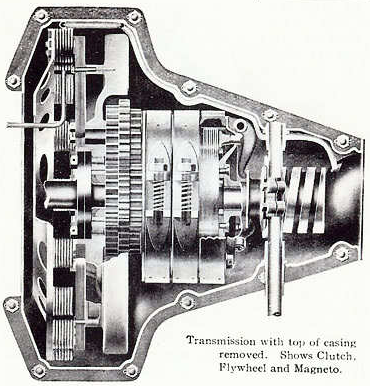
Henry Ford (July 30, 1863 – April 7, 1947) was an American industrialist and business magnate. As the founder of the Ford Motor Company, he is credited as a pioneer in making automobiles affordable for middle-class Americans through the system that came to be known as Fordism. In 1911, he was awarded a patent for the transmission mechanism that would be used in the Ford Model T and other automobiles.
Ford was born in a farmhouse in Greenfield Township, Michigan, and left home at the age of 16 to find work in Detroit. It was a few years before this time that Ford first experienced automobiles, and throughout the later half of the 1880s, he began repairing and later constructing engines, and through the 1890s worked with a division of Edison Electric. He founded the Ford Motor Company in 1903 after prior failures in business, but was successful in constructing automobiles.
The introduction of the Ford Model T vehicle in 1908 is credited with having revolutionized both transportation and American industry. As the sole owner of the Ford Motor Company, Ford became one of the wealthiest people in the world. He was also among the pioneers of the five-day work-week. Ford believed that consumerism could help to bring about world peace. His commitment to systematically lowering costs resulted in many technical and business innovations, including a franchise system, which allowed for car dealerships throughout North America and in major cities on six continents.
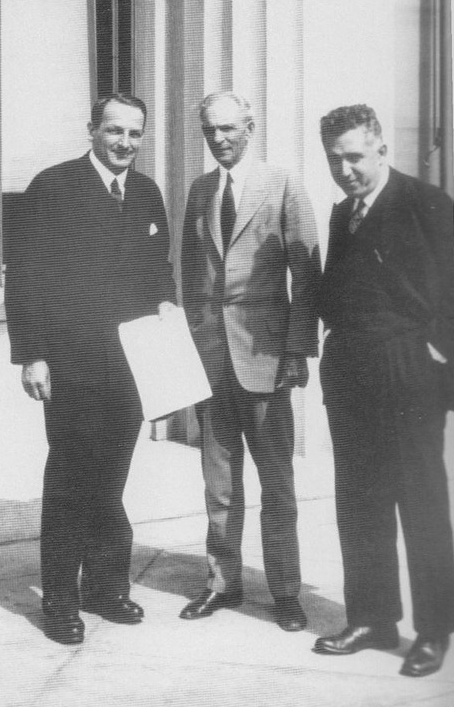
Ford was known for his pacifism during the first years of World War I, although during the war his company became a major supplier of weapons. He promoted the League of Nations. In the 1920s, Ford promoted antisemitism through his newspaper The Dearborn Independent and the book The International Jew. He opposed his country's entry into World War II, and served for a time on the board of the America First Committee. After his son Edsel died in 1943, Ford resumed control of the company, but was too frail to make decisions and quickly came under the control of several of his subordinates. He turned over the company to his grandson Henry Ford II in 1945. Upon his death in 1947, he left most of his wealth to the Ford Foundation and control of the company to his family.
Early life
Henry Ford was born July 30, 1863, on a farm in Greenfield Township, Michigan. The house he was born in stood at the intersection of Ford and Greenfield Roads in present-day Dearborn. His father, William Ford (1826–1905), was born in County Cork, Ireland, to a family that had emigrated from Somerset, England in the 16th century. His mother, Mary Ford (née Litogot; c. 1839–1876), was born in Michigan as the youngest child of Belgian immigrants; her parents died when she was a child and she was adopted by neighbors, the O'Herns. Henry Ford's siblings were John Ford (c. 1865–1927), Margaret Ford (1867–1960), Jane Ford (c. 1869–1906), William Ford (1871–1959), and Robert Ford (1873–1934). Ford finished eighth grade at a one-room school, Springwells Middle School. He never attended high school; he later took a bookkeeping course at a commercial school.
His father gave him a pocket watch when he was 12. At 15, Ford dismantled and reassembled the timepieces of friends and neighbors dozens of times, gaining the reputation of a watch repairman. At twenty, Ford walked four miles to their Episcopal church every Sunday.
Ford said two significant events occurred in 1875 when he was 12: he received the watch, and he witnessed the operation of a Nichols and Shepard road engine, "...the first automobile other than horse-drawn that I had ever seen".
Ford was devastated when his mother died in 1876. His father expected him to take over the family farm eventually, but he despised farm work. He later wrote, "I never had any particular love for the farm—it was the mother on the farm I loved."
In 1879, Ford left home to work as an apprentice machinist in Detroit, first with James F. Flower & Brothers, and later with the Detroit Dry Dock Company. In 1882, he returned to Dearborn to work on the family farm, where he became adept at operating the Westinghouse portable steam engine. He was later hired by Westinghouse to service their steam engines.

In his farm workshop, Ford built a "steam wagon or tractor" and a steam car, but thought "steam was not suitable for light automobiles," as "the boiler was dangerous." Ford also said that he "did not see the use of experimenting with electricity, due to the expense of trolley wires, and "no storage battery was in sight of a weight that was practical." In 1885, Ford repaired an Otto engine, and in 1887, he built a four-cycle model with a one-inch bore and a three-inch stroke. In 1890, Ford started work on a two-cylinder engine.
Ford said, "In 1892, I completed my first motor car, powered by a two-cylinder four horsepower motor, with a two-and-half-inch bore and a six-inch stroke, which was connected to a countershaft by a belt and then to the rear wheel by a chain. The belt was shifted by a clutch lever to control speeds at 10 or 20 miles per hour, augmented by a throttle. Other features included 28-inch wire bicycle wheels with rubber tires, a foot brake, a 3-gallon gasoline tank, and later, a water jacket around the cylinders for cooling. Ford added that "in the spring of 1893 the machine was running to my partial satisfaction and giving an opportunity further to test out the design and material on the road." Between 1895 and 1896, Ford drove that machine about 1000 miles. He then started a second car in 1896, eventually building three of them in his home workshop.
Marriage and family
Ford married Clara Jane Bryant (1866–1950) on April 11, 1888, and supported himself by farming and running a sawmill. They had one child, Edsel Ford (1893–1943).

Career
In 1891, Ford became an engineer with the Edison Illuminating Company of Detroit. After his promotion to Chief Engineer in 1893, he had enough time and money to devote attention to his experiments on gasoline engines. These experiments culminated in 1896 with the completion of a self-propelled automobile, which he named the Ford Quadricycle. He test-drove it on June 4. After various test drives, Ford brainstormed ways to improve the Quadricycle.
Also in 1896, Ford attended a meeting of Edison executives, where he was introduced to Thomas Edison. Edison approved of Ford's automobile experimentation. Encouraged by Edison, Ford designed and built a second automobile, completing it in 1898. Backed by the capital of Detroit lumber baron William H. Murphy, Ford resigned from the Edison Company and founded the Detroit Automobile Company on August 5, 1899. However, the automobiles produced were of a lower quality and higher price than Ford wanted. Ultimately, the company was not successful and was dissolved in January of 1901.
With the help of C. Harold Wills, Ford designed, built, and successfully raced a 26-horsepower automobile in October 1901. With this success, Murphy and other stockholders in the Detroit Automobile Company formed the Henry Ford Company on November 30, 1901, with Ford as chief engineer. In 1902, Murphy brought in Henry M. Leland as a consultant; Ford, in response, left the company bearing his name. With Ford gone, Leland renamed the company the Cadillac Automobile Company.
Teaming up with former racing cyclist Tom Cooper, Ford also produced the 80+ horsepower racer "999", which Barney Oldfield was to drive to victory in a race in October 1902. Ford received the backing of an old acquaintance, Alexander Y. Malcomson, a Detroit-area coal dealer. They formed a partnership, Ford & Malcomson, Limited, to manufacture automobiles. Ford went to work designing inexpensive automobiles, and the duo leased a factory and contracted with a machine shop owned by John and Horace E. Dodge to supply over $160,000 in parts. Sales were slow, and a crisis arose when the Dodge brothers demanded payment for their first shipment.
Ford Motor Company
In response, Malcomson brought in another group of investors and convinced the Dodge brothers to accept a portion of the new company. Ford & Malcomson was reincorporated as the Ford Motor Company on June 16, 1903, with $28,000 capital. The original investors included Ford and Malcomson, the Dodge brothers, Malcomson's uncle John S. Gray, Malcolmson's secretary James Couzens, and two of Malcomson's lawyers, John W. Anderson and Horace Rackham. Because of Ford's volatility, Gray was elected president of the company. Ford then demonstrated a newly designed car on the ice of Lake St. Clair, driving 1 mile (1.6 km) in 39.4 seconds and setting a new land speed record at 91.3 miles per hour (146.9 kilometres per hour). Convinced by this success, race driver Barney Oldfield, who named this new Ford model "999" in honor of the fastest locomotive of the day, took the car around the country, making the Ford brand known throughout the United States. Ford was also one of the early backers of the Indianapolis 500.
Transmission Patent
In 1909, Ford applied for a patent on his new transmission mechanism. It was awarded a patent in 1911.

Model T
The Model T debuted on October 1, 1908. It had the steering wheel on the left, which every other company soon copied. The entire engine and transmission were enclosed; the four cylinders were cast in a solid block; the suspension used two semi-elliptic springs. The car was simple to drive, easy and inexpensive to repair. It was so inexpensive at $825 in 1908 ($29,560 today), with the price falling every year, that by the 1920s, a majority of American drivers had learned to drive on the Model T.
Ford created a huge publicity machine in Detroit to ensure every newspaper carried stories and ads about the new product. Ford's network of local dealers made the car ubiquitous in almost every city in North America. As independent dealers, the franchises grew rich and publicized not just the Ford but also the concept of car local motor clubs sprang up to help new drivers and encourage them to explore the countryside. Ford was always eager to sell to farmers, who looked at the automobile as a commercial device to help their business. Sales skyrocketed—several years posted 100% gains on the previous year. In 1913, Ford introduced moving assembly belts into his plants, which enabled an enormous increase in production. Although Ford is often credited with the idea, contemporary sources indicate that the concept and development came from employees Clarence Avery, Peter E. Martin, Charles E. Sorensen, and C. Harold Wills. (See Ford Piquette Avenue Plant.)
Sales passed 250,000 in 1914. By 1916, as the price dropped to $360 for the basic touring car, sales reached 472,000.
By 1918, half of all cars in the United States were Model Ts. All new cars were black; as Ford wrote in his autobiography, "Any customer can have a car painted any color that he wants so long as it is black." Until the development of the assembly line, which mandated black because of its quicker drying time, Model Ts were available in other colors, including red. The design was fervently promoted and defended by Ford, and production continued as late as 1927; the final total production was 15,007,034. This record stood for the next 45 years, and was achieved in 19 years from the introduction of the first Model T (1908).
Henry Ford turned the presidency of Ford Motor Company over to his son Edsel Ford in December 1918. Henry retained final decision authority and sometimes reversed the decisions of his son. Ford started another company, Henry Ford and Son, and made a show of taking himself and his best employees to the new company; the goal was to scare the remaining holdout stockholders of the Ford Motor Company into selling their stakes to him before they lost most of their value. (He was determined to have full control over strategic decisions.) The ruse worked, and Henry and Edsel purchased all remaining stock from the other investors, thus giving the family sole ownership of the company.
In 1922, Ford also purchased Lincoln Motor Co., founded by Cadillac founder Henry Leland and his son Wilfred during World War I. The Lelands briefly stayed to manage the company, but were soon expelled from it. Despite this acquisition of a premium car maker, Henry displayed relatively little enthusiasm for luxury automobiles in contrast to Edsel, who actively sought to expand Ford into the upscale market. The original Lincoln Model L that the Lelands had introduced in 1920 was also kept in production, untouched for a decade until it became too outdated. It was replaced by the modernized Model K in 1931.
By the mid-1920s, General Motors was rapidly rising as the leading American vehicle manufacturer. GM president Alfred Sloan established the company's "price ladder" whereby GM would offer an automobile for "every purse and purpose", in contrast to Ford's lack of interest in anything outside the low-end market. Although Henry Ford was against replacing the Model T, now 16 years old, Chevrolet was mounting a bold new challenge as GM's entry-level division in the company's price ladder. Ford also resisted the increasingly popular idea of payment plans for cars. With Model T sales starting to slide, Ford was forced to relent and approve work on a successor model, shutting down production for 18 months. During this time, Ford constructed a massive new assembly plant at River Rouge for the new Model A, which launched in 1927.
In addition to its price ladder, GM also quickly established itself at the forefront of automotive styling under Harley Earl's Arts & Color Department, another area of automobile design that Henry Ford did not entirely appreciate or understand. Ford would not have a true equivalent of the GM styling department for many years.
Model A and Ford's later career
By 1926, flagging sales of the Model T finally convinced Ford to make a new model. He pursued the project with a great deal of interest in the design of the engine, chassis, and other mechanical necessities, while leaving the body design to his son. Although Ford fancied himself an engineering genius, he had little formal training in mechanical engineering and could not even read a blueprint. A talented team of engineers performed most of the actual work of designing the Model A (and later the flathead V8), with Ford supervising them closely and giving them overall direction. Edsel also managed to prevail over his father's initial objections in the inclusion of a sliding-shift transmission.
The result was the Ford Model A, introduced in December 1927 and produced through 1931, with a total output of more than four million. Subsequently, the Ford company adopted an annual model change system similar to that recently pioneered by its competitor General Motors (and still in use by automobiles today). Not until the 1930s did Ford overcome his objection to finance companies, and the Ford-owned Universal Credit Corporation became a major car-financing operation. Henry Ford still resisted many technological innovations, such as hydraulic brakes and all-metal roofs, which Ford automobiles did not adopt until 1935–1936. For 1932, however, Ford dropped a bombshell with the flathead Ford V8, the first low-price eight-cylinder engine. The flathead V8, variants of which were used in Ford automobiles for 20 years, was the result of a secret project launched in 1930, and Henry had initially considered a radical X-8 engine before agreeing to a conventional design. It gave Ford a reputation as a performance make well-suited for hot-rodding.
Also, at Edsel's insistence, Ford launched Mercury in 1939 as a mid-range make to challenge Dodge and Buick, although Henry also displayed relatively little enthusiasm for it.
Labor philosophy
Five-dollar wage
Ford was a pioneer of "welfare capitalism", designed to improve the lot of his workers and especially to reduce the heavy turnover that had many departments hiring 300 men per year to fill 100 slots. Efficiency meant hiring and keeping the best workers.
Ford astonished the world in 1914 by offering a $5 daily wage ($161 in 2025), which more than doubled the rate of most of his workers. A Cleveland, Ohio newspaper editorialized that the announcement "shot like a blinding rocket through the dark clouds of the present industrial depression". The move proved extremely profitable; instead of constant employee turnover, the best mechanics in Detroit flocked to Ford, bringing their human capital and expertise, raising productivity, and lowering training costs. Ford announced his $5-per-day program on January 5, 1914, raising the minimum daily pay from $2.34 to $5 for qualifying male workers.
Detroit was already a high-wage city, but competitors were forced to raise wages or lose their best workers. Ford's policy proved that paying employees more would enable them to afford the cars they were producing and thus boost the local economy. He viewed the increased wages as profit-sharing linked with rewarding those who were most productive and of good character. It may have been James Couzens who convinced Ford to adopt the $5-day wage.
Real profit-sharing was offered to employees who had worked at the company for six months or more, and, importantly, conducted their lives in a manner that Ford's "Social Department" approved. They frowned on heavy drinking, gambling, and on what are now called deadbeat dads. The Social Department used 50 investigators and support staff to maintain employee standards; a large percentage of workers were able to qualify for this "profit-sharing".
Ford's incursion into his employees' private lives was highly controversial, and he soon backed off from the most intrusive aspects. By the time he wrote his 1922 memoir, he spoke of the Social Department and the private conditions for profit-sharing in the past tense. He admitted that "paternalism has no place in the industry. Welfare work that consists of prying into employees' private concerns is out of date. Men need counsel and men need help, often special help; and all this ought to be rendered for decency's sake. But the broad workable plan of investment and participation will do more to solidify the industry and strengthen the organization than will any social work on the outside. Without changing the principle, we have changed the method of payment."
Five-day workweek
In addition to raising his workers' wages, Ford also introduced a new, reduced workweek in 1926. The decision was made in 1922, when Ford and Crowther described it as six 8-hour days, giving a 48-hour week, but in 1926 it was announced as five 8-hour days, giving a 40-hour week. The program apparently started with Saturday being designated a workday, before becoming a day off sometime later. On May 1, 1926, the Ford Motor Company's factory workers switched to a five-day, 40-hour workweek, with the company's office workers making the transition the following August.
Ford had decided to boost productivity, as workers were expected to put more effort into their work in exchange for more leisure time. Ford also believed decent leisure time was good for business, giving workers additional time to purchase and consume more goods. However, charitable concerns also played a role. Ford explained, "It is high time to rid ourselves of the notion that leisure for workmen is either 'lost time' or a class privilege."
Labor unions
Ford was adamantly against labor unions, describing them as "the worst thing that ever struck the earth". He explained his views on unions in Chapter 18 of My Life and Work. He thought they were too heavily influenced by leaders who would end up doing more harm than good for workers, despite their ostensible good motives. Most wanted to restrict productivity as a means to foster employment, but Ford saw this as self-defeating because, in his view, productivity was necessary for economic prosperity to exist.
He believed that productivity gains that obviated certain jobs would nevertheless stimulate the broader economy and grow new jobs elsewhere, whether within the same corporation or in others. Ford also believed that union leaders had a perverse incentive to foment perpetual socio-economic crises to maintain their power. Meanwhile, he believed that smart managers had an incentive to do right by their workers, because doing so would maximize their profits. However, Ford did acknowledge that many managers were basically too bad at managing to understand this fact. But Ford believed that eventually, if good managers such as he could fend off the attacks of misguided people from both left and right (i.e., both socialists and bad-manager reactionaries), the good managers would create a socio-economic system wherein neither bad management nor bad unions could find enough support to continue existing.
To forestall union activity, Ford promoted Harry Bennett, a former Navy boxer, to head the Service Department. Bennett employed various intimidation tactics to quash union organizing. On March 7, 1932, during the Great Depression, unemployed Detroit auto workers staged the Ford Hunger March to the Ford River Rouge Complex to present 14 demands to Henry Ford. The Dearborn police department and Ford security guards opened fire on workers, leading to over sixty injuries and five deaths. On May 26, 1937, Bennett's security men beat members of the United Automobile Workers (UAW), including Walter Reuther, with clubs. While Bennett's men were beating the UAW representatives, the supervising police chief on the scene was Carl Brooks, an alumnus of Bennett's Service Department, and Brooks "did not give orders to intervene".The following day photographs of the injured UAW members appeared in newspapers, later becoming known as The Battle of the Overpass.
In the late 1930s and early 1940s, Edsel—who was president of the company—thought Ford had to come to a collective bargaining agreement with the unions because the violence, work disruptions, and bitter stalemates could not go on forever. But Ford, who still had the final veto in the company on a de facto basis even if not an official one, refused to cooperate. For several years, he kept Bennett in charge of talking to the unions trying to organize the Ford Motor Company. Sorensen's memoir makes clear that Ford's purpose in putting Bennett in charge was to make sure no agreements were ever reached.
The Ford Motor Company was the last Detroit automaker to recognize the UAW, despite pressure from the rest of the U.S. automotive industry and even the U.S. government. A sit-down strike by the UAW union in April 1941 closed the River Rouge Plant. Sorensen recounted that a distraught Henry Ford was very close to following through with a threat to break up the company rather than cooperate. Still, his wife, Clara, told him she would leave him if he destroyed the family business. In her view, it would not be worth the chaos it would create. Ford complied with his wife's ultimatum and even agreed with her in retrospect.
Overnight, the Ford Motor Company went from the most stubborn holdout among automakers to the one with the most favorable UAW contract terms. The contract was signed in June 1941. About a year later, Ford told Walter Reuther, "It was one of the most sensible things Harry Bennett ever did when he got the UAW into this plant." Reuther inquired, "What do you mean?" Ford replied, "Well, you've been fighting General Motors and the Wall Street crowd. Now you're in here, and we've given you a union shop and more than you got out of them. That puts you on our side, doesn't it? We can fight General Motors and Wall Street together, eh?"
Ford Airplane Company
Like other automobile companies, Ford entered the aviation business during World War I, building Liberty engines. After the war, it returned to auto manufacturing until 1925, when Ford acquired the Stout Metal Airplane Company.
Ford's most successful aircraft was the Ford 4AT Trimotor, often called the "Tin Goose" because of its corrugated metal construction. It used a new alloy called Alclad that combined the corrosion resistance of aluminum with the strength of duralumin. The plane was similar to Fokker's V.VII–3m. The Trimotor first flew on June 11, 1926, and was the first successful U.S. passenger airliner, accommodating about 12 passengers in a rather uncomfortable fashion. Several variants were also used by the U.S. Army. The Smithsonian Institution has honored Ford for changing the aviation industry. 199 Trimotors were built before it was discontinued in 1933, when the Ford Airplane Division shut down because of poor sales during the Great Depression.
In 1985, Ford was posthumously inducted into the National Aviation Hall of Fame for his impact on the industry.
World War I era and peace activism
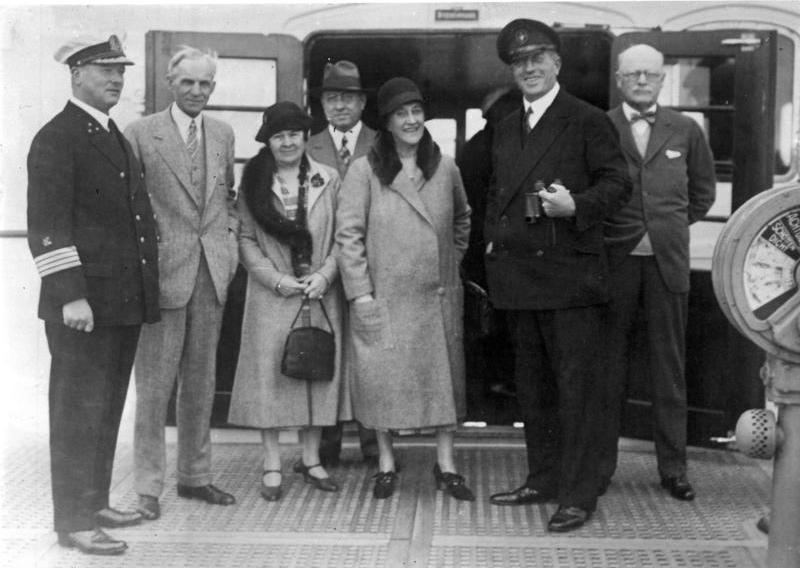
Ford opposed war, which he viewed as a terrible waste, and supported causes that opposed military intervention. Ford became highly critical of those who he felt financed war, and he tried to stop them. In 1915, the pacifist Rosika Schwimmer gained favor with Ford, who agreed to fund a Peace Ship to Europe, where World War I was raging. He led 170 other peace activists. Ford's Episcopalian pastor, Reverend Samuel S. Marquis, accompanied him on the mission. Marquis headed Ford's Sociology Department from 1913 to 1921. Ford talked to President Woodrow Wilson about the mission, but had no government support. His group went to neutral Sweden and the Netherlands to meet with peace activists. A target of much ridicule, Ford left the ship as soon as it reached Sweden. In 1915, Ford blamed "German-Jewish bankers" for instigating the war.
According to biographer Steven Watts, Ford's status as a leading industrialist gave him a worldview that warfare was wasteful folly that retarded long-term economic growth. The losing side in the war typically suffered heavy damage. Small businesses were especially hurt, for it takes years to recuperate. He argued in many newspaper articles that a focus on business efficiency would discourage warfare because, "If every man who manufactures an article would make the very best he can in the very best way at the very lowest possible price, the world would be kept out of war, for commercialists would not have to search for outside markets which the other fellow covets." Ford admitted that munitions makers enjoyed wars, but he argued that most businesses wanted to avoid wars and instead work to manufacture and sell useful goods, hire workers, and generate steady, long-term profits.