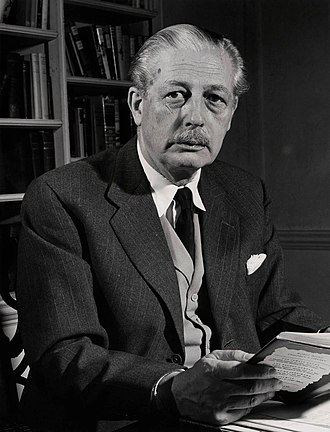
Maurice Harold Macmillan, 1st Earl of Stockton (10 February 1894 – 29 December 1986) was a British statesman and Conservative politician who was Prime Minister of the United Kingdom from 1957 to 1963. Nicknamed "Supermac", he was known for his pragmatism, wit, and unflappability.
Macmillan was seriously injured as an infantry officer during the First World War. He suffered pain and partial immobility for the rest of his life. After the war he joined his family book-publishing business, then entered Parliament at the 1924 general election for Stockton-on-Tees. Losing his seat in 1929, he regained it in 1931, soon after which he spoke out against the high rate of unemployment in Stockton. He opposed the appeasement of Germany practised by the Conservative government. He rose to high office during the Second World War as a protégé of Prime Minister Winston Churchill. In the 1950s Macmillan served as Foreign Secretary and Chancellor of the Exchequer under Anthony Eden.
When Eden resigned in 1957 following the Suez Crisis, Macmillan succeeded him as prime minister and Leader of the Conservative Party. He was a One Nation Tory of the Disraelian tradition and supported the post-war consensus. He supported the welfare state and the necessity of a mixed economy with some nationalised industries and strong trade unions. He championed a Keynesian strategy of deficit spending to maintain demand and pursuit of corporatist policies to develop the domestic market as the engine of growth. Benefiting from favourable international conditions, he presided over an age of affluence, marked by low unemployment and high—if uneven—growth. In his speech of July 1957 he told the nation it had "never had it so good", but warned of the dangers of inflation, summing up the fragile prosperity of the 1950s. He led the Conservatives to success in 1959 with an increased majority.
In international affairs, Macmillan worked to rebuild the Special Relationship with the United States from the wreckage of the 1956 Suez Crisis (of which he had been one of the architects), and facilitated the decolonisation of Africa. Reconfiguring the nation's defences to meet the realities of the nuclear age, he ended National Service, strengthened the nuclear forces by acquiring Polaris, and pioneered the Nuclear Test Ban with the United States and the Soviet Union. After the Skybolt Crisis undermined the Anglo-American strategic relationship, he sought a more active role for Britain in Europe, but his unwillingness to disclose United States nuclear secrets to France contributed to a French veto of the United Kingdom's entry into the European Economic Community and independent French acquisition of nuclear weapons in 1960. Near the end of his premiership, his government was rocked by the Vassall Tribunal and the Profumo affair, which to cultural conservatives and supporters of opposing parties alike seemed to symbolise the moral decay of the British establishment. Following his resignation, Macmillan lived out a long retirement as an elder statesman, being an active member of the House of Lords in his final years. He died in December 1986 at the age of 92.
Early life
Family
Maurice Harold Macmillan was born on 10 February 1894 at 52 Cadogan Place in Belgravia, London, to Maurice Crawford Macmillan, a publisher, and the former Helen (Nellie) Artie Tarleton Belles, an artist and socialite from Spencer, Indiana. He had two brothers, Daniel, eight years his senior, and Arthur, four years his senior. His paternal grandfather, Daniel MacMillan, who founded Macmillan Publishers, was the son of a Scottish crofter from the Isle of Arran. Macmillan considered himself a Scot.
Education and early political views
Macmillan received an intensive early education, closely guided by his American mother. He learned French at home every morning from a succession of nursery maids, and exercised daily at Mr Macpherson's Gymnasium and Dancing Academy, around the corner from the family home. From the age of six or seven he received introductory lessons in classical Latin and Greek at Mr Gladstone's day school, close by in Sloane Square.

Macmillan attended Summer Fields School, Oxford (1903–06). He was Third Scholar at Eton College, but his time there (1906–10) was blighted by recurrent illness, starting with a near-fatal attack of pneumonia in his first half (term); he missed his final year after being taken ill, and was taught at home by private tutors (1910–11), notably Ronald Knox, who did much to instil his High Church Anglicanism. He won an exhibition (scholarship) to Balliol College, Oxford.
In his youth, he was an admirer of the policies and leadership of a succession of Liberal prime ministers, starting with Henry Campbell-Bannerman, who came to power when Macmillan was 11 years old and H. H. Asquith, whom he later described as having "intellectual sincerity and moral nobility", and particularly of Asquith's successor, David Lloyd George, whom he regarded as a "man of action", likely to accomplish his goals.
Macmillan went up to Balliol College in 1912, where he joined many political societies. His political opinions at this stage were an eclectic mix of moderate conservatism, moderate liberalism and Fabian socialism. He read avidly about Benjamin Disraeli, but was also particularly impressed by a speech by Lloyd George at the Oxford Union Society in 1913, where he had become a member. Macmillan was a protégé of the president of the Union Society Walter Monckton, later a Cabinet colleague; as such, he became secretary then junior treasurer (elected unopposed in March 1914, then an unusual occurrence) of the Union, and would in his biographers' view "almost certainly" have been president had the war not intervened. He obtained a First in Honour Moderations, informally known as 'Mods' (consisting of Latin and Greek, the first half of the four-year Oxford Literae Humaniores course, informally known as "Greats"), in 1914. With his final exams over two years away, he enjoyed an idyllic Trinity term at Oxford, just before the outbreak of the First World War.

War service
Volunteering as soon as war was declared, Macmillan was commissioned as a temporary second lieutenant in the King's Royal Rifle Corps on 19 November 1914. Promoted to lieutenant on 30 January 1915, he soon transferred to the Grenadier Guards. He fought on the front lines in France, where the casualty rate was high, including the probability of an "early violent death". He served with distinction and was wounded on three occasions. Shot in the right hand and receiving a glancing bullet wound to the head in the Battle of Loos in September 1915, Macmillan was sent to Lennox Gardens in Chelsea for hospital treatment, then joined a reserve battalion at Chelsea Barracks from January to March 1916, until his hand had healed. He then returned to the front lines in France. Leading an advance platoon in the Battle of Flers–Courcelette (part of the Battle of the Somme) in September 1916, he was severely wounded, and lay for over twelve hours in a shell hole, sometimes feigning death when Germans passed, and reading Aeschylus in the original Greek. Raymond Asquith, eldest son of the prime minister, was a brother officer in Macmillan's regiment and was killed that month.
Macmillan spent the final two years of the war in King Edward VII's Hospital in Grosvenor Gardens undergoing a series of operations. He was still on crutches at the Armistice of 11 November 1918. His hip wound took four years to heal completely, and he was left with a slight shuffle to his walk and a limp grip in his right hand from his previous wound, which affected his handwriting.
Macmillan saw himself as both a "gownsman" and a "swordsman" and would later display open contempt for other politicians (e.g. Rab Butler, Hugh Gaitskell, Harold Wilson) who had not seen military service in either World War.

Canadian aide-de-campship
Of the scholars and exhibitioners of his year, only he and one other survived the war. As a result, he refused to return to Oxford to complete his degree, saying the university would never be the same; in later years he joked that he had been "sent down by the Kaiser".
Owing to the impending contraction of the Army after the war, a regular commission in the Grenadiers was out of the question. However, at the end of 1918 Macmillan joined the Guards Reserve Battalion at Chelsea Barracks for "light duties". On one occasion he had to command reliable troops in a nearby park as a unit of Guardsmen was briefly refusing to reembark for France, although the incident was resolved peacefully. The incident prompted an inquiry from the War Office as to whether the Guards Reserve Battalion "could be relied on".
Macmillan then served in Ottawa, Canada, in 1919 as aide-de-camp (ADC) to Victor Cavendish, 9th Duke of Devonshire, then Governor General of Canada, and his future father-in-law. The engagement of Captain Macmillan to the Duke's daughter Lady Dorothy was announced on 7 January 1920. He relinquished his commission on 1 April 1920. As was common for contemporary former officers, he continued to be known as 'Captain Macmillan' until the early 1930s and was listed as such in every general election between 1923 and 1931. As late as his North African posting of 1942–43 he reminded Churchill that he held the rank of captain in the Guards reserve.

Macmillan Publishers
On his return to London in 1920 he joined the family publishing firm Macmillan Publishers as a junior partner. In 1936, Harold and his brother Daniel took control of the firm, with the former focusing on the political and non-fiction side of the business. Harold resigned from the company on appointment to ministerial office in 1940. He resumed working with the firm from 1945 to 1951 when the party was in opposition.
Personal life
According to Michael Bloch, there have long been rumours that Macmillan was expelled from Eton for homosexuality. Macmillan's biographer D. R. Thorpe is of the view that he was removed by his mother when she discovered that he was being "used" by older boys. Dick Leonard reports that Alistair Horne refers to "inevitable rumours" and that "he left for the 'usual reasons' for boys to be expelled from public schools".
Marriage
Macmillan married Lady Dorothy Cavendish, the daughter of the 9th Duke of Devonshire, on 21 April 1920. Her great-uncle was Spencer Cavendish, 8th Duke of Devonshire, who was leader of the Liberal Party in the 1870s, and a close colleague of William Ewart Gladstone, Joseph Chamberlain and Lord Salisbury. Lady Dorothy was also descended from William Cavendish, 4th Duke of Devonshire, who served as prime minister from 1756 to 1757 in communion with Newcastle and Pitt the Elder. Her nephew William Cavendish, Marquess of Hartington, married Kathleen Kennedy, a sister of John F. Kennedy.

In 1929, Lady Dorothy began a lifelong affair with the Conservative politician Robert Boothby, an arrangement that scandalised high society but remained unknown to the general public. Philip Frere, a partner in Frere Cholmely solicitors, urged Macmillan not to divorce his wife, which at that time would have been fatal to a public career even for the "innocent party". Macmillan and Lady Dorothy lived largely separate lives in private thereafter. The stress caused by that may have contributed to Macmillan's nervous breakdown in 1931. He was often treated with condescension by his aristocratic in-laws and was observed to be a sad and isolated figure at Chatsworth in the 1930s. John Campbell suggests that Macmillan's humiliation was first a major cause of his odd and rebellious behaviour in the 1930s then, in subsequent decades, made him a harder and more ruthless politician than his rivals Eden and Butler.
The Macmillans had four children:
Maurice Macmillan, Viscount Macmillan of Ovenden (1921–1984), Conservative politician and publisher. Married the Hon. Katharine Ormsby-Gore, daughter of the 4th Baron Harlech. His father outlived him by nearly three years.
Lady Caroline Macmillan (1923–2016). Married Julian Faber; five children.
Lady Catherine Macmillan (1926–1991). Married Julian Amery (later Baron Amery of Lustleigh), Conservative politician; four children.
Sarah Macmillan (1930–1970). A family rumour that Boothby was her natural father has been discounted by the most recent and detailed study. Married Andrew Heath in 1953; two children. Having had an abortion in 1951, she was unable to have children of her own and the couple adopted two sons. She had an unhappy life, which was blighted by a drinking problem, and died aged only 40, her father outliving her by 16 years.
Lady Dorothy died on 21 May 1966, aged 65.
In old age, Macmillan was a close friend of Ava Anderson, Viscountess Waverley, née Bodley, the widow of John Anderson, 1st Viscount Waverley. Eileen O'Casey, née Reynolds, the actress wife of Irish dramatist Seán O'Casey, was another female friend, Macmillan publishing her husband's plays. Although she is said to have replaced Lady Dorothy in Macmillan's affections, there is disagreement over how intimate they became after the deaths of their respective spouses, and whether he proposed.
Political career, 1924–1951
Member of Parliament (1924–1929)
Macmillan contested the depressed northern industrial constituency of Stockton-on-Tees in 1923. The campaign cost him about £200–£300 out of his own pocket; at that time candidates were often expected to fund their own election campaigns. The collapse in the Liberal vote let him win in 1924. In 1927, four MPs, including Boothby and Macmillan, published a short book advocating radical measures. In 1928, Macmillan was described by his political hero, and now Parliamentary colleague, David Lloyd George, as a "born rebel".
Macmillan lost his seat in 1929 in the face of high regional unemployment. He almost became Conservative candidate for the safe seat of Hitchin in 1931. However the sitting MP, Guy Kindersley cancelled his retirement plans, in part because of his own association with the anti-Baldwin rebels and his suspicion of Macmillan's sympathy for Oswald Mosley's promises of radical measures to reduce unemployment. Instead, the resignation of the new candidate at Stockton allowed Macmillan to be re-selected there, and he returned to the House of Commons for his old seat in 1931.
Member of Parliament (1931–1939)
Macmillan spent the 1930s on the backbenches. In March 1932 he published "The State and Industry" (not to be confused with his earlier pamphlet "Industry and the State"). In September 1932 he made his first visit to the Soviet Union. Macmillan also published "The Next Step". He advocated cheap money and state direction of investment. In 1933 he was the sole author of "Reconstruction: A Plea for a National Unity". In 1935 he was one of 15 MPs to write "Planning for Employment". His next publication, "The Next Five Years", was overshadowed by Lloyd George's proposed "New Deal" in 1935. Macmillan Press also published the work of the economist John Maynard Keynes.
Macmillan resigned the government whip (but not the Conservative party one) in protest at the lifting of sanctions on Italy after her conquest of Abyssinia. "Chips" Channon described him as the "unprepossessing, bookish, eccentric member for Stockton-on-Tees" and recorded (8 July 1936) that he had been sent a "frigid note" by Conservative Prime Minister Stanley Baldwin. Baldwin later mentioned that he had survived by steering a middle course between Macmillan and John Gretton, an extreme right-winger.
The Next Five Years Group, to which Macmillan had belonged, was wound up in November 1937. His book The Middle Way appeared in June 1938, advocating a broadly centrist political philosophy both domestically and internationally. Macmillan took control of the magazine New Outlook and made sure it published political tracts rather than purely theoretical work.
In 1936, Macmillan proposed the creation of a cross-party forum of antifascists to create democratic unity but his ideas were rejected by the leadership of both the Labour and Conservative parties.
Macmillan supported Chamberlain's first flight for talks with Hitler at Berchtesgaden, but not his subsequent flights to Bad Godesberg and Munich. After Munich he was looking for a "1931 in reverse", i.e. a Labour-dominated coalition in which some Conservatives would serve, the reverse of the Conservative-dominated coalition which had governed Britain since 1931. He supported the independent candidate, Lindsay, at the 1938 Oxford by-election. He wrote a pamphlet "The Price of Peace" calling for alliance between Britain, France and the USSR, but expecting Poland to make territorial "accommodation" to Germany (i.e. give up the Danzig corridor). In "Economic Aspects of Defence", early in 1939, he called for a Ministry of Supply.
Phoney War (1939–1940)
Macmillan visited Finland in February 1940, then the subject of great sympathy in Britain as it was being invaded by the USSR, then allied to Nazi Germany. His last speech from the backbenches was to attack the government for not doing enough to help Finland. Britain was saved from a potentially embarrassing commitment when the Winter War ended in March 1940.
Macmillan voted against the Government in the Norway Debate of May 1940, helping to bring down Neville Chamberlain as prime minister, and tried to join in with Colonel Josiah Wedgwood singing "Rule, Britannia!" in the House of Commons Chamber.
Parliamentary Secretary, Ministry of Supply (1940–1942)
Macmillan finally attained office by serving in the wartime coalition government as the Parliamentary Secretary to the Ministry of Supply from 1940. Channon commented (29 May 1940) that there was "some amusement over Harold Macmillan's so obvious enjoyment of his new position".
Macmillan's job was to provide armaments and other equipment to the British Army and Royal Air Force. He travelled up and down the country to co-ordinate production, working with some success under Lord Beaverbrook to increase the supply and quality of armoured vehicles.
Colonial Under-Secretary (1942)
Macmillan was appointed Under-Secretary of State for the Colonies in 1942, in his own words "leaving a madhouse to enter a mausoleum". Though a junior minister he was a member of the Privy Council, and he spoke in the House of Commons for Colonial Secretaries Lord Moyne and Lord Cranborne. Macmillan was given responsibility for increasing colonial production and trade, and signalled the future policy direction when in June 1942 he declared:
The governing principle of the Colonial Empire should be the principle of partnership between the various elements composing it. Out of partnership comes understanding and friendship. Within the fabric of the Commonwealth lies the future of the Colonial territories.
Macmillan predicted that the Conservatives faced landslide defeat after the war, causing Channon to write (6 Sep 1944) of "the foolish prophecy of that nice ass Harold Macmillan". In October 1942 Harold Nicolson recorded Macmillan as predicting "extreme socialism" after the war. Macmillan nearly resigned when Oliver Stanley was appointed Secretary of State in November 1942, as he would no longer be the spokesman in the Commons as he had been under Cranborne. Brendan Bracken advised him not to quit.
Minister Resident in the Mediterranean (1942–1945)
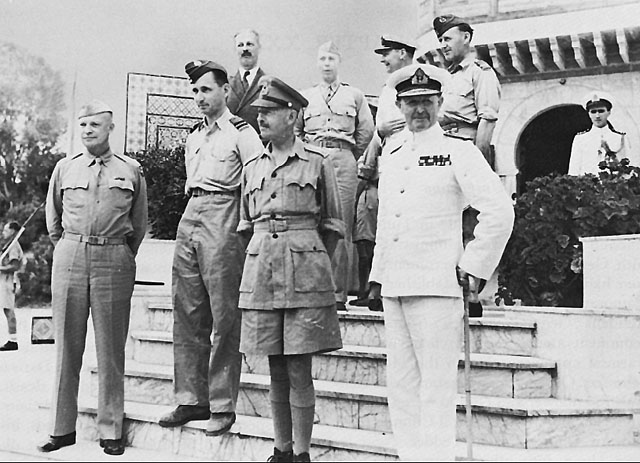
After Harry Crookshank had refused the job, Macmillan attained real power and Cabinet rank late in 1942 as British Minister Resident at Algiers in the Mediterranean, recently liberated in Operation Torch. He reported directly to the Prime Minister instead of to the Foreign Secretary, Anthony Eden. Oliver Lyttelton had a similar job at Cairo, while Robert Murphy was Macmillan's US counterpart. Macmillan built a rapport with US General Dwight D. Eisenhower, then Supreme Allied Commander in the Mediterranean (SACMED), which proved helpful in his career, and Richard Crossman later recalled that Macmillan's "Greeks in the Roman Empire" metaphor dated from this time (i.e., that as the US replaced Britain as the world's leading power, British politicians and diplomats should aim to guide her in the same way that Greek slaves and freedmen had advised powerful Romans). Macmillan told Crossman: "We, my dear Crossman, are the Greeks in the American empire. You will find the Americans much as the Greeks found the Romans—great big, vulgar bustling people, more vigorous than we are and also more idle, with more unspoiled virtues, but also more corrupt. We must run AFHQ (Allied Forces Headquarters) as the Greek slaves ran the operations of the Emperor Claudius". At the Casablanca Conference Macmillan helped to secure US acceptance, if not recognition, of the Free French leader Charles de Gaulle. Macmillan wrote in his diary during the Casablanca conference: "I christened the two personalities the Emperor of the East and the Emperor of the West and indeed it was rather like a meeting of the late Roman empire". For Macmillan, the "remarkable and romantic episodes" as President Roosevelt met Prime Minister Churchill in Casablanca convinced him that personal diplomacy was the best way to deal with Americans, which later influenced his foreign policy as prime minister.
On 22 February 1943, Macmillan was badly burned in a plane crash, re-entering the wreckage to rescue a Frenchman and escaping just before the plane exploded. He had to have a plaster cast put on his face. In his delirium he imagined himself back in a Somme casualty clearing station and asked for a message to be passed to his mother, now dead.
Together with Gladwyn Jebb he helped to negotiate the Italian armistice in August 1943, between the fall of Sicily and the Salerno Landings. This caused friction with Eden and the Foreign Office. He was based at Caserta for the rest of the war. He was appointed UK High Commissioner for the Advisory Council for Italy late in 1943. He visited London in October 1943 and again clashed with Eden. Eden appointed Duff Cooper as Representative to the Free French government in Algeria (after the liberation of mainland France, he later continued as Ambassador to France from November 1944) and Noel Charles as Ambassador to Italy to reduce Macmillan's influence. In May 1944 Macmillan infuriated Eden by demanding an early peace treaty with Italy (at that time a pro-Allied regime under Badoglio held some power in the southern, liberated, part of Italy), a move which Churchill favoured. In June 1944 he argued for a British-led thrust up the Ljubljana Gap into Central Europe (Operation "Armpit") instead of the planned diversion of US and Free French forces to the South of France (Operation Dragoon). This proposal impressed Churchill and General Alexander, but did not meet with American approval. Eden sent out Robert Dixon to abolish the job of Resident Minister, there being then no job for Macmillan back in the UK, but he managed to prevent his job being abolished. Churchill visited Italy in August 1944. On 14 September 1944 Macmillan was appointed Chief Commissioner of the Allied Control Commission for Italy (in succession to General Noel Mason-MacFarlane). He continued to be British Minister Resident at Allied Headquarters and British political adviser to "Jumbo" Wilson, now Supreme Commander, Mediterranean. On 10 November 1944 he was appointed Acting President of the Allied Commission (the Supreme Commander being President).
Macmillan visited Greece on 11 December 1944. As the Germans had withdrawn, British troops under General Scobie had deployed to Athens, but there were concerns that the pro-communist Greek resistance, EAM and its military wing ELAS, would take power (see Dekemvriana) or come into conflict with British troops. Macmillan rode in a tank and was under sniper fire at the British Embassy. Despite the hostility of large sections of British and American opinion, who were sympathetic to the guerrillas and hostile to what was seen as imperialist behaviour, he persuaded a reluctant Churchill, who visited Athens later in the month, to accept Archbishop Damaskinos as Regent on behalf of the exiled King George II. A truce was negotiated in January 1945, enabling a pro-British regime to remain in power, as Churchill had demanded in the Percentages agreement the previous autumn. In 1947 the US would take over Britain's role as "protector" of Greece and Turkey, to keep the Soviets out of the Mediterranean, the so-called "Truman Doctrine".
Macmillan was also the minister advising General Keightley of V Corps, the senior Allied commander in Austria responsible for Operation Keelhaul, which included the forced repatriation of up to 70,000 prisoners of war to the Soviet Union and Josip Broz Tito's Yugoslavia in 1945. The deportations and Macmillan's involvement later became a source of controversy because of the harsh treatment meted out to Nazi collaborators and anti-partisans by the receiving countries, and because in the confusion V Corps went beyond the terms agreed at the Yalta Conference and Allied Forces Headquarters directives by repatriating 4000 White Russian troops and 11,000 civilian family members.