
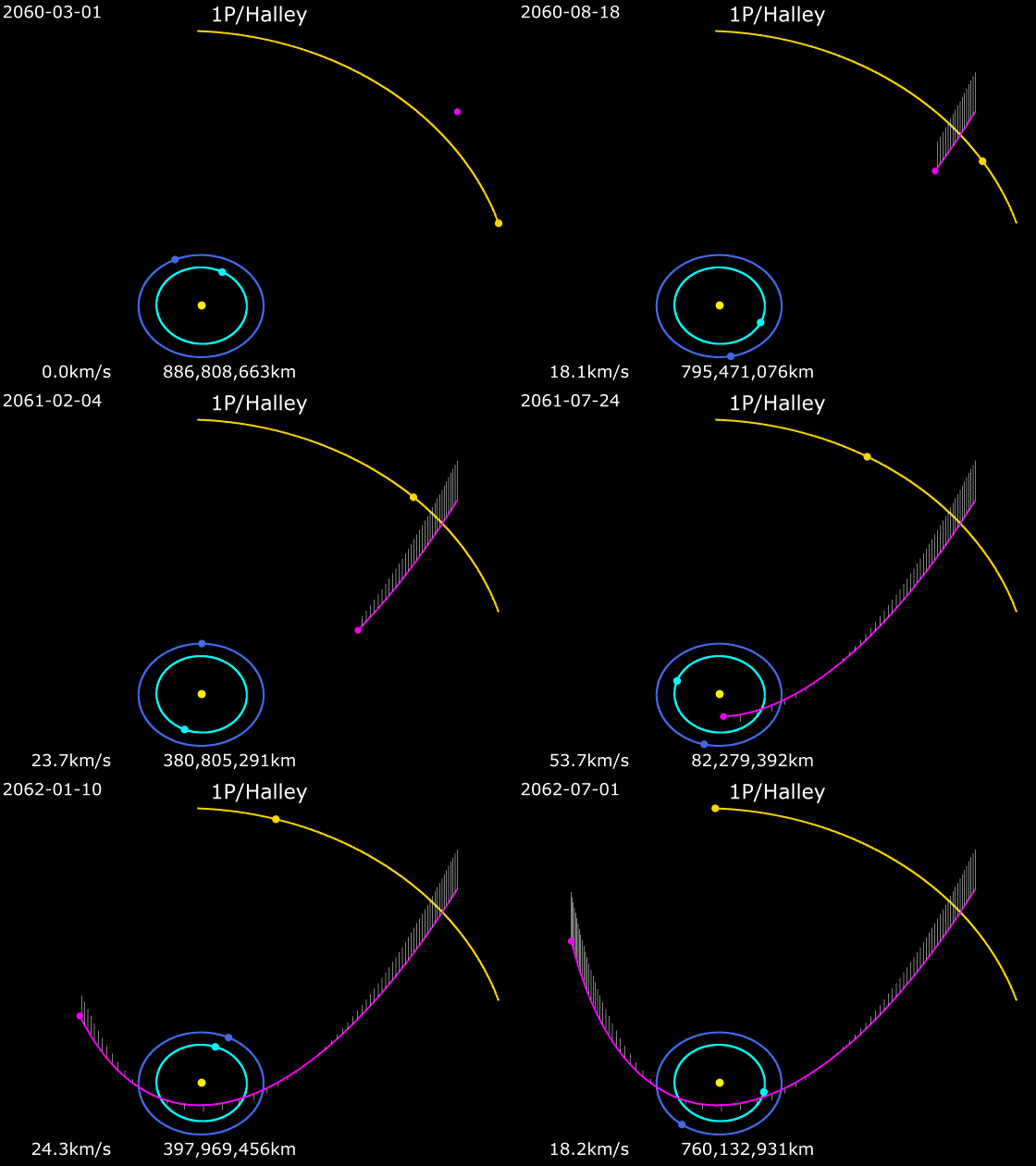
Halley's Comet is the only known short-period comet that is consistently visible to the naked eye from Earth, appearing roughly every 75–76 years, though with the majority of recorded apparitions (25 of 30) occurring after 75–77 years. It last appeared in the inner parts of the Solar System in 1986 and will next appear in mid-2061. Officially designated 1P/Halley, it is also commonly called Comet Halley, or sometimes simply Halley.
Halley's periodic returns to the inner Solar System have been observed and recorded by astronomers around the world since at least 240 BC, but it was not until 1705 that the English astronomer Edmond Halley understood that these appearances were re-appearances of the same comet. As a result of this discovery, the comet is named after Halley.
In March 1986, during its latest visit to the inner Solar System, Halley's Comet became the first comet to be observed in detail by a spacecraft, the European Space Agency's Giotto mission, providing the first observational data on the structure of a comet nucleus and the mechanism of coma and tail formation. These observations supported several longstanding hypotheses about comet construction, particularly Fred Whipple's "dirty snowball" model, which correctly predicted that Halley would be composed of a mixture of volatile ices—such as water, carbon dioxide, ammonia—and dust.

The missions also provided data that substantially reformed and reconfigured these ideas; for instance, it is now understood that the surface of Halley is largely composed of dusty, non-volatile materials, and that only a small portion of it is icy. It was also visited by the two spacecraft of the Vega program, Vega 1 & 2, on 6 and 9 March, respectively. They went as close as 8,890 km (5,520 mi), and 8,030 km (4,990 mi), providing data on Halley's dimensions, shape, temperature, and surface properties.
Pronunciation
Comet Halley is usually pronounced , rhyming with valley, or sometimes , rhyming with daily. As to the surname Halley, Colin Ronan, one of Edmond Halley's biographers, preferred , rhyming with crawly.
Spellings of Halley's name during his lifetime included Hailey, Haley, Hayley, Halley, Haly, Hawley, and Hawly, so its contemporary pronunciation is uncertain, but the version rhyming with valley seems to be preferred by modern bearers of the surname.

Computation of orbit
Halley was the first comet to be recognised as periodic. Until the Renaissance, the philosophical consensus on the nature of comets, promoted by Aristotle, was that there were disturbances in Earth's atmosphere. This idea was disproven in 1577 by Tycho Brahe, who used parallax measurements to show that comets must lie beyond the Moon. Many were still unconvinced that comets orbited the Sun, and assumed instead that they must follow straight paths through the Solar System. In 1687, Sir Isaac Newton published his Philosophiæ Naturalis Principia Mathematica, in which he outlined his laws of gravity and motion. His work on comets was decidedly incomplete. Although he had suspected that two comets that had appeared in succession in 1680 and 1681 were the same comet before and after passing behind the Sun (he was later found to be correct see Newton's Comet), he was initially unable to completely reconcile comets into his model.
Ultimately it was Newton's friend, editor and publisher, Edmond Halley, who, in his 1705 Synopsis of the Astronomy of Comets, used Newton's new laws to calculate the gravitational effects of Jupiter and Saturn on cometary orbits. Having compiled a list of 24 comet observations, he calculated that the orbital elements of a second comet that had appeared in 1682 were nearly the same as those of two comets that had appeared in 1531 (observed by Petrus Apianus) and 1607 (observed by Johannes Kepler). Halley thus concluded that all three comets were the same object returning about every 76 years, a period that has since been found to vary between 72 and 80 years. After a rough estimate of the perturbations the comet would sustain from the gravitational attraction of the planets, he predicted its return for 1758. He personally observed the comet around perihelion in September 1682, but died in 1742 before he could observe its predicted return.
Halley's prediction of the comet's return proved to be correct, although it was not seen until 25 December 1758, by Johann Georg Palitzsch, a German farmer and amateur astronomer. Other observers from throughout Europe and its colonies sent confirmations to Paris after the comet brightened early the following year. In the Americas, John Winthrop lectured at Harvard University to explain the implications of the comet's reappearance for Newtonian mechanics and natural theology.

Another independent recognition that the comet had returned was made by the Jamaican astronomer Francis Williams, but his observations did not reach Europe. A unique portrait commissioned by Williams demonstrates the impact of the comet's return on period astronomers. Williams' hand rests on page 521 of the third edition of Newton's Principia with procedures to predict comet sightings. The white smudge in the sky is probably a depiction of Halley's comet relative to the constellations in March 1759, and the cord hanging above the book likely represents the comet's orbit. In 2024, using X-ray imaging, the painting was shown to depict the field of stars in which the comet would have been visible in 1759. Williams likely commissioned the portrait to commemorate his observations.
The comet did not pass through its perihelion until 13 March 1759, the attraction of Jupiter and Saturn having caused a delay of 618 days. This effect was computed before its return (with a one-month error to 13 April) by a team of three French mathematicians, Alexis Clairaut, Joseph Lalande, and Nicole-Reine Lepaute. The confirmation of the comet's return was the first time anything other than planets had been shown to orbit the Sun. It was also one of the earliest successful tests of Newtonian physics, and a clear demonstration of its explanatory power. The comet was first named in Halley's honour by French astronomer Nicolas-Louis de Lacaille in 1759.
Some scholars have proposed that first-century Mesopotamian astronomers already had recognised Halley's Comet as periodic. This theory notes a passage in the Babylonian Talmud, tractate Horayot that refers to "a star which appears once in seventy years that makes the captains of the ships err". It has also been suggested that the passage may have referred to the variable star Mira, whose brightness oscillates with a period of sixty years.

Researchers in 1981 attempting to calculate the past orbits of Halley by numerical integration starting from accurate observations in the seventeenth and eighteenth centuries could not produce accurate results further back than 837 owing to a close approach to Earth in that year. It was necessary to use ancient Chinese comet observations to constrain their calculations.
Orbit and origin
Halley's orbital period has varied between 74 and 80 years since 240 BC. Its orbit around the Sun is highly elliptical, with an orbital eccentricity of 0.967 (with 0 being a circle and 1 being a parabolic trajectory). The perihelion, the point in the comet's orbit when it is nearest the Sun, is 0.59 au (88 million km). This is between the orbits of Mercury and Venus. Its aphelion, or farthest distance from the Sun, is 35 au (5.2 billion km), roughly the orbital distance of Pluto. Unlike the overwhelming majority of objects in the Solar System, Halley's orbit is retrograde; it orbits the Sun in the opposite direction to the planets, or, clockwise from above the Sun's north pole. The orbit is inclined by 18° to the ecliptic, with much of it lying south of the ecliptic. This is usually represented as 162°, to account for Halley's retrograde orbit. The 1910 passage was at a relative velocity of 70.56 km/s (157,800 mph). Because its orbit comes close to Earth's in two places, Halley is associated with two meteor showers: the Eta Aquariids in early May, and the Orionids in late October.
Halley is classified as a periodic or short-period comet: one with an orbit lasting 200 years or less. This contrasts it with long-period comets, whose orbits last for thousands of years. Periodic comets have an average inclination to the ecliptic of only ten degrees, and an orbital period of just 6.5 years, so Halley's orbit is atypical. Most short-period comets (those with orbital periods shorter than 20 years and inclinations of 30 degrees or less) are called Jupiter-family comets. Those resembling Halley, with orbital periods of between 20 and 200 years and inclinations extending from zero to more than 90 degrees, are called Halley-type comets. As of 2024, 105 Halley-type comets have been observed, compared with 816 identified Jupiter-family comets.

The orbits of the Halley-type comets suggest that they were originally long-period comets whose orbits were perturbed by the gravity of the giant planets and directed into the inner Solar System. If Halley was once a long-period comet, it is likely to have originated in the Oort cloud, a sphere of cometary bodies around 20,000–50,000 au from the Sun. Conversely the Jupiter-family comets are generally believed to originate in the Kuiper belt, a flat disc of icy debris between 30 au (Neptune's orbit) and 50 au from the Sun (in the scattered disc). Another point of origin for the Halley-type comets was proposed in 2008, when a trans-Neptunian object with a retrograde orbit similar to Halley's was discovered, 2008 KV42, whose orbit takes it from just outside that of Uranus to twice the distance of Pluto. It may be a member of a new population of small Solar System bodies that serves as the source of Halley-type comets.
Halley has probably been in its current orbit for 16,000–200,000 years, although it is not possible to numerically integrate its orbit for more than a few tens of apparitions, and close approaches before 837 AD can only be verified from recorded observations. The non-gravitational effects can be crucial; as Halley approaches the Sun, it expels jets of sublimating gas from its surface, which knock it very slightly off its orbital path. These orbital changes cause delays in its perihelion passage of four days on average.
In 1989 Boris Chirikov and Vitold Vecheslavov performed an analysis of 46 apparitions of Halley's Comet taken from historical records and computer simulations, which showed that its dynamics were chaotic and unpredictable on long timescales. Halley's projected dynamical lifetime is estimated to be about 10 million years. The dynamics of its orbit can be approximately described by a two-dimensional symplectic map, known as the Kepler map, a solution to the restricted three-body problem for highly eccentric orbits. Based on records from the 1910 apparition, David Hughes calculated in 1985 that Halley's nucleus has been reduced in mass by 80 to 90% over the last 2,000 to 3,000 revolutions, and that it will most likely disappear completely after another 2,300 perihelion passages. More recent work suggests that Halley will evaporate, or split in two, within the next few tens of thousands of years, or will be ejected from the Solar System within a few hundred thousand years.
Structure and composition
The Giotto and Vega missions gave planetary scientists their first view of Halley's surface and structure. The nucleus is a conglomerate of ices and dust, often referred to as a "dirty snowball". Like all comets, as Halley nears the Sun, its volatile compounds (those with low boiling points, such as water, carbon monoxide, carbon dioxide and other ices) begin to sublimate from the surface. This causes the comet to develop a coma, or atmosphere, at distances up to 230,000 kilometres (140,000 mi) from the nucleus. Sublimation of this dirty ice releases dust particles, which travel with the gas away from the nucleus. Gas molecules in the coma absorb solar light and then re-radiate it at different wavelengths, while dust particles scatter the solar light, making the coma visible. As a fraction of the gas molecules in the coma are ionised by the solar ultraviolet radiation, pressure from the solar wind, a stream of charged particles emitted by the Sun, pulls the coma's ions out into a long tail, which may extend more than 100 million kilometres into space. Changes in the flow of the solar wind can cause disconnection events, in which the tail completely breaks off from the nucleus.
Despite the vast size of its coma, Halley's nucleus is relatively small: barely 15 kilometres (9.3 mi) long, 8 kilometres (5.0 mi) wide and perhaps 8 kilometres (5.0 mi) thick. Based on a reanalysis of images taken by the Giotto and Vega spacecraft, Lamy et al. determined an effective diameter of 11 kilometres (6.8 mi). Its shape has been variously compared to that of a peanut, a potato, or an avocado. Its mass is roughly 2.2 × 10¹⁴ kg, with an average density of about 0.55 grams per cubic centimetre (0.32 oz/cu in). The low density indicates that it is made of a large number of small pieces, held together very loosely, forming a structure known as a rubble pile. Ground-based observations of coma brightness suggested that Halley's rotation period was about 7.4 days. Images taken by the various spacecraft, along with observations of the jets and shell, suggested a period of 52 hours. Given the irregular shape of the nucleus, Halley's rotation is likely to be complex. The flyby images revealed an extremely varied topography, with hills, mountains, ridges, depressions, and at least one crater.
Halley's day side (the side facing the Sun) is far more active than the night side. Spacecraft observations showed that the gases ejected from the nucleus were 80% water vapour, 17% carbon monoxide and 3–4% carbon dioxide, with traces of hydrocarbons although more recent sources give a value of 10% for carbon monoxide and also include traces of methane and ammonia. The dust particles were found to be primarily a mixture of carbon–hydrogen–oxygen–nitrogen (CHON) compounds common in the outer Solar System, and silicates, such as are found in terrestrial rocks. The dust particles ranged in size down to the limits of detection (≈0.001 μm). The ratio of deuterium to hydrogen in the water released by Halley was initially thought to be similar to that found in Earth's ocean water, suggesting that Halley-type comets may have delivered water to Earth in the distant past. Subsequent observations showed Halley's deuterium ratio to be far higher than that found in Earth's oceans, making such comets unlikely sources for Earth's water.
Giotto provided the first evidence in support of Fred Whipple's "dirty snowball" hypothesis for comet construction; Whipple postulated that comets are icy objects warmed by the Sun as they approach the inner Solar System, causing ices on their surfaces to sublime (change directly from a solid to a gas), and jets of volatile material to burst outward, creating the coma. Giotto showed that this model was broadly correct, though with modifications. Halley's albedo, for instance, is about 0.04, meaning that it reflects only 4% of the sunlight hitting it – about what one would expect for coal. Thus, despite astronomers predicting that Halley would have an albedo of about 0.17 (roughly equivalent to bare soil), Halley's Comet is in fact pitch black. The "dirty ices" on the surface sublime at temperatures between 170 K (−103 °C) in sections of higher albedo to 220 K (−53 °C) at low albedo; Vega 1 found Halley's surface temperature to be in the range 300–400 K (27–127 °C). This suggested that only 10% of Halley's surface was active, and that large portions of it were coated in a layer of dark dust that retained heat. Together, these observations suggested that Halley was in fact predominantly composed of non-volatile materials, and thus more closely resembled a "snowy dirtball" than a "dirty snowball".
History
Before 1066
Due to its intrinsic brightness, about one eighth of all comet sightings mentioned in historic records belong to Halley's Comet. The first certain appearance of Halley's Comet in the historical record is a description from 240 BC, in the Chinese chronicle Records of the Grand Historian or Shiji, which describes a comet that appeared in the east and moved north. The only surviving record of the 164 BC apparition is found on two fragmentary Babylonian tablets, which were rediscovered in August 1984 in the collection of the British Museum.
The apparition of 87 BC was recorded in Babylonian tablets which state that the comet was seen "day beyond day" for a month. This appearance may be recalled in the representation of Tigranes the Great, an Armenian king who is depicted on coins with a crown that features, according to Vahe Gurzadyan and R. Vardanyan, "a star with a curved tail [that] may represent the passage of Halley's Comet in 87 BC." Gurzadyan and Vardanyan argue that "Tigranes could have seen Halley's Comet when it passed closest to the Sun on August 6 in 87 BC" as the comet would have been a "most recordable event".
The apparition of 12 BC was recorded in the Book of Han by Chinese astronomers of the Han dynasty who tracked it from August through October. It passed within 0.16 au of Earth. According to the Roman historian Cassius Dio, a comet appeared suspended over Rome for several days portending the death of Marcus Vipsanius Agrippa in that year. Halley's appearance in 12 BC, only a few years distant from the conventionally assigned date of the birth of Jesus Christ, has led some theologians and astronomers to suggest that it might explain the biblical story of the Star of Bethlehem. There are other explanations for the phenomenon, such as planetary conjunctions, and there are also records of other comets that appeared closer to the date of Jesus's birth.
If Yehoshua ben Hananiah's reference in the Talmud to "a star which arises once in seventy years and misleads the sailors" refers to Halley's Comet, he can only have witnessed the 66 AD appearance. Another possible reference to the same apparition is also found in the writings of the Jewish historian Josephus, who described several portents visible over Jerusalem shortly before the outbreak of the First Jewish–Roman War. He reported that "there was a star resembling a sword, which stood over the city, and a comet, that continued a whole year," events that were interpreted as omens of the city's destruction in 70 AD.
The 141 AD apparition was recorded in Chinese chronicles, with observations of a bluish white comet on 27 and 16 March, 22 April and 23. The early Tamil bards of southern India (c. 1st – 4th century CE) also describe a certain relatable event.
The 374 AD and 607 approaches each came within 0.09 au of Earth. The 451 AD apparition was said to herald the defeat of Attila the Hun at the Battle of Chalons.
The 684 AD apparition was reported in Chinese records as the "broom star".
The 760 AD apparition was recorded in the Zuqnin Chronicle's entry for iyyōr 1071 SE (May 760 AD), calling it a "white sign":
The year [SE] one thousand seventy one (AD 759/760).
In the month of iyyōr (May) a white sign was seen in the sky,
before early twilight, in the north-east [quarter],
in the Zodiac [sign] which is called Aries, to the north from these three stars in it, which are very shining.
And it resembled in its shape a broom [...]
And the sign itself remained for fifteen nights, until dawn of the feast of Pentecost.
In 837 AD, Halley's Comet may have passed as close as 0.03 astronomical units (2.8 million miles; 4.5 million kilometres) from Earth, by far its closest approach. Its tail may have stretched 60 degrees across the sky. It was recorded by astronomers in China, Japan, Germany, the Byzantine Empire, and the Middle East; Emperor Louis the Pious observed this appearance and devoted himself to prayer and penance, fearing that "by this token a change in the realm and the death of a prince are made known."
In 912 AD, Halley is recorded in the Annals of Ulster, which states "A dark and rainy year. A comet appeared."
1066
In 1066, the comet was seen in England and thought to be an omen: later that year Harold II of England died at the Battle of Hastings and William the Conqueror claimed the throne. The comet is represented on the Bayeux Tapestry and described in the tituli as a star. Surviving accounts from the period describe it as appearing to be four times the size of Venus, and shining with a light equal to a quarter of that of the Moon. Halley came within 0.10 au of Earth at that time.
This appearance of the comet is also noted in the Anglo-Saxon Chronicle. Eilmer of Malmesbury may have seen Halley in 989 and 1066, as recorded by William of Malmesbury:
Not long after, a comet, portending (they say) a change in governments, appeared, trailing its long flaming hair through the empty sky: concerning which there was a fine saying of a monk of our monastery called Æthelmær. Crouching in terror at the sight of the gleaming star, "You've come, have you?", he said. "You've come, you source of tears to many mothers. It is long since I saw you; but as I see you now you are much more terrible, for I see you brandishing the downfall of my country."
The Irish Annals of the Four Masters recorded the comet as "A star [that] appeared on the seventh of the Calends of May, on Tuesday after Little Easter, than whose light the brilliance or light of The Moon was not greater; and it was visible to all in this manner till the end of four nights afterwards." Chaco Native Americans in New Mexico may have recorded the 1066 apparition in their petroglyphs.
The Italo-Byzantine chronicle of Lupus the Protospatharios mentions that a "comet-star" appeared in the sky in the year 1067 (the chronicle is erroneous, as the event occurred in 1066, and by Robert he means William).
The Emperor Constantine Ducas died in the month of May, and his son Michael received the Empire. And in this year there appeared a comet star, and the Norman count Robert [sic] fought a battle with Harold, King of the English, and Robert was victorious and became king over the people of the English.
The Armenian chronicler, Matthew of Edessa, also noted the appearance of the comet, and its coincidence with a Turkic invasion saying:
"At the beginning of the year 515 of the Armenian era [March 5, 1066 – March 4, 1067] a comet appeared out of the eastern portion of the sky and traveled in a westerly direction. It appeared for one month and then disappeared. A number of days after this, it reappeared for one month and then disappeared. A number of days after this, it reappeared in the western portion of the sky at night; many who saw it said that it was the same comet which had appeared in the eastern portion before. During these times, the infidels marched forth and ravaged all of Armenia, consuming all the faithful by the sword and enslavement."
1145–1378
The 1145 apparition may have been recorded by the monk Eadwine.
According to legend, Genghis Khan was inspired to turn his conquests toward Europe by the westward-seeming trajectory of the 1222 apparition. In Korea, the comet was reportedly visible during the daylight on 9 September 1222. In Vietnam, the comet was recorded visible in the south-west direction in August (September in solar calendar).
The 1301 apparition was visually spectacular, and may be the first that resulted in convincing portraits of a particular comet. The Florentine chronicler Giovanni Villani wrote that the comet left "great trails of fumes behind", and that it remained visible from September 1301 until January 1302. It was seen by the artist Giotto di Bondone, who represented the Star of Bethlehem as a fire-coloured comet in the Nativity section of his Arena Chapel cycle, completed in 1305. Giotto's depiction includes details of the coma, a sweeping tail, and the central condensation. According to the art historian Roberta Olson, it is much more accurate than other contemporary descriptions, and was not equaled in painting until the 19th century. Olson's identification of Halley's Comet in Giotto's Adoration of the Magi is what inspired the European Space Agency to name their mission to the comet Giotto, after the artist.
Halley's 1378 appearance is recorded in the Annales Mediolanenses as well as in East Asian sources.
1456
In 1456, the year of Halley's next apparition, the Ottoman Empire invaded the Kingdom of Hungary, culminating in the siege of Belgrade in July of that year. In a papal bull, Pope Callixtus III ordered special prayers be said for the city's protection. In 1470, the humanist scholar Bartolomeo Platina wrote in his Lives of the Popes that,