
The grizzly bear (Ursus arctos horribilis), also known as the North American brown bear or simply grizzly, is a population or subspecies of the brown bear inhabiting North America.
In addition to the mainland grizzly (Ursus arctos horribilis), other forms of brown bear are sometimes identified as grizzly bears. These include three living populations—the Kodiak bear (U. a. middendorffi), the Kamchatka bear (U. a. beringianus), and the peninsular grizzly (U. a. gyas)—as well as the extinct California grizzly (U. a. californicus†) and Mexican grizzly (formerly U. a. nelsoni†).
The Ussuri brown bear (U. a. lasiotus), inhabiting the Ussuri Krai, Sakhalin, the Amur Oblast, the Shantar Islands, Iturup Island, and Kunashir Island in Siberia, northeastern China, North Korea, and Hokkaidō in Japan, is sometimes referred to as the "black grizzly", although it is no more closely related to North American brown bears than other subspecies of the brown bear around the world.

Classification
Meaning of "grizzly"
Meriwether Lewis and William Clark first described it as grisley, which could be interpreted as either "grizzly" (i.e., "grizzled"—that is, with grey-tipped hair) or "grisly" ("fear-inspiring", now usually "gruesome"). The modern spelling supposes the former meaning; even so, naturalist George Ord formally classified it in 1815 as U. horribilis for its character.
Evolution and genetics
Phylogenetics
Several studies have been conducted on the genetic history of the grizzly bear. Classification has been revised along genetic lines. There are two morphological forms of Ursus arctos: the grizzly and the coastal brown bears, but these morphological forms do not have distinct mtDNA lineages. The genome of the grizzly bear was sequenced in 2018 and found to be 2,328.64Mb (mega-basepairs) in length, and contain 30,387 genes.
Ursus arctos
Brown bears originated in Eurasia, and first migrated to North America between 177,000 BP ~ 111,000 BP. Most grizzly bears belong to this initial population of North American brown bear (clade 4), which continues to be the dominant mitochondrial grouping south of subarctic North America. Genetic divergences suggest brown bears first migrated south during MIS-5 (~92,000 - 83,000 BP) upon the opening of the ice-free corridor, with the first fossils being near Edmonton (26,000 BP). Other mitochondrial lineages appear later- the Alexander and Haida Gwaii archipelagoes have an endemic lineage, which first appears around 20,000 BP. After a local extinction in Beringia ~33,000 BP, two closely related lineages repopulated Alaska and northern Canada from Eurasia after the Last Glacial Maximum (>25,000 BP).
In the 19th century, the grizzly was classified as 86 distinct species. By 1928 only seven grizzly species remained, and by 1953, only one species remained globally. However, modern genetic testing reveals the grizzly to be a subspecies of the brown bear (Ursus arctos). Biologist R.L. Rausch found that North America has but one species of grizzly. Therefore, everywhere it is the "brown bear"; in North America, it is the "grizzly", but these are all the same species, Ursus arctos.
Subspecies in North America
In 1963, Rausch reduced the number of North American subspecies to one, Ursus arctos middendorffi. Further testing of Y-chromosomes is required to yield an accurate new taxonomy with different subspecies. Coastal grizzlies, often referred to by the popular but geographically redundant synonym of "brown bear" or "Alaskan brown bear" are larger and darker than inland grizzlies, which is why they, too, were considered a different species from grizzlies. Kodiak grizzly bears were also at one time considered distinct. Therefore, at one time the thought was there were five different "species" of brown bear, including three in North America.
It remains an open question how many subspecies of Ursus arctos are present in North America. Traditionally, the following have been recognized alongside U. a. horribilis proper: Alaskan brown bear (U. a. alascensis), California grizzly bear (U. a. californicus), Dall Island brown bear (U. a. dalli), the Alaska Peninsula brown bear (U. a. gyas), Kodiak bear (U. a. middendorffi), Mexican grizzly bear (U. a. nelsoni), ABC Islands bear (U. a. sitkensis), and Stickeen brown bear (U. a. stikeenensis).

One study based on mitochondrial DNA recovered no distinct genetic groupings of North American brown bears, implying that previous grizzly bear subspecies designations are unwarranted and these bears should all be considered populations of U. a. horribilis. The only genetically anomalous grouping was the ABC Islands bear, which bears genetic introgression from the polar bear. A formal taxonomic revision was not performed, however, and the implied synonymy has not been accepted by taxonomic authorities. Furthermore, a handful of studies have suggested that certain Alaskan brown bears, including the Kodiak and Alaskan Peninsula grizzly bears, are members of a Eurasian brown bear lineage, more closely related to Siberian brown bear populations than to other North American brown bears. Until the systematics of North American brown bears is studied in more depth, other North American subspecies have been provisionally considered separate from U. a. horribilis.
Appearance
Size
Grizzly bears are some of the largest subspecies of brown bear, only being beaten by the Kamchatka brown bears and the Kodiak bears. Grizzly bears vary in size depending on timing and populations.
The largest populations are the coastal grizzlies in the Alaskan peninsula, with males weighing 389 kilograms (858 lb) and females weighing 207 kilograms (456 lb).

The populations in northern interior Canada are much smaller, with males weighing 139 kilograms (306 lb) and females weighing 95 kilograms (209 lb). This is actually similar to the American black bear population of the area.
Average total length in this subspecies is between 198 cm (78 in) and 240 cm (94 in), with an average shoulder height of 102 cm (40 in) and hindfoot length of 28 cm (11 in). Newborn bears may weigh less than 500 g (18 oz).
Characteristics
Although variable in color from blond to nearly black, grizzly bear fur is typically brown with darker legs and commonly white or blond tipped fur on the flank and back.
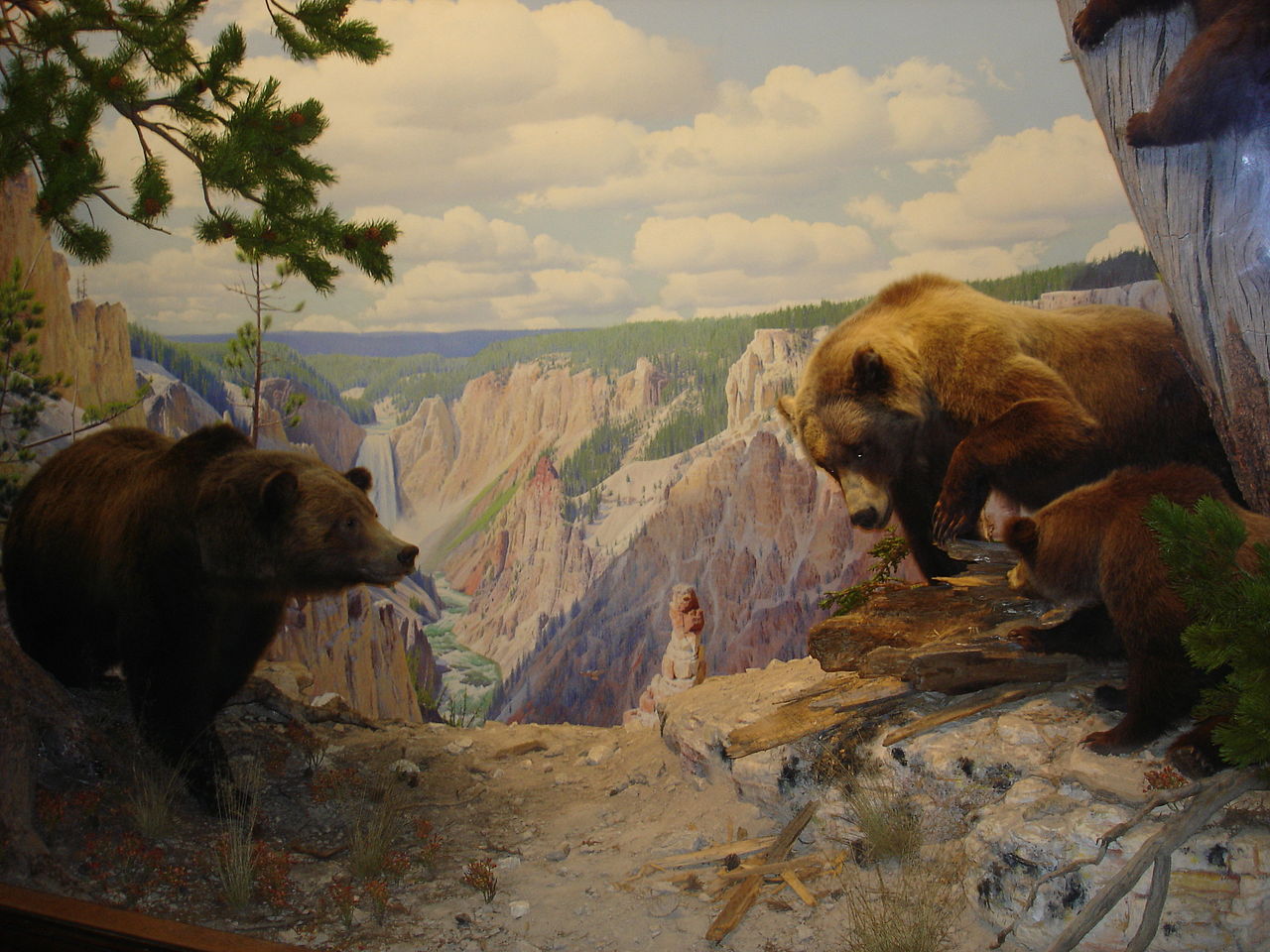
Grizzly bears overlap with Black Bears in range, but there are numerous factors that can differentiate the two:
A pronounced muscular hump appears on adult grizzlies' shoulders; black bears do not have this hump.
Aside from the distinguishing hump a grizzly bear can be identified by a "dished in" profile of their face with short, rounded ears, whereas a black bear has a straight face profile and longer ears.

A grizzly bear can also be identified by its rump, which is lower than its shoulders; a black bear's rump is higher than its shoulders.
A grizzly bear's front claws measure about 51–102 mm (2–4 in) in length; a black bear's claws measure about 25–51 mm (1–2 in) in length.
Range
In North America, grizzly bears previously ranged from Alaska down to Mexico and as far east as the western shores of Hudson Bay; the species is now found in Alaska, south through much of western Canada, and into portions of the northwestern United States (including Washington, Idaho, Montana, and Wyoming), extending as far south as Yellowstone and Grand Teton National Parks. In Canada, there are approximately 25,000 grizzly bears occupying British Columbia, Alberta, the Yukon, the Northwest Territories, Nunavut, and the northern part of Manitoba.
An article published in 1954 suggested they may be present in the tundra areas of the Ungava Peninsula and the northern tip of Labrador-Quebec. In British Columbia, grizzly bears inhabit approximately 90% of their original territory. There were approximately 25,000 grizzly bears in British Columbia when the European settlers arrived. However, population size has since significantly decreased due to hunting and habitat loss. In 2008, it was estimated there were 16,000 grizzly bears. A revised Grizzly bear count in 2012 for British Columbia was 15,075. Population estimates for British Columbia are based on hair-snagging, DNA-based inventories, mark-and-recapture, and a refined multiple regression model. In 2003, researchers from the University of Alberta spotted a grizzly on Melville Island in the high Arctic, which is the most northerly sighting ever documented.
Populations
Around 60,000 wild grizzly bears are located throughout North America, 30,000 of which are found in Alaska. and up to 29,000 live in Canada. The Alaskan population of 30,000 individuals is the highest population of any province / state in North America. Populations in Alaska are densest along the coast, where food supplies such as salmon are more abundant. The Admiralty Island National Monument protects the densest population: 1,600 bears on a 1,600 square-mile island. The majority of Canada's grizzlies live in British Columbia.
In the lower 48 United States, around 1,000 are found in the Northern Continental Divide in northwestern Montana. About 1,000 more live in the Greater Yellowstone Ecosystem in the tri-state area of Wyoming, Idaho and Montana. There are an estimated 70–100 grizzly bears living in northern and eastern Idaho. In September 2007, a hunter produced evidence of one bear in the Selway-Bitterroot Wilderness ecosystem, by killing a male grizzly bear there.
In the North Cascades ecosystem of northern Washington, grizzly bear populations are estimated to be fewer than 20 bears, but there is a longterm management plan to reintroduce the bears to North Cascades National Park.
Extirpated populations and recovery
The grizzly bear's original range included much of the Great Plains and the southwestern states, but it has been extirpated in most of those areas. Combining Canada and the United States, grizzly bears inhabit approximately half the area of their historical range.
Although the once-abundant California grizzly bear appears prominently on the state flag of California and was the symbol of the Bear Flag Republic before the state of California's admission to the Union in 1850, the subspecies or population is currently extinct. The last known grizzlies in California were killed in the Sierra foothills east of Fresno in the early 1920s.
The killing of the last grizzly bear in Arizona—in 1936 at Escudilla Mountain—is noted by naturalist Aldo Leopold in his A Sand County Almanac of 1949. There has been no confirmed sighting of a grizzly in Colorado since 1979.
Other provinces and the United States may use a combination of methods for population estimates. Therefore, it is difficult to say precisely what methods were used to produce total population estimates for Canada and North America, as they were likely developed from a variety of studies. The grizzly bear currently has legal protection in Mexico, European countries, some areas of Canada, and in all of the United States. However, it is expected that repopulating its former range will be a slow process, due to various reasons, including the bear's slow reproductive habits and the effects of reintroducing such a large animal to areas prized for agriculture and livestock.
Biology
Hibernation
Grizzly bears hibernate for five to seven months each year (except where the climate is warm—the California grizzly did not hibernate). During this time, female grizzly bears give birth to their offspring, who then consume milk from their mother and gain strength for the remainder of the hibernation period. To prepare for hibernation, grizzlies must prepare a den and consume an immense amount of food because they do not eat during hibernation. Grizzly bears also do not defecate or urinate throughout the entire hibernation period. The male grizzly bear's hibernation ends in early to mid-March, while females emerge in April or early May.
In preparation for winter, bears can gain approximately 180 kg (400 lb), during a period of hyperphagia, before going into hibernation. The bear often waits for a substantial snowstorm before it enters its den: such behavior lessens the chances that predators will find the den. The dens are typically at elevations above 1,800 meters (5,900 ft) on north-facing slopes. There is some debate among professionals as to whether grizzly bears technically hibernate: much of this debate revolves around body temperature and the ability of the bears to move around during hibernation on occasion. Grizzly bears can "partially" recycle their body wastes during this period. Although inland or Rocky Mountain grizzlies spend nearly half of their life in dens, coastal grizzlies with better access to food sources spend less time in dens. In some areas where food is very plentiful year round, grizzly bears skip hibernation altogether.
Reproduction
Except for females with cubs, grizzlies are normally solitary, active animals, but in coastal areas, grizzlies gather around streams, lakes, rivers, and ponds during the salmon spawn. Females (sows) produce one to four young (usually two) that are small and weigh only about 450 g (16 oz) at birth. A sow is protective of her offspring and will attack if she thinks she or her cubs are threatened.
Grizzly bears have one of the lowest reproductive rates of all terrestrial mammals in North America. This is due to numerous ecological factors. Grizzly bears do not reach sexual maturity until they are at least five years old. Once mated with a male in the summer, the female delays embryo implantation until hibernation, during which miscarriage can occur if the female does not receive the proper nutrients and caloric intake. On average, females produce two cubs in a litter and the mother cares for the cubs for up to two years, during which the mother will not mate.
Once the young leave or are killed, females may not produce another litter for three or more years, depending on environmental conditions. Male grizzly bears have large territories, up to 4,000 km2 (1,500 sq mi), making finding a female scent difficult in such low population densities. Population fragmentation of grizzlies may destabilize the population from inbreeding depression. The gestation period for grizzly bears is approximately 180–250 days.
Litter size varies between one and four cubs, typically comprising twins or triplets. Cubs are always born in the mother's winter den while she is in hibernation. Female grizzlies are fiercely protective of their cubs, being able to fend off predators including larger male bears. Cubs feed entirely on their mother's milk until summer comes, after which they still drink milk but begin to eat solid foods. Cubs gain weight rapidly during their time with the mother—their weight will have increased from 4.5 to 45 kg (9.9 to 99.2 lb) in the two years spent with the mother. Mothers may see their cubs in later years but both avoid each other.
Lifespan
The average lifespan for a male is estimated at 22 years, with that of a female being slightly longer at 26. Females live longer than males due to their less dangerous life; they do not engage in seasonal breeding fights as males do. The oldest known wild inland grizzly was about 34 years old in Alaska; the oldest known coastal bear was 39, but most grizzlies die in their first year of life. Captive grizzlies have lived as long as 47 years.
Movement
They have a tendency to chase fleeing animals, and although it has been said anecdotally that grizzly bears (Ursus arctos horribilis) can run at 56 km/h (35 mph), the maximum speed reliably recorded at Yellowstone is 48 km/h (30 mph). In addition, they can climb trees.
Ecology
Diet
Although grizzlies are of the order Carnivora and have the digestive system of carnivores, they are normally omnivores: their diets consist of both plants and animals. They have been known to prey on large mammals, when available, such as moose, elk, caribou, white-tailed deer, mule deer, bighorn sheep, bison, and even black bears, though they are more likely to take calves and injured individuals rather than healthy adults. Grizzly bears feed on fish such as salmon, trout, and bass, and those with access to a more protein-enriched diet in coastal areas potentially grow larger than inland individuals. Grizzly bears also readily scavenge food or carrion left behind by other animals. Grizzly bears will also eat birds and their eggs, and gather in large numbers at fishing sites to feed on spawning salmon. They frequently prey on baby deer left in the grass, and occasionally they raid the nests of raptors such as bald eagles.
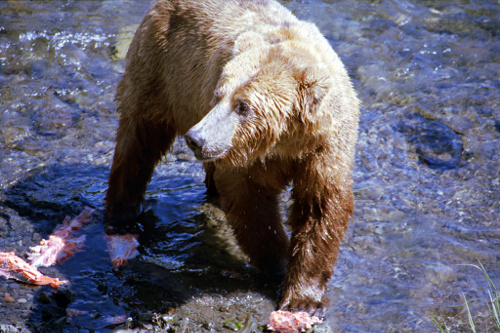
Coastal Canadian and Alaskan grizzlies are larger than those that reside in the Rocky Mountains. This is due, in part, to the richness of their diets. In Yellowstone National Park in the United States, the grizzly bear's diet consists mostly of whitebark pine nuts, tubers, grasses, various rodents, army cutworm moths, and scavenged carcasses. None of these, however, match the fat content of the salmon available in Alaska and British Columbia. With the high fat content of salmon, it is not uncommon to encounter grizzlies in Alaska weighing 540 kg (1,200 lb). Grizzlies in Alaska supplement their diet of salmon and clams with sedge grass and berries. In areas where salmon are forced to leap waterfalls, grizzlies gather at the base of the falls to feed on and catch the fish. Salmon are at a disadvantage when they leap waterfalls because they cluster together at their bases and are therefore easier targets for the grizzlies. Grizzly bears are well-documented catching leaping salmon in their mouths at Brooks Falls in Katmai National Park and Preserve in Alaska. They are also very experienced in chasing the fish around and pinning them with their claws. At such sites such as Brooks Falls and McNeil Falls in Alaska, big male grizzlies fight regularly for the best fishing spots. Grizzly bears along the coast also forage for razor clams, and frequently dig into the sand to seek them. During the spring and fall, directly before and after the salmon runs, berries and grass make up the mainstay of the diets of coastal grizzlies.
Inland grizzlies may eat fish too, most notably in Yellowstone grizzlies eating Yellowstone cutthroat trout. The relationship with cutthroat trout and grizzlies is unique because it is the only example where Rocky Mountain grizzlies feed on spawning salmonid fish. However, grizzly bears themselves and invasive lake trout threaten the survival of the trout population and there is a slight chance that the trout will be eliminated.
Grizzly bears occasionally prey on small mammals, such as marmots, ground squirrels, lemmings, and voles. The most famous example of such predation is in Denali National Park and Preserve, where grizzlies chase, pounce on, and dig up Arctic ground squirrels to eat. In some areas, grizzly bears prey on hoary marmots, overturning rocks to reach them, and in some cases preying on them when they are in hibernation. Larger prey includes bison and moose, which are sometimes taken by bears in Yellowstone National Park. Because bison and moose are dangerous prey, grizzlies usually use cover to stalk them and/or pick off weak individuals or calves. Grizzlies in Alaska also regularly prey on moose calves, which in Denali National Park may be their main source of meat. In fact, grizzly bears are such important predators of moose and elk calves in Alaska and Yellowstone that they may kill as many as 51 percent of elk or moose calves born that year. Grizzly bears have also been blamed in the decline of elk in Yellowstone National Park when the actual predators were thought to be gray wolves. In northern Alaska, grizzlies are a significant predator of caribou, mostly taking sick or old individuals or calves. Several studies show that grizzly bears may follow the caribou herds year-round in order to maintain their food supply. In northern Alaska, grizzly bears often encounter muskox. Despite the fact that muskox do not usually occur in grizzly habitat and that they are bigger and more powerful than caribou, predation on muskox by grizzlies has been recorded.