
The Greco-Persian Wars, also called the Persian Wars, were a series of armed conflicts involving various Greek city-states and the Achaemenid Empire from 499 BC to 449 BC. The precipitating collision between the fractious political world of ancient Greece and the enormous empire of ancient Persia had begun when the Persian king Cyrus the Great conquered the Greek-inhabited region of Ionia in 547 BC. As they struggled to exert authority over the independent-minded Ionian cities, the Persians appointed Greek tyrants to rule each of them, though this would prove to be the source of much trouble for the Greeks and the Persians alike.
In 499 BC, the Greek tyrant Aristagoras of Miletus embarked on what would ultimately be a failed expedition to conquer Naxos with Persian support. Anticipating his dismissal, Aristagoras incited Greek city-states in Asia Minor to join him in deposing their Persian rulers, sparking the Ionian Revolt. Despite initially lacking support from mainland Greece, Aristagoras secured alliances with Athens and Eretria that helped him capture and raze Sardis in 498 BC. In response to the loss of his regional capital city, the Persian king Darius the Great vowed to exact revenge against the Athenians and the Eretrians. Both sides then effectively stalemated until 495 BC, but in 494 BC, the Persian army consolidated and launched a major assault at the heart of the Ionion Revolt in Miletus; Ionia suffered a decisive defeat in the Battle of Lade, which enabled the collapse of the rebellion over the course of the following year.
Seeking to protect the Achaemenid Empire from being threatened by further uprisings in Asia Minor, Darius embarked on a scheme to conquer the mainland Greeks themselves—both to prevent their political and military interference in Asia Minor and to fulfill his earlier vow to specifically punish Athens and Eretria for their role in the destruction of Sardis. In 492 BC, the first Persian invasion of Greece began under the command of Mardonius, who successfully re-subjugated Thrace and Macedon before several mishaps forced an early end to the rest of the campaign. In 490 BC, another Persian force was sent to Greece—this time across the Aegean Sea—under the command of Datis and Artaphernes, who successfully subjugated the Cyclades before razing Eretria. Before they could reach Athens itself, however, the Persians were defeated by the Athenians and the Plataeans in the Battle of Marathon.
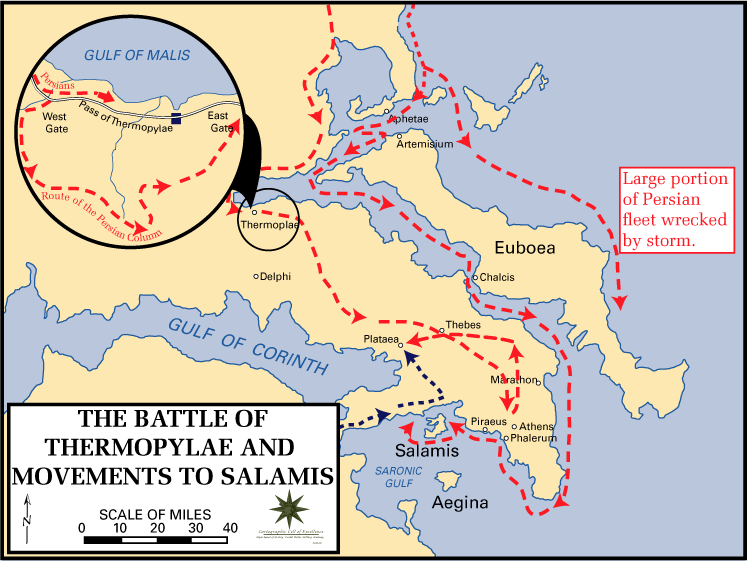
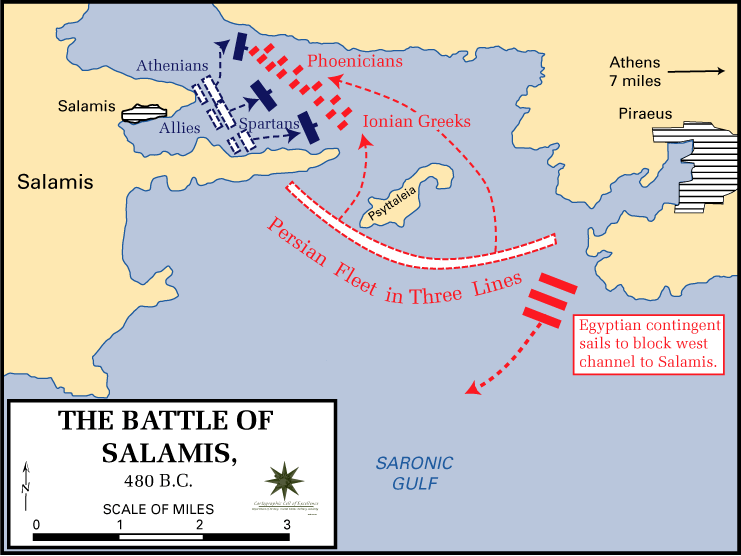
Upon the death of Darius in 486 BC, his son Xerxes I took the throne and the responsibility for continuing the Achaemenid Empire's stalled conquest of Greece. In 480 BC, Xerxes initiated and personally led the second Persian invasion of Greece with one of the largest armies ever assembled in the ancient world. His victory over the Greek alliance in the Battle of Thermopylae allowed the Persian army to raze an evacuated Athens and occupy most of the Greek mainland. Subsequently seeking to destroy the combined Greek fleet, the Persians suffered a severe defeat in the Battle of Salamis. The following year, the confederated Greek forces initiated a joint offensive that decisively routed the Persian army in the Battle of Plataea, which granted independence to Attica and Boeotia.
The Greeks followed up on their success at Plataea by destroying the rest of the Persian fleet in the Battle of Mycale before expelling Persian garrisons from Sestos in 479 BC and from Byzantium in 478 BC. These consecutive losses would force Persian troops to eventually withdraw from Europe, allowing Macedonia and the Ionian city-states to again assert their independence. Tensions between Sparta and other Greek city-states, especially amidst the suspicion that the Spartan general Pausanias had conspired with Xerxes as well as due to Sparta's lack of interest in aiding the Greeks of Asia Minor, prompted the anti-Persian alliance to fall to Athenian hegemony under the Delian League. For the next three decades, the Wars of the Delian League focused on removing the Persian army from Greek territory in both Asia Minor and Cyprus. In 466 BC, the League achieved a double victory in the Battle of the Eurymedon, which completely liberated Ionia. By 460 BC, the Athenians led the League to militarily intervene in support of the Egyptian pharaoh Inaros II, who was rebelling against Artaxerxes I. Although the Greek–Egyptian alliance saw initial tactical success, the Persian army was able to secure a strategic advantage from Memphis and inflicted a disastrous defeat on the League, which was forced to suspend any further campaigns against the Achaemenid Empire, while Inaros was captured and executed by crucifixion in Susa. A Greek fleet was sent to Cyprus in 451 BC, but achieved little, drawing the Greco-Persian Wars to a quiet end shortly thereafter. Some contemporary and later Greek and Roman sources suggest that the conflict was formally resolved when Athens and the Achaemenid Empire signed the purported Peace of Callias.
Origins of the conflict
The Greeks of the classical period believed that, in the dark age that followed the collapse of the Mycenaean civilization, significant numbers of Greeks fled and had emigrated to Asia Minor and settled there. Modern historians generally accept this migration as historic (but separate from the later colonization of the Mediterranean by the Greeks). There are, however, those who believe the Ionian migration cannot be explained as simply as the classical Greeks claimed. These settlers were from three tribal groups: the Aeolians, Dorians and Ionians. The Ionians had settled about the coasts of Lydia and Caria, founding the twelve cities that made up Ionia. These cities were Miletus, Myus and Priene in Caria; Ephesus, Colophon, Lebedos, Teos, Clazomenae, Phocaea and Erythrae in Lydia; and the islands of Samos and Chios. Although the Ionian cities were independent of one another, they recognized their shared heritage and supposedly had a common temple and meeting place, the Panionion. They thus formed a 'cultural league', to which they would admit no other cities, or even other tribal Ionians.

The cities of Ionia remained independent until they were conquered by the Lydians of western Asia Minor. The Lydian king Alyattes attacked Miletus, a conflict that ended with a treaty of alliance between Miletus and Lydia, that meant that Miletus would have internal autonomy but follow Lydia in foreign affairs. At this time, the Lydians were also in conflict with the Median Empire, and the Milesians sent an army to aid the Lydians in this conflict. Eventually a peaceable settlement was established between the Medes and the Lydians, with the Halys River set up as the border between the kingdoms. The famous Lydian king Croesus succeeded his father Alyattes in around 560 BC and set about conquering the other Greek city states of Asia Minor.
The Persian prince Cyrus led a rebellion against the last Median king Astyages in 553 BC. Cyrus was a grandson of Astyages and was supported by part of the Median aristocracy. By 550 BC, the rebellion was over, and Cyrus had emerged victorious, founding the Achaemenid Empire in place of the Median kingdom in the process. Croesus saw the disruption in the Median Empire and Persia as an opportunity to extend his realm and asked the oracle of Delphi whether he should attack them. The Oracle supposedly replied the famously ambiguous answer that "if Croesus was to cross the Halys he would destroy a great empire". Blind to the ambiguity of this prophecy, Croesus attacked the Persians, but was eventually defeated and Lydia fell to Cyrus.
While fighting the Lydians, Cyrus had sent messages to the Ionians asking them to revolt against Lydian rule, which the Ionians had refused to do. After Cyrus finished the conquest of Lydia, the Ionian cities now offered to be his subjects under the same terms as they had been subjects of Croesus. Cyrus refused, citing the Ionians' unwillingness to help him previously. The Ionians thus prepared to defend themselves, and Cyrus sent the Median general Harpagus to conquer them. He first attacked Phocaea; the Phocaeans decided to abandon their city entirely and sail into exile in Sicily, rather than become Persian subjects (although a number of them later returned). Some Teians also chose to emigrate when Harpagus attacked Teos, but the rest of the Ionians remained, and were each in turn conquered.
In the years following their conquest, the Persians found the Ionians difficult to rule. Elsewhere in the empire, Cyrus identified elite native groups such as the priesthood of Judea – to help him rule his new subjects. No such group existed in Greek cities at this time; while there was usually an aristocracy, this was inevitably divided into feuding factions. The Persians thus settled for sponsoring a tyrant in each Ionian city, even though this drew them into the Ionians' internal conflicts. Furthermore, certain tyrants might develop an independent streak and have to be replaced. The tyrants themselves faced a difficult task; they had to deflect the worst of their fellow citizens' hatred, while staying in the favour of the Persians. In the past, Greek states had often been ruled by tyrants, but that form of government was on the decline. Past tyrants had also tended and needed to be strong and able leaders, whereas the rulers appointed by the Persians were simply place-men. Backed by Persian military might, these tyrants did not need the support of the population, and could thus rule absolutely. On the eve of the Greco-Persian wars, it is probable that the Ionian population had become discontented and was ready for rebellion.
Warfare in the ancient Mediterranean
In the Greco-Persian wars both sides made use of spear-armed infantry and light missile troops. Greek armies placed the emphasis on heavier infantry, while Persian armies favoured lighter troop types.
Persia
The Persian military consisted of a diverse group of men drawn across the various nations of the empire. However, according to Herodotus, there was at least a general conformity in armor and style of fighting. The troops were usually armed with a bow, a 'short spear' and a sword or axe, and carried a wicker shield. They wore a leather jerkin, although individuals of high status wore high-quality metal armor. The Persians most likely used their bows to wear down the enemy, then closed in to deliver the final blow with spears and swords. The first rank of Persian infantry formations, the so-called 'sparabara', had no bows, carried larger wicker shields and were sometimes armed with longer spears. Their role was to protect the back ranks of the formation. The cavalry probably fought as lightly armed missile cavalry.
Greece
The style of warfare between the Greek city-states, which dates back until at least 650 BC (as dated by the 'Chigi vase'), was based around the hoplite phalanx supported by missile troops. The 'hoplites' were foot soldiers usually drawn from the members of the middle-classes (in Athens called the zeugites), who could afford the equipment necessary to fight in this manner. The heavy armour (the hoplon) usually included a breastplate or a linothorax, greaves, a helmet, and a large round, concave shield (the aspis) . Hoplites were armed with long spears (the dory), which were significantly longer than Persian spears, and a sword (the xiphos). The heavy armour and longer spears made them superior in hand-to-hand combat and gave them significant protection against ranged attacks. Lightly armed skirmishers, the psiloi also comprised a part of Greek armies growing in importance during the conflict; at the Battle of Plataea, for instance, they may have formed over half the Greek army. Use of cavalry in Greek armies is not reported in the battles of the Greco-Persian Wars.
Naval warfare
At the beginning of the conflict, all naval forces in the eastern Mediterranean had switched to the trireme, a warship powered by three banks of oars. The most common naval tactics during the period were ramming (Greek triremes were equipped with a cast-bronze ram at the bows), or boarding by ship-borne marines. More experienced naval powers had by this time also begun to use a manoeuver known as diekplous. It is not clear what this was, but it probably involved sailing into gaps between enemy ships and then ramming them in the side.
The Persian naval forces were primarily provided by the seafaring people of the empire: Phoenicians, Egyptians, Cilicians and Cypriots. Other coastal regions of the Persian Empire would contribute ships throughout the course of the wars.
Preliminary contacts between Persia and mainland Greece (507 BC)
In 507 BC, Artaphernes, as brother of Darius I and Satrap of Asia Minor in his capital Sardis, received an embassy from newly democratic Athens, probably sent by Cleisthenes, which was looking for Persian assistance to resist the threats from Sparta. Herodotus reports that Artaphernes had no previous knowledge of the Athenians, and his initial reaction was "Who are these people?". Artaphernes asked the Athenians for "Water and Earth", a symbol of submission, if they wanted help from the Achaemenid king. The Athenians ambassadors apparently accepted to comply, and to give "Earth and Water". Artaphernes also advised the Athenians that they should receive back the Athenian tyrant Hippias. The Persians threatened to attack Athens if they did not accept Hippias. Nevertheless, the Athenians preferred to remain democratic despite the danger from Persia, and the ambassadors were disavowed and censured upon their return to Athens.
The Athenians dispatched envoys to Sardis, desiring to make an alliance with the Persians; for they knew that they had provoked the Lacedaemonians and Cleomenes to war. When the envoys came to Sardis and spoke as they had been bidden, Artaphrenes son of Hystaspes, viceroy of Sardis, asked them, "What men are you, and where dwell you, who desire alliance with the Persians?" Being informed by the envoys, he gave them an answer whereof the substance was, that if the Athenians gave king Darius earth and water, then he would make alliance with them; but if not, his command was that they should begone. The envoys consulted together and consented to give what was asked, in their desire to make the alliance. So they returned to their own country, and were then greatly blamed for what they had done.
There is a possibility that the Achaemenid ruler now saw the Athenians as subjects who had solemnly promised submission through the gift of "Earth and Water", and that subsequent actions by the Athenians, such as their intervention in the Ionian revolt, were perceived as a break of oath, and a rebellion to the central authority of the Achaemenid ruler.
Ionian Revolt (499–493 BC)
The Ionian Revolt and associated revolts in Aeolis, Doris, Cyprus, and Caria were military rebellions by several regions of Asia Minor against Persian rule, lasting from 499 to 493 BC. At the heart of the rebellion was the dissatisfaction of the Greek cities of Asia Minor with the tyrants appointed by Persia to rule them, along with opposition to the individual actions of two Milesian tyrants, Histiaeus and Aristagoras. In 499 BC the then tyrant of Miletus, Aristagoras, launched a joint expedition with the Persian satrap Artaphernes to conquer Naxos, in an attempt to bolster his position in Miletus (both financially and in terms of prestige). The mission was a debacle, and sensing his imminent removal as tyrant, Aristagoras chose to incite the whole of Ionia into rebellion against the Persian king Darius the Great.
Struggling to rule the independent-minded cities of Ionia, the Persians appointed local tyrants to rule each of them. This would prove to be the source of much trouble for the Greeks and Persians alike. In 498 BC, supported by troops from Athens and Eretria, the Ionians marched on, captured, and burnt Sardis. However, on their return journey to Ionia, they were followed by Persian troops, and decisively beaten at the Battle of Ephesus. This campaign was the only offensive action taken by the Ionians, who subsequently went on the defensive. The Persians responded in 497 BC with a three-pronged attack aimed at recapturing the outlying areas of the rebellious territory, but the spread of the revolt to Caria meant the largest army, under Darius, moved there instead. While at first campaigning successfully in Caria, this army was wiped out in an ambush at the Battle of Pedasus. This resulted in a stalemate for the rest of 496 and 495 BC.
By 494 BC the Persian army and navy had regrouped, and they made straight for the epicentre of the rebellion at Miletus. The Ionian fleet sought to defend Miletus by sea, but was defeated decisively at the Battle of Lade, after the Samians had defected. Miletus was then besieged, captured, and its population was enslaved. This double defeat effectively ended the revolt, and the Carians surrendered to the Persians as a result. The Persians spent 493 BC reducing the cities along the west coast that still held out against them, before finally imposing a peace settlement on Ionia that was considered to be both just and fair.
The Ionian Revolt constituted the first major conflict between Greece and the Achaemenid Empire and represents the first phase of the Greco-Persian Wars. Asia Minor had been brought back into the Persian fold, but Darius had vowed to punish Athens and Eretria for their support for the revolt. Moreover, seeing that the political situation in Greece posed a continued threat to the stability of his Empire, he decided to embark on the conquest of all Greece.
First invasion of Greece (492–490 BC)
After having reconquered Ionia, the Persians began to plan their next moves of extinguishing the threat to their empire from Greece; and punishing Athens and Eretria. The resultant first Persian invasion of Greece consisted of two main campaigns.
492 BC: Mardonius' campaign
The first campaign, in 492 BC, was led by Darius's son-in-law Mardonius, who re-subjugated Thrace, which had nominally been part of the Persian empire since 513 BC. Mardonius was also able to force Macedon to become a fully subordinate client kingdom of Persia; it had previously been a vassal, but retained a broad degree of autonomy. However, further progress in this campaign was prevented when Mardonius's fleet was wrecked in a storm off the coast of Mount Athos. Mardonius himself was then injured in a raid on his camp by a Thracian tribe, and after this he returned with the rest of the expedition to Asia.
The following year, having given clear warning of his plans, Darius sent ambassadors to all the cities of Greece, demanding their submission. He received it from almost all of them, except Athens and Sparta, both of whom instead executed the ambassadors. With Athens still defiant, and Sparta now also effectively at war with him, Darius ordered a further military campaign for the following year.
490 BC: Datis and Artaphernes' campaign
In 490 BC, Datis and Artaphernes (son of the satrap Artaphernes) were given command of an amphibious invasion force, and set sail from Cilicia. The Persian force sailed first to the island of Rhodes, where a Lindian Temple Chronicle records that Datis besieged the city of Lindos, but was unsuccessful. The fleet sailed next to Naxos, to punish the Naxians for their resistance to the failed expedition the Persians had mounted there a decade earlier. A number of the inhabitants fled to the mountains; those that the Persians caught were enslaved. The Persians then burnt the city and temples of the Naxians. The fleet then proceeded to island-hop across the rest of the Aegean on its way to Eretria, taking hostages and troops from each island.
The task force sailed on to Euboea, and to the first major target, Eretria. The Eretrians made no attempt to stop the Persians from landing or advancing and thus allowed themselves to be besieged. For six days, the Persians attacked the walls, with losses on both sides; however, on the seventh day two reputable Eretrians opened the gates and betrayed the city to the Persians. The city was razed, and temples and shrines were looted and burned. Furthermore, according to Darius's commands, the Persians enslaved all the remaining townspeople.
Battle of Marathon
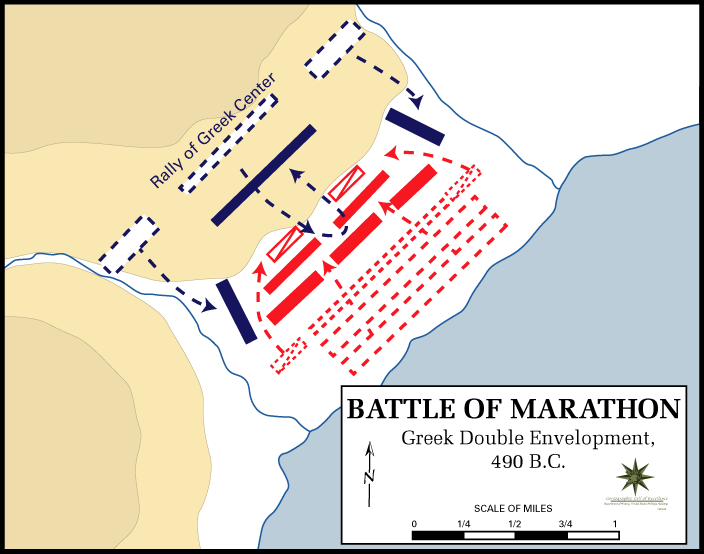
The Persian fleet next headed south down the coast of Attica, landing at the bay of Marathon, roughly 40 kilometres (25 mi) from Athens. Under the guidance of Miltiades, the general with the greatest experience of fighting the Persians, the Athenian army marched to block the two exits from the plain of Marathon. Stalemate ensued for five days, before the Persians decided to continue onward to Athens, and began to load their troops back onto the ships. After the Persians had loaded their cavalry (their strongest soldiers) on the ships, the 10,000 Athenian soldiers descended from the hills around the plain. The Greeks crushed the weaker Persian foot soldiers by routing the wings before turning towards the centre of the Persian line. The remnants of the Persian army fled to their ships and left the battle. Herodotus records that 6,400 Persian bodies were counted on the battlefield; the Athenians lost only 192 men.
As soon as the Persian survivors had put to sea, the Athenians marched as quickly as possible to Athens. They arrived in time to prevent Artaphernes from securing a landing in Athens. Seeing his opportunity lost, Artaphernes ended the year's campaign and returned to Asia.
The Battle of Marathon was a watershed in the Greco-Persian wars, showing the Greeks that the Persians could be beaten. It also highlighted the superiority of the more heavily armoured Greek hoplites, and showed their potential when used wisely.
Interbellum (490–480 BC)
Achaemenid Empire
After the failure of the first invasion, Darius began raising a huge new army with which he intended to subjugate Greece completely. However, in 486 BC, his Egyptian subjects revolted, and the revolt forced an indefinite postponement of any Greek expedition. Darius died while preparing to march on Egypt, and the throne of Persia passed to his son Xerxes I. Xerxes crushed the Egyptian revolt, and quickly resumed the preparations for the invasion of Greece. Since this was to be a full-scale invasion, it needed longterm planning, stockpiling and conscription. Xerxes decided that the Hellespont would be bridged to allow his army to cross to Europe, and that a canal should be dug across the isthmus of Mount Athos (a Persian fleet had been destroyed in 492 BC while rounding this coastline). These were both feats of exceptional ambition that would have been beyond the capabilities of any other contemporary state However, the campaign was delayed by one year because of another revolt in Egypt and Babylonia.
The Persians had the sympathy of several Greek city-states, including Argos, which had pledged to defect when the Persians reached their borders. The Aleuadae family, who ruled Larissa in Thessaly, saw the invasion as an opportunity to extend their power. Thebes, though not explicitly 'Medising', was suspected of being willing to aid the Persians once the invasion force arrived.
In 481 BC, after roughly four years of preparation, Xerxes began to muster the troops to invade Europe. Herodotus gives the names of 46 nations from which troops were drafted. The Persian army was gathered in Asia Minor in the summer and autumn of 481 BC. The armies from the Eastern satrapies were gathered in Kritala, Cappadocia and were led by Xerxes to Sardis where they passed the winter. Early in spring, it moved to Abydos where it was joined with the armies of the western satrapies. Then the army that Xerxes had mustered marched towards Europe, crossing the Hellespont on two pontoon bridges.
Size of the Persian forces
The numbers of troops that Xerxes mustered for the second invasion of Greece have been the subject of endless dispute. Most modern scholars reject as unrealistic the figures of 2.5 million given by Herodotus and other ancient sources because the victors likely miscalculated or exaggerated. The topic has been hotly debated, but the consensus revolves around the figure of 200,000.
The size of the Persian fleet is also disputed, although perhaps less so. Other ancient authors agree with Herodotus' number of 1,207. These numbers are by ancient standards consistent, and this could be interpreted that a number around 1,200 is correct. Among modern scholars, some have accepted this number, although suggesting the number must have been lower by the Battle of Salamis. Other recent works on the Persian Wars reject this number, viewing 1,207 as more of a reference to the combined Greek fleet in the Iliad. These works generally claim that the Persians could have launched no more than around 600 warships into the Aegean.
Greek city states
Athens
A year after Marathon, Miltiades, the hero of Marathon, was injured in a military campaign to Paros. Taking advantage of his incapacitation, the powerful Alcmaeonid family arranged for him to be prosecuted for the failure of the campaign. A huge fine was imposed on Miltiades for the crime of 'deceiving the Athenian people', but he died weeks later from his wound.
The politician Themistocles, with a power base firmly established among the poor, filled the vacuum left by Miltiades's death, and in the following decade became the most influential politician in Athens. During this period, Themistocles continued to support the expansion of Athens' naval power. The Athenians were aware throughout this period that the Persian interest in Greece had not ended, and Themistocles's naval policies may be seen in the light of the potential threat from Persia. Aristides, Themistocles's great rival, and champion of the zeugites (the 'upper hoplite-class') vigorously opposed such a policy.
In 483 BC, a vast new seam of silver was found in the Athenian mines at Laurium. Themistocles proposed that the silver should be used to build a new fleet of triremes, ostensibly to assist in a long running war with Aegina. Plutarch suggests that Themistocles deliberately avoided mentioning Persia, believing that it was too distant a threat for the Athenians to act on, but that countering Persia was the fleet's aim. Fine suggests that some Athenians must have admitted that such a fleet would be needed to resist the Persians, whose preparations for the coming campaign were known. Themistocles's motion was passed easily, despite strong opposition from Aristides. Its passage was probably due to the desire of a number of the poorer Athenians for paid employment as rowers in the fleet. It is unclear from the ancient sources whether 100 or 200 ships were initially authorised; both Fine and Holland suggest that at first 100 ships were authorised and that a second vote increased this number to the levels seen during the second invasion. Aristides continued to oppose Themistocles's policy, and tension between the two camps built over the winter, so the ostracism of 482 BC became a direct contest between Themistocles and Aristides. In what Holland characterises as, in essence, the world's first referendum, Aristides was ostracised, and Themistocles's policies were endorsed. Indeed, becoming aware of the Persian preparations for the coming invasion, the Athenians voted to build more ships than those for which Themistocles had asked. Thus, during the preparations for the Persian invasion, Themistocles had become the leading politician in Athens.
Sparta
The Spartan king Demaratus had been stripped of his kingship in 491 BC, and replaced with his cousin Leotychides. Sometime after 490 BC, the humiliated Demaratus had chosen to go into exile, and had made his way to Darius's court in Susa. Demaratus would from then on act as an advisor to Darius, and later Xerxes, on Greek affairs, and accompanied Xerxes during the second Persian invasion. At the end of Herodotus's book 7, there is an anecdote relating that prior to the second invasion, Demaratus sent an apparently blank wax tablet to Sparta. When the wax was removed, a message was found scratched on the wooden backing, warning the Spartans of Xerxes's plans. However, some historians believe that this chapter was inserted into the text by a later author, possibly to fill a gap between the end of book 7 and the start of book 8. The veracity of this anecdote is therefore unclear.
Hellenic alliance
In 481 BC, Xerxes sent ambassadors to city states throughout Greece, asking for food, land, and water as tokens of their submission to Persia. However, Xerxes' ambassadors deliberately avoided Athens and Sparta, hoping thereby that those states would not learn of the Persians' plans. States that were opposed to Persia thus began to coalesce around these two city states. A congress of states met at Corinth in late autumn of 481 BC, and a confederate alliance of Greek city-states was formed. This confederation had powers both to send envoys to ask for assistance and to dispatch troops from the member states to defensive points after joint consultation. Herodotus does not formulate an abstract name for the union but simply calls them "οἱ Ἕλληνες" (the Greeks) and "the Greeks who had sworn alliance" (Godley translation) or "the Greeks who had banded themselves together" (Rawlinson translation). From here on, they will be referred to in this article as the 'Allies'. Sparta and Athens had a leading role in the congress but the interests of all the states influenced defensive strategy. Little is known about the internal workings of the congress or the discussions during its meetings. Only 70 of the nearly 700 Greek city-states sent representatives. Nevertheless, this was remarkable for the disjointed Greek world, especially since a number of the city-states present were still technically at war with one another.
Second invasion of Greece (480–479 BC)
Early 480 BC: Thrace, Macedonia, and Thessaly
Having crossed into Europe in April 480 BC, the Persian army began its march to Greece, taking 3 months to travel unopposed from the Hellespont to Therme. It paused at Doriskos where it was joined by the fleet. Xerxes reorganized the troops into tactical units replacing the national formations used earlier for the march.