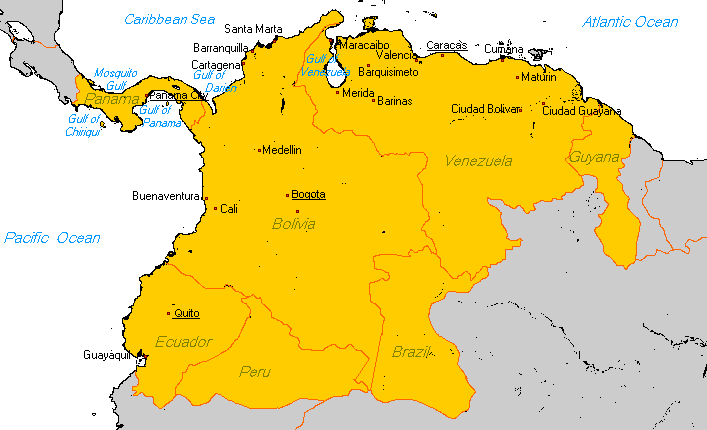
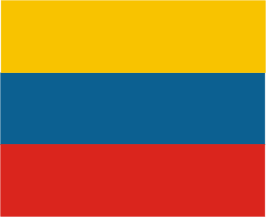
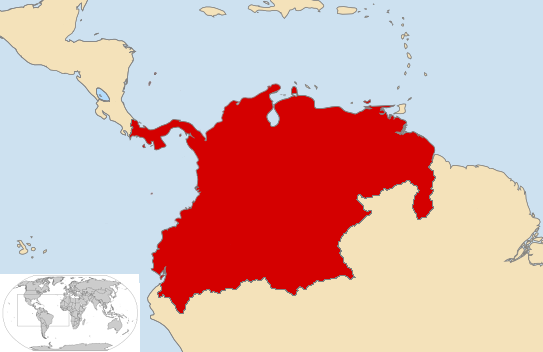
Greater Colombia (Great Colombia) is a name used today for the state that encompassed a great part of the territory of northern South America and part of southern Central America during the years 1819 to 1831. This short-lived republic encompassed the territories of present-day Colombia, Venezuela, Ecuador, and Panama. The first three were the successor states to Gran Colombia at its dissolution. Since its territory corresponded more or less to the original jurisdiction of the former Viceroyalty of New Granada, it also claimed the Caribbean coast of Costa Rica, the Mosquito Coast, "Guayana Esequiba" in Guyana and small parts of what today are Peru and Brazil.
Its existence was marked by a struggle between those who supported a highly centralized state with a strong presidency and those who supported a decentralized, federal form of government. At the same time another, three-way, political division emerged between those who supported the legitimacy of the Constitution of Cúcuta, which created the nation, and two groups who sought to do away with the Constitution, either in favor of breaking up the nation into smaller republics or maintaining the union but creating an even stronger presidency. The faction that favored constitutional rule coalesced around Vice-President Francisco de Paula Santander, while those that supported the creation of an even stronger presidency were led by President Simón Bolívar. The two originally had been allies in the war against Spanish rule, but by 1825 their differences had become public and were an important part of the political instability from that year onward.
Reunification of Greater Colombia
Reunification of Greater Colombia refers to the hypothetical future reunification of Colombia, Venezuela, Ecuador, and Panama under a single government. Although Gran Colombia only existed for 12 years and dissolved in the 19th century, interest and efforts in reunification were expressed as early as 1903 when Panama separated from Colombia. People in favor of reunification are called "unionistas" or unionists. In 2008, President of Venezuela Hugo Chávez announced a proposal for the political restoration of Gran Colombia, under the Bolivarian Revolution.
Some media commentators believe that a reunified Gran Colombia could become a global economic powerhouse. That would contrast with Gran Colombia in the 1820s, whose was mostly agrarian and had little industry. It was speculated by the BBC that if Gran Colombia existed in 2017, it would have had a population of 96 Million people and an estimated gross domestic product of US$952 Billion.
Reading level
Audio Summary
Played with your browser's voice. Studio-quality audio can be added with a text-to-speech service.
Ask about this article
📝 Quick Quiz1 / 4
What is "Greater Colombia" primarily known for?
Vocix Daily — In Your Inbox
Top stories, deep-dive articles, and "On This Day" history — one crisp digest delivered every morning.
Sources & references
Reference material for this entry is drawn from the open encyclopedic record, including Wikipedia , available under the CC BY-SA 4.0 license. Images are credited individually beside each photo.
In 2025, the President of Colombia, Gustavo Petro proposed a restoration of Gran Colombia. He proposed that the reunited state would operate as a confederation with protected autonomy of the individual member countries but operate under a shared trade policy and citizenship. When he attended the inauguration of the President of Ecuador, Daniel Noboa he discussed the possibility of opening up a dialogue on it. He believed it would promote South American security following the United States seizing Venezuelan oil tankers. In 2026, he proposed national referendums in each potential member country on the reunification of Gran Colombia.
Great Colombia
Great Colombia is the name given to the Republic of Colombia of 1819, was a short-lived republic in South America consisting of present-day Colombia, Venezuela, Ecuador, Bolivia, and Panama.
Its territory corresponded more or less to the jurisdiction of the Viceroyalty of New Granada, the Captaincy General of Venezuela and the Royal Audience of Quito
Colombia or Great Colombia?
The official name at the time was the Republic of Colombia; the word "Gran" or "Great" that precedes the name was not used by contemporaries, and is an addition by later historians in order to distinguish it from the present-day Republic of Colombia, so there never was a country named "Gran Colombia".
The word "Colombia" comes from the name of Christopher Columbus (Cristóbal Colón in Spanish, Cristoforo Colombo in Italian) and was conceived by the revolutionary Francisco de Miranda as a reference to the New World, especially to all American territories and colonies under Spanish and Portuguese rule.
Simón Bolívar, the Liberator of Spanish South America and other revolutionaries in the First Venezuelan Republic occasionally used the term Colombia as a reference to all of Spanish America, until the proclamation of a republic under that name in 1819 at the Congress of Angostura.
It was initially conceived at that Congress as a Federal republic, made up of three departments with capitals in the cities of Bogotá (Department of Cundinamarca), Caracas (Department of Venezuela), and Quito (Department of Quito). In that year, not all the provinces of the former viceroyalty were free yet.
The constitution of the new republic was drafted in 1821 at the Congress of Cúcuta, establishing its capital in Bogotá. A greater degree of centralisation was established here, as several convinced federalists now came to believe that it would be necessary in order to better manage a unified war effort, at least for the time being.
A new territorial division (Venezuela, Cundinamarca, and Quito were split into various smaller departments) was conceived. Bolívar was elected president and Francisco de Paula Santander vice president.
In the first years of existence, Gran Colombia helped other provinces still at war with Spain to become independent - Panama came to the federation in 1821 and so did the remaining provinces of Quito and Venezuela.
The independence of Peru was consolidated later in 1824 through Gran Colombia's aid. Bolívar and Santander were re-elected in 1826.
Federalists against Separatists
As the war against Spain came to an end, federalist and regionalist sentiments began to arise once again. Permanent calls for modifications of the political division (along with related economic and commercial disputes) during the existence of Gran Colombia, as a result of local confrontations between the regions, led to local changes and compromises.
These changes never fully pleased contemporaries and little permanent consolidation was achieved, showing the instability of the state's structure.
Bolívar dreamt of uniting Latin America but was unable to achieve this during the struggle for independence. The Republic of Gran Colombia was his initial attempt at creating a single Latin American state.
Other regional and Latin American politicians, however, objected to his idea, and Bolívar, disgruntled, resigned from the project in 1828 and from his presidency in early 1830.
Internal political strife between the different regions intensified after Bolívar's resignation and continued even as General Rafael Urdaneta temporarily took power in Bogotá, attempting to use his authority to ostensibly restore order and give the presidency back to Bolívar.
The federation finally dissolved during the rest of 1830 and was formally abolished in 1831, as Venezuela, Ecuador and New Granada came to exist as independent states.
Independent nations
The dissolution of Gran Colombia characterized the failure of Bolívar's dream. Countries that were created after its dissolution include:
As the Federation of Great Colombia was dissolved in 1830, the Department of Cundinamarca (as established in Angostura) became a new country, the Republic of New Granada. In 1863 New Granada changed its name officially to United States of Colombia, and in 1886 adopted its present day name: Republic of Colombia.
Panama remained as a province of this country until 1903, when – with intervention from the USA – it became independent.
Origin of the Name
The official name at the time was the Republic of Colombia; the word "Greater" that precedes the name was not used by contemporaries, and is an addition by later historians in order to distinguish it from the present-day Republic of Colombia, so there never was a country named "Greater Colombia".
The word "Colombia" comes from the name of Christopher Columbus (Cristóbal Colón in Spanish, Cristoforo Colombo in Italian) and was conceived by the revolutionary Francisco de Miranda as a reference to the New World, especially to all American territories and colonies under Spanish and Portuguese rule.
Also, while "Gran" in English translates as "Great", historians have traditionally chosen to render it as "Greater" in English.