
Garry Kimovich Kasparov (born Garik Kimovich Weinstein on 13 April 1963) is a Russian chess grandmaster, political activist and writer, who was the World Chess Champion from 1985 to 2000. His peak FIDE chess rating of 2851, achieved in 1999, was the highest recorded until being surpassed by Magnus Carlsen in 2013. From 1984 until his retirement from regular competitive chess in 2005, Kasparov was ranked the world's No. 1 player for a record 255 months overall. Kasparov also holds records for the most consecutive professional tournament victories (15) and Chess Oscars (11).
Kasparov became the youngest undisputed world champion in 1985 at age 22 by defeating then-champion Anatoly Karpov, a record he held until 2024. He defended the title against Karpov three times, in 1986, 1987 and 1990. Kasparov held the official FIDE world title until 1993, when a dispute with FIDE led him to set up a rival organisation, the Professional Chess Association. In 1997, he became the first world champion to lose a match to a computer under standard time controls when he was defeated by the IBM supercomputer Deep Blue in a highly publicised match. He continued to hold the "Classical" world title until his defeat by Vladimir Kramnik in 2000. Despite losing the PCA title, he continued winning tournaments and was the world's highest-rated player at the time of his official retirement. Kasparov coached Carlsen in 2009–2010, during which time Carlsen rose to world No. 1. Kasparov stood unsuccessfully for FIDE president in 2013–2014.
Since retiring from chess, Kasparov has devoted his time to writing and politics. His book series My Great Predecessors, first published in 2003, details the history and games of the world champion chess players who preceded him. He formed the United Civil Front movement and was a member of The Other Russia, a coalition opposing the administration and policies of Vladimir Putin. In 2008, he announced an intention to run as a candidate in that year's Russian presidential race, but after encountering logistical problems in his campaign, for which he blamed "official obstruction", he withdrew. Following the Russian mass protests that began in 2011, he announced in June 2013 that he had left Russia for the immediate future out of fear of persecution. Following his flight from Russia, he lived in New York City with his family. In 2014, he obtained Croatian citizenship and has maintained a residence in Podstrana near Split. Russia designated him as "foreign agent" in 2022.

Kasparov was chairman of the Human Rights Foundation from 2011 to 2024. In 2017, he founded the Renew Democracy Initiative (RDI), an American political organisation promoting and defending liberal democracy in the U.S. and abroad. He serves as chairman of the group.
Early life
Kasparov was born Garik Kimovich Weinstein (Russian: Гарик Кимович Вайнштейн, romanized: Garik Kimovich Vainshtein) in Baku, Azerbaijan SSR (now Azerbaijan), Soviet Union. His father, Kim Moiseyevich Weinstein, was Jewish and his mother, Klara Shagenovna Kasparova, was Armenian. Both of his mother's parents were Armenians from Karabakh. According to Kasparov himself, he was named after United States President Harry S. Truman, "whom my father admired for taking a strong stand against communism. It was a rare name in Russia, until Harry Potter came along." Kasparov has described himself as a "self-appointed Christian", although "very indifferent" and identifying as Russian: "[A]lthough I'm half-Armenian, half-Jewish, I consider myself Russian because Russian is my native tongue, and I grew up with Russian culture."
When he was seven years old, his father died of leukemia. At the age of twelve, Kasparov, upon the request of his mother Klara and with the consent of the family, adopted Klara's surname Kasparov. Kasparov and his family had to flee anti-Armenian pogroms in Baku in January 1990.

Introduction to chess
Kasparov began the serious study of chess after he came across a problem set up by his parents and proposed a solution. From age seven, he attended the Young Pioneer Palace in Baku and, at ten, began training at Mikhail Botvinnik's chess school under coach Vladimir Makogonov. When Kasparov was 11, Botvinnik wrote, "The future of chess lies in the hands of this young man." Makogonov helped develop Kasparov's positional skills and taught him to play the Caro–Kann Defence and the Tartakower System of the Queen's Gambit Declined. Kasparov won the Soviet Junior Championship in Tbilisi in 1976, scoring 7/9 points, at age 13. He repeated the feat the following year, winning with a score of 8.5/9. He was being coached by Alexander Shakarov during this time.
Chess career
Rising up the ranks
In early 1978, Kasparov participated in the Sokolsky Memorial tournament in Minsk. Normally only established masters and local players were invited, but he received a special invitation, and took first place. Kasparov said that after the victory, he thought he had a "very good shot" at the world championship. He first qualified for the USSR Chess Championship at age 15 in 1978, the youngest-ever player at that level, by winning a 64-player Swiss system tournament at Daugavpils. He scored 8.5/17 in that Soviet championship.
Kasparov's first international tournament was in Banja Luka, Yugoslavia, in April 1979 while he was still unrated. Kasparov won this high-class tournament by 2 points, emerging with a provisional rating of 2545, enough to rank him equal 40th in the world. The next year, 1980, he won the World Junior Chess Championship in Dortmund, West Germany. Later that year, he made his debut as the second reserve for the Soviet Union at the Chess Olympiad at Valletta, Malta, and became a Grandmaster. He quickly rose up the world rankings: equal 15th in January 1980, sixth in January 1981, equal fourth in July 1981, fourth in January 1982 and second behind Karpov in July 1982.

As a teenager, Kasparov shared the USSR Chess Championship in 1981 with Lev Psakhis (12.5/17), although Psakhis won their game. His first win in a superclass-level international tournament was scored at Bugojno, Yugoslavia, in 1982. He earned a place in the 1982 Moscow Interzonal tournament, which he won, to qualify for the Candidates Tournament. At age 19, he was the youngest Candidate since Bobby Fischer, who was 15 when he qualified in 1958.
Kasparov's first (quarter-final) Candidates match was against Alexander Beliavsky, whom he defeated 6–3 (four wins, one loss). Politics threatened Kasparov's semi-final against Victor Korchnoi, which was scheduled to be played in Pasadena, California. The Soviet authorities would not allow Kasparov to travel to the United States, meaning that Korchnoi could have had a walkover. This decision was met with disapproval by the chess world, and Korchnoi agreed to the match to being played in London instead, along with the previously scheduled match between Vasily Smyslov and Zoltán Ribli. The Kasparov-Korchnoi match was put together on short notice by Raymond Keene. Kasparov lost the first game but won the match 7–4 (four wins, one loss).
In January 1984, Kasparov became the No. 1 ranked player in the world, with a FIDE rating of 2710. He became the youngest-ever world No. 1, a record that lasted 12 years until being broken by Kramnik in January 1996. That same year, he won the Candidates' final 8½–4½ (four wins, no losses) against former world champion Smyslov at Vilnius, thus qualifying to play Karpov for the world championship.

1984–1985 world championship
The World Chess Championship 1984–1985 match between Kasparov and Karpov had many ups and downs and a controversial finish. Karpov started in very good form, and after nine games Kasparov was down 4–0 in a "first to six wins" match. In an unexpected turn of events, there followed a series of 17 successive draws, some relatively short, others drawn in unsettled positions. Kasparov lost game 27 (5–0), then fought back with another series of draws until game 32, earning his first-ever win against the world champion and bringing the score to 5–1. Another 14 successive draws followed, through game 46; the previous record length for a world title match had been 34 games (José Raúl Capablanca vs. Alexander Alekhine in 1927).
Kasparov won games 47 and 48 to bring the score to 5–3 in Karpov's favour. Then the match was ended without result by FIDE President Florencio Campomanes, and a new match was announced to start a few months later. The termination was controversial, as both players stated that they preferred the match to continue. Announcing his decision, Campomanes cited the health of the players, which had been strained by the length of the match. According to grandmasters Boris Gulko and Korchnoi, and historians Vladimir Popow and Yuri Felshtinsky in their The KGB Plays Chess book, Campomanes had been a KGB agent and was tasked with preventing Karpov's defeat at all costs; and the match was terminated while Karpov was still ahead to avoid the impression that the decision had been made for his benefit. US Grandmaster Andy Soltis said it was "absurd" to suggest that Campomones was a KGB agent, but thought that his decisions in the match favoured Karpov.
The match became the first, and so far only, world championship match to be abandoned without a result. Kasparov's relations with Campomanes and FIDE became strained, and matters came to a head in 1993 with Kasparov's complete break-away from FIDE.

World champion
The second Karpov–Kasparov match in 1985 was organised in Moscow as the best of 24 games, where the first player to win 12½ points would claim the title. The scores from the terminated match would not carry over; however, in the event of a 12–12 draw, the title would remain with Karpov. On 9 November 1985, Kasparov secured the world crown by a score of 13–11. Karpov, with White, needed to win the 24th game to retain the title but Kasparov won it with the Sicilian Defence. He was 22 years old at the time, making him the youngest-ever world champion, a record held by Mikhail Tal for over 20 years. Kasparov's win with Black in the 16th game has been recognised as one of the all-time chess masterpieces, including being voted the best game played during the first 64 issues of the magazine Chess Informant.
At the time, the champion still had the right to a rematch after losing the title. This rematch took place in 1986, hosted jointly in London and Leningrad, with each city hosting 12 games. At one point in the match, Kasparov opened a three-point lead and looked well on his way to a decisive victory. But Karpov fought back by winning three consecutive games to level the score late in the match. At this point, Kasparov dismissed one of his seconds, grandmaster Evgeny Vladimirov, accusing him of selling his opening preparation to the Karpov team. Kasparov scored one more win and kept his title by a score of 12½–11½.
A fourth match for the world title took place in 1987 in Seville, as Karpov had qualified through the Candidates' Matches to become the official challenger once again. This match was also very close, with neither player holding more than a one-point lead at any time. With one game left, Kasparov was down a point and needed a win to draw the match and retain his title. A long, tense game ensued, in which Karpov blundered away a pawn just before the first time control. Kasparov then won a long ending to retain the title on a 12–12 scoreline.
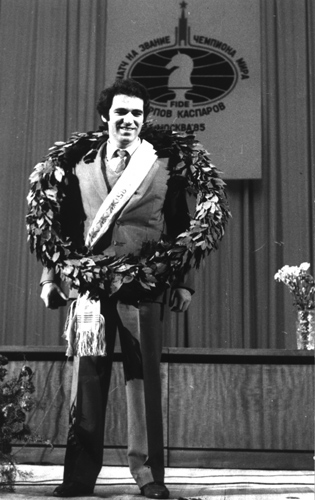
Kasparov and Karpov met for a fifth time, on this occasion in New York City and Lyon in 1990, with each city hosting 12 games. Again, the result was a close one, with Kasparov winning by a margin of 12½–11½. In their five world championship matches, Kasparov had 21 wins, 19 losses and 104 draws in 144 games.
Break with and ejection from FIDE
In November 1986, Kasparov had created the Grandmasters Association (GMA) to represent professional players and give them more say in FIDE's activities. Kasparov assumed a leadership role. GMA's major achievement was in organising a series of six World Cup tournaments for the world's top players. This caused an uneasy relationship to develop between Kasparov and FIDE. The previous month, Kasparov had made his feelings clear to fellow grandmaster Keene: "Campomanes must go. It is war to the death with him as far as I am concerned. I will do everything I can to remove him."
This stand-off lasted until 1993, by which time a new challenger had qualified through the Candidates cycle: Nigel Short, a British grandmaster who had defeated Karpov in a qualifying match and then Jan Timman in the finals held in early 1993. After a confusing and compressed bidding process produced lower financial estimates than expected, the world champion and his challenger both rejected FIDE's bid for an August match in Manchester and decided to play outside FIDE's jurisdiction. Their match took place under the auspices of the Professional Chess Association (PCA), an organisation established by Kasparov and Short. At this point, a fracture occurred in the lineage of the FIDE World Championship. In an interview in 2007, Kasparov called the break with FIDE in 1993 the worst mistake of his career, as it hurt the game in the long run.
Kasparov and Short were ejected from FIDE and played their well-sponsored match in London in September 1993. Kasparov won convincingly by a score of 12½–7½. The match considerably raised the profile of chess in the UK, with a substantial level of coverage on Channel 4. Meanwhile, FIDE organised its world championship match between Timman (the defeated Candidates finalist) and former world champion Karpov (a defeated Candidates semi-finalist), which Karpov won. FIDE removed Kasparov and Short from its rating list. Subsequently, the PCA created a rating list of its own, which featured all the world's top players regardless of their relation to FIDE. There were now two world champions: PCA champion Kasparov and FIDE champion Karpov. The title remained split for 13 years.
Kasparov defended his PCA title in a 1995 match against Viswanathan Anand at the World Trade Center in New York City. Kasparov won the match by four wins to one, with thirteen draws. He tried to organise another world championship match under a different organisation, the World Chess Association (WCA), with Linares International Chess Tournament organiser Luis Rentero. Alexei Shirov and Kramnik played a candidates match to decide the challenger, which Shirov won in an upset. But when Rentero admitted that the funds required and promised had never materialised, the WCA collapsed. Yet another body stepped in, BrainGames.com, headed by Raymond Keene. After a match with Shirov could not be agreed by BrainGames.com and talks with Anand collapsed, a match was instead arranged against Kramnik.
During this period, Kasparov was approached by Oakham School in the United Kingdom, at the time the only school in the country with a full-time chess coach, and developed an interest in the use of chess in education. In 1997, Kasparov supported a scholarship programme at the school.
Losing the title and aftermath
The Kasparov–Kramnik match took place in London during the latter half of 2000. Kramnik had been a student of Kasparov's at the famous Botvinnik/Kasparov chess school in Russia and had served on Kasparov's team for the 1995 match with Anand. Kasparov found that Kramnik was better prepared. As White, Kasparov could not crack the passive but solid Berlin Defence in the Ruy Lopez, and Kramnik managed to draw all his games as Black. As black, Kasparov lost two (games 2 and 10), meaning Kramnik won the match 8½–6½, and Kramnik succeeded Kasparov as the Classical World Champion.
After losing the title, Kasparov won a series of major tournaments and remained the top-rated player in the world, ahead of both Kramnik and the FIDE World Champion. In 2001, he refused an invitation to the 2002 Candidates Tournament to choose Kramnik's first challenger, claiming his results had earned him a rematch with Kramnik. Kasparov and Karpov played a four-game match with rapid time controls over two days in December 2002 in New York City. Kasparov suffered a surprise loss (1½–2½).
Because of Kasparov's continuing strong results and status as FIDE world No. 1, he was included in the so-called "Prague Agreement", masterminded by Yasser Seirawan and intended to reunite the two world championships. Kasparov was to play a match against the FIDE World Champion Ponomariov in September 2003. But this match was called off after Ponomariov refused to sign his contract for it without reservation. In its place, there were plans for a match against Rustam Kasimdzhanov, winner of the FIDE World Chess Championship 2004, to be held in January 2005 in the United Arab Emirates. These also fell through owing to a lack of funding. Plans to hold the match in Turkey instead came too late. Kasparov announced in January 2005 that he was tired of waiting for FIDE to arrange a match and had decided to stop all efforts to become undisputed world champion once more.
Retirement from regular competitive chess
After winning the prestigious Linares tournament for the ninth time, Kasparov announced on 10 March 2005 that he would retire from regular competitive chess. He cited as the reason a lack of personal goals in the chess world. When winning the Russian championship in 2004, he commented that it had been the last major title he had never won outright. He also expressed frustration at the failure to reunify the world championship. Kasparov said he might play in some rapid chess events for fun, but he intended to spend more time on his books, including the My Great Predecessors series, and work on the links between decision-making in chess and other areas of life. He also stated that he would continue to involve himself in Russian politics, which he viewed as "headed down the wrong path".
Post-retirement chess
On 22 August 2006, in his first public chess games since his retirement, Kasparov played in the Lichthof Chess Champions Tournament, a blitz event played at the time control of five minutes per side and three-second increments per move. Kasparov tied for first with Karpov, scoring 4½/6. The pair played a 12-game match from 21 to 24 September 2009, in Valencia, Spain. It consisted of four rapid (or semi rapid) games, in which Kasparov won 3–1, and eight blitz games, in which Kasparov won 6–2, winning the match with a final result of 9–3. The event took place exactly 25 years after the two players' unfinished encounter at World Chess Championship 1984.
Kasparov coached Carlsen for approximately one year, beginning in February 2009. The collaboration remained secret until September 2009. Under Kasparov's tutelage, in October 2009 Carlsen became the youngest ever to achieve a FIDE rating higher than 2800, and he rose from world number four to world number one. While the pair initially planned to work together throughout 2010, in March of that year it was announced that Carlsen had split from Kasparov and would no longer be using him as a trainer. According to an interview with the German magazine Der Spiegel, Carlsen indicated that he would remain in contact and that he would continue to attend training sessions with Kasparov; however, no further training sessions were held, and the cooperation fizzled out over the course of the spring. In 2011, Carlsen said: "Thanks to [Kasparov] I began to understand a whole class of positions better. ... Kasparov gave me a great deal of practical help." In 2012, when asked what he learnt from working with Kasparov, Carlsen answered: "Complex positions. That was the most important thing."
In May 2010, Kasparov played and won 30 games simultaneously against players at Tel Aviv University in Israel. In the same month, it was revealed that he had aided Anand in his preparation for the World Chess Championship 2010 against challenger Veselin Topalov. Anand won the match 6½–5½ to retain the title. Kasparov began training the U.S. grandmaster Hikaru Nakamura in January 2011. The first of several training sessions was held in New York just before Nakamura participated in the Tata Steel Chess tournament in Wijk aan Zee, the Netherlands. In December 2011, it was announced that their cooperation had come to an end.
Kasparov played two blitz exhibition matches in the autumn of 2011. The first was in September against French grandmaster Maxime Vachier-Lagrave, in Clichy (France), which Kasparov won 1½–½. The second was a longer match consisting of eight blitz games played on 9 October, against English grandmaster Short. Kasparov won again by a score of 4½–3½. A little after that, in October 2011, Kasparov played and defeated fourteen opponents in a simultaneous exhibition that took place in Bratislava.
On 25 and 26 April 2015, Kasparov played a mini-match against Short. The match consisted of two rapid games and eight blitz games and was contested over the course of two days. Commentators GM Maurice Ashley and Alejandro Ramírez remarked how Kasparov was an 'initiative hog' throughout the match, consistently not allowing Short to gain any foothold in the games. Kasparov won the match decisively (8½–1½), winning all five games on the second day. These victories were characterised by aggressive pawn moves breaking up Short's position, thereby allowing Kasparov's pieces to achieve positional superiority.
Kasparov played and won all nineteen games of a simultaneous exhibition in Pula, Croatia on 19 August 2015. At the Chess Club and Scholastic Center of Saint Louis on 28 and 29 April 2016, Kasparov played a 6-round exhibition blitz round-robin tournament with Fabiano Caruana, Wesley So and Nakamura in an event called the Ultimate Blitz Challenge. He finished the tournament third with 9.5/18, behind Nakamura (11/18) and So (10/18). At the post-tournament interview, Kasparov announced that he would donate his winnings from playing the next top-level blitz exhibition match to assist funding of the American Olympiad team. On 2 June 2016, Kasparov played against fifteen chess players in a simultaneous exhibition in the Kaiser-Friedrich-Halle of Mönchengladbach. He won all games.
Kasparov participated in the inaugural St. Louis Rapid and Blitz tournament from 14 to 19 August 2017, scoring 3.5/9 in the rapid and 9/18 in the blitz, representing Croatia. He finished eighth in a strong field of ten, including Nakamura, Caruana, former world champion Anand and the eventual winner, Levon Aronian. Kasparov promised that any tournament money he earned would go towards charities to promote chess in Africa. In 2020, he participated in 9LX, a Chess960 tournament, and finished eighth of a field of ten players. His game against Carlsen, who tied for first place, was drawn.
He launched Kasparov Chess, a subscription-based online chess community featuring documentaries, lessons, puzzles, podcasts, articles, interviews and playing zones, in 2021. He also played in the blitz section of the Grand Chess Tour 2021 event in Zagreb, Croatia. He performed poorly, however, scoring 0.5/9 on the first day and 2/9 on the second day, getting his only win against Jorden van Foreest. He also participated in 9LX 2, finishing fifth in a field of ten players, with a score of 5/9.
Olympiads and major team events
Kasparov played in a total of eight Chess Olympiads. He represented the Soviet Union four times and Russia four times, following the break-up of the Soviet Union in 1991. In his 1980 Olympiad debut, he became, at age 17, the youngest player to represent the Soviet Union or Russia at that level, a record which was broken by Kramnik in 1992. In 82 games, he scored (+50−3=29), for 78.7%, and won a total of nineteen medals, including team gold medals all eight times he competed.
For the 1994 Moscow Olympiad, he had a significant organisational role in helping to put together the event on short notice, after Thessaloniki cancelled its offer to host only a few weeks before the scheduled dates. Kasparov's detailed Olympiad record follows:
Valletta 1980, USSR 2nd reserve, 9½/12 (+8−1=3), team gold, board bronze;
Lucerne 1982, USSR 2nd board, 8½/11 (+6−0=5), team gold, board bronze;
Dubai 1986, USSR 1st board, 8½/11 (+7−1=3), team gold, board gold, performance gold;
Thessaloniki 1988, USSR 1st board, 8½/10 (+7−0=3), team gold, board gold, performance gold;
Manila 1992, Russia board 1, 8½/10 (+7−0=3), team gold, board gold, performance silver;
Moscow 1994, Russia board 1, 6½/10 (+4−1=5), team gold;
Yerevan 1996, Russia board 1, 7/9 (+5−0=4), team gold, board silver, performance gold;
Bled 2002, Russia board 1, 7½/9 (+6−0=3), team gold, performance gold.
Kasparov made his international debut for the USSR at age 16 in the 1980 European Team Championship and played for Russia in the 1992 edition of that championship. He won a total of five medals. His detailed record in this event follows:
Skara 1980, USSR 2nd reserve, 5½/6 (+5−0=1), team gold, board gold;
Debrecen 1992, Russia board 1, 6/8 (+4−0=4), team gold, board gold, performance silver.