
The French colonial empire (French: Empire colonial français) consisted of the overseas colonies, protectorates, and mandate territories that came under French rule from the 16th century onward. A distinction is generally made between the "first French colonial empire", that existed until 1814, by which time most of it had been lost or sold, and the "second French colonial empire", which began with the conquest of Algiers in 1830. On the eve of World War I, France's colonial empire was the second-largest in the world after the British Empire.
France began to establish colonies in the Americas, the Caribbean, and India in the 16th century but lost most of its possessions after its defeat in the Seven Years' War. The North American possessions were lost to Britain and Spain, but Spain later returned Louisiana to France in 1800. The territory was then sold to the United States in 1803. France rebuilt a new empire mostly after 1850, concentrating chiefly in Africa as well as Indochina and the South Pacific. As it developed, the new French empire took on roles of trade with the metropole, supplying raw materials and purchasing manufactured items. Especially after the disastrous Franco-Prussian War, which saw Germany become the leading economic and military power of the continent of Europe, acquiring colonies and rebuilding an empire was seen as a way to restore French prestige in the world. It was also to provide manpower during the world wars.
A central ideological foundation of French colonialism was the Mission civilisatrice, or "civilizing mission", which aimed to spread French language, institutions, and values. Promoted by figures like Jules Ferry, who spoke of a "duty to civilize", this vision framed colonialism as a universalist and progressive project. It was nonetheless contested, including by prominent politicians such as Georges Leygues, who rejected the policy of assimilation: "when faced with Muslim, Hindu, Annamite populations, all with a long history of brilliant civilizations, the policy of assimilation would be the most disastrous and absurd."

In practice, colonial subjects were governed under unequal legal systems and only rarely granted full citizenship, despite the universalist principles of the French Republic. While the French empire sometimes provided greater access to citizenship or education than other colonial powers, efforts to extend republican institution, such as the possibility of naturalization for Algerian Muslims, largely failed, facing both internal divisions and widespread refusal by colonized populations to fully submit to the laws of the French Republic.
In World War II, Charles de Gaulle and the Free French used the colonies as a base from which they prepared to liberate France. Historian Tony Chafer argues that: "In an effort to restore its world-power status after the humiliation of defeat and occupation, France was eager to maintain its overseas empire at the end of the Second World War." However, after 1945, anti-colonial movements began to challenge European authority. Revolts in Indochina and Algeria proved costly and France lost both colonies. After these conflicts, a relatively peaceful decolonization took place elsewhere after 1960. The French Constitution of 27 October 1946 (Fourth French Republic) established the French Union, which endured until 1958. Newer remnants of the colonial empire were integrated into France as overseas departments and territories within the French Republic. These now total altogether 119,394 km2 (46,098 sq. miles), with 2.8 million people in 2021. Links between France and its former colonies persist through La francophonie, the CFA franc, and joint military operations such as Operation Serval.
France sent few settlers to most colonies, with the notable exception of Algeria, where Europeans, though a minority, held political and economic dominance. The empire generated both collaboration and resistance, and many future anti-colonial leaders were educated in France, drawing on its republican ideals to challenge colonial rule.

First French colonial empire (16th century to 1814)
The Americas
During the 16th century, the French colonization of the Americas began. Excursions of Giovanni da Verrazzano and Jacques Cartier in the early 16th century, as well as the frequent voyages of French boats and fishermen to the Grand Banks of Newfoundland throughout that century, were the precursors to the story of France's colonial expansion. But Spain's defense of its American monopoly, and the further distractions caused in France itself in the later 16th century by the French Wars of Religion, prevented any constant efforts by France to settle colonies. Early French attempts to found colonies in Brazil, in 1555 at Rio de Janeiro ("France Antarctique") and in Florida (including Fort Caroline in 1562), and in 1612 at São Luís ("France Équinoxiale"), were not successful, due to a lack of official interest and to Portuguese and Spanish vigilance.
The story of France's colonial empire truly began on 27 July 1605, with the foundation of Port Royal in the colony of Acadia in North America, in what is now Nova Scotia, Canada. A few years later, in 1608, Samuel de Champlain founded Quebec, which was to become the capital of the enormous, but sparsely settled, fur-trading colony of New France (also called Canada).
New France had a rather small population, which resulted from more emphasis being placed on the fur trade rather than agricultural settlements. Due to this emphasis, the French relied heavily on creating friendly contacts with the local First Nations community. Without the appetite of New England for land, and by relying solely on Aboriginals to supply them with fur at the trading posts, the French composed a complex series of military, commercial, and diplomatic connections. These became the most enduring alliances between the French and the First Nation community. The French were, however, under pressure from religious orders to convert them to Catholicism.
Through alliances with various Native American tribes, the French were able to exert a loose control over much of the North American continent. Areas of French settlement were generally limited to the St. Lawrence River Valley. Prior to the establishment of the 1663 Sovereign Council, the territories of New France were developed as mercantile colonies. It is only after the arrival of intendant Jean Talon in 1665 that France gave its American colonies the proper means to develop population colonies comparable to that of the British. Acadia itself was lost to the British in the Treaty of Utrecht in 1713. Back in France, there was relatively little interest in colonialism, which concentrated rather on dominance within Europe, and for most of its history, New France was far behind the British North American colonies in both population and economic development.
In 1699, French territorial claims in North America expanded still further, with the foundation of Louisiana in the basin of the Mississippi River. The extensive trading network throughout the region connected to Canada through the Great Lakes, was maintained through a vast system of fortifications, many of them centred in the Illinois Country and in present-day Arkansas.
As the French empire in North America grew, the French also began to build a smaller but more profitable empire in the West Indies. Settlement along the South American coast in what is today French Guiana began in 1624, and a colony was founded on Saint Kitts in 1625 (the island had to be shared with the English until the Treaty of Utrecht in 1713, when it was ceded outright). The current isle of the Commonwealth of Dominica in the eastern Caribbean also fell under increasing French settlement from the early 1630s. The Compagnie des Îles de l'Amérique founded colonies in Guadeloupe and Martinique in 1635, and a colony was later founded on Saint Lucia by (1650). The food-producing plantations of these colonies were built and sustained through slavery, with the supply of slaves dependent on the African slave trade. Local resistance by the indigenous peoples resulted in the Carib Expulsion of 1660. France's most important Caribbean colonial possession was established in 1664, when the colony of Saint-Domingue (today's Haiti) was founded on the western half of the Spanish island of Hispaniola. In the 18th century, Saint-Domingue grew to be the richest sugar colony in the Caribbean. The eastern half of Hispaniola (today's Dominican Republic) also came under French rule for a short period, after being given to France by Spain in 1795.

Asia (first empire)
With the end of the French Wars of Religion, in 1598, King Henry IV encouraged various enterprises to establish trade with the Africa and Asia due to their relations at the time. In December 1600, a company was formed through the association of Saint-Malo, Laval, and Vitré to trade with the Moluccas and Japan. Two ships, the Croissant and the Corbin, were sent around the Cape of Good Hope in May 1601. One was wrecked in the Maldives, leading to the adventure of François Pyrard de Laval, who managed to return to France in 1611. The second ship, carrying François Martin de Vitré, reached Ceylon and traded with Aceh in Sumatra, but was captured by the Dutch on the return leg at Cape Finisterre. François Martin de Vitré was the first Frenchman to write an account of travels to the Far East in 1604, at the request of Henry IV, and from that time numerous accounts on Asia would be published.
From 1604 to 1609, following the return of François Martin de Vitré, Henry developed a strong enthusiasm for travel to Asia and attempted to set up a French East India Company on the model of England and the Netherlands. On 1 June 1604, he issued letters patent to Dieppe merchants to form the first French East Indies Company, giving them exclusive rights to Asian trade for 15 years. No ships were sent, however, until 1616. In 1609, another adventurer, Pierre-Olivier Malherbe, returned from a circumnavigation of the globe and informed Henry of his adventures. He had visited China and India and had an encounter with Akbar.
Colonies were established in India's Chandernagore (1673) and Pondichéry in the south east (1674), and later at Yanam (1723), Mahe (1725), and Karikal (1739) (see French India).

In 1664, the French East India Company was established to compete for trade in the east.
Africa (first empire)
Although initial French colonization primarily occurred in the Americas and in Asia, the French did establish a few colonies and trading posts on the African continent. Initial French colonization in Africa began in modern-day Senegal, Madagascar, and along the Mascarene Islands. Initial French colonial projects, partially administered by the French East India Company, prioritized plantation economies and slave labor. These economies were based on monoculture agriculture and forced African labor. Poor living conditions, famines, and disease made enslaved labor conditions particularly lethal across French colonies. French presence in Senegal began in 1626, although formal colonies and trading posts were not established until 1659 with the founding of Saint-Louis, and 1677 with the founding of Gorée. Additionally, the first settlement of Madagascar began in 1642 with the establishment of Fort Dauphin.
Initial French colonial expansion in Senegal and Madagascar was primarily motivated by desires to secure access to natural resources including gum arabic, groundnuts (or peanuts) and other raw materials. In addition they were further motivated by desires throughout the 17th and 19th century to secure access to and control the slave trade. Through an emphasis on controlling seaports, the French sought to forcibly extract enslaved people to send them abroad for profit.

Colonial development prioritized export oriented production while local industry remained very underdeveloped. There was high development of production for export oriented production, notably of ground nuts in Senegal. In additional coastal areas, the French set up slave plantations. Initial French development prioritized the building of roads to connect natural resources to harbors and ports.
Additional initial French settlements were established on the Mascarene Islands which include Reunion Island, Mauritius, and Rodrigues. Reunion Island was first settled in 1642 and was administered by the French East India Company starting in 1665.
After initial settlement by the Netherlands, France took control of Mauritius, which it renamed the Island of France in 1721. Furthermore, France took control of Rodrigues in 1735 and Seychelles in 1756.
On Reunion Island (Bourbon Island), the French East India Company first introduced the slave trade in the 1730s. The French East India Company additionally introduced coffee and sought to create a plantation economy centered around forced labor.
Characteristic of plantation colonies, the French colonists were a minority on Reunion Island. In 1763 there were only 4,000 French colonists while there were over 18,000 African enslaved people. The majority of enslaved people on Reunion Island worked on coffee plantations. They primarily came from Madagascar, Mozambique, and Senegal.
The economy of the Mauritius (Island of France) was similarly based on an exploitative plantation system dependent on forced African labor. The monoculture plantations farmed sugar cane, cotton, indigo, rice, and wheat. Around 2,000 colonists and enslaved people from Reunion Island migrated to Mauritius.
Conditions for enslaved people on the Mascarene Island plantations were very poor. Enslaved labor was highly lethal because of poor living conditions and famines. After a series of crop failures from 1725 to 1737, as much as 10% of the islands' enslaved populations died due to famine and disease.
Collapse of First French colonial empire
Colonial conflict with Britain
In the middle of the 18th century, a series of colonial conflicts began between France and Britain, which ultimately resulted in the destruction of most of the first French colonial empire and the near-complete expulsion of France from the Americas. These wars were the War of the Austrian Succession (1740–1748), the Seven Years' War (1756–1763), the American Revolution (1775–1783), the French Revolutionary Wars (1793–1802) and the Napoleonic Wars (1803–1815). It may even be seen further back in time to the first of the French and Indian Wars. This cyclic conflict is sometimes known as the Second Hundred Years' War.
Although the War of the Austrian Succession was indecisive – despite French successes in India under the French Governor-General Joseph François Dupleix and Europe under Marshal Saxe – the Seven Years' War, after early French successes in Menorca and North America, saw a French defeat, with the numerically superior British (over one million to about 50 thousand French settlers) conquering not only New France (excluding the small islands of Saint Pierre and Miquelon), but also most of France's West Indian (Caribbean) colonies, and all of the French Indian outposts.
While the peace treaty saw France's Indian outposts, and the Caribbean islands of Martinique and Guadeloupe restored to France, the competition for influence in India had been won by the British, and North America was entirely lost – most of New France was taken by Britain (also referred to as British North America), except Louisiana, which France ceded to Spain as payment for Spain's late entrance into the war (and as compensation for Britain's annexation of Spanish Florida). Also ceded to the British were Grenada and Saint Lucia in the West Indies. Although the loss of Canada would cause much regret in future generations, it excited little unhappiness at the time; colonialism was widely regarded as both unimportant to France, and immoral.
Some recovery of the French colonial empire was made during the French intervention in the American Revolution, with Saint Lucia being returned to France by the Treaty of Paris in 1783, but not nearly as much as had been hoped for at the time of French intervention.
Haitian Revolution
True disaster came to what remained of France's colonial empire in 1791 when Saint Domingue (the Western third of the Caribbean island of Hispaniola), France's richest and most important colony, was riven by a massive slave revolt, caused partly by the divisions among the island's elite, which had resulted from the French Revolution of 1789.
The slaves, led eventually by Toussaint L'Ouverture and then, following his capture by the French in 1801, by Jean-Jacques Dessalines, held their own against French and British opponents. The French launched a failed expedition in 1802, and were up against a crippling Royal Naval blockade the following year. As a result, the Empire of Haiti ultimately achieved independence in 1804 (becoming the first black republic in the world, followed by Liberia in 1847). The black and mulatto population of the island (including the Spanish east) had declined from 700,000 in 1789 to 351,819 in 1804. About 80,000 Haitians died in the 1802–03 campaign alone. Of the 55,131 French soldiers dispatched to Haiti in 1802–03, 45,000, including 18 generals, died, along with 10,000 sailors, the great majority from disease. Captain [first name unknown] Sorrell of the British navy observed, "France lost there one of the finest armies she ever sent forth, composed of picked veterans, the conquerors of Italy and of German legions. She is now entirely deprived of her influence and her power in the West Indies."
Meanwhile, France's newly resumed war with Britain resulted in the British capture of practically all remaining French colonies. These were restored at the Treaty of Amiens in 1802, but when war resumed in 1803, the British soon recaptured them. France's 1800 recovery of Louisiana from Spain in the secret Third Treaty of San Ildefonso came to nothing, as the success of the Haitian Revolution convinced Napoleon that holding Louisiana would not be worth the cost, leading to its sale to the United States in 1803.
Failed invasion of Egypt
The French attempt to establish a colony in Egypt in 1798–1801 was not successful. Battle casualties for the campaign were at least 15,000 killed or wounded and 8,500 prisoners for France; 50,000 killed or wounded and 15,000 prisoners for Turkey, Egypt, other Ottoman lands, and Britain.
Second French colonial empire (post-1830)
At the close of the Napoleonic Wars, most of France's colonies were restored to it by Britain, notably Guadeloupe and Martinique in the West Indies, French Guiana on the coast of South America, various trading posts in Senegal, the Île Bourbon (Réunion) in the Indian Ocean, and France's tiny Indian possessions; however, Britain finally annexed Saint Lucia, Tobago, the Seychelles, and the Isle de France (now Mauritius).
In 1825 Charles X sent an expedition to Haïti, resulting in the Haiti indemnity controversy.
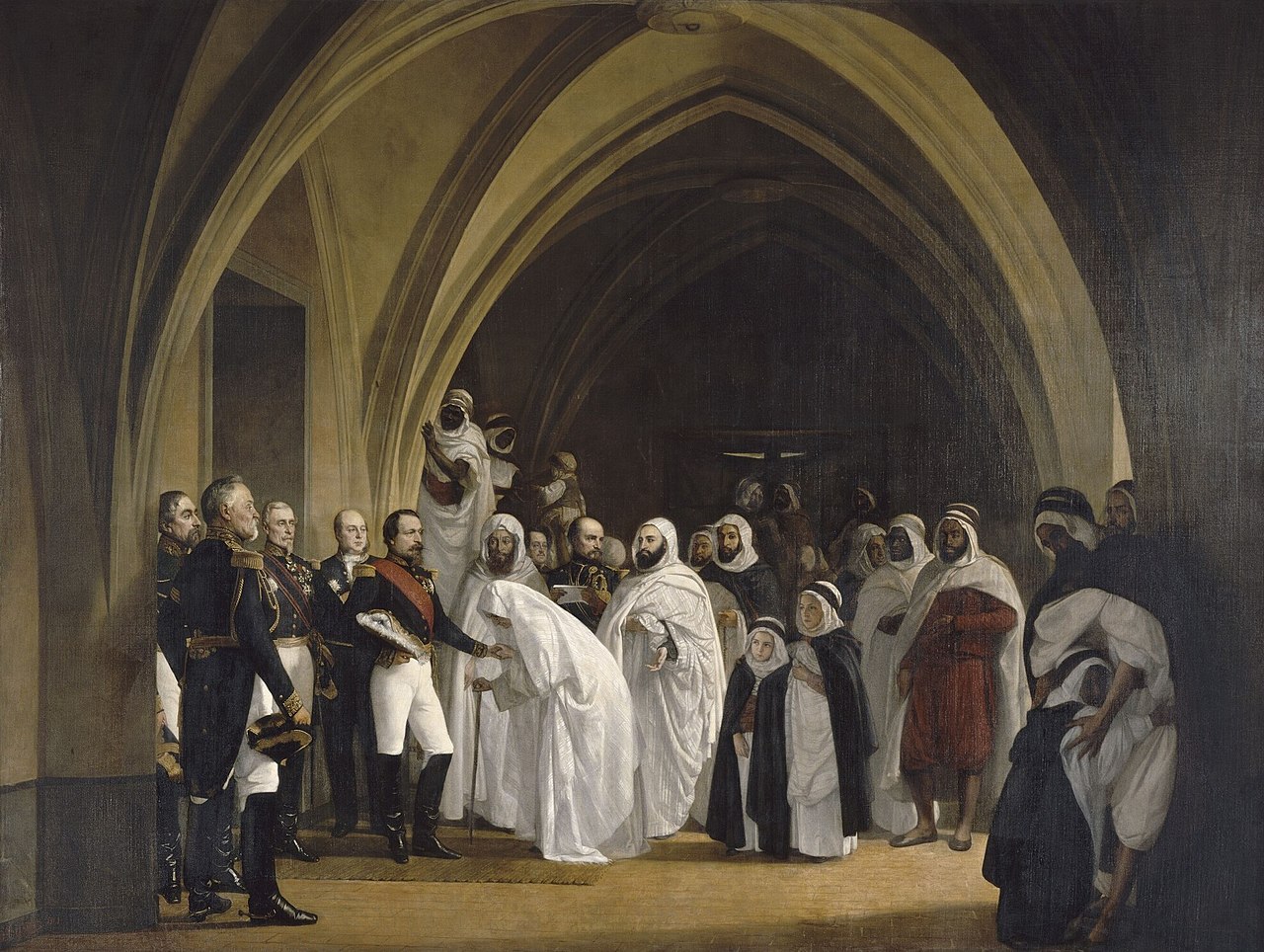
The beginnings of the second French colonial empire were laid in 1830 with the French invasion of Algeria, which was fully conquered by 1903. Historian Ben Kiernan estimates that 825,000 Algerians died during the conquest by 1875.
Africa (second empire)
Morocco
The French Colonial Empire established a protectorate in Morocco between the years of 1912 to 1956. France's general approach to governing the protectorate of Morocco was a policy of in-direct rule where they co-opted existing governance systems to control the protectorate. Specifically, the Moroccan elite and Sultan were both left in control while being strongly influenced by the French government.
French colonialism in Morocco was discriminatory against native Moroccans and highly detrimental to the Moroccan economy. Moroccans were treated as second class citizens and discriminated against in all aspects of colonial life. Infrastructure was discriminatory in colonial Morocco. The French colonial government built 36.5 kilometers of sewers in the new neighborhoods created to accommodate new French settlers while only 4.3 kilometers of sewers were built in indigenous Moroccan communities. Additionally, land in Morocco was far more expensive for Moroccans than for French settlers. For example, while the average Moroccan had a plot of land 50 times smaller than their French settler counterparts, Moroccans were forced to pay 24% more per hectare. Moroccans were additionally prohibited from buying land from French settlers.
Colonial Morocco's economy was designed to benefit French businesses at the detriment of Moroccan laborers. Morocco was forced to import all of its goods from France despite higher costs. Additionally, improvements to agriculture and irrigation systems in Morocco exclusively benefited colonial agriculturalists while leaving Moroccan farms at a technological disadvantage.
Between the years of 1914 to 1921 the Zaian Confederation of Berber Tribes, primarily from the Atlas Mountain region of Morocco, staged an armed resistance against French colonial control. The outbreak of World War One prevented the French from committing fully to the conflict, and thus the French forces suffered high losses. For example, at the Battle of El Herri in 1914, 600 French soldiers were killed. The fighting was primarily characterized by Guerrilla warfare. The Zaian forces additionally received military and economic support from the Central Powers.
The Berber independence leader Abd el-Krim (1882–1963) organized armed resistance against the Spanish and French for control of Morocco. The Spanish had faced unrest off and on from the 1890s, but in 1921 Spanish forces were massacred at the Battle of Annual. El-Krim founded an independent Rif Republic that operated until 1926 but had no international recognition. Paris and Madrid agreed to collaborate to destroy it. They sent in 200,000 soldiers, forcing el-Krim to surrender in 1926; he was exiled in the Pacific until 1947. Morocco became quiet, and in 1936 became the base from which Francisco Franco launched his revolt against Madrid.
Tunisia
The French protectorate of Tunisia lasted from 1881 to 1956. The protectorate was initially established after the successful invasion of Tunisia in 1881. The groundwork for occupation was laid on April 24, 1881, when the French deployed 35,000 troops from Algeria to invade several Tunisian cities.
As in Morocco, the French governed indirectly and preserved the existing government structure. The bey remained an absolute monarch, Tunisian ministers were still appointed, although they were both subject to French authority. Over time, the French gradually weakened the existing structures of power and centralized power into a French colonial administration.
French West Africa
French West Africa was a confederation of eight other French colonial territories including French Mauritania, French Senegal, French Guinea, French Ivory Coast, French Niger, French Upper Volta, French Dahomey, French Togoland, and French Sudan.
At the beginning of Napoleon III's reign, the presence of France in Senegal was limited to a trading post on the island of Gorée, a narrow strip on the coast, the town of Saint-Louis, and a handful of trading posts in the interior. The economy had largely been based on the slave trade, carried out by the rulers of the small kingdoms of the interior, as well as elite families, until France abolished slavery in its colonies in 1848. In 1854, Napoleon III named an enterprising French officer, Louis Faidherbe, to govern and expand the colony, and to give it the beginning of a modern economy. Faidherbe built a series of forts along the Senegal River, formed alliances with leaders in the interior, and sent expeditions against those who resisted French rule. He built a new port at Dakar, established and protected telegraph lines and roads, followed these with a rail line between Dakar and Saint-Louis and another into the interior. He built schools, bridges, and systems to supply fresh water to the towns. He also introduced the large-scale cultivation of Bambara groundnuts and peanuts as a commercial crop. Reaching into the Niger valley, Senegal became the primary French base in West Africa and a model colony. Dakar became one of the most important cities of the French Empire and of Africa.
French Equatorial Africa
French Equatorial Africa was a confederation of French colonial possessions in the Sahel and Congo River regions of Africa. Colonies included in French Equatorial Africa include French Gabon, French Congo, Ubangui-Shari, and French Chad.