
The Directory (also called Directorate; French: le Directoire [diʁɛktwaʁ] ) was the system of government established by the French Constitution of
1795. It takes its name from the committee of five men vested with executive power. The Directory governed the French First Republic from 26 October 1795 (4 Brumaire an IV) until 9 November 1799, when it was overthrown by Napoleon Bonaparte in the Coup of 18 Brumaire and replaced by the Consulate.
The Directory was continually at war with foreign coalitions, including Britain, Austria, Prussia, the Kingdom of Naples, Russia and the Ottoman Empire. It annexed Belgium and the left bank of the Rhine, while Bonaparte conquered a large part of Italy. The Directory established 29 short-lived sister republics in Italy, Switzerland and the Netherlands. The conquered cities and states were required to send France huge amounts of money, as well as art treasures, which were used to fill the new Louvre museum in Paris. An army led by Bonaparte tried to conquer Egypt and marched as far as Saint-Jean-d'Acre in Syria. The Directory defeated a resurgence of the War in the Vendée, the royalist-led civil war in the Vendée region, but failed in its venture to support the Irish Rebellion of 1798 and create an Irish Republic.

The French economy was in continual crisis during the Directory. At the beginning, the treasury was empty; the paper money, the assignat, had fallen to a fraction of its value, and prices soared. The Directory stopped printing assignats and restored the value of the money, but this caused a new crisis; prices and wages fell, and economic activity slowed to a standstill.
In its first two years, the Directory concentrated on ending the excesses of the Jacobin Reign of Terror; mass executions stopped, and measures taken against exiled priests and royalists were relaxed. The Jacobin political club was closed on 12 November 1794 and the government crushed an armed uprising planned by the Jacobins and an early socialist revolutionary, François-Noël Babeuf, known as "Gracchus Babeuf". But after the discovery of a royalist conspiracy including a prominent general, Jean-Charles Pichegru, the Jacobins took charge of the new Councils and hardened the measures against the Church and émigrés. They took two additional seats in the Directory, hopelessly dividing it.
In 1799, after several defeats, French victories in the Netherlands and Switzerland restored the French military position, but the Directory had lost all the political factions' support, including some of its Directors. Bonaparte returned from Egypt in October, and was engaged by Abbé Sieyès and others to carry out a parliamentary coup d'état on 9–10 November 1799. The coup abolished the Directory and replaced it with the French Consulate led by Bonaparte.
Background
The period known as the Reign of Terror began as a way of harnessing revolutionary fervour, but quickly degenerated into the settlement of personal grievances. On 17 September 1793, the Law of Suspects authorised the arrest of any suspected "enemies of freedom"; on 10 October, the National Convention recognised the Committee of Public Safety under Maximilien Robespierre as the supreme authority, and suspended the Constitution until "peace was achieved".
According to archival records, from September 1793 to July 1794 some 16,600 people were executed on charges of counter-revolutionary activity; another 40,000 may have been summarily executed or died awaiting trial. At its peak, the slightest hint of counter-revolutionary thoughts could place one under suspicion, and even his supporters began to fear their own survival depended on removing Robespierre. On 27 July, he and his allies were arrested and executed the next day.
In July 1794, the Convention established a committee to draft what became the 1795 Constitution. Largely designed by Pierre Daunou and Boissy d'Anglas, it established a bicameral legislature, intended to slow down the legislative process, ending the wild swings of policy under the previous unicameral systems. Deputies were chosen by indirect election, a total franchise of around 5 million voting in primaries for 30,000 electors, or 0.5% of the population. Since they were also subject to stringent property qualification, it guaranteed the return of conservative or moderate deputies.

The Directory was established after the Constitution of Year III which was adopted by a referendum on 24 September 1795, and constituted after the first elections which were held from 12–21 October 1795. On 25 October the National Convention held its last meeting; the Committee of Public Safety was dissolved or rather disappeared before the end of the month. On 31 October, in addition to Paul Barras, Jean-François Rewbell, Louis-Marie de La Révellière-Lépeaux, Étienne-François Le Tourneur and Emmanuel-Joseph Sieyès were chosen as Directors.
At the end of October a legislature consisting of the Council of 500 was created, responsible for drafting legislation, and Council of Ancients, an upper house containing 250 men over the age of 40, who would review and approve it. Executive power was in the hands of five Directors, selected by the Council of Ancients from a list provided by the lower house, with a five-year mandate. This was intended to prevent executive power being concentrated in the hands of one man.
D'Anglas wrote to the Convention:

We propose to you to compose an executive power of five members, renewed with one new member each year, called the Directory. This executive will have a force concentrated enough that it will be swift and firm, but divided enough to make it impossible for any member to even consider becoming a tyrant. A single chief would be dangerous. Each member will preside for three months; he will have during this time the signature and seal of the head of state. By the slow and gradual replacement of members of the Directory, you will preserve the advantages of order and continuity and will have the advantages of unity without the inconveniences.
Drafting the new Constitution
The 1789 Declaration of the Rights of Man and of the Citizen was attached as a preamble, declaring "the Rights of Man in society are liberty, equality, security, and property". It guaranteed freedom of religion, freedom of the press, and freedom of labour, but forbade armed assemblies and even public meetings of political societies. Only individuals or public authorities could tender petitions.
The judicial system was reformed, and judges were given short terms of office: two years for justices of the peace, five for judges of department tribunals. They were elected, and could be re-elected, to assure their independence from the other branches of government.

The new legislature had two houses, a Council of Five Hundred and a Council of Ancients with two hundred fifty members. Electoral assemblies in each canton of France, which brought together a total of thirty thousand qualified electors, chose representatives to an electoral assembly in each department, which then elected the members of both houses. The members of this legislature had a term of three years, with one-third of the members renewed every year. The Ancients could not initiate new laws, but could veto those proposed by the Council of Five Hundred.
The Constitution established a unique kind of executive, a five-man Directory chosen by the legislature. It required the Council of Five Hundred to prepare, by secret ballot, a list of candidates for the Directory. The Council of Ancients then chose, again by secret ballot, the Directors from that provided list. The Constitution required that Directors be at least forty years old. To assure gradual but continual change, one Director, chosen by lot, was replaced each year. Ministers for the various departments of State aided the Directors. These ministers did not form a council or cabinet and had no general powers of government.
The new Constitution sought to create a separation of powers; the Directors had no voice in legislation or taxation, nor could Directors or Ministers sit in either house. To assure that the Directors would have some independence, each would be elected by one portion of the legislature, and they could not be removed by the legislature unless they violated the law.

Under the new Constitution of 1795, to be eligible to vote in the elections for the Councils, voters were required to meet certain minimum property and residency standards. In towns with over six thousand population, they had to own or rent a property with a revenue equal to the standard income for at least one hundred fifty or two hundred days of work, and to have lived in their residence for at least a year. This ruled out a large part of the French population.
The greatest victim under the new system was the City of Paris, which had dominated events in the first part of the Revolution. On 24 August 1794, the committees of the sections of Paris, bastions of the Jacobins which had provided most of the manpower for demonstrations and invasions of the Convention, were abolished. Shortly afterwards, on 31 August, the municipality of Paris, which had been the domain of Danton and Robespierre, was abolished, and the city placed under direct control of the national government. When the Law of 19 Vendémiaire Year IV (11 October 1795), in application of the new Constitution, created the first twelve arrondissements of Paris, it established twelve new committees, one for each arrondissement. The city became a new department, the Department of the Seine, replacing the former Department of Paris created in 1790.
Political developments (July 1794 – March 1795)
Meanwhile, the leaders of the still ruling National Convention tried to meet challenges from both neo-Jacobins on the left and royalists on the right. On 21 September 1794, the remains of Jean-Paul Marat, whose furious articles had promoted the Reign of Terror, were placed with great ceremony in the Panthéon, while on the same day, the moderate Convention member Merlin de Thionville described the Jacobins as "A hangout of outlaws" and the "knights of the guillotine". Young men known as Muscadins, largely from middle-class families, attacked the Jacobin and radical clubs. The new freedom of the press saw the appearance of a host of new newspapers and pamphlets from the left and the right, such as the royalist L'Orateur du peuple edited by Stanislas Fréron, an extreme Jacobin who had moved to the extreme right, and at the opposite end of the spectrum, the Tribun du peuple, edited by Gracchus Babeuf, a former priest who advocated an early version of socialism. On 5 February 1795, the semi-official newspaper Le Moniteur Universel (Le Moniteur) attacked Marat for encouraging the bloody extremes of the Reign of Terror. Marat's remains were removed from the Panthéon two days later. The surviving Girondin deputies, whose leaders had been executed during the Reign of Terror, were brought back into the Convention on 8 March 1795.
The Convention tried to bring a peaceful end to the Catholic and royalist uprising in the Vendée. The Convention signed an amnesty agreement, promising to recognize the freedom of religion and allowing territorial guards to keep their weapons if the Vendéens would end their revolt. On a proposal from Boissy d'Anglas, on 21 February 1795 the Convention formally proclaimed the freedom of religion and the separation of church and state.
Foreign policy
Between July 1794 and the October 1795 elections for the new-style Parliament, the government tried to obtain international peace treaties and secure French gains. In January 1795 General Pichegru took advantage of an extremely cold winter and invaded the Dutch Republic. He captured Utrecht on 18 January, and on 14 February units of French cavalry captured the Dutch fleet, which was trapped in the ice at Den Helder. The Dutch government asked for peace, conceding Dutch Flanders, Maastricht and Venlo to France. On 9 February, after a French offensive in the Alps, Ferdinand III, Grand Duke of Tuscany signed a treaty with France. Soon afterwards, on 5 April, France signed a peace treaty, the Peace of Basel, with Prussia, where King Frederick William II was tired of the war; Prussia recognized the French occupation of the western bank of the Rhine. On 22 July 1795, a peace agreement, the "Treaty of Basel", was signed with Spain, where the French Revolutionary Army had marched as far as Bilbao in the War of the Pyrenees. By the time the Directory was chosen, the coalition against France was reduced to Britain and Austria, which hoped that Russia might be brought in on its side.
Failed Jacobin coup (May 1795) and rebellion in Brittany (June–July)
On 20 May 1795 (1 Prairial Year III), the Jacobins attempted to seize power in Paris. Following the model of Danton's seizure of the National Assembly in June 1792, a mob of sans-culottes invaded the meeting hall of the Convention at the Tuileries Palace, killed one deputy, and demanded that a new government be formed. This time the army moved swiftly to clear the hall. Several deputies who had taken the side of the invaders were arrested. The uprising continued the following day, as the sans-culottes seized the Hôtel de Ville as they had done in earlier uprisings, but with little effect; crowds did not move to support them. On the third day, 22 May, the army moved into and occupied the working-class neighborhood of the Faubourg Saint-Antoine. The sans-culottes were disarmed and their leaders were arrested. In the following days the surviving members of the Committee of Public Safety, the committee that had been led by Robespierre, were arrested, with the exception of Carnot and two others. Six of the deputies who had participated in the uprising and had been sentenced to death committed suicide before they were taken to the guillotine.
On 23 June 1795, the Chouans, royalist and Catholic rebels in Brittany, formed an army of 14,000 men near Quiberon. With the assistance of the British navy, a force of two thousand royalists was landed at Quiberon. The French army under General Lazare Hoche reacted swiftly, forcing the royalists to take refuge on the peninsula and then to withdraw. They surrendered on 21 July; 748 of the rebels were executed by firing squad.
Adoption of the new Constitution
The new Constitution of the Year III was presented to the Convention and debated between 4 July – 17 August 1795, and was formally adopted on 22 August 1795. It was a long document, with 377 articles, compared with 124 in the first French Constitution of 1793. Even before it took effect, however, the members of the Convention took measures to assure they would still have dominance in the legislature over the government. They required that in the first elections, two hundred and fifty new deputies would be elected, while five hundred members of the old Convention would remain in place until the next elections. A national referendum of eligible voters was then held. The total number of voters was low; of five million eligible voters, 1,057,390 electors approved the Constitution, and 49,978 opposed it. The proposal that two thirds of members of the old Convention should remain in place was approved by a much smaller margin, 205,498 to 108,754.
October 1795 royalist rebellion
The new Constitution of the Year III was officially proclaimed in force on 23 September 1795, but the new Councils had not yet been elected, and the Directors had not yet been chosen. The leaders of the royalists and constitutional monarchists chose this moment to try to seize power. They saw that the vote in favor of the new Constitution was hardly overwhelming. Paris voters were particularly hostile to the idea of keeping two-thirds of the old members of the Convention in the new Councils. A central committee was formed, with members from the wealthier neighborhoods of Paris, and they began planning a march on the center of the city and on the Tuileries, where the Convention still met.
The members of the Convention, very much experienced with conspiracies, were well aware that the planning was underway. A group of five republican deputies, led by Paul Barras, had already formed an unofficial directory, in anticipation of the creation of the real one. They were concerned about the National Guard members from western Paris, and were unsure about the military commander of Paris, General Jacques-François Menou. Barras decided to turn to military commanders in his entourage who were known republicans, particularly Napoleon Bonaparte, whom he had known when Bonaparte was successfully fighting the British in Toulon. Bonaparte, at this point a general of second rank in the Army of the Interior, was ordered to defend the government buildings on the right bank.
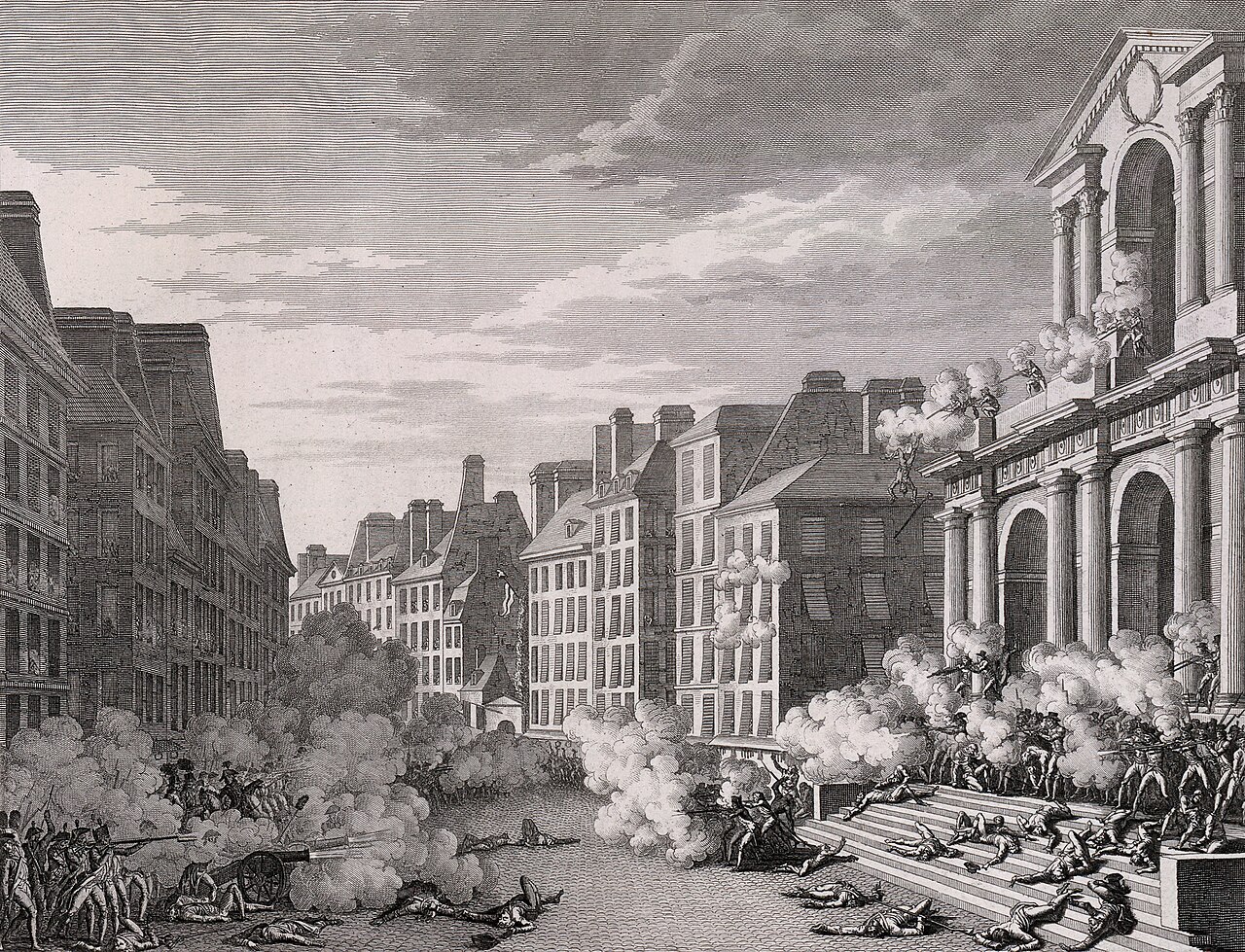
The armed royalist insurgents planned a march in two columns along both the right bank and left bank of the Seine toward the Tuileries. There on 5 October 1795, the royalists were met by the artillery of sous-lieutenant Joachim Murat at the Sablons and by Bonaparte's soldiers and artillery in front of the church of Saint-Roch. Over the next two hours, the "whiff of grapeshot" of Bonaparte's cannons and gunfire of his soldiers brutally mowed down advancing columns, killing some four hundred insurgents, and ending the rebellion. Bonaparte was promoted to General of Division on 16 October, and General in Chief of the Army of the Interior on 26 October. It was the last uprising to take place in Paris during the French Revolution.
History
Directory takes charge
Between 12 and 21 October 1795, immediately after the suppression of royalist uprising in Paris, the elections for the new Councils decreed by the new Constitution took place. 379 members of the old Convention, for the most part moderate republicans, were elected to the new legislature. To assure that the Directory did not abandon the Revolution entirely, the Council required that all of the members of the Directory be former members of the Convention and regicides, those who had voted for the execution of Louis XVI.
Due to the rules established by the Convention, a majority of members of the new legislature, 381 of 741 deputies, had served in the Convention and were ardent republicans, but a large part of the new deputies elected were royalists, 118 versus 11 from the left. The members of the upper house, the Council of Ancients, were chosen by lot from among all of the deputies.
On 31 October 1795, the Council of Ancients chose the first Directory from a list of candidates submitted by the Council of Five Hundred. One person elected, the Abbé Sieyès, refused to take the position, saying it didn't suit his interests or personality. A new member, Lazare Carnot, was elected in his place.
The members elected to the Directory were the following:
Paul François Jean Nicolas, vicomte de Barras, a member of a minor noble family from Provence, Barras had been a revolutionary envoy to Toulon, where he met the young Bonaparte, and arranged his promotion to captain. Barras had been removed from the Committee of Public Safety by Robespierre. Fearing for his life, Barras had helped organize the downfall of Robespierre. An expert at political intrigue, Barras became the dominant figure in the Directory. His leading opponent in the Directory, Carnot, described him as "without faith and without morals... in politics, without character and without resolution... He has all the tastes of an opulent prince, generous, magnificent and dissipated."
Louis Marie de La Révellière-Lépeaux was a fierce republican and anti-Catholic, who had proposed to execute Louis XVI after the flight to Varennes. He promoted the establishment of a new religion, theophilanthropy, to replace Christianity.
Jean-François Rewbell had an expertise in foreign relations, and was a close ally of Paul Barras. He was a firm moderate republican who had voted for the death of the king but had also opposed Robespierre and the extreme Jacobins. He was an opponent of the Catholic church and a proponent of individual liberties.
Étienne-François Le Tourneur was a former captain of engineers, and a specialist in military and naval affairs. He was a close ally within the Directory of Carnot.
Lazare Nicolas Marguerite Carnot took the place of Abbé Sieyés, who was elected by the Ancients but refused the position. Carnot was an army captain at the beginning of the Revolution, and when elected to the Convention became a member of the commission of military affairs, as well as a vocal opponent of Robespierre. He was an energetic and efficient manager, who restructured the French military and helped it achieve its first successes, earning him the title of "The Organizer of the Victory". Napoleon, who later made Carnot his Minister of War, described him as "a hard worker, sincere in everything, but without intrigues, and easy to fool."
The following day, the members of the new government took over their offices in the Luxembourg Palace, which had previously been occupied by the Committee of Public Safety. Nothing had been prepared, and the rooms had no furniture: they managed to find firewood to heat the room, and a table in order to work. Each member took charge of a particular sector: Rewbell diplomacy; Carnot and Le Tourneur military affairs, La Révellière-Lépeaux religion and public instruction, and Barras internal affairs.
The Council of Ancients was attributed the building at the Tuileries Palace formerly occupied by the Convention, while the Council of Five Hundred deliberated in the Salle du Manège, the former riding school west of the palace in the Tuileries Garden. One of the early decisions of the new parliament was to designate uniforms for both houses: the Five Hundred wore long white robes with a blue belt, a scarlet cloak and a hat of blue velour, while members of the Ancients wore a robe of blue-violet, a scarlet sash, a white mantle, and a violet hat.
Finance and economy
The new Director overseeing financial affairs, La Réveillière-Lépeaux, gave a succinct description of the financial state of France when the Directory took power: "The national Treasury was completely empty; not a single sou remained. The assignats were almost worthless; the little value which remained drained away each day with accelerated speed. One could not print enough money in one night to meet the most pressing needs of the next day.... The public revenues were nonexistent; citizens had lost the habit of paying taxes. [...] All public credit was dead and all confidence lost. [...] The depreciation of the assignats, the frightening speed of the fall, reduced the salary of all public employees and functionaries to a value which was purely nominal."
The drop in value in the money was accompanied by extraordinary inflation. The Louis d'or (gold coin), which was worth 2,000₶. in paper money at the beginning of the Directory, increased to 3,000₶. and then 5,000₶. The price of a liter of wine increased from 2₶.10s. in October 1795 to 10₶. and then 30₶. A measure of flour worth 2₶. in 1790 was worth 225₶. in October 1794.
The new government continued to print assignats, which were based on the value of property confiscated from the Church and the aristocracy, but it could not print them fast enough; even when it printed one hundred million in a day, it covered only one-third of the government's needs. To fill the treasury, the Directory resorted in December 1795 to a forced loan of 600 million-₶. from wealthy citizens, who were required to pay between 50₶. and 6,000₶. each.
To fight inflation, the government began minting more coins of gold and silver, which had real value; the government had little gold but large silver reserves, largely in the form of silverware, candlesticks and other objects confiscated from the churches and the nobility. It minted 72 million écus, and when this silver supply ran low, it obtained much more gold and silver through military campaigns outside of France, particularly from Bonaparte's army in Italy. Bonaparte demanded gold or silver from each city he conquered, threatening to destroy the cities if they did not pay.
These measures reduced the rate of inflation. On 19 February 1796, the government held a ceremony in the Place Vendôme to destroy the printing presses which had been used to produce huge quantities of assignats. This success produced a new problem: the country was still flooded with more than two billion four hundred million (2.400.000.000) assignats, claims on confiscated properties, which now had some value. Those who held assignats were able to exchange them for state mandates, which they could use to buy châteaux, church buildings and other biens nationaux (state property) at extremely reduced prices. Speculation became rampant, and property in Paris and other cities could change hands several times a day.
Another major problem faced by the Directory was the enormous public debt, the same problem that had led to the Revolution in the first place. In September–December 1797, the Directory attacked this problem by declaring bankruptcy on two-thirds of the debt, but assured payment on the other third. This resulted in the ruin of those who held large quantities of government bonds, but stabilized the currency. To keep the treasury full, the Directory also imposed new taxes on property owners, based on the number of fireplaces and chimneys, and later on the number of windows, of their residences. It refrained from adding more taxes on wine and salt, which had helped cause the 1789 revolution, but added new taxes on gold and silver objects, playing cards, tobacco, and other luxury products. Through these means, the Directory brought about a relative stability of finances which continued through the Directory and Consulate.
Food supply
The food supply for the population, and particularly for the Parisians, was a major economic and political problem before and during the Revolution; it had led to food riots in Paris and attacks on the Convention. To assure the supply of food to the sans-culottes in Paris, the base of support of the Jacobins, the Convention had strictly regulated grain distribution and set maximum prices for bread and other essential products. As the value of the currency dropped, the fixed prices soon did not cover the cost of production, and supplies dropped. The Convention was forced to abolish the maximum on 24 December 1794, but it continued to buy huge quantities of bread and meat which it distributed at low prices to the Parisians. This Paris food distribution cost a large part of the national budget, and was resented by the rest of the country, which did not have that benefit. By early 1796, the grain supply was supplemented by deliveries from Italy and even from Algeria. Despite the increased imports, the grain supply to Paris was not enough. The Ministry of the Interior reported on 23 March 1796 that there was only enough wheat to make bread for five days, and there were shortages of meat and firewood. The Directory was forced to resume deliveries of subsidized food to the very poor, the elderly, the sick, and government employees. The food shortages and high prices were one factor in the growth of discontent and the Gracchus Babeuf's uprising, the Conspiracy of the Equals, in 1796. The harvests were good in the following years and the food supplies improved considerably, but the supply was still precarious in the north, the west, the southeast, and the valley of the Seine.
Babeuf's Conspiracy of the Equals
In 1795, the Directory faced a new threat from the left, from the followers of François Noël Babeuf, a talented political agitator who took the name Gracchus and was the organizer of what became known as the Conspiracy of the Equals. Babeuf had, since 1789, been drawn to the Agrarian Law, an agrarian reform preconized by the ancient Roman brothers, Tiberius and Gaius Gracchus, of sharing goods in common, as means of achieving economic equality. By the time of the fall of Robespierre, he had abandoned this as an impractical scheme and was moving towards a more complex plan. Babeuf did not call for the abolition of private property, and wrote that peasants should own their own plots of land, but he advocated that all wealth should be shared equally: all citizens who were able would be required to work, and all would receive the same income. Babeuf did not believe that the mass of French citizens was ready for self-government; accordingly, he proposed a dictatorship under his leadership until the people were educated enough to take charge. "People!", Babeuf wrote. "Breathe, see, recognize your guide, your defender.... Your tribune presents himself with confidence."