
The Federated States of Micronesia ( , abbreviated FSM), or simply Micronesia, is an island country in Micronesia, a region of Oceania. The federation encompasses the majority of the Caroline Islands (excluding Palau) and consists of four states—from west to east: Yap, Chuuk, Pohnpei, and Kosrae—that span the western Pacific just north of the equator for a longitudinal distance of almost 2,700 km (1,700 mi). Together, the states comprise around 607 islands and a combined land area of approximately 702 km2 or 271 sq mi.
The entire island federation lies across the northern Pacific accordingly: northeast of Indonesia and Papua New Guinea, south of Guam and the Marianas, west of Nauru and the Marshall Islands, east of Palau and the Philippines, about 2,900 km (1,800 mi) north of eastern Australia, 3,400 km (2,100 mi) southeast of Japan, and some 4,000 km (2,485 mi) southwest of Honolulu of the Hawaiian Islands.
The country's total land area is relatively small, but its waters occupy nearly 3 million km2 (1.2 million mi2) of the Pacific Ocean, giving the country the 14th-largest exclusive economic zone in the world. The nation's capital is Palikir, on Pohnpei Island, and its largest city is Weno, an island municipality in the Chuuk Lagoon.

Each of its four states is centered on one or more main volcanic islands, and all but Kosrae include numerous outlying atolls. The FSM spreads across part of the Caroline Islands in the wider region of Micronesia, which region consists of thousands of small islands divided among several countries. The term Micronesia may refer to the Federated States of Micronesia or to the region as a whole.
The FSM was a part of the former Trust Territory of the Pacific Islands (TTPI), a United Nations Trust Territory administered by the United States from 1947 to 1994. On May 10, 1979, the islands ratified a constitutional government and then became a sovereign state after attaining independence on November 3, 1986—under a Compact of Free Association with the United States. Other neighboring island entities (also former members of the TTPI) also formed constitutional governments, becoming the Republic of the Marshall Islands and the Republic of Palau. The FSM has a seat in the United Nations and has been a member of the Pacific Community since 1983.
History
Early settlement and Nan Madol
The ancestors of the Micronesians settled over four thousand years ago. A decentralized chieftain-based system eventually evolved into a more centralized economic and religious culture centered on Yap Island.

Nan Madol, a UNESCO World Heritage Site, consisting of a series of small artificial islands linked by a network of canals, is often called the Venice of the Pacific. It is located on the eastern periphery of the island of Pohnpei and used to be the ceremonial and political seat of the Saudeleur dynasty that united Pohnpei's estimated 25,000 people from about AD 500 until 1500 when the centralized system collapsed.
European contact and colonial rule
European explorers—first the Portuguese in search of the Spice Islands (Indonesia) and then the Spanish—reached the Carolines in the sixteenth century. The Treaty of Tordesillas gave these lands to Spain and the Spanish incorporated the archipelago to the Spanish East Indies through the capital, Manila, and in the 19th century established several outposts and missions. In 1887, they founded the town of Santiago de la Ascensión in what today is Kolonia on the island of Pohnpei.
In the 1870s, Germany began extending its sphere of influence in the Caroline Islands, leading to the Carolines Question of 1885 in which Pope Leo XIII was asked to determine if Germany or Spain had authority over the islands. The result was a confirmation of Spanish authority over the islands, but Germany would have free access to the islands.
Following defeat in the Spanish–American War, the Spanish sold the archipelago to Germany in 1899 under the German–Spanish Treaty of 1899. Germany incorporated it into German New Guinea. (A few remote islands, notably Kapingamarangi, were not specifically named in the treaty, but this remained unnoticed until the late 1940s and, while acknowledging the historical curiosity in 1949, Spain has made no modern claims to the islands.)
During World War I, it was captured by Japan. Following the war, the League of Nations awarded a mandate for Japan to administer the islands as part of the South Seas Mandate.
World War II and the aftermath
Operation Hailstone
Truk Lagoon served as a significant base for the Imperial Japanese Navy during World War II. In February 1944, the U.S. Navy launched Operation Hailstone, a massive air and surface attack on Truk Lagoon. Over two days, U.S. carrier aircraft and surface vessels targeted Japanese warships, merchant vessels, and shore installations, resulting in the sinking of numerous ships and the destruction of hundreds of aircraft. This operation severely diminished Japan's naval capabilities in the Pacific.

U.S. administration under the United Nations
Following World War II, the islands of Micronesia were placed under the administration of the United States as part of the Trust Territory of the Pacific Islands. This arrangement was formalized on 2 April 1947, with the adoption of United Nations Security Council Resolution 21, which approved the terms of trusteeship for the Pacific Islands formerly under Japanese mandate.
Path to independence
On May 10, 1979, four of the Trust Territory districts ratified a new constitution to become the Federated States of Micronesia. Palau, the Marshall Islands, and the Northern Mariana Islands chose not to participate. The FSM signed a Compact of Free Association with the United States, which entered into force on November 3, 1986, marking Micronesia's emergence from trusteeship to independence. Independence was formally concluded under international law in 1990, when the United Nations officially ended the Trusteeship status pursuant to Security Council Resolution 683. The Compact was renewed in 2004.
In February 2021, due to a bitter leadership dispute, the Federated States of Micronesia announced it would quit the Pacific Islands Forum in its formal process of withdrawal. However, in June 2022, the Suva Agreement was reached and the Federated States of Micronesia agreed to remain in the forum.

Politics
The Federated States of Micronesia is governed by the 1979 constitution, which guarantees fundamental human rights and establishes a separation of governmental powers. This constitution structures the national government to be similar to—but not exactly like—that of the United States. The unicameral Congress has fourteen members elected by popular vote. Four senators—one from each state—serve four-year terms; the remaining ten senators represent single-member districts based on population and serve two-year terms. Congress elects the President and Vice President from among the four state-based senators to serve four-year terms in the executive branch. Their congressional seats are then filled by special elections.
An appointed cabinet supports the president and vice president. There are no formal political parties.
Defense and foreign affairs
In international politics, the Federated States of Micronesia has often voted with the United States concerning United Nations General Assembly resolutions.

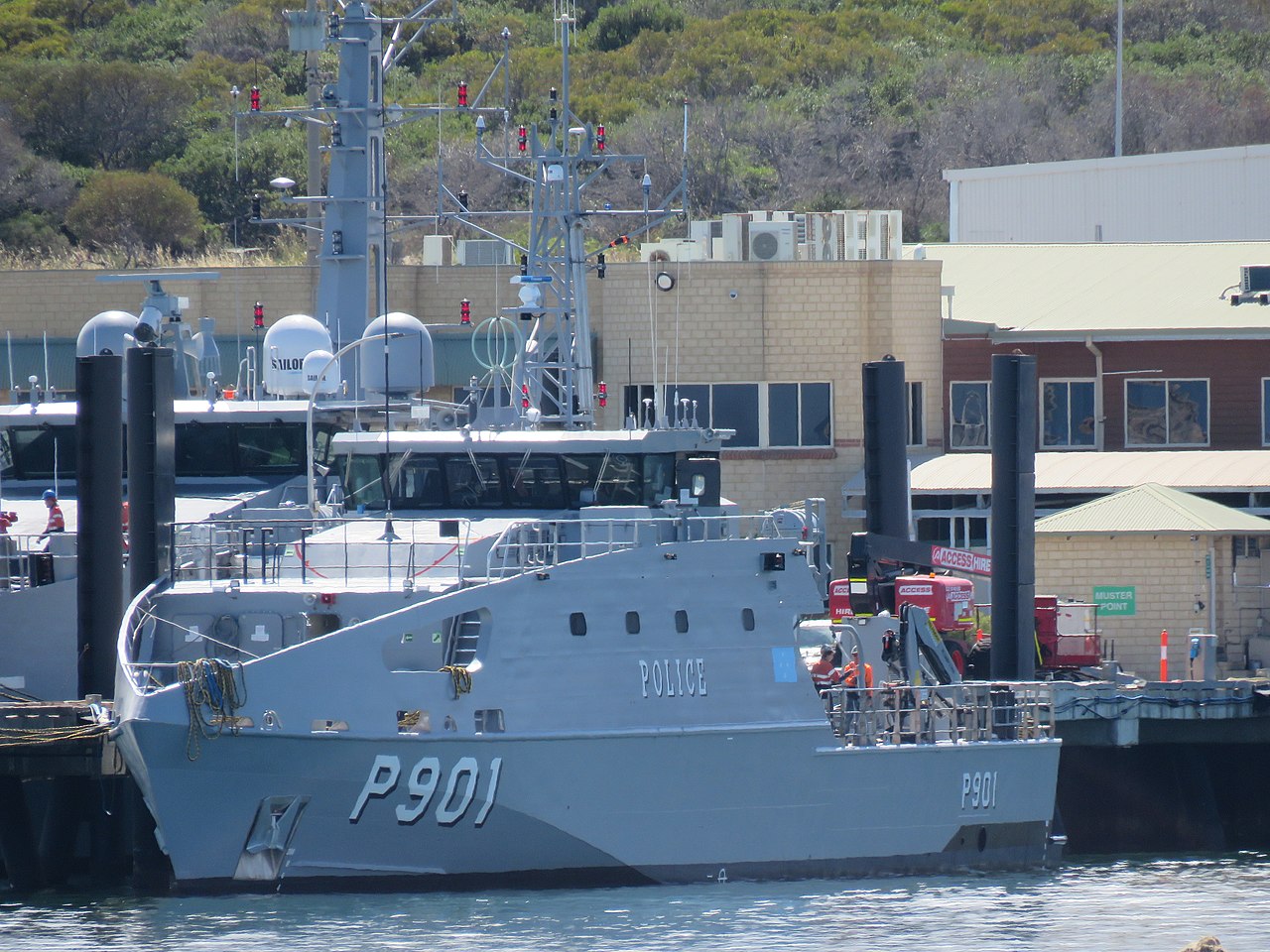
The FSM is a sovereign, self-governing state in free association with the United States of America, which is wholly responsible for its defense. The FSM National Police operates a Maritime Wing Unit. The Compact of Free Association allows FSM citizens to join the U.S. military without having to obtain U.S. permanent residency or citizenship, allows for immigration and employment for Micronesians in the U.S., and establishes economic and technical aid programs.
The FSM has foreign relations with 56 countries, including the Holy See and the Sovereign Military Order of Malta. FSM was admitted to the United Nations based on the Security Council's recommendation on August 9, 1991, in Resolution 703 and the General Assembly's approval on September 17, 1991, in Resolution 46/2. The FSM was an active member of the Pacific Islands Forum. However, in February 2021, FSM announced it would be formally withdrawing from the Forum in a joint statement with Marshall Islands, Kiribati, and Nauru after a dispute regarding Henry Puna's election as the Forum's secretary-general. In February 2022, following the Russian invasion of Ukraine, FSM severed its diplomatic relations with Russia and called the invasion "unjustified and brutal".
States
The four states in the federation are, from west to east:
These states are further divided into municipalities.
Geography
The Federated States of Micronesia consists of 607 islands extending 2,900 km (1,802 mi) across the archipelago of the Caroline Islands east of the Philippines. The islands have a combined area of 702 km2 (271 sq mi).
The islands are grouped into four states, which are Yap, Chuuk (called Truk until January 1990), Pohnpei (known as "Ponape" until November 1984), and Kosrae (formerly Kusaie). These four states are each represented by a white star on the national flag. The capital is Palikir, on Pohnpei.
Two terrestrial ecoregions lie within the country's borders: Carolines tropical moist forests and Yap tropical dry forests. It had a 2019 Forest Landscape Integrity Index mean score of 7.55/10, ranking it 37th globally out of 172 countries.
Biodiversity
The Federated States of Micronesia (FSM) is recognized as a biodiversity hotspot, hosting approximately 3,025 animal species and 1,553 plant species. The diversity of terrestrial plants and animals within the FSM varies from east to west due to differences in climate, geology, topography, and geographical isolation.
Over 457 plant species have been introduced to the islands of the FSM by early Micronesians and subsequent settlers. The FSM comprises 607 islands extending 2,900 km across the Caroline Islands, with a combined area of 702 km2. The FSM has 58 Key Biodiversity Areas.
The region is characterized by thousands of isolated small coral atolls and higher volcanic islands, contributing to its high biodiversity. The FSM's National Biodiversity Strategy and Action Plan outlines efforts to protect and conserve its rich biodiversity. The FSM's marine biodiversity is under pressure due to growing population demands, leading to increased degradation of marine resources.
Climate
The Federated States of Micronesia has a tropical rainforest climate (Köppen: Af). The weather is warm, humid and rainy all year round. The islands are located north of the equator and are affected by constant trade winds, which temper the climate. Minimum temperatures range all year round between 22 and 25 °C, and maximum temperatures between 30 and 32 °C. The abundant precipitations oscillate between 2500 and 5000 mm per year, although in the faces oriented to the wind they can surpass 6000 mm. Mount Nahnalaud, only 750 m high, on the island of Pohnpei, receives an average of 10,160 mm, being one of the rainiest places on earth, with almost always overcast skies. In general, the rains are produced by showers and storms of short duration but very intense. The driest places are the flat atolls, where rainfall can drop below 3,000 mm. The driest months are January and February, with no less than 250 mm and 20 days of rain.
Climate patterns in the FSM are also affected by the El Niño-Southern Oscillation, leading to considerable variability in weather conditions from year to year. During El Niño events, the region may experience increased rainfall and storm activity, while La Niña events can bring drier conditions and potential droughts.
Transportation
The Federated States of Micronesia is served by four international airports.
Pohnpei International Airport, on the main island of Pohnpei State.
Chuuk International Airport, located on the main island of Chuuk State.
Kosrae International Airport, located on the main island of Kosrae State.
Yap International Airport, located on the main island of Yap State.
Economy
Economic activity in the Federated States of Micronesia consists primarily of subsistence farming and fishing. The islands have few mineral deposits worth exploiting, except for high-grade phosphate. Long line fishing of tuna is also viable with foreign vessels from China that operated in the 1990s. The potential for a tourist industry exists, but the remoteness of the location and a lack of adequate facilities hinder development. Financial assistance from the U.S. is the primary source of revenue, with the U.S. pledged to spend $1.3 billion in the islands in 1986–2001; when the Compact was amended in 2004, the United States committed to providing $110 million in development aid through 2023. The CIA World Factbook lists high dependence on U.S. aid as one of the main concerns of the FSM. Geographical isolation and a poorly developed infrastructure are major impediments to long-term growth.
Society
Demographics
The indigenous population of the nation, which is predominantly Micronesian, consists of various ethnolinguistic groups. It has a nearly 100% Pacific Islander and Asian population: Chuukese 48.8%, Pohnpeian 24.2%, Kosraean 6.2%, Yapese 5.2%, Yap outer islands 4.5%, Asian 1.8%, Polynesian 1.5%, other 6.4%, unknown 1.4%. A sizable minority also have some Japanese ancestry, which is a result of intermarriages between Japanese settlers and Micronesians during the Japanese colonial period.
There is also a growing expatriate population of Americans, Australians, Europeans, and residents from China and the Philippines since the 1990s. English has become the common language of the government, and for secondary and tertiary education. Outside of the main capital towns of the four FSM states, the local languages are primarily spoken. Spanish is offered at the university and the international secondary school. Growth remains high at more than 3% annually, offset somewhat by net emigration.
Languages
English is the official and common language. Aside from English, the following Austronesian languages are spoken:
Religion
The people of the Federated States of Micronesia are 97% Christian. More than half of the population follows the Catholic Church (55%) and about 42% follow various Protestant Christian groups. In general this is due to Spanish and German colonial history. Spanish rule meant that a large part of the population remained Catholic. During the German colonial period, until 1914, Catholic and Protestant missionaries from the German Empire were deployed. Several Protestant denominations, as well as the Roman Catholic Church, are present in every Micronesian state. Most Protestant groups trace their roots to American Congregationalist missionaries. On the island of Kosrae, the population is approximately 7,800; 95 percent are Protestants. On Pohnpei, the population of 35,000 is evenly divided between Protestants and Catholics. Most immigrants are Filipino Catholics who have joined local Catholic churches, e.g. Our Lady of Mercy Catholic Church in Pohnpei.
On Chuuk and Yap, an estimated 60 percent are Catholic and 40 percent are Protestant. Religious groups with small followings include Baptists, Assemblies of God, Salvation Army, Seventh-day Adventists, Jehovah's Witnesses, The Church of Jesus Christ of Latter-day Saints (Mormons), and the Baháʼí Faith. There is a small group of Buddhists on Pohnpei, and a small group of Ahmadiyya Muslims in both Pohnpei and Kosrae. Attendance at religious services is generally high; churches are well supported by their congregations and play a significant role in civil society.