
Falun Gong, also called Falun Dafa, is a new religious movement founded by Li Hongzhi in China in the early 1990s. Falun Gong has its global headquarters in Dragon Springs, a 173-hectare (427-acre) compound in Deerpark, New York, United States, near the residence of Li.
Falun Gong emerged from the qigong movement in China in 1992, combining meditation, qigong exercises, and moral teachings rooted in Buddhist and Taoist traditions. While initially supported by some government agencies in China, Falun Gong's rapid growth and independence from state control led several top officials in China to perceive it as a threat, resulting in periodic acts of harassment in the late 1990s. On 25 April 1999, over 10,000 Falun Gong practitioners gathered peacefully outside the central government compound in Beijing, seeking official recognition of the right to practice their faith without interference.
In July 1999, the government of China implemented a ban on Falun Gong, categorizing it as an "illegal organization". Mass arrests, widespread torture and abuses followed. In 2008, U.S. government reports cited estimates that as much as half of China's labor camp population was made up of Falun Gong practitioners. In 2009, human rights groups estimated that at least 2,000 Falun Gong practitioners had died from persecution by that time. Falun Gong practitioners also face systematic societal discrimination in employment, education, housing, and business opportunities. Prior to its 1999 ban on Falun Gong, the Chinese government estimated there were 70 million adherents. In 2009, Falun Gong sources estimated that tens of millions continue to practice privately. A 2017 Freedom House report estimated there were between 7 and 20 million practitioners in China at the time.

Led by Li Hongzhi, Falun Gong practitioners operate a variety of organizations in the United States and elsewhere, including the dance troupe Shen Yun. The Falun Gong also operates the Epoch Media Group, which is known for its subsidiaries, New Tang Dynasty Television and The Epoch Times newspaper. The latter has been broadly noted as a politically far-right media entity, and it has received significant attention in the United States for promoting conspiracy theories, such as QAnon and anti-vaccine misinformation, and producing advertisements for U.S. President Donald Trump. It has also drawn attention in Europe for promoting far-right politicians, primarily in France and Germany. The media have noted Falun Gong's opposition to the Chinese Communist Party (CCP), its negative views on homosexuality and feminism, and its objections to evolution.
Beliefs and practices
Falun Gong is based around the teachings of its founder and leader, Li Hongzhi. According to NBC News, "To his followers, Li is a God-like figure who can levitate, walk through walls and see into the future. His ultra-conservative and controversial teachings include a rejection of modern science, art and medicine, and a denunciation of homosexuality, feminism and general worldliness."
According to French sociologist David A. Palmer, four main themes dominate the sacred writings (jing) of Li Hongzhi. First, an "apocalyptic" theme that emphasize the moral decline of humanity and includes claims that extraterrestrial beings are influencing humanity through modern science. Second, a theme of "rigorous spiritual discipline", in which Li calls on his followers to eliminate worldly attachments and "purify" themselves. Third, a "messianic" theme in which Li is presented as an "omniscient and omnipotent saviour of the entire universe" who revealed the "fundamental law of the universe", understood as the only tool to protect against the apocalypse. Fourth, the "sectarian practise" where followers must follow Falun Gong exclusively and it is forbidden to engage with other religions, philosophy or other schools of Qigong.
According to David Ownby, then-employed as an anthropology professor at the Université de Montréal, Li appreciates the achievements of modern science but argues that it is incapable of understanding higher spiritual realities, multiple dimensions, and the ultimate nature of the universe. Ownby also noted that many leadership positions among Falun Gong practitioners are occupied by women.
Central teachings
According to the Falun Gong, the Falun Gong aspires to enable the practitioner to ascend spiritually through moral rectitude and the practice of a set of exercises and meditation. The three stated tenets of the belief are truthfulness (Chinese: 真; pinyin: Zhēn), compassion (Chinese: 善; pinyin: Shàn), and forbearance (Chinese: 忍; pinyin: Rěn). These principles are regarded within Falun Gong as the fundamental nature of the cosmos, the criteria for differentiating right from wrong, and are held to be the highest manifestations of the Tao. Adherence to and cultivation of these virtues is regarded as a fundamental part of Falun Gong practice. According to Li, humanity was once in harmony with these concepts (which are the fundamental characteristics of the universe) but descended to the ordinary level, in which humanity is a state characterized by unpleasantness, filthiness, and degradation.
Some commentators argue that Falun Gong practitioners tend to emphasize these core principles when speaking to outsiders while downplaying the more controversial aspects of Li's teachings, including his supernatural cosmology. Li has instructed his followers to avoid discussing such teachings in external settings.

In Zhuan Falun (轉法輪), the foundational text published in 1995, Li Hongzhi writes, "It doesn't matter how mankind's moral standard changes [...] The nature of the cosmos doesn't change, and it is the only standard for determining who's good and who's bad. So to be a cultivator you have to take the nature of the cosmos as your guide for improving yourself."
Practice of Falun Gong consists of two features: performance of the exercises, and the refinement of one's xinxing (moral character, temperament). In Falun Gong's central text, Li states that xinxing "includes virtue (which is a type of matter), it includes forbearance, it includes awakening to things, it includes giving up things—giving up all the desires and all the attachments that are found in an ordinary person—and you also have to endure hardship, to name just a few things." The elevation of one's moral character is achieved, on the one hand, by aligning one's life with truth, compassion, and tolerance; and on the other, by abandoning desires and "negative thoughts and behaviors, such as greed, profit, lust, desire, killing, fighting, theft, robbery, deception, jealousy, etc."
Among the central concepts found in the teachings of Falun Gong is the existence of 'Virtue' (Chinese: 德; pinyin: Dé) and 'Karma' (Chinese: 業; pinyin: Yè). The former is generated through doing good deeds and suffering, while the latter is accumulated through doing wrong deeds. A person's ratio of karma to virtue is said to determine their fortunes in this life or the next. While virtue engenders good fortune and enables spiritual transformation, an accumulation of karma results in suffering, illness, and alienation from the nature of the universe. In Falun Gong teachings, karma accumulates as a black substance in the body. Spiritual elevation is achieved through the elimination of negative karma and the accumulation of virtue. Through cultivating truthfulness, compassion, forbearance and practicing qigong, practitioners can turn the black substance into a white substance, eliminating the root cause of illness and leading to Consummation. (yuanman). Practitioners believe that through a process of moral cultivation, one can achieve Tao and obtain special powers and a level of divinity.

Falun Gong's teachings posit that human beings are originally and innately good—even divine—but that they descended into a realm of delusion and suffering after developing selfishness and accruing karma. The practice holds that reincarnation exists, with the cycle of rebirth shaped by the accumulation of karma—a concept somewhat analogous to the Christian notion of "reaping what one sows." This perspective helps explain the perceived unfairness of differences among individuals, such as between the rich and the poor, while also encouraging moral behavior despite these inequalities. To re-ascend and return to the "original, true self", Falun Gong practitioners are supposed to assimilate themselves to the qualities of truthfulness, compassion and tolerance, let go of "attachments and desires" and suffer to repay karma.
Traditional Chinese cultural thought and opposition to modernity are two focuses of Li Hongzhi's teachings. Falun Gong echoes traditional Chinese beliefs that humans are connected to the universe through mind and body, and Li seeks to challenge "conventional mentalities", concerning the nature and genesis of the universe, time-space, and the human body. The practice draws on East Asian mysticism and traditional Chinese medicine, but claims to have the power to heal incurable illnesses. Falun Gong describes modern science as too limited, and views traditional Chinese research and practice as valid.
Li says that he is a being who has come to help humankind from the destruction it could face as the result of rampant evil. When asked if he was a human being, Li replied "You can think of me as a human being." In Zhuan Falun, Li states that he cultivated supernatural powers starting at age eight. Zhuan Falun also promises practitioners supernatural powers such as "see[ing] through a wall or into a human body". Meanwhile, it states that these powers are byproducts of virtue cultivation, and should neither be sought after nor misused.

According to Yanfei Sun, a sociologist at China's state-run Zhejiang University, Li asserts that he possesses the ultimate truth of the universe, that he can assume incarnations to protect his followers, and that he can install a spinning wheel of energy in the abdomen of Falun Gong practitioners. Sun further stated that Li's teachings are syncretic, borrowing from existing traditions including Buddhism and Daoism. In particular, Falun Gong borrows heavily from Buddhist cosmology and soteriology but applies Li's idiosyncratic interpretation. According to Sun, Li asserts that the teachings of Buddhism and Daoism are confined to the Milky Way Galaxy, whereas Falun Gong's teachings are of the highest, universe-wide order.
French sociologist David Palmer writes that Li teaches that his "Dharma-bodies" (fashen) accompany disciples, and protect and heal them, and know everything that passes through their minds.
Palmer notes that participation in Falun Gong is voluntary, but writes that Li teaches that only he can guide practitioners to a "superior level". According to Palmer, Li instructed practitioners to be exclusive to Falun Gong and discouraged them from learning taichiquan or learning from other Qigong masters, whom he claimed most Qigong masters were "swindlers" and that practitioners wouldn't be able to tell which were the legitimate masters among them. Li had stated it is "forbidden to mix even the slightest thought of another Qigong method" to Falun Gong teachings and that combining different cultivation systems was described as a serious spiritual error. Li had taught that such mixing could interfere with the functioning of the "Falun" (law wheel) that he had installed in the lower abdomens of practitioners, and can lead to harmful consequences.

Exercises
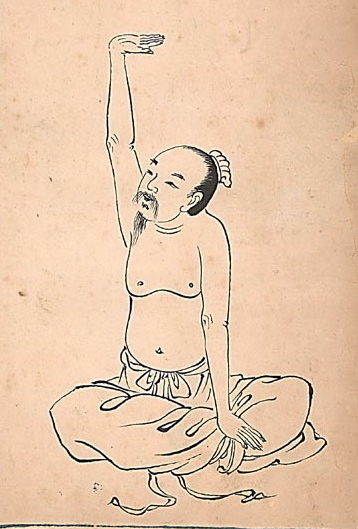
In addition to its moral philosophy, Falun Gong consists of four standing exercises and one sitting meditation. The exercises are regarded as secondary to moral elevation, though are still an essential component of Falun Gong cultivation practice.
The first exercises, called "Buddha Stretching a Thousand Arms", are intended to facilitate the free flow of energy through the body and open up the meridians. The second exercise, "Falun Standing Stance", involves holding four static poses—each of which resembles holding a wheel—for an extended period. The objective of this exercise is to "enhances wisdom, increases strength, raises a person's level, and strengthens divine powers". The third, "Penetrating the Cosmic Extremes", involves three sets of movements, which aim to enable the expulsion of bad energy (e.g., pathogenic or black qi) and the absorption of good energy into the body. Through practice of this exercise, the practitioner aspires to cleanse and purify the body. The fourth exercise, "Falun Cosmic Orbit", seeks to circulate energy freely throughout the body. Unlike the first through fourth exercises, the fifth exercise is performed in the seated lotus position. Called "Reinforcing Supernatural Powers", it is a meditation intended to be maintained as long as possible.
Falun Gong exercises can be practiced individually or in group settings, and can be performed for varying lengths of time in accordance with the needs and abilities of the individual practitioner. Porter writes that practitioners of Falun Gong are encouraged to read Falun Gong books and practice its exercises on a regular basis, preferably daily. Falun Gong exercises are practiced in group settings in parks, university campuses, and other public spaces in over 70 countries worldwide, and are taught for free by volunteers. In addition to five exercises, in 2001 another meditation activity was introduced called "sending righteous thoughts", which is intended to reduce persecution on the spiritual plane.
Discussions of supernatural skills also feature prominently within the qigong movement, and the existence of these skills gained a level of mainstream acceptance in China's scientific community in the 1980s.Falun Gong's teachings hold that practitioners can acquire supernatural skills through a combination of moral cultivation, meditation and exercises. These include—but are not limited to—precognition, clairaudience, telepathy, and divine sight (via the opening of the third eye or celestial eye). However, Falun Gong stresses that these powers can be developed only as a result of moral practice, and should not be pursued or casually displayed. According to David Ownby, Falun Gong teaches that "pride in one's abilities, or the desire to show off, are marks of dangerous attachments", and Li warns his followers not to be distracted by the pursuit of such powers.
On healing and medicine
Like most qigong practices, Falun Gong's concept of healing through both physical exercises and moral cultivation aligns with Chinese traditions. Practitioners are not encouraged to rely on Western medicine, but are not prohibited from using it. Many do seek out doctors and hospitals. According to Ownby, Falun Gong teachings on karma holds that illnesses are a consequence of a past wrongdoing, and suffering can function as a means of eliminating karma. Both Ownby and scholar Benjamin Penny argue that this framework explains Falun Gong's approach to illness and medical treatment, in which disease would be understood as something that needs to be endured or worked through rather than immediately treating through medicine. Penny states that "if disease comes from karma and karma can be eradicated through cultivation of "xinxing", then what good will medicine do?"
David Palmer writes that Falun Gong teaches that a true practitioner should not not take medicines in case of illness". Li had taught that medicine only alters the outward appearance but it does not truly resolve the "karmic debt". In order to repay one's karmic debt, one has to let the illness "follow its natural course" unless Li himself intervenes. It is also forbidden to try to heal others with Falun Gong. According to Li, a person who tries to heal others with Qigong will only absorb the patient's "morbid energy" into their body.
Social practices
Falun Gong differentiates itself from Buddhist monastic traditions in that it places great importance on participation in the secular world. Falun Gong practitioners are required to maintain regular jobs and family lives, to observe the laws of their respective governments, and are instructed not to distance themselves from society. An exception is made for Buddhist Bhikkhus and Bhikkhunīs, who are permitted to continue a monastic lifestyle while practicing Falun Gong.
As part of its emphasis on ethical behavior, Falun Gong's teachings prescribe a strict personal morality for practitioners. They are expected to do good deeds, and conduct themselves with patience and forbearance when encountering difficulties. For instance, Li stipulates that a practitioner of Falun Gong must "not hit back when attacked, not talk back when insulted." In addition, they must "abandon negative thoughts and behaviors", such as greed, deception, jealousy, etc. The teachings contain injunctions against smoking and the consumption of alcohol, as these are considered addictions that are detrimental to health and mental clarity. Practitioners of Falun Gong are forbidden to kill living things—including animals for the purpose of obtaining food—though they are not required to adopt a vegetarian diet.
In addition to these things, practitioners of Falun Gong must abandon a variety of worldly attachments and desires. In the course of cultivation practice, the student of Falun Gong aims to relinquish the pursuit of fame, monetary gain, sentimentality, and other entanglements. Li's teachings repeatedly emphasize the emptiness of material pursuits; although practitioners of Falun Gong are not encouraged to leave their jobs or eschew money, they are expected to give up the psychological attachments to these things.
Falun Gong doctrine counsels against participation in political or social issues. Excessive interest in politics is viewed as an attachment to worldly power and influence, and Falun Gong aims for transcendence of such pursuits. According to Hu Ping, "Falun Gong deals only with purifying the individual through exercise, and does not touch on social or national concerns. It has not suggested or even intimated a model for social change. Many religions [...] pursue social reform to some extent [...] but there is no such tendency evident in Falun Gong."
Sexual desire and lust are treated as attachments to be discarded, though Falun Gong students are still generally expected to marry and have families. All sexual relations outside the confines of monogamous, heterosexual marriage are regarded as immoral.
Li Hongzhi taught that homosexuality makes one "unworthy of being human", creates bad karma, and is comparable to organized crime. He also taught that "disgusting homosexuality shows the dirty abnormal psychology of the gay who has lost his ability of reasoning", and that homosexuality is a "filthy, deviant state of mind". Li additionally stated in a 1998 speech in Switzerland that the gods' "first target of annihilation would be homosexuals". Although gay, lesbian, and bisexual people may practice Falun Gong, founder Li stated that they must "give up the bad conduct" of all same-sex sexual activity.
Falun Gong's cosmology attributes different spiritual heavens to different ethnicities, and that individuals of mixed race lose some aspect of this connection. Falun Gong's teachings include belief in reincarnation and that one's soul (original spirit) always maintains single racial identity despite having a body of mixed race. Investigative journalist Ethan Gutmann noted that interracial marriage is common in the Falun Gong community.
French sociologist David Palmer reports Li has stated that "mixing the races of the world is not allowed" and described racial mixing as a "grave problem". Palmer further reports that Li claimed that "the white race has its Heaven, which occupies a tiny part of the universe", while "the yellow race has its Buddha-world and Tao-world" and fills "almost the whole universe". Palmer also cites Li stating that there is a physical and intellectual decline in mixed-race children, and that "modern science knows well that each generation is inferior to the preceding one".
Texts
Li Hongzhi authored the first book of Falun Gong teachings in April 1993; titled China Falun Gong, or simply Falun Gong, it is an introductory text that discusses qigong, Falun Gong's relationship to Buddhism, the principles of cultivation practice, and the improvement of moral character (xinxing). The book also provides illustrations and explanations of the exercises and meditation.
The main body of teachings is articulated in the book Zhuan Falun, published in Chinese in January 1995. The book is divided into nine "lectures", and was based on edited transcriptions of the talks Li gave throughout China in the preceding three years. Falun Gong texts have since been translated into an additional 40 languages.
The Falun Gong teachings use numerous untranslated Chinese religious and philosophical terms, and make frequent allusion to characters and incidents in Chinese folk literature and concepts drawn from Chinese folk religion. This, coupled with the literal translation style of the texts, which imitate the colloquial style of Li's speeches, can make Falun Gong scriptures difficult to approach for Westerners.
Symbols
The main symbol of the practice is the Falun (Dharma wheel, or Dharmacakra in Sanskrit). In Buddhism, the Dharmacakra represents the completeness of the doctrine. To "turn the wheel of dharma" (Zhuan Falun) means to preach the Buddhist doctrine, and is the title of Falun Gong's main text. Despite the invocation of Buddhist language and symbols, the law wheel as understood in Falun Gong has distinct connotations, and is held to represent the universe. It is conceptualized by an emblem consisting of one large and four small (counter-clockwise) swastika symbols, representing the Buddha, and four small Taiji (yin-yang) symbols of the Daoist tradition.
Dharma-ending period
French sociologist Palmer notes that a dominant theme of Li's writings are about the forces that brings about the apocalypse or the "end of the Dharma" (Mo Fa, 末法), which is marked by "unprecedented moral degeneration". Racial mixing, homosexuality, modern science, extraterrestrials, and feminism are commonly identified by Li as among the factors contributing to this degeneration. In particular, Li had claimed that "modern science is the greatest threat to humanity" and that it is a tool used by aliens to infiltrate mankind. Li taught that hundreds of thousands and even millions of years ago, there were past civilisations that were extremely advanced in technology, material and artistic development but because they had abandoned their morals, they caused the apocalypse. Li explains that during the apocalypse, all science and technology cease to exist, and civilization becomes destroyed with only a few survivors left to rebuild society again at the Stone age. Li had claimed this cycle had already occurred 81 times in Earth's history.
The current era is described in Falun Gong's teachings as the "Fa rectification" period (zhengfa, which might also be translated as "to correct the dharma"), a time of cosmic transition and renewal. The process of Fa rectification is necessitated by the moral decline and degeneration of life in the universe, and in the post-1999 context, the persecution of Falun Gong by the Chinese government has come to be viewed as a tangible symptom of this moral decay. Through the process of the Fa rectification, life will be reordered according to the moral and spiritual quality of each, with good people being saved and ascending to higher spiritual planes, and bad ones being eliminated or cast down. In this paradigm, Li assumes the role of rectifying the Dharma by disseminating through his moral teachings.
Some scholars, such as Maria Hsia Chang and Susan Palmer, have described Li's rhetoric about the "Fa rectification" and providing salvation "in the final period of the Last Havoc" as apocalyptic. However, Benjamin Penny, a professor of Chinese history at the Australian National University, argues that Li's teachings are better understood in the context of a "Buddhist notion of the cycle of the Dharma or the Buddhist law". Richard Gunde wrote that, unlike apocalyptic groups in the West, Falun Gong does not fixate on death or the end of the world, and instead "has a simple, innocuous ethical message". Li Hongzhi does not discuss a "time of reckoning", and has rejected predictions of an impending apocalypse in his teachings.
Extraterrestrials
According to Yanfei Sun, Falun Gong incorporates beliefs about extraterrestrials and prehistorical civilizations; these parascientific beliefs had come to China from the West at the time that Falun Gong was developing.
Li in the 1990s repeated claims that aliens were responsible for scientific inventions through the manipulation of scientists. For example, in a 1999 interview with Time, Li attributed the invention of computers and airplanes to extraterrestrials, as well as war and violence. However, his position on aliens seemed fairly inconsistent to observers Graeme Lang and Lu Yunfeng. In the Time interview, Li believed that aliens were attempting to replace humans through a cloning process, in which human bodies would be cloned with no soul, so that the aliens can replace the soul and inhabit human bodies (which to him are perfect).
Li Hongzhi alleged that extraterrestrials disguise themselves as humans to corrupt and manipulate humanity. According to an ABC investigation, while some practitioners stated that this was metaphorical, a former member said she was taught it as literal truth.
Categorization
Scholars describe Falun Gong as a new religious movement. While commonly described by scholars as a new religious movement, adherents may reject this term. Yuezhi Zhao describes Falun Gong as "a multifaceted and totalizing movement that means different things to different people, ranging from a set of physical exercises and a praxis of transformation to a moral philosophy and a new knowledge system."
In the cultural context of China, Falun Gong is generally described either as a system of qigong, or a type of "cultivation practice" (xiulian), a process by which an individual seeks spiritual perfection, often through both physical and moral conditioning. Varieties of cultivation practice are found throughout Chinese history, spanning Buddhist, Daoist, and Confucian traditions. Benjamin Penny writes "the best way to describe Falun Gong is as a cultivation system. Cultivation systems have been a feature of Chinese life for at least 2,500 years." Qigong practices can also be understood as a part of a broader tradition of "cultivation practice".
In the West, Falun Gong is frequently classified as a religion on the basis of its theological and moral teachings, its concerns with spiritual cultivation and transformation, and its extensive body of scripture. Falun Gong practitioners themselves have sometimes disavowed this classification, however. This rejection reflects the relatively narrow definition of "religion" in contemporary China. According to David Ownby, religion in China has been defined since 1912 to refer to "world-historical faiths" that have "well-developed institutions, clergy, and textual traditions"—namely, Buddhism, Daoism, Islam, Protestantism, and Catholicism. Moreover, if Falun Gong had described itself as a religion in China, it likely would have invited immediate suppression. These historical and cultural circumstances notwithstanding, the practice has often been described as a form of Chinese religion.
Media influence operations
The performance arts group Shen Yun and the media organization The Epoch Times are the major outreach organizations of Falun Gong. Both promote the spiritual and political teachings of Falun Gong. They and a variety of other organizations such as New Tang Dynasty Television (NTD) operate as extensions of Falun Gong. These extensions promote the new religious movement and its teachings. In the case of The Epoch Times, they also promote conspiracy theories such as QAnon and anti-vaccine misinformation and far-right politics in both Europe and the United States. Around the time of the 2016 United States presidential election, The Epoch Times began running articles supportive of Donald Trump and critical of his opponents. Falun Gong extensions have also been active in promoting the European radical right.
The exact financial and structural connections between Falun Gong, Shen Yun and The Epoch Times remains unclear. According to NBC News:
The Epoch Media Group, along with Shen Yun, a dance troupe known for its ubiquitous advertising and unsettling performances, make up the outreach effort of Falun Gong, a relatively new spiritual practice that combines ancient Chinese meditative exercises, mysticism and often ultraconservative cultural worldviews. Falun Gong's founder has referred to Epoch Media Group as "our media", and the group's practice heavily informs The Epoch Times' coverage, according to former employees who spoke with NBC News.
The Epoch Times, digital production company NTD and the heavily advertised dance troupe Shen Yun make up the nonprofit network that Li calls "our media". Financial documents paint a complicated picture of more than a dozen technically separate organizations that appear to share missions, money and executives. Though the source of their revenue is unclear, the most recent financial records from each organization paint a picture of an overall business thriving in the Trump era.