
Lutheranism or Evangelical Lutheranism is a major branch of Protestantism that arose under the work of Martin Luther, the 16th-century German friar and reformer whose efforts to reform the theology and practices of the Catholic Church helped launch the Reformation in 1517. The Lutheran churches adhere to the Bible and the ecumenical creeds, with Lutheran doctrine being explicated in the Book of Concord. Lutherans hold themselves to be in continuity with the apostolic church and affirm the writings of the Church Fathers and the first four ecumenical councils.
The schism between Roman Catholicism and Lutheranism, which was formalized in the Edict of Worms of 1521, centered on two points: the proper source of authority in the church, often called the formal principle of the Reformation, and the doctrine of justification, the material principle of Lutheran theology. Lutheranism advocates a doctrine of justification "by Grace alone through faith alone on the basis of Scripture alone", the doctrine that scripture is the final authority on all matters of faith. This contrasts with the belief of the Roman Catholic Church, defined at the Council of Trent, which contends that final authority comes from both Scripture and tradition. In Lutheranism, tradition is subordinate to Scripture and is cherished for its role in the proclamation of the Gospel.
The Lutheran churches retain many of the liturgical practices and sacramental teachings of the pre-Reformation Western Church, with a particular emphasis on the Eucharist, or Lord's Supper, although Eastern Lutheranism uses the Byzantine Rite. Though Lutherans are not dogmatic about the number of sacraments, three Lutheran sacraments are generally recognized including baptism, confession, and the eucharist. The Lutheran churches teach baptismal regeneration, that humans "are cleansed of our sins and born again and renewed in Holy Baptism by the Holy Ghost". Lutheranism teaches that sanctification begins at the time of justification and that Christians, as a result of their living faith, ought to do good works, which are rewarded by God. The act of mortal sin forfeits salvation, unless individuals turn back to God through faith. In the Lutheran churches, the Office of the Keys exercised through confession and absolution is the "authority which Christ has given to His Church on earth: to forgive the sins of the penitent sinners, but to retain the sins of the impenitent as long as they do not repent." The doctrine of the real presence of Christ in the Eucharist via a sacramental union is central to the Lutheran faith, with the Mass (also known as the Divine Service) being celebrated regularly, especially on the Lord's Day.

Lutheranism became the state church of many parts of Northern Europe, starting with Prussia in 1525. In Scandinavia, the Roman Catholic bishops largely accepted the Lutheran reforms and the church there became Lutheran in belief; the threefold ministry of bishops, priests, and deacons was continued. Lutheran divines who contributed to the development of Lutheran theology include Martin Luther, Martin Chemnitz, Philip Melanchthon, Joachim Westphal, Laurentius Petri, Olaus Petri, and Laurentius Andreae.
Lutheranism has contributed to Christian hymnody and the arts, as well as the development of education. Christian missions have been established by Lutherans in various regions. Lutheran churches operate a number of Lutheran schools, colleges and universities around the world, in addition to hospitals and orphanages. A number of Lutheran religious orders, as well as monasteries and convents, live in community to pray and work. Lutherans are found across all continents of the globe, numbering 90 million.
Etymology
The name Lutheran originated as a derogatory term used against Luther by German Scholastic theologian Johann Maier von Eck during the Leipzig Debate in July 1519. Eck and other Roman Catholics followed the traditional practice of naming a heresy after its leader, thus labeling all who identified with the theology of Martin Luther as Lutherans.
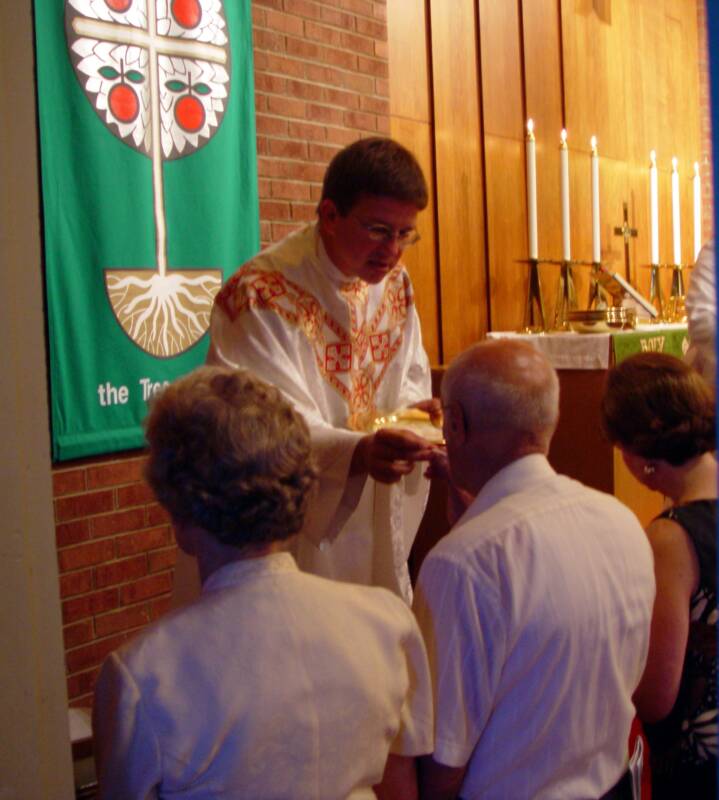
Evangelical Lutheranism derives from the word "evangelical" (derived from εὐαγγέλιον euangelion, a Greek word meaning "good news", i.e. "Gospel") and "Lutheran" in reference to Martin Luther, who contributed to the development of the tradition. Martin Luther always disliked the term Lutheran, preferring the term evangelical. The Evangelical Lutheran Catechism notes that the church uses the term "Evangelical" to show "her adherence to the pure evangelical or gospel doctrines, and to the Scriptures in general". The followers of John Calvin, Huldrych Zwingli, and other theologians linked to the Reformed tradition also used that term. To distinguish the two evangelical groups, others began to refer to the two groups as Evangelical Lutheran and Evangelical Reformed. As time passed by, the word Evangelical was not always used; Lutherans themselves began to use the term Lutheran in the middle of the 16th century, in order to distinguish themselves from other groups such as the Anabaptists and the Reformed (Calvinist) tradition. A large number of Evangelical-Lutheran denominations use the full form, such as the Evangelical Lutheran Church in Kenya, Wisconsin Evangelical Lutheran Synod, and Evangelical Lutheran Church of Finland. That being said, many personal opinions of Martin Luther were not adopted by the Lutheran churches in the Augsburg Confession (the primary confession of faith of the Lutheran tradition), and because Lutheranism retained much of the pre-Reformation liturgical and devotional practices, the Lutheran Reformation is generally considered to be the most conservative among the Protestant traditions.
In various parts of the world, the terms "Evangelical Lutheranism", "Evangelicalism", and "Lutheranism" are used to refer to the faith. A number of Evangelical-Lutheran denominations reference the Augsburg Confession in their names, such as the Evangelical Church of the Augsburg Confession in Poland, Evangelical Church of the Augsburg Confession in Slovakia, Protestant Church of the Augsburg Confession in Austria, among others.
In 1597, theologians in Wittenberg defined the title Lutheran as referring to the true church.
History
Lutheranism has its roots in the work of Martin Luther, who sought to reform the Western Church to what he considered a more biblical foundation. The reaction of the government and church authorities to the international spread of his writings, beginning with the Ninety-five Theses, divided Western Christianity. During the Reformation, Lutheranism became the state religion of numerous states of northern Europe, especially in northern Germany, Scandinavia, and the then-Livonian Order. Lutheran clergy became civil servants and the Lutheran churches became part of the state.
In 1521, the split between the Lutheran Church and the Roman Catholic Church was made public and clear with the Edict of Worms, in which the Diet condemned Luther and officially banned subjects of the Holy Roman Empire from defending or propagating Luther's ideas, facing advocates of Lutheranism with forfeiture of all property. Half of it would be then forfeited to the imperial government and the remaining half to the accusing party. In Scandinavia, the Roman Catholic bishops largely accepted the Lutheran reforms and the church there became Lutheran in belief; the threefold ministry of bishops, priests, and deacons was continued. The Evangelical-Lutheran Church saw itself as the true continuation of the Catholic Church, holding that the Church of Rome fell away from the catholic faith at the time of the Reformation; Evangelical-Lutheran divine Hermann Sasse summarizes Evangelical-Lutheran ecclesiology in the context of the Reformation and later developments:
...that the evangelical [Lutheran] church is none other than the medieval Catholic Church purged of certain heresies and abuses. The Lutheran theologian acknowledges that he belongs to the same visible church to which Thomas Aquinas and Bernard of Clairvaux, Augustine and Tertullian, Athanasius and Irenaeus once belonged. The orthodox evangelical [Lutheran] church is the legitimate continuation of the medieval Catholic Church, not the Church of Trent and the Vatican Council which renounced evangelical truth when it renounced the Reformation. For the orthodox evangelical [Lutheran] Church is really identical with the orthodox Catholic Church of all times.

Evangelical-Lutherans distinguished themselves with other streams of the Protestant Reformation, holding that while "the very nature of the Reformed Church emphasizes its strong opposition to the medieval church, so the very nature of the Lutheran Church requires it to go to the farthest possible limit in its insistence on its identity with the Catholic Church."
Spread to Northern Europe
Lutheranism spread through all of Scandinavia during the 16th century as the monarchs of Denmark–Norway and Sweden adopted the faith. Through Baltic-German and Swedish rule, Lutheranism also spread into Estonia and Latvia. It also began spreading into Lithuania Proper with practically all members of the Lithuanian nobility converting to Lutheranism or Calvinism, but at the end of the 17th century Protestantism at large began losing support due to the Counter-Reformation and religious persecutions. In German-ruled Lithuania Minor, however, Lutheranism remained the dominant branch of Christianity. Lutheranism played a crucial role in preserving the Lithuanian language.
Since 1520, regular Lutheran services have been held in Copenhagen. Under the reign of Frederick I (1523–1533), Denmark–Norway remained officially Catholic. Although Frederick initially pledged to persecute Lutherans, he soon adopted a policy of protecting Lutheran preachers and reformers, the most significant of which was Hans Tausen.
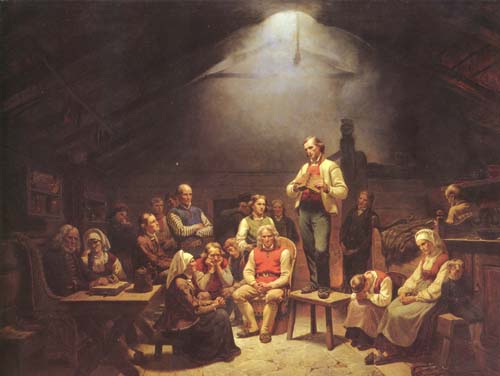
During Frederick's reign, Lutheranism made significant inroads in Denmark. At an open meeting in Copenhagen attended by King Christian III in 1536, the people shouted, "We will stand by the holy Gospel, and do not want such bishops anymore". Frederick's son was openly Lutheran, which prevented his election to the throne upon his father's death in 1533. However, following his victory in the civil war that followed, in 1536 he became Christian III and advanced the Reformation in Denmark–Norway.
The constitution upon which the Danish Norwegian Church, according to the Church Ordinance, should rest was "The pure word of God, which is the Law and the Gospel". It does not mention the Augsburg Confession. The priests had to understand the Holy Scripture well enough to preach and explain the Gospel and the Epistles to their congregations.
The youths were taught from Luther's Small Catechism, available in Danish since 1532. They were taught to expect at the end of life: "forgiving of their sins", "to be counted as just", and "the eternal life". Instruction is still similar.

The first complete Bible in Danish was based on Martin Luther's translation into German. It was published in 1550 with 3,000 copies printed in the first edition; a second edition was published in 1589. Unlike Catholicism, Lutheranism rejects the view that only the communion of the Bishop of Rome has been entrusted to interpret the "Word of God".
The Reformation in Sweden began with Olaus and Laurentius Petri, brothers who took the Reformation to Sweden after studying in Germany. They led Gustav Vasa, elected king in 1523, to Lutheranism. The pope's refusal to allow the replacement of an archbishop who had supported the invading forces opposing Gustav Vasa during the Stockholm Bloodbath led to the severing of any official connection between Sweden and the papacy in 1523.
Four years later, at the Diet of Västerås, the king succeeded in forcing the diet to accept his dominion over the national church. The king was given possession of all church properties, as well as the church appointments and approval of the clergy. While this effectively granted official sanction to Lutheran ideas, Lutheranism did not become official until 1593. At that time the Uppsala Synod declared Holy Scripture the sole guideline for faith, with four documents accepted as faithful and authoritative explanations of it: the Apostles' Creed, the Nicene Creed, the Athanasian Creed, and the unaltered Augsburg Confession of 1530. Mikael Agricola's translation of the first Finnish New Testament was published in 1548.
Counter-Reformation and controversies
After the death of Martin Luther in 1546, the Schmalkaldic War started out as a conflict between two German Lutheran rulers in 1547. Soon, Holy Roman Imperial forces joined the battle and conquered the members of the Schmalkaldic League, oppressing and exiling many German Lutherans as they enforced the terms of the Augsburg Interim. Religious freedom in some areas was secured for Lutherans through the Peace of Passau in 1552, and under the legal principle of Cuius regio, eius religio (the religion of the ruler was to dictate the religion of those ruled) and the Declaratio Ferdinandei (limited religious tolerance) clauses of the Peace of Augsburg in 1555.
Religious disputes among the Crypto-Calvinists, Philippists, Sacramentarians, Ubiquitarians, and Gnesio-Lutherans raged within Lutheranism during the middle of the 16th century. These finally ended with the resolution of the issues in the Formula of Concord. Large numbers of politically and religiously influential leaders met together, debated, and resolved these topics on the basis of Scripture, resulting in the Formula, which over 8,000 leaders signed. The Book of Concord replaced earlier, incomplete collections of doctrine, unifying all German Lutherans with identical doctrine and beginning the period of Lutheran Orthodoxy.
In lands where Catholicism was the state religion, Lutheranism was officially illegal, although enforcement varied. Until the end of the Counter-Reformation, some Lutherans worshipped secretly, such as at the Hundskirke (which translates as dog church or dog altar), a triangle-shaped Communion rock in a ditch between crosses in Paternion, Austria. The crowned serpent is possibly an allusion to Ferdinand II, Holy Roman Emperor, while the dog possibly refers to Peter Canisius. Another figure interpreted as a snail carrying a church tower is possibly a metaphor for the Protestant church. Also on the rock is the number 1599 and a phrase translating as "thus gets in the world".
Lutheran orthodoxy
The historical period of Lutheran Orthodoxy is divided into three sections: Early Orthodoxy (1580–1600), High Orthodoxy (1600–1685), and Late Orthodoxy (1685–1730). Lutheran scholasticism developed gradually, especially for the purpose of arguing with the Jesuits, and it was finally established by Johann Gerhard. Abraham Calovius represents the climax of the scholastic paradigm in orthodox Lutheranism. Other orthodox Lutheran theologians include Martin Chemnitz, Aegidius Hunnius, Leonhard Hutter, Nicolaus Hunnius, Jesper Rasmussen Brochmand, Salomo Glassius, Johann Hülsemann, Johann Conrad Dannhauer, Johannes Andreas Quenstedt, Johann Friedrich König, and Johann Wilhelm Baier.
Near the end of the Thirty Years' War, the compromising spirit seen in Philip Melanchthon rose up again in the Helmstedt School and especially in theology of Georgius Calixtus, causing the syncretistic controversy. Another theological issue that arose was the Crypto-Kenotic controversy.
Late orthodoxy was torn by influences from rationalism, philosophy based on reason, and Pietism, a revival movement in Lutheranism. After a century of vitality, the Pietist theologians Philipp Jakob Spener and August Hermann Francke warned that orthodoxy had degenerated into meaningless intellectualism and formalism, while orthodox theologians found the emotional and subjective focuses of Pietism to be vulnerable to Rationalist propaganda.
The last famous orthodox Lutheran theologian before the rationalist Aufklärung, or Enlightenment, was David Hollatz. Late orthodox theologian Valentin Ernst Löscher took part in the controversy against Pietistic Lutheranism. Medieval mystical traditions continued in the works of Martin Moller, Johann Arndt, and Joachim Lütkemann. Pietism became a rival of orthodoxy but adopted some devotional literature by orthodox theologians, including Arndt, Christian Scriver, and Stephan Prätorius.
Rationalism
Rationalist philosophers from France and England had an enormous impact during the 18th century, along with the German Rationalists Christian Wolff, Gottfried Leibniz, and Immanuel Kant. Their work led to an increase in rationalist beliefs, "at the expense of faith in God and agreement with the Bible".
In 1709, Valentin Ernst Löscher warned that this new Rationalist view of the world fundamentally changed society by drawing into question every aspect of theology. Instead of considering the authority of divine revelation, he explained, Rationalists relied solely on their personal understanding when searching for truth.
Johann Melchior Goeze (1717–1786), pastor of St. Catherine's Church in Hamburg, wrote apologetical works against Rationalists, including a theological and historical defence against the historical criticism of the Bible.
Dissenting Lutheran pastors were often reprimanded by the government bureaucracy overseeing them, for example, when they tried to correct Rationalist influences in the parish school. As a result of the impact of a local form of rationalism, termed Neology, by the latter half of the 18th century, genuine piety was found almost solely in small Pietist conventicles. However, some of the laity preserved Lutheran orthodoxy from both Pietism and rationalism by reusing old catechisms, hymnbooks, postils, and devotional writings, including those written by Johann Gerhard, Heinrich Müller and Christian Scriver.
Revivals
Luther scholar Johann Georg Hamann (1730–1788), a layman, became famous for countering Rationalism and striving to advance a revival known as the Erweckung, or Awakening. In 1806, Napoleon's invasion of Germany promoted Rationalism and angered German Lutherans, stirring up a desire among the people to preserve Luther's theology from the Rationalist threat. Those associated with this Awakening held that reason was insufficient and pointed out the importance of emotional religious experiences.
Small groups sprang up, often in universities, which devoted themselves to Bible study, reading devotional writings, and revival meetings. Although the beginning of this Awakening tended heavily toward Romanticism, patriotism, and experience, the emphasis of the Awakening shifted around 1830 to restoring the traditional liturgy, doctrine, and confessions of Lutheranism in the Neo-Lutheran movement.
This Awakening swept through all of Scandinavia except Iceland. It developed from both German Neo-Lutheranism and Pietism. Danish pastor and philosopher N. F. S. Grundtvig reshaped church life throughout Denmark through a reform movement beginning in 1830. He also wrote about 1,500 hymns, including God's Word Is Our Great Heritage.
In Norway, Hans Nielsen Hauge, a lay street preacher, emphasized spiritual discipline and sparked the Haugean movement, which was followed by the Johnsonian Awakening within the state-church as spearheaded by its namesake, dogmatician and Pietist Gisle Johnson. The Awakening drove the growth of foreign missions in Norway to non-Christians to a new height, which has never been reached since. In Sweden, Lars Levi Læstadius began the Laestadian movement that emphasized moral reform. In Finland, a farmer, Paavo Ruotsalainen, began the Finnish Awakening when he took to preaching about repentance and prayer.
In 1817, Frederick William III of Prussia ordered the Lutheran and Reformed churches in his territory to unite, forming the Prussian Union of Churches. The unification of the two branches of German Protestantism sparked the Schism of the Old Lutherans. Many Lutherans, called "Old Lutherans", chose to leave the state churches despite imprisonment and military force. Some formed independent church bodies, or "free churches", at home while others left for the United States, Canada and Australia. A similar legislated merger in Silesia prompted thousands to join the Old Lutheran movement. The dispute over ecumenism overshadowed other controversies within German Lutheranism.
Despite political meddling in church life, local and national leaders sought to restore and renew Christianity. Neo-Lutheran Johann Konrad Wilhelm Löhe and Old Lutheran free church leader Friedrich August Brünn both sent young men overseas to serve as pastors to German Americans, while the Inner Mission focused on renewing the situation home. Johann Gottfried Herder, superintendent at Weimar and part of the Inner Mission movement, joined with the Romantic movement with his quest to preserve human emotion and experience from Rationalism.
Ernst Wilhelm Hengstenberg, though raised Reformed, became convinced of the truth of historic Lutheranism as a young man. He led the Neo-Lutheran Repristination School of theology, which advocated a return to the orthodox theologians of the 17th century and opposed modern Bible scholarship. As editor of the periodical Evangelische Kirchenzeitung, he developed it into a major support of Neo-Lutheran revival and used it to attack all forms of theological liberalism and rationalism. Although he received a large amount of slander and ridicule during his forty years at the head of revival, he never gave up his positions.
The theological faculty at the University of Erlangen in Bavaria became another force for reform. There, professor Adolf von Harless, though previously an adherent of rationalism and German idealism, made Erlangen a magnet for revival oriented theologians. Termed the Erlangen School of theology, they developed a new version of the Incarnation, which they felt emphasized the humanity of Jesus better than the ecumenical creeds. As theologians, they used both modern historical critical and Hegelian philosophical methods instead of attempting to revive the orthodoxy of the 17th century.
Friedrich Julius Stahl led the High Church Lutherans. Though raised Jewish, he was baptized as a Christian at the age of 19 through the influence of the Lutheran school he attended. As the leader of a neofeudal Prussian political party, he campaigned for the divine right of kings, the power of the nobility, and episcopal polity for the church. Along with Theodor Kliefoth and August Friedrich Christian Vilmar, he promoted agreement with the Roman Catholic Church with regard to the authority of the institutional church, ex opere operato effectiveness of the sacraments, and the divine authority of clergy. Unlike Catholics, however, they also urged complete agreement with the Book of Concord.
The Neo-Lutheran movement managed to slow secularism and counter atheistic Marxism, but it did not fully succeed in Europe. It partly succeeded in continuing the Pietist movement's drive to right social wrongs and focus on individual conversion. The Neo-Lutheran call to renewal failed to achieve widespread popular acceptance because it both began and continued with a lofty, idealistic Romanticism that did not connect with an increasingly industrialized and secularized Europe. The work of local leaders resulted in specific areas of vibrant spiritual renewal, but people in Lutheran areas became increasingly distant from church life. Additionally, the revival movements were divided by philosophical traditions. The Repristination school and Old Lutherans tended towards Kantianism, while the Erlangen school promoted a conservative Hegelian perspective. By 1969, Manfried Kober complained that "unbelief is rampant" even within German Lutheran parishes.
In the 21st century, Lutheranism has experienced growth, especially in Africa and Asia, as well as among young adults in the West. Conversion to Lutheran Christianity is colloquially known as having "walked the Wittenberg Trail".
Doctrine
Bible
Traditionally, Lutherans hold the Scriptures of the Old and New Testaments to be the only divinely inspired books, the only presently available sources of divinely revealed knowledge, and the only infallible source of Christian doctrine. The Luther Bible placed the Apocrypha in a section in between the Old Testament and New Testament, being books that were useful for edification and instruction in moral matters, though noncanonical. Scripture alone is the formal principle of the faith, the final authority for all matters of faith and morals because of its inspiration, authority, clarity, efficacy, and sufficiency.
The authority of the Scriptures has been challenged during the history of Lutheranism. Martin Luther taught that the Bible was the written Word of God, and the only infallible guide for faith and practice. He held that every passage of Scripture has one straightforward meaning, the literal sense as interpreted by other Scripture. These teachings were accepted during the orthodox Lutheranism of the 17th century. During the 18th century, Rationalism advocated reason rather than the authority of the Bible as the final source of knowledge, but most of the laity did not accept this Rationalist position. In the 19th century, a confessional revival re-emphasized the authority of the Scriptures and agreement with the Lutheran Confessions.
Today, Lutherans disagree about the inspiration and authority of the Bible. Theological conservatives use the historical-grammatical method of Biblical interpretation, while theological liberals use the higher critical method.
Inspiration
Although many Lutherans today hold less specific views of inspiration, historically, Lutherans affirm that the Bible does not merely contain the Word of God, but every word of it is, because of plenary, verbal inspiration, the direct, immediate word of God. The Apology of the Augsburg Confession identifies Holy Scripture with the Word of God and calls the Holy Spirit the author of the Bible. Because of this, Lutherans confess in the Formula of Concord, "we receive and embrace with our whole heart the prophetic and apostolic Scriptures of the Old and New Testaments as the pure, clear fountain of Israel". The prophetic and apostolic Scriptures are confessed as authentic and written by the prophets and apostles. A correct translation of their writings is seen as God's Word because it has the same meaning as the original Hebrew and Greek. A mistranslation is not God's word, and no human authority can invest it with divine authority.
Clarity
Historically, Lutherans understand the Bible to present all doctrines and commands of the Christian faith clearly. In addition, Lutherans believe that God's Word is freely accessible to every reader or hearer of ordinary intelligence, without requiring any special education. A Lutheran must understand the language that scriptures are presented in, and should not be so preoccupied by error so as to prevent understanding. As a result of this, Lutherans do not believe there is a need to wait for any clergy, pope, scholar, or ecumenical council to explain the real meaning of any part of the Bible.
Efficacy
Lutherans confess that Scripture is united with the power of the Holy Spirit and with it, not only demands, but also creates the acceptance of its teaching. This teaching produces faith and obedience. Holy Scripture is not a dead letter, but rather, the power of the Holy Spirit is inherent in it. Scripture does not compel a mere intellectual assent to its doctrine, resting on logical argumentation, but rather it creates the living agreement of faith. As the Smalcald Articles affirm, "in those things which concern the spoken, outward Word, we must firmly hold that God grants His Spirit or grace to no one, except through or with the preceding outward Word".