The Encyclopædia Britannica (Latin for 'British Encyclopædia') is a general-knowledge English-language encyclopaedia. It has been published since 1768, and after several ownership changes is currently owned by Encyclopædia Britannica, Inc. The 2010 version of the 15th edition, which spans 32 volumes and 32,640 pages, was the last printed edition. Since 2016, it has been published exclusively as an online encyclopaedia at the website Britannica.com.
Printed for 245 years, the Britannica was the longest-running in-print encyclopaedia in the English language. It was first published between 1768 and 1771 in Edinburgh, Scotland, in weekly instalments that came together to form three volumes. At first, the encyclopaedia grew quickly in size from edition to edition. The second edition was extended to 10 volumes, and by its fourth edition (1801–1810), the Britannica had expanded to 20 volumes. Since the beginning of the twentieth century, its size, measured as total word count, has remained roughly steady at about 40 million words.
The Britannica's rising stature as an authoritative and scholarly work helped recruit eminent contributors, and the 9th (1875–1889) and 11th editions (1911) are landmark encyclopaedias for scholarship and literary style. Starting with the 11th edition and following its acquisition by an American firm, the Britannica shortened and simplified articles to broaden its appeal to the North American market. Though published in the United States since 1901, the Britannica has for the most part maintained British English spelling.
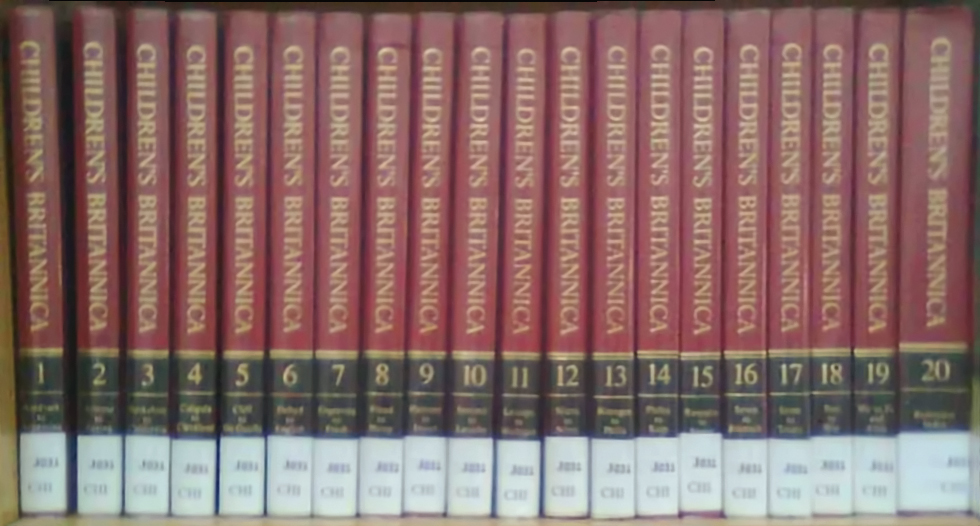
In 1932, the Britannica adopted a policy of "continuous revision," in which the encyclopaedia is continually revised and reprinted, with every article updated on a schedule. The publishers of Compton's Pictured Encyclopedia had already pioneered such a policy.
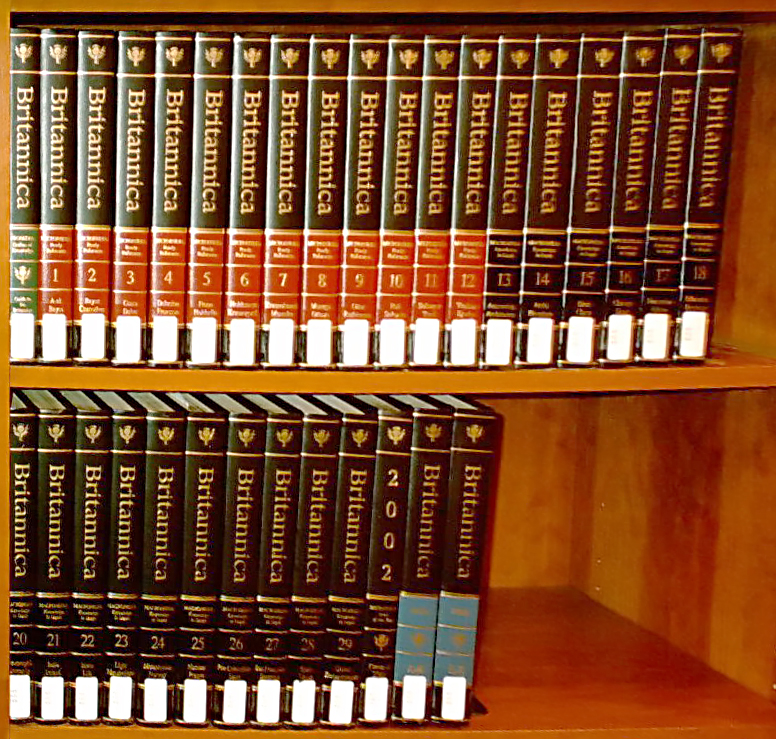
The 15th edition (1974–2010) has a three-part structure: a 12-volume Micropædia of short articles (generally fewer than 750 words), a 17-volume Macropædia of long articles (two to 310 pages), and a single Propædia volume to give a hierarchical outline of knowledge. The Micropædia was meant for quick fact-checking and as a guide to the Macropædia; readers are advised to study the Propædia outline to understand a subject's context and to find more detailed articles.
In the 21st century, the Britannica faced strong competition: initially this came principally from the digital and multimedia encyclopaedia Microsoft Encarta, and later from the online peer-produced encyclopaedia Wikipedia. Despite (or perhaps because of) such competition, Britannica retained its reputation for authoritative, comprehensive, structured, and scholarly treatments of included subjects. While it continued to score well in assessments of its overall quality, as compared to its competitors, it could not (as an expert-authored compilation of a limited number of articles on important subjects only) match their breadth of coverage and continuous updating.

In March 2012, it announced it would no longer publish printed editions and would focus instead on the online version.
History
Past owners have included, in chronological order, the Scottish printers Colin Macfarquhar and Andrew Bell, the Scottish bookseller Archibald Constable, the Scottish publisher A. & C. Black, Horace Everett Hooper, Sears Roebuck, William Benton, and Jacqui Safra, a Swiss billionaire residing in New York.
Recent advances in information technology and the rise of electronic encyclopaedias such as Encyclopædia Britannica Ultimate Reference Suite, Encarta and Wikipedia have reduced the demand for print encyclopaedias. To remain competitive, Encyclopædia Britannica, Inc. has stressed the reputation of the Britannica, reduced its price and production costs, and developed electronic versions on CD-ROM, DVD, and the World Wide Web. Since the early 1930s, the company has also promoted spin-off reference works.

Editions
The Encyclopaedia Britannica has been issued in 15 editions, with multi-volume supplements to the 3rd edition and to the 4th, 5th, and 6th editions as a group (see the Table below). The 5th and 6th editions were reprints of the 4th, and the 10th edition was only a supplement to the 9th, just as the 12th and 13th editions were supplements to the 11th. For the 15th edition (1974), the Britannica underwent a massive reorganization and became the New Encyclopaedia Britannica. The 14th and 15th editions were edited every year throughout their runs, so that later printings of each were quite different from early ones.
Throughout its history, the Britannica has had two aims: to be an excellent reference book, and to provide educational material. In 1974, the 15th edition adopted a third goal: to systematize all human knowledge.
The history of the Britannica can be divided into five eras, punctuated by changes in management or reorganization of the encyclopaedia.
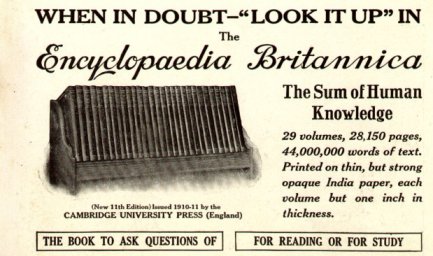
1768–1824
In the first era (1st–6th editions, 1768–1824), the Britannica was managed and published by its founders, Colin Macfarquhar and Andrew Bell, and by Archibald Constable.
The Britannica was first published in serial instalments between December 1768 and about August 1771 in Edinburgh as the Encyclopædia Britannica, or, A Dictionary of Arts and Sciences, compiled upon a New Plan. The new plan in question was an organizational one, namely to include two kinds of typographically distinct entries (articles and longer "treatises") in a single alphabetical sequence. In principle, "treatises" were to cover the arts and sciences, leaving articles to deal with their subordinate objects. The idea may have been inspired by Dennis de Coetlogon's Universal History of Arts and Sciences, an alphabetical encyclopaedia that contained only treatises. Regardless, the Britannica continued to intermix formally distinguished articles and treatises through the 10th edition.
According to Arthur Herman's book How the Scots Invented the Modern World, the Encyclopaedia Britannica is one of the most enduring legacies of the Scottish Enlightenment. It is important to be more specific, however, about how the early Britannica was and was not Scottish and a monument to the Scottish Enlightenment. The two publishers and William Smellie, whom they engaged to compile the work, were all Scots. Much of the first edition was compiled by Smellie from Scottish sources. At the same time, despite working in Edinburgh, the centre of the Scottish Enlightenment, neither Smellie nor James Tytler, the editor of the second edition, arranged for contributions from any local luminaries. Nor does the work seem to have been much noticed by participants in the Scottish Enlightenment before its third edition. Likewise, it is significant that the title chosen was the Encyclopaedia Britannica (and not the Encyclopaedia Scotorum, or 'Scottish Encyclopaedia'). Indeed, by the time of the third edition, the Britannica was starting to evolve into a symbol of Britishness.
In this era, the Britannica grew significantly in size, sales, and reputation. Just as important were changes to the way it was compiled and edited. On his tombstone, Smellie was characterized as the editor of the first edition of the Britannica, but he was not an editor in anything like the sense in which Macvey Napier, who edited the Supplement to the Fourth, Fifth, and Sixth Editions, was. Smellie compiled nearly all the articles in the first edition himself, although we know he had minor help from at least one contributor, James Anderson, who wrote the articles "Dictionary," "Pneumatics," and "Smoke." For the third edition and its Supplement, editors still compiled the bulk of the articles, but they were assisted by dozens of collaborators. We know of thirty-five who wrote for the third edition, for example, some of them named in the preface, including the chemist Joseph Black and the natural philosopher John Robison. Then, by the time of the Supplement, Napier had become mostly a managing editor. He still wrote some articles, but his main job was recruiting collaborators, for the prospectus stipulated that "the various articles, in the Supplement, shall be written by the most Eminent Men, in the different departments of Science."
Several other encyclopaedias competed with the Britannica throughout this period, among them editions of Ephraim Chambers' and Abraham Rees's Cyclopædia, Coleridge's Encyclopædia Metropolitana, and David Brewster's Edinburgh Encyclopædia.
1827–1901
During the second era (7th–9th editions, 1827–1901), the Britannica was managed by the Edinburgh publishing firm A & C Black. Although some contributors were again recruited through friendships of the chief editors, notably Macvey Napier, others were attracted by the Britannica's reputation. The contributors often came from other countries and included the world's most respected authorities in their fields. A general index of all articles was included for the first time in the 7th edition, a practice maintained until 1974.

Production of the 9th edition was overseen by Thomas Spencer Baynes, the first English-born editor-in-chief. Dubbed the "Scholar's Edition", the 9th edition is the most scholarly of all Britannicas. After 1880, Baynes was assisted by William Robertson Smith. No biographies of living persons were included. James Clerk Maxwell and Thomas Huxley were special advisors on science. However, by the close of the 19th century, the 9th edition was outdated, and the Britannica faced financial difficulties.
1901–1973
In the third era (10th–14th editions, 1901–1973), the Britannica was managed by American businessmen who introduced direct marketing and door-to-door sales. The American owners gradually simplified articles, making them less scholarly for a mass market. The 10th edition was an eleven-volume supplement (including one each of maps and an index) to the 9th, numbered as volumes 25–35, but the 11th edition was a completely new work; its owner, Horace Hooper, lavished enormous effort on the project.
When Hooper fell into financial difficulties, the Britannica was managed by Sears Roebuck for 18 years (1920–1923, 1928–1943). In 1932, the vice-president of Sears, Elkan Harrison Powell, assumed presidency of the Britannica; in 1936, he began the policy of continuous revision. This was a departure from earlier practice, in which the articles were not changed until a new edition was produced, at roughly 25-year intervals, some articles unchanged from earlier editions. Powell developed new educational products that built upon the Britannica's reputation.
In 1943, Sears donated the Encyclopædia Britannica to the University of Chicago. William Benton, then a vice president of the university, provided the working capital for its operation. The stock was divided between Benton and the university, with the university holding an option on the stock. Benton became chairman of the board and managed the Britannica until his death in 1973. Benton set up the Benton Foundation, which managed the Britannica until 1996, and whose sole beneficiary was the University of Chicago. In 1968, the Britannica celebrated its bicentennial.
1974–1994
In the fourth era (1974–1994), the Britannica introduced its 15th edition, which was reorganized into three parts: the Micropædia, the Macropædia, and the Propædia. Under Mortimer J. Adler (member of the Board of Editors of Encyclopædia Britannica since its inception in 1949, and its chair from 1974; director of editorial planning for the 15th edition of Britannica from 1965), the Britannica sought not only to be a good reference work and educational tool, but to systematize all human knowledge. The absence of a separate index and the grouping of articles into parallel encyclopaedias (the Micro- and Macropædia) provoked a "firestorm of criticism" of the initial 15th edition. In response, the 15th edition was completely reorganized and indexed for a re-release in 1985. This second version of the 15th edition continued to be published and revised through the release of the 2010 print version. The official title of the 15th edition is The New Encyclopædia Britannica, although it has also been promoted as Britannica 3.
On 9 March 1976 the US Federal Trade Commission entered an opinion and order enjoining Encyclopædia Britannica, Inc. from using: a) deceptive advertising practices in recruiting sales agents and obtaining sales leads, and b) deceptive sales practices in the door-to-door presentations of its sales agents.
1994–present
In the fifth era (1994–present), digital versions have been developed and released on optical media and online.
In 1996, the Britannica was bought by Jacqui Safra at well below its estimated value, owing to the company's financial difficulties. Encyclopædia Britannica, Inc. split in 1999. One part retained the company name and developed the print version, and the other, Britannica.com Incorporated, developed digital versions. Since 2001, the two companies have shared a CEO, Ilan Yeshua, who has continued Powell's strategy of introducing new products with the Britannica name. In March 2012, Britannica's president, Jorge Cauz, announced that it would not produce any new print editions of the encyclopaedia, with the 2010 15th edition being the last. The company will focus only on the online edition and other educational tools.
Britannica's final print edition was in 2010, a 32-volume set. Britannica Global Edition was also printed in 2010, containing 30 volumes and 18,251 pages, with 8,500 photographs, maps, flags, and illustrations in smaller "compact" volumes, as well as over 40,000 articles written by scholars from across the world, including Nobel Prize winners. Unlike the 15th edition, it did not contain Macro- and Micropædia sections, but ran A through Z as all editions up through the 14th had. The following is Britannica's description of the work:
The editors of Encyclopædia Britannica, the world standard in reference since 1768, present the Britannica Global Edition. Developed specifically to provide comprehensive and global coverage of the world around us, this unique product contains thousands of timely, relevant, and essential articles drawn from the Encyclopædia Britannica itself, as well as from the Britannica Concise Encyclopedia, the Britannica Encyclopedia of World Religions, and Compton's by Britannica. Written by international experts and scholars, the articles in this collection reflect the standards that have been the hallmark of the leading English-language encyclopedia for over 240 years.
In 2020, Encyclopædia Britannica, Inc. released the Britannica All New Children's Encyclopedia: What We Know and What We Don't, an encyclopaedia aimed primarily at younger readers, covering major topics. The encyclopaedia was widely praised for bringing back the print format. It was Britannica's first encyclopaedia for children since 1984.
Dedications
The Britannica was dedicated to the reigning British monarch from 1788 to 1901 and then, upon its sale to an American partnership, to the British monarch and the President of the United States. Thus, the 11th edition is "dedicated by Permission to His Majesty George the Fifth, King of Great Britain and Ireland and of the British Dominions beyond the Seas, Emperor of India, and to William Howard Taft, President of the United States of America." The order of the dedications has changed with the relative power of the United States and Britain, and with relative sales; the 1954 version of the 14th edition is "Dedicated by Permission to the Heads of the Two English-Speaking Peoples, Dwight David Eisenhower, President of the United States of America, and Her Majesty, Queen Elizabeth the Second."
Print version
The logo of the Britannica has long been a thistle, the floral emblem of Scotland (see also plant badge).
From 1985, it consisted of four parts: the Micropædia, the Macropædia, the Propædia, and a two-volume index. The Britannica's articles are contained in the Micro- and Macropædia, which encompass 12 and 17 volumes, respectively, each volume having roughly one thousand pages. The 2007 Macropædia has 699 in-depth articles, ranging in length from two pages to 310 pages, with references and named contributors. In contrast, the 2007 Micropædia has roughly 65,000 articles, the vast majority (about 97%) of which contain fewer than 750 words, no references, and no named contributors. The Micropædia articles are intended for quick fact-checking and to help in finding more thorough information in the Macropædia. The Macropædia articles are meant as authoritative, well-written commentaries on their subjects, as well as storehouses of information not covered elsewhere. The longest article (310 pages) is on the subject of the United States, and it resulted from merging separate articles on the individual US states. A 2013 "Global Edition" of Britannica contained approximately 40,000 articles.
Information can be found in the Britannica by following the cross-references in the Micropædia and Macropædia; these are sparse, however, averaging one cross-reference per page. Readers are instead recommended to consult the alphabetical index or the Propædia, which organizes the Britannica's contents by topic.
The core of the Propædia is its "Outline of Knowledge", which aims to provide a logical framework for all human knowledge. Accordingly, the Outline is consulted by the Britannica's editors to decide which articles should be included in the Micro- and Macropædia. The Outline can also be used as a study guide, as it puts subjects in their proper perspective and suggests a series of Britannica articles for the student wishing to learn a topic in depth. However, libraries have found that it is scarcely used for this purpose, and reviewers have recommended that it be dropped from the encyclopaedia. The Propædia contains colour transparencies of human anatomy and several appendices listing the staff members, advisors, and contributors to all three parts of the Britannica.
Taken together, the Micropædia and Macropædia comprise roughly 40 million words and 24,000 images. The two-volume index has 2,350 pages, listing the 228,274 topics covered in the Britannica, together with 474,675 subentries under those topics. The Britannica generally prefers British spelling over American; for example, it uses colour (not color), centre (not center), and encyclopaedia (not encyclopedia). There are some exceptions to this rule, such as defense rather than defence. Common alternative spellings are provided with cross-references such as "Color: see Colour."
Since 1936, the contents (articles) of Britannica have been revised on a regular schedule, with at least 10% of the articles considered for revision each year. According to one Britannica website, 46% of the articles in the 2007 edition were revised over the preceding three years; however, according to another Britannica website, only 35% of the articles were revised over the same period.
The alphabetization of articles in the Micropædia and Macropædia follows strict rules. Diacritical marks and non-English letters are ignored, while numerical entries such as "1812, War of" are alphabetized as if the number had been written out ("Eighteen-twelve, War of"). Articles with identical names are ordered first by persons, then by places, then by things. Rulers with identical names are organized first alphabetically by country and then by chronology; thus, Charles III of France precedes Charles I of England, listed in Britannica as the ruler of Great Britain and Ireland. (That is, they are alphabetized as if their titles were "Charles, France, 3" and "Charles, Great Britain and Ireland, 1".) Similarly, places that share names are organized alphabetically by country, then by ever-smaller political divisions.
In March 2012, the company announced that the 2010 edition would be the last printed version. This was part of a move by the company to adapt to the times and focus on its future using digital distribution. The peak year for the printed encyclopaedia was 1990, when 120,000 sets were sold, but sales had dropped to 40,000 per annum by 1996. There were 12,000 sets of the 2010 edition printed, of which 8,000 had been sold by March 2012. By late April 2012, the remaining copies of the 2010 edition had sold out at Britannica's online store. As of 2016, a replica of Britannica's 1768 first edition is available via the online store.
Related printed material
Britannica Junior was first published in 1934 as 12 volumes. It was expanded to 15 volumes in 1947, and renamed Britannica Junior Encyclopædia in 1963. It was taken off the market after the 1984 printing.
A British Children's Britannica edited by John Armitage was issued in London in 1960. Its contents were determined largely by the eleven-plus standardized tests given in Britain. Britannica introduced the Children's Britannica to the US market in 1988, aimed at ages seven to 14.
In 1961, a 16-volume Young Children's Encyclopaedia was issued for children just learning to read. My First Britannica is aimed at children ages six to 12, and the Britannica Discovery Library is for children aged three to six (issued 1974 to 1991). Compton's by Britannica, first published in 2007, incorporating the former Compton's Encyclopedia, is aimed at 10- to 17-year-olds and consists of 26 volumes and 11,000 pages.
There have been, and are, several abridged Britannica encyclopaedias. The single-volume Britannica Concise Encyclopædia has 28,000 short articles condensing the larger 32-volume Britannica; there are authorized translations in languages such as Chinese created by Encyclopedia of China Publishing House and Vietnamese.
Since 1938, Encyclopædia Britannica, Inc. has also published an annual Book of the Year to 'update' the encyclopaedia proper: this covers the past year's events and presents a variety of updated statistics (e.g. as to national populations, Nobel Prize winners, and the like). A given edition of the Book of the Year is named in terms of the year of its publication, though the volume actually covers the events and statistics of the previous year.
The company also publishes several specialized reference works, such as Shakespeare: The Essential Guide to the Life and Works of the Bard (2006).
Optical disc, online, and mobile versions
The Britannica Ultimate Reference Suite 2012 DVD contains over 100,000 articles. This includes regular Britannica articles, as well as others drawn from the Britannica Student Encyclopædia, and the Britannica Elementary Encyclopædia. The package includes a range of supplementary content including maps, videos, sound clips, animations and web links. It also offers study tools and dictionary and thesaurus entries from Merriam-Webster.
Britannica Online is a website with more than 120,000 articles and is updated regularly. It has daily features, updates and links to news reports from The New York Times and the BBC. As of 2009, roughly 60% of Encyclopædia Britannica's revenue came from online operations, of which around 15% came from subscriptions to the consumer version of the websites. As of 2006, subscriptions were available on a yearly, monthly or weekly basis. Special subscription plans are offered to schools, colleges and libraries; such institutional subscribers constitute an important part of Britannica's business. Beginning in early 2007, the Britannica made articles freely available if they are hyperlinked from an external site. Non-subscribers are served pop-ups and advertising.
On 20 February 2007, Encyclopædia Britannica, Inc. announced that it was working with mobile phone search company AskMeNow to launch a mobile encyclopaedia. Users would be able to send a question via text message, and AskMeNow would search Britannica's 28,000-article concise encyclopaedia to return an answer to the query. Daily topical features sent directly to users' mobile phones were also planned.
On 3 June 2008, an initiative to facilitate collaboration between online expert and amateur scholarly contributors for Britannica's online content (in the spirit of a wiki), with editorial oversight from Britannica staff, was announced. Approved contributions would be credited, though contributing automatically grants Encyclopædia Britannica, Inc. perpetual, irrevocable licence to those contributions.
On 22 January 2009, Britannica's president, Jorge Cauz, announced that the company would be accepting edits and additions to the online Britannica website from the public. The published edition of the encyclopaedia would not be affected by the changes. Individuals wishing to edit the Britannica website would have to register under their real name and address prior to editing or submitting their content. All edits submitted would be reviewed and checked and will have to be approved by the encyclopaedia's professional staff. Contributions from non-academic users would sit in a separate section from the expert-generated Britannica content, as would content submitted by non-Britannica scholars. Articles written by users, if vetted and approved, would also only be available in a special section of the website, separate from the professional articles. Official Britannica material would carry a "Britannica Checked" stamp, to distinguish it from the user-generated content.