
The Empire of Brazil (Portuguese: Império do Brasil) was a 19th-century state that broadly comprised the territories which form modern Brazil and Uruguay until the latter achieved independence in 1828. The empire's government was a representative parliamentary constitutional monarchy under the rule of Emperors Pedro I and his son Pedro II. A colony of the Kingdom of Portugal, Brazil became the seat of the Portuguese Empire in 1808, when the Portuguese Prince regent, later King Dom John VI, fled from Napoleon's invasion of Portugal and established himself and his government in the Brazilian city of Rio de Janeiro. John VI later returned to Portugal, leaving his eldest son and heir-apparent, Pedro, to rule the Kingdom of Brazil as regent. On 7 September 1822, Pedro declared the independence of Brazil and, after waging a successful war against his father's kingdom, was acclaimed on 12 October as Pedro I, the first Emperor of Brazil. The new country was huge, sparsely populated, and ethnically diverse.
Unlike most of the neighboring Hispanic American republics, Brazil had political stability, vibrant economic growth, constitutionally guaranteed freedom of speech, and respect for civil rights of its subjects, albeit with legal restrictions on women and slaves, the latter regarded as property and not citizens. The Empire's bicameral parliament was elected under comparatively democratic methods for the era, as were the provincial and local legislatures. This led to a long ideological conflict between Pedro I and a sizable parliamentary faction over the role of the monarch in the government. He also had to face other obstacles. The unsuccessful Cisplatine War against the neighboring United Provinces of the Río de la Plata in 1828 led to the secession of the province of Cisplatina (later to become Uruguay). In 1826, despite his role in Brazilian independence, he became the king of Portugal; he abdicated the Portuguese throne in favor of Maria, his eldest daughter. Two years later, she was usurped by Pedro I's younger brother Miguel. Unable to deal with both Brazilian and Portuguese affairs, Pedro I abdicated his Brazilian throne on 7 April 1831 and immediately departed for Europe to restore his daughter to the Portuguese throne.
Pedro I's successor in Brazil was his five-year-old son, Pedro II. As the latter was still a minor, a weak regency was created. The power vacuum resulting from the absence of a ruling monarch as the ultimate arbiter in political disputes led to regional civil wars between local factions. Having inherited an empire on the verge of disintegration, Pedro II, once he was legally declared of age, managed to bring peace and stability to the country, which eventually became an emerging international power. Brazil was victorious in three international conflicts (the Platine War, the Uruguayan War, and the Paraguayan War) under Pedro II's rule, and the Empire prevailed in several other international disputes and outbreaks of domestic strife. With prosperity and economic development came an influx of European immigration, including Protestants and Jews, although Brazil remained mostly Catholic. Slavery, which had initially been widespread, was restricted by successive legislation until its final abolition in 1888. Brazilian visual arts, literature and theater developed during this time of progress. Although heavily influenced by European styles that ranged from Neoclassicism to Romanticism, each concept was adapted to create a culture that was uniquely Brazilian.

Even though the last four decades of Pedro II's reign were marked by continuous internal peace and economic prosperity, he had no desire to see the monarchy survive beyond his lifetime and made no effort to maintain support for the institution. The next in line to the throne was his daughter Isabel, but neither Pedro II nor the ruling classes considered a female monarch acceptable. Lacking any viable heir, the Empire's political leaders saw no reason to defend the monarchy. After a 58-year reign, on 15 November 1889 the Emperor was overthrown in a sudden coup d'état led by a clique of military leaders whose goal was the formation of a republic headed by a dictator, forming the First Brazilian Republic.
History
Independence and early years
The territory which would come to be known as Brazil was claimed by Portugal on 22 April 1500, when the navigator Pedro Álvares Cabral landed on its coast. Permanent settlement followed in 1532, and for the next 300 years the Portuguese slowly expanded westwards until they had reached nearly all of the borders of modern Brazil. In 1808, the army of French Emperor Napoleon I invaded Portugal, forcing the Portuguese royal family—the House of Braganza, a branch of the thousand-year-old Capetian dynasty—into exile. They re-established themselves in the Brazilian city of Rio de Janeiro, which became the unofficial seat of the Portuguese Empire.
In 1815, the Portuguese crown prince Dom John (later Dom John VI), acting as regent, created the United Kingdom of Portugal, Brazil and the Algarves, which raised the status of Brazil from colony to kingdom. He ascended the Portuguese throne the following year, after the death of his mother, Maria I of Portugal. He returned to Portugal in April 1821, leaving behind his son and heir, Prince Dom Pedro, to rule Brazil as his regent. The Portuguese government immediately moved to revoke the political autonomy that Brazil had been granted since 1808. The threat of losing their limited control over local affairs ignited widespread opposition among Brazilians. José Bonifácio de Andrada, along with other Brazilian leaders, convinced Pedro to declare Brazil's independence from Portugal on 7 September 1822. On 12 October, the prince was acclaimed Pedro I, first Emperor of the newly created Empire of Brazil, a constitutional monarchy. The declaration of independence was opposed throughout Brazil by armed military units loyal to Portugal. The ensuing war of independence was fought across the country, with battles in the northern, northeastern, and southern regions. The last Portuguese soldiers to surrender did so in March 1824, and independence was recognized by Portugal in August 1825.

Pedro I encountered a number of crises during his reign. A secessionist rebellion in the Cisplatina Province in early 1825 and the subsequent attempt by the United Provinces of the Río de la Plata (later Argentina) to annex Cisplatina led the Empire into the Cisplatine War: "a long, inglorious, and ultimately futile war in the south". In March 1826, John VI died and Pedro I ; inherited the Portuguese crown, briefly becoming King Pedro IV of Portugal before abdicating in favor of his eldest daughter, Maria II. The situation worsened in 1828 when the war in the south ended with Brazil's loss of Cisplatina, which would become the independent republic of Uruguay. During the same year in Lisbon, Maria II's throne was usurped by Prince Miguel, Pedro I's younger brother.
Other difficulties arose when the Empire's parliament, the General Assembly, opened in 1826. Pedro I, along with a significant percentage of the legislature, argued for an independent judiciary, a popularly elected legislature and a government which would be led by the emperor who held broad executive powers and prerogatives. Others in parliament argued for a similar structure, only with a less influential role for the monarch and the legislative branch being dominant in policy and governance. The struggle over whether the government would be dominated by the emperor or by the parliament was carried over into debates from 1826 to 1831 on the establishment of the governmental and political structure. Unable to deal with the problems in both Brazil and Portugal simultaneously, the Emperor abdicated on behalf of his son, Pedro II, on 7 April 1831 and immediately sailed for Europe to restore his daughter to her throne.
Chaos
Following the hasty departure of Pedro I, Brazil was left with a five-year-old boy as head of state. With no precedent to follow, the Empire was faced with the prospect of a period of more than twelve years without a strong executive, as, under the constitution, Pedro II would not attain his majority and begin exercising authority as Emperor until 2 December 1843. A regency was elected to rule the country in the interim. Because the Regency held few of the powers exercised by an emperor and was completely subordinated to the General Assembly, it could not fill the vacuum at the apex of Brazil's government.

The hamstrung Regency proved unable to resolve disputes and rivalries between national and local political factions. Believing that granting provincial and local governments greater autonomy would quell the growing dissent, the General Assembly passed a constitutional amendment in 1834, called the Ato Adicional (Additional Act). Instead of ending the chaos, these new powers only fed local ambitions and rivalries. Violence erupted throughout the country. Local parties competed with renewed ferocity to dominate provincial and municipal governments, as whichever party dominated the provinces would also gain control over the electoral and political system. Those parties which lost elections rebelled and tried to assume power by force, resulting in several rebellions.
The politicians who had risen to power during the 1830s had by then become familiar with the difficulties and pitfalls of power. According to historian Roderick J. Barman, by 1840, "they had lost all faith in their ability to rule the country on their own. They accepted Pedro II as an authority figure whose presence was indispensable for the country's survival." Some of these politicians (who would form the Conservative Party in the 1840s) believed that a neutral figure was required—one who could stand above political factions and petty interests to address discontent and moderate disputes. They envisioned an emperor who was more dependent on the legislature than the constitutional monarch envisioned by Pedro I, yet with greater powers than had been advocated at the beginning of the Regency by their rivals (who later formed the Liberal Party). The liberals, however, contrived to pass an initiative to lower Pedro II's age of majority from eighteen to fourteen. The Emperor was declared fit to rule in July 1840.
Consolidation
To achieve their goals, the liberals allied themselves with a group of high-ranking palace servants and notable politicians: the "Courtier Faction". The courtiers were part of the Emperor's inner circle and had established influence over him, which enabled the appointment of successive liberal-courtier cabinets. Their dominance, however, was short-lived. By 1846, Pedro II had matured physically and mentally. No longer an insecure 14-year-old swayed by gossip, suggestions of secret plots, and other manipulative tactics, the young emperor's weaknesses faded and his strength of character came to the fore. He successfully engineered the end of the courtiers' influence by removing them from his inner circle without causing any public disruption. He also dismissed the liberals, who had proved ineffective while in office, and called on the conservatives to form a government in 1848.
The abilities of the Emperor and the newly appointed conservative cabinet were tested by three crises between 1848 and 1852. The first crisis was a confrontation over the illegal importation of slaves. Importing slaves had been banned in 1826 as part of a treaty with Britain. Trafficking continued unabated, however, and the British government's passage of the Slave Trade (Brazil) Act 1845 (8 & 9 Vict. c. 122) authorized British warships to board Brazilian ships and seize anyone who was found to be involved in the slave trade. While Brazil grappled with this problem, the Praieira revolt, a conflict between local political factions within Pernambuco province (and one in which liberal and courtier supporters were involved), erupted on 6 November 1848, but was suppressed by March 1849. It was the last rebellion to occur during the monarchy, and its end marked the beginning of forty years of internal peace in Brazil. The Eusébio de Queirós Law was promulgated on 4 September 1850 giving the government broad authority to combat the illegal slave trade. With this new tool Brazil moved to eliminate the importation of slaves, and by 1852 this first crisis was over, with Britain accepting that the trade had been suppressed.
The third crisis was a conflict with the Argentine Confederation over ascendancy in territories adjacent to the Río de la Plata and free navigation of that waterway. Since the 1830s, Argentine dictator Juan Manuel de Rosas had supported rebellions within Uruguay and Brazil. The Empire was unable to address the threat posed by Rosas until 1850, when an alliance was forged between Brazil, Uruguay and disaffected Argentines, leading to the Platine War and the subsequent overthrow of the Argentine ruler in February 1852. The Empire's successful navigation of these crises considerably enhanced the nation's stability and prestige, and Brazil emerged as a hemispheric power. Internationally, Europeans came to see the country as embodying familiar liberal ideals, such as freedom of the press and constitutional respect for civil liberties. Its representative parliamentary monarchy also stood in stark contrast to the mix of dictatorships and instability endemic in the other nations of South America during this period.
Growth
At the beginning of the 1850s, Brazil was enjoying internal stability and economic prosperity. The nation's infrastructure was being developed, with progress in the construction of railroads, the electric telegraph and steamship lines uniting Brazil into a cohesive national entity. After five years in office, the successful conservative cabinet was dismissed and in September 1853, Honório Hermeto Carneiro Leão, Marquis of Paraná, head of the Conservative Party, was charged with forming a new cabinet. Emperor Pedro II wanted to advance an ambitious plan, which became known as "the Conciliation", aimed at strengthening the parliament's role in settling the country's political disputes.

Paraná invited several liberals to join the conservative ranks and went so far as to name some as ministers. The new cabinet, although highly successful, was plagued from the start by strong opposition from ultraconservative members of the Conservative Party who repudiated the new liberal recruits. They believed that the cabinet had become a political machine infested with converted liberals who did not genuinely share the party's ideals and were primarily interested in gaining public offices. Despite this mistrust, Paraná showed resilience in fending off threats and overcoming obstacles and setbacks. However, in September 1856, at the height of his career, he died unexpectedly, although the cabinet survived him until May 1857.
The Conservative Party had split down the middle: on one side were the ultraconservatives, and on the other, the moderate conservatives who supported the Conciliation. The ultraconservatives were led by Joaquim Rodrigues Torres, Viscount of Itaboraí, Eusébio de Queirós, and Paulino Soares de Sousa, 1st Viscount of Uruguai—all former ministers in the 1848–1853 cabinet. These elder statesmen had taken control of the Conservative Party after Paraná's death. In the years following 1857, none of the cabinets survived long. They quickly collapsed due to the lack of a majority in the Chamber of Deputies.
The remaining members of the Liberal Party, which had languished since its fall in 1848 and the disastrous Praieira rebellion in 1849, took advantage of what seemed to be the Conservative Party's impending implosion to return to national politics with renewed strength. They delivered a powerful blow to the government when they managed to win several seats in the Chamber of Deputies in 1860. When many moderate conservatives defected to unite with liberals to form a new political party, the Progressive League, the conservatives' hold on power became unsustainable due to the lack of a workable governing majority in the parliament. They resigned, and in May 1862 Pedro II named a progressive cabinet. The period since 1853 had been one of peace and prosperity for Brazil: "The political system functioned smoothly. Civil liberties were maintained. A start had been made on the introduction into Brazil of railroad, telegraph and steamship lines. The country was no longer troubled by the disputes and conflicts that had racked it during its first thirty years."

Paraguayan War
This period of calm came to an end in 1863, when the British consul in Rio de Janeiro nearly sparked a war by issuing an abusive ultimatum to Brazil in response to two minor incidents (see Christie Question). The Brazilian government refused to yield, and the consul issued orders for British warships to capture Brazilian merchant vessels as indemnity. Brazil prepared itself for the imminent conflict, and coastal defenses were given permission to fire upon any British warship that tried to capture Brazilian merchant ships. The Brazilian government then severed diplomatic ties with Britain in June 1863.
As war with the British Empire loomed, Brazil had to turn its attention to its southern frontiers. Another civil war had begun in Uruguay which pitted its political parties against one another. The internal conflict led to the murder of Brazilians and the looting of their Uruguayan properties. Brazil's progressive cabinet decided to intervene and dispatched an army, which invaded Uruguay in December 1864, beginning the brief Uruguayan War. The dictator of nearby Paraguay, Francisco Solano López, took advantage of the Uruguayan situation in late 1864 by attempting to establish his nation as a regional power. In November of that year, he ordered a Brazilian civilian steamship seized, triggering the Paraguayan War, and then invaded Brazil.
What had appeared at the outset to be a brief and straightforward military intervention led to a full-scale war in South America's southeast. However, the possibility of a two-front conflict (with Britain and Paraguay) faded when, in September 1865, the British government sent an envoy who publicly apologized for the crisis between the empires. The Paraguayan invasion in 1864 led to a conflict far longer than expected, and faith in the progressive cabinet's ability to prosecute the war vanished. Also, from its inception, the Progressive League was plagued by internal conflict between factions formed by former moderate conservatives and by former liberals.
The cabinet resigned and the Emperor named the aging Viscount of Itaboraí to head a new cabinet in July 1868, marking the return of the conservatives to power. This impelled both progressive wings to set aside their differences, leading them to rechristen their party as the Liberal Party. A third, smaller and radical progressive wing would declare itself republican in 1870—an ominous signal for the monarchy. Nonetheless, the "ministry formed by the viscount of Itaboraí was a far abler body than the cabinet it replaced" and the conflict with Paraguay ended in March 1870 with total victory for Brazil and its allies. More than 50,000 Brazilian soldiers had died, and war costs were eleven times the government's annual budget. However, the country was so prosperous that the government was able to retire the war debt in only ten years. The conflict was also a stimulus to national production and economic growth.
Apogee
The diplomatic victory over the British Empire and the military victory over Uruguay in 1865, followed by the successful conclusion of the war with Paraguay in 1870, marked the beginning of the "golden age" of the Brazilian Empire. The Brazilian economy grew rapidly; railroad, shipping and other modernization projects were started; immigration flourished. The Empire became known internationally as a modern and progressive nation, second only to the United States in the Americas; it was a politically stable economy with a good investment potential.
In March 1871, Pedro II named the conservative José Paranhos, Viscount of Rio Branco as the head of a cabinet whose main goal was to pass a law to immediately free all children born to female slaves. The controversial bill was introduced in the Chamber of Deputies in May and faced "a determined opposition, which commanded support from about one third of the deputies and which sought to organize public opinion against the measure." The bill was finally promulgated in September and became known as the "Law of Free Birth". Rio Branco's success, however, seriously damaged the long-term political stability of the Empire. The law "split the conservatives down the middle, one party faction backed the reforms of the Rio Branco cabinet, while the second—known as the escravocratas (English: slavocrats)—were unrelenting in their opposition", forming a new generation of ultraconservatives.
The "Law of Free Birth", and Pedro II's support for it, resulted in the loss of the ultraconservatives' unconditional loyalty to the monarchy. The Conservative Party had experienced serious divisions before, during the 1850s, when the Emperor's total support for the conciliation policy had given rise to the Progressives. The ultraconservatives led by Eusébio, Uruguai and Itaboraí who opposed conciliation in the 1850s had nonetheless believed that the Emperor was indispensable to the functioning of the political system: the Emperor was an ultimate and impartial arbiter when political deadlock threatened. By contrast, this new generation of ultraconservatives had not experienced the Regency and early years of Pedro II's reign, when external and internal dangers had threatened the Empire's very existence; they had only known prosperity, peace and a stable administration. To them—and to the ruling classes in general—the presence of a neutral monarch who could settle political disputes was no longer important. Furthermore, since Pedro II had clearly taken a political side on the slavery question, he had compromised his position as a neutral arbiter. The young ultraconservative politicians saw no reason to uphold or defend the Imperial office.
Decline
The weaknesses in the monarchy took many years to become apparent. Brazil continued to prosper during the 1880s, with the economy and society both developing rapidly, including the first organized push for women's rights (which would progress slowly over the next decades). By contrast, letters written by Pedro II reveal a man grown world-weary with age, increasingly alienated from current events and pessimistic in outlook. He remained diligent in performing his formal duties as Emperor, albeit often without enthusiasm, but he no longer actively intervened to maintain stability in the country. His increasing "indifference towards the fate of the regime" and his inaction to protect the imperial system once it came under threat have led historians to attribute the "prime, perhaps sole, responsibility" for the dissolution of the monarchy to the Emperor himself.
The lack of an heir who could feasibly provide a new direction for the nation also threatened the long-term prospects for the Brazilian monarchy. The Emperor's heir was his eldest daughter Isabel, the Princess Imperial, who had no interest in, nor expectation of, becoming the monarch. Even though the Constitution allowed female succession to the throne, Brazil was still a very traditional, male-dominated society, and the prevailing view was that only a male monarch would be capable as head of state. Pedro II, the ruling circles and the wider political establishment all considered a female successor to be inappropriate, and Pedro II himself believed that the death of his two sons and the lack of a male heir were a sign that the Empire was destined to be supplanted.
A weary emperor who no longer cared for the throne, an heir who had no desire to assume the crown, an increasingly discontented ruling class who were dismissive of the Imperial role in national affairs: all these factors presaged the monarchy's impending doom. The means to achieve the overthrow of the Imperial system would soon appear within the Army ranks. Republicanism had never flourished in Brazil outside of certain elitist circles, and had little support in the provinces. A growing combination of republican and positivist ideals among the army's junior and mid-level officer ranks, however, began to form a serious threat to the monarchy. These officers favored a republican dictatorship, which they believed would be superior to the liberal democratic monarchy. Beginning with small acts of insubordination at the beginning of the 1880s, discontent in the army grew in scope and audacity during the decade, as the Emperor was uninterested and the politicians proved incapable of re-establishing the government's authority over the military.
Fall
The nation enjoyed considerable international prestige during the final years of the Empire and had become an emerging power in the international arena. While Pedro II was receiving medical treatment in Europe, the parliament passed, and Princess Isabel signed on 13 May 1888, the Golden Law, which completely abolished slavery in Brazil. Predictions of economic and labor disruption caused by the abolition of slavery proved to be unfounded. Nonetheless, the end of slavery was the final blow to any remaining belief in the crown's neutrality, and this resulted in an explicit shift of support to Republicanism by the ultraconservatives—themselves backed by rich and powerful coffee farmers who held great political, economic and social power in the country.
To avert a republican backlash, the government exploited the credit readily available to Brazil as a result of its prosperity to fuel further development. The government extended massive loans at favorable interest rates to plantation owners and lavishly granted titles and lesser honors to curry favor with influential political figures who had become disaffected. The government also indirectly began to address the problem of the recalcitrant military by revitalizing the moribund National Guard, by then an entity which existed mostly only on paper.
The measures taken by the government alarmed civilian republicans and the positivists in the military. The republicans saw that it would undercut support for their own aims, and were emboldened to further action. The reorganization of the National Guard was begun by the cabinet in August 1889, and the creation of a rival force caused the dissidents among the officer corps to consider desperate measures. For both groups, republicans and military, it had become a case of "now or never". Although there was no desire among the majority of Brazilians to change the country's form of government, republicans began pressuring army officers to overthrow the monarchy.
They launched a coup and instituted the republic on 15 November 1889. The few people who witnessed what occurred did not realize that it was a rebellion. Historian Lídia Besouchet noted that, "[r]arely has a revolution been so minor." Throughout the coup Pedro II showed no emotion, as if unconcerned about the outcome. He dismissed all suggestions put forward by politicians and military leaders for quelling the rebellion. The Emperor and his family were sent into exile on 17 November. Although there was significant monarchist reaction after the fall of the Empire, this was thoroughly suppressed, and neither Pedro II nor his daughter supported a restoration. Despite being unaware of the plans for a coup, once it occurred and in light of the Emperor's passive acceptance of the situation, the political establishment supported the end of the monarchy in favor of a republic. They were unaware that the goal of the coup leaders was the creation of a dictatorial republic rather than a presidential or parliamentary republic.
Government
Parliament
Article 2 of Brazil's 1824 Constitution defined the roles of both the emperor and the General Assembly of Brazil which in 1824 was composed of 50 senators and 102 general deputies, as the nation's representatives. The Constitution endowed the Assembly with both status and authority, and created legislative, moderating, executive and judicial branches as "delegations of the nation" with the separation of those powers envisaged as providing balances in support of the Constitution and the rights it enshrined.
The prerogatives and authority granted to the legislature within the Constitution meant that it could and would play a major and indispensable role in the functioning of the government—it was not a mere rubber stamp. The General Assembly alone could enact, revoke, interpret, and suspend laws under Article 13 of the Constitution. The legislature also held the power of the purse and was required to annually authorize expenditures and taxes. It alone approved and exercised oversight of government loans and debts. Other responsibilities entrusted to the Assembly included setting the size of the military's forces, the creation of offices within the government, monitoring the national welfare and ensuring that the government was being run in conformity to the Constitution. This last provision allowed the legislature wide authority to examine and debate government policy and conduct.
Regarding matters of foreign policy, the Constitution (under Article 102) required that the General Assembly be consulted about declarations of war, treaties and the conduct of international relations. A determined legislator could exploit these Constitutional provisions to block or limit government decisions, influence appointments and force reconsideration of policies.
During the Assembly's annual four-month sessions, the body conducted public debates that were widely reported and served as a national forum for the expression of public concerns from all parts of the country. These debates frequently provided a venue for expressing opposition to policies and airing grievances. Legislators enjoyed immunity from prosecution for speeches made from the floor and in the discharge of their duties, and only their own chambers within the Assembly could order the arrest of a member during their tenure. "With no actual responsibility for the actual conduct of affairs, the legislators were free to propose sweeping reforms, advocate ideal solutions, and denounce compromising and opportunistic conduct by the government."
Emperor and council of ministers
The emperor was the head of both the moderating and executive branches (being aided by the Council of State and the Council of Ministers, respectively); he had the final say and held ultimate control over the national government. He was tasked with ensuring national independence and stability. The Constitution (Article 101) gave him very few avenues for imposing his will upon the General Assembly. His main recourse was the right to dissolve or extend legislative sessions. In the Senate, an emperor's authority to appoint senators did not necessarily give him added influence since senators held their offices for life and were thus freed from government pressure once confirmed. On those occasions when the Chamber of Deputies was dissolved, new elections were required to be held immediately and the new Chamber seated. "This power was effective when held in reserve as a threat. It could not be employed repeatedly, nor would its use work to the emperor's advantage."
During the reign of Pedro I, the Chamber of Deputies was never dissolved and legislative sessions were never extended or postponed. Under Pedro II, the Chamber of Deputies was only ever dissolved at the request of the president of the Council of Ministers (prime minister). There were eleven dissolutions during Pedro II's reign and, of these, ten occurred after consultation with the Council of State, which was beyond what was required by the Constitution. A constitutional balance of power existed between the General Assembly and the executive branch under the emperor. The legislature could not operate alone and the monarch could not force his will upon the Assembly. In practice, the system functioned smoothly only when both Assembly and Emperor acted in a spirit of cooperation for the national good.
A new element was added when the office of "president of the Council of Ministers" was formally created in 1847—although the role had existed informally since 1843. The president of the Council owed his position to both his party and to the Emperor and these could sometimes come into conflict. 19th-century abolitionist leader and historian Joaquim Nabuco said that the "president of the Council in Brazil was no Russian chancellor, Sovereign's creature, nor a British prime minister, made only by the trust of the [House of] Commons: the delegation of the Crown was to him as necessary and important as the delegation of the Chamber, and, to exert with safety his functions, he had to dominate the caprice, the oscillations and ambitions of the Parliament, as well as to preserve always unalterable the favor, the good will of the emperor."
Provincial and local government
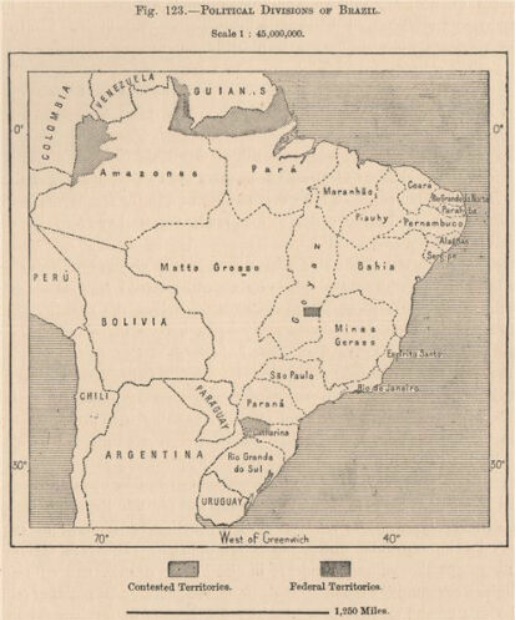
When enacted in 1824, the Imperial Constitution created the Conselho Geral de Província (Provincial General Council), the legislature of the provinces. This council was composed of either 21 or 13 elected members, depending on the size of a province's population. All "resolutions" (laws) created by the councils required approval by the General Assembly, with no right of appeal. Provincial Councils also had no authority to raise revenues, and their budgets had to be debated and ratified by the General Assembly. Provinces had no autonomy and were entirely subordinate to the national government as the country was a unitary state.
With the 1834 constitutional amendment known as the Additional Act, Provincial General Councils were supplanted by the Assembleias Legislativas Provinciais (Provincial Legislative Assemblies). The new Assemblies enjoyed much greater autonomy from the national government. A Provincial Assembly was composed of 36, 28 or 20 elected deputies, the number depending on the size of the province's population. The election of provincial deputies followed the same procedure as used to elect general deputies to the national Chamber of Deputies.
The responsibilities of the Provincial Assembly included defining provincial and municipal budgets and levying the taxes necessary to support them; providing primary and secondary schools (higher education was the responsibility of the national government); oversight and control of provincial and municipal expenditures; and providing for law enforcement and maintenance of police forces. The Assemblies also controlled the creation and abolishment of, and salaries for, positions within provincial and municipal civil services. The nomination, suspension and dismissal of civil servants was reserved for the president (governor) of the province, but how and under what circumstances he could exercise these prerogatives was delineated by the Assembly. The expropriation of private property (with due monetary compensation) for provincial or municipal interests was also a right of the Assembly. In effect, the Provincial Assembly could enact any kind of law—with no ratification by Parliament—so long as such local laws did not violate or encroach upon the Constitution. However, provinces were not permitted to legislate in the areas of criminal law, criminal procedure laws, civil rights and obligations, the armed forces, the national budget or matters concerning national interests, such as foreign relations.
The provincial presidents were appointed by the national government and were, in theory, charged with governing the province. In practice, however, their power was intangible, varying from province to province based upon each president's relative degree of personal influence and personal character. Since the national government wanted to ensure their loyalty, presidents were, in most cases, sent to a province in which they had no political, familial or other ties. To prevent them from developing any strong local interests or support, presidents would be limited to terms of only a few months in office. As the president usually spent a great deal of time away from the province, often traveling to their native province or the imperial capital, the de facto governor was the vice-president, who was chosen by the Provincial Assembly and was usually a local politician. With little power to undermine provincial autonomy, the president was an agent of the central government with little function beyond conveying its interests to the provincial political bosses. Presidents could be used by the national government to influence, or even rig, elections, although to be effective the president had to rely on provincial and local politicians who belonged to his own political party. This interdependency created a complex relationship which was based upon exchanges of favors, private interests, party goals, negotiations, and other political maneuvering.
The câmara municipal (town council) was the governing body in towns and cities and had existed in Brazil since the beginning of the colonial period in the 16th century. The Chamber was composed of vereadores (councilmen), the number of which depended on the size of the town. Unlike the Provincial General Council, the Constitution gave town councils great autonomy. However, when the Provincial Assembly replaced the Provincial General Council in 1834, many of the powers of town councils (including the setting of municipal budgets, oversight of expenditures, creation of jobs, and the nomination of civil servants) were transferred to the provincial government. Additionally, any laws enacted by the town council had to be ratified by the Provincial Assembly—but not by Parliament. While the 1834 Additional Act granted greater autonomy to the provinces from the central government, it transferred the towns' remaining autonomy to the provincial governments. There was no office of mayor, and towns were governed by a town council and its president (who was the councilman who won the most votes during elections).
Elections
Until 1881, voting was mandatory and elections occurred in two stages. In the first phase voters chose electors who then selected a slate of senatorial candidates. The emperor would choose a new senator (member of the Senate, the upper house in the General Assembly) from a list of the three candidates who had received the highest number of votes. The electors also chose the General Deputies (members of the Chamber of Deputies, the lower house), provincial deputies (members of the Provincial Assemblies) and councilmen (members of the town councils) without the involvement of the emperor in making a final selection. All men over the age of 25 with an annual income of at least Rs 100$000 (or 100,000 réis; the equivalent in 1824 to $98 US) were eligible to vote in the first phase. The voting age was lowered to 21 for married men. To become an elector it was necessary to have an annual income of at least Rs 200$000.
The Brazilian system was relatively democratic for a period during which indirect elections were common in democracies. The income requirement was much higher in the United Kingdom, even after the reforms of 1832. At the time the only nations not requiring a minimum level of income as a qualification for voting were France and Switzerland where universal suffrage was introduced only in 1848. It is probable that no European country at the time had such liberal legislation as Brazil. The income requirement was low enough that any employed male citizen could qualify to vote. As an illustration, the lowest paid civil employee in 1876 was a janitor who earned Rs 600$000 annually.