
Emperor Tenji (also romanized Tenchi, 626–671) was the 38th emperor of Japan according to the traditional order of succession. Initially known as Prince Kazuraki, and later Prince Naka no Ōe, he was the son of two future sovereigns: Emperor Jomei and Empress Kōgyoku. His father ascended to the throne in 629; after his death in 641, a succession dispute emerged between the young Prince Naka and another royal prince, Prince Yamashiro. This was mediated by the ascension of his mother as empress. Naka conspired with a group of aristocrats to assassinate the despotic minister Soga no Iruka in 645. After the assassination, his mother resigned as ruler and Naka served as the crown prince for his uncle, Emperor Kōtoku. However, after Kōtoku's death in 654, the throne instead returned to Naka's mother (now known as Empress Saimei). During the early 660s, Saimei died and the Japanese military suffered a defeat against the forces of Tang China and Silla during an expedition to Korea. Prince Naka did not immediately ascend to the throne, instead serving as regent for the following seven years.
During his term as regent, Naka implemented reforms to the royal court and built up military infrastructure in Kyushu, fearing a Chinese invasion. He moved the royal capital to the Ōmi Ōtsu Palace northeast of Asuka, after which he ascended to the throne as emperor. He established the Daijō-kan (Council of State), appointing his son Prince Ōtomo as the inaugural Daijō-daijin ('prime minister'), and allegedly ordered the compilation of the first version of the Ritsuryō law code. He fell ill and died in 671, prompting a succession dispute between Prince Ōtomo and Tenji's brother, Prince Ōama. It is unknown which Tenji wished to succeed him. The dispute broke out into a brief civil war, which ended with the victory of Ōama, who then ruled as Emperor Tenmu. Tenji was not memorialized under Tenmu's reign, but was given a burial tumulus in 700 under the reign of his daughter, Empress Jitō.
The 8th-century history chronicle Nihon Shoki dedicates relatively little coverage to Tenji's reign, although it emphasizes his importance during the reigns of his predecessors. He received poems in honor of him in the 8th-century anthologies Man'yōshū and Kaifūsō, including a cycle of nine banka elegies. Tenji's reign at Ōmi was traditionally portrayed as a golden age for art and culture, although this was likely overstated by later chroniclers.

Early life
Prince Kazuraki was born in 626 as the eldest son of Prince Tamura (later known as Emperor Jomei) and his consort Princess Takara (later known as Empress Kōgyoku). Two years later, the empress regent Suiko died. This caused a succession crisis, as two of her potential successors (her nephew Prince Shōtoku and son Prince Takeda) had recently died, leaving Prince Tamura and Prince Yamashiro as the highest ranking princes. Prince Tamura was the grandson of Emperor Bidatsu, Suiko's consort and brother, while Yamashiro was Prince Shōtoku's son. Unlike in the earlier succession crisis which brought Suiko, there were no imperial princesses in a position to serve as a neutral candidate.
The powerful Senior Minister Soga no Emishi backed Prince Tamura's candidacy, and he took the throne in 629 as Emperor Jomei. However, Yamashiro continued to serve as a pretender to the throne. The Nihon Shoki, an early 8th century chronicle produced by the imperial court, first mentions Prince Kazuraki when describing Jomei's ascension. After his father's ascension, he took a new name, Naka no Ōe no Ōji (中大兄皇子; 'middle senior prince'). Minabuchi Shōan, part of an embassy of Japanese scholars who studied in China from 608 to 640, tutored Prince Naka on Confucian philosophy.
Emperor Jomei died in 641, beginning a succession dispute between Prince Yamashiro and the Crown Prince Naka. As the latter was only sixteen years old, he was considered too young to rule. Soga no Emishi proposed that another of Jomei's sons (and Prince Naka's half-brother), Prince Furuhito no Ōji, should take the throne instead. However, Emishi was unable to secure support for this candidate. Reportedly, Naka's mother Princess Takara was instead instated, following the precedent set by Suiko, and reigned as Empress Kōgyoku. However, some scholars have theorized that there may have been an interregnum, with no sovereign until 645. The Nihon Shoki names Prince Naka as Kōgyoku's crown prince, although it is more likely that Prince Furuhito served in this position.
Isshi incident
Empress Kōgyoku had much less authority over her ministers than prior sovereigns. Some historians have theorized that this reign was a later historical fabrication, and that there was in fact no sovereign during this period. In the early 640s, Soga no Emishi's son Soga no Iruka emerged as a powerful and despotic political leader. The Nihon shoki records that Iruka built palaces for himself and his father, stockpiled weapons, and began to refer to members of the clan as princes and princesses. In 642, one of Prince Yamashiro's sisters openly criticized him for his construction of extravagant tombs for himself and his father using forced labor. In response, Iruka dispatched a military force to attack Yamashiro's family, forcing him and thirty-two of his close relatives to commit suicide.
By 643, the Nihon Shoki relays that Iruka's activities had prompted the aristocrat Nakatomi no Kamatari to recruit conspirators to overthrow him. He approached figures such as Prince Naka, Kogyuko's younger brother Prince Karu, and the military commander Soga no Ishikawa Maro. In reality, as a relatively low-level courtier at the time, Kamatari may have been a minor player in the plot whose importance was exaggerated by later chroniclers. In 644, the military dictator Yŏn Kaesomun overthrew and massacred the royal family of the Korean kingdom of Goguryeo, sparking a Tang invasion and likely fears among Japanese nobles that Iruka would do the same.
In the 6th month of 645, four days before a court ceremony where memorials from the Korean kingdoms would be presented to Empress Kōgyoku, Prince Naka explained to the other conspirators his plot to kill Iruka. By the day of the ceremony, Naka had the palace gates closed, bribed guards, hid a spear in the great hall, gained the support of a group of soldiers, and arranged for four men to attack Iruka during the ceremony, in what would be known as the Isshi incident.

During the ceremony, the conspirator reading out the memorials to Kōgyoku had difficulties continuing to read, and the men Prince Naka had ordered to attack Iruka hesitated. Prince Naka instead rushed forward and attacked Iruka with a sword, hit him in his head and shoulder. The wounded Iruka claimed that he was innocent of the charges against him. Prince Naka explained his case to Kōgyoku, claiming that Iruka intended to usurp the imperial throne for the Soga. She left the room, and Naka's assassins killed Iruka. His father, Soga no Emishi, killed himself at Hōkō-ji.
According to the Nihon Shoki, a building housing the imperial and provincial chronicles, alongside various other precious items, was set aflame during the incident. Fune no Fubito is said to have rushed into the building to save the provincial chronicles, and presented them as a gift to Prince Naka. The chronicles burned were likely compiled by Prince Shōtoku and Soga no Umako in 620, and likely had a pro-Soga bias. As such, their destruction may have been an effort by the conspirators to minimize the Soga legacy.
Term as crown prince
Within days of the Isshi incident, Kōgyoku abdicated, and Prince Furuhito was sent to become a Buddhist monk. Her younger brother Prince Karu took the throne as Emperor Kōtoku; both Kamatari and Prince Naka have been described as the force behind Kōtoku's selection. Prince Naka took control of state affairs, occupying a similar role to what Prince Shōtoku had taken. Kamatari became inner minister (equivalent to an advisor to the emperor), while Soga no Ishikawa Maro became minister of the right.

The post-coup government quickly implemented various reforms, beginning a decades-long transformation of the imperial government which would later be known as the Taika Reforms. The Nihon Shoki describes the reforms, which purportedly overhauled the taxation system and set the borders for the provinces. Over the course of 645, the government was said to have established a new governance system for Buddhist temple affairs, began a census and land survey, and set up a system of provincial emissaries. In an attempt to prevent future revolts, weapons were confiscated across Japan.
Also in 645, the imperial court decided to move from Asuka to the port of Naniwa-kyō in modern day Osaka, likely to have easier access to diplomatic communications. Early into the new administration, Kōtoku and Prince Naka called a meeting of the new ministers, and had them swear an oath of allegiance. The Naniwa Nagaratoyosaki palace was completed in 652, including a Chinese-style temple. The Nihon Shoki describes a falling out between Naka and Kōtoku over unspecified reasons, which led Naka and Kōgyoku to return to Asuka in 653. The chronicles cover Kōgyoku's reign little, avoiding direct mention of him when describing imperial edicts; these are instead presented through Prince Naka (or other courtiers) relaying them to others. This was likely done to elevate Naka's importance with regard to the Taika Reforms.
Emperor Kōtoku died in 654, and Kōgyoku again took the throne, ruling from Asuka under the new name Empress Saimei. It is unknown why Prince Naka, the crown prince, was passed over in the succession. The Nihon Shoki records that Prince Naka oversaw the construction of a water clock in Asuka in 660, the first in Japan. This had ritual and political connotations, tying the monarchy to roles of timekeeping traditionally held by Chinese sovereigns.
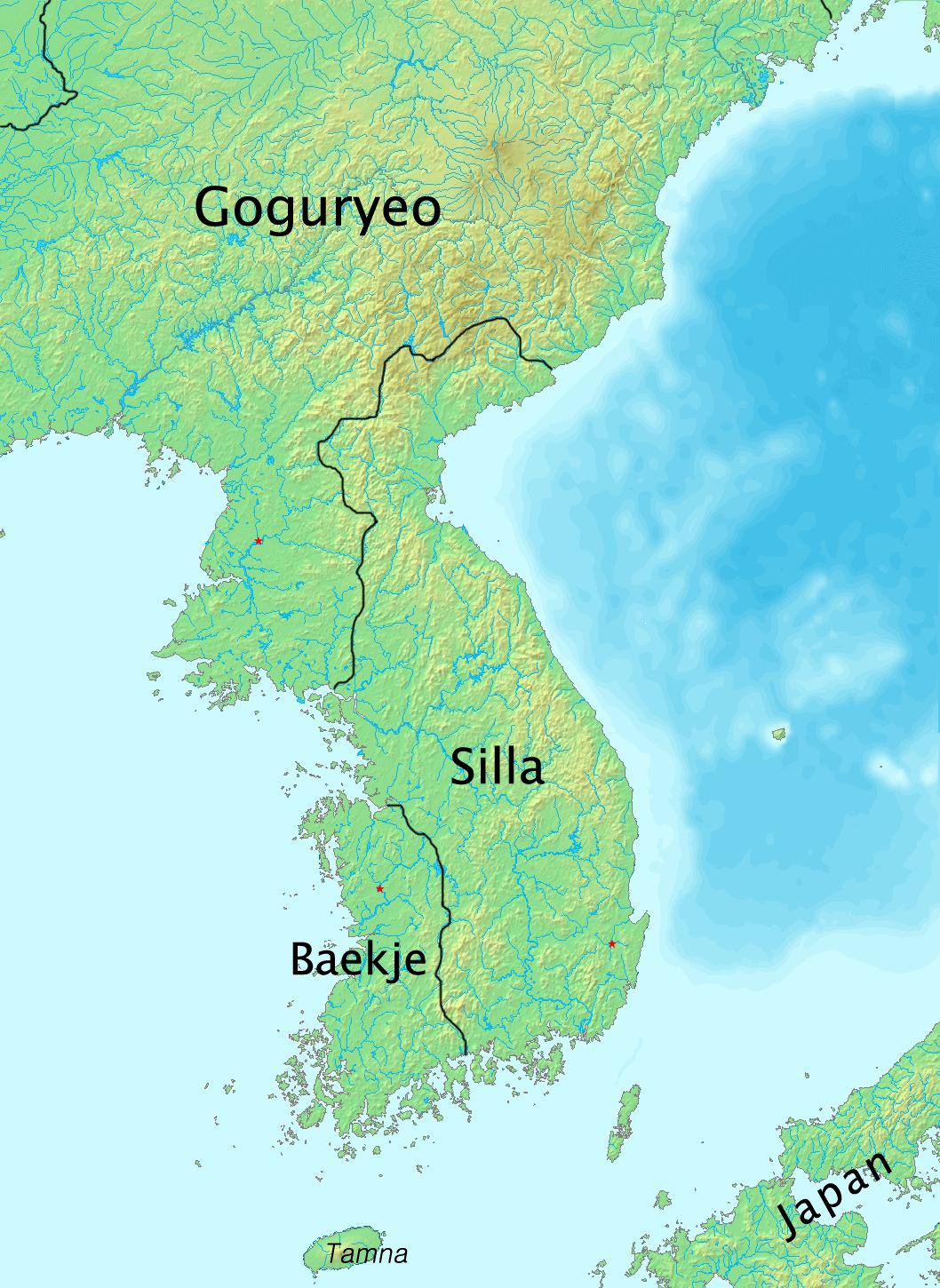
In late 660, the Korean kingdom of Paekche collapsed in a war against the Tang dynasty of China and the kingdom of Silla. After the Tang forces withdrew from the region, the Japanese royal court partnered with restorations in Paekche and prepared a military expedition to restore the allied kingdom. In 661, Prince Naka visited Naniwa to manage plans for the naval expedition. Empress Saimei traveled to Tsukushi Province (in modern Fukuoka Prefecture on Kyushu) to oversee the preparations for a military expedition to Korea, accompanied by Naka and his younger brother Ōama, as well as Kamatari. Soon after meeting with returning diplomats in Tsukushi, Empress Saimei died.
Regency
After Saimei's death, Prince Naka became the regent, but the position of emperor was left vacant. He further mobilized the military, and by 661, the Japanese-backed claimant to the Paekche throne, Prince Pung, returned to Korea. Japanese forces arrived in the region by the following year. Pung was enthroned as king by restorationist rebels in Paekche, who were able to secure a region around the old capital of Sabi and hold off Tang and Silla forces. In 663, the Tang and Silla navies destroyed the Japanese fleet at the mouth of the Geum River, killing many Japanese soldiers. Pung fled to Goguryeo, and the rebellion in Paekche collapsed, leading to the loss of Japanese influence in Korea.
The defeat at the Geum prompted fears of an invasion of Japan. Naka oversaw the construction of fortifications on the islands of Tsushima and Iki, and established the Dazaifu regional government at Hakata Bay on Kyushu, alongside a network of forts and signal beacons. The new Tang-controlled government of Paekche sent delegations to Japan over the following two years, leading to the restoration of Japan's friendly relations with the Tang and Silla. However, by 667, Tang forces under Emperor Emperor Gaozong invaded Goguryeo, leading to its collapse by the following year. Japan refused to send a military expedition to Goguryeo, focusing instead on building up its defenses. Thousands of migrants fled from Paekche and Goguryeo to Japan following the collapse of their kingdoms. Many of these migrants were former elites and officials, and received positions in the Japanese government. They allowed for the transmission of new military technology and methods of statecraft to Japan.
In 664, Prince Naka is recorded to have ordered Ōama to reform and expand the system of court ranks to 26 ranks, integrating regional elites. The reform inaugurated the practice of royal confirmation for the heads of families. Implemented by 671, this may have been an attempt to reform the system of court ranks along Chinese and Korean lines. The provincial emissaries drew new districts boundaries across the realm, and conducted a census in 670.
In 667, Naka moved the imperial seat away from Asuka to the new Ōmi Ōtsu Palace at Ōtsu, situated between Lake Biwa and the mountains. The location was easily defensible, allowed for easier connection to the eastern provinces, and was adjacent to the provinces of Ōmi and Yamashiro, areas heavily settled by Korean refugees.
Reign
In 668, following the move to Ōmi, Prince Naka was officially enthroned as emperor, a reign referred to by his posthumous name Tenji. That year, Tenji is said to have ordered the compilation of a law code, the first iteration of the Ritsuryō, as well as the compilation of ceremonial regulations. Scholars generally consider it unlikely that Tenji ordered the law code, viewing its an anachronism. He later established the Daijō-kan (Council of State), an executive body consisting of six ministries, alongside several ministers and advisors. It was headed by a Daijō-daijin ('prime minister'), tasked with carrying out the emperor's orders. The inaugural Daijō-daijin was Tenji's son Prince Ōtomo, codifying the elevated status of senior princes previously held by Tenji and Prince Shōtoku.
Taking advantage of the influx of scholars and literary material from Tang China, establishing a university at Ōtsu and recruiting noted scholars and poets to his court. Chinese encyclopedias and dictionaries circulated among his courtiers. Due to increased familiarity with the Chinese classics among the royal government, Tenji was depicted as a Son of Heaven, following the Chinese concept of divine rulership. A Japanese embassy was dispatched to Tang China in 669. This would be the last such official delegation until 701. Sources such as the Nihon Shoki and the 8th-century poetry anthology Kaifūsō portray Tenji's reign in Ōmi as a golden age of prosperity and artistic achievement.
The Nihon Shoki is inconsistent when describing who Tenji appointed as his crown prince. Prince Ōama is most frequently referred to as such, with titles such as Eastern Prince (東宮), but other accounts instead claim that Prince Ōtomo was his crown prince. As Ōtomo's mother was a low-ranking concubine, Ōama may have had more political legitimacy, being the son of two previous rulers.
Death and succession
Tenji suffered an illness in 671. Attempting to secure his recovery through religious means, he authorized a mass admission of novices to Buddhist monastic orders. Different chapters of the Nihon Shoki give contradicting accounts of the events around Tenji's death and succession, portraying Tenji and Prince Ōama alternatively as allies or rivals. The Tenji volume states that Tenji summoned Prince Ōama on his deathbed and offered him the throne. Ōama refused on the grounds of poor health, and suggested that his consort Yamato-hime instead serve as empress regent, with Ōtomo as the state minister. The volume then states that Prince Ōama gained his permission to leave the capital and become a Buddhist monk. In contrast, the Tenmu (Ōama) volume states that the minister Soga no Yasumaro warned Ōama to "think carefully before you speak", leading him to suspect that the offer of the throne was in reality a plot against him. Tenji died in the last month of 671.
After his death, a succession dispute broke out between Prince Ōama and Prince Ōtomo, leading to the Jinshin War. Ōtomo controlled the palace at Ōmi, while Ōama traveled to the eastern and northern provinces to rally support against him. Prince Ōtomo was retroactively recognized as a legitimate emperor by the royal government in 1870, under the posthumous title Emperor Kōbun. However, it is unknown whether he was ever enthroned; some historians instead posit that Yamato-hime served as a regent during the war. Alternatively, there may have simply been no emperor during this period. After several battles, Ōtomo was defeated and forced to commit suicide. Ōama was enthroned in 673, referred to under his posthumous title of Emperor Tenmu.
Legacy
The emperor was honored with the posthumous name Tenji. Like that of Tenmu, this name includes a reference to heaven through the syllable ten. He was also given the Japanese-style posthumous name Amemikoto Hirakasuwake (天命開別).
Tenji was not memorialized under Tenmu's reign, as the imperial court sought to emphasize Tenmu's role as a transformative and powerful ruler. Tenji was initially the only Japanese ruler since the mythical Emperor Ōjin not to be honored with an official mausoleum or burial after his death. However, his memory began to be rehabilitated at the end of the century, during the reign of his daughter Empress Jitō. Around 700, a tomb was constructed in his honor. His tomb is octagonal, covered by a round tumulus. This was a new form of burial first used for his mother Saimei. It was intended to represent universal rule and distinguish the tombs of the sovereigns from the similarly grand tombs made for the chiefs of prominent uji (clans).
Shortly before her death in 703, the empress emeritus Jitō ordered for Tenji to be honored in the imperial memorial ceremonies. The reign of Tenmu's descendants came to an end with the ascension of Emperor Kōnin, one of Tenji's grandsons, in 770. All future Japanese emperors have been descendants of Tenji.
The Man'yōshū, a collection of Japanese poetry compiled during the mid-8th century, contains a long sequence of nine banka (elegies, literally 'coffin-puller's songs') centered around Tenji's death and burial. These comprise six tanka (short poems) and three chōka (long poems). The Man'yōshū attributes the first banka to Prince Arima in the late 650s, although the Tenji banka are more closely tied to funerary rituals, leading scholar Kevin Collins to describe them as the "first real banka". Commentators have praised these poems for their lyrical qualities, possibly reflecting a broader perception of Tenji's reign as a flourishing of culture.
Unlike Jomei or Tenmu, there is no "imperial poem" attributed to him in the Ōmi section of the collection. However, one poem is credited to him from his time as the crown prince under Saimei. The preface to the Kaifūsō, a 751 collection of kanshi (Chinese-language poetry from Japan), credits the introduction of the genre to Tenji's political reforms; however, this likely overstates the cultural importance of the Ōmi court.
The Nihon Shoki dedicates far more detail for Tenmu's reign in comparison to that of Tenji; according to one estimate, Tenmu received almost ten times as much coverage. However, Tenji is covered disproportionately often in the chapters on his predecessors. Eighth century chroniclers depicted the Isshi incident and the succeeding Taika Reforms as a monumental event which solidified imperial control across Japan. The historian Herman Ooms describes Tenji as one of the chief initiators of the bureaucratic state under the Ritsuryō system.
Family
Emperor Tenji is recorded to have had nine consorts and fourteen children. His brother Tenmu took four of his daughters as consorts, and adopted two of his sons after his death. Some legends claim that Tenmu's first wife, Princess Nukata, was forced to marry Tenji around 660. His consorts recorded in the Nihon Shoki were:
Empress Yamato-hime no Ōkimi, the daughter of Prince Furuhito no Ōji
Ochi no Iratsume, the daughter of Soga no Ishikawa Maro
Prince Takeru
Princess Ōta, a consort of Tenmu
Princess Uno no Sarara, the chief consort of Tenmu. She later reigned as Empress Jitō and mothered Prince Kusakabe.
Mei no Iratsume, the daughter of Soga no Ishikawa Maro
Princess Minabe
Princess Abe, later reigned as Empress Genmei. She mothered Emperor Monmu and Empress Genshō with Prince Kusakabe.
Tachibana no Iratsume, the daughter of Abe no Kurahashi Maro
Princess Asuka
Princess Niitabe, a consort of Tenmu.
Hitachi no Iratsume, the daughter of Soga no Akae
Princess Yamanobe
Shikibuko no Iratsume, a courtier
Princess Ōe, a consort of Tenmu.
Prince Kawashima, credited with a poem in the Man’yōshū. Later adopted by Tenmu.
Princess Izumi
Kurohime no Iratsume, a courtier
Princess Minushi
Kochi no Michi no Iratsume, a courtier