
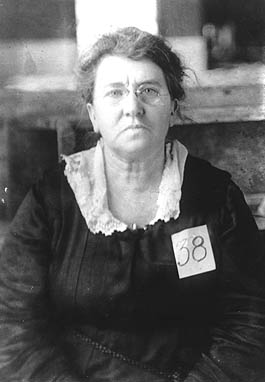
Emma Goldman (June 27, 1869 – May 14, 1940) was a Russian-born anarchist revolutionary, political activist, and writer. She played a pivotal role in the development of anarchist political philosophy in North America and Europe in the first half of the 20th century.
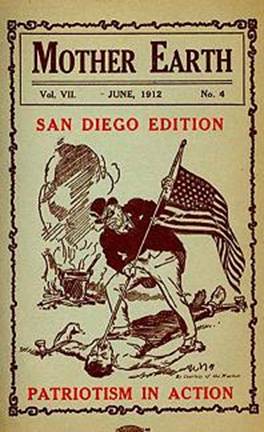
Born in Kaunas, Lithuania (then within the Russian Empire), to a Lithuanian Jewish family, Goldman immigrated to the United States in 1885. Attracted to anarchism after the Haymarket affair in Chicago, Goldman became a writer and a renowned lecturer on anarchist philosophy, women's rights, and social issues, attracting crowds of thousands. She and anarchist writer Alexander Berkman, her lover and lifelong friend, planned to assassinate industrialist and financier Henry Clay Frick as an act of propaganda of the deed. Frick survived the attempt on his life in 1892, and Berkman was sentenced to 22 years in prison. Goldman was imprisoned several times in the years that followed, for "inciting to riot" and illegally distributing information about birth control. In 1906, Goldman founded the anarchist journal Mother Earth.
In 1917, Goldman and Berkman were sentenced to two years in jail for conspiring to "induce persons not to register" for the newly instated draft. After their release from prison, they were arrested—along with 248 others—in the so-called Palmer Raids during the First Red Scare and deported to Russia in December 1919. Initially supportive of that country's October Revolution that brought the Bolsheviks to power, Goldman changed her opinion in the wake of the Kronstadt rebellion; she denounced the Soviet Union for its violent repression of independent voices. She left the Soviet Union and in 1923 published a book about her experiences, My Disillusionment in Russia. While living in England, Canada, and France, she wrote an autobiography called Living My Life. It was published in two volumes, in 1931 and 1935. After the outbreak of the Spanish Civil War, Goldman traveled to Spain to support the anarchist revolution there. She died in Toronto, Ontario, Canada, in 1940, aged 70.
During her life, Goldman was lionized as a freethinking "rebel woman" by admirers, and denounced by detractors as an advocate of politically motivated murder and violent revolution. Her writing and lectures spanned a wide variety of issues, including prisons, atheism, freedom of speech, militarism, capitalism, marriage, free love, and homosexuality. Although she distanced herself from first-wave feminism and its efforts toward women's suffrage, she developed new ways of incorporating gender politics into anarchism. After decades of obscurity, Goldman gained iconic status in the 1970s by a revival of interest in her life, when feminist and anarchist scholars rekindled popular interest.
Biography
Family
Emma Goldman was born into an Orthodox Jewish family in Kaunas in Lithuania, then within the Russian Empire. Goldman's mother Taube Bienowitch had been married before to a man with whom she had two daughters—Helena in 1860 and Lena in 1862. When her first husband died of tuberculosis, Taube was devastated. Goldman later wrote: "Whatever love she had had died with the young man to whom she had been married at the age of fifteen."
Taube's second marriage was arranged by her family and, as Goldman puts it, "mismated from the first". Her second husband, Abraham Goldman, invested Taube's inheritance in a business that quickly failed. The ensuing hardship, combined with the emotional distance between husband and wife, made the household a tense place for the children. When Taube became pregnant, Abraham hoped desperately for a son; a daughter, he believed, would be one more sign of failure. They eventually had three sons, but their first child was Emma.

Emma Goldman was born on June 27, 1869. Her father used violence to punish his children, beating them when they disobeyed him. He used a whip on Emma, the most rebellious of them. Her mother provided scarce comfort, rarely calling on Abraham to tone down his beatings. Goldman later speculated that her father's furious temper was at least partly a result of sexual frustration.
Goldman's relationships with her elder half-sisters, Helena and Lena, were a study in contrasts. Helena, the oldest, provided the comfort the children lacked from their mother and filled Goldman's childhood with "whatever joy it had". Lena, however, was distant and uncharitable. The three sisters were joined by brothers Louis (who died at the age of six), Herman (born in 1872), and Moishe (born in 1879).
Adolescence
When Emma Goldman was a young girl, the Goldman family moved to the village of Papilė, where her father ran an inn. While her sisters worked, she became friends with a servant named Petrushka, who excited her "first erotic sensations". Later in Papilė she witnessed a peasant being whipped with a knout in the street. This event traumatized her and contributed to her lifelong distaste for violent authority.

At the age of seven, Goldman moved with her family to the Prussian city of Königsberg (then part of the German Empire), and she was enrolled in a Realschule. One teacher punished disobedient students—targeting Goldman in particular—by beating their hands with a ruler. Another teacher tried to molest his female students and was fired when Goldman fought back. She found a sympathetic mentor in her German-language teacher, who loaned her books and took her to an opera. A passionate student, Goldman passed the exam for admission into a gymnasium, but her religion teacher refused to provide a certificate of good behavior and she was unable to attend.
The family moved to the Russian capital of Saint Petersburg, where her father opened one unsuccessful store after another. Their poverty forced the children to work, and Goldman took an assortment of jobs, including one in a corset shop. As a teenager Goldman begged her father to allow her to return to school, but instead he threw her French book into the fire and shouted: "Girls do not have to learn much! All a Jewish daughter needs to know is how to prepare gefilte fish, cut noodles fine, and give the man plenty of children."
Goldman pursued an independent education on her own. She studied the political turmoil around her, particularly the Nihilists responsible for assassinating Alexander II of Russia. The ensuing turmoil intrigued Goldman, although she did not fully understand it at the time. When she read Nikolai Chernyshevsky's novel, What Is to Be Done? (1863), she found a role model in the protagonist Vera, who adopts a Nihilist philosophy and escapes her repressive family to live freely and organize a sewing cooperative. The book enthralled Goldman and remained a source of inspiration throughout her life.

Her father, meanwhile, continued to insist on a domestic future for her, and he tried to arrange for her to be married at the age of fifteen. They fought about the issue constantly; he complained that she was becoming a "loose" woman, and she insisted that she would marry for love alone. At the corset shop, she was forced to fend off unwelcome advances from Russian officers and other men. One man took her into a hotel room and committed what Goldman described as "violent contact"; two biographers call it rape. She was stunned by the experience, overcome by "shock at the discovery that the contact between man and woman could be so brutal and painful." Goldman felt that the encounter forever soured her interactions with men.
Rochester, New York
In 1885, her sister Helena made plans to move to New York in the United States to join her sister Lena and her husband. Goldman wanted to join her sister, but their father refused to allow it. Despite Helena's offer to pay for the trip, Abraham turned a deaf ear to their pleas. Desperate, Goldman threatened to throw herself into the Neva River if she could not go. Their father finally agreed. On December 29, 1885, Helena and Emma arrived at New York City's Castle Garden, the entry for immigrants.
They settled upstate, living in the Rochester home which Lena had made with her husband, Samuel. Fleeing the rising antisemitism of Saint Petersburg, their parents and brothers joined them a year later. Goldman began working as a seamstress, sewing overcoats for more than ten hours a day, earning two and a half dollars a week. She asked for a raise and was denied; she quit and took work at a smaller shop nearby.
At her new job, Goldman met a fellow worker named Jacob Kershner, who shared her love for books, dancing, and traveling, as well as her frustration with the monotony of factory work. After four months, they married in February 1887. Once he moved in with Goldman's family, their relationship faltered. On their wedding night she discovered that he was impotent; they became emotionally and physically distant. Before long he became jealous and suspicious and threatened to commit suicide should she leave him. Meanwhile, Goldman was becoming more engaged with the political turmoil around her, particularly the aftermath of executions related to the 1886 Haymarket affair in Chicago and the anti-authoritarian political philosophy of anarchism.
Less than a year after the wedding, the couple were divorced; Kershner begged Goldman to return and threatened to poison himself if she did not. They reunited, but after three months she left once again. Her parents considered her behavior "loose" and refused to allow Goldman into their home. Carrying her sewing machine in one hand and a bag with five dollars in the other, she left Rochester and headed southeast to New York City.
Most and Berkman
On her first day in New York City, Goldman met two men who would have a significant and enduring influence on the course of her life. At Sachs' Café, a gathering place for radicals, she was introduced to Alexander Berkman, an anarchist who invited her to a public speech that evening. They went to hear Johann Most, editor of a radical publication called Freiheit and an advocate of "propaganda of the deed"—the use of violence to instigate change. She was impressed by his fiery oration, and Most took her under his wing, training her in methods of public speaking. He encouraged her vigorously, telling her that she was "to take my place when I am gone." One of her first public talks in support of "the Cause" was in Rochester. After convincing Helena not to tell their parents of her speech, Goldman found her mind a blank once on stage. She later wrote, suddenly:

something strange happened. In a flash I saw it—every incident of my three years in Rochester: the Garson factory, its drudgery and humiliation, the failure of my marriage, the Chicago crime...I began to speak. Words I had never heard myself utter before came pouring forth, faster and faster. They came with passionate intensity...The audience had vanished, the hall itself had disappeared; I was conscious only of my own words, of my ecstatic song.
Excited by the experience, Goldman refined her public persona during subsequent engagements. She quickly found herself arguing with Most over her independence. After a momentous speech in Cleveland, she felt as though she had become "a parrot repeating Most's views" and resolved to express herself on the stage. When she returned to New York, Most became furious and told her: "Who is not with me is against me!" She left Freiheit and joined another publication, Die Autonomie.
Meanwhile, Goldman had begun a friendship with Berkman, whom she affectionately called Sasha. Before long they became lovers and moved into a communal apartment with his cousin Modest "Fedya" Stein and Goldman's friend, Helene Minkin, on 42nd Street. Although their relationship had numerous difficulties, Goldman and Berkman would share a close bond for decades, united by their anarchist principles and commitment to personal equality.
In 1892, Goldman joined with Berkman and Stein in opening an ice cream shop in Worcester, Massachusetts. After a few months of operating the shop, Goldman and Berkman were diverted to participate in the Homestead Strike near Pittsburgh.
Homestead plot
Berkman and Goldman came together through the Homestead Strike. In June 1892, a steel plant in Homestead, Pennsylvania, owned by Andrew Carnegie became the focus of national attention when talks between the Carnegie Steel Company and the Amalgamated Association of Iron and Steel Workers (AA) broke down. The factory's manager was Henry Clay Frick, a fierce opponent of the union. When a final round of talks failed at the end of June, management closed the plant and locked out the workers, who immediately went on strike. Strikebreakers were brought in and the company hired Pinkerton guards to protect them. On July 6, a fight broke out between 300 Pinkerton guards and a crowd of armed union workers. During the twelve-hour gunfight, seven guards and nine strikers were killed.
When a majority of the nation's newspapers expressed support of the strikers, Goldman and Berkman resolved to assassinate Frick, an action they expected would inspire the workers to revolt against the capitalist system. Berkman chose to carry out the assassination and ordered Goldman to stay behind in order to explain his motives after he went to jail. He would be in charge of "the deed"; she of the associated propaganda. Berkman set off for Pittsburgh on his way to Homestead, where he planned to shoot Frick.
Goldman, meanwhile, decided to help fund the scheme through prostitution. Remembering the character of Sonya in Fyodor Dostoevsky's novel Crime and Punishment (1866), she mused: "She had become a prostitute in order to support her little brothers and sisters ... Sensitive Sonya could sell her body; why not I?" Once on the street, Goldman caught the eye of a man who took her into a saloon, bought her a beer, gave her ten dollars, informed her she did not have "the knack," and told her to quit the business. She was "too astounded for speech". She wrote to Helena, claiming illness, and asked her for fifteen dollars.
On July 23, Berkman gained access to Frick's office while carrying a concealed handgun; he shot Frick three times, and stabbed him in the leg. A group of workers—far from joining in his attentat—beat Berkman unconscious, and he was carried away by the police. Berkman was convicted of attempted murder and sentenced to 22 years in prison. Goldman suffered during his long absence.
Convinced Goldman was involved in the plot, police raided her apartment. Although they found no evidence, they pressured her landlord into evicting her. Furthermore, the attentat had failed to rouse the masses: workers and anarchists alike condemned Berkman's action. Johann Most, their former mentor, lashed out at Berkman and the assassination attempt. Furious at these attacks, Goldman brought a toy horsewhip to a public lecture and demanded, onstage, that Most explain his betrayal. He dismissed her, whereupon she struck him with the whip, broke it on her knee, and hurled the pieces at him. She later regretted her assault, confiding to a friend: "At the age of twenty-three, one does not reason."
"Inciting to riot"
When the Panic of 1893 struck in the following year, the United States suffered one of its worst economic crises. By year's end, the unemployment rate was higher than 20 percent, and "hunger demonstrations" sometimes gave way to riots. Goldman began speaking to crowds of frustrated men and women in New York City. On August 21, she spoke to a crowd of nearly 3,000 people in Union Square, where she encouraged unemployed workers to take immediate action. Her exact words are unclear: undercover agents insist she ordered the crowd to "take everything ... by force". But Goldman later recounted this message: "Well then, demonstrate before the palaces of the rich; demand work. If they do not give you work, demand bread. If they deny you both, take bread." Later in court, Detective-Sergeant Charles Jacobs offered yet another version of her speech.
A week later, Goldman was arrested in Philadelphia and returned to New York City for trial, charged with "inciting to riot". During the train ride, Jacobs offered to drop the charges against her if she would inform on other radicals in the area. She responded by throwing a glass of ice water in his face. As she awaited trial, Goldman was visited by Nellie Bly, a reporter for the New York World. She spent two hours talking to Goldman and wrote a positive article about the woman she described as a "modern Joan of Arc."
Despite this positive publicity, the jury was persuaded by Jacobs's testimony and frightened by Goldman's politics. The assistant district attorney questioned Goldman about her anarchism, as well as her atheism; the judge spoke of her as "a dangerous woman". She was sentenced to one year in the Blackwell's Island Penitentiary. Once inside, she suffered an attack of rheumatism and was sent to the infirmary. There, she befriended a visiting doctor and received informal training in nursing, eventually being placed in charge of a 16-bed women's ward in the infirmary. She also read dozens of books, including works by the American activist-writers Ralph Waldo Emerson and Henry David Thoreau; novelist Nathaniel Hawthorne; poet Walt Whitman, and philosopher John Stuart Mill. When Goldman was released after ten months, a raucous crowd of nearly 3,000 people greeted her at the Thalia Theater in New York City. She soon became swamped with requests for interviews and lectures.
To make money, Goldman decided to continue the medical studies she had started in prison, but her preferred fields of specialization—midwifery and massage—were unavailable to nursing students in the United States. She sailed to Europe, lecturing in London, Glasgow, and Edinburgh. She met with renowned anarchists such as Errico Malatesta, Louise Michel, and Peter Kropotkin. In Vienna, she received two diplomas for midwifery and put them immediately to use back in the United States.
Alternating between lectures and midwifery, Goldman conducted the first cross-country tour by an anarchist speaker. In November 1899, she returned to Europe to speak, where she met the Czech anarchist Hippolyte Havel in London. They went together to France and helped organize what would have been the 1900 International Anarchist Congress on the outskirts of Paris. Afterward, Havel immigrated to the United States, traveling with Goldman to Chicago. They shared a residence there with friends of Goldman.
McKinley assassination
On September 6, 1901, Leon Czolgosz, an unemployed factory worker and anarchist, shot U.S. President William McKinley twice during a public speaking event in Buffalo, New York. McKinley was hit in the breastbone and stomach, and died eight days later. Czolgosz was arrested, and interrogated around the clock. During interrogation he claimed to be an anarchist and said he had been inspired to act after attending a speech by Goldman. The authorities used this as a pretext to charge Goldman with planning McKinley's assassination. They tracked her to the residence in Chicago she shared with Havel, as well as with Mary and Abe Isaak, an anarchist couple and their family. Goldman was arrested, along with Isaak, Havel, and ten other anarchists.
Earlier, Czolgosz had tried but failed to become friends with Goldman and her companions. During a talk in Cleveland, Czolgosz had approached Goldman and asked her advice on which books he should read. In July 1901, he had appeared at the Isaak house, asking a series of unusual questions. They assumed he was an infiltrator, like a number of police agents sent to spy on radical groups. They had remained distant from him, and Abe Isaak sent a notice to associates warning of "another spy".
Although Czolgosz repeatedly denied Goldman's involvement, the police held her in close custody, subjecting her to what she called the "third degree" (intense interrogation by police). Magistrate Prindiville ruled Goldman should be held without bail pending a preliminary hearing set for September 19, a decision Goldman challenged by declaring herself ready to act as her own attorney. When shown a dispatch claiming Czolgosz had admitted to a plot to assassinate McKinley and implicated her, Goldman responded: "I can prove that I have not been in Buffalo since I left there the latter part of August. He declares he had no one to assist him. Why should he implicate me?" She also criticized police interrogation methods, warning that they would have to use "very severe means" before obtaining a confession from her. She explained her housemates' distrust of Czolgosz, and the police finally recognized that she had not had any significant contact with the attacker. No evidence was found linking Goldman to the attack, and she was released after two weeks of detention. Before McKinley died, Goldman offered to provide nursing care, referring to him as "merely a human being". Czolgosz, despite considerable evidence of mental illness, was convicted of murder and executed.
Throughout her detention and after her release, Goldman steadfastly refused to condemn Czolgosz's actions, standing virtually alone in doing so. Friends and supporters—including Berkman—urged her to quit his cause. But Goldman defended Czolgosz as a "supersensitive being" and chastised other anarchists for abandoning him. She was vilified in the press as the "high priestess of anarchy", while many newspapers declared the anarchist movement responsible for the murder. In the wake of these events, socialism gained support over anarchism among U.S. radicals. McKinley's successor, Theodore Roosevelt, declared his intent to crack down "not only against anarchists, but against all active and passive sympathizers with anarchists".
Mother Earth and Berkman's release
After Czolgosz was executed, Goldman withdrew from society and, from 1903 to 1913, lived at 208–210 East 13th Street, New York City. Scorned by her fellow anarchists, vilified by the press, and separated from her love, Berkman, she retreated into anonymity and nursing. "It was bitter and hard to face life anew," she wrote later.
Using the name E. G. Smith, she left public life and took on a series of private nursing jobs while suffering from severe depression. The U.S. Congress's passage of the Anarchist Exclusion Act (1903) stirred a new wave of oppositional activism, pulling Goldman back into the movement. A coalition of people and organizations across the left end of the political spectrum opposed the law on grounds that it violated freedom of speech, and she had the nation's ear once again.
Following the arrest and threatened deportation of English anarchist John Turner under the Anarchist Exclusion Act, Goldman joined forces with the Free Speech League to champion Turner's cause. The league enlisted the aid of noted attorneys Clarence Darrow and Edgar Lee Masters, who took Turner's case to the U.S. Supreme Court. Although Turner and the League lost, Goldman considered it a victory of propaganda. She had returned to anarchist activism, but it was taking its toll on her. "I never felt so weighed down," she wrote to Berkman. "I fear I am forever doomed to remain public property and to have my life worn out through the care for the lives of others."
In 1906, Goldman decided to start a publication, "a place of expression for the young idealists in arts and letters". Mother Earth was staffed by a cadre of radical activists, including Hippolyte Havel, Max Baginski, and Leonard Abbott. In addition to publishing original works by its editors and anarchists around the world, Mother Earth reprinted selections from a variety of writers. These included the French philosopher Pierre-Joseph Proudhon, Russian anarchist Peter Kropotkin, German philosopher Friedrich Nietzsche, and British writer Mary Wollstonecraft. Goldman wrote frequently about anarchism, politics, labor issues, atheism, sexuality, and feminism, and was the first editor of the magazine.
On May 18 of the same year, Alexander Berkman was released from prison. Carrying a bouquet of roses, Goldman met him on the train platform and found herself "seized by terror and pity" as she beheld his gaunt, pale form. Neither was able to speak; they returned to her home in silence. For weeks, he struggled to readjust to life on the outside: an abortive speaking tour ended in failure, and in Cleveland he purchased a revolver with the intent of killing himself. Upon returning to New York, he learned that Goldman had been arrested with a group of activists meeting to reflect on Czolgosz. Invigorated anew by this violation of freedom of assembly, he declared, "My resurrection has come!" and set about securing their release.
Berkman took the helm of Mother Earth in 1907, while Goldman toured the country to raise funds to keep it operating. Editing the magazine was a revitalizing experience for Berkman. But his relationship with Goldman faltered, and he had an affair with a 15-year-old anarchist named Becky Edelsohn. Goldman was pained by his rejection of her but considered it a consequence of his prison experience. Later that year she served as a delegate from the U.S. to the International Anarchist Congress of Amsterdam. Anarchists and syndicalists from around the world gathered to sort out the tension between the two ideologies, but no decisive agreement was reached. Goldman returned to the U.S. and continued speaking to large audiences.
Reitman, essays, and birth control
For the next ten years, Goldman traveled around the country nonstop, delivering lectures and agitating for anarchism. The coalitions formed in opposition to the Anarchist Exclusion Act had given her an appreciation for reaching out to those of other political positions. When the U.S. Justice Department sent spies to observe, they reported the meetings as "packed". Writers, journalists, artists, judges, and workers from across the spectrum spoke of her "magnetic power", her "convincing presence", her "force, eloquence, and fire".
In the spring of 1908, Goldman met and fell in love with Ben Reitman, the so-called "Hobo doctor". Having grown up in Chicago's Tenderloin District, Reitman spent several years as a drifter before earning a medical degree from the College of Physicians and Surgeons of Chicago. As a doctor, he treated people suffering from poverty and illness, particularly venereal diseases. He and Goldman began an affair. They shared a commitment to free love and Reitman took a variety of lovers, but Goldman did not. She tried to reconcile her feelings of jealousy with a belief in freedom of the heart but found it difficult.
Two years later, Goldman began feeling frustrated with lecture audiences. She yearned to "reach the few who really want to learn, rather than the many who come to be amused". She collected a series of speeches and items she had written for Mother Earth and published a book titled Anarchism and Other Essays. Covering a wide variety of topics, Goldman tried to represent "the mental and soul struggles of twenty-one years".
When Margaret Sanger, an advocate of access to contraception, coined the term "birth control" and disseminated information about various methods in the June 1914 issue of her magazine The Woman Rebel, she received aggressive support from Goldman. The latter had already been active in efforts to increase birth control access for several years. In 1916, Goldman was arrested for giving lessons in public on how to use contraceptives. Sanger, too, was arrested under the Comstock Law, which prohibited the dissemination of "obscene, lewd, or lascivious articles", which authorities defined as including information relating to birth control.
Although they later split from Sanger over charges of insufficient support, Goldman and Reitman distributed copies of Sanger's pamphlet Family Limitation (along with a similar essay of Reitman's). In 1915 Goldman conducted a nationwide speaking tour, in part to raise awareness about contraception options. Although the nation's attitude toward the topic seemed to be liberalizing, Goldman was arrested on February 11, 1916, as she was about to give another public lecture. Goldman was charged with violating the Comstock Law. Refusing to pay a $100 fine, she spent two weeks in a prison workhouse, which she saw as an "opportunity" to reconnect with those rejected by society.
World War I
Although President Woodrow Wilson was re-elected in 1916 under the slogan "He kept us out of the war", at the start of his second term, he announced that Germany's continued deployment of unrestricted submarine warfare was sufficient cause for the U.S. to enter the Great War. Shortly afterward, Congress passed the Selective Service Act of 1917, which required all males aged 21–30 to register for military conscription. Goldman saw the decision as an exercise in militarist aggression, driven by capitalism. She declared in Mother Earth her intent to resist conscription, and to oppose U.S. involvement in the war.
To this end, she and Berkman organized the No Conscription League of New York, which proclaimed: "We oppose conscription because we are internationalists, antimilitarists, and opposed to all wars waged by capitalistic governments." The group became a vanguard for anti-draft activism, and chapters began to appear in other cities. When police began raiding the group's public events to find young men who had not registered for the draft, Goldman and others focused their efforts on distributing pamphlets and other writings. At a No-Conscription League meeting in the Bronx on June 5, 1917, nearly 300 patrolmen and detectives surrounded the hall, police automobiles equipped with searchlights patrolled the streets, federal agents mingled in the audience while stenographers recorded every word spoken, and three army soldiers were stationed at each door. Young men in khaki in the galleries heckled speakers; when one speaker was struck by a light bulb thrown from the gallery, Goldman came to the platform and rebuked the police for failing to prevent the soldiers from "breaking the law." In the midst of the nation's patriotic fervor, many elements of the political left refused to support the League's efforts. The Women's Peace Party, for example, ceased their peace efforts and turned to war relief once the U.S. entered the war. The Socialist Party of America took an official stance against U.S. involvement but supported Wilson in most of his activities.