
East Germany, officially the German Democratic Republic (GDR), was a country in Central Europe from its formation on 7 October 1949 until its reunification with West Germany (Federal Republic of Germany) on 3 October 1990. Until 1989, it was generally viewed as a communist state and described itself as a socialist workers' and peasants' state.
Before its establishment, the country's territory was administered and occupied by Soviet forces following the Berlin Declaration abolishing German sovereignty in World War II. The Potsdam Agreement established the Soviet-occupied zone, bounded on the east by the Oder–Neiße line. The Socialist Unity Party of Germany (SED) was established in 1946 through a forced merger of the East German branches of the Communist Party of Germany and the Social Democratic Party of Germany. The SED dominated political life in the GDR following the country's establishment, before being democratized and liberalized amid the revolutions of 1989; this paved the way for East Germany's reunification with West Germany. Unlike the government of West Germany, the SED did not see its state as the successor to the German Reich (1871–1945). In 1974, it abolished the goal of unification in the constitution. The SED-ruled GDR was often described as a Soviet satellite state; historians describe it as an authoritarian regime.
Geographically, the GDR bordered the Baltic Sea to the north, Poland to the east, Czechoslovakia to the southeast, and West Germany to the west. Internally, the GDR bordered East Berlin, the Soviet sector of Allied-occupied Berlin, which was also administered as the country's de facto capital. It also bordered the three sectors occupied by the United States, United Kingdom, and France, known collectively as West Berlin (de facto part of the FRG). The economy of the country was centrally planned and state-owned. Although the GDR had to pay substantial war reparations to the Soviet Union, its economy became the most successful in the Eastern Bloc. Emigration to the West was a significant problem; as many emigrants were well-educated young people, this trend economically weakened the state. In response, the GDR government fortified its inner German border and built the Berlin Wall in 1961. Many people attempting to flee were killed by border guards or booby traps such as landmines.

In 1989, numerous social, economic, and political forces in the GDR and abroad—one of the most notable being peaceful protests starting in the city of Leipzig—led to the fall of the Berlin Wall and the establishment of a government committed to liberalization. The following year, a free and fair election was held in the country, and international negotiations between the four former Allied countries and the two German states commenced. The negotiations led to the signing of the Final Settlement treaty, which replaced the Potsdam Agreement on the status and borders of a future, reunited Germany. The GDR ceased to exist when its five states ("Länder") joined the Federal Republic of Germany under Article 23 of the Basic Law, and its capital East Berlin united with West Berlin on 3 October 1990. Several of the GDR's leaders, notably its last communist leader Egon Krenz, were later prosecuted for offenses committed during the GDR era.
Etymology
The official name was Deutsche Demokratische Republik ('German Democratic Republic'), usually abbreviated to DDR (GDR). Both terms were used in East Germany, with increasing usage of the abbreviated form, especially since East Germany considered West Germans and West Berliners to be foreigners following the promulgation of its second constitution in 1968. West Germans, the western media, and statesmen initially avoided the official name and its abbreviation, instead using terms like Ostzone ('Eastern Zone'), Sowjetische Besatzungszone ('Soviet Occupation Zone'; often abbreviated to SBZ), and sogenannte DDR ('so-called GDR').
In the West, the centre of political power in East Berlin was referred to as Pankow (the seat of command of the Soviet forces in Germany was in Karlshorst, a district in the East of Berlin). Over time, however, the abbreviation DDR was also increasingly used colloquially by West Germans and West German media.

When used by West Germans, the term Westdeutschland ('West Germany') almost always referred to the geographic region of western Germany and not to the area within the boundaries of the Federal Republic of Germany. However, this use was not always consistent and West Berliners frequently used the term Westdeutschland to denote the Federal Republic. Before World War II, Ostdeutschland ('East Germany') was used to describe all the territories east of the Elbe (East Elbia), as reflected in the works of sociologist Max Weber and political theorist Carl Schmitt.
History
Explaining the internal impact of the GDR government from the perspective of German history in the long term, historian Gerhard A. Ritter (2002) has argued that two dominant forces defined the East German state: Soviet communism on the one hand, and German traditions filtered through the interwar experiences of German communists on the other. Throughout its existence, the GDR consistently grappled with the influence of the more prosperous West, against which East Germans continually measured their own nation. The notable transformations instituted by the communist regime were particularly evident in the abolition of capitalism, the overhaul of industrial and agricultural sectors, the militarization of society, and the political orientation of both the educational system and the media.
On the other hand, the new regime made relatively few changes in the historically independent domains of the sciences, the engineering professions, the Protestant churches, and in many bourgeois lifestyles. Social policy, says Ritter, became a critical legitimization tool in the last decades and mixed socialist and traditional elements about equally.

Origins
At the Yalta Conference during World War II, the Allies – the United States (US), the United Kingdom (UK), and the Soviet Union (USSR) – agreed to divide defeated Nazi Germany into occupation zones, as well as divide Berlin, the German capital, among the Allied powers. Initially, this meant the formation of three zones of occupation (i.e., American, British, and Soviet). Later, a French zone was carved out of the US and British zones.
1949 establishment
The ruling communist party, known as the Socialist Unity Party of Germany (SED), formed on 21 April 1946 from the merger between the Communist Party of Germany (KPD) and the Social Democratic Party of Germany (SPD). The two former parties had previously been notorious rivals before the Nazis consolidated all power and criminalized both of them. Official East German and Soviet histories portrayed this merger as a voluntary pooling of efforts by the socialist parties and as symbolic of the new friendship of German socialists after defeating their common enemy. However, there is much evidence that the merger was more troubled than was commonly portrayed; that the Soviet occupation authorities applied great pressure on the SPD's eastern branch to merge with the KPD; and the communists, who held a majority, had virtually total control over policy. The SED remained the dominant party for the entire duration of the East German state. It had close ties with the Soviets, which maintained military forces in East Germany until the dissolution of the Soviet Union in 1991 (Russia continued to maintain forces in the territory of the former East Germany until 1994), with the purpose of countering NATO bases in West Germany.
As West Germany was reorganized and gained independence from its occupiers (1945–1949), the GDR was established in eastern Germany in October 1949. The emergence of the two sovereign states solidified the 1945 division of Germany. On 10 March 1952 (in what would become known as the "Stalin Note"), the General Secretary of the Communist Party of the Soviet Union, Joseph Stalin, issued a proposal to reunify Germany with a policy of neutrality, with no conditions on economic policies and with guarantees for "the rights of man and basic freedoms, including freedom of speech, press, religious persuasion, political conviction, and assembly" and free activity of democratic parties and organizations. The West demurred; reunification was not then a priority for the leadership of West Germany, and the NATO powers declined the proposal, asserting that Germany should be able to join NATO and that such a negotiation with the Soviet Union would be seen as a capitulation.
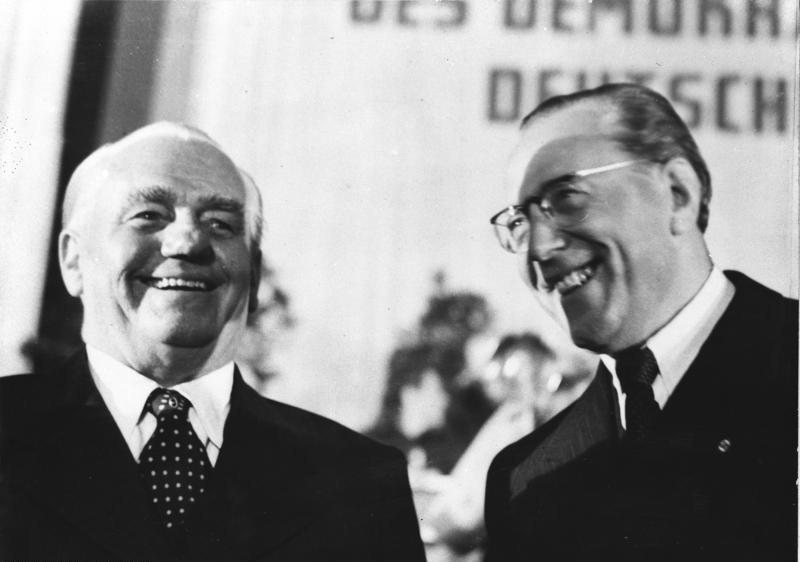
On October 7, 1949 the German Democratic Republic was formally established and the Soviets Military Administration turned control of East Germany over to the SED, headed by Wilhelm Pieck (1876–1960), who became President of the GDR and held the office until his death, while the SED general secretary Walter Ulbricht assumed most executive authority. Socialist leader Otto Grotewohl (1894–1964) became prime minister until his death.
The government of East Germany denounced West German failures in accomplishing denazification and renounced ties to the Nazi past, imprisoning many former Nazis and preventing them from holding government positions. The SED set a primary goal of ridding East Germany of all traces of Nazism. It is estimated that between 180,000 and 250,000 people were sentenced to imprisonment on political grounds.
Zones of occupation
In the Yalta and Potsdam conferences of 1945, the Allies established their joint military occupation and administration of Germany via the Allied Control Council (ACC), a four-power (US, UK, USSR, France) military government effective until the restoration of German sovereignty. In eastern Germany, the Soviet Occupation Zone (Sowjetische Besatzungszone, SBZ) comprised the five states (Länder) of Mecklenburg-Vorpommern, Brandenburg, Saxony, Saxony-Anhalt, and Thuringia. Disagreements over the policies to be followed in the occupied zones quickly led to a breakdown in cooperation among the four powers, and the Soviets administered their zone without regard to the policies implemented in the other zones. The Soviets withdrew from the ACC in 1948; subsequently, as the other three zones were increasingly unified and granted self-government, the Soviet administration instituted a separate socialist government in its zone.

Seven years after the Allies' 1945 Potsdam Agreement on common German policies, the USSR via the Stalin Note (10 March 1952) proposed German reunification and superpower disengagement from Central Europe, which the three Western Allies (US, UK, France) rejected. Soviet leader Joseph Stalin, a Communist proponent of reunification, died in early March 1953. Similarly, Lavrenty Beria, the First Deputy Prime Minister of the USSR, pursued German reunification but was removed from power that same year before he could act on the matter. His successor, Nikita Khrushchev, rejected reunification as equivalent to returning East Germany for annexation to the West; hence reunification was off the table until the fall of the Berlin wall in 1989.
East Germany regarded East Berlin as its capital, and the Soviet Union and the rest of the Eastern Bloc diplomatically recognized East Berlin as the capital. However, the Western Allies disputed this recognition, and considered the entire city of Berlin to be occupied territory governed by the ACC. According to Margarete Feinstein, the West and most Third World countries largely unrecognized East Berlin's status as the capital. In practice, the Cold War nullified the ACC's authority, East Berlin's status as occupied territory largely became a legal fiction, and the Soviet sector of Berlin fully integrated into the GDR.
The deepening Cold War conflict between the Western Powers and the Soviet Union over the unresolved status of West Berlin led to the Berlin Blockade (24 June 1948 – 12 May 1949). The Soviet army initiated the blockade by halting all Allied rail, road, and water traffic to and from West Berlin. The Allies countered the Soviets with the Berlin Airlift (1948–49) of food, fuel, and supplies to West Berlin.
Partition
On 21 April 1946 the Communist Party of Germany (Kommunistische Partei Deutschlands; KPD) and the part of the Social Democratic Party of Germany (Sozialdemokratische Partei Deutschlands; SPD) in the Soviet zone merged to form the Socialist Unity Party of Germany (Sozialistische Einheitspartei Deutschlands; SED), which then won the elections of October 1946. The SED government nationalised infrastructure and industrial plants.
In March 1948 the German Economic Commission (Deutsche Wirtschaftskomission; DWK) under its chairman Heinrich Rau assumed administrative authority in the Soviet occupation zone, thus becoming the predecessor of the East German government.
On 7 October 1949 the SED established the German Democratic Republic (Deutsche Demokratische Republik; GDR), based on a socialist political constitution establishing its control of the Anti-Fascist National Front of the German Democratic Republic (Nationale Front der Deutschen Demokratischen Republik; NF), an omnibus alliance of every party and mass organisation in East Germany. The NF was established to stand for election to the People's Chamber (Volkskammer), the East German parliament. The first and only president of the German Democratic Republic was Wilhelm Pieck. However, after 1950, political power in East Germany was held by the First Secretary of the SED, Walter Ulbricht.
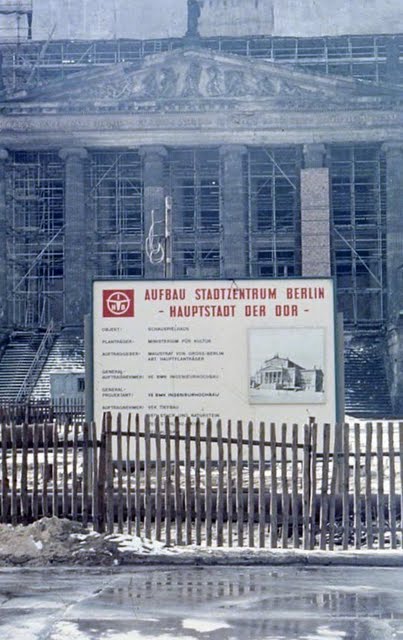
On 16 June 1953, workers constructing the new Stalinallee boulevard in East Berlin, according to the GDR's officially promulgated Sixteen Principles of Urban Design, rioted against a 10% production-quota increase. Initially a labour protest, the action soon included the general populace, and on 17 June similar protests occurred throughout the GDR, with more than a million people striking in some 700 cities and towns. Fearing anti-communist counter-revolution, on 18 June 1953 the government of the GDR enlisted the Soviet Occupation Forces to aid the police in ending the riot; some fifty people were killed and 10,000 were jailed (see Uprising of 1953 in East Germany).
The German war reparations owed to the Soviets impoverished the Soviet Zone of Occupation and severely weakened the East German economy. During 1945–46 the Soviets confiscated and transported to the USSR approximately 33% of the industrial plants, and by the early 1950s had extracted some US$10 billion in reparations in agricultural and industrial products. The poverty of East Germany, induced or deepened by reparations, provoked the Republikflucht ("desertion from the republic") to West Germany, further weakening the GDR's economy. Western economic opportunities induced a brain drain. In response, the GDR closed the inner German border, and on the night of 12 August 1961, East German soldiers began erecting the Berlin Wall. Many people attempting to flee were killed by border guards or booby traps such as landmines.
In 1971, Ulbricht was removed from leadership after Soviet leader Leonid Brezhnev supported his ousting; Erich Honecker replaced him. While the Ulbricht government had experimented with liberal reforms, the Honecker government reversed them. The new government introduced a new East German Constitution which defined the German Democratic Republic as a "republic of workers and peasants".
Initially, East Germany claimed an exclusive mandate for all of Germany, a claim supported by most of the Communist Bloc. It claimed that West Germany was an illegally constituted puppet state of NATO. However, from the 1960s onward, East Germany began recognizing itself as a separate country from West Germany and shared the legacy of the united German state of 1871–1945. This was formalized in 1974 when the reunification clause was removed from the revised East German constitution. West Germany, in contrast, maintained that it was the only legitimate government of Germany. From 1949 to the early 1970s, West Germany maintained that East Germany was an illegally constituted state. It argued that the GDR was a Soviet puppet-state and frequently referred to it as the "Soviet occupation zone". West Germany's allies shared this position until 1973. East Germany was recognized primarily by socialist countries and the Arab Bloc, along with some "scattered sympathizers". According to the Hallstein Doctrine (1955), West Germany did not establish (formal) diplomatic ties with any country – except the Soviets – that recognized East German sovereignty.
In the early 1970s, the Ostpolitik ('Eastern Policy') of "Change Through Rapprochement" of the pragmatic government of FRG Chancellor Willy Brandt, established normal diplomatic relations with the Eastern Bloc states. This policy saw the Treaty of Moscow (August 1970), the Treaty of Warsaw (December 1970), the Four Power Agreement on Berlin (September 1971), the Transit Agreement (May 1972), and the Basic Treaty (December 1972), which relinquished any separate claims to an exclusive mandate over Germany as a whole and established normal relations between the two Germanies. Both countries were admitted into the United Nations on 18 September 1973. This also increased the number of countries recognizing East Germany to 55, including the US, UK and France, though these three still refused to recognize East Berlin as the capital, and insisted on a specific provision in the UN resolution accepting the two Germanies into the UN to that effect. Following the Ostpolitik, West Germany viewed East Germany as a de facto government within a single German nation and a de jure state organisation of parts of Germany outside the Federal Republic. The Federal Republic continued to maintain that it could not within its own structures recognize the GDR de jure as a sovereign state under international law; but it fully acknowledged that, within the structures of international law, the GDR was an independent sovereign state. By distinction, West Germany then viewed itself as being within its own boundaries, not only the de facto and de jure government, but also the sole de jure legitimate representative of a dormant "Germany as whole". The two German governments each relinquished any claim to represent the other internationally, which they acknowledged as necessarily implying a mutual recognition of each other as both capable of representing their own populations de jure in participating in international bodies and agreements, such as the United Nations and the Helsinki Final Act.
This assessment of the Basic Treaty was confirmed in a decision of the Federal Constitutional Court in 1973:
the German Democratic Republic is in the international-law sense a State and as such a subject of international law. This finding is independent of recognition in international law of the German Democratic Republic by the Federal Republic of Germany. Such recognition has not only never been formally pronounced by the Federal Republic of Germany but on the contrary repeatedly explicitly rejected. If the conduct of the Federal Republic of Germany towards the German Democratic Republic is assessed in the light of its détente policy, in particular, the conclusion of the Treaty as de facto recognition, then it can only be understood as de facto recognition of a special kind. The special feature of this Treaty is that while it is a bilateral Treaty between two States, to which the rules of international law apply and which like any other international treaty possesses validity, it is between two States that are parts of a still existing, albeit incapable of action as not being reorganized, comprehensive State of the Whole of Germany with a single body politic.
Travel between the GDR and Poland, Czechoslovakia, and Hungary became visa-free from 1972.
GDR identity
From the beginning, the newly formed GDR tried to establish its own separate identity. Because of the imperial and military legacy of Prussia, the SED repudiated continuity between Prussia and the GDR. The SED destroyed a number of symbolic relics of the former Prussian aristocracy – Junker manor-houses were torn down, the Berliner Stadtschloß was razed and the Palace of the Republic was built in its place, and the equestrian statue of Frederick the Great was removed from East Berlin. Instead, the SED focused on the progressive heritage of German history, including Thomas Müntzer's role in the German Peasants' War (1524–1525) and the roles of heroes of the class struggle during Prussia's industrialization. The SED upheld other notable figures and reformers from Prussian history – such as Karl Freiherr vom Stein (1757–1831), Karl August von Hardenberg (1750–1822), Wilhelm von Humboldt (1767–1835), and Gerhard von Scharnhorst (1755–1813) – as examples and role models.
Remembrance of the Third Reich
The communist regime of the GDR based its legitimacy on the struggle of anti-fascist militants. The Buchenwald Resistance, a resistance group, was established at the memorial site of the Buchenwald concentration camp, with the creation of a museum in 1958, and the annual celebration of the Buchenwald oath taken on 19 April 1945 by the prisoners who pledged to fight for peace and freedom. In the 1990s, the 'state anti-fascism' of the GDR gave way to the 'state anti-communism' of the FRG. From then on, the dominant interpretation of GDR history, based on the concept of totalitarianism, led to the equivalence of communism and Nazism.
Although officially built in opposition to the 'fascist world' in West Germany, 32% of GDR public administration employees in 1954 were former members of the Nazi Party (NSDAP). While by 1961, the share of former NSDAP members among the senior Interior Ministry administration staff was less than 10% in the GDR, compared to 67% in the FRG, being a former Nazi was still not a hindrance for a career in the GDR's ministries and even in the SED, several high-ranking party functionaries such as Fritz Müller and Bruno Lietz being former NSDAP members. While a work of memory on the resurgence of Nazism was carried out in West Germany, this was not the case in the East, where the existence of Neo-Nazism in a socialist state was seen as being impossible. In addition, East Germany, not seeing itself as the legal successor to Nazi Germany, refused all remuneration requests by Jewish Holocaust victims and their families.
On 17 October 1987, around thirty skinheads threw themselves into a crowd of 2,000 people at a rock concert in the Zionskirche without the police intervening. In 1990, the writer Freya Klier received a death threat for writing an essay on antisemitism and xenophobia in the GDR. SPDA Vice President Wolfgang Thierse, for his part, complained in Die Welt about the rise of the extreme right in the everyday life of the inhabitants of the former GDR, in particular the terrorist group NSU, with the German journalist Odile Benyahia-Kouider explaining that "it is no coincidence that the neo-Nazi party NPD has experienced a renaissance via the East".
The historian Sonia Combe observes that until the 1990s, the majority of West German historians described the Normandy landings in June 1944 as an "invasion", exonerated the Wehrmacht of its responsibility for the genocide of the Jews, and fabricated the myth of a diplomatic corps that "did not know". In contrast, Auschwitz was never a taboo in the GDR. The Nazis' crimes were the subject of extensive film, theatre, and literary productions. In 1991, 16% of the population in West Germany and 6% in East Germany had antisemitic prejudices. In 1994, 40% of West Germans and 22% of East Germans felt that too much emphasis was placed on the genocide of the Jews.
Historian Ulrich Pfeil, nevertheless, recalls the fact that anti-fascist commemoration in the GDR had "a hagiographic and indoctrination character". As in the case of the memory of the protagonists of the German labour movement and the victims of the camps, it was "staged, censored, ordered" and, during the 40 years of the regime, was an instrument of legitimisation, repression, and maintenance of power.
Die Wende (German reunification)
In May 1989, following widespread public anger over the faking of local government election results, many GDR citizens applied for exit visas or left the country contrary to GDR laws. The impetus for this exodus of East Germans was the removal of the electrified fence along Hungary's border with Austria on 2 May 1989. Although formally the Hungarian frontier was still closed, many East Germans took the opportunity to enter Hungary via Czechoslovakia, and then make the illegal crossing from Hungary to Austria and to West Germany beyond. By July, 25,000 East Germans had crossed into Hungary; most of them did not attempt the risky crossing into Austria but remained instead in Hungary or claimed asylum in West German embassies in Prague or Budapest.
The opening of a border gate between Austria and Hungary at the Pan-European Picnic on 19 August 1989 then triggered a chain reaction leading to the end of the GDR and the disintegration of the Eastern Bloc. It was the largest mass escape from East Germany since the building of the Berlin Wall in 1961. The idea of opening the border at a ceremony came from Otto von Habsburg, who proposed it to Miklós Németh, then Hungarian Prime Minister, who promoted the idea. The patrons of the picnic, Habsburg and Hungarian Minister of State Imre Pozsgay, who did not attend the event, saw the planned event as an opportunity to test Mikhail Gorbachev's reaction to an opening of the border on the Iron Curtain. In particular, it tested whether Moscow would give the Soviet troops stationed in Hungary the command to intervene. The Paneuropean Union advertised extensively for the planned picnic with posters and flyers distributed among GDR holidaymakers in Hungary. The Austrian branch of the Paneuropean Union, then headed by Karl von Habsburg, distributed thousands of brochures inviting GDR citizens to a picnic near the border at Sopron (near Hungary's border with Austria). The local Sopron organizers knew nothing of possible GDR refugees, but envisaged a local party with Austrian and Hungarian participation. But with the mass exodus at the picnic, the subsequent hesitant behavior of the Socialist Unity Party of East Germany and the non-intervention of the Soviet Union broke the dams. Thus, the barrier of the Eastern Bloc was broken. Tens of thousands of East Germans, alerted by the media, made their way to Hungary, which was no longer ready to keep its borders completely closed or force its border troops to open fire on escapees. The GDR leadership in East Berlin did not dare to completely lock down their own country's borders.
The next major turning point in the exodus came on 10 September 1989, when Hungarian Foreign Minister Gyula Horn announced that his country would no longer restrict movement from Hungary into Austria. Within two days, 22,000 East Germans crossed into Austria; tens of thousands more did so in the following weeks.
Many other GDR citizens demonstrated against the ruling party, especially in the city of Leipzig. The Leipzig demonstrations became a weekly occurrence, with a turnout of 10,000 people at the first demonstration on 2 October, and a peak of an estimated 300,000 by the end of the month. The protests were surpassed in East Berlin, where half a million demonstrators turned out against the regime on 4 November. Kurt Masur, conductor of the Leipzig Gewandhaus Orchestra, led local negotiations with the government and held town meetings in the concert hall. The demonstrations eventually led Erich Honecker to resign in October; he was replaced by a slightly more moderate communist, Egon Krenz.
The massive demonstration in East Berlin on 4 November coincided with Czechoslovakia formally opening its border to West Germany. With the West more accessible than ever before, 30,000 East Germans made the crossing via Czechoslovakia in the first two days alone. To try to stem the outward flow of the population, the SED proposed a law loosening travel restrictions. When the Volkskammer rejected it on 5 November, the Cabinet and Politburo of the GDR resigned. This left only one avenue open for Krenz and the SED: completely abolishing travel restrictions between East and West.
On 9 November 1989, a few sections of the Berlin Wall were opened, resulting in thousands of East Germans crossing freely into West Berlin and West Germany for the first time in nearly 30 years. Krenz resigned a month later, and the SED opened negotiations with the leaders of the incipient Democratic movement, Neues Forum, to schedule free elections and begin the process of democratization. As part of this process, the SED eliminated the clause in the East German constitution guaranteeing the Communists leadership of the state. The change was approved in the Volkskammer on 1 December 1989 by a vote of 420 to 0.
East Germany held its last election in March 1990. The winner was Alliance for Germany, a coalition headed by the East German branch of West Germany's Christian Democratic Union, which advocated speedy reunification. Negotiations (2+4 Talks) were held involving the two German states and the former Allies, which led to agreement on the conditions for German unification. By a two-thirds vote in the Volkskammer on 23 August 1990, the German Democratic Republic declared its accession to the Federal Republic of Germany. The five original East German states that had been abolished in the 1952 redistricting were restored. On 3 October 1990, the five states officially joined the Federal Republic of Germany, while East and West Berlin united as a third city-state (in the same manner as Bremen and Hamburg). On 1 July, a currency union preceded the political union: the Ostmark was abolished, and the Western German Deutsche Mark became the common currency.
Although the Volkskammer's declaration of accession to the Federal Republic had initiated the process of reunification, the act of reunification itself (with its many specific terms, conditions, and qualifications, some of which involved amendments to the West German Basic Law) was achieved constitutionally by the subsequent Unification Treaty of 31 August 1990 – that is, through a binding agreement between the former Democratic Republic and the Federal Republic, now recognising each other as separate sovereign states in international law. The treaty was then voted into effect prior to the agreed date for unification by both the Volkskammer and the Bundestag by the constitutionally required two-thirds majorities, effecting on the one hand the extinction of the GDR, and on the other the agreed amendments to the Basic Law of the Federal Republic.
The wide economic and socio-political inequalities between the former German states required government subsidies for the full integration of the GDR into the FRG. Because of the resulting deindustrialization in former East Germany, the causes of the failure of this integration continue to be debated. Some western commentators claim that the depressed eastern economy is a natural aftereffect of a demonstrably inefficient command economy. But many East German critics contend that the shock-therapy style of privatization, the artificially high rate of exchange offered for the Ostmark, and the speed with which the entire process was implemented did not leave room for East German enterprises to adapt.
Government and politics
The political history of East Germany had four periods: 1949–1961, which saw the "Construction of Socialism"; 1961–1970, after the Berlin Wall closed off escape, was a period of stability and consolidation; 1971–1985 was termed the "Honecker Era", and saw closer ties with West Germany; and 1985–1990 saw the decline and extinction of East Germany.
Organization
East Germany officially described itself as a socialist workers' and peasants' state. The ruling political party in East Germany was the Sozialistische Einheitspartei Deutschlands (Socialist Unity Party of Germany; SED). It was created in 1946 through the Soviet-directed merger of the Communist Party of Germany (KPD) and the Social Democratic Party of Germany (SPD) in the Soviet-controlled zone. However, the SED quickly transformed into a full-fledged communist party as the more independent-minded social democrats were pushed out. The internal power organisation of East Germany was a unitary state.
The Potsdam Agreement committed the Soviets to support a democratic form of government in Germany, though the Soviets' understanding of democracy was radically different from that of the West. As in other Soviet Bloc countries, non-communist political parties were allowed. Nevertheless, every political party in the GDR was forced to join the National Front of Democratic Germany, a SED-led coalition of parties and mass political organisations, which included:
Christlich-Demokratische Union Deutschlands (Christian Democratic Union of Germany; CDU), which merged with the West German CDU after reunification;
Demokratische Bauernpartei Deutschlands (Democratic Farmers' Party of Germany; DBD), which party merged with the West German CDU after reunification;