
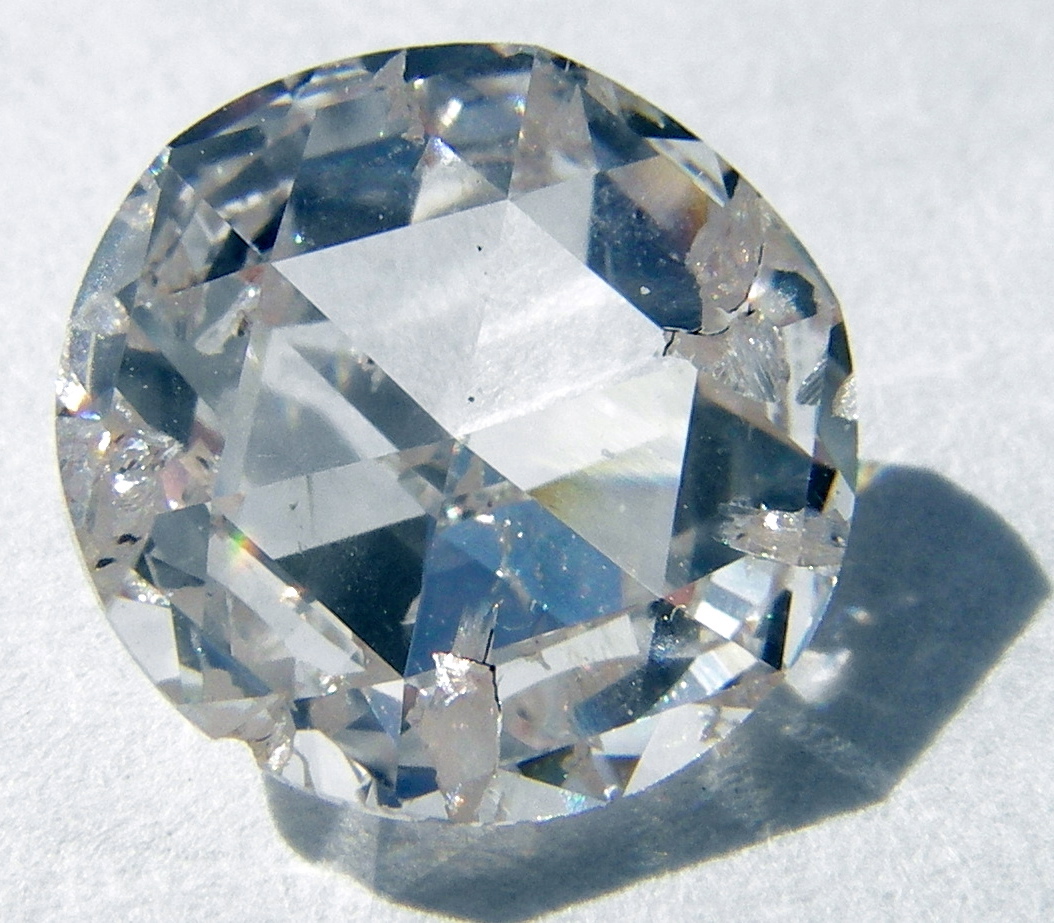
Diamond is a mineral form of the element carbon with its atoms arranged in a crystal structure called diamond cubic. Diamond is a tasteless, odorless, strong, brittle solid, a poor conductor of electricity, colorless in pure form, and insoluble in water. Another solid form of carbon known as graphite is the chemically stable form of carbon at room temperature and pressure, but diamond is metastable and converts to it at a negligible rate under those conditions. Diamond has the highest hardness and thermal conductivity of any natural material, properties that are used in major industrial applications such as cutting and polishing tools.
Because the arrangement of atoms in diamond is extremely rigid, few types of impurity can contaminate it (two exceptions are boron and nitrogen). Small numbers of defects or impurities—about one per million of lattice atoms—can color a diamond blue (boron), yellow (nitrogen), brown (defects), green (radiation exposure), purple, pink, orange, or red. Diamond also has a very high refractive index and a relatively high optical dispersion.
Most natural diamonds have ages between 1 billion and 3.5 billion years. Most were formed at depths between 150 and 250 kilometres (93 and 155 mi) in the Earth's mantle, although a few have come from as deep as 800 kilometres (500 mi). Under high pressure and temperature, carbon-containing fluids dissolved various minerals and replaced them with diamonds. Much more recently (hundreds to tens of million years ago), they were carried to the surface in volcanic eruptions and deposited in igneous rocks known as kimberlites and lamproites.

Synthetic diamonds can be grown from high-purity carbon under high pressures and temperatures or from hydrocarbon gases by chemical vapor deposition (CVD). Natural and synthetic diamonds are most commonly distinguished using optical techniques or thermal conductivity measurements.
Etymology, earliest use and composition discovery
The name diamond is derived from Ancient Greek: ἀδάμας (adámas), 'proper, unalterable, unbreakable, untamed', from ἀ- (a-), 'not' + Ancient Greek: δαμάω (damáō), 'to overpower, tame'. Diamonds are thought to have been first recognized and mined in India, where significant alluvial deposits of the stone could be found many centuries ago along the rivers Penner, Krishna, and Godavari. Diamonds have been known in India for at least 3,000 years but most likely 6,000 years.
Diamonds have been treasured as gemstones since their use as religious icons in ancient India. Their usage in engraving tools also dates to early human history. The popularity of diamonds has risen since the 19th century due to increased supply, improved cutting and polishing techniques, growth in the world economy, and innovative and successful advertising campaigns.

In 1772, the French scientist Antoine Lavoisier used a lens to concentrate the rays of the sun on a diamond in an atmosphere of oxygen, and showed that the only product of the combustion was carbon dioxide, proving that diamond is composed of carbon. Later, in 1797, the English chemist Smithson Tennant repeated and expanded that experiment. By demonstrating that burning diamond and graphite releases the same amount of gas, he established the chemical equivalence of these substances.
Properties
Diamond is a solid form of pure carbon with its atoms arranged in a crystal. Solid carbon comes in different forms known as allotropes depending on the type of chemical bond. The two most common allotropes of pure carbon are diamond and graphite. In graphite, the bonds are sp2 orbital hybrids and the atoms form in planes, with each bound to three nearest neighbors, 120 degrees apart. In diamond, they are sp3 and the atoms form tetrahedral, with each bound to four nearest neighbors. Tetrahedra are rigid, the bonds are strong, and, of all known substances, diamond has the greatest number of atoms per unit volume, which is why it is both the hardest and the least compressible. It also has a high density, ranging from 3150 to 3530 kilograms per cubic metre (over three times the density of water) in natural diamonds and 3520 kg/m3 in pure diamond. In graphite, the bonds between nearest neighbors are even stronger, but the bonds between parallel adjacent planes are weak, so the planes easily slip past each other. Thus, graphite is much softer than diamond. However, the stronger bonds make graphite less flammable.
Diamonds have been adopted for many uses because of the material's exceptional physical characteristics. It has the highest thermal conductivity and the highest sound velocity. It has low adhesion and friction, and its coefficient of thermal expansion is extremely low. Its optical transparency extends from the far infrared to the deep ultraviolet, and it has high optical dispersion. It also has high electrical resistance. It is chemically inert, not reacting with most corrosive substances, and has excellent biological compatibility.
Thermodynamics
The equilibrium pressure and temperature conditions for a transition between graphite and diamond are well established theoretically and experimentally. The equilibrium pressure varies linearly with temperature, between 1.7 GPa at 0 K and 12 GPa at 5000 K (the diamond/graphite/liquid triple point). However, the phases have a wide region about this line where they can coexist. At standard temperature and pressure, 20 °C (293 K) and 1 standard atmosphere (0.10 MPa), the stable phase of carbon is graphite, but diamond is metastable, with a significant kinetic energy barrier that the atoms must overcome to reach the lower energy state, and its rate of conversion to graphite is negligible, with a timescale of millions to billions of years. However, at temperatures above about 4500 K, diamond rapidly converts to graphite. Experiments have found that diamond, in the presence of H2O passes through an intermediate linear carbon phase.
Rapid conversion of graphite to diamond requires pressures well above the equilibrium line: at 2000 K, a pressure of 35 GPa (about 350,000 standard atmospheres) is needed.
Above the graphite–diamond–liquid carbon triple point, the melting point of diamond increases slowly with increasing pressure, but at pressures of hundreds of GPa, it decreases. At high pressures, silicon and germanium have a BC8 body-centered cubic crystal structure, and a similar structure is predicted for carbon at high pressures. At 0 K, the transition is predicted to occur at 1100 GPa.

Results published in Nature Physics in 2010 suggest that, at ultra-high pressures and temperatures (about 10 million atmospheres or 1 TPa and 50,000 °C), diamond melts into a metallic fluid. The extreme conditions required for this to occur are present in the ice giant planets Neptune and Uranus, both of which are made up of approximately 10 percent carbon and could hypothetically contain oceans of liquid carbon. Since large quantities of metallic fluid can affect the magnetic field, this could serve to explain why the geographic and magnetic poles of the two planets are not aligned.
Crystal structure
The most common crystal structure of diamond is called diamond cubic. It is formed of unit cells stacked together. Although there are 18 atoms in the figure, each corner atom is shared by eight unit cells and each atom in the center of a face is shared by two, so there are a total of eight atoms per unit cell. The length of each side of the unit cell is denoted by a and is 3.567 angstroms.
The nearest neighbor distance in the diamond lattice is 1.732a/4 where a is the lattice constant, usually given in Angstrøms as a = 3.567 Å, which is 0.3567 nm.

A diamond cubic lattice can be thought of as two interpenetrating face-centered cubic lattices with one displaced by 1⁄4 of the diagonal along a cubic cell, or as one lattice with two atoms associated with each lattice point. Viewed from a <1 1 1> crystallographic direction, it is formed of layers stacked in a repeating ABCABC ... pattern. Diamonds can also form an ABAB ... structure, which is known as hexagonal diamond or lonsdaleite, but this is far less common and is formed under different conditions from cubic carbon.
Crystal habit
Diamonds occur most often as euhedral or rounded octahedra and twinned octahedra known as macles. As diamond's crystal structure has a cubic arrangement of the atoms, they have many facets that belong to a cube, octahedron, rhombicosidodecahedron, tetrakis hexahedron, or disdyakis dodecahedron. The crystals can have rounded-off and unexpressive edges and can be elongated. Diamonds (especially those with rounded crystal faces) are commonly found coated in nyf, an opaque gum-like skin.
Some diamonds contain opaque fibers. They are referred to as opaque if the fibers grow from a clear substrate or fibrous if they occupy the entire crystal. Their colors range from yellow to green or gray, sometimes with cloud-like white to gray impurities. Their most common shape is cuboidal, but they can also form octahedra, dodecahedra, macles, or combined shapes. The structure is the result of numerous impurities with sizes between 1 and 5 microns. These diamonds probably formed in kimberlite magma and sampled the volatiles.

Diamonds can also form polycrystalline aggregates. There have been attempts to classify them into groups with names such as boart, ballas, stewartite, and framesite, but there is no widely accepted set of criteria. Carbonado, a type in which the diamond grains were sintered (fused without melting by the application of heat and pressure), is black in color and tougher than single crystal diamond. It has never been observed in a volcanic rock. There are many theories for its origin, including formation in a star, but no consensus.
Mechanical
Hardness
Diamond is the hardest material on the qualitative Mohs scale. To conduct the quantitative Vickers hardness test, samples of materials are struck with a pyramid of standardized dimensions using a known force – a diamond crystal is used for the pyramid to permit a wide range of materials to be tested. From the size of the resulting indentation, a Vickers hardness value for the material can be determined. Diamond's great hardness relative to other materials has been known since antiquity, and is the source of its name. This does not mean that it is infinitely hard, indestructible, or unscratchable. Indeed, diamonds can be scratched by other diamonds and worn down over time even by softer materials, such as vinyl phonograph records.
Diamond hardness depends on its purity, crystalline perfection, and orientation: hardness is higher for flawless, pure crystals oriented to the <111> direction (along the longest diagonal of the cubic diamond lattice). Therefore, whereas it might be possible to scratch some diamonds with other materials, such as boron nitride, the hardest diamonds can only be scratched by other diamonds and nanocrystalline diamond aggregates.
The hardness of diamond contributes to its suitability as a gemstone. Because it can only be scratched by other diamonds, it maintains its polish extremely well. Unlike many other gems, it is well-suited to daily wear because of its resistance to scratching—perhaps contributing to its popularity as the preferred gem in engagement or wedding rings, which are often worn every day.
The hardest natural diamonds mostly originate from the Copeton and Bingara fields located in the New England area in New South Wales, Australia. These diamonds are generally small, perfect to semiperfect octahedra, and are used to polish other diamonds. Their hardness is associated with the crystal growth form, which is single-stage crystal growth. Most other diamonds show more evidence of multiple growth stages, which produce inclusions, flaws, and defect planes in the crystal lattice, all of which affect their hardness. It is possible to treat regular diamonds under a combination of high pressure and high temperature to produce diamonds that are harder than the diamonds used in hardness gauges.
Diamonds cut glass, but this does not positively identify a diamond because other materials, such as quartz, also lie above glass on the Mohs scale and can also cut it. Diamonds can scratch other diamonds, but this can result in damage to one or both stones. Hardness tests are infrequently used in practical gemology because of their potentially destructive nature. The extreme hardness and high value of diamond means that gems are typically polished slowly, using painstaking traditional techniques and greater attention to detail than is the case with most other gemstones; these tend to result in extremely flat, highly polished facets with exceptionally sharp facet edges. Diamonds also possess an extremely high refractive index and fairly high dispersion. Taken together, these factors affect the overall appearance of a polished diamond and most diamantaires still rely upon skilled use of a loupe (magnifying glass) to identify diamonds "by eye".
Toughness
Somewhat related to hardness is another mechanical property toughness, which is a material's ability to resist breakage from forceful impact. The toughness of natural diamond has been measured as 50–65 MPa·m1/2. This value is good compared to other ceramic materials, but poor compared to most engineering materials such as engineering alloys, which typically exhibit toughness over 80 MPa·m1/2. As with any material, the macroscopic geometry of a diamond contributes to its resistance to breakage. Diamond has a cleavage plane and is therefore more fragile in some orientations than others. Diamond cutters use this attribute to cleave some stones before faceting them. "Impact toughness" is one of the main indexes to measure the quality of synthetic industrial diamonds.
Yield strength
Diamond has a compressive yield strength of 130–140 GPa. This exceptionally high value, along with the hardness and transparency of diamond, are the reasons that diamond anvil cells are the main tool for high pressure experiments. These anvils have reached pressures of 600 GPa. Much higher pressures may be possible with nanocrystalline diamonds.
Elasticity and tensile strength
Usually, attempting to deform bulk diamond crystal by tension or bending results in brittle fracture. However, when single crystalline diamond is in the form of micro/nanoscale wires or needles (~100–300 nanometers in diameter, micrometers long), they can be elastically stretched by as much as 9–10 percent tensile strain without failure, with a maximum local tensile stress of about 89–98 GPa, very close to the theoretical limit for this material.
Electrical conductivity
Other specialized applications also exist or are being developed, including use as semiconductors: some blue diamonds are natural semiconductors, in contrast to most diamonds, which are excellent electrical insulators. The conductivity and blue color originate from boron impurity. Boron substitutes for carbon atoms in the diamond lattice, donating a hole into the valence band.
Substantial conductivity is commonly observed in nominally undoped diamond grown by chemical vapor deposition. This conductivity is associated with hydrogen-related species adsorbed at the surface, and it can be removed by annealing or other surface treatments.
Thin needles of diamond can be made to vary their electronic band gap from the normal 5.6 eV to near zero by selective mechanical deformation.
High-purity diamond wafers 5 cm in diameter exhibit perfect resistance in one direction and perfect conductance in the other, creating the possibility of using them for quantum data storage. The material contains only 3 parts per million of nitrogen. The diamond was grown on a stepped substrate, which eliminated cracking.
Surface property
Diamonds are naturally lipophilic and hydrophobic, which means the diamonds' surface cannot be wet by water, but can be easily wet and stuck by oil. This property can be utilized to extract diamonds using oil when making synthetic diamonds. However, when diamond surfaces are chemically modified with certain ions, they are expected to become so hydrophilic that they can stabilize multiple layers of water ice at human body temperature.
The surface of diamonds is partially oxidized. The oxidized surface can be reduced by heat treatment under hydrogen flow. That is to say, this heat treatment partially removes oxygen-containing functional groups. But diamonds (sp3C) are unstable against high temperature (above about 400 °C (752 °F)) under atmospheric pressure. The structure gradually changes into sp2C above this temperature. Thus, diamonds should be reduced below this temperature.
Chemical stability
At room temperature, diamonds do not react with any chemical reagents including strong acids and bases.
In an atmosphere of pure oxygen, diamond has an ignition point that ranges from 690 °C (1,274 °F) to 840 °C (1,540 °F); smaller crystals tend to burn more easily. It increases in temperature from red to white heat and burns with a pale blue flame, and continues to burn after the source of heat is removed. By contrast, in air the combustion will cease as soon as the heat is removed because the oxygen is diluted with nitrogen. A clear, flawless, transparent diamond is completely converted to carbon dioxide; any impurities will be left as ash. Heat generated from cutting a diamond will not ignite the diamond, and neither will a cigarette lighter, but house fires and blow torches are hot enough. Jewelers must be careful when molding the metal in a diamond ring.
Diamond powder of an appropriate grain size (around 50 microns) burns with a shower of sparks after ignition from a flame. Consequently, pyrotechnic compositions based on synthetic diamond powder can be prepared. The resulting sparks are of the usual red-orange color, comparable to charcoal, but show a very linear trajectory which is explained by their high density. Diamond also reacts with fluorine gas above about 700 °C (1,292 °F).
Color
Diamond has a wide band gap of 5.5 eV corresponding to the deep ultraviolet wavelength of 225 nanometers. This means that pure diamond should transmit visible light and appear as a clear colorless crystal. Colors in diamond originate from lattice defects and impurities. The diamond crystal lattice is exceptionally strong, and only atoms of nitrogen, boron, and hydrogen can be introduced into diamond during the growth at significant concentrations (up to atomic percents). Transition metals nickel and cobalt, which are commonly used for growth of synthetic diamond by high-pressure high-temperature techniques, have been detected in diamond as individual atoms; the maximum concentration is 0.01% for nickel and even less for cobalt. Virtually any element can be introduced to diamond by ion implantation.
Nitrogen is by far the most common impurity found in gem diamonds and is responsible for the yellow and brown color in diamonds. Boron is responsible for the blue color. Color in diamond has two additional sources: irradiation (usually by alpha particles), that causes the color in green diamonds, and plastic deformation of the diamond crystal lattice. Plastic deformation is the cause of color in some brown and perhaps pink and red diamonds. In order of increasing rarity, yellow diamond is followed by brown, colorless, then by blue, green, black, pink, orange, purple, and red. "Black", or carbonado, diamonds are not truly black, but rather contain numerous dark inclusions that give the gems their dark appearance. Colored diamonds contain impurities or structural defects that cause the coloration, while pure or nearly pure diamonds are transparent and colorless. Most diamond impurities replace a carbon atom in the crystal lattice, known as a carbon flaw. The most common impurity, nitrogen, causes a slight to intense yellow coloration depending upon the type and concentration of nitrogen present. The Gemological Institute of America (GIA) classifies low saturation yellow and brown diamonds as diamonds in the normal color range, and applies a grading scale from "D" (colorless) to "Z" (light yellow). Yellow diamonds of high color saturation or a different color, such as pink or blue, are called fancy colored diamonds and fall under a different grading scale.
In 2008, the Wittelsbach Diamond, a 35.56-carat (7.112 g) blue diamond once belonging to the King of Spain, fetched over US$24 million at a Christie's auction. In May 2009, a 7.03-carat (1.406 g) blue diamond fetched the highest price per carat ever paid for a diamond when it was sold at auction for 10.5 million Swiss francs (6.97 million euros, or US$9.5 million at the time). That record was, however, beaten the same year: a 5-carat (1.0 g) vivid pink diamond was sold for US$10.8 million in Hong Kong on December 1, 2009.
Clarity
Clarity is one of the 4C's (color, clarity, cut and carat weight) that helps in identifying the quality of diamonds. The Gemological Institute of America (GIA) developed 11 clarity scales to decide the quality of a diamond for its sale value. The GIA clarity scale spans from Flawless (FL) to included (I) having internally flawless (IF), very, very slightly included (VVS), very slightly included (VS) and slightly included (SI) in between. Impurities in natural diamonds are due to the presence of natural minerals and oxides. The clarity scale grades the diamond based on the color, size, location of impurity and quantity of clarity visible under 10x magnification. Inclusions in diamond can be extracted by optical methods. The process is to take pre-enhancement images, identifying the inclusion removal part and finally removing the diamond facets and noises.
Fluorescence
Between 25% and 35% of natural diamonds exhibit some degree of fluorescence when examined under invisible long-wave ultraviolet light or higher energy radiation sources such as X-rays and lasers. Incandescent lighting will not cause a diamond to fluoresce. Diamonds can fluoresce in a variety of colors including blue (most common), orange, yellow, white, green and very rarely red and purple. Although the causes are not well understood, variations in the atomic structure, such as the number of nitrogen atoms present are thought to contribute to the phenomenon.
Thermal conductivity
Diamonds can be identified by their high thermal conductivity (900–2320 W·m−1·K−1). Their high refractive index is also indicative, but other materials have similar refractivity.
Geology
Diamonds are extremely rare, with concentrations of at most parts per billion in source rock. Before the 20th century, most diamonds were found in alluvial deposits. Loose diamonds are also found along existing and ancient shorelines, where they tend to accumulate because of their size and density. Rarely, they have been found in glacial till (notably in Wisconsin and Indiana), but these deposits are not of commercial quality. These types of deposit were derived from localized igneous intrusions through weathering and transport by wind or water.