
Malcolm X (born Malcolm Little, later el-Hajj Malik el-Shabazz; May 19, 1925 – February 21, 1965) was an American civil rights activist and Muslim minister who came from a background of poverty, family disruption, and criminal activity to a prominent figure during the civil rights movement until his assassination in 1965. He discovered the new religious movement the Nation of Islam while in prison and served as its spokesperson from 1952 until he transitioned to Sunni Islam in 1964. He is often regarded as one of the most significant Muslim figures in the United States. A controversial figure accused of preaching violence, Malcolm X is also a celebrated figure with lots of people in the African American community for his pursuit of racial justice.
Malcolm spent his adolescence living in a series of foster homes and with various relatives, after his father's death and his mother's hospitalization. In 1946, he was sentenced to eight to ten years in prison for larceny and burglary. While there, he joined the Nation of Islam, adopting the name Malcolm X to symbolize his unknown African ancestral surname while discarding "the white slavemaster name of 'Little'", and after his parole in 1952, he quickly became one of the organization's most influential leaders. He was the public face of the organization for 12 years, advocating black empowerment and separation of Black and white Americans, as well as criticizing Martin Luther King Jr. and the mainstream civil rights movement for its emphasis on non-violence and racial integration. Malcolm X also expressed pride in some of the Nation's social welfare achievements such as its free drug rehabilitation program. From the 1950s onward, Malcolm X was subjected to surveillance by the Federal Bureau of Investigation (FBI).
In the 1960s, Malcolm X began to grow disillusioned with the Nation of Islam and its leader Elijah Muhammad. He subsequently embraced Sunni Islam and the mainstream civil rights movement after completing the Hajj to Mecca and became known as "el-Hajj Malik el-Shabazz", which roughly translates to "The Pilgrim Malcolm the Patriarch". After a brief period of travel across Africa, he publicly renounced the Nation of Islam and founded the Islamic MMI and the Pan-African Organization of Afro-American Unity (OAAU). Throughout 1964, his conflict with the Nation of Islam intensified and he was repeatedly sent death threats. On February 21, 1965, he was assassinated in New York City. Three Nation members were charged with the murder and given indeterminate life sentences. In 2021, two of the convictions were vacated. Speculation about the assassination and whether it was conceived or aided by leading or additional members of the Nation, or with law enforcement agencies, has persisted for decades.
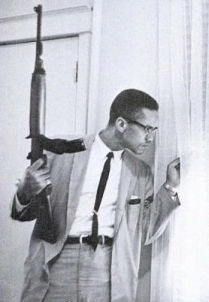
Malcolm was posthumously honored with Malcolm X Day on which he is commemorated in various cities across the United States. Hundreds of streets and schools in the US have been renamed in his honor, while the Audubon Ballroom, the site of his assassination, was partly redeveloped in 2005 to accommodate the Malcolm X and Dr. Betty Shabazz Memorial and Educational Center. His autobiography, on which he collaborated with Alex Haley, was published posthumously in 1965.
Early years
Childhood
Malcom X was born May 19, 1925, at University Hospital in Omaha, Nebraska. He was the fourth of seven children of Louise Little (née Langdon), born in Grenada, and Reverend Earl Little, born in Reynolds, Georgia. Earl was an outspoken Baptist minister and both he and Louise, a seamstress, were admirers of Pan-African activist Marcus Garvey. Malcolm had ten siblings; his older siblings were Wilfred, Hilda and Philbert and his younger siblings were Reginald, Wesley, Yvonne (1929–2003), and Robert. Malcolm also had older half-siblings from his father's first marriage, Ella (1914–1996), Mary and Earl Jr. Earl was the local leader of the Universal Negro Improvement Association (UNIA) and Louise served as secretary and "branch reporter", sending news of local UNIA activities to Negro World; they inculcated self-reliance and black pride in their children.
The family home was located at 3448 Pinkney Street and was designated a historical site by the National Register of Historic Places. Malcolm later said that white violence killed four of his father's brothers. Due to threats by members of the Ku Klux Klan that Earl's UNIA activities were said to be "spreading trouble", the family were forced to flee to Milwaukee in 1926, and shortly thereafter to Lansing, Michigan. In Lansing, his parents were sued for eviction from their newly purchased home due to a covenant that prevented the sale to non-white buyers. They were frequently harassed by the Black Legion, a white supremacist group who Earl later accused of burning down their family home in 1929. No fire truck was dispatched to their home to extinguish the blaze.

In 1931, when Malcolm was six years old, his father Earl died unexpectedly, in what has been officially ruled a streetcar accident. His mother Louise believed Earl had been murdered by the Black Legion. Rumors that local members were responsible for his father's death were widely circulated and were very disturbing to Malcolm X as a child. As an adult, he expressed conflicting beliefs on the question. After a dispute with creditors, Louise received a life insurance benefit (nominally $1,000 —about $21,000 in 2025) in payments of $18 per month; the issuer of another, larger policy refused to pay, claiming her husband Earl died by suicide. To make ends meet, Louise rented out part of her garden and her sons hunted game.
During the 1930s, white Seventh-day Adventists witnessed to the Little family; later on, Louise Little and her son Wilfred were baptized into the Seventh-day Adventist Church. Malcolm said the Adventists were "the friendliest white people" he ever saw.
In 1937, a man Louise had been dating—marriage had seemed a possibility—vanished from her life when she became pregnant with his child. In late 1938, she had a nervous breakdown and was committed to Kalamazoo State Hospital. The children were separated and sent to foster homes. Malcolm and his siblings secured her release 24 years later.

Malcolm attended West Junior High School in Lansing and then Mason High School in Mason, Michigan, but left high school in 1941 before graduating. He excelled in junior high school but dropped out of high school after a white teacher told him that practicing law, his aspiration at the time, was "no realistic goal for a nigger." Later, Malcolm X recalled feeling that the white world offered no place for a career-oriented black man regardless of talent.
Criminal career
From ages 14 to 21, Malcolm held a variety of jobs while living with his half-sister Ella Little-Collins in Roxbury, a largely African American neighborhood of Boston.
After a short time in Flint, Michigan, Malcolm moved to Harlem in 1943, where he found employment on the New Haven Railroad and engaged in drug dealing, gambling, racketeering, robbery, and pimping. According to biographer Bruce Perry, Malcolm also occasionally had sex with other men, usually for money, though this conjecture has been disputed by those who knew him. He befriended John Elroy Sanford, a fellow dishwasher at Jimmy's Chicken Shack in Harlem who aspired to be a professional comedian. Both men had reddish hair, so Sanford was called "Chicago Red" after his hometown, and Malcolm was known as "Detroit Red". Years later, Sanford became famous as comedian and actor Redd Foxx.

Summoned by the local draft board for military service in World War II in late 1943, he feigned mental disturbance by rambling and declaring: "I want to be sent down South. Organize them nigger soldiers ... steal us some guns, and kill us [some] crackers". He was then declared "mentally disqualified for military service".
In late 1945, Malcolm returned to Boston where he and four accomplices committed a series of burglaries targeting wealthy white families. In 1946, he was arrested while picking up a stolen watch he had left at a shop for repairs, and in February began serving a sentence of eight to ten years at Charlestown State Prison for larceny and breaking and entering. In 1947, he was transferred to Concord Reformatory where he served 15 months before transferring again to Norfolk Prison Colony.
The Nation of Islam
Prison
When Malcolm was in prison, he met fellow convict John Bembry, a self-educated man he would later describe as "the first man I had ever seen command total respect ... with words". Under Bembry's influence, Malcolm developed a voracious appetite for reading.

At this time, several of his siblings wrote to him about the Nation of Islam, a relatively new religious movement preaching black self-reliance and, ultimately, the return of the African diaspora to Africa (which was then undergoing the process of independence), where they would be free from white American and European domination. He showed scant interest at first, but after his brother Reginald wrote in 1948, "Malcolm, don't eat any more pork and don't smoke any more cigarettes. I'll show you how to get out of prison", he almost instantly quit smoking and began to refuse pork.
Following a visit during which Reginald detailed the group's teachings, including the notion that white people are considered devils, Malcolm initially struggled to accept this belief. Over time, however, Malcolm reflected on his past relationships with white individuals and concluded that they had all been marked by dishonesty, injustice, greed, and hatred. Malcolm, whose hostility to Christianity had earned him the prison nickname "Satan", became receptive to the message of the Nation of Islam.
In late 1948, Malcolm wrote to Elijah Muhammad, the leader of the Nation of Islam. Muhammad advised him to renounce his past, humbly bow in prayer to God and promise never to engage in destructive behavior again. Though he later recalled the inner struggle he had before bending his knees to pray, Malcolm soon became a member of the Nation of Islam, maintaining a regular correspondence with Muhammad.

In 1950, the FBI opened a file on Malcolm after he wrote a letter from prison to President Harry S. Truman expressing opposition to the Korean War and declaring himself a communist. That year, he also began signing his name "Malcolm X". Muhammad instructed his followers to leave their family names behind when they joined the Nation of Islam and use "X" instead. When the time was right, after they had proven their sincerity, he said, he would reveal the Muslim's "original name". In his autobiography, Malcolm X explained that the "X" symbolized the true African family name that he could never know. "For me, my 'X' replaced the white slavemaster name of 'Little' which some blue-eyed devil named Little had imposed upon my paternal forebears."
Early ministry
After his parole in August 1952, Malcolm X visited Elijah Muhammad in Chicago. In June 1953, he was named assistant minister of the Nation's Temple Number One in Detroit. Later that year he established Boston's Temple Number 11; in March 1954, he expanded Temple Number 12 in Philadelphia; and two months later he was selected to lead Temple Number 7 in Harlem, where he rapidly expanded its membership.
In 1953, the FBI began surveillance of him, turning its attention from Malcolm X's possible communist associations to his rapid ascent in the Nation of Islam.
During 1955, Malcolm X continued his successful recruitment of members on behalf of the Nation of Islam. He established temples in Springfield, Massachusetts (Number 13); Hartford, Connecticut (Number 14); and Atlanta (Number 15). Hundreds of African Americans were joining the Nation of Islam every month.
Besides his skill as a speaker, Malcolm X had an impressive physical presence. He stood 6 feet 3 inches (1.91 m) tall and weighed about 180 pounds (82 kg). One writer described him as "powerfully built", and another as "mesmerizingly handsome ... and always spotlessly well-groomed".
Marriage and family
In 1955, Betty Sanders met Malcolm X after one of his lectures, then again at a dinner party; soon she was regularly attending his lectures. In 1956, she joined the Nation of Islam, changing her name to Betty X. One-on-one dates were contrary to the Nation's teachings, so the couple courted at social events with dozens or hundreds of others, and Malcolm X made a point of inviting her on the frequent group visits he led to New York City's museums and libraries.
Malcolm X proposed during a telephone call from Detroit in January 1958, and they married two days later. They had six daughters: Attallah (born 1958; Arabic for 'gift of God'); Qubilah (born 1960, named after Kublai Khan); Ilyasah (born 1962, named after Elijah Muhammad); Gamilah Lumumba (born 1964, named after Gamal Abdel Nasser and Patrice Lumumba); and twins Malikah (1965–2021) and Malaak (born 1965, both born after their father's death and named in his honor).
Hinton Johnson incident
The American public first became aware of Malcolm X in 1957, after Hinton Johnson, a Nation of Islam member, was beaten by two New York City police officers. On April 26, Johnson and two other passersby—also Nation of Islam members—saw the officers beating an African American man with nightsticks. When they attempted to intervene, shouting, "You're not in Alabama ... this is New York!" one of the officers turned on Johnson, beating him so severely that he suffered brain contusions and subdural hemorrhaging. All four African American men were arrested.
Alerted by a witness, Malcolm X and a small group of Muslims went to the police station and demanded to see Johnson. Police initially denied that any Muslims were being held, but when the crowd grew to about five hundred, they allowed Malcolm X to speak with Johnson. Afterward, Malcolm X insisted on arranging for an ambulance to take Johnson to Harlem Hospital.
Johnson's injuries were treated and by the time he was returned to the police station, some four thousand people had gathered outside. Inside the station, Malcolm X and an attorney were making bail arrangements for two of the Muslims. Johnson was not bailed, and police said he could not go back to the hospital until his arraignment the following day. Considering the situation to be at an impasse, Malcolm X stepped outside the station house and gave a hand signal to the crowd. Nation members silently left, after which time the rest of the crowd also dispersed.
One police officer told the New York Amsterdam News: "No one man should have that much power." Within a month the New York City Police Department arranged to keep Malcolm X under surveillance; it also made inquiries with authorities in other cities in which he had lived, and prisons in which he had served time. A grand jury declined to indict the officers who beat Johnson. In October, Malcolm X sent an angry telegram to the police commissioner. Soon the police department assigned undercover officers to infiltrate the Nation of Islam.
Increasing prominence
By the late 1950s, Malcolm X was using a new name, Malcolm Shabazz or el-Hajj Malik el-Shabazz ("The Pilgrim Malcolm the Patriarch"), although he was still widely referred to as Malcolm X. His comments on issues and events were being widely reported, in print and on radio and television. He was featured in a 1959 New York City television broadcast about the Nation of Islam, The Hate That Hate Produced.
In September 1960, at the United Nations General Assembly in New York City, Malcolm X was invited to the official functions of several African nations. He met Gamal Abdel Nasser of Egypt, Ahmed Sékou Touré of Guinea, and Kenneth Kaunda of the Zambian African National Congress. Fidel Castro also attended the Assembly, and Malcolm X met publicly with him as part of a welcoming committee of Harlem community leaders. Castro was sufficiently impressed with Malcolm X to suggest a private meeting, and after two hours of talking, Castro invited Malcolm X to visit Cuba. After the meeting, X publicly praised Castro, stating that he was "the only white person I ever liked". While X admired Castro, he told the FBI during an interrogation after the meeting, that he could never be a communist, because according to X, communists do not believe in God.
Advocacy and teachings while with the Nation
From his adoption of the Nation of Islam in 1952 until he broke with it in 1964, Malcolm X promoted the Nation's teachings. These included beliefs:
That black people are the original people of the world
That white people are "devils" and
That the demise of the white race is imminent.
Louis E. Lomax said that "those who don't understand biblical prophecy wrongly label him as a racist and as a hate teacher, or as being anti-white or as teaching black Supremacy". One of the goals of the civil rights movement was to end disenfranchisement of African Americans, but the Nation of Islam forbade its members from participating in voting and other aspects of the political process. The NAACP and other civil rights organizations denounced him and the Nation of Islam as irresponsible extremists whose views did not represent the common interests of African Americans.
Malcolm X had been equally critical of the civil rights movement. During this period, he denounced Martin Luther King Jr. as a "chump", and referred to other civil rights leaders as being "stooges" of the white establishment and was strongly against any kind of racial integration. He called the 1963 March on Washington "the farce on Washington", and said he did not know why so many black people were excited about a demonstration "run by whites in front of a statue of a president who has been dead for a hundred years and who didn't like us when he was alive."
In 1961, Malcolm X spoke at an NOI rally alongside George Lincoln Rockwell, the head of the American Nazi Party. Rockwell saw overlap between black nationalism and white supremacy. While the civil rights movement fought against racial segregation, Malcolm X advocated the complete separation of African Americans from whites. He proposed that African Americans should return to Africa and that, in the interim, a separate country for black people in America should be created. He rejected the civil rights movement's strategy of nonviolence, arguing that black people should defend and advance themselves "by any means necessary". His speeches had a powerful effect on his audiences, who were generally African Americans in northern and western cities. Many of them—tired of being told to wait for freedom, justice, equality and respect—felt that he articulated their complaints better than did the civil rights movement.
Effect on Nation membership
Malcolm X is widely regarded as the second most influential leader of the Nation of Islam after Elijah Muhammad. He is largely credited with helping the group's dramatic increase in membership between the early 1950s and early 1960s—from around 1,200 to between 50,000 and 100,000 members, with up to 25,000 actively attending, according to estimates.
He inspired the boxer Muhammad Ali to join the Nation, and the two became close.
In January 1964, Ali brought Malcolm X and his family to Miami to watch him train for his fight against Sonny Liston.
When Malcolm X left the Nation of Islam, he tried to convince Ali (who had just been renamed by Elijah Muhammad) to join him in converting to Sunni Islam, but Ali instead broke ties with him, later describing the break as one of his greatest regrets.
Malcolm X mentored and guided Louis X (later known as Louis Farrakhan), who eventually became the leader of the Nation of Islam. Malcolm X also served as a mentor and confidant to Elijah Muhammad's son, Wallace D. Muhammad; the son told Malcolm X about his skepticism toward his father's "unorthodox approach" to Islam. Wallace Muhammad was excommunicated from the Nation of Islam several times, although he was eventually re-admitted.
Disillusionment and departure
During 1962 and 1963, events caused Malcolm X to reassess his relationship with the Nation of Islam, and particularly its leader, Elijah Muhammad.
Lack of Nation of Islam response to LAPD violence
In late 1961, there were violent confrontations between the Nation of Islam members and police in South Central Los Angeles, and numerous Muslims were arrested. They were acquitted, but tensions had been raised. Just after midnight on April 27, 1962, two LAPD officers, unprovoked, shoved and beat several Muslims outside Temple Number 27. A large crowd of angry Muslims emerged from the mosque and the officers attempted to intimidate them.
One officer was disarmed; his partner was shot in the elbow by a third officer. More than 70 backup officers arrived who then raided the mosque and randomly beat Nation of Islam members. Police officers shot seven Muslims, including William X Rogers, who was hit in the back and paralyzed for life, and Ronald Stokes, a Korean War veteran, who was shot from behind while raising his hands over his head to surrender, killing him.
A number of Muslims were indicted after the event, but no charges were laid against the police. The coroner ruled that Stokes's killing was justified. To Malcolm X, the desecration of the mosque and the associated violence demanded action, and he used what Louis X (later Louis Farrakhan) later called his "gangsterlike past" to rally the more hardened of the Nation of Islam members to take violent revenge against the police.