
The Gulf War was an armed conflict between Iraq and a 42-country coalition led by the United States. The coalition's efforts were in two phases: Operation Desert Shield, which marked the military buildup from August 1990 to January 1991; and Operation Desert Storm, from the bombing campaign against Iraq on 17 January until the American-led liberation of Kuwait on 28 February.
On 2 August 1990, Iraq, governed by Saddam Hussein, invaded neighboring Kuwait and occupied the country within two days. The invasion was primarily over Kuwait's alleged slant drilling in Iraq's Rumaila oil field, and Iraq's large debt to Kuwait from the recently ended Iran–Iraq War. After a brief rump puppet government known as the Republic of Kuwait, Iraq split Kuwait's territory, absorbing the north into Basra Governorate, and establishing Kuwait Governorate in the south.
The invasion of Kuwait was met with immediate international condemnation. The UN Security Council demanded Iraq's immediate withdrawal and imposed a total embargo on products from Iraq and Kuwait. A coalition began a military buildup in the Persian Gulf region. The broadest military alliance since World War II, its largest contributors were the US, Saudi Arabia, the United Kingdom, and Egypt.

The Security Council issued an ultimatum to Iraq on 29 November 1990, expiring on 15 January 1991, to withdraw from Kuwait, with member-states thereafter empowered to use "all necessary means" to force withdrawal. On 17 January, the coalition began aerial and naval bombardment of Iraq and Kuwait, which continued for five weeks. Iraq fired missiles at Israel and at Saudi Arabia, but failed to provoke the Israeli military response it hoped would split Muslim-majority countries from the coalition. On 24 February 1991, the coalition launched a decisive ground assault liberating Kuwait and promptly advancing into Iraqi territory. The coalition halted its ground advance after one hundred hours, and declared a ceasefire.
In the war's aftermath, the Iraqi government suppressed a series of uprisings until 5 April 1991. Coalition countries responded by establishing two no-fly zones over Iraq's north and south. The United Nations Special Commission sought to end Iraq's weapons of mass destruction programs. In 2003, another US-led coalition invaded and occupied Iraq, beginning the Iraq War.
The conflict's environmental impact included Iraqi forces causing over six hundred oil well fires and the largest oil spill in history until that point. US bombing and demolition of Iraqi chemical weapons facilities were concluded to be the primary cause of Gulf War syndrome, experienced by over 40% of US veterans.
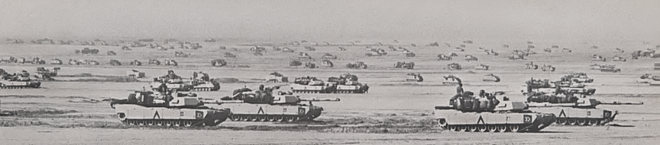
The conflict introduced live news broadcasts from the front lines of the battle, principally by American network CNN. It earned the nickname Video Game War, after the daily broadcast of images from cameras onboard American military aircraft. Considered the "first space war", the US adopted satellite-based reconnaissance, communications, and GPS navigation. Precision-guided munitions and a stealth aircraft, the F-117 Nighthawk, were novel features of the air war. The largest tank battles in American military history were fought, surpassed only by the Battle of the Bulge: the Battle of Medina Ridge, the Battle of Norfolk, and the Battle of 73 Easting.
Names
The war is also known under other names, such as the Second Gulf War (not to be confused with the 2003 Iraq War, also referred to as such), Persian Gulf War, Kuwait War, or Iraq War before the term "Iraq War" became identified with the 2003 Iraq War (also known in the US as "Operation Iraqi Freedom"). The war was named Umm al-Ma'arik ("mother of all battles") by Iraqi officials. After the US invasion of Iraq in 2003, the Gulf War of 1990–1991 is often known as the "First Iraq War".
The following names have been used to describe the conflict itself:

Gulf War and Persian Gulf War are the most common terms for the conflict used within western countries, though it may also be called the First Gulf War (to distinguish it from the 2003 invasion of Iraq and the subsequent Iraq War). Some authors have called it the Second Gulf War to distinguish it from the Iran–Iraq War. Liberation of Kuwait (Arabic: تحرير الكويت) (taḥrīr al-kuwayt) is the term used by Kuwait and most of the coalition's Arab states, including Saudi Arabia, Bahrain, Egypt, and the United Arab Emirates. Terms in other languages include French: la Guerre du Golfe and Guerre du Koweït (War of Kuwait); German: Golfkrieg (Gulf War) and Zweiter Golfkrieg (Second Gulf War).
Operational names
Most of the coalition states used various names for their operations and the war's operational phases. These are sometimes incorrectly used as the conflict's overall name, especially the US Desert Storm:
Operation Desert Shield was the US operational name for the US buildup of forces and Saudi Arabia's defense from 2 August 1990 to 16 January 1991

Operation Desert Storm was the US name of the airland conflict from 17 January 1991 through 28 February 1991
Operation Desert Sabre (early name Operation Desert Sword) was the US name for the air and land offensive against the Iraqi Army in the Kuwaiti Theater of Operations (the "100-hour war") from 24 to 28 February 1991, in itself, part of Operation Desert Storm
Operation Desert Farewell was the name given to the return of US units and equipment to the US in 1991 after Kuwait's liberation, sometimes referred to as Operation Desert Calm

Operativo Alfil was the Argentine name for Argentine military activities
Opération Daguet was the French name for French military activities in the conflict
Operation Friction was the name of the Canadian operations

Operation Granby was the British name for British military activities during the operations and conflict
Operazione Locusta (Italian for Locust) was the Italian name for the operations and conflict
Background
Throughout the Cold War, Iraq had been an ally of the Soviet Union, and there was a history of friction between Iraq and the United States. The US was concerned with Iraq's position on Israeli–Palestinian politics. The US also disliked Iraqi support for Palestinian militant groups, which led to Iraq's inclusion on the developing US list of State Sponsors of Terrorism in December 1979.
The US remained officially neutral after Iraq's invasion of Iran in 1980, which became the Iran–Iraq War, although it provided resources, political support, and some "non-military" aircraft to Iraq. In March 1982, Iran began a successful counteroffensive (Operation Undeniable Victory), and the US increased its support for Iraq to prevent Iran from forcing a surrender. In a US bid to open full diplomatic relations with Iraq, the country was removed from the US list of State Sponsors of Terrorism. Ostensibly, this was because of improvement in the regime's record, although former US assistant defense secretary Noel Koch later stated: "No one had any doubts about [the Iraqis'] continued involvement in terrorism ... The real reason was to help them succeed in the war against Iran."
With Iraq's newfound success in the war, and the Iranian rebuff of a peace offer in July, arms sales to Iraq reached a record spike in 1982. When Iraqi president Saddam Hussein expelled Abu Nidal to Syria at the US's request in November 1983, the Reagan administration sent Donald Rumsfeld to meet Saddam as a special envoy and to cultivate ties. By the time the ceasefire with Iran was signed in August 1988, Iraq was heavily debt-ridden and tensions within society were rising. Most of its debt was owed to Saudi Arabia and Kuwait. Iraq's debts to Kuwait amounted to $14 billion. Iraq pressured both nations to forgive the debts, but they refused.
The Iraq–Kuwait border dispute involved Iraqi claims to Kuwaiti territory. Kuwait had been a part of the Ottoman Empire's province of Basra, something that Iraq claimed made Kuwait rightful Iraqi territory. Kuwait's ruling dynasty, the al-Sabah family, had concluded a protectorate agreement in 1899 that assigned responsibility for Kuwait's foreign affairs to the United Kingdom. The UK drew the border between Kuwait and Iraq in 1922, making Iraq almost entirely landlocked. Kuwait rejected Iraqi attempts to secure further provisions in the region.
Iraq also accused Kuwait of exceeding its OPEC quotas for oil production. In order for the cartel to maintain its desired price of $18 per barrel, discipline was required. The United Arab Emirates and Kuwait were consistently overproducing; the latter at least in part to repair losses caused by Iranian attacks in the Iran–Iraq War and to pay for the losses of an economic scandal. The result was a slump in the oil price – as low as $10 per barrel ($63/m3) – with a resulting loss of $7 billion a year to Iraq, equal to its 1989 balance of payments deficit. Resulting revenues struggled to support the government's basic costs, let alone repair Iraq's damaged infrastructure. Jordan and Iraq both looked for more discipline, with little success. The Iraqi government described it as a form of economic warfare, which it claimed was aggravated by Kuwait slant-drilling across the border into Iraq's Rumaila oil field. According to oil workers in the area, Iraq's slant drilling claim was fabricated, as "oil flows easily from the Rumaila field without any need for these techniques." At the same time, Saddam looked for closer ties with those Arab states that had supported Iraq in the war. This move was supported by the US, who believed that Iraqi ties with pro-Western Gulf states would help bring and maintain Iraq inside the US' sphere of influence.
In 1989, it appeared that Saudi–Iraqi relations, strong during the war, would be maintained. A pact of non-interference and non-aggression was signed between the countries, followed by a Kuwaiti-Iraqi deal for Iraq to supply Kuwait with water for drinking and irrigation, although a request for Kuwait to lease Iraq Umm Qasr was rejected. Saudi-backed development projects were hampered by Iraq's large debts, even with the demobilization of 200,000 soldiers. Iraq also looked to increase arms production so as to become an exporter, although the success of these projects was also restrained by Iraq's obligations; in Iraq, resentment to OPEC's controls mounted.
Iraq's relations with its Arab neighbors, particularly Egypt, were degraded by mounting violence in Iraq against expatriate groups, who were well-employed during the war, by unemployed Iraqis, among them demobilized soldiers. These events drew little notice outside the Arab world because of fast-moving events directly related to the fall of Communism in Eastern Europe. However, the US did begin to condemn Iraq's human rights record, including the well-known use of torture. The UK also condemned the execution of Farzad Bazoft, a journalist working for the British newspaper The Observer. Following Saddam's declaration that "binary chemical weapons" would be used on Israel if it used military force against Iraq, Washington halted part of its funding. A UN mission to the Israeli-occupied territories, where riots had resulted in Palestinian deaths, was vetoed by the US, making Iraq deeply skeptical of US foreign policy aims in the region, combined with the reliance of the US on Middle Eastern energy reserves.
In early July 1990, Iraq complained about Kuwait's behavior, such as not respecting their quota, and openly threatened to take military action. On the 23rd, the CIA reported that Iraq had moved 30,000 troops to the Iraq–Kuwait border, and the US naval fleet in the Persian Gulf was placed on alert. Saddam believed an anti-Iraq conspiracy was developing – Kuwait had begun talks with Iran, and Iraq's rival Syria had arranged a visit to Egypt. On 15 July 1990, Saddam's government laid out its combined objections to the Arab League, including that policy moves were costing Iraq $1 billion a year, that Kuwait was still using the Rumaila oil field, and that loans made by the UAE and Kuwait could not be considered debts to its "Arab brothers". He threatened force against Kuwait and the UAE, saying: "The policies of some Arab rulers are American ... They are inspired by America to undermine Arab interests and security." The US sent aerial refuelling planes and combat ships to the Persian Gulf in response to these threats. Discussions in Jeddah, Saudi Arabia, mediated on the Arab League's behalf by Egyptian president Hosni Mubarak, were held on 31 July and led Mubarak to believe that a peaceful course could be established.
During Saddam Hussein's 2003–2004 interrogation following his capture he claimed that in addition to economic disputes, an insulting exchange between the Kuwaiti emir Al Sabah and the Iraqi foreign minister – during which the emir stated his intention to turn "every Iraqi woman into a $10 prostitute" by bankrupting the country – was a decisive factor in triggering the Iraqi invasion.
On the 25th, Saddam met with April Glaspie, the US ambassador to Iraq, in Baghdad. The Iraqi leader attacked American policy with regards to Kuwait and the UAE:
So what can it mean when America says it will now protect its friends? It can only mean prejudice against Iraq. This stance plus maneuvers and statements which have been made has encouraged the UAE and Kuwait to disregard Iraqi rights ... If you use pressure, we will deploy pressure and force. We know that you can harm us although we do not threaten you. But we too can harm you. Everyone can cause harm according to their ability and their size. We cannot come all the way to you in the United States, but individual Arabs may reach you ... We do not place America among the enemies. We place it where we want our friends to be and we try to be friends. But repeated American statements last year made it apparent that America did not regard us as friends.
Glaspie replied:
I know you need funds. We understand that and our opinion is that you should have the opportunity to rebuild your country. But we have no opinion on the Arab-Arab conflicts, like your border disagreement with Kuwait ... Frankly, we can only see that you have deployed massive troops in the south. Normally that would not be any of our business. But when this happens in the context of what you said on your national day, then when we read the details in the two letters of the Foreign Minister, then when we see the Iraqi point of view that the measures taken by the UAE and Kuwait is, in the final analysis, parallel to military aggression against Iraq, then it would be reasonable for me to be concerned.
Saddam stated that he would attempt last-ditch negotiations with the Kuwaitis but Iraq "would not accept death."
According to Glaspie's own account, she stated in reference to the precise border between Kuwait and Iraq, "... that she had served in Kuwait 20 years before; 'then, as now, we took no position on these Arab affairs'." Glaspie similarly believed that war was not imminent.
Saddam's foreign minister Tariq Aziz later told PBS Frontline in 1996 that the Iraqi leadership was under "no illusion" about America's likely response to the Iraqi invasion: "She [Glaspie] didn't tell us anything strange. She didn't tell us in the sense that we concluded that the Americans will not retaliate. That was nonsense you see. It was nonsense to think that the Americans would not attack us." Then in a second 2000 interview with the same television program, Aziz said:There were no mixed signals. We should not forget that the whole period before August 2 witnessed a negative American policy towards Iraq. So it would be quite foolish to think that, if we go to Kuwait, then America would like that. Because the American tendency ... was to untie Iraq. So how could we imagine that such a step was going to be appreciated by the Americans? It looks foolish, you see, this is fiction. About the meeting with April Glaspie—it was a routine meeting...She didn't say anything extraordinary beyond what any professional diplomat would say without previous instructions from his government...what she said were routine, classical comments on what the president was asking her to convey to President Bush. He wanted her to carry a message to George Bush—not to receive a message through her from Washington. On 26 July 1990, only a few days before the Iraqi invasion, OPEC officials said that Kuwait and the United Arab Emirates had agreed to a proposal to limit their oil output to 1.5 million barrels (240,000 m3) per day, "down from the nearly 2 million barrels a day they had each been pumping," thus potentially settling differences over oil policy between Kuwait and Iraq.
Invasion of Kuwait
The result of the Jeddah talks was an Iraqi demand for $10 billion to cover the lost revenues from Rumaila; Kuwait offered $500 million. The Iraqi response was to immediately order an invasion, which started on 2 August 1990 with the bombing of Kuwait's capital, Kuwait City.
Before the invasion, the Kuwaiti military was believed to have numbered 16,000 men, arranged into three armored, one mechanized infantry and one under-strength artillery brigade. The pre-war strength of the Kuwait Air Force was around 2,200 Kuwaiti personnel, with 80 fixed-wing aircraft and 40 helicopters. In spite of Iraqi sabre-rattling, Kuwait did not mobilize its force; the army had been stood-down on 19 July, and during the Iraqi invasion many Kuwaiti military personnel were on leave.
By 1988, at the end of the Iran–Iraq war, the Iraqi Army was the world's fourth largest army, consisting of 955,000 standing soldiers and 650,000 paramilitary forces in the Popular Army. According to John Childs and André Corvisier, a low estimate shows the Iraqi Army capable of fielding 4,500 tanks, 484 combat aircraft and 232 combat helicopters. According to Michael Knights, a high estimate shows the Iraqi Army capable of fielding one million troops and 850,000 reservists, 5,500 tanks, 3,000 artillery pieces, 700 combat aircraft and helicopters; it held 53 divisions, 20 special-forces brigades, and several regional militias, and had a strong air defense.
Iraqi commandos infiltrated the Kuwaiti border first to prepare for the major units, which began the attack at midnight. The Iraqi attack had two prongs, with the primary attack force driving south straight for Kuwait City down the main highway, and a supporting attack force entering Kuwait farther west, but then turning and driving east, cutting off Kuwait City from the country's southern half. The commander of a Kuwaiti armored battalion, 35th Armoured Brigade, deployed them against the Iraqi attack and conducted a robust defense at the Battle of the Bridges near Al Jahra, west of Kuwait City.
Kuwaiti aircraft scrambled to meet the invading force, but approximately 20% were lost or captured. A few combat sorties were flown against Iraqi ground forces.
The main Iraqi thrust into Kuwait City was conducted by commandos deployed by helicopters and boats to attack the city from the sea, while other divisions seized the airports and two airbases. The Iraqis attacked the Dasman Palace, the Royal Residence of Kuwait's emir, Jaber Al-Ahmad Al-Jaber Al-Sabah, which was defended by the Emiri Guard supported with M-84 tanks. In the process, the Iraqis killed Fahad Al-Ahmed Al-Jaber Al-Sabah, the Emir's youngest brother.
Within 12 hours, most resistance had ended within Kuwait, and the royal family had fled, allowing Iraq to control most of Kuwait. After two days of intense combat, most of the Kuwaiti military were either overrun by the Iraqi Republican Guard, or had escaped to Saudi Arabia. The emir and key ministers fled south along the highway for refuge in Saudi Arabia. Iraqi ground forces consolidated their control of Kuwait City, then headed south and redeployed along the Saudi border. After the decisive Iraqi victory, Saddam initially installed a puppet regime known as the "Provisional Government of Free Kuwait" before installing his cousin Ali Hassan al-Majid as Kuwait's governor on 8 August.
After the invasion, the Iraqi military looted over $1 billion in banknotes from Kuwait's Central Bank. At the same time, Saddam Hussein made the Kuwaiti dinar equal to the Iraqi dinar, thereby lowering the Kuwaiti currency to one-twelfth of its original value. In response, Sheikh Jaber al-Ahmad al-Sabah ruled the banknotes as invalid and refused to reimburse stolen notes, which became worthless because of a UN embargo. After the conflict ended, many of the stolen banknotes made their way back into circulation. The stolen banknotes are a collectible for numismatists.
Kuwaiti resistance movement
Kuwaitis founded a local armed resistance movement following the Iraqi occupation of Kuwait. The Kuwaiti resistance's casualty rate far exceeded that of the coalition military forces and Western hostages. The resistance predominantly consisted of ordinary citizens who lacked any form of training and supervision.
Run-up to the war
Diplomatic means
A key element of US political, military and energy economic planning occurred in 1984. The Iran–Iraq war had been going on for five years and both had sustained casualties into the hundreds of thousands. Within President Ronald Reagan's National Security Council concern was growing war could spread beyond the two belligerents. A National Security Planning Group meeting was formed, chaired by then vice president George H. W. Bush, to review US options. It was determined that the conflict would likely spread into Saudi Arabia and other Gulf states, but the US had little capability to defend the region. A prolonged war in the region would induce much higher oil prices and threaten the recovery of the world economy, which was just beginning to gain momentum. In May 1984, President Reagan was briefed on the project conclusions by William Flynn Martin who had served as the head of the NSC staff that organized the study. The conclusions were: first, oil stocks needed to be increased among members of the International Energy Agency and, if necessary, released early if the oil market was disrupted; second, the US needed to strengthen the security of friendly Arab states in the region; and third, an embargo should be placed on sales of military equipment to Iran and Iraq. The plan was approved by Reagan and affirmed by the G7 leaders headed by the UK's prime minister, Margaret Thatcher, in the 10th G7 summit, held in London in June. The plan was implemented and became the basis for US preparedness to respond to the Iraqi occupation of Kuwait in 1991.
Within hours of the invasion, Kuwait and US delegations requested a meeting of the UN Security Council, which passed Resolution 660, condemning the invasion and demanding a withdrawal of Iraqi troops. On 3 August 1990, the Arab League passed a resolution, which called for a solution from within the league, and warned against outside intervention. Iraq and Libya were the only Arab League states that opposed the resolution for Iraq to withdraw; the Palestine Liberation Organization (PLO) opposed it as well. Yemen and Jordan – a Western ally which bordered Iraq and relied on the country for economic support – opposed military intervention from non-Arab states. Separately, Sudan, also an Arab League member, aligned itself with Saddam.
On 6 August, Resolution 661 placed economic sanctions on Iraq. Resolution 665 followed soon after, which authorized a naval blockade to enforce the sanctions. It said the "use of measures commensurate to the specific circumstances as may be necessary ... to halt all inward and outward maritime shipping in order to inspect and verify their cargoes and destinations and to ensure strict implementation of resolution 661."
The US administration had at first been indecisive with an "undertone ... of resignation to the invasion and even adaptation to it as a fait accompli" until the UK's prime minister Thatcher played a powerful role, reminding the President that appeasement in the 1930s had led to war, that Saddam would have the whole Gulf at his mercy along with 65% of the world's oil supply, and famously urging Bush "not to go wobbly". Once persuaded, US officials insisted on Iraqi pullout, without any linkage to other Middle Eastern problems, accepting the British view that any concession would strengthen Iraqi influence.
On 12 August 1990, Saddam "propose[d] that all cases of occupation, and those cases that have been portrayed as occupation, in the region, be resolved simultaneously". He called for Israel to withdraw from occupied territories in Palestine, Syria, and Lebanon, Syria to withdraw from Lebanon, and "mutual withdrawals by Iraq and Iran and arrangement for the situation in Kuwait." He called for a replacement of US troops, that mobilized in Saudi Arabia, with "an Arab force", as long as that force did not involve Egypt. He requested an "immediate freeze of all boycott and siege decisions" and a normalization of relations with Iraq. Bush was strongly opposed to any "linkage" between Iraq's occupation of Kuwait and the Palestinian issue.
On 23 August, Saddam appeared on state television with Western hostages to whom he had refused exit visas. In the video, he asks a British boy, Stuart Lockwood, whether he is getting his milk, and goes on to say, through his interpreter, "We hope your presence as guests here will not be for too long. Your presence here, and in other places, is meant to prevent the scourge of war."
Another Iraqi proposal communicated was delivered to US national security advisor Brent Scowcroft by an unidentified Iraqi official. The official communicated that Iraq would "withdraw from Kuwait and allow foreigners to leave" provided the UN lifted sanctions, allowed "guaranteed access to the Persian Gulf through the Kuwaiti islands of Bubiyan and Warbah", and allowed Iraq to "gain full control of the Rumaila oil field that extends slightly into Kuwaiti territory". The proposal also "include[d] offers to negotiate an oil agreement with the United States 'satisfactory to both nations' national security interests,' develop a joint plan 'to alleviate Iraq's economical and financial problems' and 'jointly work on the stability of the gulf.'"
On 29 November 1990, the Security Council passed Resolution 678, which gave Iraq until 15 January 1991 to withdraw from Kuwait, and empowered states to use "all necessary means" to force Iraq out of Kuwait after the deadline.