
The Dalai Lama (UK: , US: ; Tibetan: ཏཱ་ལའི་བླ་མ་, Wylie: Tā la'i bla ma [táːlɛː láma]) is the head of the Gelug school of Tibetan Buddhism. The term is part of the full title "Holiness Knowing Everything Vajradhara Dalai Lama" given by Altan Khan. He offered it in appreciation to the Gelug school's then-leader, Sonam Gyatso, who received the title in 1578 at Yanghua Monastery. At that time, Sonam Gyatso had just given teachings to the Khan, and so the title of Dalai Lama was also given to the entire tulku lineage. Sonam Gyatso became the 3rd Dalai Lama, while the first two tulkus in the lineage, the 1st Dalai Lama and the 2nd Dalai Lama, were posthumously awarded the title.
Since the time of the 5th Dalai Lama in the 17th century, the Dalai Lama has been a symbol of unification of the state of Tibet. The Dalai Lama was an important figure of the Gelug tradition, which was dominant in Central Tibet, but his religious authority went beyond sectarian boundaries, representing Buddhist values and traditions not tied to a specific school. The Dalai Lama's traditional function as an ecumenical figure has been taken up by the 14th Dalai Lama, who has worked to overcome sectarian and other divisions in the exile community and become a symbol of Tibetan nationhood for Tibetans in Tibet and in exile. He is Tenzin Gyatso, who escaped from Lhasa in 1959 during the Tibetan uprising and lives in exile in Dharamshala, India.
From 1642 to 1951, the Dalai Lama led the secular government of Tibet. During this period, the Dalai Lamas or their Kalons (regents) led the Tibetan government in Lhasa, known as the Ganden Phodrang. The Ganden Phodrang government officially functioned as a protectorate under Qing China rule and governed all of the Tibetan Plateau while respecting varying degrees of autonomy. After the Qing dynasty collapsed in 1912, the Republic of China (ROC) claimed succession over all former Qing territories, but struggled to establish authority in Tibet. The 13th Dalai Lama declared that Tibet's relationship with China had ended with the Qing dynasty's fall and proclaimed independence, though this was not formally recognized under international law. In 1951, the 14th Dalai Lama ratified the Seventeen Point Agreement with China. In 1959, he revoked the agreement. He initially supported the Tibetan independence movement, but in 1974, he rejected calls for Tibetan independence, agreeing publicly in 2005 that Tibet is part of China.

The extent and nature of the Dalai's secular and religious power remains contested. One common interpretation is the mchod yon (མཆོད་ཡོན), often translated as "priest and patron relationship". It describes the historical alliance between Tibetan Buddhist leaders and secular rulers, such as the Mongols, Manchus, and Chinese authorities. In this relationship, the secular patron (yon bdag) provides political protection and support to the religious figure, who in turn offers spiritual guidance and legitimacy. Proponents of this theory argue that it allowed Tibet to maintain a degree of autonomy in religious and cultural matters while ensuring political stability and protection.
Critics, including Sam van Schaik, contend that the theory oversimplifies the situation and often obscures the political dominance more powerful states exert over Tibet. Historians such as Melvyn Goldstein have called Tibet a vassal state or tributary, subject to external control. During the Yuan dynasty, Tibetan lamas held significant religious influence, but the Mongol Khans had ultimate political authority. Similarly, under the Qing Dynasty, which established control over Tibet in 1720, the region enjoyed a degree of autonomy, but all diplomatic agreements recognized Qing China's sovereign right to negotiate and conclude treaties and trade agreements involving Tibet. Since the 18th century, Chinese authorities have asserted the right to oversee the selection of Tibetan spiritual leaders, including the Dalai and Panchen Lamas. This practice was formalized in 1793 through the "29-Article Ordinance for the More Effective Governing of Tibet".
According to Tibetan Buddhist doctrine, the Dalai Lama chooses his reincarnation. In recent years, the 14th Dalai Lama has opposed Chinese government involvement, emphasizing that his reincarnation should not be subject to external political influence.
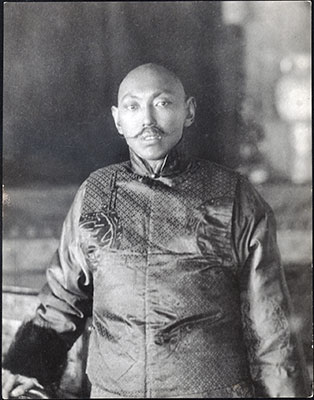
Names
"Dalai Lama" is part of the full title "圣 识一切 瓦齐尔达喇 达赖 喇嘛" ("Holiness Knowing Everything Vajradhara Dalai Lama") given by Altan Khan. "Dalai Lama" combines the Mongolic word dalai ('ocean') and the Tibetan word བླ་མ་ (bla-ma) ('master, guru'). The word dalai corresponds to the Tibetan word gyatso or rgya-mtsho, and, according to Schwieger, was chosen by analogy with the Mongolian title Dalaiyin qan or Dalaiin khan. Others suggest it may have been chosen in reference to the breadth of the Dalai Lama's wisdom. The Dalai Lama is also known in Tibetan as the Rgyal-ba Rin-po-che ('Precious Conqueror') or simply the Rgyal-ba.
History
Origins in myth and legend
Since the 11th century, it has been widely believed in Central Asian Buddhist countries that Avalokiteśvara, the bodhisattva of compassion, has a special relationship with the people of Tibet and intervenes in their fate by incarnating as benevolent rulers and teachers such as the Dalai Lamas. The Book of Kadam, the main text of the Kadampa school from which the 1st Dalai Lama hailed, is said to have laid the foundation for the Tibetans' later identification of the Dalai Lamas as incarnations of Avalokiteśvara. It traces the legend of the bodhisattva's incarnations as early Tibetan kings and emperors such as Songtsen Gampo and later as Dromtönpa (1004–1064). This lineage has been extrapolated by Tibetans up to and including the Dalai Lamas.
Thus, according to such sources, an informal line of succession of the present Dalai Lamas as incarnations of Avalokiteśvara stretches back much further than the 1st Dalai Lama, Gendun Drub; as many as sixty persons are enumerated as earlier incarnations of Avalokiteśvara and predecessors in the same lineage leading up to Gendun Drub. These earlier incarnations include a mythology of 36 Indian personalities, ten early Tibetan kings and emperors all said to be previous incarnations of Dromtönpa, and fourteen further Nepalese and Tibetan yogis and sages. In fact, according to the "Birth to Exile" article on the 14th Dalai Lama's website, he is "the seventy-fourth in a lineage that can be traced back to a Brahmin boy who lived in the time of Buddha Shakyamuni."

Avalokiteśvara's "Dalai Lama master plan"
According to the 14th Dalai Lama, long ago Avalokiteśvara had promised the Buddha to guide and defend the Tibetan people. In the late Middle Ages, his master plan to fulfill this promise was the stage-by-stage establishment of the Dalai Lama institution in Tibet.
First, Tsongkhapa established three great monasteries around Lhasa in the province of Ü before he died in 1419. The 1st Dalai Lama soon became Abbot of the greatest one, Drepung, and developed a large popular power base in Ü. He later extended this to cover Tsang, where he constructed a fourth great monastery, Tashi Lhunpo, at Shigatse. The 2nd studied there before returning to Lhasa, where he became Abbot of Drepung. Having reactivated the 1st's large popular followings in Tsang and Ü, the 2nd then moved on to southern Tibet and gathered more followers there who helped him construct a new monastery, Chokorgyel. He established the method by which later Dalai Lama incarnations would be discovered through visions at the "oracle lake", Lhamo Lhatso.
The 3rd built on his predecessors' fame by becoming Abbot of the two great monasteries of Drepung and Sera. The Mongol leader Altan Khan, first Ming Shunyi King, hearing of his reputation, invited the 3rd to Mongolia, where he converted the King and his followers to Buddhism, covering a vast tract of central Asia. This brought most of Mongolia into the Dalai Lama's sphere of influence, founding a spiritual empire which largely survives to the modern age. After being given the Mongolian name 'Dalai', he returned to Tibet to found the great monasteries of Lithang in Kham, eastern Tibet and Kumbum in Amdo, north-eastern Tibet.
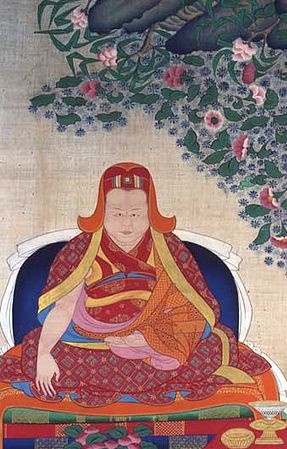
The 4th was then born in Mongolia as the great-grandson of Altan Khan, cementing strong ties between Central Asia, the Dalai Lamas, the Gelugpa and Tibet. The 5th in the succession used the vast popular power base of devoted followers built up by his four predecessors. By 1642, with the strategy provided by his chagdzo (manager) Sonam Rapten and the military assistance of Khoshut chieftain Gushri Khan, the 'Great 5th' founded the Dalai Lamas' religious and political reign over Tibet that survived for over 300 years.
Establishment of the Dalai Lama lineage
Gendun Drup (1391–1474), a disciple of Je Tsongkapa, would eventually be known as the 'First Dalai Lama', but he would not receive this title until 104 years after he died.
There was resistance to naming him as such, since he was ordained a monk in the Kadampa tradition and for various reasons, the Kadampa school had eschewed the adoption of the tulku system to which the older schools adhered. Therefore, although Gendun Drup grew to be an important Gelugpa lama, there was no search to identify his incarnation after his death in 1474.
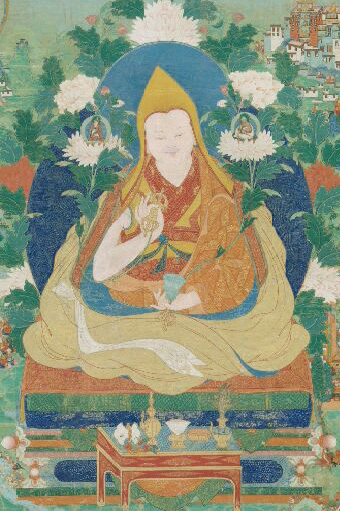
Despite this, 55 years after Tsongkhapa, the Tashilhunpo monks heard accounts that an incarnation of Gendun Drup had appeared nearby and repeatedly announced himself from the age of two. The monastic authorities saw compelling evidence that convinced them the child in question was indeed the incarnation of their founder and felt obliged to break with their own tradition, and in 1487, the boy was renamed Gendun Gyatso and installed at Tashilhunpo as Gendun Drup's tulku, albeit informally.
Gendun Gyatso died in 1542, but the lineage of Dalai Lama tulkus became firmly established with the third incarnation, Sonam Gyatso (1543–1588), who was formally recognised and enthroned at Drepung in 1546. Sonam Gyatso was given the title "Dalai Lama" by the Tümed Altan Khan in 1578, and his two predecessors were then accorded the title posthumously, making Sonam now the third in the lineage.
1st Dalai Lama
Pema Dorje (1391–1474), who would eventually be posthumously declared the 1st Dalai Lama, was born in a cattle pen in Shabtod, Tsang in 1391. His family were goatherders, but when his father died in 1398, his mother entrusted him to his uncle for education as a Buddhist monk. Pema Dorje was sent to Narthang, a major Kadampa monastery near Shigatse, which ran the largest printing press in Tibet. Its celebrated library attracted many scholars, so Pema Dorje received an education beyond the norm at the time as well as exposure to diverse spiritual schools and ideas.
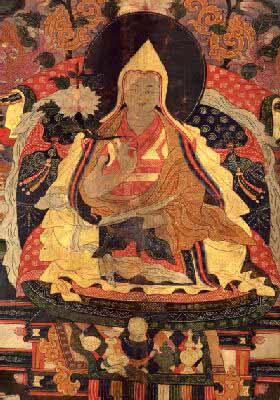
He studied Buddhist philosophy extensively. In 1405, ordained by Narthang's abbot, he took the name of Gendun Drup. He was recognised as an exceptionally gifted pupil, so the abbot tutored him personally and took special interest in his progress. In twelve years he passed the twelve grades of monkhood and took the highest vows. After completing his intensive studies at Narthang he left to continue at specialist monasteries in Central Tibet.
In 1415, Gendun Drup met Tsongkhapa, founder of the Gelugpa school, and became his student. After the death of Tsongkhapa's successor, the Panchen Lama Khedrup Je, Gendun Drup became the leader of the Gelugpa. He rose to become Abbot of Drepung, the greatest Gelugpa monastery outside Lhasa.
It was mainly due to Gendun Drup that Tsongkhapa's new school grew into an order capable of competing with others on an equal footing. Taking advantage of good relations with the nobility and a lack of determined opposition from rival orders, he founded Tashilhunpo Monastery at Shigatse, on the very edge of Karma Kagyu-dominated territory, and would serve as its Abbot until his death. This monastery became the fourth great Gelugpa monastery in Tibet, after Ganden, Drepung, and Sera, all founded in Tsongkhapa's time, and would later become the seat of the Panchen Lamas.
By establishing it at Shigatse in the middle of Tsang, Gendun Drup expanded the Gelugpa sphere of influence, and his own, from the Lhasa region of Ü to this province, which was the stronghold of the Karma Kagyu school and their patrons, the rising Tsangpa dynasty. Tashilhunpo eventually became 'Southern Tibet's greatest monastic university' with a complement of 3,000 monks.
Gendun Drup was said to be the greatest scholar-saint ever produced by Narthang Monastery and became 'the single most important lama in Tibet'. Through hard work he became a leading lama, known as 'Perfecter of the Monkhood', 'with a host of disciples'. Famed for his Buddhist scholarship, he was also referred to as Panchen Gendun Drup, 'Panchen' being an honorary title designating 'great scholar'. By the great Jonangpa master Bodong Chokley Namgyal he was accorded the honorary title Tamchey Khyenpa meaning "The Omniscient One", an appellation that was later assigned to all Dalai Lama incarnations.
At the age of 50, he entered meditation retreat at Narthang. As he grew older, Karma Kagyu adherents, finding their sect was losing too many recruits to the monkhood to burgeoning Gelugpa monasteries, tried to contain Gelug expansion by launching military expeditions against them. This led to decades of military and political power struggles between Tsangpa dynasty forces and others across central Tibet. In an attempt to ameliorate these clashes, Gendun Drup issued a poem of advice to his followers advising restraint from responding to violence with more violence and urged compassion and patience instead. The poem, entitled Shar Gang Rima, "The Song of the Eastern Snow Mountains", became one of his most enduring popular literary works.
Gendun Drup's spiritual accomplishments brought him substantial donations from devotees which he used to build and furnish new monasteries, as well as to print and distribute Buddhist texts and to maintain monks and meditators. In 1474, at the age of 84, he went on a final teaching tour by foot to visit Narthang Monastery. Returning to Tashilhunpo he died 'in a blaze of glory, recognised as having attained Buddhahood'.
His remains were interred in a bejewelled silver stupa at Tashi Lhunpo Monastery, which survived the Cultural Revolution and can still be seen.
2nd Dalai Lama
After Gendun Drup died, a boy called Sangyey Pel, born to Nyngma adepts at Yolkar in Tsang, declared himself at the age of three to be Gendun Drup and asked to be 'taken home' to Tashilhunpo. He spoke in mystical verses, quoted classical texts spontaneously, and claimed to be Dromtönpa, an earlier incarnation of the Dalai Lamas. When he saw monks from Tashilhunpo, he greeted the disciples of the late Gendun Drup by name. Convinced by the evidence, the Gelugpa elders broke with the traditions of their school and recognised him as Gendun Drup's tulku at the age of eight.
His father took him on teachings and retreats, training him in all the family Nyingma lineages. At twelve he was installed at Tashilhunpo as Gendun Drup's incarnation, ordained, enthroned, and renamed Gendun Gyatso Palzangpo (1475–1542).
Tutored personally by the abbot, he made rapid progress, and in 1492 at the age of seventeen he was requested to teach all over Tsang, where thousands gathered to listen and give obeisance, including senior scholars and abbots. Two years later, he met some opposition from the Tashilhunpo establishment when tensions arose over conflicts between advocates of the two types of succession: the traditional abbatial election through merit and incarnation. He therefore moved to central Tibet, where he was invited to Drepung and where his reputation as a brilliant young teacher quickly grew. This move had the effect of shifting central Gelug authority back to Lhasa.
He was afforded all the loyalty and devotion that Gendun Drup had earned and the Gelug school remained as united as ever. Under his leadership, the sect continued growing in size and influence and its lamas were asked to mediate in disputes between other rivals. Gendun Gyatso's popularity in Ü-Tsang grew as he went on pilgrimage, teaching and studying from masters such as the adept Khedrup Norzang Gyatso in the Olklha mountains. He also stayed in Kongpo and Dagpo and became known all over Tibet. He spent his winters in Lhasa, writing commentaries, and spent the rest of the year travelling and teaching many thousands of monks and laypeople.
In 1509, he moved to southern Tibet to build Chokorgyel Monastery near the 'Oracle Lake', Lhamo Latso, completing it by 1511. That year he saw visions in the lake and 'empowered' it to impart clues to help identify incarnate lamas. All Dalai Lamas from the 3rd on were found with the help of such visions granted to regents. He was invited back to Tashilhunpo and given the residence built for Gendun Drup, to be occupied later by the Panchen Lamas. He was made abbot of Tashilhunpo and stayed there teaching in Tsang for nine months.
Gendun Gyatso continued to travel widely and teach while based at Tibet's largest monastery, Drepung and became known as 'Drepung Lama', his fame and influence spreading all over Central Asia as the best students from hundreds of lesser monasteries in Asia were sent to Drepung for education.
Throughout Gendun Gyatso's life, the Gelugpa were opposed and suppressed by older rivals, particularly the Karma Kagyu and their Ringpung clan patrons from Tsang, who felt threatened by their loss of influence. In 1498, the Ringpung army captured Lhasa and banned the Gelugpa annual New Year Monlam Prayer Festival. Gendun Gyatso was promoted to abbot of Drepung in 1517 and that year Ringpung forces were forced to withdraw from Lhasa. Gendun Gyatso then went to the Gongma (King) Drakpa Jungne to obtain permission for the festival to be held again. The next New Year, the Gongma was so impressed by Gendun Gyatso's performance leading the festival that he sponsored construction of a large new residence for him at Drepung, 'a monastery within a monastery'. It was called the Ganden Phodrang, a name later adopted by the Tibetan Government, and it served as home for Dalai Lamas until the Fifth moved to the Potala Palace in 1645.
In 1525, already abbot of Chokhorgyel, Drepung and Tashilhunpo, he was made abbot of Sera monastery as well, and worked to increase the number of monks there. Based at Drepung in winter and Chokorgyel in summer, he spent his remaining years composing commentaries, making regional teaching tours, visiting Tashilhunpo, and acting as abbot of these four great monasteries. As abbot, he made Drepung the largest monastery in the whole of Tibet. He attracted many students and disciples 'from Kashmir to China' as well as major patrons and disciples such as Gongma Nangso Donyopa of Droda who built a monastery at Zhekar Dzong in his honour and invited him to name it and be its spiritual guide.
Gongma Gyaltsen Palzangpo of Khyomorlungand and his Queen, Sangyey Paldzomma, became his favorite patrons and disciples and he visited their area to carry out rituals as 'he chose it for his next place of rebirth'. He died in meditation at Drepung in 1542 at the age of 67 and his reliquary stupa was constructed at Khyomorlung. It was said that, by the time he died, through his disciples and their students, his personal influence covered the whole of Buddhist Central Asia where 'there was nobody of any consequence who did not know of him.' The Dalai Lama title was posthumously granted to Gedun Gyatso after 1578.
3rd Dalai Lama
The Third Dalai Lama, Sonam Gyatso (1543–1588), was born in Tolung, near Lhasa,
as predicted by his predecessor. Claiming he was Gendun Gyatso and readily recalling events from his previous life, he was recognised as the incarnation, named 'Sonam Gyatso' and installed at Drepung, where 'he quickly excelled his teachers in knowledge and wisdom and developed extraordinary powers'. Unlike his predecessors, he came from a noble family, connected with the Sakya and the Phagmo Drupa (Karma Kagyu affiliated) dynasties, and it is to him that the effective conversion of Mongolia to Buddhism is due.
A brilliant scholar and teacher, he had the spiritual maturity to be made Abbot of Drepung, taking responsibility for the material and spiritual well-being of Tibet's largest monastery at the age of nine. At 10 he led the Monlam Prayer Festival, giving daily discourses to the assembly of all Gelugpa monks. His influence grew so quickly that soon the monks at Sera Monastery also made him their Abbot and his mediation was being sought to prevent fighting between political power factions. At 16, in 1559, he was invited to Nedong by King Ngawang Tashi Drakpa, a Karma Kagyu supporter, and became his personal teacher.
At 17, when fighting broke out in Lhasa between Gelug and Kagyu parties and efforts by local lamas to mediate failed, Sonam Gyatso negotiated a peaceful settlement. At 19, when the Kyichu River burst its banks and flooded Lhasa, he led his followers to rescue victims and repair the dykes. He then instituted a custom whereby on the last day of Monlam, all the monks would work on strengthening the flood defences. Gradually, he was shaping himself into a national leader. His popularity and renown became such that in 1564 when the Nedong King died, it was Sonam Gyatso at the age of 21 who was requested to lead his funeral rites, rather than his own Kagyu lamas.
Required to travel and teach without respite after taking full ordination in 1565, he still maintained extensive meditation practices in the hours before dawn and again at the end of the day. In 1569, at age 26, he went to Tashilhunpo to study the layout and administration of the monastery built by his predecessor Gendun Drup. Invited to become the Abbot he declined, already being Abbot of Drepung and Sera, but left his deputy there in his stead. From there he visited Narthang, the first monastery of Gendun Drup and gave numerous discourses and offerings to the monks in gratitude.
Meanwhile, Altan Khan, chief of all the Mongol tribes near China's borders, had heard of Sonam Gyatso's spiritual prowess and repeatedly invited him to Mongolia. By 1571, when Altan Khan received a title of Shunyi Wang (King) from the Ming dynasty of China and swore allegiance to Ming, Although he remained de facto quite independent, he had fulfilled his political destiny and a nephew advised him to seek spiritual salvation, saying that "in Tibet dwells Avalokiteshvara", referring to Sonam Gyatso, then 28 years old. China was also happy to help Altan Khan by providing necessary translations of holy scripture, and also lamas.
At the second invitation, in 1577–78 Sonam Gyatso travelled 1,500 miles to Mongolia to see him. They met in an atmosphere of intense reverence and devotion and their meeting resulted in the re-establishment of strong Tibet-Mongolia relations after a gap of 200 years.
To Altan Khan, Sonam Gyatso identified himself as the incarnation of Drogön Chögyal Phagpa, and Altan Khan as that of Kubilai Khan, thus placing the Khan as heir to the Chingizid lineage whilst securing his patronage.
Altan Khan and his followers quickly adopted Buddhism as their state religion, replacing the prohibited traditional Shamanism.
Mongol law was reformed to accord with Tibetan Buddhist law. From this time Buddhism spread rapidly across Mongolia and soon the Gelugpa had won the spiritual allegiance of most of the Mongolian tribes.
As proposed by Sonam Gyatso, Altan Khan sponsored the building of Thegchen Chonkhor Monastery at the site of Sonam Gyatso's open-air teachings given to the whole Mongol population. He also called Sonam Gyatso "Dalai", Mongolian for 'Gyatso' (Ocean).
The name "Dalai Lama", by which the lineage later became known throughout the non-Tibetan world, was thus established and it was applied to the first two incarnations retrospectively.
In 1579, the Ming allowed the third Dalai Lama to pay regular tribute. Returning eventually to Tibet by a roundabout route and invited to stay and teach all along the way, in 1580 Sonam Gyatso was in Hohhot [or Ningxia], not far from Beijing, when the Chinese Emperor summoned him to his court.
By then he had established a religious empire of such proportions that it was unsurprising the Emperor wanted to summon him and grant him a diploma.
Through Altan Khan, the 3rd Dalai Lama requested to pay tribute to the Emperor of China in order to raise his State Tutor ranking, and the Ming imperial court of China agreed with the request. In 1582, he heard Altan Khan had died and invited by his son Dhüring Khan he decided to return to Mongolia. Passing through Amdo, he founded a second great monastery, Kumbum, at the birthplace of Tsongkhapa near Kokonor. Further on, he was asked to adjudicate on border disputes between Mongolia and China. It was the first time a Dalai Lama had exercised such political authority.
Arriving in Mongolia in 1585, he stayed 2 years with Dhüring Khan, teaching Buddhism to his people and converting more Mongol princes and their tribes. Receiving a second invitation from the Emperor in Beijing he accepted, but died en route in 1588. As he was dying, his Mongolian converts urged him not to leave them, as they needed his continuing religious leadership. He promised them he would be incarnated next in Mongolia, as a Mongolian.
4th Dalai Lama
The Fourth Dalai Lama, Yonten Gyatso (1589–1617) was a Mongol, the great-grandson of Altan Khan who was a descendant of Kublai Khan and leader of the Tümed Mongols who had already been converted to Buddhism by the Third Dalai Lama, Sonam Gyatso (1543–1588). This strong connection caused the Mongols to zealously support the Gelugpa sect in Tibet, strengthening their status and position but also arousing intensified opposition from the Gelugpa's rivals, particularly the Tsang Karma Kagyu in Shigatse and their Mongol patrons and the Bönpo in Kham and their allies. Being the newest school, unlike the older schools the Gelugpa lacked an established network of Tibetan clan patronage and were thus more reliant on foreign patrons.