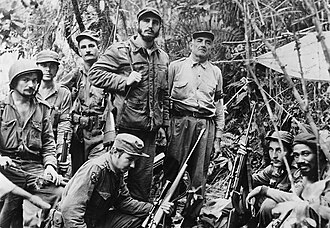
The Cuban Revolution (Spanish: Revolución cubana) was the military and political movement that overthrew the dictatorship of Fulgencio Batista, who had ruled Cuba from 1952 to 1959. The revolution began after the 1952 Cuban coup d'état, in which Batista overthrew the emerging Cuban democracy and consolidated power. Among those who opposed the coup was Fidel Castro, then a young lawyer, who initially tried to challenge the takeover through legal means in the Cuban courts. When these efforts failed, Fidel Castro and his brother Raúl led an armed assault on the Moncada Barracks, a Cuban military post, on 26 July 1953.
Following the attack's failure, Fidel Castro and his co-conspirators were arrested and formed the 26th of July Movement (M-26-7) in detention. At his trial, Fidel Castro launched into a two-hour speech that won him national fame as he laid out his grievances against the Batista dictatorship. In an attempt to win public approval, Batista granted amnesty to the surviving Moncada Barracks attackers and the Castros fled into exile. During their exile, the Castros consolidated their strategy in Mexico and subsequently reentered Cuba in 1956, accompanied by Che Guevara, whom they had encountered during their time in Mexico.
Returning to Cuba aboard the Granma, the Castros, Guevara, and other supporters encountered gunfire from Batista's troops. The rebels fled to the Sierra Maestra where the M-26-7 rebel forces would reorganize, conducting urban sabotage and covert recruitment. Over time the Popular Socialist Party, once the largest and most powerful organizations opposing Batista, would see its influence and power wane in favor of the 26th of July Movement. As the irregular war against Batista escalated, the rebel forces transformed from crude, guerrilla fighters into a cohesive fighting force that could confront Batista's army in military engagements. By the time the rebels were able to oust Batista, the revolution was being driven by a coalition between the Popular Socialist Party, the 26th of July Movement and the Revolutionary Directorate of 13 March.

The rebels, led by the 26th of July Movement, finally toppled Batista on 31 December 1958, after which he fled the country. Batista's government was dismantled as Castro became the most prominent leader of the revolutionary forces. Soon thereafter, the 26th of July Movement established itself as the de facto government. Although Castro was immensely popular in the period immediately following Batista's ouster, he quickly consolidated power, leading to domestic and international tensions. 26 July 1953 is celebrated in Cuba as Día de la Revolución (from Spanish: "Day of the Revolution"). The 26th of July Movement later reformed along Marxist–Leninist lines, becoming the Communist Party of Cuba in October 1965.
The Cuban Revolution had significant domestic and international repercussions, particularly with regard to Cuba–United States relations, which were severely damaged and remain strained despite attempts at reconciliation, such as the Cuban thaw in the 2010s and 2020s. In addition, the Cuban Revolution also had profound ripples effects across many Latin American states as well, serving not only as a symbol of resistance but as a blueprint for what a successful revolution looks like. According to Historian Hal Brands, Cuba became the ideological and strategic heart of what he calls, "Latin America's Cold War." At the same time though, heavy conservative regimes in the Americas began to crack down on this newfound inspiration for dissent, in hopes of preventing, "another Cuba." That being said, Brands notes that Cuba's revolution deepened the region's political divide and added to the overall fuel of Cold War violence. In the revolution's aftermath, Castro's government initiated a program of nationalization, centralized the press, and consolidated political power, which transformed Cuba's economy and civil society, alienating both segments of the Cuban population and the United States. Castro's authoritarianism, combined with economic challenges, contributed to the Cuban Exodus, with many fleeing to the United States. The revolution also marked the beginning of Cuba's interventions in foreign conflicts, including in Africa, the Americas, South-East Asia and the Middle East. Several rebellions, mainly in the Escambray Mountains, occurred between 1959 and 1965, and were suppressed by the revolutionary government.
Background
During the 1950s, Cuba’s economic and social situation showed significant contrasts. Many macroeconomic indicators ranked the country among the most advanced in Latin America, particularly in terms of life expectancy, gross domestic product per capita, and household ownership of electrical appliances; however, these national averages masked significant social and regional disparities.

The decade was marked by five major socioeconomic problems: a low rate of economic growth; excessive dependence on sugar cultivation and exports; reliance on the United States for investment and trade; high levels of unemployment and underemployment; and stark disparities in living standards between urban and rural areas.
Export economy, sugar, and investment
In the 1950s, the Cuban economy relied heavily on sugar cultivation and its export. It was particularly dependent on fluctuations in international market prices and on quotas set by the United States. This sector, long a driver of growth, was no longer sufficient to sustain economic development. Because of its seasonal nature, the sugar economy also affected other sectors, such as trade and transportation.
Hindered by foreign competition, particularly from the United States, and by limited support for local businesses, industrialization in the country, unlike in other Latin American nations, made little progress. A significant share of Cuban capital flowed abroad, especially into real estate and financial investments in the United States, rather than into domestic industrial development. As a result, job creation and wealth generation on the island remained limited.

The strong trade dependence on the United States was accompanied by external deficits and a decline in monetary reserves. By the end of the decade, these economic weaknesses fostered a climate of uncertainty across all classes of Cuban society.
The middle class
At this time, by several indicators, Cuba displayed one of the highest standards of living in Latin America; however, this image concealed growing difficulties for the middle class. Political and economic instability fostered a sense of uncertainty, and the hopes placed in Batista’s return to power in 1952 quickly faded.
Although average income per capita was high, Cubans lived in an environment where prices and consumption patterns were aligned with those of the United States. The cost of living was therefore high, particularly in Havana, which ranked among the most expensive cities in the world at the time; in 1954, Havana had the highest number of Cadillacs per capita in the world. Consumption of imported American goods increased sharply, while purchasing power was eroded by rising prices, especially for food and housing.

Integrated into the North American economic system but without benefiting from its social programs and with lower wages, many Cubans experienced a growing sense of disparity. Over the course of the decade, stagnating per capita income and setbacks linked to sugar crises gave part of the middle class the impression of losing ground, fueling frustration and discontent.
Countryside, cities and Havana
Living conditions in Cuba differed sharply between urban areas, the countryside, and Havana. The peasantry lived under precarious conditions, with limited access to education, healthcare, and adequate housing. Rural workers earned low wages and faced seasonal unemployment.
Disparities in infrastructure and services were stark: electricity, running water, sanitation, schools, and healthcare facilities were concentrated primarily in urban areas. Only 15% of the rural population had access to running water. The physician-to-population ratio was just one per 2,423 inhabitants in Oriente, compared to one per 227 in Havana. Rural illiteracy rates were significantly higher than in cities. Health indicators also revealed major shortcomings in the countryside, where malnutrition and parasitic diseases were widespread and access to healthcare was limited.

Havana occupied a distinct position. The capital concentrated a large share of industry, stable employment, infrastructure, and medical personnel. It also accounted for a disproportionate share of wages, electricity consumption, telephones, and automobiles in the country: 70% of electricity consumption and 80% of infrastructure were concentrated on 0.5% of the territory, representing 20% of the population. Unemployment and illiteracy rates were lower in Havana than in the rest of the island.
However, most Cubans did not live in Havana, and for many, especially in rural areas, social and economic progress remained highly uneven.
Unemployment
During this decade, unemployment and underemployment constituted a central problem of the Cuban economy. Nearly one-third of the labor force did not have full-time employment, and during the sugar off-season, unemployment reached 20%. Approximately 475,000 sugar workers, nearly a quarter of the workforce, worked on average only about one hundred days per year. The economy remained heavily dependent on agriculture, which employed around 40% of the active population.

Population growth increased pressure on the labor market: roughly 50,000 young people reached working age each year, while the economy created few new jobs. Between 1955 and 1958, industry generated only 8,000 positions for an estimated 150,000 new male entrants into the workforce.
This employment instability affected the entire economy. Fear of job loss fueled worker opposition to mechanization in sugar mills, cigar factories, and ports, limiting productivity gains and, consequently, the competitiveness of exports.
Organized Crime and Gambling
The regime of Fulgencio Batista maintained close ties with the gambling sector and organized crime, particularly with American Mafia figures such as Meyer Lansky.
Upon his return to power, Batista entered into agreements aimed at developing a network of casinos, hotels, and nightclubs in Havana geared toward tourism and gambling. He brought in Lansky as an advisor to reorganize and expand the gaming sector and facilitated the establishment of foreign operators. Legal measures, such as the 1955 Hotel Law, provided public financial incentives for the construction of luxury establishments associated with casinos. Some projects were partially financed by public or semi-public funds, fueling allegations of corruption. Several iconic venues of Havana’s nightlife were thus linked to mafia interests or to officials within the security forces.
Corruption in Cuba
In the decades following the United States' invasion of Cuba in 1898, and formal independence from the U.S. on 20 May 1902, Cuba experienced a period of significant instability, enduring a number of revolts, coups and a period of U.S. military occupation. The Republic of Cuba largely became characterized by a deeply ingrained tradition of corruption where political participation resulted in opportunities for elites to engage in wealth accumulation. Cuba's first presidential period under Don Tomás Estrada Palma from 1902 to 1906 was considered to uphold the best standards of administrative integrity in the history of the Republic of Cuba. However, a United States intervention in 1906 resulted in Charles Edward Magoon, an American diplomat, taking over the government until 1909. Although Magoon's government did not condone corrupt practices, there is debate as to how much was done to stop what was widespread especially with the surge of American money coming into the small country. Hugh Thomas suggests that while Magoon disapproved of corrupt practices, corruption persisted under his administration and he undermined the autonomy of the judiciary and their court decisions. On 29 January 1909, the sovereign government of Cuba was restored, and José Miguel Gómez became president. No explicit evidence of Magoon's corruption ever surfaced, but his parting gesture of issuing lucrative Cuban contracts to U.S. firms was a continued point of contention. Cuba's subsequent president, José Miguel Gómez, was the first to become involved in pervasive corruption and government corruption scandals. These scandals involved bribes that were allegedly paid to Cuban officials and legislators under a contract to search the Havana harbour, as well as the payment of fees to government associates and high-level officials. Gómez's successor, Mario García Menocal, wanted to put an end to the corruption scandals and claimed to be committed to administrative integrity as he ran on a slogan of "honesty, peace and work". Despite his intentions, corruption actually intensified under his government from 1913 to 1921. Instances of fraud became more common while private actors and contractors frequently colluded with public officials and legislators. Charles Edward Chapman attributes the increase of corruption to the sugar boom that occurred in Cuba under the Menocal administration. Furthermore, the advent of World War One enabled the Cuban government to manipulate sugar prices, the sales of exports and import permits. While in office, García Menocal hosted his college fraternity, in the 1920 Delta Kappa Epsilon National Convention, the first international fraternity conference outside the US, which took place in Cuba. He was responsible for creating the Cuban Peso; until his presidency Cuba used both the Spanish Real and US Dollar. President Menocal left the Cuban national treasury in overdraft and therefore in precarious financial situation. Menocal supposedly spent $800 million during his 8 years in office and left a floating debt of $40 million.
Alfredo Zayas succeeded Menocal from 1921 to 1925 and engaged in what Calixto Masó refers to as the "maximum expression of administrative corruption". Both petty and grand corruption spread to nearly all aspects of public life and the Cuban administration became largely characterized by nepotism as Zayas relied on friends and relatives to illegally gain greater access to wealth. Gerardo Machado succeeded Zayas from 1925 to 1933, and entered the presidency with widespread popularity and support from the major political parties. However, his support declined over time. Due to Zayas' previous policies, Gerardo Machado aimed to diminish corruption and improve the public sector's performance through an "honest administration", which had been referred to as moralización, from 1925 to 1933. While he was successfully able to reduce the amounts of low level and petty corruption, grand corruption still largely persisted. Machado embarked on development projects that enabled the persistence of grand corruption through inflated costs and the creation of "large margins" that enabled public officials to appropriate money illegally. Under his government, opportunities for corruption became concentrated into fewer hands with "centralized government purchasing procedures" and the collection of bribes among a smaller number of bureaucrats and administrators. Through the development of real estate infrastructures and the growth of Cuba's tourism industry, Machado's administration was able to use insider information to profit from private sector business deals. Many people objected to his running again for re-election in 1928, as his victory violated his promise to serve for only one term. As protests and rebellions became more strident, his administration curtailed free speech and used repressive police tactics against opponents. Machado unleashed a wave of violence against his critics, and there were numerous murders and assassinations committed by the police and army under Machado's administration. The extent of his involvement in these is disputed, though Russell Porter makes the claim that Machado confessed to being involved. Though the extent of Machado's participation in such violent acts is unknown, he has since been described as a dictator. In May 1933, Machado was forced out as newly appointed US ambassador Sumner Welles arrived in Cuba and initiated negotiation with the opposition groups for a government to succeed Machado's. A provisional government headed by Carlos Manuel de Céspedes y Quesada (son of Cuban independence hero Carlos Manuel de Céspedes) and including members of the ABC was brokered; it took power on 12 August 1933 amidst a general strike in Havana.
Carlos Manuel de Céspedes y Quesada subsequently was offered the position of President by ambassador Sumner Welles. He took office on 12 August 1933, and Welles proposed that "general elections may be held approximately 3 months from now so that Cuba may once more have a constitutional government in the real sense of the word." Céspedes agreed, and declared that a general election would be held on 24 February 1934, for a new presidential term to begin on 20 May 1934. However, on 4-5 September 1933, the Sergeants' Revolt took place while Céspedes was in Matanzas and Santa Clara after a hurricane had ravaged those regions. The junta of officers led by Sergeant Fulgencio Batista and students proclaimed that it had taken power in order to fulfill the aims of the revolution; it briefly described a program which included economic restructuring, punishment of wrongdoers, recognition of public debts, creation of courts, political reorganization, and any other actions necessary to construct a new Cuba based on justice and democracy. Only five days after the coup, Batista and the Student Directory promoted Ramón Grau to the role of President. The ensuing One Hundred Days Government issued a number of reformist declarations but never gained diplomatic recognition from the US; it was overthrown in January 1934 under pressure from Batista and the US ambassador. Grau was replaced by Carlos Mendieta, and within five days the U.S. recognized Cuba's new government. The corruption was not curtailed under Mendieta and he resigned in 1935 after unrest continued, and their followed a number of interim and weak presidents under the guidance of Batista and the US. Batista, supported by the Democratic Socialist Coalition which included Julio Antonio Mella's Communist Party, defeated Grau in the first presidential election under the new Cuban constitution in the 1940 election, and served a four-year term as President of Cuba. Batista was endorsed by the original Communist Party of Cuba (later known as the Popular Socialist Party), which at the time had little significance and no probability of an electoral victory. This support was primarily due to Batista's labor laws and his support for labor unions, with which the Communists had close ties. In fact, Communists attacked the anti-Batista opposition, saying Grau and others were "fascists" and "reactionaries".
Senator Eduardo Chibás dedicated himself to exposing corruption in the Cuban government, and formed the Partido Ortodoxo in 1947 to further this aim. Argote-Freyre points out that Cuba's population under the Republic had a high tolerance for corruption. Furthermore, Cubans knew and criticized who was corrupt, but admired them for their ability to act as "criminals with impunity". Corrupt officials went beyond members of congress to also include military officials who granted favours to residents and accepted bribes. The establishment of an illegal gambling network within the military enabled army personnel such as Lieutenant Colonel Pedraza and Major Mariné to engage in extensive illegal gambling activities. Mauricio Augusto Font and Alfonso Quiroz, authors of The Cuban Republic and José Martí, say that corruption "pervaded in political life" under the administrations of Presidents Ramón Grau and Carlos Prío Socarrás. Prío was reported to have stolen over $90 million in public funds, which was equivalent to one fourth of the annual national budget. Prior to the Communist revolution, Cuba was ruled under the elected government of Fulgencio Batista from 1940 to 1944. Throughout this time period, Batista's support base consisted mainly of corrupt politicians and military officials. Batista himself was able to heavily profit from the regime before coming into power through inflated government contracts and gambling proceeds. In 1942, the British Foreign Office reported that the U.S. State Department was "very worried" about corruption under President Fulgencio Batista, describing the problem as "endemic" and exceeding "anything which had gone on previously". British diplomats believed that corruption was rooted within Cuba's most powerful institutions, with the highest individuals in government and military being heavily involved in gambling and the drug trade. In terms of civil society, Eduardo Saenz Rovner writes that corruption within the police and government enabled the expansion of criminal organizations in Cuba. Batista refused U.S. President Franklin Roosevelt's offer to send experts to help reform the Cuban Civil Service. Batista didn't run in the 1944 election, and Partido Auténtico party member Ramón Grau was elected president, and oversaw extensive corruption during his administration. He had Carlos Prío Socarrás serve turns as Minister of Public Works, Minister of Labor and Prime Minister. On the next election 1 July 1948, Prío was elected president of Cuba as a member of the Partido Auténtico which presided over corruption and irresponsible government of this period. Prío was assisted by Chief of the Armed Forces General Genobebo Pérez Dámera and Colonel José Luis Chinea Cardenas, who had previously been in charge of the province of Santa Clara.
The eight years under Grau and Prío, were marked by violence among political factions and reports of theft and self-enrichment in the government ranks. The Prío administration increasingly came to be perceived by the public as ineffectual in the face of violence and corruption, much as the Grau administration before it.
With elections scheduled for the middle of 1952, rumors surfaced of a planned military coup by long-shot presidential contender Fulgencio Batista. Prío, seeing no constitutional basis to act, did not do so. The rumors proved to be true. On 10 March 1952, Batista and his collaborators seized military and police commands throughout the country and occupied major radio and TV stations. Batista assumed power when Prío, failing to mount a resistance, boarded a plane and went into exile.
Batista regime
Batista, after his military coup against Prío Socarras, again took power and ruled until 1959. Under his rule, Batista led a corrupt dictatorship that involved close links with organized crime organizations and the reduction of civil freedoms of Cubans. This period resulted in Batista engaging in more "sophisticated practices of corruption" at both the administrative and civil society levels. Batista and his administration engaged in profiteering from the lottery as well as illegal gambling. Corruption further flourished in civil society through increasing amounts of police corruption, censorship of the press as well as media, and creating anti-communist campaigns that suppressed opposition with violence, torture and public executions. The former culture of toleration and acceptance towards corruption also dissolved with the dictatorship of Batista. For instance, a Cuban student stated, "however corrupt Grau and Prío were, we elected them and therefore allowed them to steal from us. Batista robs us without our permission." Corruption under Batista further expanded into the economic sector with alliances that he forged with foreign investors and the prevalence of illegal casinos and criminal organizations in the country's capital of Havana.
Although Batista had been relatively progressive during his first term, in his dictatorship he proved far more indifferent to popular concerns.
While Cuba remained plagued by high unemployment and limited water infrastructure, Batista antagonized the population by forming lucrative links to organized crime and allowing American companies to dominate the Cuban economy, especially sugar-cane plantations and other local resources. Although the US armed and politically supported the Batista dictatorship, later US president John F. Kennedy recognized its corruption and the justifiability of removing it.
During his first term as president, Batista was supported by the original Communist Party of Cuba (later known as the Popular Socialist Party), but during his second term he became strongly anti-communist. In the months following the March 10, 1952 coup d'état, Fidel Castro, then a young lawyer and activist, put into motion a lawsuit against Batista, whom he accused of corruption and tyranny. However, Castro's constitutional arguments were rejected by the Cuban courts, as the coup was perceived as being a "de facto, revolutionary overturn of the constitution". After deciding that the Cuban regime could not be replaced through legal means, Castro resolved to launch an armed revolution. To this end, he and his brother Raúl founded a paramilitary organization known as "The Movement", stockpiling weapons and recruiting around 1,200 followers from Havana's disgruntled working class by the end of 1952.
History
Early stages: 1953–1955
Plan to attack Camp Colombia
Rafael García Bárcena, a professor of philosophy, founded the National Revolutionary Movement (Movimiento Nacional Revolucionario – MNR), consisting largely of middle-class members. In March 1953, the MNR had planned to attack and seize control of the barracks at Camp Colombia, but police had been alerted to the plot, with the conspirators being rounded up and tortured. In all, fourteen people were sentenced to imprisonment for the attack plot.
Attack on the Moncada Barracks
Striking their first blow against the Batista government, Fidel and Raúl Castro gathered an upwards of 126 fighters and planned a multi-pronged attack on several military installations. On 26 July 1953, the rebels attacked the Moncada Barracks in Santiago and the barracks in Bayamo only to be decisively defeated by the far more numerous government soldiers following a call to withdraw when Fidel Castro realized a lack of adequate knowledge about the barracks, as well as the lack of weapon experience amongst the recruited fighters, would ultimately lead to failure. It was hoped that the staged attack would spark a nationwide revolt against Batista's government. After an hour of fighting most of the rebels and their leader fled to the mountains. The exact number of rebels killed is debatable; however, in his autobiography, Fidel Castro claimed that five were killed in the midst of battle, and an additional fifty-six were executed after being captured by the Batista government. Due to the government's large number of men, Hunt revised the number to be around 60 members taking the opportunity to flee to the mountains along with Castro. Among the dead was Abel Santamaría, Castro's second-in-command, who was imprisoned, tortured, and executed on the same day as the attack.
Imprisonment and immigration
Numerous key Movement revolutionaries, including the Castro brothers, were captured shortly afterwards. In a highly political trial, Fidel spoke for nearly four hours in his defense, ending with the words "Condemn me, it does not matter. History will absolve me." Castro's defense was based on nationalism, the representation and beneficial programs for the non-elite Cubans, and his patriotism and justice for the Cuban community. In October 1953, Fidel was sentenced to fifteen years in the Presidio Modelo prison, located on Isla de Pinos, while Raúl was sentenced to thirteen years. However, on 15 May 1955, under broad political pressure, the Batista government freed all political prisoners in Cuba, including the Moncada attackers. Fidel's Jesuit childhood teachers succeeded in persuading Batista to include Fidel and Raúl in the release.
Soon, the Castro brothers joined with other exiles in Mexico to prepare for the overthrow of Batista, receiving training from Alberto Bayo, a leader of Republican forces in the Spanish Civil War. On 12 June 1955, the revolutionaries named themselves the "26th of July Movement", in reference to the date of their attack on the Moncada Barracks in 1953. A month later, in July, Fidel met the Argentine revolutionary Ernesto "Che" Guevara in Mexico, the latter joining his cause. Raúl and Fidel's chief advisor Ernesto aided the initiation of Batista's amnesty.
Student demonstrations
By late 1955, student riots and demonstrations became more common, and unemployment became problematic as new graduates could not find jobs. These protests were confronted with increasing repression. All young people were seen as possible revolutionaries. Due to its continued opposition to the Cuban government and much protest activity taking place on its campus, the University of Havana was temporarily closed on 30 November 1956 (it did not reopen until 1959 under the first revolutionary government).
Attack on the Domingo Goicuria Barracks
While the Castro brothers and the other 26 July Movement guerrillas were training in Mexico and preparing for their amphibious deployment to Cuba, another revolutionary group followed the example of the Moncada Barracks assault. On 29 April 1956, an Auténtico guerrilla group comprising upwards of thirty rebels, brought together by Reynold García, attacked the Domingo Goicuría Barracks in the Matanzas province. A total of fifteen rebels died, with five killed during battle and the remaining ten captured and executed. At least one rebel was executed by Pilar García, Batista's garrison commander. Florida International University historian Miguel A. Bretos was in the nearby cathedral when the firefight began. In his 2011 biography, titled Matanzas: The Cuba Nobody Knows', he wrote: "That day the Cuban Revolution began for me and Matanzas."
Insurgency: 1956–1957
Granma landing
The yacht Granma departed from Tuxpan, Veracruz, Mexico, on 25 November 1956, carrying the Castro brothers and eighty others, even though the yacht was designed to accommodate twelve people with a maximum of twenty-five. The yacht landed in Playa Las Coloradas on 2 December, in the southern municipality of Niquero, arriving two days later than planned because the boat was heavily loaded, unlike during the practice sailing runs. This dashed any hopes for a coordinated attack with the llano wing of the Movement. After arriving and exiting the ship, the band of rebels began to make their way into the Sierra Maestra mountains, a range in southeastern Cuba. Three days after the trek began, Batista's army attacked and killed most of the Granma participants – while the exact number is disputed, no more than twenty of the original eighty-two men survived the initial encounters with the Cuban army and escaped into the Sierra Maestra mountains.
The group of survivors included Fidel and Raúl Castro, Che Guevara and Camilo Cienfuegos. The dispersed survivors, alone or in small groups, wandered through the mountains, looking for each other. Eventually, the men would link up again – with the help of peasant sympathizers – and would form the core leadership of the guerrilla army. A number of female revolutionaries, including Celia Sánchez and Haydée Santamaría (the sister of Abel Santamaría), also assisted Fidel Castro's operations in the mountains.
Battle of La Plata
On 17 January 1957, the 26th of July Movement engaged in armed combat with Cuba's small army garrison stationed in barracks in La Plata, a village in the Sierra Maestra mountain. The battle began at 2:40 am, initiated by Fidel who shot the first two bullets. There had been a brief moment of urgency on the rebels' end, as the army garrison had been pushing forward in an unexpectedly relentless manner, whilst the rebels' explosives were not detonating when thrown. Subsequently, Guevara and Luis Crespo closed in on the barracks and the latter set it on fire, helping ward off the soldiers and shoot those who were in the line of fire. It was not long before the Cuban army garrison surrendered. In the end, the rebels were uninjured. In contrast, two Cuban soldiers died in the midst of battle, five were wounded, and three were taken as prisoners (they ultimately succumbed to their injuries); only some were able to escape. Only one of the surviving Cuban army soldiers worked under the command of Raúl following the battle, eventually being promoted to lieutenant.
The 26th of July Movement's success in this battle marked the first major victory the rebels. In addition, the men took advantage of the available loot left behind by the opposing party: nine weapons were taken, an abundance of ammo, clothes, food, and fuel.