
Copts (Coptic: ⲚⲓⲢⲉⲙ̀ⲛⲭⲏⲙⲓ ⲛ̀Ⲭⲣⲏⲥⲧⲓ̀ⲁⲛⲟⲥ, romanized: NiRemenkēmi enKhristianos; Arabic: أقباط, romanized: aqbāṭ) are a Christian ethnoreligious group native to Egypt who have inhabited the area of modern Egypt since antiquity. They are, like the broader Egyptian population, descended from the ancient Egyptians. Copts predominantly follow the Coptic Orthodox Church, the Alexandrian Greek Orthodox Church and the Coptic Catholic Church. They are the largest Christian population in Egypt and the Middle East, as well as in Sudan and Libya. Copts account for roughly 5 to 15 percent of the population of Egypt.
Originally referring to all Egyptians, the term Copt became synonymous with native Christians in light of Egypt's Islamization and Arabization after the Muslim conquest of Egypt in 639–646 AD. Copts have historically spoken the Coptic language, a direct descendant of the Demotic Egyptian that was spoken in late antiquity.
Following the Arab Muslim conquest of Egypt in the 7th century, the treatment of the Coptic Christians who did not convert ranged from relative tolerance to open persecution. Historically, the Copts suffered from waves of persecution giving way to relative tolerance in cycles that varied according to the local ruler and other political and economic circumstances. Themes of persecution and martyrdom constitute a significant part of Coptic identity due to historic and current conflicts.

Most Copts adhere to the Coptic Orthodox Church of Alexandria, an Oriental Orthodox Church. The smaller Coptic Catholic Church is an Eastern Catholic Church, in communion with the Holy See of Rome; others belong to the Evangelical Church of Egypt. Under Islamic rule, the Copts held important administrative and commercial positions. Copts also played an integral role in the Arab Renaissance which is known as "Al Nahda". They also contributed to Egypt's social and political life and key debates such as pan-Arabism, governance, educational reform, and democracy. They have historically flourished in business affairs.
While an integral part of broader Egyptian society and culture, Copts also preserve distinct religious traditions and some unique cultural elements. Coptic music is thought to incorporate some influences from earlier Egyptian musical traditions. Copts also maintain the use of the Coptic calendar, which is based on the ancient Egyptian calendar and remains significant in their liturgical practices.
Many Copts view Arab identity as closely associated with Islam and may not fully identify with it, but they also have a national identity shared with other Egyptians. Copts and Muslim Egyptians are recognized as being physically indistinguishable. In urban cities of Egypt such as Cairo and Alexandria, Copts have a relatively high educational attainment, wealth index, and a strong representation in white-collar job types. Copts also face unique challenges, with most living in Upper Egypt far from national core cities, working in blue collar jobs, and having limited representation in the security agencies which dominate national politics. The majority of demographic, socio-economic, and health indicators are similar among Coptic Christians and Muslims in Egypt.

Etymology
The English language adopted the word Copt in the 17th century from Neo-Latin Coptus, Cophtus, which derives from the Arabic collective qubṭ / qibṭ قبط "the Copts" with nisba adjective qubṭī, qibṭī قبطى, plural aqbāṭ أقباط; Also quftī, qiftī (where the Arabic /f/ reflects the historical Coptic /p/) an Arabisation of the Coptic word ⲁⲓⲅⲩⲡⲧⲓⲟⲛ aiguption (Bohairic for "Egyptian" or in relation to Egypt) or ⲕⲩⲡⲧⲁⲓⲟⲛ kuptaion (Sahidic). The Coptic word in turn represents an adaptation of the Greek term for the indigenous people of Egypt, Aigýptios (Αἰγύπτιος).
The Greek term for Egypt, Aígyptos (Ancient Greek: Αἴγυπτος), itself derives from the Egyptian language, but dates to a much earlier period, being attested already in Mycenaean Greek as a3-ku-pi-ti-jo (lit. "Egyptian"; used here as a man's name). This Mycenaean form likely comes from Middle Egyptian ḥwt kꜣ ptḥ (reconstructed pronunciation /ħawitˌkuʀpiˈtaħ/ → /ħajiʔˌkuʀpiˈtaħ/ → /ħəjˌkuʔpəˈtaħ/, Egyptological pronunciation Hut-ka-Ptah), literally "estate/palace of the kꜣ ("double" spirit) of Ptah" (compare Akkadian āluḫi-ku-up-ta-aḫ), the name of the temple complex of the god Ptah at Memphis (and a synecdoche for the city of Memphis and the region around it).
The term Aigýptios in Greek came to designate the native Egyptian population in Roman Egypt (as distinct from Greeks, Romans, Jews, etc.). After the Muslim conquest of Egypt (639–646) it became restricted to those Egyptians adhering to the Christian religion.
In their historic Coptic language, which represents the final stage of the Egyptian language, there is no distinct term equivalent to Copt, as a designation separate from Egyptian. Instead, terms such as rem en kēme (in the Sahidic dialect) ⲣⲙⲛⲕⲏⲙⲉ, lem en kēmi (Fayyumic), and rem en khēmi (Bohairic) ⲣⲉⲙ̀ⲛⲭⲏⲙⲓ are attested, all of which literally mean "people of Egypt" or "Egyptians"; cf. Egyptian rmṯ n kmt, Demotic rmt n kmỉ. This is not unique to Coptic, as many community endonyms translate simply to "people", though it is understood that by saying "people", an in-group is being referred to. For example, the term Inuit means "the people", and the term Romani derives from words referring to "man" or "people". To an extent it was not necessary to make a distinction between "person of Egypt" as someone other than a Copt throughout much of history, as other groups residing in Egypt (such as the Greeks) had recognized ethnonyms in Coptic, such as "Hellene", that were sufficient. In the medieval era there also was not always a distinction made between Christian Copts and their Pre-Christian ancestors, and the same ethnonym was sometimes used for both, meaning identity to the culture of being "Coptic" was not as tightly tied to Christianity as it commonly is today (though it was still often placed as in opposition to being Muslim, usually by Muslims themselves, who ceased identifying a family as "Coptic" after the first generation of converts to Islam).
The Arabic word qibṭ "Copt" has also been connected to the Greek name of the town of Kóptos (Koine Greek: Κόπτος, now Qifṭ; Coptic Kebt and Keft) in Upper Egypt. This association may have contributed to making "Copt" the settled form of the name.
In the 20th century, some Egyptian nationalists and intellectuals in the context of Pharaonism began using the term qubṭ in the historical sense to refer to all ethnic Egyptians, both Christians and Muslims.

History
Ptolemaic and Roman Egypt
After the conquest of Egypt by Alexander the Great in 332 B.C., the country came under the rule of Greek Ptolemaic kings. While the majority of the population remained Egyptian, foreign settlers of both Greek and non-Greek origin emigrated to Egypt during that period. While 10% may stand as a very approximate figure for the total immigrant population in Ptolemaic Egypt, including both Greeks and non-Greeks, this figure has been challenged as excessive. The native Egyptian population, which remained Egyptian in language and culture, spoke the latest stage of the Egyptian language, which came to be known later as Coptic. The creation of Coptic as a coherent writing system to express the Egyptian language undoubtedly served to cement the distinction between the native population in Egypt and the ruling Greeks.
Despite the presence of these immigrants and a foreign pharaoh, Egypt remained home primarily to Egyptians, by far the largest group within the population. In fact, most of the rural and urban native population that lived in towns, villages and hamlets the length of the Nile Valley continued their lives little changed during the rule of the Ptolemies. Even in Alexandria, the capital of Ptolemaic Egypt and the largest Greek city outside of Greece, the number of native Egyptians far outnumbered that of Greeks. In numbers and in culture, Egypt remained essentially Egyptian, even as foreign communities were incorporated into the life of the country. Over time, the small numbers of foreigners were integrated into the Egyptian population so that, when finally Rome took control of Egypt in 30 BC, the vast majority of Greeks in Egypt were essentially categorized by the Roman conquerors as Egyptians.
The Faiyum mummy portraits reflect the complex synthesis of the predominant Egyptian culture and religion, with that of Hellenistic art, and were attached to sarcophagi of firmly Egyptian character. The dental morphology of the Roman-period Faiyum mummies was compared with that of earlier Egyptian populations, and was found to be "much more closely akin" to that of ancient Egyptians than to Greeks or other European populations.

Foundation of the Christian Church in Egypt
According to ancient tradition, Christianity was introduced to present day Egypt by St. Mark (Also known as St. Markos) in Alexandria, shortly after the ascension of Christ and during the reign of the Roman emperor Claudius around 42 AD. The legacy that St. Mark left in Egypt was a considerable Christian community in Alexandria. Within half a century of St. Mark's arrival Christianity had spread throughout Egypt. This is clear from a fragment of the Gospel of John, written in Coptic and found in Upper Egypt that can be dated to the first half of the 2nd century, and the New Testament writings found in Oxyrhynchus, in Middle Egypt, which date around 200 AD. In the 2nd century, Christianity began to spread to the rural areas, and scriptures were translated into the Coptic language (then known as Egyptian). By the beginning of the 3rd century AD, Christians constituted the majority of Egypt's population, and the Church of Alexandria was recognized as one of Christendom's four apostolic sees, second in honor only to the Church in Rome. The Church of Alexandria is therefore the oldest Christian church in Africa.
Contributions to Christianity
The Copts in Egypt contributed immensely to the Christian tradition. The Catechetical School of Alexandria was the oldest institution of its kind in the world. Founded around 190 AD by the scholar Pantanaeus, the school became an important focus of religious learning, where students were taught by scholars such as Athenagoras, Clement, Didymus, and Origen (185–251, the father of theology,
who was also active in the field of commentary and comparative Biblical studies). However, the scope of this school was not limited to theological subjects: science, mathematics and humanities were also taught there. The question-and-answer method of commentary began there, and 15 centuries before Braille, blind scholars used wood-carving techniques there to read and write.

As major early adopters of Christianity, Copts have the reputation of missionaries spreading the Christian faith as far afield as Switzerland, Abyssinia and India, influencing Mesopotamia, Persia, Rome, and Ireland.
Another major contribution the Egyptian Copts made to Christianity was the creation and organization of monasticism. Worldwide Christian monasticism stems, either directly or indirectly, from Egyptian origins. Prominent figures of the early monastic movement in Egypt included Anthony the Great (251–356), Paul of Thebes (c. 227 – c. 341), Macarius the Great (c. 300 – 391), Shenouda the Archimandrite (died 465) and Pachomius the Cenobite (died 348). By the end of the 5th century, there were hundreds of monasteries, and thousands of cells and caves scattered throughout the Egyptian desert. Pilgrims from all over the world visited the Egyptian Desert Fathers to emulate their spiritual, disciplined lives. St Basil the Great Archbishop of Caesarea Mazaca, and the founder and organiser of the monastic movement in Asia Minor, visited Egypt around 357 AD and his monastic rules are followed by the Eastern Orthodox Churches. Saint Jerome, who translated the Bible into Latin, came to Egypt while en route to Jerusalem around 400 AD, leaving details of his experiences in his letters. St. Benedict founded the Benedictine Order in the 6th century on the model of Saint Pachomius, although in a stricter form.
Ecumenical councils
The major contributions that the See of Alexandria has contributed to the establishment of early Christian theology and dogma are attested to by fact that the first three ecumenical councils in the history of Christianity were headed by Egyptian patriarchs. The Council of Nicaea (325 AD) was presided over by Pope Alexander I of Alexandria, along with Saint Hosius of Córdoba. In addition, the most prominent figure of the council was the future Patriarch of Alexandria Athanasius, who played the major role in the formulation of the Nicene Creed, recited today in most Christian churches of different denominations. One of the council's decisions was to entrust the Patriarch of Alexandria with calculating and annually announcing the exact date of Easter to the rest of the Christian churches. The Council of Constantinople (381 AD) was presided over by Pope Timothy I of Alexandria, while the Council of Ephesus (431 AD) was presided over by Pope Cyril of Alexandria.
Council of Chalcedon
In the fourth and fifth centuries AD, the foundations were laid for the divergence in doctrine between the native Christian Church of the Egyptians, and that of the empire. The official schism occurred at the Council of Chalcedon in 451 AD. The council, which condemned, deposed, exiled and replaced the native Egyptian Patriarch of Alexandria Dioscorus I, was rejected by the Egyptian delegation to the council, and by extension by the entirety of the native Egyptian population. As a result of the Council of Chalcedon, the Church of Alexandria, which had jurisdiction over the entire country of Egypt, as well as all of continent of Africa, was divided into a church that accepted the decrees of the council, and one that rejected them. The church that accepted the council, became known as the Chalcedonian church, and survives today as the Greek Orthodox Patriarchate of Alexandria. On the other hand, the church that rejected the council of Chalcedon, to whom the vast majority of the native Copts adhered, became the predecessor of the Coptic Orthodox Church. The latter has been erroneously referred to as Monophysite, although it itself rejects that term and self-proclaims to be Miaphysite. The non-Chalcedonian Miaphysite doctrine became adopted as a badge of nationalism for the native Egyptians.
Byzantine Egypt
A distinctive Egyptian character of Egypt's native Copts began to develop after the council of Chalcedon, and reached its zenith in the period after the reign of emperor Justinian I in the sixth century AD. That process became the foundation for the evolution of a distinctive Egyptian character for the Coptic Orthodox Church, with its distancing from the empire's official Chalcedonian Christology and its distinctive Greek character. During that period and until the Arab invasion of Egypt in the seventh century, the Byzantine emperors repeatedly deposed and exiled native Egyptian non-Chalcedonian patriarchs of Alexandria, and imposed pro-Chalcedonian ones, most of whom were non-Egyptian. Over the years, because of what they had construed as persecution of the imperial authorities, the Egyptians hardened their position and rejected all conciliatory efforts that fell short of a full condemnation of the Council of Chalcedon. This position coincided with the rise in the public visibility of the Coptic language in several areas of the Egyptians' daily life.
Arab conquest of Egypt
In 641 AD, Egypt was conquered by Arab Muslim forces following the defeat of the Byzantine army. According to historian Roger S. Bagnall, the Copts who had developed a distinct Egyptian and non-Chalcedonian identity were subjected to a new system of governance that prioritized fiscal exploitation and systematic resource extraction, particularly through taxation.
Alfred J. Butler records that parts of Alexandria were damaged during the Arab entry into the city, including the destruction of some of its walls and the burning of several churches.
During the early years of the Rashidun Caliphate, Egypt's population particularly the native Copts was subjected to the imposition of new forms of taxation, forced labor requisitions for state infrastructure, and the appropriation of agricultural and technical resources. The fertile Nile Valley and the country's skilled labor force, particularly in shipbuilding and irrigation, were of strategic importance to the new administration.
By the early eighth century, Coptic Christians were increasingly compelled to participate in state-sponsored labor. According to Alfred J. Butler, entire Egyptian villages were required to supply annual quotas of workers for construction projects including palaces and mosques in Fustat, Damascus, and Jerusalem. Additionally, they were conscripted into naval expeditions considered especially harsh, as those sent rarely returned to their villages due to the dangerous conditions.
Roger S. Bagnall emphasizes that fiscal exploitation and labor requisition were central elements of the early Islamic administrative system in Egypt. These policies imposed disproportionate burdens on rural communities, particularly the Copts, who bore the brunt of extractive practices aimed at funding the caliphate's military and infrastructural expansion.
In addition to labor, native Christians were subject to the jizya a special tax levied exclusively on non-Muslims under Islamic law. Aziz Suryal Atiya notes that during the Umayyad period, this tax was extended even to monks, in violation of earlier pledges of exemption, and was often enforced with harsh penalties.
Faced with the cumulative pressures of taxation, legal inequality, and the threat of forced conscription or persecution, many Copts gradually converted to Islam. These converts were classified as Mawali (non-Arab Muslims) who, while integrated into the Muslim community, initially occupied a lower social and legal status than Arab Muslims.
The burden of taxation left many Copts in rural areas unable to meet their obligations. Oppressive taxation resulted in local resistance and many revolts by the Copts against the Arab occupiers, the most famous of which were the Bashmurian revolts between 720 A.D. and 832 A.D. Another reaction to the heavy taxation was for poor Christian Copts to either borrow money from richer members of their communities, or to altogether flee their lands and escape to other parts of Egypt.
Middle Ages
Despite the political upheaval, Egypt remained mainly Christian for approximately 800 years. Coptic Christians lost their majority status after the 14th century, as a result of successive persecutions and the destruction of the Christian churches in Egypt. From the Muslim conquest of Egypt onwards, the Coptic Christians were persecuted by different Muslim regimes, such as the Umayyad Caliphate, the Abbasid Caliphate, the Fatimid Caliphate, the Mamluk Sultanate, and the Ottoman Empire. The persecution of Coptic Christians included closing and demolishing churches, forced conversions to Islam, and heavy Jizya taxation for those who refused to convert.
Coptic converts to Islam may have been motivated by the prospect of financial relief, as they would no longer be subject to the Jizya tax, which was levied only on non-Muslims according to Islamic Sharia law. The History of the Patriarchs of Alexandria recounts the history of fiscal oppression imposed by the caliphate against Copts as driving conversions from Christianity to Islam. Early converts had to attach themselves to Arab Muslim patrons as Mawali. While they had to adopt Arabic as their main language, they remained fluent in Coptic, thus creating a growing bilingual group among Egyptian Muslims. Nevertheless, Egypt remained a majority Christian country well into the Middle Ages. Many cities in Upper Egypt had no Muslim communities at all during that time.
Early Modern Period
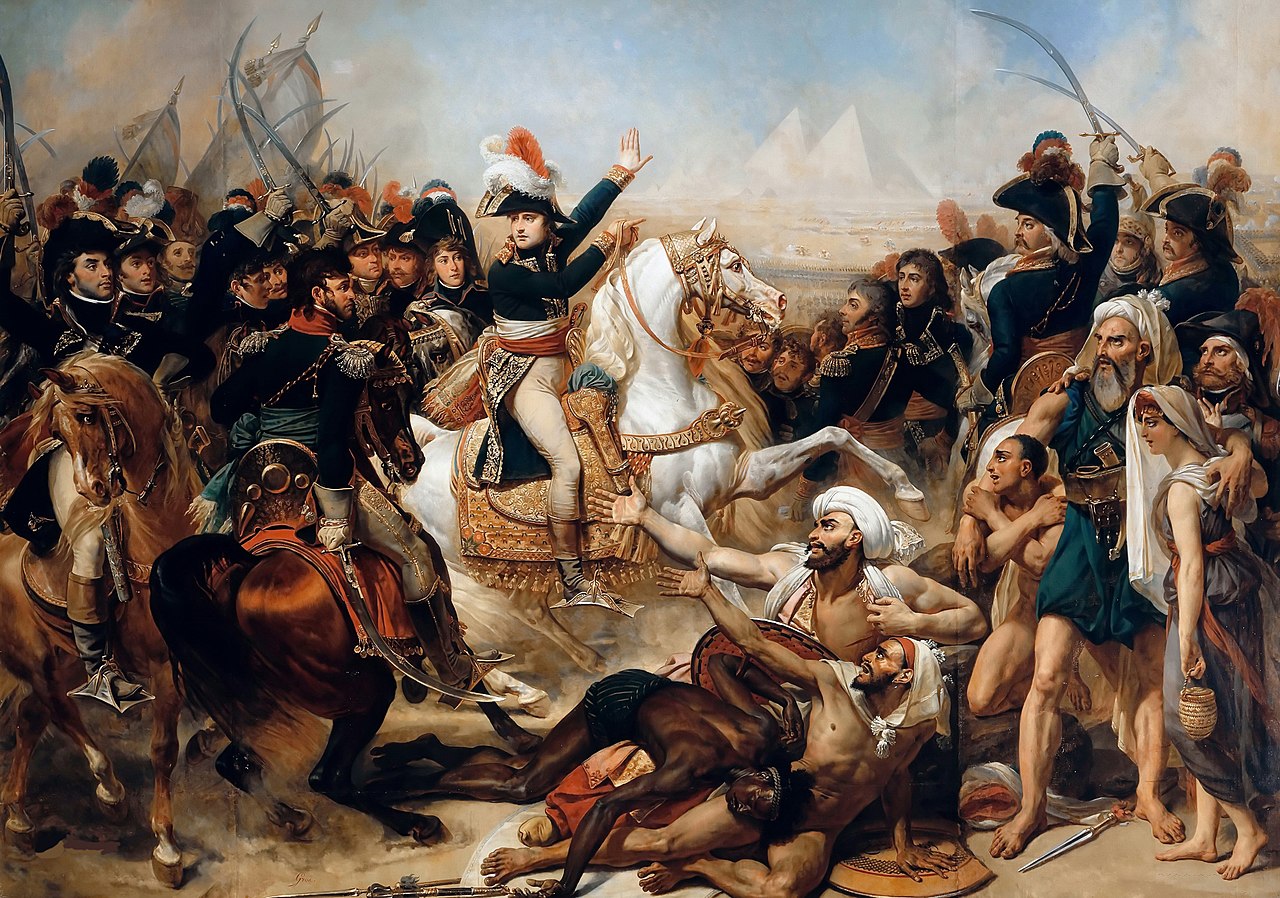
The treatment of Christian Copts by Muslim rulers remained challenging throughout the Middle Ages and continued into the Early modern period. When Napoleon conquered Egypt in 1798 as part of the Napoleonic wars, a military unit known as the Coptic Legion was created out of necessity for self-defense by the Coptic community for protection against the Mamluks, Ottomans and Egyptian Muslims. The Coptic Legion was headed by a Coptic general, General Yaqub, who recruited young Copts from Cairo and Upper Egypt for the Legion. These were trained by instructors from the French army. Together with the Greek Legion, the Coptic Legion formed the Bataillon des Chasseurs d'Orient. Members of the Coptic Legion returned with the French army to France in 1801 after the defeat of the Napoleonic conquest of Egypt.
General Yaqub is considered to be the founder of the first project for Egypt's independence in modern times from the Ottoman Empire. He argued for the country's independence from an Egyptian nationalist point of view, highlighting the past glory of Egypt, lamenting its current state unworthy of a people who built a great civilization, and stressing the debt that humanity owes to Egypt's ancient culture.
During the Ottoman period, Copts were classified alongside other Oriental Orthodox (namely the Syriac Orthodox) and Church of the East peoples under the Armenian millet. Under Muslim rule, Christians paid special taxes, had lower access to political power, and were exempt from military service.
The position of the Copts improved dramatically under the rule of Muhammad Ali in the early 19th century. He abolished the jizya (a tax on non-Muslims) and allowed Copts to enroll in the army. Pope Cyril IV, who reigned from 1854 to 1861, reformed the church and encouraged broader Coptic participation in Egyptian affairs. Khedive Isma'il Pasha, in power 1863–1879, further promoted the Copts. He appointed them judges to Egyptian courts and awarded them political rights and representation in government. They flourished in business affairs.
Copts in modern Egypt
Egypt's struggle for independence from both the Ottoman Empire and the United Kingdom was marked by secular Egyptian nationalism. Copts were in the forefront of that struggle for Egypt's independence. When the Egyptian nationalist leader Saad Zaghlul met the Arab delegates at Versailles in 1919, he insisted that their struggles for statehood were not connected, stressing that the problem of Egypt was an Egyptian problem and not an Arab one.
When Zaghlul was exiled by the British to Malta in 1919, a number of prominent Christian Coptic figures who joined him in resisting the British occupation of Egypt were also exiled with him, including Wissa Wassef and George Khayat, both key members of the Egyptian nationalist movement. When Zaghlul returned from his first exile, he was joined by the Copts Wissa Wassef, Sinout Hanna, Wassef Ghali, Morcos Hanna and Makram Ebeid in forming a strong opposition against British colonialism in Egypt. Later in 1921, when Zaghlul was exiled to the Seychelles, the prominent Copt Makram Ebeid was exiled with him.
The exiles were part of the larger Egyptian nationalist response to British colonial rule and represented a unified effort across religious lines in Egypt. They galvanized widespread protests in Egypt that culminated in the famous 1919 revolution, which further emphasized the shared desire for independence among Egyptians of all faiths. This unity became a hallmark of the early 20th-century Egyptian nationalism. In his memoirs,
Fakhri 'Abd al-Nur, one of the most recognized Coptic figures of the 1919 Revolution, recalls the positive impact of the statement made by Saad Zaghlul at the onset of the revolution, declaring "equal responsibilities and equal rights" of Egyptian Copts and Muslims. In fact, the preacher of the 1919 Revolution was a Coptic priest, Father Morcos Sergius, who had been previously exiled by the British in 1915.
In April 1922, the British ordered the execution of seven Egyptian nationalists, four of whom were Copts: Wissa Wassef, Wassef Ghali, George Khayat, and Morcos Hanna. As a result of their struggle, Egypt gained its independence from both Great Britain and the Ottoman Empire on 28 February 1922. This struggle of Copts against the British and the Ottomans within the framework of Egyptian nationalism highlighted the Copts' (as well as the Egyptian Muslims') self-identification as Egyptians first and foremost with little attention to religious affiliations.
Significant cultural achievements for Copts during this era include the founding of the Coptic Museum in 1910 and the Higher Institute of Coptic Studies in 1954. Prominent Coptic thinkers from this period are Salama Moussa, Louis Awad and Secretary General of the Wafd Party Makram Ebeid.
In 1952, Gamal Abdel Nasser led a clique of army officers in a coup d'état against King Farouk, which overthrew the monarchy and declared Egypt a republic. Nasser was a secularist whose ideology was rooted in pan-Arab nationalism and socialism. The Copts were severely affected by Nasser's nationalization programs and his pan-Arab policies undermined the Copts' strong attachment to and sense of identity about their Egyptian pre-Arab identity.
Demographics
The Coptic population in Egypt is difficult to estimate because researchers are forbidden by Egyptian authorities to ask a survey participant's religion. A lack of definite, reliable demographic data renders all estimates uncertain. As of 2019, Copts were generally understood to make up approximately 10 percent of Egypt's population, with an estimated population of 9.5 million (figure cited in the Wall Street Journal, 2017) or 10 million (figure cited in the Associated Press, 2019). Smaller or larger figures have also been cited, in the range of "somewhere between 6% and 18% of the population," with the Egyptian government estimating lower numbers and the Coptic Orthodox Church estimating higher numbers. In 2023, Pope Tawadros II of Alexandria stated that the number of Copts in Egypt is estimated at 15 million out of a total population of 105 million, or approximately 14% of the population in Egypt. He also said there were another 2 million Copts living in approximately 100 different countries in the diaspora. He explained that this data was obtained from records of child baptisms, marriages, and deaths.
Despite challenges, Copts are well integrated in the Egyptian society. The highest concentrations of Copts are in Upper Egypt, especially around Asyut, Minya, Sohag and Qena, along with some districts in major cities of Cairo and Alexandria.
Diaspora
There are approximately 1-2 million Copts living outside of Egypt, and are known as the Coptic diaspora. They live mainly in the United States (500,000), Sudan (400,000–500,000), Australia (75,000), Libya (60,000), Canada (50,000), France (45,000), Italy (30,000), the United Kingdom (25,000–30,000), the United Arab Emirates (10,000) and the Netherlands (10,000).