
The Communist International (abbreviated as Comintern), also known as the Third International, was a Marxist political international that advocated world communism and existed from 1919 to 1943. Emerging from the collapse of the Second International during World War I, it was founded at a congress in Moscow convened by Vladimir Lenin and the Russian Communist Party (Bolsheviks) (RCP), which aimed to create a new international body committed to revolutionary socialism and the overthrow of capitalism worldwide.
Initially, the Comintern operated with the expectation of imminent proletarian revolutions in post-war Europe, particularly in the former German Empire, which were seen as crucial for the survival and success of the Russian Revolution. Its early years were characterized by attempts to foment and coordinate revolutionary uprisings and the establishment of disciplined communist parties across the globe, often demanding strict adherence to the "Twenty-one Conditions" for admission. As these revolutionary hopes faded by the early 1920s, the Comintern's policies shifted, notably with the adoption of the "united workers' front" tactic, aiming to win over the working masses from reformist socialist parties. Throughout the 1920s, the Comintern underwent a process of "Bolshevization", increasing the centralization of its structure and the dominance of the RCP within its ranks. This process intensified with the rise to power of Joseph Stalin in the Soviet Union.
The "Third Period" (1928–1933) saw the Comintern adopt an ultra-sectarian line and denounce social democratic parties as "social fascism". From 1934, the Comintern shifted to the Popular Front policy, advocating broad alliances with socialist and even liberal parties against fascism. This was formally adopted at its Seventh World Congress in 1935. The Comintern played a significant role in organizing support for the Republican side in the Spanish Civil War, including the formation of the International Brigades. However, this period also coincided with the Great Purge in the Soviet Union, during which many Comintern officials and foreign communists residing in Moscow were arrested and executed.

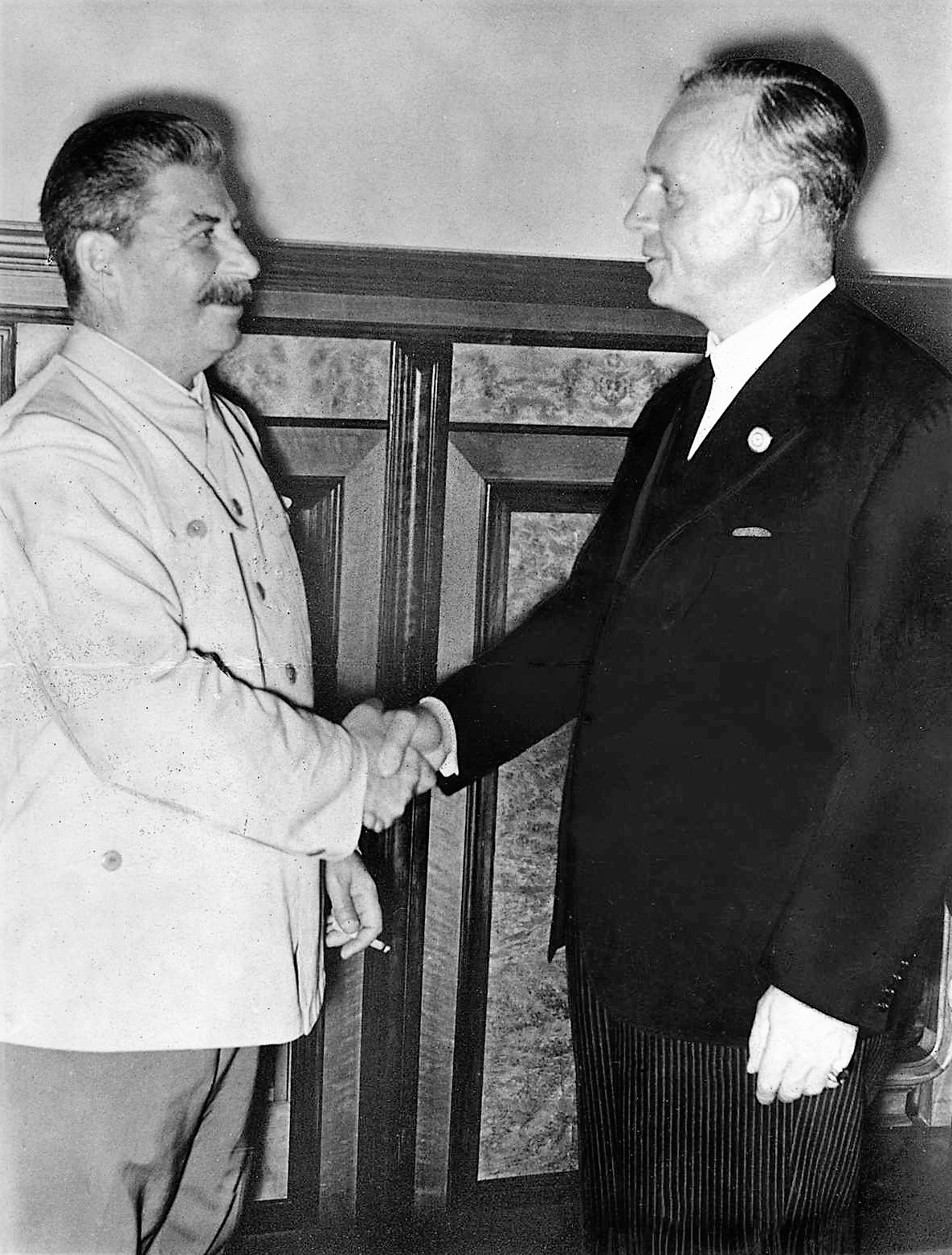
With the signing of the Nazi–Soviet Pact in August 1939, the Comintern again changed its line, denouncing the war between Nazi Germany and the Western powers as an "imperialist war" and abandoning its anti-fascist stance until the German invasion of the Soviet Union in June 1941. As a gesture to its Allies in World War II, Stalin unilaterally dissolved the Comintern on 15 May 1943. While its formal structures were dismantled, mechanisms of Soviet control over the international communist movement persisted and were later partially revived through the Cominform (1947–1956).
Background
The Communist International, or Third International, was a direct descendant of the First International (1864–1876) and the Second International (1889–1914). The First International, of which Karl Marx and Friedrich Engels were leading figures, aimed to coordinate the proletariat in its worldwide struggle against capitalism, based on the premise that "the working men have no country" and that horizontal class allegiance would supersede vertical national divisions. By the late 19th century, however, the Western labour movement had largely abandoned the revolutionary zeal of the First International. Powerful trade unions and socialist parties emerged which, while often adhering to Marxist revolutionary theory, in practice pursued the implementation of gradual, constitutional reforms, improving the workers' lot within the existing capitalist framework. This created a manifest contradiction between revolutionary rhetoric and peaceful practice.
The Second International, created in 1889, was a looser federation of autonomous socialist parties, comprising "left", "right", and "centrist" factions, divided on issues such as bourgeois democracy, the national question, general strikes, and, crucially, war. It foundered in August 1914 on the rock of national chauvinism when most of its constituent parties chose to support their respective national governments in World War I by voting for war credits. Vladimir Lenin, a key figure in the Russian Bolshevik Party (later the Russian Communist Party, RCP), viewed this as a "sheer betrayal of socialism" and declared the Second International dead, calling for a Third International by the autumn of 1914.

During the war, anti-war socialists attempted to regroup at the Zimmerwald Conference in 1915 and the Kienthal Conference in 1916. At Zimmerwald, a divide emerged between a pacifist majority, which sought an immediate peace without annexations or indemnities, and Lenin's left-wing minority, which advocated turning the imperialist war into a revolutionary civil war. Lenin's position gained more support at Kienthal, and the Zimmerwald Left laid the ideological foundations for the future Third International.
The Bolsheviks emerged from a distinct Russian revolutionary tradition. Unlike the mass-based, reformist parties of the West, Russian revolutionaries operated in a clandestine underground, organized in small, disciplined groups of "professional revolutionaries". Drawn largely from the intelligentsia of the Russian Empire, this movement possessed a quasi-religious devotion to the cause of revolution itself, an enthusiasm that contrasted sharply with the practical, matter-of-fact nature of Western labour movements. The October Revolution of 1917 in Russia, led by the Bolsheviks, was seen by Lenin as the first act of a global drama, with European workers expected to follow suit. To achieve this, a new International, purged of reformist "traitors", was deemed an absolute necessity.
Foundation and early years (1919–1923)
The Communist International was founded at a congress of revolutionaries in Moscow from 2–6 March 1919. The impetus for its creation came from the Bolsheviks' belief in the imminence of world proletarian revolution, spurred by the perceived collapse of capitalism after World War I and revolutionary upheavals across Europe, particularly the German "November Revolution". The mission of the Comintern was to build a "world party" of communists dedicated to the armed overthrow of capitalist private property and its replacement by a system of collective ownership.

First (Founding) Congress
On 24 January 1919, a "Letter of Invitation to the First Congress of the Communist International" was sent by wireless from Moscow, identifying thirty-nine communist parties and revolutionary groups eligible to attend; it was deliberately timed to pre-empt the Berne Conference, held in early February by reformist socialists attempting to revive the Second International. The congress convened in the Kremlin on 2 March 1919. Of the fifty-one delegates, only nine arrived from abroad due to the Allied blockade of Russia; the rest resided in Soviet Russia, and many lacked authorized credentials. Hugo Eberlein, the delegate of the Communist Party of Germany (KPD), was mandated to oppose the immediate formation of a new International, reflecting Rosa Luxemburg's earlier concerns that a premature founding would allow the Bolsheviks to dominate the new organization. Despite Eberlein's abstention, the congress voted overwhelmingly to establish the Third International on 4 March 1919.
The principal document of the congress was Leon Trotsky's "Manifesto to the Proletariat of the Entire World", which emphasized soviets (workers' councils) as the instrument of working-class unity and action, deeming the Russian model universally applicable. It dismissed "bourgeois democracy" and reiterated Lenin's insistence on the dictatorship of the proletariat. Unusually, the Manifesto made no explicit reference to the role of national Communist Parties, instead placing its emphasis on the soviets on one hand and, on the other, the "International Communist Party" whose task was to overthrow the capitalist order. The improvised nature of the congress meant that no formal statutes or rules were adopted, but an Executive Committee (ECCI) was elected, with Grigory Zinoviev as its first President. While provision was made for foreign party representation on the ECCI, Bolsheviks predominated due to the prestige of the Russian Revolution and the weakness of foreign parties.
Universalisation of Bolshevism
The foundation of the Comintern institutionalized the split in the international labour movement between revolutionary communists and reformist social democrats. This schism was rooted in fundamentally different conceptions of the path to socialism. Karl Kautsky, a leading theoretician of the Second International, condemned the Bolshevik coup in The Dictatorship of the Proletariat (1918), arguing that socialism was inseparable from democracy and that a revolution in backward Russia could only result in a terroristic dictatorship. Lenin, in his reply The Proletarian Revolution and the Renegade Kautsky (1918), excoriated Kautsky, asserting that parliamentary institutions were a sham concealing bourgeois class rule and that "proletarian democracy is a million times more democratic than any bourgeois democracy". He proclaimed that Bolshevism could "serve as a model of tactics for all". Rosa Luxemburg, while a committed revolutionary, also criticized the Bolsheviks from a democratic standpoint, warning that their centralist organizational model would lead to a bureaucratic dictatorship over the proletariat, not of it.
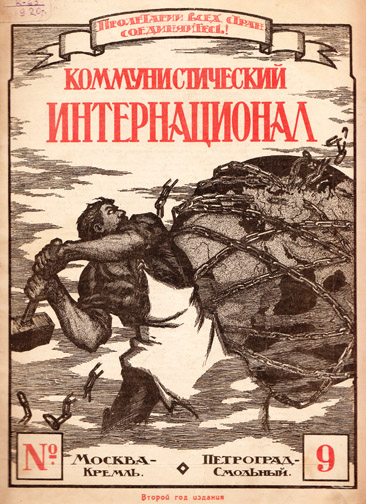
The Second World Congress, held in Petrograd and Moscow from 19 July to 7 August 1920, is considered the true founding congress of the Comintern. Many delegates undertook hazardous, illegal journeys through the Allied blockade and civil war to attend, with some travelling for weeks to reach Russia. The congress itself took place amidst the privations of War Communism, but the Bolsheviks staged impressive cultural spectacles, such as a mass performance depicting the history of class struggle, to foster revolutionary enthusiasm among the delegates and the domestic population.
The congress adopted the famous "Twenty-one Conditions" for admission, drafted primarily by Zinoviev under Lenin's guidance. These conditions, a "much more stringent and deterrent set" than the initial platform, aimed to split the rank-and-file of European socialist parties from their "opportunist" leaders and enforce Bolshevik organizational principles. Key conditions included: systematic removal of reformists and centrists from all responsible posts; combining legal and illegal activity; a complete break with figures like Kautsky and Ramsay MacDonald; establishing communist cells in trade unions; adherence to democratic centralism based on iron discipline and periodic purges; unconditional support for every Soviet republic; and changing party names to "Communist Party". Point sixteen stated that all decisions of Comintern congresses and the ECCI were binding on all parties. The congress also ratified the Statutes of the Comintern, which established the annual world congress as the supreme body and the ECCI as the directing body between congresses. Point 8 of the Statutes stipulated that the work of the ECCI was performed mainly by the party of the country where it was located (Soviet Russia), which had five representatives with full voting rights, while other major parties had only one.
This "universalisation of Bolshevism" was further elaborated in Lenin's pamphlet "Left-Wing" Communism: An Infantile Disorder (April 1920), which argued that "certain fundamental features of our revolution have a significance that is not local... but international". The Third (June–July 1921) and Fourth (November–December 1922) Congresses reinforced the centralist Bolshevik model, creating ECCI bodies like the Presidium, Secretariat, Organisational Bureau (Orgburo), and International Control Commission (ICC) that paralleled Russian party structures. The Comintern also began dispatching "agents" and "emissaries" to intervene in the affairs of national parties. Funding for foreign communist parties and the Comintern's clandestine activities, managed by the International Liaison Department (OMS) from 1921, came from the Soviet state treasury, creating economic dependence.
Despite the trend towards Russian dominance and centralisation, the Comintern in Lenin's era displayed a degree of pluralism and open debate not seen later. Figures like Paul Levi of the KPD and the Italian Amadeo Bordiga were not docile, and some national parties resisted or reinterpreted Moscow's directives.
"United workers' front"
By late 1920 and into 1921, with the failure of revolutionary upheavals in Europe (such as the factory occupations in Italy and the "March Action" in Germany in 1921), Lenin reluctantly concluded that proletarian revolution was no longer on the immediate agenda. This led to the adoption of the "united workers' front" policy, formally expounded in ECCI theses on 18 December 1921. The policy aimed to win over the majority of the working class by engaging in joint defensive struggles with socialist rank-and-file against the capitalist offensive. It allowed for temporary alliances with reformist leaders ("united front from above") but primarily focused on unity "from below". The slogan of the Third Congress (1921) was "To the masses!".
The United Front policy was closely intertwined with changes in Soviet domestic and foreign policy, particularly the New Economic Policy (NEP) and the search for trade relations with capitalist nations. The Rapallo Treaty of April 1922 between Germany and Soviet Russia epitomized the growing tension between the Comintern's revolutionary goals and Soviet state interests. The United Front tactics faced intense opposition from left-wing elements in many communist parties (e.g., in France and Italy), who found it inconceivable to court the "social chauvinists". The Comintern's trade union arm, the Profintern (Red International of Labour Unions), founded on Lenin's initiative at the Second Congress in 1920, played a crucial role in applying United Front tactics in the industrial field, though this often led to splits in national trade union movements, as in Czechoslovakia and France.

A conference of the three Internationals (Second, Comintern, and the Vienna Union or "Two-and-a-half International") in Berlin in April 1922, aimed at creating common action, failed amidst mutual suspicion and recriminations. The Communists, led by Karl Radek, denounced the "social patriots", who in turn condemned the persecution of Socialist Revolutionaries and Mensheviks in Russia and the Soviet invasion of the Social Democratic republic of Georgia. Despite the hostility, a temporary Committee of Nine (three from each International) was formed to explore further steps towards unity, but it met only once in May 1922 and achieved nothing, with the Comintern soon withdrawing.
The "German October" of 1923, a failed Comintern-inspired uprising in Germany, revealed fundamental limitations in Comintern thinking, including inadequate military preparations and a misjudgment of the German workers' mood. This debacle convinced many Bolsheviks, notably Joseph Stalin, that European revolution was a distant prospect, reinforcing the priority of defending the Soviet state.
Bolshevisation and Stalin's rise (1924–1928)
The period from 1924 to 1928 was characterized by the "Bolshevisation" of the Comintern and its member sections. This entailed an increasing Russian dominance, the Russification of ideological and organizational structures, and the canonization of Leninist principles of party unity, discipline, and democratic centralism, particularly the concentration of power in the hands of the Russian party delegation to the ECCI.
Impact of Soviet inner-party struggles
The failure of the "German October" and Lenin's death in January 1924 intensified inner-party struggles in the Soviet Union, which profoundly affected the Comintern. The triumvirate of Zinoviev, Lev Kamenev, and Stalin moved against Trotsky and his supporters. At an ECCI Presidium session in January 1924, Zinoviev attributed the German failure to the "opportunism" of Radek, Heinrich Brandler, and August Thalheimer, implicating Trotsky by association. "Trotskyism" was branded a "right deviation".
The slogan of "Bolshevisation" was officially proclaimed at the Fifth Comintern Congress (June–July 1924). In practice, it meant creating centralized, disciplined Leninist organizations fiercely loyal to the RCP majority in its struggle against the "Trotskyite opposition". Zinoviev declared the need for "iron discipline" and the eradication of "social-democratism, federalism, 'autonomy'". This led to a series of denunciations and expulsions: Brandler and Thalheimer were removed from the KPD leadership, replaced by leftists Arkadi Maslow and Ruth Fischer; Boris Souvarine was expelled from the French party; and Polish leaders like Adolf Warski were condemned.
The Fifth Congress also marked a tactical shift to the left regarding the United Front. The Theses on Tactics rejected united fronts "solely from above" and re-emphasized the united front "from below" under communist party leadership as a means to unmask reformist "bosses". Radek was removed from the ECCI, and Trotsky was demoted to non-voting status, replaced by Stalin.
However, the period 1925–1926 saw a tentative move back to the centre under Nikolai Bukharin's growing influence in the Comintern, emphasizing a broader conception of the United Front. It has been suggested that the failures of the Comintern to export proletarian revolution across the globe prompted Stalin to resort to the doctrine of "socialism in one country", first propounded in December 1924. This theory argued that the Soviet Union could build socialism without the need for immediate world revolution, and that the main task of communist parties was to defend the USSR. This fundamentally altered the strategic orientation of the international communist movement, subordinating the goal of world revolution to the defence and construction of the USSR, which was now considered the essential factor in that revolution. In order to sustain this "essential factor" its rapid industrialization was imperative but could not be achieved without normalizing diplomatic and economic relations with the developed capitalist countries, which in turn demanded taming the Comintern so that the attempts at exporting proletarian revolutions into them cease. A key initiative of this period was the Anglo-Russian Trade Union Committee, formed in April 1925, which aimed to foster trade union unity but ended in failure after the 1926 British General Strike.
By 1926, Zinoviev and Trotsky formed the United Opposition against the Stalin-Bukharin duumvirate, criticizing "socialism in one country" and the Comintern's rightward turn. The ensuing power struggle dominated the Comintern, leading to Zinoviev's removal as Comintern President in October 1926 (replaced by a "collective leadership" headed by Bukharin) and Trotsky's expulsion from the ECCI and eventually the Soviet Union.
National party responses
Foreign communist parties responded to Bolshevisation in various ways. Many leaders and members, out of sincere respect for the Bolsheviks' revolutionary success or a sense of disorientation, accepted Moscow's directives, sometimes lapsing into deference. Loyalty to the USSR as the first "socialist bastion" and a commitment to "internationalism" as defined by Moscow were powerful motivating factors. Figures like Palmiro Togliatti of the Italian party ultimately aligned with the RCP majority, recognizing the operational necessity of Moscow's support.
Bureaucratisation within the Comintern and national parties also facilitated Russian control. As world congresses became less frequent, power devolved to the ECCI and its Presidium, which were disproportionately staffed by Bolsheviks and managed the day-to-day workings of the International. However, there was also resistance. "Ultra-left" elements in parties like the KPD challenged the Russification of the Comintern and the perceived subordination of revolutionary goals to Soviet state interests. There was also widespread reluctance to implement specific organizational prescriptions of Bolshevisation, such as the replacement of territorial branches with factory cells and the formation of communist fractions in reformist trade unions. These measures often clashed with local traditions and practical difficulties, leading to slow implementation or outright disregard.
Third Period (1928–1933)
The years 1928–1933 in Comintern history are known as the "Third Period", a phase of sectarian tactics which entailed increased opposition to the social democratic parties. This period was characterized by the belief that capitalism was entering its final crisis, leading to a new revolutionary upsurge and impending imperialist wars.
Defeat of the "right deviation"
The concept of a "Third Period" was first introduced by Bukharin at the Seventh ECCI Plenum (November–December 1926). He posited it as a phase following the initial post-war revolutionary upheaval (First Period) and the relative capitalist stabilization (Second Period), where the internal contradictions of stabilization would lead to a new revolutionary wave. This analysis remained Comintern orthodoxy through the Sixth World Congress (July–September 1928).
However, by 1928, the political landscape within the Soviet Union was shifting. Stalin began to move against Bukharin and his allies (the "Right Opposition"), who resisted his policies of rapid industrialization and forced collectivization. This struggle inevitably extended to the Comintern. The Sixth Congress, while formally still under Bukharin's influence, saw the Stalinist faction begin to construct a "right-wing deviation" within the Comintern, linking it to social democracy. Stalin's pivotal speech at an ECCI Presidium meeting in December 1928 concerning the KPD (the "German question") signalled a decisive move against any "Right faction" in the Comintern, demanding "iron inner-party discipline" and condemning "conciliators". This led to purges in various parties, such as in Germany, Sweden, and Czechoslovakia. Bukharin himself was removed from his Comintern duties in July 1929. Leading Comintern officials like Dmitri Manuilsky, Osip Piatnitsky, Otto Kuusinen, and Klement Gottwald aligned with Stalin.
Theory and practice of "social fascism"
The central ideological tenet of the Third Period was the doctrine of "social fascism". This theory, formally expounded at the Tenth ECCI Plenum (July 1929), asserted that social democracy had transformed from a right-wing working-class party into a wing of the bourgeoisie, and in the context of capitalism's final crisis, had become the "moderate wing of fascism". "Left" social democrats (like the Austro-Marxists or the British Independent Labour Party) were branded as the most dangerous enemies, as they allegedly deceived the workers with revolutionary phrases while supporting capitalism.
This doctrine precluded any united front with social democratic leaders and mandated a strategy of "class against class", meaning communists should fight independently for the leadership of the working class. In practice, this led to intense hostility towards social democratic parties and trade unions. The Comintern urged the creation of independent "Red" trade unions or revolutionary oppositions within existing unions, aiming to organize the unorganized and unemployed, who were seen as a key revolutionary force. This policy proved largely counterproductive, isolating communists from the bulk of the organized working class and leading to a decline in membership and influence in many countries, such as Britain and Czechoslovakia.
In Germany, the "social fascism" line had particularly tragic consequences. The KPD, under Ernst Thälmann, directed its main fire against the Social Democratic Party of Germany (SPD), even engaging in joint actions with the Nazis against SPD-led governments (e.g., the Prussian referendum of 1931). The Twelfth ECCI Plenum in August 1932 was dominated by the German question and a sense of growing crisis, but its resolutions were confused and contradictory, reflecting deep divisions in Moscow over how to respond to the Nazi threat. While some leaders like Manuilsky and Kuusinen urged a more flexible united front, hard-liners like Vilhelm Knorin insisted on the primacy of the struggle against the SPD, and no clear line emerged. This division in the German labour movement fatally weakened its ability to resist the rise of Adolf Hitler. Historian G. D. H. Cole described the policy as "disastrous" and argued it was "largely responsible for Hitler's victory in Germany".
While some local-level collaboration between communists and social democrats occurred, the official Comintern line remained largely unchanged even after Hitler's accession to power in January 1933. The Thirteenth ECCI Plenum in December 1933, held in the aftermath of the German catastrophe, failed to reassess the policy, instead blaming the SPD for the Nazi victory and reasserting the "social fascism" line. In response to the SPD executive-in-exile's "Prague Manifesto" of January 1934, which called for revolutionary unity against Nazism, the Comintern maintained its "implacable hostility" and, in an appeal in May, denounced Social Democracy as the "ally of Fascism". The policy was also influenced by Soviet foreign policy concerns, particularly Stalin's initial fear of an Anglo-French war of intervention and the need to combat social democratic support for such a war, as well as the desire to maintain stable relations with Weimar Germany and prevent its alignment with Western powers against the USSR.
Popular Front and Great Purge (1934–1939)
The disastrous consequences of the Third Period, epitomized by the Nazi seizure of power in Germany, led to a gradual and complex reorientation of Comintern policy towards the Popular Front. This era was simultaneously marked by the devastating impact of the Stalinist Great Purge on the Comintern itself.
Origins of the Popular Front
The catalyst for the shift away from "social fascism" came largely from events in France. In February 1934, joint actions by socialist and communist workers against a common fascist threat created a powerful groundswell for unity from below. This coincided with a growing recognition within parts of the Comintern leadership, notably Georgi Dimitrov (who became General Secretary in spring 1934 after his Leipzig trial), that the old tactics had failed. By mid-May 1934, Dimitrov began to advocate for broader anti-fascist alliances, including with social democratic parties ("united front from above") and even middle-class "democratic" forces. The transition was marked by intense and protracted internal debates in Moscow throughout 1934 between proponents of the new line, like Dimitrov, Manuilsky and Kuusinen, and "hard-line" opponents such as Knorin, Béla Kun and Solomon Lozovsky, who resisted any deviation from the established dogma. Stalin's role was initially indecisive, but he ultimately gave his cautious approval to the new course. The enforcement of the line before Stalin was fully ready for a policy change led to the purging of leaders who dissented, such as Heinz Neumann and Hermann Remmele in Germany and Karl Kilbom in Sweden.
The process was driven by a "triple interaction": national factors (such as the anti-fascist unity in France), internal Comintern dynamics, and Soviet foreign policy (the USSR's search for collective security against Nazi Germany, leading to its entry into the League of Nations in September 1934, the efforts of Maxim Litvinov for "united resistance to Fascist aggression", and the Franco-Soviet Pact in May 1935). In July 1934, the French Communist Party (PCF) signed a "Pact of Unity of Action" with the French Socialists. The PCF, under Maurice Thorez, then pioneered the call for a broader Rassemblement Populaire in October 1934, extending appeals to the Radical Party.
Popular Front in practice
The Seventh World Congress of the Comintern (July–August 1935) formally ratified the Popular Front policy. Dimitrov's main report defined fascism as "the open terrorist dictatorship of the most reactionary, most chauvinistic and most imperialist elements of finance capital" and called for a "broad people's anti-fascist front" based on the proletarian united front but extending to the peasantry and urban petty-bourgeoisie. Communists were to defend bourgeois democratic liberties against fascism and present themselves as tribunes of national independence. The Congress resolution allowed for communist participation in Popular Front governments under certain pre-revolutionary conditions, viewing them as potential "transitional forms" to proletarian revolution.
However, the break with the past was partial. The universal applicability of the Bolshevik model was not challenged, and conditions for "organic unity" with socialists remained prohibitively strict. The Popular Front era was marked by an unresolved tension between inherited ideologies and new initiatives. While parties were given more leeway for local adaptation, Moscow's ultimate control remained, especially concerning foreign policy.
In France, the Popular Front led to an electoral victory in May 1936 and the formation of a government under Léon Blum, which the PCF supported from outside. This period saw massive growth in PCF membership and trade union influence, but was also characterized by a massive wave of strikes and factory occupations in June 1936 that alarmed the Radicals and complicated Soviet foreign policy aims of alliance with France. The PCF leadership, under Thorez, acted to end the strikes, arguing that it was necessary to know when to stop and that "The People's Front is not the revolution", a line driven by the need to preserve the Franco-Soviet pact.
Spanish Civil War
The Popular Front policy found its most prominent and fraught application in Spain. The Popular Front's narrow electoral victory in February 1936 brought a republican government to power, which the small Spanish Communist Party (PCE) supported. The victory was followed by a military coup led by Francisco Franco in July 1936, which plunged Spain into a civil war that was also a widespread social revolution. From the outset, the war became an international issue, with Nazi Germany and Fascist Italy providing crucial support to Franco's nationalists.
The Comintern and the Soviet Union were initially hesitant to intervene directly, balancing support for the Republic with the diplomatic aim of not antagonizing Britain and France, whose policy of non-intervention the USSR initially joined. However, as nationalist successes mounted and Italo-German aid continued, Moscow shifted its policy. In September 1936, the Comintern began organizing the International Brigades for the defence of Madrid. The USSR also began to supply arms and military advisers, with Soviet tanks and aircraft playing a crucial role in saving Madrid in November 1936.
Soviet intervention was a "turning-point" in the war, but it also became the primary instrument for extending Comintern and Stalinist influence over the Republic's internal affairs. The PCE, hitherto a marginal force, grew enormously in numbers and prestige, its authority buttressed by the arrival of Soviet aid. The Comintern's strategy, directed from Moscow and implemented by figures like Palmiro Togliatti, was to subordinate all revolutionary objectives to the goal of military victory. This required building a broad "national front" and maintaining the appearance of a "democratic parliamentary republic" to avoid alienating the Western democracies, effectively "pushing the proletarian revolution back within the bourgeois-democratic bounds". This made the communists, in the view of G. D. H. Cole, "definitely a right-wing influence in Spanish affairs". This put the PCE in direct conflict with the powerful anarchist CNT and the revolutionary Marxist POUM, and allied it with the socialist centre and right wing under Indalecio Prieto.
Under Comintern guidance, the PCE and its Soviet advisers, including NKVD representative Alexander Orlov, established their own secret police and systematically persecuted their rivals on the Left. Tensions culminated in the Barcelona May Days of 1937, an armed conflict between government forces (backed by the communists) and anarchists. The defeat of the anarchists led to the fall of the socialist Prime Minister Francisco Largo Caballero, who had resisted communist pressure, and his replacement by the more compliant Juan Negrín. The POUM was subsequently outlawed, and its leader, Andreu Nin, was tortured and murdered by Soviet agents. The Comintern's policy in Spain thus became a microcosm of Stalinism, prioritizing the elimination of "Trotskyist" and other revolutionary opponents over a genuine united front against Franco. According to historian Fernando Claudin, the entire episode was the "sacrifice of a revolution to the interests of Soviet raison d'état". The internal divisions fatally weakened the Republican war effort, which ultimately collapsed in March 1939.