
The civil rights movement was a social movement in the United States from 1954 to 1968 which aimed to abolish legalized racial segregation, discrimination, and disenfranchisement in the country, which most commonly affected African Americans. The movement had origins in the Reconstruction era in the late 19th century, and modern roots in the 1940s and in Mohandas Gandhi's nonviolent movement in India. After years of nonviolent protests and civil disobedience campaigns, the civil rights movement achieved many of its legislative goals in the 1960s, during which it secured new protections in federal law for the civil rights of all Americans, including the Civil Rights Act of 1964, the Voting Rights Act of 1965, and the Civil Rights Act of 1968.
Following the American Civil War (1861–1865), the three Reconstruction Amendments to the U.S. Constitution abolished slavery and granted citizenship to all African Americans, the majority of whom had recently been enslaved in the southern states. During Reconstruction, African-American men in the South voted and held political office, but after 1877 they were increasingly deprived of civil rights under racist Jim Crow laws (which for example banned interracial marriage, introduced literacy tests for voters, and segregated schools) and were subjected to violence from white supremacists during the nadir of American race relations. African Americans who moved to the North to improve their prospects during the Great Migration also faced barriers to employment and housing. Legal racial discrimination was upheld by the Supreme Court in its 1896 decision in Plessy v. Ferguson, which established the doctrine of "separate but equal". The movement for civil rights, led by figures such as W. E. B. Du Bois and Booker T. Washington, achieved few gains until after World War II. In 1948, President Harry S. Truman issued an executive order abolishing discrimination in the armed forces.
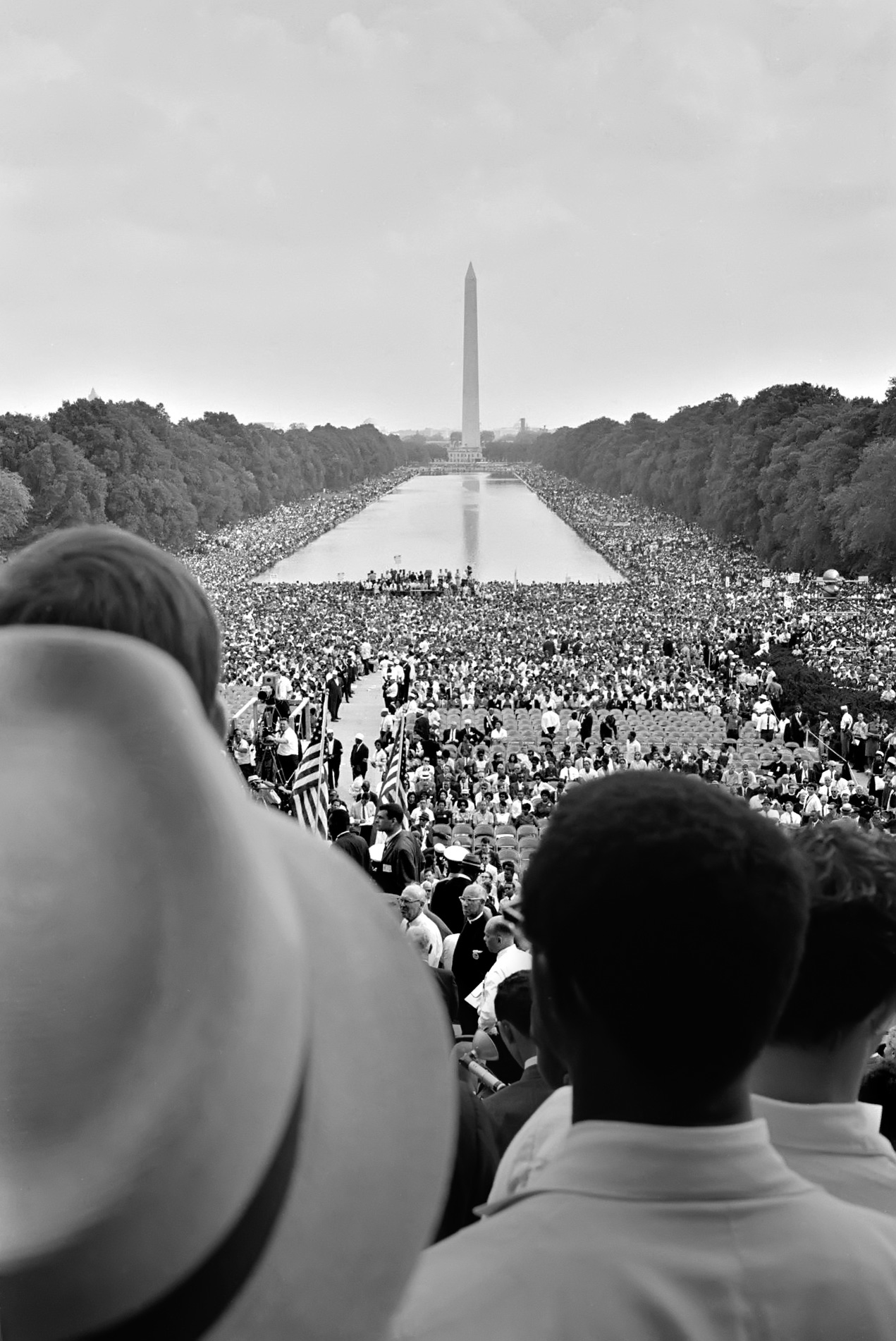
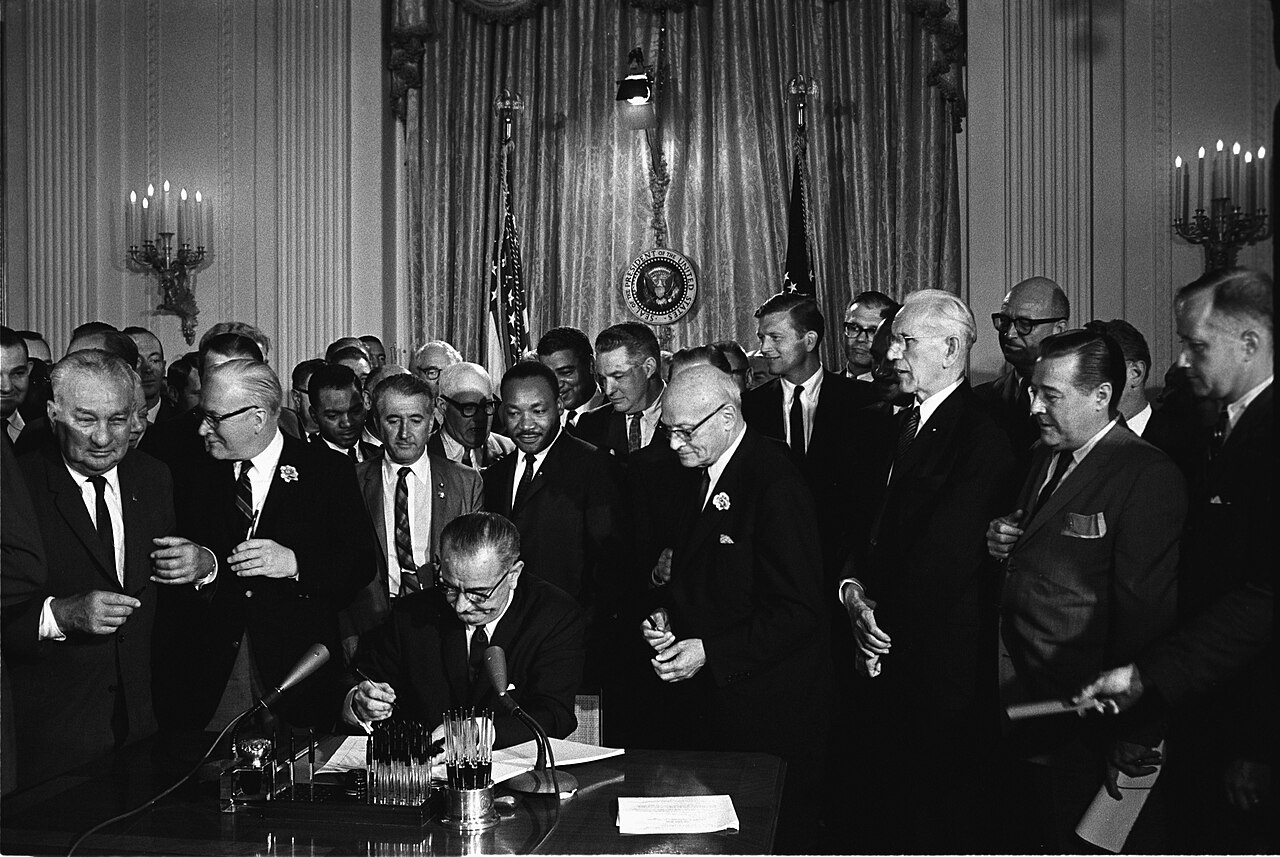
In 1954, the Supreme Court struck down state laws establishing racial segregation in public schools in Brown v. Board of Education. A mass movement for civil rights, led by Martin Luther King Jr. and others, began a campaign of nonviolent protests and civil disobedience including the Montgomery bus boycott in 1955–1956, "sit-ins" in Greensboro and Nashville in 1960, the Birmingham campaign and its Children's Crusade in 1963, and a march from Selma to Montgomery in 1965. Press coverage of events such as the lynching of Emmett Till in 1955 and the use of fire hoses and dogs against protesters in Birmingham increased public support for the civil rights movement. In 1963, about 250,000 people participated in the March on Washington, after which President John F. Kennedy asked Congress to pass civil rights legislation. Kennedy's successor, Lyndon B. Johnson, overcame the opposition of southern politicians to pass three major laws: the Civil Rights Act of 1964, which prohibited discrimination based on race, color, religion, sex, or national origin in public accommodations, employment, and federally assisted programs; the Voting Rights Act of 1965, which outlawed discriminatory voting laws and authorized federal oversight of election law in areas with a history of voter suppression; and the Fair Housing Act of 1968, which banned housing discrimination. The Supreme Court made further pro–civil rights rulings in cases including Browder v. Gayle (1956) and Loving v. Virginia (1967), banning segregation in public transport and striking down laws against interracial marriage.
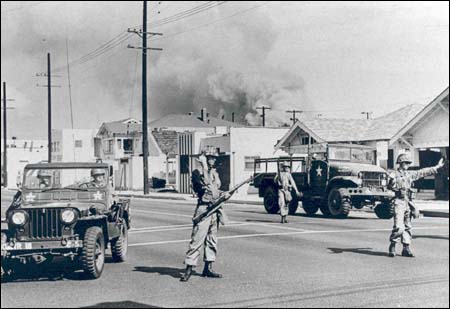
The new civil rights laws ended most legal discrimination against African Americans, though informal racism remained. In the mid-1960s, the Black power movement emerged, criticizing leaders of the civil rights movement for their moderate, incremental tendencies. A wave of civil unrest in Black communities between 1964 and 1969, which peaked in 1967 and after the assassination of King in 1968, weakened support for the movement from White moderates. Despite affirmative action and other programs that expanded opportunities for Black and other minorities in the U.S. by the early 21st century, racial gaps in income, housing, education, and criminal justice persist.
Background
American Civil War and Reconstruction era
Before the American Civil War, eight serving presidents enslaved people, almost four million black people remained enslaved in the South, generally only white men with property could vote, and the Naturalization Act of 1790 limited U.S. citizenship to whites. Following the Civil War, three constitutional amendments were passed, including the 13th Amendment (1865) that ended slavery; the 14th Amendment (1869) that gave black people citizenship, adding their total for Congressional apportionment; and the 15th Amendment (1870) that gave black males the right to vote (only males could vote in the U.S. at the time). From 1865 to 1877, the United States underwent a turbulent Reconstruction era during which the federal government tried to establish free labor and the civil rights of freedmen in the South after the end of slavery. Many whites resisted the social changes, leading to the formation of insurgent movements such as the Ku Klux Klan (KKK), whose members attacked black and white Republicans to maintain white supremacy. In 1871, President Ulysses S. Grant, the U.S. Army, and U.S. Attorney General Amos T. Akerman, initiated a campaign to repress the KKK under the Enforcement Acts. Some states were reluctant to enforce the federal measures of the act. In addition, by the early 1870s, other white supremacist and insurgent paramilitary groups arose that violently opposed African-American legal equality and suffrage, intimidating and suppressing black voters, and assassinating Republican officeholders. However, if the states failed to implement the acts, the laws allowed the Federal Government to get involved. Many Republican governors were afraid of sending black militia troops to fight the Klan for fear of war.
Disenfranchisement after Reconstruction
After the disputed election of 1876, which resulted in the end of Reconstruction and the withdrawal of federal troops, whites in the South regained political control of the region's state legislatures. They continued to intimidate and violently attack Black people before and during elections to suppress their voting, but the last African Americans were elected to Congress from the South before the disenfranchisement of Black people by states throughout the region, as described below.
From 1890 to 1908, southern states passed new constitutions and laws to disenfranchise African Americans and many Poor Whites by creating barriers to voter registration; voting rolls were dramatically reduced as Black people and poor whites were forced out of electoral politics. After the landmark Supreme Court case of Smith v. Allwright (1944), which prohibited white primaries, progress was made in increasing black political participation in the Rim South and Acadiana – although almost entirely in urban areas and a few rural localities where most Black people worked outside plantations. The status quo ante of excluding African Americans from the political system lasted in the remainder of the South, especially North Louisiana, Mississippi and Alabama, until national civil rights legislation was passed in the mid-1960s to provide federal enforcement of constitutional voting rights. For more than sixty years, Black people in the South were essentially excluded from politics, unable to elect anyone to represent their interests in Congress or local government. Since they could not vote, they could not serve on local juries.
During this period, the white-dominated Democratic Party maintained political control of the South. With whites controlling all the seats representing the total population of the South, they had a powerful voting bloc in Congress. The Republican Party—the "party of Lincoln" and the party to which most Black people had belonged—shrank to insignificance except in remote Unionist areas of Appalachia and the Ozarks as black voter registration was suppressed. The Republican lily-white movement also gained strength by excluding Black people. Until 1965, the "Solid South" was a one-party system under the white Democrats. Excepting the previously noted historic Unionist strongholds the Democratic Party nomination was tantamount to election for state and local office. In 1901, President Theodore Roosevelt invited Booker T. Washington, president of the Tuskegee Institute, to dine at the White House, making him the first African American to attend an official dinner there. "The invitation was roundly criticized by southern politicians and newspapers." Washington persuaded the president to appoint more Black people to federal posts in the South and to try to boost African-American leadership in state Republican organizations. However, these actions were resisted by both white Democrats and white Republicans as an unwanted federal intrusion into state politics.
During the same time as African Americans were being disenfranchised, white southerners imposed racial segregation by law. Violence against Black people increased, with numerous lynchings through the turn of the century. The system of de jure state-sanctioned racial discrimination and oppression that emerged from the post-Reconstruction South became known as the "Jim Crow" system. The United States Supreme Court, composed almost entirely of Northerners, upheld the constitutionality of state laws requiring racial segregation in public facilities in its 1896 decision Plessy v. Ferguson, thereby legitimizing them through the "separate but equal" doctrine. Segregation, which began with slavery, continued with Jim Crow laws, with signs used to show Black people where they could legally walk, talk, drink, rest, or eat. For those places that were racially mixed, non-whites had to wait until all white customers were served first. Elected in 1912, President Woodrow Wilson gave in to demands by Southern members of his cabinet who ordered segregation of workplaces in the federal government.

The early 20th century is a period often referred to as the "nadir of American race relations", when the number of lynchings was highest. While tensions and civil rights violations were most intense in the South, social discrimination affected African Americans in other regions as well. At the national level, the Southern bloc controlled important committees in Congress, defeated passage of federal laws against lynching, and exercised considerable power beyond the number of whites in the South.
Characteristics of the post-Reconstruction period:
Racial segregation. By law, public facilities and government services such as education were divided into separate "white" and "colored" domains. Characteristically, those for colored people were underfunded and of inferior quality.

Disenfranchisement. When white Democrats regained power, they passed laws that made voter registration more restrictive, essentially forcing black voters off the voting rolls. The number of African-American voters dropped dramatically, and they were no longer able to elect representatives. From 1890 to 1908, Southern states of the former Confederacy created constitutions with provisions that disfranchised tens of thousands of African Americans, and U.S. states such as Alabama disenfranchised poor whites as well.
Exploitation. Increased economic oppression of Black people through the convict lease system, denial of economic opportunities, and widespread employment discrimination.
Violence. Individual, police, paramilitary, organizational, and mob racial violence against Black people.

African Americans rejected this regime. They resisted it in numerous ways and sought better opportunities through lawsuits, new organizations, political redress, and labor organizing (see the Civil rights movement (1896–1954)). The National Association for the Advancement of Colored People (NAACP) was founded in 1909. It fought to end racial discrimination through litigation, education, and lobbying efforts. Its crowning achievement was its legal victory in the Supreme Court decision Brown v. Board of Education (1954), when the Supreme Court ruled that segregation of public schools in the US was unconstitutional and, by implication, overturned the "separate but equal" doctrine established in Plessy v. Ferguson of 1896. Following the unanimous Supreme Court ruling, many states began to integrate their schools gradually, but some areas of the South resisted by closing public schools altogether.
The integration of Southern public libraries followed demonstrations and protests that used techniques seen in other elements of the larger civil rights movement. This included sit-ins, beatings, and white resistance. For example, in 1963 in the city of Anniston, Alabama, two black ministers were brutally beaten for attempting to integrate the public library. Though there was resistance and violence, the integration of libraries was generally quicker than the integration of other public institutions.
National issues
The situation for Black people outside of the South was somewhat better (in most states, they could vote and have their children educated, though they still faced discrimination in housing and jobs). In 1900, Reverend Matthew Anderson, speaking at the annual Hampton Negro Conference in Virginia, said that "...the lines along most of the avenues of wage-earning are more rigidly drawn in the North than in the South. There seems to be an apparent effort throughout the North, especially in the cities to debar the colored worker from all the avenues of higher remunerative labor, which makes it more difficult to improve his economic condition even than in the South." From 1910 to 1970, Black people sought better lives by migrating north and west out of the South. A total of nearly seven million Black people left the South in what was known as the Great Migration, most during and after World War II. So many people migrated that the demographics of some previously black-majority states changed to a white majority (in combination with other developments). The rapid influx of Black people altered the demographics of Northern and Western cities; happening at a period of expanded European, Hispanic, and Asian immigration, it added to social competition and tensions, with the new migrants and immigrants battling for a place in jobs and housing.
Reflecting social tensions after World War I, as veterans struggled to return to the workforce and labor unions were organizing, the Red Summer of 1919 was marked by hundreds of deaths and higher casualties across the U.S. as a result of white race riots against Black people that took place in more than three dozen cities. Urban problems such as crime and disease were blamed on the large influx of Southern Black people to cities in the north and west, based on stereotypes of rural southern African-Americans. Overall, Black people in Northern and Western cities experienced systemic discrimination in a plethora of aspects of life. Within employment, economic opportunities for Black people were limited to the lowest status and restrictive in potential mobility. Within the housing market, stronger discriminatory measures were used in correlation to the influx, resulting in a mix of "targeted violence, restrictive covenants, redlining and racial steering". The Great Migration resulted in many African Americans becoming urbanized, and they began to realign from the Republican to the Democratic Party, especially because of opportunities under the New Deal of the Franklin D. Roosevelt administration during the Great Depression in the 1930s. Substantially under pressure from African-American supporters who began the March on Washington Movement, President Roosevelt issued the first federal order banning discrimination and created the Fair Employment Practice Committee. After both World Wars, black military veterans pressed for full civil rights and often led activist movements. In 1948, President Harry Truman issued Executive Order 9981, which ended segregation in the military.
Housing segregation became a nationwide problem following the Great Migration of black people out of the South. Racial covenants were employed by many real estate developers to "protect" entire subdivisions, with the primary intent to keep "white" neighborhoods "white". Ninety percent of the housing projects built in the years following World War II were racially restricted by such covenants. Cities known for their widespread use of racial covenants include Chicago, Baltimore, Detroit, Milwaukee, Los Angeles, Seattle, and St. Louis.
Said premises shall not be rented, leased, or conveyed to, or occupied by, any person other than of the white or Caucasian race.
While many whites defended their space with violence, intimidation, or legal tactics toward black people, many other whites migrated to more racially homogeneous suburban or exurban regions, a process known as white flight. From the 1930s to the 1960s, the National Association of Real Estate Boards (NAREB) issued guidelines that specified that a realtor "should never be instrumental in introducing to a neighborhood a character or property or occupancy, members of any race or nationality, or any individual whose presence will be clearly detrimental to property values in a neighborhood." The result was the development of all-black ghettos in the North and West, where much housing was older, as well as South.
The first anti-miscegenation law was passed by the Maryland General Assembly in 1691, criminalizing interracial marriage. In a speech in Charleston, Illinois in 1858, Abraham Lincoln stated, "I am not, nor ever have been in favor of making voters or jurors of negroes, nor of qualifying them to hold office, nor to intermarry with white people". By the late 1800s, 38 US states had anti-miscegenation statutes. By 1924, the ban on interracial marriage was still in force in 29 states. While interracial marriage had been legal in California since 1948, in 1957, actor Sammy Davis Jr. faced a backlash for his involvement with white actress Kim Novak. Davis briefly married a black dancer in 1958 to protect himself from mob violence. In 1958, officers in Virginia entered the home of Mildred and Richard Loving and dragged them out of bed for living together as an interracial couple, on the basis that "any white person intermarry with a colored person"— or vice versa—each party "shall be guilty of a felony" and face prison terms of five years.
Invigorated by the victory of Brown and frustrated by the lack of immediate practical effect, private citizens increasingly rejected gradualist, legalistic approaches as the primary tool to bring about desegregation. They were faced with "massive resistance" in the South by proponents of racial segregation and voter suppression. In defiance, African-American activists adopted a combined strategy of direct action, nonviolence, nonviolent resistance, and many events described as civil disobedience, giving rise to the civil rights movement of 1954 to 1968.
A. Philip Randolph had planned a march on Washington, D.C., in 1941 to support demands for elimination of employment discrimination in the defense industry; he called off the march when the Roosevelt administration met the demand by issuing Executive Order 8802, which barred racial discrimination and created an agency to oversee compliance with the order.
Protests begin
The strategy of public education, legislative lobbying, and litigation that had typified the civil rights movement during the first half of the 20th century broadened after Brown to a strategy that emphasized nonviolent "direct action": economic boycotts, sit-ins, Freedom Rides, marches or walks, and similar tactics that relied on mass mobilization, nonviolent resistance, standing in line, and, at times, civil disobedience.
Churches, local grassroots organizations, fraternal societies, and black-owned businesses mobilized volunteers to participate in broad-based actions. This was a more direct and potentially more rapid means of creating change than the traditional approach of mounting court challenges used by the NAACP and others.
In 1952, the Regional Council of Negro Leadership (RCNL), led by T. R. M. Howard, a black surgeon, entrepreneur, and planter, organized a successful boycott of gas stations in Mississippi that refused to provide restrooms for Black people. Through the RCNL, Howard led campaigns to expose brutality by the Mississippi state highway patrol and to encourage Black people to make deposits in the black-owned Tri-State Bank of Nashville which, in turn, gave loans to civil rights activists who were victims of a "credit squeeze" by the White Citizens' Councils.
After Claudette Colvin was arrested for refusing to give up her seat on a Montgomery, Alabama bus in March 1955, a bus boycott was considered but rejected. But when Rosa Parks was arrested in December, Jo Ann Gibson Robinson of the Montgomery Women's Political Council launched the bus boycott. Late that night, she, John Cannon (chairman of the Business Department at Alabama State University), and others mimeographed and distributed thousands of leaflets calling for a boycott. The eventual success of the boycott made its spokesman Martin Luther King Jr., a nationally known figure. It also inspired other bus boycotts, such as the successful Tallahassee, Florida boycott of 1956–57. This movement also sparked the 1956 Sugar Bowl riots in Atlanta which later became a major organizing center of the civil rights movement, with Martin Luther King Jr.
In 1957, King and Ralph Abernathy, the leaders of the Montgomery Improvement Association, joined with other church leaders who had led similar boycott efforts, such as C. K. Steele of Tallahassee and T. J. Jemison of Baton Rouge, and other activists such as Fred Shuttlesworth, Ella Baker, A. Philip Randolph, Bayard Rustin and Stanley Levison, to form the Southern Christian Leadership Conference (SCLC). The SCLC, headquartered in Atlanta, Georgia, did not attempt to create a network of chapters as the NAACP did. It offered training and leadership assistance for local efforts to fight segregation. The headquarters organization raised funds, mostly from Northern sources, to support such campaigns. It made nonviolence both its central tenet and its primary method of confronting racism.
In 1959, Septima Clarke, Bernice Robinson, and Esau Jenkins, with the help of Myles Horton's Highlander Folk School in Tennessee, began the first Citizenship Schools in South Carolina's Sea Islands. They taught literacy to help Black people pass literacy tests. The program was an enormous success and tripled the number of black voters on Johns Island. SCLC took over the program and duplicated its results elsewhere.
History
Brown v. Board of Education, 1954
In the spring of 1951, black students in Virginia protested their unequal status in the state's segregated educational system. Students at Moton High School protested the overcrowded conditions and failing facility. Some local leaders of the NAACP had tried to persuade the students to back down from their protest against the Jim Crow laws of school segregation. When the students did not budge, the NAACP joined their battle against school segregation. The NAACP proceeded with five cases challenging the school systems; these were later combined under what is known today as Brown v. Board of Education. Under the leadership of Walter Reuther, the United Auto Workers donated $75,000 to help pay for the NAACP's efforts at the Supreme Court.
On May 17, 1954, the U.S. Supreme Court under Chief Justice Earl Warren ruled unanimously in Brown v. Board of Education of Topeka, Kansas, that mandating, or even permitting, public schools to be segregated by race was unconstitutional. Chief Justice Warren wrote in the court majority opinion that
Segregation of white and colored children in public schools has a detrimental effect upon the colored children. The impact is greater when it has the sanction of the law; for the policy of separating the races is usually interpreted as denoting the inferiority of the Negro group.
The lawyers from the NAACP had to gather credible evidence to win the case of Brown vs. Board of Education. Their approach to addressing school segregation was to present several arguments. One pertained to having exposure to interracial contact in a school environment. It was argued that interracial contact would, in turn, help prepare children to live with the pressures that society exerts regarding race and thereby afford them a better chance of living in a democracy. In addition, another argument emphasized how "'education' comprehends the entire process of developing and training the mental, physical and moral powers and capabilities of human beings".
Risa Goluboff wrote that the NAACP intended to show the Courts that African American children were the victims of school segregation and their futures were at risk. The Court ruled that both Plessy v. Ferguson (1896), which had established the "separate but equal" standard in general, and Cumming v. Richmond County Board of Education (1899), which had applied that standard to schools, were unconstitutional.
The federal government filed a friend of the court brief in the case, urging the justices to consider the effect that segregation had on America's image in the Cold War. Secretary of State Dean Acheson was quoted in the brief stating that "The United States is under constant attack in the foreign press, over the foreign radio, and in such international bodies as the United Nations because of various practices of discrimination in this country."
The following year, in the case known as Brown II, the Court ordered segregation to be phased out over time, "with all deliberate speed". Brown v. Board of Education of Topeka, Kansas (1954) did not overturn Plessy v. Ferguson (1896). Plessy v. Ferguson was segregation in transportation modes. Brown v. Board of Education dealt with segregation in education. Brown v. Board of Education did set in motion the future overturning of 'separate but equal'.
On May 18, 1954, Greensboro, North Carolina, became the first city in the South to publicly announce that it would abide by the Supreme Court's Brown v. Board of Education ruling. "It is unthinkable,' remarked School Board Superintendent Benjamin Smith, 'that we will try to [override] the laws of the United States." This positive reception for Brown, together with the appointment of African American David Jones to the school board in 1953, convinced numerous white and black citizens that Greensboro was heading in a progressive direction. Integration in Greensboro occurred rather peacefully compared to the process in Southern states such as Alabama, Arkansas, and Virginia, where "massive resistance" was practiced by top officials and throughout the states. In Virginia, some counties closed their public schools rather than integrate, and many white Christian private schools were founded to accommodate students who used to go to public schools. Even in Greensboro, much local resistance to desegregation continued, and in 1969, the federal government found the city was not in compliance with the 1964 Civil Rights Act. Transition to a fully integrated school system did not begin until 1971.
Many Northern cities also had de facto segregation policies, which resulted in a vast gulf in educational resources between black and white communities. In Harlem, New York, for example, neither a single new school was built since the turn of the century, nor did a single nursery school exist – even as the Second Great Migration was causing overcrowding. Existing schools tended to be dilapidated and staffed with inexperienced teachers. Brown helped stimulate activism among New York City parents like Mae Mallory who, with the support of the NAACP, initiated a successful lawsuit against the city and state on Brown's principles. Mallory and thousands of other parents bolstered the pressure on the school with a boycott in 1959. During the boycott, some of the first freedom schools were established. The city responded to the campaign by permitting more open transfers to high-quality, historically white schools. (New York's African-American community, and Northern desegregation activists generally, now found themselves contending with the problem of white flight, however.)
Emmett Till's murder, 1955
Emmett Till, a 14-year-old African American from Chicago, visited his relatives in Money, Mississippi, for the summer. He allegedly had an interaction with a white woman, Carolyn Bryant, in a small grocery store that violated the norms of Mississippi culture, and Bryant's husband, Roy, and his half-brother, J. W. Milam, brutally murdered young Emmett Till. They beat and mutilated him before shooting him in the head and sinking his body in the Tallahatchie River. Three days later, Till's body was discovered and retrieved from the river. After Emmett's mother, Mamie Till, came to identify the remains of her son, she decided she wanted to "let the people see what I have seen". Till's mother then had his body taken back to Chicago where she had it displayed in an open casket during the funeral services where many thousands of visitors arrived to show their respects. A later publication of an image at the funeral in Jet is credited as a crucial moment in the civil rights era for displaying in vivid detail the violent racism that was being directed at black people in America. In a column for The Atlantic, Vann R. Newkirk wrote: "The trial of his killers became a pageant illuminating the tyranny of white supremacy". The state of Mississippi tried two defendants, but they were speedily acquitted by an all-white jury.
"Emmett's murder," historian Tim Tyson writes, "would never have become a watershed historical moment without Mamie finding the strength to make her private grief a public matter." The visceral response to his mother's decision to have an open-casket funeral mobilized the black community throughout the U.S. The murder and resulting trial ended up markedly impacting the views of several young black activists. Joyce Ladner referred to such activists as the "Emmett Till generation." One hundred days after Emmett Till's murder, Rosa Parks refused to give up her seat on the bus in Montgomery, Alabama. Parks later informed Till's mother that her decision to stay in her seat was guided by the image she still vividly recalled of Till's brutalized remains. The glass-topped casket that was used for Till's Chicago funeral was found in a cemetery garage in 2009. Till had been reburied in a different casket after being exhumed in 2005. Till's family decided to donate the original casket to the Smithsonian's National Museum of African American Culture and History, where it is now on display. In 2007, Bryant said that she had fabricated the most sensational part of her story in 1955.
Rosa Parks and the Montgomery bus boycott, 1955–1956
On December 1, 1955, nine months after a 15-year-old high school student, Claudette Colvin, refused to give up her seat to a white passenger on a public bus in Montgomery, Alabama, and was arrested, Rosa Parks did the same thing. Parks soon became the symbol of the resulting Montgomery bus boycott and received national publicity. She was later hailed as the "mother of the civil rights movement".
Parks was secretary of the Montgomery NAACP chapter and had recently returned from a meeting at the Highlander Folk School in Tennessee, where nonviolence as a strategy was taught by Myles Horton and others. After Parks' arrest, African Americans organized the Montgomery bus boycott to demand equal treatment on buses. The organization was led by Jo Ann Robinson, a member of the Women's Political Council who had been waiting for the opportunity to boycott the bus system. Following Rosa Parks' arrest, Jo Ann Robinson mimeographed 52,500 leaflets calling for a boycott. They were distributed around the city and helped gather the attention of civil rights leaders. After the city rejected many of its suggested reforms, the NAACP, led by E. D. Nixon, pushed for full desegregation of public buses. With the support of most of Montgomery's 50,000 African Americans, the boycott lasted for 381 days, until the local ordinance segregating African Americans and whites on public buses was repealed. 90% of African Americans in Montgomery participated in the boycotts, which significantly reduced bus revenue because they comprised the majority of riders. This movement also sparked riots leading up to the 1956 Sugar Bowl. In November 1956, the United States Supreme Court upheld a district court ruling in the case of Browder v. Gayle and ordered Montgomery's buses desegregated, ending the boycott.
Local leaders established the Montgomery Improvement Association to focus their efforts. Martin Luther King Jr. was elected President of this organization. The lengthy protest attracted national attention for him and the city. His eloquent appeals to Christian brotherhood and American idealism created a positive impression on people both inside and outside the South.
Little Rock Nine, 1957
The Little Rock Nine were a group of nine students who attended segregated black high schools in Little Rock, the capital of Arkansas. They each volunteered when the NAACP and the national civil rights movement obtained federal court orders to integrate the prestigious Little Rock Central High School in September, 1957. The Nine faced intense harassment and threats of violence from white parents and students, as well as organized white supremacist groups. The enraged opposition emphasized miscegenation as a threat to white society. Arkansas Governor, Orval Faubus, claiming his only goal was to preserve the peace, deployed the Arkansas National Guard to prevent the black students from entering the school. Faubus defied federal court orders, whereupon President Dwight D. Eisenhower intervened. He federalized the Arkansas National Guard and sent them home. Then he sent in an elite Army unit to escort the students to school and protect them between classes during the 1957–58 school year. In class, however, the Nine were teased and ridiculed every day. In the city, compromise efforts all failed, and political tensions continued to fester. A year later, in September 1958, the Supreme Court ruled that all the city's high schools had to be integrated immediately. Governor Faubus and the legislature responded by immediately closing all the city's public high schools for the entire 1958–1959 school year, despite the harm it caused to all the students. The decision to integrate the school was a landmark event in the civil rights movement, and the students' bravery and determination in the face of violent opposition are remembered as a key moment in American history. The city and state were entangled in very expensive legal disputes for decades, while suffering a reputation for hatred and obstruction.
Method of nonviolence and nonviolence training
During the period considered the "African-American civil rights" era, the predominant form of protest was nonviolent, or peaceful. Often referred to as pacifism, the method of nonviolence is considered to be an attempt to impact society positively. Although acts of racial discrimination have occurred historically throughout the United States, perhaps the most violent regions have been in the former Confederate states. During the 1950s and 1960s, the nonviolent protests of the civil rights movement sparked significant tension and drew national attention.
To prepare for protests, both physically and psychologically, demonstrators received nonviolence training. According to former civil rights activist Bruce Hartford, there are two main components of nonviolence training. There is the philosophical method, which involves understanding the method of nonviolence and why it is considered useful; there is the tactical method, which ultimately teaches demonstrators "how to be a protestor—how to sit-in, how to picket, how to defend yourself against attack, giving training on how to remain cool when people are screaming racist insults into your face and pouring stuff on you and hitting you" (Civil Rights Movement Archive). The philosophical basis of the practice of nonviolence in the American civil rights movement was largely inspired by Mahatma Gandhi's "non-cooperation" policies during his involvement in the Indian independence movement, which were intended to gain attention so that the public would either "intervene in advance" or "provide public pressure in support of the action to be taken" (Erikson, 415). As Hartford explains it, philosophical nonviolence training aims to "shape the individual person's attitude and mental response to crises and violence" (Civil Rights Movement Archive). Hartford and activists like him, who trained in tactical nonviolence, considered it necessary to ensure physical safety, instill discipline, teach demonstrators how to demonstrate, and form confidence among demonstrators (Civil Rights Movement Archive).
For many, the concept of nonviolent protest was a way of life, a culture. However, not everyone agreed with this notion. James Forman, former SNCC (and later Black Panther) member and nonviolence trainer, was among those who did not. In his autobiography, The Making of Black Revolutionaries, Forman revealed his perspective on nonviolence as "strictly a tactic, not a way of life without limitations." Similarly, Bob Moses, who was also an active member of the SNCC, believed that nonviolence was practical. When interviewed by author Robert Penn Warren, Moses said "There's no question that he (Martin Luther King Jr.) had a great deal of influence with the masses. But I don't think it's in the direction of love. It's in a practical direction … ." (Who Speaks for the Negro? Warren).