
The Chevrolet Caprice is a full-size car produced by Chevrolet in North America from 1965 through the 1996 model years. All versions of the full-size Chevrolet models reached their peak in 1965, with over a million units sold. It was the most popular car in the U.S. in the 1960s and early 1970s, during a time when its production also included the Biscayne, Bel Air, and Impala trims.
Introduced in mid-1965 as a luxury trim package for the Impala four-door hardtop, Chevrolet offered a complete line of Caprice body style versions for the 1966 and subsequent model years, including a "formal hardtop" coupe and a station wagon. The 1971 through 1976 models are the largest Chevrolets built. The downsized 1977 and restyled 1991 models were awarded Motor Trend Car of the Year. Production ended in 1996.
From 2011 until 2017, the Caprice nameplate returned to North America as a full-size, rear wheel drive police vehicle, a captive import from Australia, built by General Motors' subsidiary Holden. The police vehicle is a rebadged version of the Holden WM/WN Caprice. The nameplate also had a civilian and police presence in the Middle East from 1999 until 2017, where the imported Holden Statesman/Caprice built by Holden was marketed as the Chevrolet Caprice in markets that included Saudi Arabia and the UAE.
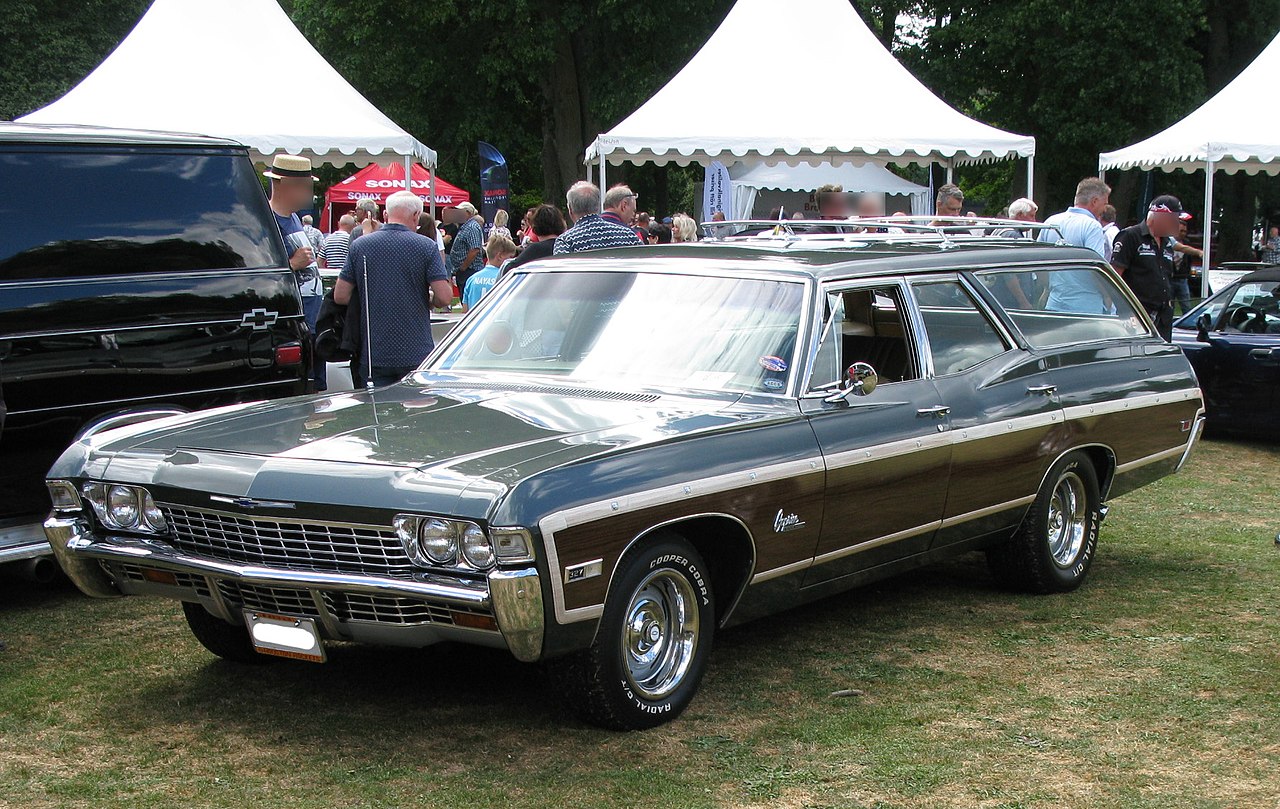
Early history
Differing accounts explain the origin of the Caprice name, including that the nameplate was given by Bob Lund, Chevrolet's General Sales Manager, after a classy restaurant he frequented in New York City. Another says the car was named after Caprice Chapman, the daughter of auto executive James P. Chapman.
A Caprice Custom Sedan option package (RPO Z18) was offered on the 1965 Chevrolet Impala 4-door hardtop, adding US$200 (equivalent to $2,043 in 2025) to the US$2,742 (equivalent to $28,014 in 2025) price tag. The Caprice option included a heavier frame, suspension changes, black-accented front grille and rear trim panel with Caprice nameplate, slender body sill moldings, Fleur-de-lis roof quarter emblems, color-keyed bodyside stripes and Caprice hood and dash emblems. Full wheel covers were the same as that year's Super Sport, but a Chevy bowtie emblem replaced the "SS" emblem in the spinner's center. The Super Sport's blackout rear trim panel was also used, but without the "Impala SS" nameplate. The interior featured a higher-grade cloth and vinyl seat and door trim (as well as thicker, higher-grade carpeting), faux walnut trim on the dashboard and door panels, pull straps on the doors, and extra convenience lights. A full vinyl roof was optional. A 283 cu in (4.6 L), 195 hp (145 kW) V8 engine was standard, as was a column-mounted shifter for the three-speed manual transmission.
The Caprice was intended to compete with the Ford LTD, Plymouth VIP, and AMC's Ambassador DPL. These models included luxuriously upholstered interiors with simulated wood dashboard and door-panel trim, thicker carpeting, sound insulation, courtesy lighting, and more upscale exterior trims.
First generation (1966–1970)
1966
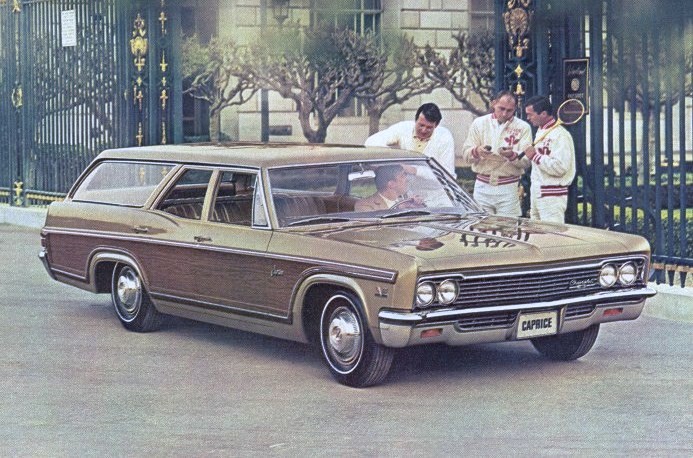
Caprice gained series status for the 1966 model year and was positioned as the top-line full-size Chevrolet. It included a four-door hardtop, six- or nine-passenger station wagon, and a two-door hardtop with a squared-off formal roofline in contrast to the Impala/SS Sport Coupe's fastback roof styling. All four Caprice models were marketed as "Caprice Custom."
The Caprice Custom Estate, a new station wagon model with simulated woodgrain exterior trim was the first Chevrolet with such a design since its real woodie wagon was offered in 1954 on the Chevrolet Bel Air. All wagons included an all-vinyl upholstered two-row bench seat interior with an optional third rear-facing seat for two. The Custom Estate became the full-sized station wagon when the Buick LeSabre Estate was discontinued in 1964. The 283 cu in (4.6 L) V8 engine was standard for Caprice models with the 325 hp (242 kW), 396 cu in (6.5 L) "Turbo Jet" V8 optional. It was possible to have Regular Production Option (RPO) L72, 425 hp (317 kW) 427 cu in (7.0 L) Turbo Jet V8 with solid lifters, special camshaft and carburetor, and 11 to 1 compression. An automatic transmission, power steering, white sidewall tires, and a vinyl top (on the hardtops) were extra-cost options, but most were built with them. Additionally, air conditioning, power windows, Cruise-Master speed control, power seats, an automatic headlight dimmer (1965 only) and stereo radios were available. The standard transmission was a Synchro-Mesh three-speed manual, mounted on the steering column. It remained standard throughout this generation.
The 1966 Caprice featured a revised grille and front bumper, and new rectangular taillights which replaced the Chevrolet-traditional triple round taillights used on Impalas since 1958, with the exception of the 1959 model. Lenses and silver trim on Caprices differed slightly from the other full-sized models. Sedans and coupe models included luxurious cloth and vinyl bench seats with a folding center armrest in the rear seat. Optional on both was a "Strato bench" seat which combined bucket-style seat backs and a center armrest with a bench cushion for six-passenger seating. Caprices had unique standard wheel covers, although some of the optional wheels and wheel covers on full-sized models were optional.

New options included the "Comfortron" air conditioning system where the driver could set a constant year-round temperature. A "Tilt/Telescopic" steering wheel option could be adjusted vertically in six positions, as well as be telescoped farther out from the steering column. Coupes could also be ordered with an all-vinyl interior featuring Strato bucket seats and center console with floor shifter, storage compartment, courtesy lighting, and full instrumentation at the front end of the console that was integrated with the lower instrument panel.
The 1965-70 GM B platform is the fourth best-selling automobile platform in history after the Volkswagen Beetle, Ford Model T, and the Lada Riva.
1967–1968
The 1967 Caprice received a restyling with more rounded body lines and revised grilles and taillights, optional front fender corner lamps which illuminated with the headlamps, as well as a revised instrument panel with round instruments and a new steering wheel. Taillamp lenses were all red as the backup lamps were relocated into the rear bumper, unlike in the lesser full-size models that had their backup lamps in the center of the taillamps. A dual-master brake cylinder was now included, while front disc brakes were optional. Other new options included a stereo 8-track tape player, power door locks, and a fiber optic exterior light monitoring system. The same seating selections continued as before with revisions to trim patterns plus the new addition of all-vinyl upholstery as a no-cost option for conventional and Strato bench seats in sedans and coupes. Engines and transmission offerings were carried over from the previous year. The exception was that the optional 425 hp (317 kW), 427 cu in (7.0 L) Turbo Jet V8 was no longer listed, leaving the 385 hp (287 kW) 427 as the top engine. The three-speed Turbo Hydramatic transmission that previously only available with the 396 cu in (6.5 L) and 427 V8s was now optional with the 275 hp (205 kW) 327 cu in (5.4 L) Turbo Fire V8. As with all 1967 cars sold in the U.S., Caprices featured occupant protection safety features that included an energy-absorbing steering column, soft or recessed interior control knobs, and front outboard shoulder belt anchors.

The "100 millionth GM car" was a light blue metallic 1967 Caprice coupe. It was assembled on April 21, 1967, at the Janesville, Wisconsin plant. It was actually the 100 millionth GM car built in the United States; production including Canadian plants had actually passed the 100 million mark in March 1966, with an Oldsmobile Toronado being the car in question.
The 1968 Caprice received a minor facelift that included a new grille with taillights set into the bumper and optional hidden headlamps. Caprice coupes now came standard with the new Astro Ventilation system, which included extra vents in the dash, and the removal of vent (wing) windows. Side marker lamps became standard on all U.S. cars and the Caprice carried over the optional white corner marker lamps at the forward edge of the fenders in addition to the amber parking lamps which were illuminated with the headlights. All 1968 Chevrolets got front side marker lamps on the fender; cars with an optional engine were identified with its cubic inch displacement listed on half the bezel; the lamp itself occupied the other half. The fiber optics monitoring system was offered again as an option. The Caprice Coupe got serious competition when Chevrolet offered the car's formal roofline in the Impala series as well. The Impala Custom Coupe became the best-selling model in the line. The L72 427 cu in (7.0 L) 425 hp (320 kW) Turbo-Jet V8 returned to the option list after a one-year hiatus. A new 307 cu in (5.0 L) Turbo Fire V8 rated at 200 hp (150 kW) replaced the 195 hp (145 kW) 283 cu in (4.6 L) small block as the standard engine. Inside, the instrument panel was revised with a return to the horizontal sweep speedometer and a revised three-spoke steering wheel. An optional instrument cluster had a narrow speedometer within its opening and flanking it with engine-turned instruments in the place of warning lamps. The fuel gauge, placed next to the speedometer within its own pod in the base models, was moved to its new place next to the speedometer. A tachometer took the place of the fuel gauge in the large opening left by the fuel gauge.
1969–1970
The 1969 Caprice and other full-sized Chevrolets were restyled with new body lines and front bumpers that wrapped around the grille (again with optional concealed headlamps, for which washers could be added as a new "one year only" option) along with ventless front windows on all models. The 119-inch (3,023 mm) wheelbase, inner bodyshell and framework were carried over from the 1965 model. The station wagon was renamed the Kingswood Estate and continued to use exterior wood grain trim along with the interior trim of the Caprice sedans and coupes. Front seat headrests were now standard equipment to meet federal safety standards and the ignition switch moved from the dashboard to the steering column and also locked the steering wheel when the key was removed. This was part of a Federal mandate for the 1970 models, but introduced a year earlier on all General Motors cars except the Corvair.
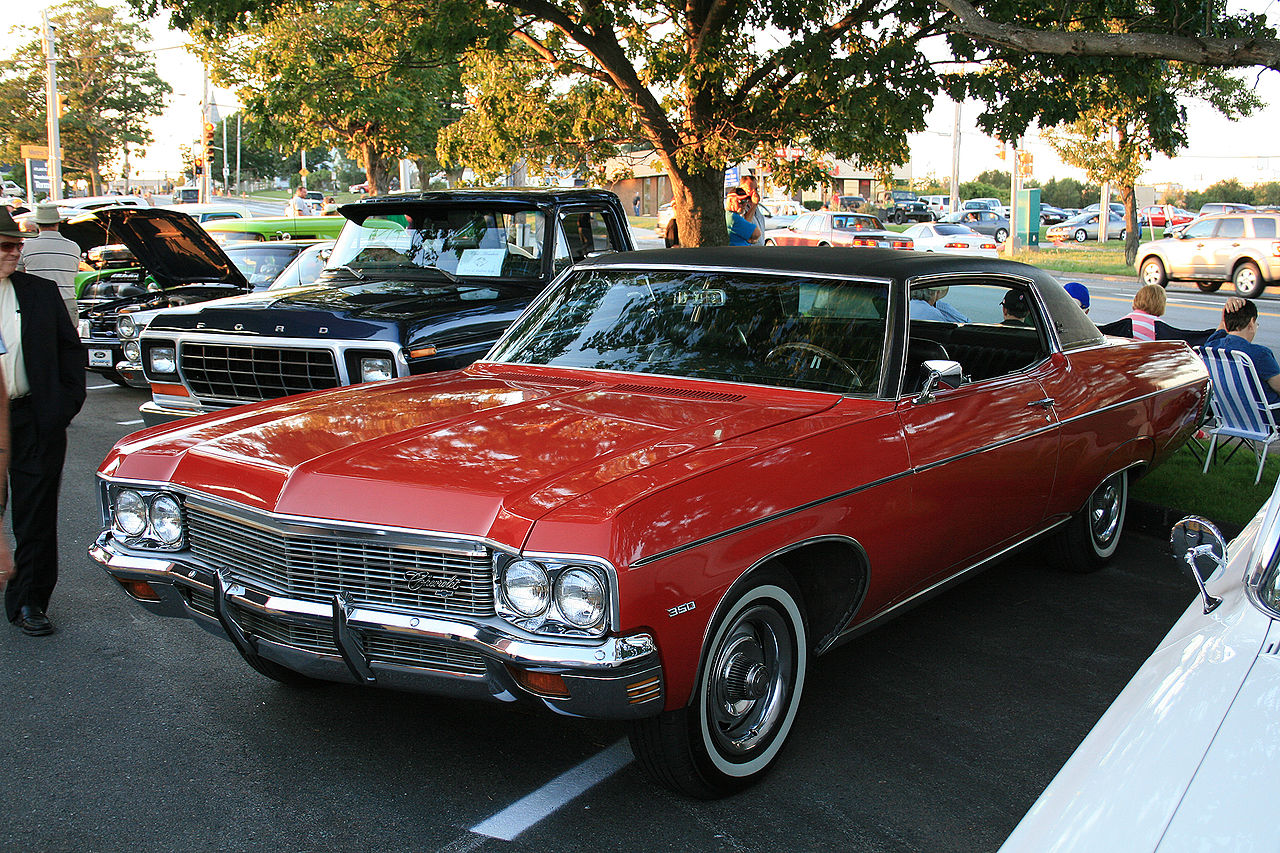
The 1969 Caprice also offered a new GM-designed variable-ratio power steering unit as optional equipment along with a seldom-ordered "Liquid Tire Chain" option, which was a vacuum activated button that would spray ice melt on the rear tires (UPC option code is "V75"). The standard engine was enlarged to a 235 hp (175 kW) 327 cu in (5.4 L) V8 with optional engine choices including a new 350 cu in (5.7 L) Turbo Fire V8 in 255 or 300 hp (190 or 224 kW) versions, a 265 hp (198 kW) 396 cu in (6.5 L) cubic-inch Turbo Jet V8, as well as a 427 cu in (7.0 L) Turbo Jet V8s rated at 335 hp (250 kW) or 390 hp (291 kW). All V8 engines were now available with the three-speed Turbo Hydramatic transmission for the first time though the two-speed Powerglide was still offered with the 327 and 350 V8s.
The 1970 Caprice received a minor facelift featuring a more conventional under the grille bumper replacing the wrap-around unit used in 1969, along with new triple vertical taillamps in the rear bumper. Power front disc brakes and fiberglass-belted tires on 15-inch wheels were made standard equipment along with a 250 hp (186 kW), 350 cubic-inch Turbo Fire V8. Optional V8s included a 300 hp (224 kW) 350 and a new 265 hp (198 kW) 400 cu in (6.6 L) Turbo Fire V8. The top engine was a new 454 cu in (7.4 L) Turbo Jet V8 offered in 345 hp (257 kW) or 390 hp (291 kW) versions. Both the 250- and 265-hp Turbo Fire engines were designed to use regular gasoline while the 300 hp (224 kW) 350 Turbo Fire and both 454 Turbo Jet engines required premium fuel. A three-speed manual transmission with column shift was standard equipment as in previous years but the floor-mounted four-speed manual with Hurst shifter was dropped from the option list for 1970 as were the Strato bucket seats and center console previously offered on coupes. Automatic transmission options included the two-speed Powerglide on 350 V8s and Turbo Hydra-Matic with all engines.
Second generation (1971–1976)
1971–1972
For 1971 the top-of-the-line Caprice was completely redesigned on a longer 121.5-inch (3,090 mm) wheelbase and featured bold, Chrysler-like fuselage styling. Flush exterior door handles and double-shell roofs were new on the Caprice – both features first appearing on the 1970½ Camaro and Pontiac Firebird. The new styling was highlighted by a Cadillac-like "egg-crate" grille with a "Caprice" emblem in the center and brushed metal trim surrounding the taillights on the rear deck. The "Full-Perimeter" frame and all-coil suspension were refined for improvements in ride and noise reduction.

Inside were revised interiors featuring a two-spoke cushioned steering wheel and new instrument panel with horizontal sweep speedometer and instrument placement similar to previous full-sized Chevrolets. Caprices continued with higher grade interiors than their Impala counterparts with luxurious cloth-and-vinyl upholstery, wood grain trim on the dash, steering wheel, and door panels as well as carpeting on lower door panels on both sedans and coupes. A center front seat armrest was also featured on sedans.
Station wagons now used a unique 125-inch (3,200 mm) wheelbase and were larger than ever before. Station wagons continued to use unique model names. The Kingswood Estate wagon was considered to be equivalent to the Chevrolet Caprice being the top-level wagon. Unlike previous years, station wagons had unique rear suspension using a solid axle with leaf springs as opposed to coil springs and trailing arms on sedans and coupes.
Wagons featured a "clamshell" design marketed as the Glide-away tailgate, also called a "disappearing" tailgate because when open, the tailgate was completely out of view. On the clamshell design, the rear power-operated glass slid up into the roof and the lower tailgate (with either manual or optional power operation), lowered completely below the load floor. The manual lower tailgate was counterbalanced by a torque rod similar to the torque rods used in holding a trunk lid open, requiring a 35 lb push to fully lower the gate. Raising the manual gate required a 5 lb pull via a handhold integral to the top edge of the retractable gate. The power operation of both upper glass and lower tailgate became standard equipment in later model years. Wagons with the design featured an optional third row of forward-facing seats accessed by the rear side doors and a folding second-row seat — and could accommodate a 4 ft × 8 ft (1.2 m × 2.4 m) sheet of building material with rear seats folded. The clamshell design required no increased footprint or operational area to open, allowing a user to stand at the cargo opening without the impediment of a door — for example, in a closed garage.
The Kingswood Estate had the 400 cu in (6.6 L) two-barrel engine as standard with the same engine options as the coupes and sedans. Station wagon models came only with single exhaust systems which meant lesser power ratings than coupes and sedans.
Power front disc brakes were standard equipment, along with a larger 255 hp (190 kW) gross (170 hp (127 kW) net) 400 cubic-inch Turbo Fire V8. This engine, along with all optional power plants, was designed to run on regular leaded, low-lead or unleaded gasoline of 91 research octane or higher. To achieve this, all engines had the compression ratios lowered to 8.5:1. General Motors was the first of the big three to have all engines run on regular fuel and these changes were made to help meet the increasingly stringent emission regulations that were to come into place in years to come.
Optional engines included 300 horsepower (206 net) 402 cubic-inch Turbo Jet V8 (marketed as "Turbo Jet 400 on full-size cars, and as "Turbo Jet 396 on intermediate cars) and 365 hp (272 kW) gross (285 hp (213 kW) net) 454 Turbo Jet V8 which came standard with dual exhaust. When equipped with dual exhaust, the 400 Turbo Jet was rated at 260 hp (194 kW). At year's beginning, a three-speed manual transmission was standard when the model was introduced in the fall of 1970, although at mid-year, the Turbo Hydramatic transmission and variable-ratio power steering became standard equipment on all Caprice models and lower-line models fitted with a V8 engine.
Chevrolet specifications included both "gross" and "net" horsepower figures in 1971, which was a year before the industry-wide transition to SAE net horsepower figures. SAE net horsepower standardized horsepower ratings in accord with SAE standard J1349 figures to get a more accurate horsepower figure. "Net" horsepower was measured "as installed" in a vehicle with power using accessories and emission equipment installed, exhaust systems, and air cleaners, leading to lower power ratings. For 1971, the 400 Turbo-Jet engine was rated at 300 gross horsepower with and without dual exhaust, while the more accurate net figures show it rated at 206 hp (154 kW) with a single exhaust and 260 with dual exhaust. Beginning in 1972, automakers would follow SAE standard J1349 and the "net" horsepower ratings were the only advertised ratings.
In its May 1971 issue, Motor Trend magazine published a comparison road test that included a Caprice Coupe and a Cadillac Sedan de Ville. The tested Caprice was powered by the 454 V8 and loaded with virtually all available options. Though testers noted that the Cadillac had a higher level of quality than the Chevrolet along with a far more luxurious interior (the DeVille was upholstered in leather while the Caprice had the standard cloth trim), the magazine ultimately considered the Chevy as the better value at $5,550 compared to the Cadillac's $9,081 price mainly due to the fact the $3,500 price difference bought only a modest-quality addition and a few more luxury features.
The 1972 Caprice received a facelift with a revised grille that was lower in height than the '71 model flanked by a new bumper with increased protection one year ahead of the Federal mandate. This was done by a bumper within the bumper design. Heavy gauge beams reinforced the bumper and attached to the frame. The rear bumper also featured this design and now had the triple taillights now mounted in the bumper. Engine offerings were carried over from 1971 with the switch to "net" horsepower ratings including 170 hp (127 kW) for the standard two-barrel 400 cu in (6.6 L) Turbo Fire V8, 210 hp (157 kW) (240 hp (179 kW) with optional dual exhaust) for the four-barrel Turbo Jet 400 big-block V8 and 270 hp (201 kW) for the four-barrel dual exhaust 454 cu in (7.4 L) Turbo Jet V8 (rated at 230 hp (172 kW) in wagons with single exhaust). Turbo Hydramatic transmission, variable-ratio power steering and power front disc brakes continued as standard equipment. New to the Caprice lineup was a pillared four-door sedan. All models also featured a revised "Astro Ventilation" system utilizing vents in the doorjambs that replaced the troublesome 1971 version that used vents in the trunk lid and turned out to be a major source of complaints to Chevy (and other GM divisions) dealers from customers. 6-way power seats, 8-track tape players, and air conditioning were optional.
1973–1974
The Caprice models were renamed to Caprice Classic for the 1973 model year. The Kingswood Estate model with simulated wood-grain body side trim was now named the Caprice Estate. The convertible was moved from the Impala to the Caprice lineup for the first time in 1973.
The 1973 facelift included a new cross-hatch grille, 5 mph (8 km/h) energy-absorbing front bumper and revised square taillights, again mounted in the bumper. New emission standards added EGR (exhaust gas recirculation) valves to engines (with a new roller camshaft), and horsepower ratings were reduced. The standard Turbo-Fire 400 cu in (6.6 L) two-barrel was now rated at 150 hp (112 kW) while the only optional engine was the Turbo-Jet 454 cu in (7.4 L) V8 produced 245 hp (183 kW) with dual exhaust 215 hp (160 kW) with single exhaust used in station wagons. A new option on sedans and coupes was a 50/50 bench seat with recliner on the passenger side. The instrument panel and steering wheel were now offered in a variety of colors to harmonize the interior, and the wheel featured a new "soft-grip" rim. Front seats were also re-positioned to give more legroom for taller drivers, but shorter people found the driving position awkward.
The 1974 models featured a new formal, upright grille while turn signals moved from the bumper and were now inset of the dual headlights. The taillights were moved above the new 5 mph (8 km/h) rear bumper. New thick "B" pillars and fixed rear quarter opera windows were new on two-door coupes, which essentially eliminated pillar-less hardtop design much like the GM intermediates did the previous year. Other body styles including the four-door pillared and hardtop sedans, convertible and Estate Wagon were carried over with only minor changes from 1973. New to the engine roster was a four-barrel version of the small block 400 cubic-inch Turbo Fire V8 rated at 180 hp (134 kW) (which was the standard engine on wagons and all cars sold in California, optional on other models in 49 states). All other engines were carried over from 1973 although the 454 Turbo Jet lost 10 horsepower (7.5 kW), now rated at 235 hp (175 kW) Also new for 1974 were integrated lap and shoulder seat belts and an "interlock" system required the driver and front seat passengers to fasten seat belts to be able to start the engine. The interlock feature proved so unpopular that Congress rescinded it shortly after the introduction of the 1975 models. A new option this year was a remote control for the passenger-side outside rear-view mirror.
1975–1976
The 1975 models received a new front end with swept-back headlights, revised grille, and turn signals returned to the bumper which also angles backward at both ends. New taillights now wrap around rear fenders. Caprice Classic Sport sedans now feature opera windows in the C-pillars. The dashboard, radio and climate control graphics were revised; the speedometer read up to 100 mph (160 km/h), and had smaller numbers for kilometers per hour. The Caprice convertible would be discontinued after the 1975 model year along with its full-size B-body counterparts including the Oldsmobile Delta 88, Buick Centurion, and Pontiac Grand Ville. About 8,350 Caprice Classic convertibles found buyers in 1975.
As fuel economy became a bigger priority among Americans following the Arab Oil Embargo of late 1973 and early 1974, Chevy made the smaller 145 hp (108 kW) 350 cu in (5.7 L) small block V8 with two-barrel carburetor standard on all Caprice models except wagons for 1975. In California, the four-barrel 155 hp (116 kW) 350 V8 was the base engine and this engine was unavailable elsewhere. Optional engines included the 175 hp (130 kW) 400 cu in (6.6 L) small block V8 (standard on wagons) and 215 hp (160 kW) 454 cu in (7.4 L) big block, the last was not available in California. All engines except for the 454 were single exhaust systems with the introduction of the catalytic converter. Station wagons that used the 454 now featured dual exhaust as well. Also introduced this year were GM's "High Energy" electronic ignition and radial tires that were advertised as part of "Chevrolet's New Efficiency System." The theme of economy continued through to the new options this year: A new "Econominder" gauge package included a temperature gauge and a "fuel econominder", the second being a gauge alerting drivers as to when their driving habits caused the engine to use more or less fuel. Also new on the options list: intermittent windshield wipers, and 50/50 seating options on the Impala coupe/sedan and Caprice Classic convertible models.
"Landau" model was also introduced in 1975, and was primarily an appearance package. Carried over unchanged into 1976, the Landau featured a choice of special paint colors, sports-styled dual remote outside rear-view mirrors, color-keyed wheel covers, a landau vinyl roof (with chrome band across the roof), a vinyl bodyside molding insert, and pinstriping. Inside there were color-keyed seat belts and floor mats. Fender and dashboard emblems rounded out the package. With minor changes, the Landau model would be carried over into the 1977 generation coupe models.
The 1976 Caprice Classic marked the sixth and final year of a body style introduced for the 1971 model year. 1976 models weighed approximately 4,314 pounds (1,957 kg) and was 222.9 inches (5,660 mm) long, growing considerably from the 1971s 4,040 pounds (1,830 kg) and 216.8-inch (5,510 mm) length. Only minor changes were made for 1976, including an eggcrate grille similar to that of the 1976 Cadillac Calais/DeVille/Fleetwood flanked by new rectangular headlights, along with revised exterior and interior trimmings. Engine options remained virtually unchanged with the 350 two-barrel remained standard in everywhere but California where the 350 four-barrel was standard. The only change was the 350 four-barrel was available in sedans and coupes nationwide and rated at 165 hp (123 kW). The dual exhaust equipped 454 increased 10 hp (7.5 kW), rated at 225 hp (168 kW) and was still unavailable in California. Also available was the 180 hp (134 kW) four-barrel 400 V8 standard on wagons and optional on all other models. This was the final year for the big block 454 V8 to be offered, along with hardtop body styles and the clam shell-tailgate design for the station wagon. The 1976 4-door hardtop Sport Sedan was the last pillarless model offered by Chevrolet; it was offered in both the Caprice Classic and Impala series. All subsequent Caprice passenger cars were pillared sedans and coupes.
Third generation (1977–1990)
1977–1979
Launched in late September 1976, the 1977 Caprice Classic was drastically downsized, which reduced its weight and exterior dimensions, while increasing headroom, rear-seat legroom and trunk space compared to 1976 models. GM called its downsizing program Project 77 and invested $600 million to develop the most changed full-size Chevrolet to date. The weight reductions from the 1976 models were 611 lb (277 kg) for coupes, 637 lb (289 kg) for sedans and 871 lb (395 kg) for wagons. The 1977 Caprice coupe and sedan were over 10 inches (250 mm) shorter while the wagon was 14 inches (360 mm) shorter. Wheelbases were reduced to 116 inches (2,900 mm) from 121.5 inches (3,090 mm) for coupes and sedans and 125 inches (3,200 mm) for wagons. Width was reduced by 4 inches (100 mm) for sedans and coupes; the wagon's width remained virtually unchanged. Heights were increased by 2.5 inches (64 mm) and trunk capacities were increased to 20.9 cubic feet (0.59 m3) for sedans and 19.8 cubic feet (0.56 m3) for coupes.
Although by modern standards the downsized Chevrolet cars are large, the new Chevrolet had exterior dimensions closer to the intermediates of its day. The 1977 Caprice shared the same 116-inch (2,900 mm) wheelbase as the intermediate Chevrolet Chevelle; 1977 also marked the first model year in history that a midsized car, the Monte Carlo, was larger than a full-sized car. The introduction of a downsized full-size car was considered a risk for General Motors. To help ensure the car was a success, preview clinics were held by Chevrolet that returned positive results.
Ford would respond with advertising the Ford LTD's traditional full-size attributes and downsized the line two years later. Chrysler responded concurrently with Ford when it re-engineered its intermediate B-body cars and designated them as full-size R-bodies.
1977 models included a four-door sedan, two-door sedan, six-passenger two-seat station wagon, and an eight-passenger three-seat station wagon. All models had framed windows; no hardtop was offered.
Two-door models featured a unique rear window that created a semi-fastback appearance. This glass had sharp corners giving it three sides. This was done through a "hot-wire" bending process. The Caprice was available as either the "Sport Coupe" or as the "Landau Coupe". The Landau Coupe features a partially covered vinyl roof.
Station wagon models received a new three-way tailgate for 1977; the clamshell design was gone. The three-seat models featured a rear-facing third seat for two occupants giving these cars an eight-passenger capacity. The cargo capacity was reduced to 87 cubic feet (2,500 L), and although the station wagon could still carry a 4 ft × 8 ft (1.2 m × 2.4 m) sheet of plywood, this could now only be done with the tailgate down. The station wagons use a coil spring suspension in the rear as with sedans and coupes.
A V8 engine was no longer standard equipment - the base engine for 1977 Caprice coupes and sedans was Chevy's long-running 250 cu in (4.1 L) I6 engine rated at 110 hp (82 kW). This engine was previously available in a full-size Chevy in the 1973 lower trim Bel Air. Standard on station wagons and optional on other Caprice models was a 145 hp (108 kW) 2-barrel 305 cu in (5.0 L) version of the Chevy's small-block V8. This was the first model year the 305 cu in had been used in a full-size Chevrolet; it was first introduced in 1976 in compact and mid-sized Chevrolet lines. A 170 hp (127 kW) 350 cu in (5.7 L) V8 with four-barrel carburetor was now the top engine offering as the larger 400 cu in (6.6 L) and 454 cu in (7.4 L) V8s were discontinued. Standard for all models was the three-speed Turbo Hydra-Matic automatic transmission.
With the new lighter weight and smaller engines, Chevrolet promised increase fuel economy without great loss of performance compared to 1976 models. The EPA estimates for 1977 Chevrolet was 17 miles per US gallon (14 L/100 km; 20 mpg‑imp) city and 22 miles per US gallon (11 L/100 km; 26 mpg‑imp) highway for six-cylinder models. Ford's 1977 LTD was rated at 15 miles per US gallon (16 L/100 km; 18 mpg‑imp) city and 19 miles per US gallon (12 L/100 km; 23 mpg‑imp) highway with its smallest engine, the 302 cu in (4.9 L) V8. By the same EPA estimates, Plymouth's Gran Fury returned 13 MPG city and 18 MPG highway with the 318 V8. Performance was good when comparing the smaller 1977 Caprice to the 1976 Caprice. A 1976 350 two-bbl powered Chevrolet ran 0–60 mph in 12.9 seconds, while a 400 powered model ran 10.7 seconds. 1977 models ran 11.4 seconds to 60 mph (97 km/h) with the 305 engine and 10.8 seconds with the 350 engine. Car and Driver tested a 1977 Chevrolet Impala with the 350 engine and 3.08:1 axle running a 9.6 second 0–60 mph time and obtaining a 117 mph (188 km/h) top speed. The 350 was available with a 2.56:1 axle ratio and a 3.08 axle ratio which may explain the difference in performance times.
The 1977 models became the number one selling car in the United States. (In 1976, the previous generation full-size Chevrolet was the third best-seller). More than 660,000 full-size Chevrolets were produced for the 1977 model year, with the most popular model being the four-door Caprice Classic sedan (212,840 produced). By 1978 more than 1 million downsized Chevrolets had been produced. Auto publications agreed with the public reception, with Motor Trend awarding the 1977 Chevrolet Caprice Car of the Year.
Car and Driver declared "Even the most jaded car critics are in fact tripping over each other trying to be the first to anoint this sedan to be the best full-sized Chevrolet ever made." Car and Driver commented on the F41 suspension option which included stiffer springs, larger sway bars, wheels, and tires to say, "It will make you think your Chevy came from the Black Forest instead of Detroit."
1978 models had minor front and rear styling revisions. The engine line-up remained unchanged, but numerically lower axle ratios were used in an attempt to boost fuel economy. The 305 and 350 engines went from a standard 2.56:1 axle for 1977 (2.73:1 for wagons), to a 2.41:1 axle for 1978 (2.56:1 for wagons). An optional 3.08 axle was also available for 350 powered Caprices. The 305 V8 engine received an aluminum intake manifold which reduced engine weight by 35 pounds. A larger brake booster was also added to help reduce braking effort. New options included a steel sliding moonroof and 40-channel CB radio built into the AM/FM radio.
The 1979 models continued with only minor refinements. One major change was the relocation of the reverse lights to the bumper filler panels right below the taillights. Again the front and rear styling was refreshed slightly. The 250 six gained five horsepower, while the 305 V8 lost 15 hp (11 kW). The change to the 305 was a result of switching from the larger Rochester 2GC carburetor to the smaller Rochester Dualjet carburetor. The 350 engine was unchanged.
1980–1985
The 1980 Caprice Classic saw its first major revision since the 1977 downsizing. To further improve the fuel economy of the car, efforts were made to reduce weight and improve aerodynamics. The Caprice received new exterior sheet metal, without drastically changing the look of the car. To improve aerodynamics the hood was tapered lower, while the trunk area was higher. The coupe's distinctive curved rear window was replaced with a nearly flat piece of glass, giving the model a more formal profile similar to that of the sedan. The grille was now an egg crate style while the tail-light panel featured three separate square lights per side. All the doors and components within were redesigned to be lighter, including the window-crank mechanisms, which now used a tape-drive mechanism. Greater use of aluminum including in-bumper reinforcement and in-sedan/coupe radiators helped to further reduce the overall weight of the vehicle. 1980 models were approximately 100 pounds (45 kg) lighter than 1979 models.
The new styling increased the trunk capacity of both coupes and sedans to 20.9 cubic feet (592 L). This increase was also partially achieved with a now-standard compact spare tire on a 16-inch (410 mm) wheel. A new frame lift jack replaced the bumper-mounted model. A larger 25 US gallons (95 L; 21 imp gal) fuel tank was standard equipment in sedans and coupes. Easy-roll radial tires, improved anti-corrosion measures, low-friction ball joints, and larger front-suspension bushings were also new for 1980. Puncture-sealant tires and cornering lights were new options.