
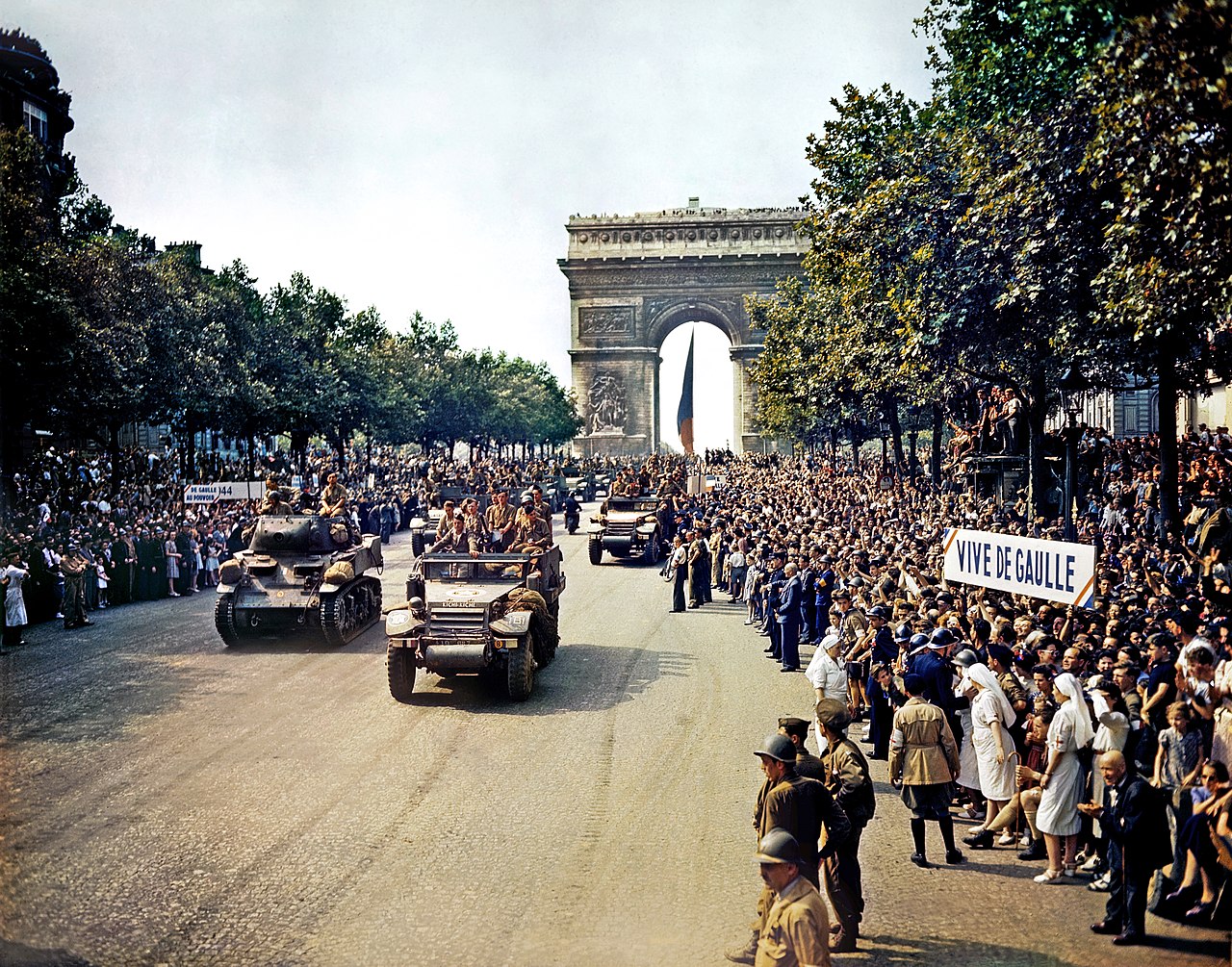
Charles André Joseph Marie de Gaulle (22 November 1890 – 9 November 1970) was a French general and statesman who led the Free French Forces against Nazi Germany and Vichy France in World War II and chaired the Provisional Government of the French Republic from 1944 to 1946 to restore democracy in France. Following the 1958 Algiers putsch, he came out of retirement at the request of President René Coty, who appointed him Prime Minister. He commissioned a new constitution which was approved by voters in a referendum, establishing the Fifth Republic. He was subsequently elected President of France later that year, a position he held until his resignation in 1969.
Born in Lille, he was a decorated officer of World War I, wounded several times and taken prisoner of war by Germany. During the interwar period, he advocated mobile armoured divisions. During the German invasion of May 1940, he led an armoured division that counterattacked the invaders; he was then appointed Undersecretary for War. Refusing to accept his government's armistice with Germany, de Gaulle fled to England and exhorted the French to continue the fight in his Appeal of 18 June. He led the Free French Forces and later headed the French National Liberation Committee and emerged as the undisputed leader of Free France. He became head of the Provisional Government of the French Republic in June 1944, the interim government of France following its liberation. As early as 1944, de Gaulle introduced a dirigiste economic policy, which included substantial state-directed control over a capitalist economy, which was followed by 30 years of unprecedented growth, known as the Trente Glorieuses. He resigned in 1946, but continued to be politically active as founder of the Rally of the French People. He retired in the early 1950s and wrote his War Memoirs, which quickly became a staple of modern French literature.
When the Algerian War threatened to bring the unstable Fourth Republic to collapse, the National Assembly brought him back to power during the May 1958 crisis. He founded the Fifth Republic with a strong presidency; he was elected with 78% of the vote to continue in that role. He managed to keep France together while taking steps to end the war, much to the anger of the Pieds-Noirs (ethnic Europeans born in Algeria) and the armed forces. He granted independence to Algeria and acted progressively towards other French colonies. In the context of the Cold War, de Gaulle initiated his "politics of grandeur", asserting that France as a major power should not rely on other countries, such as the United States, for its national security and prosperity. To this end, he pursued a policy of "national independence" which led him to withdraw from NATO's integrated military command and to launch an independent nuclear strike force which made France the world's fourth nuclear power. He restored cordial France–Germany relations with Konrad Adenauer to create a European counterweight between the Anglo-American and Soviet spheres of influence through the signing of the Élysée Treaty on 22 January 1963.

De Gaulle opposed any development of a supranational Europe, favouring Europe as a continent of sovereign nations. De Gaulle openly criticised the US intervention in Vietnam and the exorbitant privilege of the US dollar. In his later years, his use of the slogan "Vive le Québec libre" at a speech in Montreal and his two vetoes of Britain's entry into the European Economic Community generated considerable controversy in both North America and Europe. Although reelected to the presidency in 1965, he faced widespread protests by students and workers in May 68 but had the Army's support and called and won early elections with an increased majority in the National Assembly. De Gaulle resigned in late April 1969 after losing a referendum in which he proposed more decentralization. He died a year and a half later at the age of 79, leaving his presidential memoirs unfinished. Many French political parties and leaders claim a Gaullist legacy; many streets and monuments in France and other parts of the world were dedicated to his memory after his death.
Early life
Childhood and origins
Charles André Joseph Marie de Gaulle was born on 22 November 1890 in Lille, the third of five children. He was raised in a devoutly Catholic conservative and monarchist family. His father, Henri de Gaulle, was a professor of history and literature at a Jesuit college and eventually founded his own school.
Henri de Gaulle came from a long line of parliamentary gentry from Normandy and Burgundy. The name is thought to be Dutch in origin, and may have derived from van der Walle, de Walle ("from the rampart, defensive wall") or de Waal ("the wall"). De Gaulle's mother, Jeanne (born Maillot), descended from a family of wealthy entrepreneurs from Lille. She had French, Irish, Scottish, and German ancestry.
De Gaulle's father encouraged historical and philosophical debate between his children, and through his encouragement, de Gaulle learned French history from an early age. Struck by his mother's tales of how she cried as a child when she heard of the French capitulation to the Germans at Sedan in 1870, he developed a keen interest in military strategy. He was also influenced by his uncle, also named Charles de Gaulle, who was a historian and passionate Celticist who advocated the union of the Welsh, Scots, Irish, and Bretons into one people. His grandfather Julien-Philippe was also a historian, and his grandmother Joséphine-Marie wrote poems which impassioned his Christian faith.
Education and intellectual influences
De Gaulle began writing in his early teens, especially poetry; his family paid for a composition, a one-act verse play, to be privately published. A voracious reader, he favored philosophical tomes by such writers as Bergson, Péguy, and Barrès. In addition to the German philosophers Nietzsche, Kant, and Goethe, he read the works of the ancient Greeks (especially Plato) and the prose of Chateaubriand.
De Gaulle was educated in Paris at the Catholic Collège Stanislas and studied briefly in Belgium. At the age of fifteen he wrote an essay imagining "General de Gaulle" leading the French Army to victory over Germany in 1930; he later wrote that in his youth he had looked forward with somewhat naive anticipation to the inevitable future war with Germany to avenge the French defeat of 1870.

France during de Gaulle's adolescence was a divided society, with many developments which were unwelcome to the de Gaulle family: the growth of socialism and syndicalism, the legal separation of Church and state in 1905, and the reduction in the term of military service to two years. Equally unwelcome were the Entente Cordiale with Britain, the First Moroccan Crisis, and above all the Dreyfus Affair. Henri de Gaulle came to be a supporter of Dreyfus, but was less concerned with his innocence per se than with the disgrace which the army had brought onto itself. The period also saw a resurgence in evangelical Catholicism, the dedication of the Sacré-Cœur, Paris, and the rise of the cult of Joan of Arc.
De Gaulle was not an outstanding pupil until his mid-teens, but from July 1906 he focused on winning a place at the military academy, Saint-Cyr. Jean Lacouture suggests that de Gaulle joined the army, despite being more suited to a career as a writer and historian, partly to please his father and partly because it was one of the few unifying forces which represented the whole of French society. He later wrote that "when I entered the Army, it was one of the greatest things in the world", a claim which Lacouture points out needs to be treated with caution: the army's reputation was at a low. It was used extensively for strike-breaking and there were fewer than 700 applicants for Saint-Cyr in 1908, down from 2,000 at the turn of the century.
Early career
Officer cadet and lieutenant
De Gaulle won a place at Saint-Cyr in 1909. His class ranking was mediocre (119th out of 221). Under a law of 21 March 1905, aspiring army officers were required to serve a year in the ranks, including time as a private and as an NCO, before attending the academy. Accordingly, in October 1909, de Gaulle enlisted (for four years, as required, rather than the normal two-year term for conscripts) in the 33rd Infantry Regiment of the French Army, based at Arras. This was a historic regiment with Austerlitz, Wagram, and Borodino amongst its battle honours. In April 1910 he was promoted to corporal. His company commander declined to promote him to sergeant, the usual rank for a potential officer, commenting that the young man clearly felt that nothing less than Constable of France would be good enough for him. He was eventually promoted to sergeant in September 1910.
De Gaulle took up his place at Saint-Cyr in October 1910. By the end of his first year he had risen to 45th place. He was nicknamed "the great asparagus" because of his height (196 cm, 6'5"), high forehead, and nose. He did well at the academy and received praise for his conduct, manners, intelligence, character, military spirit, and resistance to fatigue. In 1912, he graduated 13th in his class and his passing-out report noted that he was a gifted cadet who would undoubtedly make an excellent officer. The future Marshal Alphonse Juin was first in the class, although the two do not appear to have been close at the time.
Preferring to serve in France rather than the overseas colonies, in October 1912 he rejoined the 33rd Infantry Regiment as a second lieutenant. The regiment was now commanded by Colonel (and future Marshal) Philippe Pétain, whom de Gaulle would follow for the next 15 years. He later wrote in his memoirs: "My first colonel, Pétain, taught me the art of command".
It has been claimed that in the build-up to World War I, de Gaulle agreed with Pétain about the obsolescence of cavalry and of traditional tactics, and often debated great battles and the likely outcome of any coming war with his superior. Lacouture is sceptical, pointing out that although Pétain wrote glowing appraisals of de Gaulle in 1913, it is unlikely that he stood out among the 19 captains and 32 lieutenants under his command. De Gaulle would have been present at the 1913 Arras manoeuvres, at which Pétain criticised General Gallet to his face, but there is no evidence in his notebooks that he accepted Pétain's unfashionable ideas about the importance of firepower against the dominant doctrine emphasizing "offensive spirit". De Gaulle stressed how Maurice de Saxe had banned volley fire, how French armies of the Napoleonic period had relied on infantry column attack, and how French military power had declined in the nineteenth century because of – supposedly – excessive concentration on firepower rather than élan. He also appears to have accepted the then-fashionable lesson drawn from the recent Russo-Japanese War of how bayonet charges by Japanese infantry with high morale had succeeded in the face of enemy firepower.
De Gaulle was promoted to first lieutenant in October 1913.
World War I
Combat commander
When war broke out in France in early August 1914, the 33rd Regiment, considered one of the best fighting units in France, was immediately thrown into checking the German advance at Dinant. However, the French Fifth Army commander, General Charles Lanrezac, remained wedded to 19th-century battle tactics, throwing his units into pointless bayonet charges against German artillery, incurring heavy losses.
As a platoon commander, de Gaulle was involved in fierce fighting from the outset. He received his baptism of fire on 15 August and was among the first to be wounded, receiving a bullet in the knee at the Battle of Dinant. It is sometimes claimed that in hospital, he grew bitter at the tactics used, and spoke with other wounded officers against the outdated methods of the French army. However, there is no contemporary evidence that he understood the importance of artillery in modern warfare. Instead, in his writing at the time, he criticised the "overrapid" offensive, the inadequacy of French generals, and the "slowness of the English troops".

He rejoined his regiment in October, as commander of the 7th company. Many of his former comrades were already dead. In December he became regimental adjutant.
De Gaulle's unit gained recognition for repeatedly crawling out into no man's land to listen to the conversations of the enemy, and the information brought back was so valuable that on 18 January 1915 he received the Croix de Guerre. On 10 February he was promoted to captain, initially on probation. On 10 March 1915, at the First Battle of Champagne, de Gaulle was shot in the left hand, a wound which initially seemed trivial but became infected. The wound incapacitated him for four months and later forced him to wear his wedding ring on the right hand. In August he commanded the 10th company before returning to duty as regimental adjutant. On 3 September 1915 his rank of captain became permanent. In late October, he returned to command of 10th company.
As a company commander at Douaumont (during the Battle of Verdun) on 2 March 1916, while leading a charge to try to break out of a position which had become surrounded, he received a bayonet wound to the left thigh after being stunned by a shell and was captured after passing out from the effects of poison gas. He was one of the few survivors of his battalion. The circumstances of his capture would later become a subject of debate as anti-Gaullists spread rumour that he had actually surrendered, a claim de Gaulle nonchalantly dismissed.
Prisoner
De Gaulle spent 32 months in six different prisoner camps, but he spent most time in the Ingolstadt Fortress, where his treatment was satisfactory.
In captivity, de Gaulle read German newspapers (he had learned German at school and spent a summer vacation in Germany) and gave talks on his view of the conflict to fellow prisoners. His patriotic fervour and confidence in victory earned him the nickname Le Connétable ("The Constable"), the title of the medieval commander-in-chief of the French army. In Ingolstadt were also journalist Remy Roure, who would eventually become a political ally of de Gaulle, and Mikhail Tukhachevsky, a future commander of the Red Army. De Gaulle became acquainted with Tukhachevsky, whose theories about a fast-moving, mechanized army closely resembled his. He also wrote his first book, Discorde chez l'ennemi (The Enemy's House Divided), analysing the divisions within the German forces. The book was published in 1924.
Originally interned at Rosenberg Fortress, he was quickly moved to progressively higher-security facilities like Ingolstadt. De Gaulle made five unsuccessful escape attempts, and was routinely punished with long periods of solitary confinement and the withdrawal of privileges such as newspapers and tobacco. He attempted escape by hiding in a laundry basket, digging a tunnel, digging through a wall, and even posing as a nurse. In letters to his parents, he constantly spoke of his frustration that the war was continuing without him. As the war neared its end, he grew depressed that he was playing no part in the victory, but he remained in captivity until the armistice. On 1 December 1918, three weeks later, he returned to his father's house in the Dordogne to be reunited with his three brothers, who had all also served in the army.
Between the wars
Early 1920s: Poland and staff college
After the armistice, de Gaulle served with the staff of the French Military Mission to Poland as an instructor of Poland's infantry during its war with communist Russia (1919–1921). He distinguished himself in operations near the River Zbrucz, with the rank of major in the Polish army, and won Poland's highest military decoration, the Virtuti Militari.
De Gaulle returned to France, where he became a lecturer in military history at Saint-Cyr. He studied at the École de Guerre (staff college) from November 1922 to October 1924. Here he clashed with his instructor Colonel Moyrand by arguing for tactics based on circumstances rather than doctrine, and after an exercise in which he had played the role of commander, he refused to answer a question about supplies, replying "de minimis non curat praetor" (roughly: "a leader does not concern himself with trivia") before ordering the responsible officer to answer Moyrand.
He obtained respectable, but not outstanding grades on many of his assessments. Moyrand wrote in his final report that he was "an intelligent, cultured and serious-minded officer; has brilliance and talent" but criticised him for not deriving as much benefit from the course as he should have, and for his arrogance: his "excessive self-confidence", his harsh dismissal of the views of others "and his attitude of a King in exile". Having entered 33rd out of 129, he graduated in 52nd place, with a grade of assez bien ("good enough"). He was posted to Mainz to help supervise supplies of food and equipment for the French Army of Occupation.
De Gaulle's book La Discorde chez l'ennemi had appeared in March 1924. In March 1925 he published an essay on the use of tactics according to circumstances, a deliberate defiance of Moyrand.
Mid-1920s: Ghostwriter for Pétain
De Gaulle's career was saved by Pétain, who arranged for his staff college grade to be amended to bien ("good"—but not the "excellent" needed for a general staff posting). From 1 July 1925 he worked for Pétain (as part of the Maison Pétain), largely as a "pen officer" (ghostwriter). De Gaulle disapproved of Pétain's decision to take command in Morocco in 1925 (he was later known to remark that "Marshal Pétain was a great man. He died in 1925, but he did not know it") and of what he saw as the lust for public adulation of Pétain and his wife. In 1925 de Gaulle began to cultivate Joseph Paul-Boncour, his first political patron. On 1 December 1925 he published an essay on the "Historical Role of French Fortresses". This was a popular topic because of the Maginot Line which was then being planned, but he argued that the aim of fortresses should be to weaken the enemy, not to economise on defence.
Friction arose between de Gaulle and Pétain over Le Soldat, a history of the French soldier which he had ghost-written and for which he wanted greater writing credit. He had written mainly historical material, but Pétain wanted to add a final chapter of his own thoughts. There was at least one stormy meeting late in 1926 after which de Gaulle was seen to emerge, white with anger, from Pétain's office. In October 1926 he returned to his duties with the Headquarters of the Army of the Rhine.
De Gaulle had sworn that he would never return to the École de Guerre except as commandant, but at Pétain's invitation, and introduced to the stage by his patron, he delivered three lectures there in April 1927: "Leadership in Wartime", "Character", and "Prestige". These later formed the basis for his book The Edge of the Sword (1932).
Late-1920s: Trier and Beirut
After spending twelve years as a captain, a normal period, de Gaulle was promoted to commandant (major) on 25 September 1927. In November 1927 he began a two-year posting as commanding officer of the 19th chasseurs à pied (a battalion of elite light infantry) with the occupation forces at Trier.
De Gaulle trained his men hard (a river crossing exercise of the freezing Moselle River at night was vetoed by his commanding general). He imprisoned a soldier for appealing to his deputy for a transfer to a cushier unit, and when investigated initially tried to invoke his status as a member of the Maison Pétain, eventually appealing to Pétain to protect himself from a reprimand for interfering with the soldier's political rights. An observer wrote of de Gaulle at this time that although he encouraged young officers, "his ego...glowed from far off". In the winter of 1928–1929, thirty soldiers ("not counting Annamese") died from so-called "German flu", seven of them from de Gaulle's battalion. After an investigation, he was singled out for praise in the ensuing parliamentary debate as an exceptionally capable commanding officer, and mention of how he had worn a mourning band for a private soldier who was an orphan earned praise from the Prime Minister Raymond Poincaré.
The breach between de Gaulle and Pétain over the ghost-writing of Le Soldat had deepened in 1928. Pétain brought in a new ghostwriter, Colonel Audet, who was unwilling to take on the job and wrote to de Gaulle in some embarrassment to take over the project. Pétain was quite friendly about the matter but did not publish the book. In 1929 Pétain did not use de Gaulle's draft text for his eulogy for the late Ferdinand Foch, whose seat at the Académie Française he was assuming.
The Allied occupation of the Rhineland was ending, and de Gaulle's battalion was due to be disbanded, although the decision was later rescinded after he had moved to his next posting. De Gaulle wanted a teaching post at the École de Guerre in 1929. There was apparently a threat of mass resignation of the faculty were he appointed. There was talk of a posting to Corsica or North Africa, but on Pétain's advice he accepted a two-year posting to Lebanon and Syria. In Beirut he was chief of the 3rd Bureau (military operations) of General Louis-Paul-Gaston de Bigault du Granrut, who wrote him a glowing reference recommending him for high command.
1930s: Staff officer
In the spring of 1931, as his posting in Beirut drew to a close, de Gaulle once again asked Pétain for a posting to the École de Guerre. Pétain tried to obtain an appointment for him as Professor of History there, but once again the faculty would not have him. Instead de Gaulle, drawing on plans he had drawn up in 1928 for reform of that institution, asked Pétain to create a special post for him which would enable him to lecture on "the Conduct of War" both to the École de Guerre and to the Centre des Hautes Études Militaires (CHEM – a senior staff college for generals, known as the "school for marshals"), to civilians at the École Normale Supérieure, and to civil servants.
Pétain instead advised him to apply for a posting to the Secrétariat Général du Conseil Supérieur de la Défense Nationale (SGDN – General Secretariat of the Supreme War Council) in Paris. Pétain promised to lobby for the appointment, which he thought would be good experience for him. De Gaulle was posted to SGDN in November 1931, initially as a "drafting officer".
He was promoted to lieutenant-colonel in December 1932 and appointed Head of the Third Section (operations). His service at SGDN gave him six years' experience of the interface between army planning and government, enabling him to take on ministerial responsibilities in 1940.
After studying arrangements in the US, Italy, and Belgium, de Gaulle drafted a bill for the organisation of the country in wartime. He made a presentation about his bill to the CHEM. The bill passed the Chamber of Deputies but failed in the Senate.
Early 1930s: Proponent of armoured warfare
Unlike Pétain, de Gaulle believed in the use of tanks and rapid maneuvers rather than trench warfare. De Gaulle became a disciple of Émile Mayer, a retired lieutenant-colonel (his career had been damaged by the Dreyfus Affair) and military thinker. Mayer thought that although wars were still bound to happen, it was "obsolete" for civilised countries to threaten or wage war on one another. He had a low opinion of French generals, and was a critic of the Maginot Line and a proponent of mechanised warfare. Lacouture suggests that Mayer focused de Gaulle's thoughts away from his obsession with the mystique of the strong leader (Le Fil d'Epée: 1932) and back to loyalty to Republican institutions and military reform.
In 1934 de Gaulle wrote Vers l'Armée de Métier (Towards a Professional Army). He proposed mechanization of the infantry, with stress on an élite force of 100,000 men and 3,000 tanks. The book imagined tanks driving around the country like cavalry. De Gaulle's mentor Emile Mayer was somewhat more prophetic than he was about the future importance of air power on the battlefield. Such an army would both compensate for France's population shortage, and be an efficient tool to enforce international law, particularly the Treaty of Versailles. He also thought it would be a precursor to a deeper national reorganisation, and wrote that "a master has to make his appearance [...] whose orders cannot be challenged – a man upheld by public opinion".
Only 700 copies were sold in France; the claim that thousands of copies were sold in Germany is thought to be an exaggeration. De Gaulle used the book to widen his contacts among journalists, notably with André Pironneau, editor of L'Écho de Paris. The book attracted praise across the political spectrum, apart from the hard left who were committed to the Republican ideal of a citizen army. De Gaulle's views attracted the attention of the maverick politician Paul Reynaud, to whom he wrote frequently, sometimes in obsequious terms. Reynaud first invited him to meet him on 5 December 1934.
De Gaulle was deeply focused on his career at this time. There is no evidence that he was tempted by fascism, and there is little evidence of his views either on domestic upheavals in 1934 and 1936 or the many foreign policy crises of the decade. He approved of the rearmament drive which the Popular Front government began in 1936, although French military doctrine remained that tanks should be used in penny packets for infantry support (ironically, in 1940 it would be German panzer units that would be used in a manner similar to what de Gaulle had advocated). A rare insight into de Gaulle's political views is a letter to his mother warning that war with Germany was inevitable and reassuring her that Pierre Laval's pact with the USSR in 1935 was for the best, likening it to Francis I's alliance with the Turks against Emperor Charles V.
Late 1930s: Tank regiment
From April 1936, whilst still in his staff position at SGDN, de Gaulle was a lecturer to generals at CHEM. De Gaulle's superiors disapproved of his views about tanks, and he was passed over for promotion to full colonel in 1936, supposedly because his service record was not good enough. He called on his political patron Reynaud, who showed his record to Minister of War Édouard Daladier. Daladier, who was an enthusiast for rearmament with modern weapons, ensured that his name was on the promotion list for the following year.
In 1937 General Bineau, who had taught him at Saint-Cyr, wrote on his report on his lectureship at CHEM that he was highly able and suitable for high command in the future, but that he hid his attributes under "a cold and lofty attitude". He was put in command of the 507th Tank Regiment (a battalion of medium Char D2s and a battalion of R35 light tanks) at Metz on 13 July 1937, and his promotion to full colonel took effect on 24 December that year. De Gaulle attracted public attention by leading a parade of 80 tanks into the Place d'Armes at Metz, in his command tank "Austerlitz".