
The Channel Islands are an archipelago in the English Channel, off the French coast of Normandy. They are divided into two Crown Dependencies: the Bailiwick of Jersey, which is the largest of the islands; and the Bailiwick of Guernsey, consisting of Guernsey, Alderney, Sark, Herm and some smaller islands. Historically, they are the remnants of the Duchy of Normandy.
Although they are not part of the United Kingdom, the UK is responsible for the defence and international relations of the islands as it is for the other Crown Dependency, the Isle of Man, and the British Overseas Territories. The Crown Dependencies are neither members of the Commonwealth of Nations, nor part of the European Union. They have a total population of about 171,916, and the bailiwicks' capitals, Saint Helier and Saint Peter Port, have populations of 33,500 and 18,207 respectively.
"Channel Islands" is a geographical term, not a political unit. The two bailiwicks have been administered separately since the late 13th century. Each has its own independent laws, elections, and representative bodies (although in modern times, politicians from the islands' legislatures are in regular contact). Any institution common to both is the exception rather than the rule.

The Bailiwick of Guernsey is divided into three jurisdictions – Guernsey, Alderney and Sark – each with its own legislature. Although there are a few pan-island institutions (such as the Channel Islands Brussels Office, the Director of Civil Aviation and the Channel Islands Financial Ombudsman, which are actually joint ventures between the bailiwicks), these tend to be established structurally as equal projects between Guernsey and Jersey. Otherwise, entities whose names imply membership of both Guernsey and Jersey might in fact be from one bailiwick only. For instance, The International Stock Exchange is in Saint Peter Port and therefore is in Guernsey.
The term "Channel Islands" began to be used around 1830, possibly first by the Royal Navy as a collective name for the islands. The term refers only to the archipelago to the west of the Cotentin Peninsula. Other populated islands located in the English Channel, and close to the coast of Britain, such as the Isle of Wight, Hayling Island and Portsea Island, are not regarded as "Channel Islands".
Geography
The two major islands are Jersey and Guernsey. They make up 99% of the population and 92% of the area.

List of islands
Names
The names of the larger islands in the archipelago in general have the -ey suffix, whilst those of the smaller ones have the -hou suffix. These are believed to be from the Old Norse ey (island) and holmr (islet).
The Chausey Islands
The Chausey Islands south of Jersey are not generally included in the geographical definition of the Channel Islands but are occasionally described in English as 'French Channel Islands' in view of their French jurisdiction. They were historically linked to the Duchy of Normandy, but they are part of the French territory along with continental Normandy, and not part of the British Isles or of the Channel Islands in a political sense. They are an incorporated part of the commune of Granville (Manche). While they are popular with visitors from France, Channel Islanders can only visit them by private or charter boats as there are no direct transport links from the other islands.
In official Jersey Standard French, the Channel Islands are called 'Îles de la Manche', while in France, the term 'Îles Anglo-normandes' (Anglo-Norman Isles) is used to refer to the British 'Channel Islands' in contrast to other islands in the Channel. Chausey is referred to as an 'Île normande' (as opposed to Anglo-normande). 'Îles Normandes' and 'Archipel Normand' have also, historically, been used in Channel Island French to refer to the islands as a whole.

Waters
The very large tidal variation provides an environmentally rich inter-tidal zone around the islands, and some islands such as Burhou, the Écréhous, and the Minquiers have been designated Ramsar sites.
The waters around the islands include the following:
The Swinge (between Alderney and Burhou)

The Little Swinge (between Burhou and Les Nannels)
La Déroute (between Jersey and Sark, and Jersey and the Cotentin)
Le Raz Blanchard, or Race of Alderney (between Alderney and the Cotentin)
The Great Russel (between Sark, Jéthou and Herm)
The Little Russel (between Guernsey, Herm and Jéthou)
Souachehouais (between Le Rigdon and L'Étacq, Jersey)

Le Gouliot (between Sark and Brecqhou)
La Percée (between Herm and Jéthou)
Highest point
The highest point in the islands is Les Platons in Jersey at 143 metres (469 ft) above sea level. The lowest point is the English Channel (sea level).
Climate
History
Prehistory
The earliest evidence of human occupation of the Channel Islands has been dated to 250,000 years ago when they were attached to the landmass of continental Europe. The islands became detached by rising sea levels in the Mesolithic period. The numerous dolmens and other archaeological sites extant and recorded in history demonstrate the existence of a population large enough and organised enough to undertake constructions of considerable size and sophistication, such as the burial mound at La Hougue Bie in Jersey or the statue menhirs of Guernsey.
From the Iron Age
Hoards of Armorican coins have been excavated, providing evidence of trade and contact in the Iron Age period. Evidence for Roman settlement is sparse, although evidently the islands were visited by Roman officials and traders. The Roman name for the Channel Islands was I. Lenuri (Lenur Islands) and is included in the Peutinger Table. The traditional Latin names used for the islands (Caesarea for Jersey, Sarnia for Guernsey, Riduna for Alderney) derive (possibly mistakenly) from the Antonine Itinerary. Gallo-Roman culture was adopted to an unknown extent in the islands.
In the sixth century, Christian missionaries visited the islands. Samson of Dol, Helier, Marculf and Magloire are among saints associated with the islands. In the sixth century, they were already included in the diocese of Coutances where they remained until the Reformation.
There were probably some Celtic Britons who settled on the Islands in the 5th and 6th centuries AD (the indigenous Celts of Great Britain, and the ancestors of the modern Welsh, Cornish, and Bretons) who had emigrated from Great Britain in the face of invading Anglo-Saxons. But there were not enough of them to leave any trace, and the islands continued to be ruled by the king of the Franks and its church remained part of the diocese of Coutances.
From the beginning of the ninth century, Norse raiders appeared on the coasts. Norse settlement eventually succeeded initial attacks, and it is from this period that many place names of Norse origin appear, including the modern names of the islands.
From the Duchy of Normandy
In 933, the islands were granted to William I Longsword by Raoul, the King of Western Francia, and annexed to the Duchy of Normandy. In 1066, William II of Normandy invaded and conquered England, becoming William I of England, also known as William the Conqueror. In the period 1204–1214, King John lost the Angevin lands in northern France, including mainland Normandy, to King Philip II of France, but managed to retain control of the Channel Islands. In 1259, his successor, Henry III of England, by the Treaty of Paris, officially surrendered his claim and title to the Duchy of Normandy, while retaining the Channel Islands, as peer of France and feudal vassal of the King of France. Since around 1290, Otto de Grandson split the Channel Islands into two separate bailiwicks which were never absorbed into the Kingdom of England nor its successor kingdoms of Great Britain or the United Kingdom. During the Hundred Years' War, the Channel Islands were part of the French territory recognizing the claims of the English kings to the French throne.
The islands were invaded by the French in 1338, who held some territory until 1345. Edward III of England granted a Charter in July 1341 to Jersey, Guernsey, Sark and Alderney, confirming their customs and laws to secure allegiance to the English Crown. Owain Lawgoch, a mercenary leader of a Free Company in the service of the French Crown, attacked Jersey and Guernsey in 1372, and in 1373 Bertrand du Guesclin besieged Mont Orgueil. The young King Richard II of England reconfirmed in 1378 the Charter rights granted by his grandfather, followed in 1394 with a second Charter granting, because of great loyalty shown to the Crown, exemption forever, from English tolls, customs and duties. Jersey was occupied by the French in 1461 as part of an exchange for helping the Lancastrians fight against the Yorkists during The War of the Roses. It was retaken by the Yorkists in 1468. In 1483 a Papal bull decreed that the islands would be neutral during time of war. This privilege of neutrality enabled islanders to trade with both France and England and was respected until 1689 when it was abolished by Order in Council following the Glorious Revolution in Great Britain.
Various attempts to transfer the islands from the diocese of Coutances (to Nantes (1400), Salisbury (1496), and Winchester (1499)) had little effect until an Order in Council of 1569 brought the islands formally into the diocese of Winchester. Control by the bishop of Winchester was ineffectual as the islands had turned overwhelmingly Calvinist and the episcopacy was not restored until 1620 in Jersey and 1663 in Guernsey.
After the loss of Calais in 1558, the Channel Islands were the last remaining English holdings in France and the only French territory that was controlled by the English kings as Kings of France. This situation lasted until the English kings dropped their title and claims to the French throne in 1801, confirming the Channel Islands in a situation of a crown dependency under the sovereignty of neither Great Britain nor France but of the British crown directly.
Sark in the 16th century was uninhabited until colonised from Jersey in the 1560s. The grant of seigneurship from Elizabeth I of England in 1565 forms the basis of Sark's constitution today.
From the 17th century
During the Wars of the Three Kingdoms, Jersey held out strongly for the Royalist cause, providing refuge for Charles, Prince of Wales in 1646 and 1649–1650, while the more strongly Presbyterian Guernsey more generally favoured the parliamentary cause (although Castle Cornet was held by Royalists and did not surrender until October 1651).
The islands acquired commercial and political interests in the North American colonies. Islanders became involved with the Newfoundland fisheries in the 17th century. In recognition for all the help given to him during his exile in Jersey in the 1640s, Charles II gave George Carteret, Bailiff and governor, a large grant of land in the American colonies, which he promptly named New Jersey, now part of the United States of America. Sir Edmund Andros, bailiff of Guernsey, was an early colonial governor in North America, and head of the short-lived Dominion of New England.
In the late 18th century, the islands were dubbed "the French Isles". Wealthy French émigrés fleeing the French Revolution sought residency in the islands. Many of the town domiciles existing today were built in that time. In Saint Peter Port, a large part of the harbour had been built by 1865.
20th century
World War II
The islands were occupied by the German Army during World War II.
The British Government demilitarised the islands in June 1940, and the lieutenant-governors were withdrawn on 21 June, leaving the insular administrations to continue government as best they could under impending military occupation.
Before German troops landed, between 30 June and 4 July 1940, evacuation took place. Many young men had already left to join the Allied armed forces, as volunteers. 6,600 out of 50,000 left Jersey while 17,000 out of 42,000 left Guernsey. Thousands of children were evacuated with their schools to England and Scotland.
The population of Sark largely remained where they were; but in Alderney, all but six people left. In Alderney, the occupying Germans built four prison camps which housed approximately 6,000 people, of whom over 700 died. Due to the destruction of documents, it is impossible to state how many forced workers died in the other islands. Some have claimed that Alderney had the only Nazi concentration camps on British soil. Others have pointed out that, technically, Alderney was not British soil.
The Royal Navy blockaded the islands from time to time, particularly following the Invasion of Normandy in June 1944. There was considerable hunger and privation during the five years of German occupation, particularly in the final months when the population was close to starvation. Intense negotiations resulted in some humanitarian aid being sent via the Red Cross, leading to the arrival of Red Cross parcels in the supply ship SS Vega in December 1944.
The German occupation of 1940–45 was harsh: over 2,000 islanders were deported by the Germans, and some Jews were sent to concentration camps; partisan resistance and retribution, accusations of collaboration, and slave labour also occurred. Many Spaniards, initially refugees from the Spanish Civil War, were brought to the islands to build fortifications. Later, Russians and Central Europeans continued the work. Many land mines were laid, with 65,718 land mines laid in Jersey alone.
There was no resistance movement in the Channel Islands on the scale of that in mainland France. This has been ascribed to a range of factors including the physical separation of the islands, the density of troops (up to one German for every two Islanders), the small size of the islands precluding any hiding places for resistance groups, and the absence of the Gestapo from the occupying forces. Moreover, much of the population of military age had already joined the British Army.
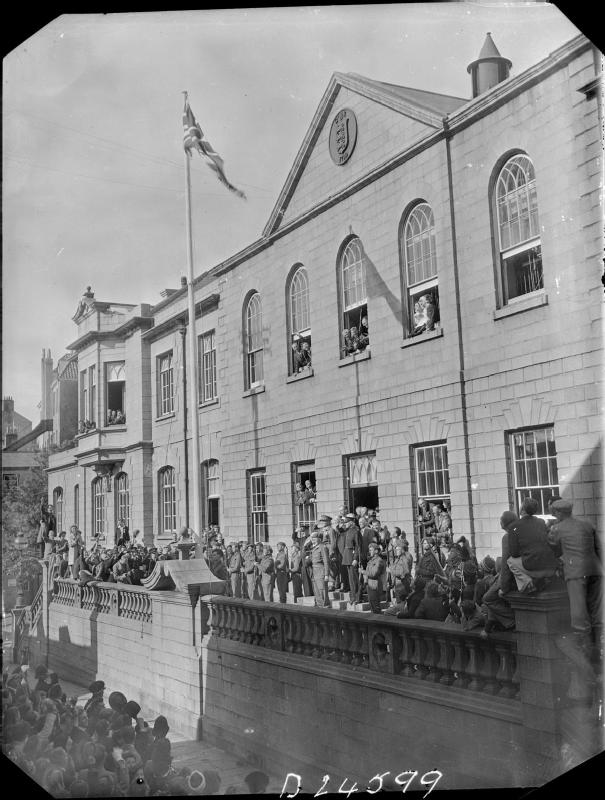
The end of the occupation came after VE-Day on 8 May 1945, with Jersey and Guernsey being liberated on 9 May. The German garrison in Alderney was not left until 16 May, and it was one of the last of the Nazi German remnants to surrender. The first evacuees returned on the first sailing from Great Britain on 23 June, but the people of Alderney were unable to start returning until December 1945. Many of the evacuees who returned home had difficulty reconnecting with their families after five years of separation.
After 1945
Following the liberation of 1945, reconstruction led to a transformation of the economies of the islands, attracting immigration and developing tourism. The legislatures were reformed and non-party governments embarked on social programmes, aided by the incomes from offshore finance, which grew rapidly from the 1960s. The islands decided not to join the European Economic Community when the UK joined. Since the 1990s, declining profitability of agriculture and tourism has challenged the governments of the islands.
Flag gallery
Governance
The Channel Islands fall into two separate self-governing bailiwicks, the Bailiwick of Guernsey and the Bailiwick of Jersey. Each of these is a British Crown Dependency, and neither is a part of the United Kingdom. They have been parts of the Duchy of Normandy since the 10th century, and Queen Elizabeth II was often referred to by her traditional and conventional title of Duke of Normandy. However, pursuant to the Treaty of Paris (1259), she governed in her right as the Queen (the "Crown in right of Jersey", and the "Crown in right of the république of the Bailiwick of Guernsey"), and not as the Duke. This notwithstanding, it is a matter of local pride for monarchists to treat the situation otherwise: the loyal toast at formal dinners was to 'The Queen, our Duke', rather than to 'Her Majesty, The Queen' as in the UK. The Queen died in 2022 and her son Charles III became the King.