
The Castellania (Maltese: Il-Kastellanija; Italian: La Castellania), also known as the Castellania Palace (Maltese: Il-Palazz Kastellanja; Italian: Palazzo Castellania), is a former courthouse and prison in Valletta, Malta that currently houses the country's health ministry. It was built by the Order of St. John between 1757 and 1760, on the site of an earlier courthouse which had been built in 1572.
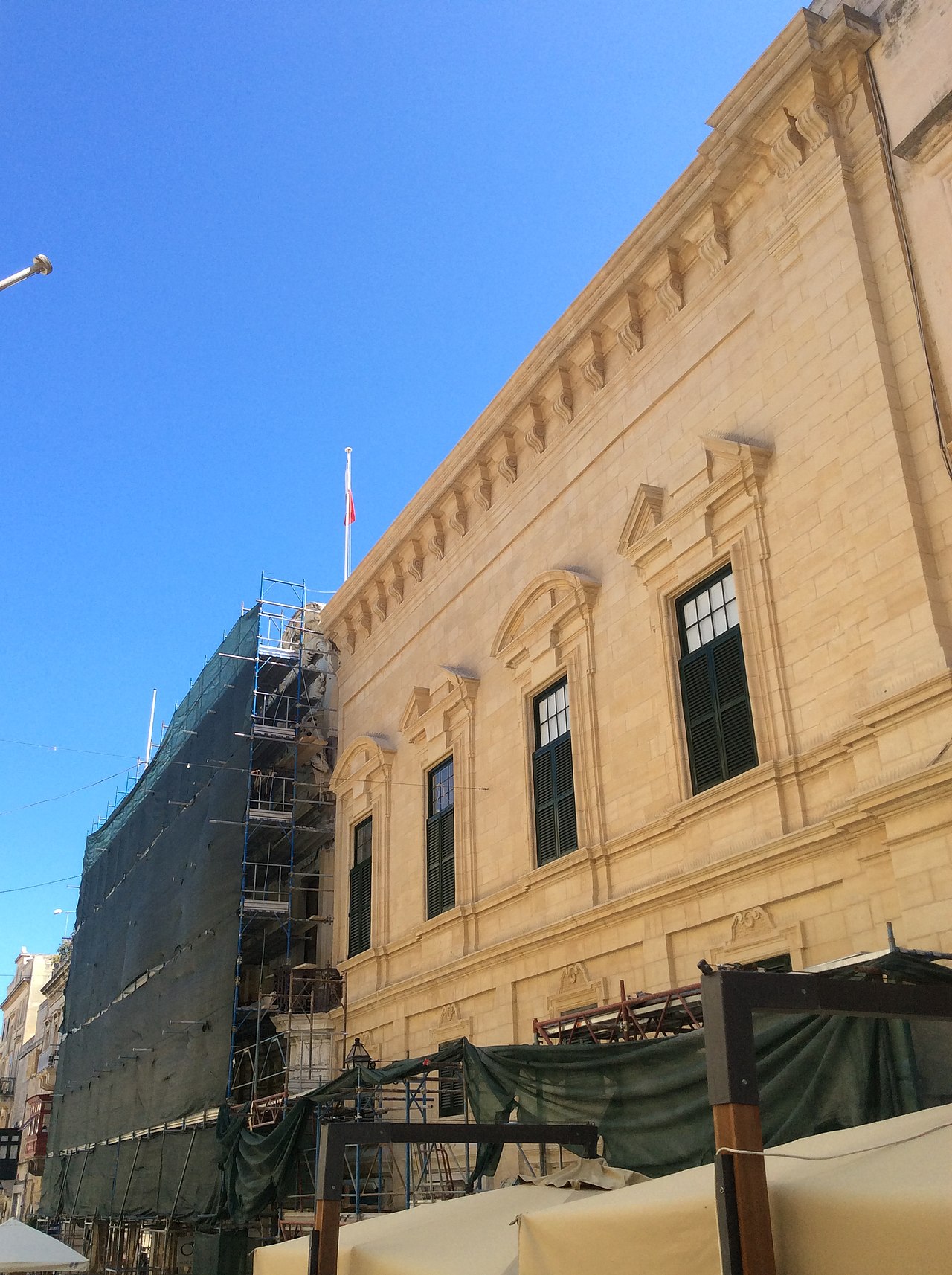
The building was built in the Baroque style to design of the architect Francesco Zerafa, and completed by Giuseppe Bonici. It is a prominent building in Merchants Street, having an ornate façade with an elaborate marble centrepiece. Features of the interior include former court halls, a chapel, prison cells, a statue of Lady Justice at the main staircase and an ornate fountain in the courtyard.
From the late 18th to the early 19th century, the building was also known by a number of names, including the Palazzo del Tribunale, the Palais de Justice and the Gran Corte della Valletta. By the mid-19th century the building was deemed too small, and the courts were gradually moved to Auberge d'Auvergne between 1840 and 1853. The Castellania was then abandoned, before being briefly converted into an exhibition centre, a tenant house and a school.

In 1895, the building was converted into the head office of the Public Health Department. The department was eventually succeeded by Malta's health ministry which is still housed in the Castellania. The building's ground floor contains a number of shops, while the belongings of Sir Themistocles Zammit's laboratory are now housed at the second floor and is open to the public by appointment as The Brucellosis Museum.
History
Institution
The Magna Curia Castellania (MCC; Italian: Gran Corte della Castellania; English: High Court of the Castellania) was a court and tribunal in Hospitaller Malta. The institution had been founded by the Order of St. John in Palestine in 1186. It was later established in Rhodes where it became known as Pragmaticæ Rhodiæ, and remained active there until the expulsion of the Order from the island in 1522.
The institution was established in Malta on 5 September 1533 after the arrival of the Order, during the magistracy of Grandmaster Philippe de L'Isle-Adam and it is sometimes distinguishably known as the Magnæ Curiæ Caſtellaniæ Melitenſis. It was among the first institutions that was found to require reforms. Johannes Quintinus was given responsibility to prepare the first set of laws for Malta, which were later established by the Grand Master. The institution followed the Sicilian legal system, known as the Ritus Magnæ Curiæ Siciliæ.

It was headed by a Castellan, also known as the President of the Castellania, who was a knight of the Order. He was ceremonially always followed by a page boy carrying a rod on a cushion when walking in public, with the rod symbolising his position, earning him the nickname captain of the rod.
Composition
The institution included two judges, one for the civil court and one for the criminal court. In the same building were the Office and Court of Appeals. The judges of the Castellania were native Maltese and dealt with cases that took place in the district of Valletta, Floriana and the Three Cities. Other districts, such as those under the courts of Mdina and Rabat, followed the same model and had to adopt decisions taken at the Castellania. On three days per week, the Fiscal Prosecutor brought cases before the judges. A Head Notary liaised for decisions taken by the institution. There was a Cancelliere, who was responsible for receiving and preserving judicial acts, registering the sentences meted out by the judges and supervising the other workers in the courts. There was a Gran Visconte (the Chief of police) who coordinated the police, and the Capitani di notte who implemented the sentences. Other workers included an official who saw that prisoners were treated fairly, those who were responsible for the archives and advocates for legal aid. Advocates were generally Italian-speaking Maltese, as most knights and foreigners considered the position for the inferior people. A report was drafted weekly and sent to the palace of the Grand Master, informing about occurrences presented to the Castellania.
The Castellania was the supreme court of justice of the islands, hence called Gran Corte or the variants in legal documents. The Grand Master had the absolute power to preside over the institution. The Papacy quarreled for a superior decision, such as when there was conflict with the court of the Bishop, but citing sovereignty of the princely Grand Master it was never conceded. The Castellania originally had decision over every aspect of life, including public morality and religion, but having the Islands been visited by an official of the Holy See in the 16th century and found lack of enforcement by the knights in religious aspects, the Inquisition was established. With the presence of the Inquisition, the Holy See considered Malta similar to a colony, but through the Castellania the Order kept rigid control and sovereignty over Malta. Though the Inquisition had the power to issue a death penalty in cases related to religion, such as heresy, fornication and sodomy, it generally left it at the discretion of the Castellania. Religious monks, including the Bishop of Malta, were not to be subject of decisions taken by the Castellania but there were instances of having to make exceptions as per offense to the state. In the late eighteenth century, under Grand Master de Rohan, Giovanni Niccolò Muscat has triggered significant controversy over his views on church-state separation in matters which are not religious in nature.

In its time, the Castellania was considered to be a secular court. Cases generally consisted of secular parties, with secular accusations, for cases of secular nature. Officially it treated people with more equity; religious courts in Malta under Roman Catholicism would refer to non-Christians and people with diverse abilities as creatures, because of their "imperfection", whereas the Castellania considered all people as humans. However the Castellania distinguished the non-Christians by considering all others as aliens, of which difference also has had negative impact in terms of equality before the law, and in practice it was still theocratic. Women had same rights as men to institute for court action. In military context the knights were not subject to the Castellania, and were instead prosecuted at the Military Tribunal (Tribunale Militare), however it received assistance from the higher hierarchy of the Castellania such as from the judge of the criminal court. The law was amended with the issue of a Bando by the Grand Master. Particular bandi regulated the procedures of medicating a seriously wounded person, where the Castellania had to be informed by medical practitioners within less than a day from the assistance.
From Birgu to Valletta
The courts and tribunals were initially housed in a building in Birgu. After the Order moved their headquarters to Valletta, the Castellania moved as well. The Castellania building in Birgu was handed to the Inquisition for free.
In Valletta, it was initially housed inconveniently in Strada Stretta, at the back of the Treasury of the Order, in a building belonging to Bailiff Bandinelli. It was sometimes known as baglio, an Italian architectural reference to courthouses, or Tribunale della Giustizia. Grand Master Jean de la Cassière bought the present site of the Castellania in Valletta for the courts to have an adequate location. Meanwhile, the original Castellania in Birgu was converted into the Inquisitor's Palace in 1574. The building of a Castellania was made in the original plans of Valletta. One of the plans for the Castellania was also to be built within the reserved area of the auberges of the knights, known as the Collacchio, but limiting access to a vast area in Valletta was found to be unpractical and the initiative was abandoned.

The first purposely built Castellania in Valletta was built in 1572 by la Cassière, and was likely designed by Girolamo Cassar, similar to other Valletta buildings of the late 16th century. The building had a military appearance, with the corners designed with massive quoins, typical of Cassar. Though the building had only one actual corner on St John Street crossing with the Square, the other ends touched the adjoining buildings. The Castellania made use of a bell, became popularly known as the ruffiana, to convey messages to the people and inform about an event. A chapel was located in the building for the spiritual services of prisoners. Similar to other prominent buildings, the Castellania was provided with water within its courtyard by connection to the Wignacourt Aqueduct. In 1646, Pierre Garsin was commissioned to execute works within the prison section of the first Castellania which constituted of works on the walls that were examined to be in a state close to collapse. People in prison were generally those awaiting trial by the Castellania, but also by the Inquisition. Regulated visits to captives were allowed. The building had a main front door which was used for official purposes such as by the Castellan of the Gran Corte della Castella.
The Magistrato degli Almamenti or Tribunale degli Armamenti, founded by Grand Master Wignacourt, was initially housed in the first Castellania building but moved to a separate location during the rule of Grand Master Perellos, who had established the Consolato del Mare in 1697. The first Castellania of Valletta was demolished in the mid-18th century on orders of Grand Master Manuel Pinto da Fonseca, as he despised its austere architecture and wanted a symbolic building of his absolutism. Pinto continued on similar steps of his predecessor, Grand Master Wignacourt, by taking several initiatives and make stately projects, and a new Castellania was one of the main prospects.
There are claims based on word of mouth that in the 18th century the courts and tribunals were housed at 254, St. Paul's Street (now known as Europe House, and occupied by the offices of the European Commission and the European Parliament), plausibly between 1757 and 1760, however this is considered as a hearsay.
Construction
Knights Giacomo de Blacas d'Aups and the Giorgio Valperga di Masino were given monopoly rights for four decades over the use of wind-power machines for the production of marble, metals, limestone and timber in Malta by Pinto in 1752. As a benefit of granting such license, Pinto secured the benefit that service for the construction of public and private projects would cost a quarter less than if handmade. The limestone used was from Misra(h) il-Barrieri in Santa Venera. A new Baroque building was constructed on site of the first Castellania, creating significant employment, with works commencing in 1757. Throughout the course of construction, prisoners were held in a tower near Valletta's Porta Reale, probably the tower of Saint James Cavalier.
The new Castellania was built to a design by the architect Francesco Zerafa, but he died during its construction on 21 April 1758. His work was completed by then Engineer, who was just elevated to architect, Giuseppe Bonici. Zerafa is accredited for the main design, and for the subjected building he has post mortem established himself as a respected architect. The edifice was completed in 1760, and saw the last finishes in October of that year, after which on 23 of that month was able to accommodate its intended functions. As a general rule, by the Officio delle Case (Officium Commissariorum Domorum), the buildings in Valletta were required to be ready within three-years period from start to completion. The Castellania was built in conformity with the Officio delle Case. The chapel was consecrated on 15 November of that year, which also marked the official inauguration. The main commemoration for the opening is an inscription above the central doorway which praises Grand Master Pinto for his achievement in rebuilding the courthouse. The prisoners were transferred to the new prison three days later, on 18 November 1760.
Local hard limestone was used for construction, however the main portico was decorated with Carrara marble. Some of the marble used was cannibalized from the ruins of the Temple of Proserpina, an ancient Roman temple in Mtarfa which had been discovered in 1613. A craftsman who worked on the decorative sculpture of the Castellania's façade's central-piece and chapel was Maestro Giovanni Vito, the Puglisi (from Pùglia), a Neapolitan buonavoglia (a rower on the galleys). He would become the first man to be convicted of murder and sentenced to death by hanging in the new Castellania on 15 December 1760. With the remodelling of the edifice, Pinto has ubiquitously besprinkled his heraldic symbolic couchant crescents, in the interior and exterior of the architecture of the building, to convey a message of his absolutism and opulence.

Sometimes after its completion, artist Tiepolo Favray took record of the notorious building. Disseminated information among European monarchies compared it to be of proportionate to the expectations of the most powerful nations.
Courthouse
During the 18th century, by hosting the courts and the tribunals, it was known as the Corte della Castellania (or the variants) and sometimes as the Palazzo del Tribunale. Among the common public was, however, simply known as the Court of the Grandmaster, probably to simply distinguish it from the courts of the inquisition and of the Bishop.
Some judges of the Castellania, such as Vincenzo Bonavita (1752–1829), served during four different periods- firstly during the Order of St John, then during French occupation, the British protectorate and finally under the Crown Colony period. The locals preferred to be subjected to the Court of the Bishop or the Inquisition, rather than Castellania.
Order of St John
Civil and criminal cases commenced after its completion, as was intended. Court sittings already started to be heard at the remodeled Castellania prior its inauguration. Conflict between the court of the Grand Master and that the court of the Bishop was a common issue during the reign of Pinto. The Bishop of Malta continuously lobbied against sentences by the Castellania when the accused was a monk. Several instances went as far as Rome to be settled. Pinto believed that it was justified to take a decision when state interest is threatened.
Homosexual practice was punishable by death by the Castellania. In an uncommon case heard in 1774 was when an intersex person, 17-year-old Rosaria "Rosa" Mifsud, a.k.a. Primitiva, from Luqa petitioned for a sex change to wear as a man, instead of the female clothing worn ever since born. Two medical experts were appointed by the court to perform an examination. This case gives detail of the use of experts in the field, similar to the late modern period. The examiners were the Physician-in-Chief and a senior surgeon, both working at the Sacra Infermeria. The Grandmaster took the decision for Mifsud to wear only men clothes from then on. The decision was taken to the court of appeals, which appointed other seven medical experts that agreed with the observations of the previous two experts.
Following the Rising of the Priests in 1775, three of the rebellion's leaders were executed without receiving fair trial. The death penalty was signed by the Castellano under the orders of Grand Master Francisco Ximénez de Tejada. Prior to judgement, some of the rebellions were locked up in the secretive prisons near the courtroom of the Castallania, some at the Castellania dungeons, and in other Valletta buildings. All those arrested were recorded on the Libro del Carcerati Della Magna Curia Castellania. Among them was Gaetano Mannarino, the leader of the rebellion. Some of them were condemned to death by strangulation in the dungeons of the Castellania. The whole process went against the conformity of the courts in Malta as the priests were not to be subjected to the Castellania but to the court of the Bishop. However the Inquisition had already determined in previous decision-making that crimes of serious nature were not to have ecclesiastical immunity from criminal prosecution at the Castellania. Some sources say that only the laymen were prosecuted at the Castellania, while the priests were tried at Fort St Elmo. Ximenes died a natural death within weeks after the sentences, with some locals believing it was a divine providence for his merciless judgement against the clergy.
In 1777, Grand Master Emmanuel de Rohan-Polduc introduced the Supremum Justitiæ Magistratum (Collegiate Tribunal of the Jury's Supreme Magistrate) in order to establish more separation of powers in judicial decisions. Giandonato Rogadeo, an eminent European jurist, was requested to come to Malta in 1781 by de Rohan to address issues related to common law. Rogadeo went on to author the Diritto Municipale, between the year of his arrival and 1784, a law book to be used for the Castellania. During his stay in Malta, he further observed that it was not the law which was just problematic but also the judges and advocates which were corrupt. His work was opposed by the advocates and judges, with Baron Gaetano Pisani and Judge Gio Nicoló Muscat anonymously publishing works in Rome in 1783 to challenge it and aiming to keep the status quo which had limited considerations. It became the primarily Maltese law of the Code de Rohan, a humane set of laws, which brought significant reformation to criminal law. The Code incorporated previous laws introduced from former Grand Masters with a more liberal approach. It also set standard regulations for advocates, with some flexibility. It was subsequently amended with the use of bandi. The Code de Rohan clarified the role and powers of the "Giudice Criminale della Gran Corte della Castellania". It gave judges the right to decide on cases presented before them, instruct for investigations of serious nature, conduct inquiries, take action as themed necessarily.
The Diritto Municipale was abolished in 1854, during the British period, and replaced by a more lenient Criminal Code. During his magistracy, Grand Master de Rohan sentenced the Castellan, allegedly for practicing conflict of interest considering his position, to a life in prison but was allowed to escape and lived in exile.
Giuseppe Elia Pace, an advocate and close friend of Mikiel Anton Vassalli, was found guilty of treason during the reign of de Rohan and was sentenced for flogging in Valletta followed by a permanent exile out of Malta. Vassalli was imprisoned at the Klistanija at the end of the rule of the Order of St. John, and was accused of plotting revolutionary ideas during the magistracy of Grand Master Hompesch. Vassalli denied the accusations and remained imprisoned. Meanwhile, he received visits from the father of Fortunato Panzavecchia. While dining together around a table with prison guards, Panzavecchia took notes from conversations he had with Vassalli. These notes shed more light on the life of Vassalli, who after his death became the national Maltese linguistic. Though given a life sentence, he either managed to escape or was released after the expulsion of the Order from Malta.
French Republic
Malta was invaded by the French First Republic in June 1798, and the Order was expelled from the island, resulting in the French occupation of Malta. Grand Master Hompesch was pressured to capitulate, as the Maltese nobility and the Magistrate of the Castellania, together with influential and high ranking figures made it clear to the Fiscal of the Castellania that, unless he surrendered, those resisting the French would have to simultaneously face an internal revolution. The French reformed the legal system with the country being divided into provinces for roughly each 3,000 inhabitants, all with their own civil and criminal jurisdiction for the Justice of Peace: this included the use of the Castellania. Corporal punishment, which was leniently used at the end of the rule of the Order of St John, was officially abolished by the French. Religious figures, such as Franciscan Prelate Monsignor Axisa, were prosecuted at the Castellania and also kept there under arrest if required.
The institution of the Castellania was replaced by the Tribunale Provisorio and the Tribunale Civile di Prim'Instanza. The post of Castellano was abolished, and judges were nominated by the Commission de Gouvernement. By 6 July public buildings in Valletta were renamed, with the Castellania renamed as Palais de Justice. The creation of the newly introduced court in Malta according to republican ideals, on 16 July 1798, saw the abolition of the Order's Courts and Tribunals together with the abolition of the Courts of the Bishop and the Inquisition. Giovanni Niccolò Muscat was made a judge and president of the court during the French period but was soon dismissed by the French. Not less than three full cases of silver secured at the Castellania, were taken by the French on 8 November 1798, and were melted to create coins to remunerate the Jacobins. It was one of a series of similar reasons that consequently triggered a Maltese revolt. The French law system did not last enough to influence the Maltese courts at the time.
British protectorate
After a successful Maltese uprising against the French occupation, in 1800 Malta became a British protectorate, with the Castellania becoming known as the Gran Corte della Valletta. It was amongst the first public institutions to be reestablished. The documents of the Tribunale della Gran Corte della Castellania were given by Government Alexander Ball to the Gran Corte Vescovile (Court of the Bishop) with other documents of the church and the Inquisition at the request of the ecclesiastic authorities. Apart from those of the Court of the Bishop, the others (including those of the Castellania) were all found to be irrelevant to the church and were transferred to the Palace of the Inquisition in Birgu. The documents of the Tribunale della Valletta were likely transferred to the palace of the Inquisition by mistake but those arriving there never saw their way back to Valletta since. On 8 March 1805, a proclamation declared the restoration of the Courts of Justice. In February 1806, Ball gave instructions to presumably guarantee independence of the Judiciary, whereas the Judges could not be removed at a simple request, and legal persons would not be threatened to be jailed if they disagree with signing legal documents. At the request of the Maltese National Congress, the law was once again reformed to the ancient rights and the Code De Rohan.
Vassalli was imprisoned again during the siege, and was kept at the Castellania from 16 September 1800 until he was exiled from the protectorate on 15 January 1801. While in jail at the Castellania, Vassalli read in Arabic, and vocally translated to Maltese, passages of the Quran to other inmates among him. His Quran, bound by a leather cover, was discovered when Vassalli underwent a spot check by British soldiers in the whereabouts of Porta Reale.
Between 1810 and 1811 most Valletta buildings were given addresses. The first address of the main door of the building was in Italian as istrada Mercanti, No.15, La Castellania. Ġampatist Gatt was engaged with the Criminal Court as an interpreter and translator, to and from English, from 1 August 1810 to 30 June 1814. The death penalty continued to be legal under British rule and the decapitation of the offender after execution remained in use by the Castellania.
In the early 19th century the building housed the Maltese Vice-Admiral Court. It was founded in June 1803. John Stoddart (1773–1856) served as the first Advocate to the British monarchy from 1803 to 1807. By 1811, during the protectorate, this court was criticized in Parliament as being unbecoming in its conduct during the early stages of establishment. It was replaced by another court and abolished in the 1890s. Literature and objects related the Vice-Admiralty Court in Malta are now exhibited at the Malta Maritime Museum in Birgu.
British colony
Maltese courts became on 5 October 1813, months before the Treaty of Paris of 1814, when Malta became a Crown colony. Soon after, in 1813, Civil Commissioner Alexander Ball terminated and transferred the judicial power of the Corte Capitanale of Mdina to the Castellania in Valletta.
Similar to other public buildings, the Castellania was closed down during the plague outbreak of 1813–14, and it was only used for emergency cases relating to the plague itself. Two people were sentenced to death for not revealing themselves of being infected of plague to relevant authorities and putting at risk the people around them. Both were executed by firing squad outside the courthouse in the street. When the plague ended, the Castellania was once again used as a courthouse and jail for accused who were still awaiting trial.
Under Governor Thomas Maitland, the British adopted a codification of a mixed system of Civil Law, which included Roman Law, Code Napoléon and continental law. Crown Advocate Adrian Dingli was trusted with the task of reforms. These reforms remain the basic of Maltese law today. By 1814 all forms of torture were abolished, however any action deemed to potentially incite a revolt could be suppressed with physical force. In 1814, the College of Auditors (Segnatura) was abolished and was replaced by the Supreme Council of Justice. The purpose of this reform was to see more equity at law at a time when the governor observed that there were questionable judicial cases, and thus gave an opportunity for review.
The Government Gazette started to report prominent cases of the court after the visit of the Commissioners Austin and Lewis.
Language
Tuscan Italian, and to some extent Latin, was used as the main functioning language of the courts throughout the periods of the knights, French occupation, British periods, until at least 1879 when the courts had already moved out of the building.
Though Maltese has always remained in use throughout the Knights period among all classes of society, the Councillor of the Supreme Tribunal of Justice Francesco Saverio Farrugia implied that Italian was considered as the maternal language which connects the country with the rest of Europe. The French language was established as the sole official language during the French occupation, however an exception was given to the courts as Italian prevailed for legal jargon. Efforts by the British to spread the usage of English during the protectorate and the early period of direct Crown control over Malta failed, mostly due to the unwillingness by the educated minority to adopt it. The supreme court proceedings were suggested to take place with the use of English, to encourage the study and use of English by judges and lawyers, but these efforts proved futile. Both during the period of French occupation and British rule, the supreme court decisions were published in Italian and the other preferred language of the government; French during the French period and English during the British periods. The Maltese language was never discussed as a possible language to be used in the Castellania. However, some documents presented to the courts were sometimes written with Italian and a mix of Sicilian or Maltese words. The language question was not solved until the 20th century, when the building had for long changed purpose.
Prison
Apart from a courthouse, the Castellania also served as a prison where suspects and convicts were imprisoned. The entrance of the former prison from St John Street and is locally known as Prisoner's Street (Triq il-Kalzrati) or Hook's Street (Triq il-Ganc). Serious criminal offenders from Gozo would be taken to the court in Gozo, and on the decision of the administrative Castellan would be sent to a temporary prison in Fort Chambray, before travelling by sea to Valletta and kept locked at the Castellania until his case is heard.
It was common to restrain political prisoners by locking them in the secure prison of the Castellania during the magistracy of the Order of St John. Prisoners who not awaiting trial were allowed to have visits from non-inmates.
Under the Order of St. John, prisoners could be sentenced to row on the galleys as punishment. Under British rule, certain crimes were punished with penal transportation to Australia, such was the case in June 1790 of Englishman John Pace. During carnival celebrations, cross-dressing males could be arrested, and those caught by police were held overnight at the Castellania "to study for a night manners more comporting with the modest of the sex."
On 15 March 1849, Lorenzo Bonello was assigned by the Governor to give service as the "Keeper of the Castellania" at the prison. The prison was permanently closed and moved to the "Palace of the Courts of Justice" in 1853. Lorenzo Aguis, a public official working as a porter, was catering for the prison before and after it became vacant.
Other uses
While the Castellania was in use as a courthouse and a prison, parts of the building were also used for a number of other purposes. The Castellan resided in an apartment in the same Castellania. The building hosted the Chamber of Commerce and the sittings of the Consulato del Mare in the eighteenth century, which were next to each other. It also housed the Monte di Sant'Anna until 1773, a decision taken by Grand Master Ximenes.
Individuals or groups could petition at the Castellania through a supplica; common cases were from practitioners needing a license to perform their occupation and the poor requesting social benefits. For such purposes and other, the Castellania and related tribunals employed the largest number of clerks. At one point, the working environment of the clerks had no standard working hours and their outcome received country-wide criticism; this resulted in counter petitions, with the clients requesting efficient service in less waiting time and the clerks requesting increase in wages. By 1780 a bando was introduced to address these issues. Clerks were not required to be Maltese, but had to be fluent in Italian which appealed to Sicilians.
Sea vessels were required by law to register at the Castellania to operate in Maltese waters and each had to pay a minimum ten grani, depending on the size of the vessel and its purpose. With the Registri Patentarum, the Castellania issued legal patents for galleys to travel from the port of Valletta to other ports and vice versa. The patents gave details subject to health inspections which included the names of the merchants and the description of the belongings for trade. Those galleys coming from non-European ports or from places subjected to possible disease were withheld in quarantine for days and only given permission to mix with the rest of the people once a Pratica was issued by the Commission of Public Health. The Clean Bill of Health continued to be issued and gradually reformed during the British period, under the supervision of the Chief Medical Officer. The Castellania imposed a charge for those not having health assurance and having to lodge at the Lazzaretto.
Titles of nobility were required to be recognized by the Cancelleria and then registered at the Castellania. Each noble title was subject to review by the judges or the Castellan. Most services at the edifice of the Castellania, such as court cases and office work, were against payment which balanced the expenses of the institution. At any given point, the Castellania could request for the valuation of goods to determine facts.