
Cary Grant (born Archibald Alec Leach; 18 January 1904 – 29 November 1986) was an English-American actor. Known for his blended British and American accent, debonair demeanor, lighthearted approach to acting, and sense of comic timing, he was one of classic Hollywood's definitive leading men. He was nominated twice for the Academy Award, received an Academy Honorary Award in 1970, and received the Kennedy Center Honor in 1981. He was named the second-greatest male star of the Golden Age of Hollywood by the American Film Institute in 1999.
Grant was born into an impoverished family in Bristol, where he had an unhappy childhood marked by the absence of his mother, and his father's alcoholism. He became attracted to theatre at a young age when he visited the Bristol Hippodrome. At 16, he went as a stage performer with the Pender Troupe for a tour of the US. After a series of successful performances in New York City, he decided to stay there. He established a name for himself in vaudeville in the 1920s and toured the United States before moving to Hollywood in the early 1930s.
Grant initially appeared in crime films and dramas, such as Blonde Venus (1932) and She Done Him Wrong (1933), but later gained renown for his performances in romantic screwball comedies such as The Awful Truth (1937), Bringing Up Baby (1938), His Girl Friday (1940), and The Philadelphia Story (1940). These pictures are frequently cited among the greatest comedy films of all time. Other well-known films in which he starred in this period were the adventure Gunga Din (1939), the dark comedy Arsenic and Old Lace (1944), and the dramas Only Angels Have Wings (1939), Penny Serenade (1941), and None but the Lonely Heart (1944), the latter two for which he was nominated for the Academy Award for Best Actor.
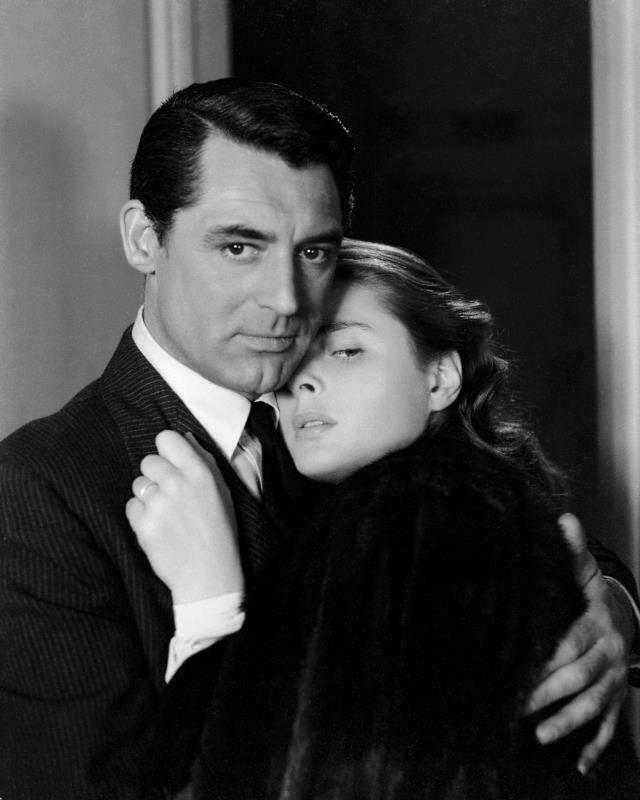
During the 1940s and 1950s, Grant had a close working relationship with director Alfred Hitchcock, who cast him in four films: Suspicion (1941), Notorious (1946), To Catch a Thief (1955), and North by Northwest (1959). For the suspense-dramas Suspicion and Notorious, Grant took on darker, morally ambiguous characters, both challenging Grant's screen persona and his acting abilities. Toward the end of his career he starred in the romantic films An Affair to Remember (1957), Indiscreet (1958), Operation Petticoat (1959), That Touch of Mink (1962), and Charade (1963). He is remembered by critics for his unusually broad appeal as a handsome, suave actor who did not take himself too seriously, and in comedies was able to toy with his dignity without sacrificing it entirely.
Grant was married five times, three of them elopements, with actresses Virginia Cherrill (1934–1935), Betsy Drake (1949–1962), and Dyan Cannon (1965–1968). He had a daughter, Jennifer Grant, with Cannon. He retired from film acting in 1966 and pursued numerous business interests, representing cosmetics firm Fabergé and sitting on the board of Metro-Goldwyn-Mayer. He died of a stroke in 1986 at the age of 82.
Early life and education
Grant was born Archibald Alec Leach at 15 Hughenden Road in Horfield, a suburb of Bristol, England. He was the second child of Elias James Leach and Elsie Maria Leach (née Kingdon). His father worked as a tailor's presser at a clothes factory, while his mother worked as a seamstress. His older brother John William Elias Leach died of tuberculous meningitis two days before his first birthday. Grant may have considered himself partly Jewish but was raised Anglican from his mother's background. He had an unhappy upbringing; his father was an alcoholic and his mother had clinical depression.

Grant's mother taught him song and dance when he was four, and she was keen on him having piano lessons. She occasionally took him to the cinema, where he enjoyed the performances of Charlie Chaplin, Chester Conklin, Fatty Arbuckle, Ford Sterling, Mack Swain, and Broncho Billy Anderson. He moved a short distance to 50 Berkeley Road at about age 4, and was sent to Bishop Road Primary School when he was 4+1⁄2. He lived at six addresses in Bristol, but said his time at Berkeley Road were his childhood's "happiest days".
Grant's biographer Graham McCann claimed that his mother "did not know how to give affection and did not know how to receive it either". Biographer Geoffrey Wansell notes that his mother blamed herself bitterly for the death of Grant's brother John, and never recovered from it. Grant acknowledged that his negative experiences with his mother affected his relationships with women later in life. She frowned on alcohol and tobacco, and reduced his pocket money for minor mishaps. Grant attributed her behavior to overprotectiveness, fearing that she would lose him as she did John.
When Grant was nine, his father placed his mother in Glenside Hospital, a mental institution, and told him she had gone away on a "long holiday", later declaring that she had died. Grant grew up resenting his mother, particularly after being told she left the family. After she was institutionalised, Grant and his father moved into Grant's grandmother's home in Bristol. When Grant was ten, his father remarried and started a new family. Grant did not learn that his mother was still alive until he was 31, his father confessing to the lie shortly before his own death. Grant made arrangements for his mother to leave the institution in June 1935, shortly after he learned of her whereabouts. He visited her regularly, including after filming Gunga Din in October 1938.

Grant enjoyed the theater, particularly pantomimes at Christmas, which he attended with his father. He befriended a troupe of acrobatic dancers known as The Penders or the Bob Pender Stage Troupe. He subsequently trained as a stilt walker and began touring with them. Jesse Lasky was a Broadway producer at the time and saw Grant performing at the Wintergarten theater in Berlin around 1914.
In 1915, Grant won a scholarship to attend Fairfield Grammar School in Bristol, although his father could barely afford to pay for the uniform. He was quite capable in most academic subjects, but he excelled at sports, particularly fives, and his good looks and acrobatic talents made him a popular figure. He developed a reputation for mischief, and frequently refused to do his homework. A former classmate referred to him as a "scruffy little boy", while an old teacher remembered "the naughty little boy who was always making a noise in the back row and would never do his homework".
He spent his evenings working backstage in Bristol theatres, and at the age of 13, was responsible for the lighting for magician David Devant at the Bristol Empire in 1917. He began hanging around backstage at the theatre at every opportunity, and volunteered for work in the summer as a messenger boy and guide at the military docks in Southampton, to escape the unhappiness of his home life. The time spent at Southampton strengthened his desire to travel; he was eager to leave Bristol and tried to sign on as a ship's cabin boy, but he was too young.
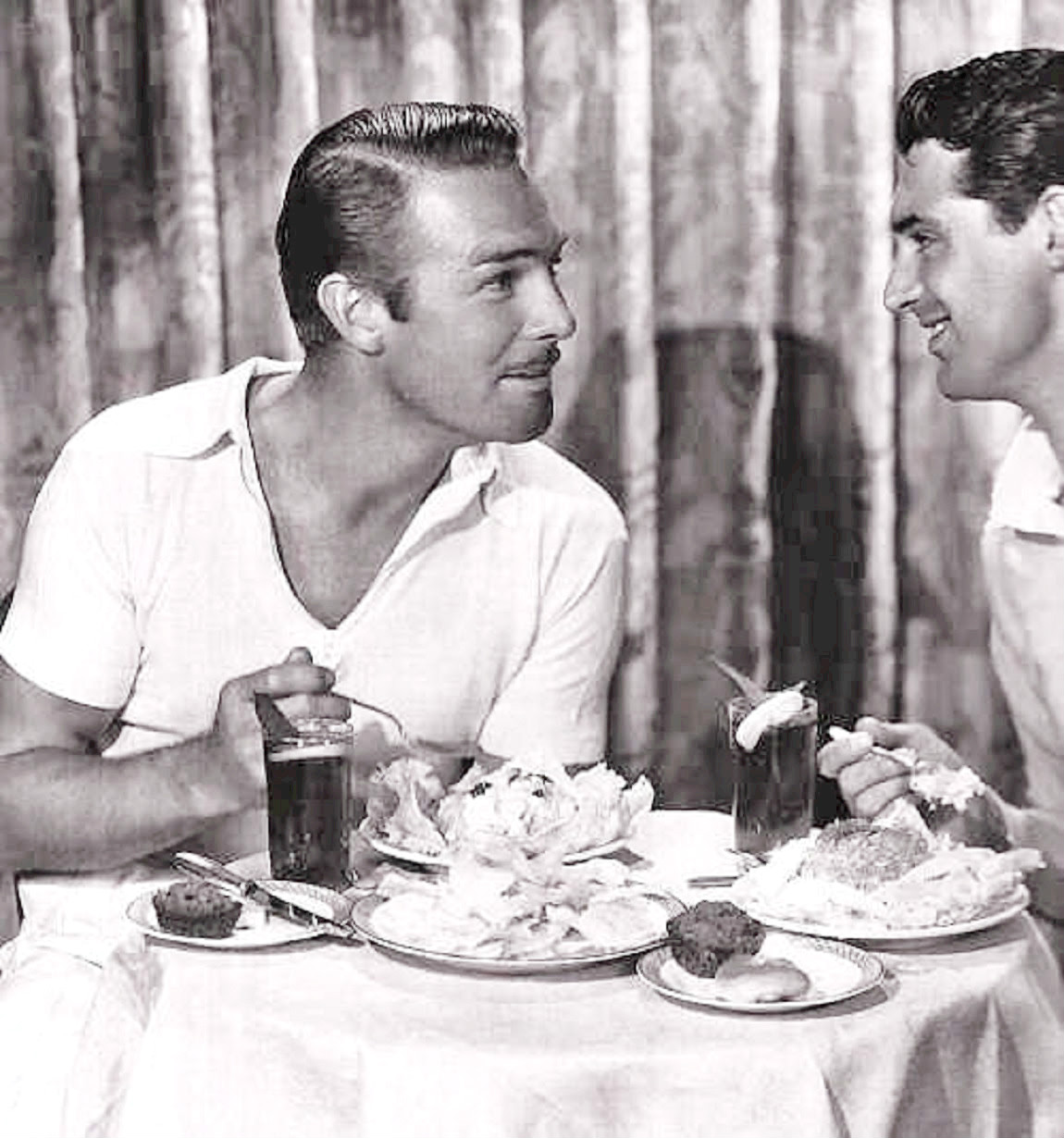
On 13 March 1918, the 14-year-old Grant was expelled from Fairfield. Several explanations were given, including being discovered in the girls' lavatory and assisting two other classmates with theft in the nearby town of Almondsbury. Wansell claims that Grant had set out intentionally to get himself expelled from school to pursue a career in entertainment with the troupe, and he did rejoin Pender's troupe three days after being expelled. His father had a better-paying job in Southampton, and Grant's expulsion brought local authorities to Pender's door with questions about why he was living in Bristol and not with his father in Southampton. His father then co-signed a three-year contract between Grant and Pender that stipulated Grant's weekly salary, along with room and board, dancing lessons, and other training for his profession until age 18. There was also a provision in the contract for salary raises based on job performance.
Vaudeville and performing career
The Pender Troupe began touring the country, and Grant's performing pantomime developed his physical skills, broadening the range of his acting. The troupe traveled on the RMS Olympic to conduct a tour of the United States on 21 July 1920, when he was 16, arriving a week later. Biographer Richard Schickel writes that Douglas Fairbanks and Mary Pickford were aboard the same ship, returning from their honeymoon; Grant played shuffleboard with Fairbanks, who became an important role model for him. After arriving in New York, the group performed at the New York Hippodrome, the largest theater in the world at the time with a capacity of 5,697. They performed there for nine months, putting on 12 shows a week, and they had a successful production of Good Times.
Grant became a part of the vaudeville circuit and began touring, performing in places such as St. Louis, Missouri, Cleveland, and Milwaukee, and he decided to stay in the US with several of the other members when the rest of the troupe returned to Britain. He became fond of the Marx Brothers during this period, and Zeppo Marx was an early role model for him. In July 1922, he performed in a group called the "Knockabout Comedians" at the Palace Theater on Broadway. He formed another group that summer called "The Walking Stanleys" with several of the former members of the Pender Troupe, and he starred in a variety show named "Better Times" at the Hippodrome towards the end of the year. While serving as a paid escort for the opera singer Lucrezia Bori at a Park Avenue party, he met George C. Tilyou Jr., whose family owned Steeplechase Park. Learning of his acrobatic experience, Tilyou hired him to work as a stilt-walker and attract large crowds on the newly opened Coney Island Boardwalk, wearing a bright greatcoat and a sandwich board that advertised the amusement park.

Grant spent the next couple of years touring the United States with "The Walking Stanleys". He visited Los Angeles for the first time in 1924, which made a lasting impression on him. The group split up and he returned to New York, where he began performing at the National Vaudeville Artists Club on West 46th Street, doing comic sketches, juggling, performing acrobatics, and as "Rubber Legs", riding a unicycle. The experience was a particularly demanding one, but it gave Grant the opportunity to improve his comic technique and to develop skills that benefitted him later in Hollywood.
Grant became a leading man alongside Jean Dalrymple and decided to form the "Jack Janis Company", which began touring vaudeville. He was sometimes mistaken for an Australian during this period and was nicknamed "Kangaroo" or "Boomerang". His accent seemed to have changed as a result of moving to London with the Pender troupe and working in so many music halls in the UK and the US, eventually developing a sort of transatlantic or mid-Atlantic accent. In 1927, he was cast as an Australian in Reggie Hammerstein's musical Golden Dawn, for which he earned $75 a week. The show was not well received, but it lasted for 184 performances and several critics started to notice Grant as the "pleasant new juvenile" or "competent young newcomer".
In 1928, he joined the William Morris Agency and was offered another juvenile part by Hammerstein in his play Polly, an unsuccessful production. One critic wrote that Grant "has a strong masculine manner, but unfortunately fails to bring out the beauty of the score". Wansell notes that the pressure of a failing production began to make him fret, and he was eventually dropped from the run after six weeks of poor reviews. Despite the setback, Hammerstein's rival Florenz Ziegfeld made an attempt to buy Grant's contract, but Hammerstein sold it to the Shubert Brothers instead.

J. J. Shubert cast him in a small role as a Spaniard opposite Jeanette MacDonald in the French risqué comedy Boom-Boom at the Casino Theater on Broadway, which premiered on 28 January 1929, ten days after his 25th birthday. MacDonald later admitted that Grant was "absolutely terrible in the role", but he exhibited a charm that endeared him to people and effectively saved the show from failure. The play ran for 72 shows, and Grant earned $350 a week before moving to Detroit, and then to Chicago.
To console himself, Grant bought a 1927 Packard sport phaeton. He visited his half-brother Eric in England, and he returned to New York to play the role of Max Grunewald in a Shubert production of A Wonderful Night. It premiered at the Majestic Theatre on 31 October 1929, two days after the Wall Street Crash, and lasted until February 1930 with 125 shows. The play received mixed reviews; one critic criticized his acting, likening it to a "mixture of John Barrymore and cockney", while another announced that he had brought a "breath of elfin Broadway" to the role. Grant found it difficult forming relationships with women, remarking that he "never seemed able to fully communicate with them" even after many years "surrounded by all sorts of attractive girls" in the theater, on the road, and in New York.
In 1930, Grant toured for nine months in a production of the musical The Street Singer. It ended in early 1931, and the Shuberts invited him to spend the summer performing on the stage at The Muny in St. Louis, Missouri; he appeared in 12 different productions, putting on 87 shows. He received praise from local newspapers for these performances, gaining a reputation as a romantic leading man. Significant influences on his acting in this period were Gerald du Maurier, A. E. Matthews, Jack Buchanan, and Ronald Squire. He admitted that he was drawn to acting because of a "great need to be liked and admired".
He was eventually fired by the Shuberts at the end of the summer season when he refused to accept a pay cut because of financial difficulties caused by the Depression. His unemployment was short-lived, however; impresario William B. Friedlander offered him the romantic lead in his musical Nikki, and Grant starred opposite Fay Wray as a soldier in post-World War I France. The production opened on 29 September 1931, in New York, but was stopped after just 39 performances due to the effects of the Depression.
Film career
1932–1936: Debut and early roles
Grant's role in Nikki was praised by Ed Sullivan of The New York Daily News, who noted that the "young lad from England" had "a big future in the movies". The review led to another screen test by Paramount Publix, resulting in an appearance as a sailor in Singapore Sue (1931), a ten-minute short film by Casey Robinson. Grant delivered his lines "without any conviction" according to McCann. Through Robinson, Grant met with Jesse L. Lasky and B. P. Schulberg, the co-founder and general manager of Paramount Pictures, respectively. After a successful screen-test directed by Marion Gering, Schulberg signed a contract with the 27-year-old Grant on 7 December 1931, for five years, at a starting salary of $450 a week. Schulberg demanded that he change his name to "something that sounded more all-American like Gary Cooper", and they eventually agreed on Cary Grant.
Grant set out to establish himself as what McCann calls the "epitome of masculine glamour", and made Douglas Fairbanks his first role model. McCann notes that Grant's career in Hollywood immediately took off because he exhibited a "genuine charm", which made him stand out among the other good looking actors at the time, making it "remarkably easy to find people who were willing to support his embryonic career". He made his feature film debut with the Frank Tuttle-directed comedy This is the Night (1932), playing an Olympic javelin thrower opposite Thelma Todd and Lili Damita. Grant disliked his role and threatened to leave Hollywood, but to his surprise a critic from Variety praised his performance, and thought that he looked like a "potential femme rave".
In 1932, Grant played a wealthy playboy opposite Marlene Dietrich in Blonde Venus, directed by Josef von Sternberg. Grant's role is described by William Rothman as projecting the "distinctive kind of nonmacho masculinity that was to enable him to incarnate a man capable of being a romantic hero". Grant found that he conflicted with the director during the filming and the two often argued in German. He played a suave playboy type in a number of films: Merrily We Go to Hell opposite Fredric March and Sylvia Sidney, Devil and the Deep with Tallulah Bankhead, Gary Cooper and Charles Laughton (Cooper and Grant had no scenes together), Hot Saturday opposite Nancy Carroll and Randolph Scott, and Madame Butterfly with Sidney. According to biographer Marc Eliot, while these films did not make Grant a star, they did well enough to establish him as one of Hollywood's "new crop of fast-rising actors".
In 1933, Grant gained attention for appearing in the pre-Code films She Done Him Wrong and I'm No Angel opposite Mae West. West later claimed that she had discovered Cary Grant. Of course Grant had already made Blonde Venus the previous year in which he was Marlene Dietrich's leading man. Pauline Kael noted that Grant did not appear confident in his role as a Salvation Army director in She Done Him Wrong, which made it all the more charming. The film was a box office hit, earning more than $2 million in the United States, and has since won much acclaim. For I'm No Angel, Grant's salary was increased from $450 to $750 a week. The film was even more successful than She Done Him Wrong, and saved Paramount from bankruptcy; Vermilye cites it as one of the best comedy films of the 1930s.
A string of financially unsuccessful films followed, including roles as a president of a company who is sued for knocking down a boy in an accident in Born to Be Bad (1934) for 20th Century Fox, a cosmetic surgeon in Kiss and Make-Up (1934), and a blinded pilot opposite Myrna Loy in Wings in the Dark (1935). Amid press reports of problems in his marriage to Cherrill, Paramount concluded that Grant was expendable.
Grant's prospects picked up in the latter half of 1935 when he was loaned out to RKO Pictures. Producer Pandro Berman agreed to take him on in the face of failure because "I'd seen him do things which were excellent, and [Katharine] Hepburn wanted him too." His first venture with RKO, playing a raffish Cockney swindler in George Cukor's Sylvia Scarlett (1935), was the first of four collaborations with Hepburn. Though a commercial failure, his dominating performance was praised by critics, and Grant always considered the film to have been the breakthrough for his career.
When his contract with Paramount ended in 1936 with the release of Wedding Present, Grant decided not to renew it and wished to work freelance. Grant claimed to be the first freelance actor in Hollywood. His first venture as a freelance actor was The Amazing Quest of Ernest Bliss (1936), which was shot in England. The film was a box office bomb and prompted Grant to reconsider his decision. Critical and commercial success with Suzy later that year in which he played a French airman opposite Jean Harlow and Franchot Tone, led to him signing joint contracts with RKO and Columbia Pictures, enabling him to choose the stories that he felt suited his acting style. His Columbia contract was a four-film deal over two years, guaranteeing him $50,000 each for the first two and $75,000 each for the others.
1937–1945: Hollywood stardom
In 1937, Grant began the first film under his contract with Columbia Pictures, When You're in Love, portraying a wealthy American artist who eventually woos a famous opera singer (Grace Moore). His performance received positive feedback from critics, with Mae Tinee of The Chicago Daily Tribune describing it as the "best thing he's done in a long time". After a commercial failure in his second RKO venture The Toast of New York, Grant was loaned to Hal Roach's studio for Topper, a screwball comedy film distributed by MGM, which became his first major comedy success. Grant played one half of a wealthy, freewheeling married couple with Constance Bennett, who wreak havoc on the world as ghosts after dying in a car accident. Topper became one of the most popular movies of the year, with a critic from Variety noting that both Grant and Bennett "do their assignments with great skill". Vermilye described the film's success as "a logical springboard" for Grant to star in The Awful Truth that year, his first film made with Irene Dunne and Ralph Bellamy. Though director Leo McCarey reportedly disliked Grant, who had mocked the director by enacting his mannerisms in the film, he recognized Grant's comic talents and encouraged him to improvise his lines and draw upon his skills developed in vaudeville. The film was a critical and commercial success and made Grant a top Hollywood star, establishing a screen persona for him as a sophisticated light comedy leading man in screwball comedies.
The Awful Truth began what film critic Benjamin Schwarz of The Atlantic later called "the most spectacular run ever for an actor in American pictures" for Grant. In 1938, he starred opposite Katharine Hepburn in the screwball comedy Bringing Up Baby, featuring a leopard and frequent bickering and verbal jousting between Grant and Hepburn. He was initially uncertain how to play his character, but was told by director Howard Hawks to think of Harold Lloyd. Grant was given more leeway in the comic scenes, the editing of the film and in educating Hepburn in the art of comedy. Despite losing over $350,000 for RKO, the film earned rave reviews from critics. He again appeared with Hepburn in the romantic comedy Holiday later that year, which did not fare well commercially, to the point that Hepburn was considered to be "box office poison" at the time.
Despite a series of commercial failures, Grant was now more popular than ever and in high demand. According to Vermilye, in 1939, Grant played roles that were more dramatic, albeit with comical undertones. He played a British army sergeant opposite Douglas Fairbanks Jr. in the George Stevens-directed adventure film Gunga Din, set at a military station in India. Roles as a pilot opposite Jean Arthur and Rita Hayworth in Hawks' Only Angels Have Wings, and a wealthy landowner alongside Carole Lombard in In Name Only followed.
In 1940, Grant played a callous newspaper editor who learns that his ex-wife and former journalist, played by Rosalind Russell, is to marry insurance officer Ralph Bellamy in Hawks' comedy His Girl Friday, which was praised for its strong chemistry and "great verbal athleticism" between Grant and Russell. Grant reunited with Irene Dunne in My Favorite Wife, a "first rate comedy" according to Life magazine, which became RKO's second biggest picture of the year, with profits of $505,000. After playing a Virginian backwoodsman in The Howards of Virginia, set during the American Revolution – which McCann considers to have been Grant's worst film and performance – his last film of the year was in the critically lauded romantic comedy The Philadelphia Story, in which he played the ex-husband of Hepburn's character. Grant felt his performance was so strong that he was bitterly disappointed not to have received an Oscar nomination, especially since both his lead co-stars, Hepburn and James Stewart, received them, with Stewart winning for Best Actor. Grant joked "I'd have to blacken my teeth first before the Academy will take me seriously". Film historian David Thomson wrote that "the wrong man got the Oscar" for The Philadelphia Story and that "Grant got better performances out of Hepburn than (her long-time companion) Spencer Tracy ever managed." Stewart's winning the Oscar "was considered a gold-plated apology for his being robbed of the award" for the previous year's Mr. Smith Goes to Washington. Grant's not being nominated for His Girl Friday the same year is also a "sin of omission" for the Oscars.
The following year Grant was considered for the Academy Award for Best Actor for Penny Serenade—his first nomination from the academy. Wansell claims that Grant found the film to be an emotional experience, because he and wife-to-be Barbara Hutton had started to discuss having their own children. Later that year he appeared in the romantic psychological thriller Suspicion, the first of Grant's four collaborations with director Alfred Hitchcock. Grant did not warm to co-star Joan Fontaine, finding her to be temperamental and unprofessional. Film critic Bosley Crowther of The New York Times considered that Grant was "provokingly irresponsible, boyishly gay and also oddly mysterious, as the role properly demands". Hitchcock later stated that he thought the conventional happy ending of the film (with the wife discovering her husband is innocent rather than his being guilty and she letting him kill her with a glass of poisoned milk) "a complete mistake because of making that story with Cary Grant. Unless you have a cynical ending it makes the story too simple". Geoff Andrew of Time Out believes Suspicion served as "a supreme example of Grant's ability to be simultaneously charming and sinister".
In 1942, Grant participated in a three-week tour of the United States as part of a group to help the war effort and was photographed visiting wounded marines in hospital. He appeared in several routines of his own during these shows and often played the straight man opposite Bert Lahr. In May 1942, when he was 38, the ten-minute propaganda short Road to Victory was released, in which he appeared alongside Bing Crosby, Frank Sinatra and Charles Ruggles. On film, Grant played Leopold Dilg, a convict on the run in The Talk of the Town (1942), who escapes after being wrongly convicted of arson and murder. He hides in a house with characters played by Jean Arthur and Ronald Colman, and gradually plots to secure his freedom. Crowther praised the script, and noted that Grant played Dilg with a "casualness which is slightly disturbing". After a role as a foreign correspondent opposite Ginger Rogers and Walter Slezak in the off-beat comedy Once Upon a Honeymoon, in which he was praised for his scenes with Rogers, he appeared in Mr. Lucky the following year, playing a gambler in a casino aboard a ship. The commercially successful submarine war film Destination Tokyo (1943) was shot in just six weeks in September and October, which left him exhausted; the reviewer from Newsweek thought it was one of the finest performances of his career.
In 1944, Grant starred alongside Priscilla Lane, Raymond Massey and Peter Lorre, in Frank Capra's dark comedy Arsenic and Old Lace, playing the manic Mortimer Brewster, who belongs to a bizarre family that includes two murderous aunts and an uncle claiming to be President Teddy Roosevelt. Grant took up the role after it was originally offered to Bob Hope, who turned it down owing to schedule conflicts. Grant found the macabre subject matter of the film difficult to contend with and believed that it was the worst performance of his career. That year he received his second Oscar nomination for a role, opposite Ethel Barrymore and Barry Fitzgerald in the Clifford Odets-directed film None but the Lonely Heart, set in London during the Depression. Late in the year he featured in the CBS Radio series Suspense, playing a tormented character who hysterically discovers that his amnesia has affected the masculine order in society in The Black Curtain.
1946–1953: Post-War success and slump
After making a brief cameo appearance opposite Claudette Colbert in Without Reservations (1946), Grant portrayed Cole Porter in the musical Night and Day (1946). The production proved to be problematic, with scenes often requiring multiple takes, frustrating the cast and crew. Grant next appeared with Ingrid Bergman and Claude Rains in the Hitchcock-directed film Notorious (1946), playing a government agent who recruits the American daughter of a convicted Nazi spy (Bergman) to infiltrate a Nazi organization in Brazil after World War II. During the course of the film Grant and Bergman's characters fall in love and share one of the longest kisses in film history at around two and a half minutes. Wansell notes how Grant's performance "underlined how far his unique qualities as a screen actor had matured in the years since The Awful Truth".
In 1947, Grant played an artist who becomes involved in a court case when charged with assault in the comedy The Bachelor and the Bobby-Soxer (released in the U.K. as "Bachelor Knight"), opposite Myrna Loy and Shirley Temple. The film was praised by the critics, who admired the picture's slapstick qualities and chemistry between Grant and Loy; it became one of the biggest-selling films at the box office that year. Later that year he starred opposite David Niven and Loretta Young in the comedy The Bishop's Wife, playing an angel who is sent down from heaven to straighten out the relationship between the bishop (Niven) and his wife (Loretta Young). The film was a major commercial and critical success, and was nominated for five Academy Awards. Life magazine called it "intelligently written and competently acted".
The following year, Grant played neurotic Jim Blandings, the title-sake in the comedy Mr. Blandings Builds His Dream House, again with Loy. Though the film lost money for RKO, Philip T. Hartung of Commonweal thought that Grant's role as the "frustrated advertising man" was one of his best screen portrayals. In Every Girl Should Be Married, an "airy comedy", he appeared with Betsy Drake and Franchot Tone, playing a bachelor who is trapped into marriage by Drake's conniving character. He finished the year as the fourth most popular film star at the box office. In 1949, Grant starred alongside Ann Sheridan in the comedy I Was a Male War Bride in which he appeared in scenes dressed as a woman, wearing a skirt and a wig. During the filming he was taken ill with infectious hepatitis and lost weight, affecting the way he looked in the picture. The film, based on the autobiography of Belgian resistance fighter Roger Charlier, proved to be successful, becoming the highest-grossing film for 20th Century Fox that year with over $4.5 million in takings and being likened to Hawks's screwball comedies of the late 1930s. By this point he was one of the highest paid Hollywood stars, commanding $300,000 per picture.
The early 1950s marked the beginning of a slump in Grant's career. His roles as a top brain surgeon who is caught in the middle of a bitter revolution in a Latin American country in Crisis, and as a medical-school professor and orchestra conductor opposite Jeanne Crain in People Will Talk were poorly received. Grant had become tired of being Cary Grant after twenty years, being successful, wealthy and popular, and remarked: "To play yourself, your true self, is the hardest thing in the world". In 1952, Grant starred in the comedy Room for One More, playing an engineer husband who, with his wife (Betsy Drake), adopt two children from an orphanage. He reunited with Howard Hawks to film the off-beat comedy Monkey Business, co-starring Ginger Rogers and Marilyn Monroe. Though the critic from Motion Picture Herald wrote gushingly that Grant had given a career's best with an "extraordinary and agile performance", which was matched by Rogers, it received a mixed reception overall. Grant had hoped that starring opposite Deborah Kerr in the romantic comedy Dream Wife would salvage his career, but it was a critical and financial failure upon release in July 1953, when Grant was 49. Though he was offered the leading part in A Star is Born, Grant decided against playing that character. He believed that his film career was over, and briefly left the industry.
1955–1966: Film resurgence and final roles
In 1955, Grant agreed to star opposite Grace Kelly in To Catch a Thief, playing a retired jewel thief named John Robie, nicknamed "The Cat", living in the French Riviera. Grant and Kelly worked well together during the production, which was one of the most enjoyable experiences of Grant's career. He found Hitchcock and Kelly to be very professional, and later stated that Kelly was "possibly the finest actress I've ever worked with". Grant was one of the first actors to go independent by not renewing his studio contract, effectively leaving the studio system, which almost completely controlled all aspects of an actor's life. He decided which films he was going to appear in, often had personal choice of directors and co-stars, and at times negotiated a share of the gross revenue, something uncommon at the time. Grant received more than $700,000 for his 10% of the gross of the successful To Catch a Thief, while Hitchcock received less than $50,000 for directing and producing it. Though critical reception to the overall film was mixed, Grant received high praise for his performance, with critics commenting on his suave, handsome appearance in the film.
In 1957, Grant starred opposite Deborah Kerr in the romance An Affair to Remember, playing an international playboy who becomes the object of her affections. Schickel sees the film as one of the definitive romantic pictures of the period, but remarks that Grant was not entirely successful in trying to supersede the film's "gushing sentimentality". That year, Grant also appeared opposite Sophia Loren in The Pride and the Passion. He had expressed an interest in playing William Holden's character in The Bridge on the River Kwai at the time, but found that it was not possible because of his commitment to The Pride and the Passion. The film was shot on location in Spain and was problematic, with co-star Frank Sinatra irritating his colleagues and leaving the production after just a few weeks. Although Grant had an affair with Loren during filming, Grant's attempts to woo Loren to marry him during the production proved fruitless, which led to him expressing anger when Paramount cast her opposite him in Houseboat (1958) as part of her contract. The sexual tension between the two was so great during the making of Houseboat that the producers found it almost impossible to make. Later in 1958, Grant starred opposite Bergman in the romantic comedy Indiscreet, playing a successful financier who has an affair with a famous actress (Bergman) while pretending to be a married man. During the filming he formed a closer friendship and gained new respect for her as an actress. Schickel stated that he thought the film was possibly the finest romantic comedy film of the era, and that Grant himself had professed that it was one of his personal favorites. Grant received his first of five Golden Globe Award for Best Actor – Motion Picture Musical or Comedy nominations for his performance and finished the year as the most popular film star at the box office.
In 1959, Grant starred in the Hitchcock-directed film North by Northwest, playing an advertising executive who becomes embroiled in a case of mistaken identity. Like Indiscreet, it was warmly received by the critics and was a major commercial success, and is now often listed as one of the greatest films of all time. Weiler, writing in The New York Times, praised Grant's performance, remarking that the actor "was never more at home than in this role of the advertising-man-on-the-lam" and handled the role "with professional aplomb and grace". Grant wore one of his most well-known suits in the film, which became very popular, a fourteen-gauge, mid-gray, subtly plaid, worsted wool that was custom-made on Savile Row. Grant finished the year playing a U.S. Navy submarine skipper opposite Tony Curtis in the comedy Operation Petticoat. The reviewer from Daily Variety saw Grant's comic portrayal as a classic example of how to attract the laughter of the audience without lines, remarking that "In this film, most of the gags play off him. It is his reaction, blank, startled, etc., always underplayed, that creates or releases the humor". The film was major box office success, and in 1973, Deschner ranked the film as the highest earning film of Grant's career at the US box office, with takings of $9.5 million.
In 1960, Grant appeared opposite Deborah Kerr, Robert Mitchum, and Jean Simmons in The Grass Is Greener, which was shot in England at Osterley Park and Shepperton Studios. McCann notes that Grant took great relish in "mocking his aristocratic character's over-refined tastes and mannerisms", though the film was panned and was seen as his worst since Dream Wife. In 1962, Grant starred in the romantic comedy That Touch of Mink, playing suave, wealthy businessman Philip Shayne romantically involved with an office worker, played by Doris Day. He invites her to his apartment in Bermuda, but her guilty conscience begins to take hold. The picture was praised by critics, and it received three Academy Award nominations and won the Golden Globe Award for Best Comedy Picture, in addition to landing Grant another Golden Globe Award nomination for Best Actor. Deschner ranked the film as the second highest grossing of Grant's career.
Producers Albert R. Broccoli and Harry Saltzman originally sought Grant for the role of James Bond in Dr. No (1962) but discarded the idea as Grant would be committed to only one feature film; therefore, the producers decided to go after someone who could be part of a franchise after James Mason would only agree to commit to three films. In 1963, Grant appeared in his last typically suave, romantic role opposite Audrey Hepburn in Charade. Grant found the experience of working with Hepburn "wonderful" and believed that their close relationship was clear on camera, though according to Hepburn, he was particularly worried during the filming that he would be criticized for being far too old for her and seen as a "cradle snatcher". Author Chris Barsanti writes: "It's the film's canny flirtatiousness that makes it such ingenious entertainment. Grant and Hepburn play off each other like the pros that they are". The film, well received by the critics, is often called "the best Hitchcock film Hitchcock never made".
In 1964, Grant changed from his typically suave, distinguished screen persona to play a grizzled beachcomber who is coerced into serving as a coastwatcher on an uninhabited island in the World War II romantic comedy Father Goose. The film was a major commercial success, and upon its release at Radio City at Christmas 1964 it took over $210,000 at the box-office in the first week, breaking the record set by Charade the previous year. Grant's final film, Walk, Don't Run (1966), a comedy co-starring Jim Hutton and Samantha Eggar, was shot on location in Tokyo, and is set amid the backdrop of the housing shortage of the 1964 Tokyo Olympics. Newsweek concluded: "Though Grant's personal presence is indispensable, the character he plays is almost wholly superfluous. Perhaps the inference to be taken is that a man in his 50s or 60s has no place in romantic comedy except as a catalyst. If so, the chemistry is wrong for everyone". Hitchcock had asked Grant to star in Torn Curtain that year, only to learn that he had decided to retire.
Later years
In 1966, when his daughter Jennifer Grant was born, Grant retired from the screen so he could focus on bringing her up and to provide a sense of permanence and stability in her life. He had become increasingly disillusioned with cinema in the 1960s, rarely finding a script of which he approved. He remarked: "I could have gone on acting and playing a grandfather or a bum, but I discovered more important things in life". He knew after he had made Charade that the "Golden Age" of Hollywood was over. Grant expressed little interest in making a career comeback, and would respond to the suggestion with "fat chance". He did, however, briefly appear in the audience for Elvis Presley's 1970 Las Vegas concert documentary Elvis: That's the Way It Is. In the 1970s, he was given the negatives from a number of his films, and he sold them to television for a sum of over $2 million in 1975 ($12 million in 2025).
Morecambe and Stirling argue that Grant's absence from film after 1966 was not because he had "irrevocably turned his back on the film industry," but because he was "caught between a decision made and the temptation to eat a bit of humble pie and re-announce himself to the cinema-going public". In the 1970s, MGM was keen on remaking Grand Hotel (1932) and hoped to lure Grant out of retirement. Hitchcock had long wanted to make a film based on the idea of Hamlet, with Grant in the lead role. Grant stated that Warren Beatty had made a big effort to get him to play the role of Mr. Jordan in Heaven Can Wait (1978), which eventually went to James Mason. Morecambe and Stirling claim that Grant had also expressed an interest in appearing in A Touch of Class (1973), The Verdict (1982), and a film adaptation of William Goldman's 1983 book about screenwriting, Adventures in the Screen Trade.
In the late 1970s and early '80s, Grant became troubled by the deaths of many close friends, including Howard Hughes in 1976, Howard Hawks in 1977, Lord Mountbatten and Barbara Hutton in 1979, Alfred Hitchcock in 1980, Grace Kelly and Ingrid Bergman in 1982, and David Niven in 1983. At the funeral of Mountbatten, he was quoted as remarking to a friend: "I'm absolutely pooped, and I'm so goddamned old. ...I'm going to quit all next year. I'm going to lie in bed... I shall just close all doors, turn off the telephone, and enjoy my life". Grace Kelly's death was the hardest on him, as it was unexpected and the two had remained close friends after filming To Catch a Thief. Grant visited Monaco three or four times each year during his retirement, and showed his support for Kelly by joining the board of the Princess Grace Foundation.
In 1980, the Los Angeles County Museum of Art put on a two-month retrospective of more than 40 of Grant's films. In 1982, he was honored with the "Man of the Year" award by the New York Friars Club at the Waldorf-Astoria Hotel. He turned 80 on 18 January 1984, and Peter Bogdanovich noticed that a "serenity" had come over him. Grant was in good health until he had a mild stroke in October that year. In the last few years of his life, he undertook tours of the United States in the one-man show A Conversation with Cary Grant, in which he would show clips from his films and answer audience questions. He made some 36 public appearances in his last four years, from New Jersey to Texas, and his audiences ranged from elderly film buffs to enthusiastic college students discovering his films for the first time. Grant admitted that the appearances were "ego-fodder", remarking that "I know who I am inside and outside, but it's nice to have the outside, at least, substantiated".
Critical reception and commentary
Film critic Pauline Kael, a fan of Grant's, once described him as "the most publicly seduced male the world has ever known." Of his persona, Kael wrote: "The little bit of shyness and reserve in Grant is pure box-office gold, and being the pursued doesn't make him seem weak or passively soft. It makes him glamorous, and since he's not available as other men, far more desirable."