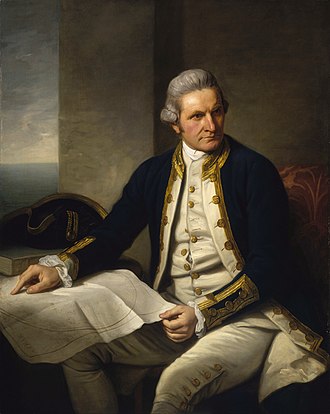
Captain James Cook (7 November 1728 – 14 February 1779) was a British Royal Navy officer, explorer, and cartographer who led three voyages of exploration to the Pacific and Southern Oceans between 1768 and 1779. He completed the first recorded circumnavigation of the main islands of New Zealand, and led the first recorded visit by Europeans to the east coast of Australia and the Hawaiian Islands.
Cook joined the British merchant navy as a teenager before enlisting in the Royal Navy in 1755. He first saw combat during the Seven Years' War, when he fought in the Siege of Louisbourg. Later in the war he surveyed and mapped much of the entrance to the St. Lawrence River during the Siege of Quebec. In the 1760s he mapped the coastline of Newfoundland and made important astronomical observations which brought him to the attention of the Admiralty and the Royal Society. This acclaim came at a pivotal moment in British overseas exploration, and it led to his commission in 1768 as commander of HMS Endeavour for the first of his three voyages.
During these voyages, Cook sailed tens of thousands of miles across largely uncharted areas, mapping coastlines, islands, and features across the globe in greater detail than previously charted – including Easter Island, Alaska and South Georgia Island. He made contact with numerous indigenous peoples and claimed several territories for the Kingdom of Great Britain. Renowned for exceptional seamanship and courage in times of danger, he was patient, persistent, sober, and competent, but sometimes hot-tempered. His contributions to the prevention of scurvy, a disease common among sailors, led the Royal Society to award him the Copley Gold Medal.

In 1779, during his second visit to Hawaii, Cook was killed when a dispute with Native Hawaiians turned violent. His voyages left a legacy of scientific and geographical knowledge that influenced his successors well into the 20th century. Numerous memorials have been dedicated to him worldwide.
Early life
James Cook was born on 7 November 1728 in the village of Marton, located in the North Riding of Yorkshire, approximately 8 miles (13 km) from the sea. He was the second of eight children of James Cook, a Scottish farm labourer from Ednam in Roxburghshire, and his wife, Grace Pace, from Thornaby-on-Tees. In 1736, his family moved to Airey Holme farm at Great Ayton, where his father's employer, Thomas Skottowe, paid for Cook to attend a school run by a charitable foundation. In 1741, after five years of schooling, he began working for his father who had been promoted to farm manager.
In 1745, when he was 16, Cook relocated 20 miles (32 km) to Staithes, a fishing village, to be apprenticed as a shopboy to grocer and haberdasher William Sanderson. After 18 months, Cook, proving not suited for shop work, travelled to the nearby port town of Whitby and was introduced to Sanderson's friends John and Henry Walker. The Walkers were prominent local ship owners in the coal trade.

Cook was taken on as a merchant navy apprentice in the Walkers' small fleet of vessels, carrying coal along the English coast. His first assignment was aboard the collier Freelove. He spent several years aboard her and various other coasters, sailing between the Tyne and London. As part of his apprenticeship, Cook applied himself to the study of algebra, geometry, trigonometry, navigation and astronomy, all skills needed to command a ship.
Upon completing his three-year apprenticeship, Cook began working on merchant ships in the Baltic Sea. After obtaining his mariner licence in 1752 he was promoted to the rank of mate and began serving on the collier brig Friendship. He served as mate on the Friendship for two and a half years, visiting ports in Norway and the Netherlands, learning to navigate in shallow waters along the east coast of Britain, and traversing the Irish Sea and the English Channel.
Royal Navy
At the age of 26, Cook was offered a promotion to captain of Friendship, but he declined and instead joined the Royal Navy at Wapping on 17 June 1755. He entered the navy when Britain was expanding its naval forces in anticipation of the conflict that became known as the Seven Years' War. Cook's first posting was two years aboard HMS Eagle, serving as able seaman and master's mate under Captain Joseph Hamar and, later, Captain Hugh Palliser. In October and November 1755 he took part in Eagle's capture of one French warship and the sinking of another. Following the death of Eagle's boatswain, Cook was unofficially promoted to fill that role in January 1756. His first command was in March 1756 when he was briefly in charge of Cruizer, a small cutter attached to Eagle. In June 1757, Cook passed his master's examinations at Trinity House, Deptford, qualifying him to navigate and handle a ship of the King's fleet. He then joined the sixth-rate frigate HMS Solebay as ship's master under Captain Robert Craig.

Seven Years' War
During the Seven Years' War, Cook served in North America as master aboard the fourth-rate Navy vessel HMS Pembroke. With others in Pembroke's crew, he took part in the major amphibious assault that captured the Fortress of Louisbourg in Nova Scotia from the French in 1758.
The day after the fall of Louisbourg, Cook met an army officer, Samuel Holland, who was using a plane table to survey the area. The two men had an immediate connection through their interest in surveying, and Holland taught Cook the methods he was using. They collaborated on developing preliminary charts of the entrance to the St. Lawrence River, with Cook writing the accompanying sailing directions. Cook's first map to be engraved and printed was of Gaspé Bay, drawn in 1758 and published in 1759. The integration of Holland's land-surveying techniques with Cook's hydrographic expertise enabled Cook, from that point forward, to produce nautical charts of coastal regions that significantly exceeded the accuracy of most contemporary charts.
As Major-General James Wolfe's advance on Quebec progressed in 1759, Cook and other ships' masters took soundings, marked shoals, and updated charts – particularly around Quebec. This information enabled Wolfe to mount a stealthy nighttime attack by transporting troops across the river, leading to victory in the Battle of the Plains of Abraham.

Newfoundland
As the Seven Years' War came to a close, Cook was tasked with charting the rugged coast of Newfoundland. He was appointed master of HMS Grenville, and spent five seasons producing charts. He surveyed the north-west stretch in 1763 and 1764, the south coast between the Burin Peninsula and Cape Ray in 1765 and 1766, and the west coast in 1767. Cook employed local pilots to point out the rocks and hidden dangers.
Cook severely injured his right hand in August 1764 when a powder horn he was carrying exploded. In July 1765, Cook experienced the first of several ship groundings he faced during his career: Grenville struck an uncharted rock, and cargo had to be unloaded before she could be refloated.
While in Newfoundland, Cook precisely recorded apparent (or local) time of the start and end of the solar eclipse of 5 August 1766. He sent the results to the English astronomer John Bevis, who compared them with the same data from an observation of the eclipse carried out in Oxford and calculated the difference in longitude between the two locations. The results were communicated to the Royal Society in 1767 and the longitude position obtained was used by Cook in his printed sailing directions for Newfoundland.

At the end of the 1767 surveying season, while HMS Grenville was returning to her home port of Deptford, Cook encountered a storm at the entrance to the Thames. He anchored Grenville off the Nore lighthouse and prepared the ship to ride out the weather. An anchor cable snapped, causing the ship to run aground on a shoal. Despite efforts to refloat her, Cook and his crew were forced to abandon ship. They returned when the storm abated, lightened and rerigged the ship, and continued into Deptford.
Exploration of the Pacific Ocean
Cook's achievements in North America – hydrographic and astronomical – were noticed by the Admiralty, and came at a pivotal moment in British overseas exploration. Europeans had started exploring the Pacific Ocean in the early 16th century, and by the mid-18th century they had charted much of the ocean's perimeter, and were actively engaged in trade with the Philippines, Spice Islands, and Mexico. Yet vast regions of the ocean remained largely unexplored by Europeans, including the coastlines of Canada and Alaska, much of the southern Pacific, and the central oceanic expanse. Several major questions persisted: Did a North-West Passage connect the North Pacific with the North Atlantic? Did the hypothesised continent of Terra Australis Incognita (undiscovered southern land) exist? And were there yet-undiscovered cultures or lands in the central Pacific?
The Treaty of Paris – signed when the Seven Years' War ended in 1763 – enabled the Royal Navy to redirect resources from warfare to exploration. Britain soon dispatched several explorers to the Pacific Ocean, including John Byron, Samuel Wallis, and Philip Carteret. They returned with accounts of Tahiti, and reported sightings of Terra Australis – setting the stage for Cook's first voyage.

First voyage (1768–1771)
Cook's first scientific voyage was a three-year expedition to the south Pacific Ocean aboard HMS Endeavour, conducted from 1768 to 1771. The voyage was jointly sponsored by the Royal Navy and Royal Society. The publicly stated goal was to observe the 1769 transit of Venus from the vantage point of Tahiti. Additional objectives – outlined in secret orders – were searching for the postulated Terra Australis and claiming lands for Britain.
In early 1768, the Admiralty asked the shipwright Adam Hayes to select a vessel for the expedition; he chose the merchant collier Earl of Pembroke, which the Royal Navy renamed Endeavour. On 5 May 1768 – based on the recommendation of Hugh Palliser – Cook, aged 39, was selected by the Admiralty to lead the voyage. The next day he took his examination for the rank of lieutenant – a rank which was required to command a ship armed with the number of guns planned for Endeavour.
Like most colliers, Endeavour had a large hold, a sturdy construction that would tolerate grounding, was small enough to be careened (laid on her side for repairs), and had a shallow draught that enabled navigating in shallows. Upon completion of the first voyage, Cook wrote: "It was to these properties in her, those on board owe their Preservation. Hence I was enabled to prosecute Discoveries in those Seas so much longer than any other Man ever did or could do." When selecting ships for his second voyage in 1772, Cook chose the same type of ship, from the same shipbuilder.
The Admiralty authorised a ship's company of 73 sailors and 12 marines. Cook's second lieutenant was Zachary Hicks, and his third lieutenant was John Gore, a 16-year naval veteran who had already circumnavigated the world twice aboard HMS Dolphin. Also on the ship were astronomer Charles Green and 25-year-old naturalist Joseph Banks. Banks provided funding for seven others to join the journey: the naturalists Daniel Solander and Herman Spöring, the artists Alexander Buchan and Sydney Parkinson, two black servants, and a secretary.
Tierra del Fuego
The expedition departed England on 25 August 1768 and headed south to round Cape Horn into the Pacific. They made a stop in Tierra del Fuego, where Cook composed his first anthropological essay, detailing his observations of the indigenous Haush people. Banks went ashore with several members of his party to collect botanical specimens. During the overnight excursion, his two black servants, Thomas Richmond and George Dorlton, froze to death.
Tahiti
The ship continued westward across the Pacific, arriving at Tahiti on 13 April 1769, where the observations of the transit of Venus were made. In May, Cook and some of his crew observed Tahitians surfing – becoming the first Europeans to witness the practice.
In June, two incidents happened that recurred in various forms throughout Cook's voyages: Tahitians were offended when some of his crew took rocks – to use as ship's ballast – from a sacred marae without permission. In a separate event, Tahitians took various items from the crew, prompting Cook to seize 22 canoes – many of which did not belong to the individuals responsible – as ransom until the stolen property was returned.
In July, two marines deserted by taking local wives and going into hiding, intending to remain on the island. In response, Cook detained a Tahitian chief as a hostage to compel the local community to locate and return the deserters. Cook then sailed from Tahiti to the nearby island of Huahine, then to Raiatea where he claimed Raiatea-Taha'a and the islands of Huahine, Borabora, Tupai, and Maupiti for Britain, naming them the Society Islands.
New Zealand
As directed by his secret orders, Cook began his search for the postulated southern continent of Terra Australis. He sailed to New Zealand and – in October 1769 – landed at Poverty Bay near the Tūranganui River. With the aid of Tupaia, a Tahitian priest who had joined the expedition, Cook was the first European to communicate with the Māori. However, encounters with them on the first two days turned violent, the British shooting several dead. Cook's approach to interactions with the Māori was to offer greetings and exchange gifts, in an attempt to establish friendly relations. But if his crew was threatened, he often ordered a quick and decisive use of force, despite his instructions from the Royal Society.
Sailing north, Endeavour anchored at Mercury Bay on 9 November where Cook observed the transit of Mercury and claimed the bay for Britain. In January 1770, Cook arrived in Queen Charlotte Sound, on the north coast of New Zealand's South Island. He claimed the location for Britain and it became a favourite base for his future voyages. While there, Cook came upon Māori eating the flesh of enemies they had recently killed, which confirmed stories of cannibalism his crew had heard in Poverty Bay. Cook established that a strait separated the North Island from the South Island and then completed the circumnavigation of New Zealand's main islands, mapping almost the complete coastline.
Australia
Convinced that no unknown southern continent existed in those latitudes, Cook continued west. On 19 April 1770, Point Hicks was sighted, and the crew became the first Europeans to encounter Australia's eastern coastline. Endeavour continued northwards along the coastline, keeping the land in sight, while Cook charted and named landmarks along the way. During this stretch, Cook saw several Aboriginal Australians on shore, but was unable to draw close enough to make contact.
On 29 April they made their first landfall on the continent in Botany Bay. In the expedition's first direct encounter with Aboriginal Australians, two Gweagal men opposed the landing and in the following confrontation one warrior was wounded with small shot. Cook and his crew stayed at Botany Bay for a week, exploring the surrounding area and collecting water, timber, fodder, and botanical specimens. Cook attempted to establish relations with the Aboriginal people but concluded that they only wanted the British to leave.
After departing Botany Bay they continued northwards, hugging the coast and charting it. They stopped at Bustard Bay in May 1770, then proceeded north through the shallow and extremely dangerous Great Barrier Reef. On 11 June Endeavour ran aground on the reef at high tide. The ship was stuck fast, so Cook ordered all excess weight thrown overboard, including six cannons. She was eventually hauled off after 27 hours. The ship was leaking badly, so the crew fothered the damage (hauling a spare sail under the ship to cover and slow the leak). Cook then careened the ship on a beach at the mouth of the Endeavour River for seven weeks while repairs were made.
The crew explored the surrounding area, where Cook observed a kangaroo for the first time. One was killed and the species was documented by Banks. The local Guugu Yimithirr people generally avoided the British, although following a dispute over green turtles, Cook ordered shots to be fired, and one local was lightly wounded.
The expedition continued northward until they reached the north-east tip of Australia: Cape York. Cook proceeded to a nearby island where he scanned the surrounding waters for a route forward. There he claimed the entire Australian coast that he had surveyed as British territory and named the island Possession Island. The expedition then turned west and continued homewards through the shallow and dangerous waters of the Torres Strait.
Return to England
In October 1770, Cook stopped in Batavia (modern Jakarta, Indonesia), where the Dutch dockyard facilities were used to inspect and repair the damage from running aground on the Great Barrier Reef.
After departing Batavia in late December 1770, the expedition sailed to the Cape of Good Hope, then to the island of Saint Helena, arriving on 30 April 1771.
The stay in Batavia marked the onset of the most severe outbreak of illness and death endured during any of Cook's voyages: seven crew members died in Batavia, and a further 23 perished on the return journey to England. The majority of the deaths were caused by dysentery (with some attributed to tuberculosis and possibly typhoid fever) often worsened by malaria.
The ship finally returned to England on 12 July 1771, anchoring in the Downs. In August, Cook was promoted to the rank of commander. A book about the voyage, based on the journals of Cook and Banks, was published in 1773.
Second voyage (1772–1775)
In 1772, Cook was commissioned to lead a second scientific expedition on behalf of the Royal Society, with the objective of determining the existence of the hypothetical continent Terra Australis. Cook created a plan to probe southward in the southern summer, then retreat to more northerly, warmer, regions in the frigid southern winter.
This voyage would have two ships and, unlike the first voyage, Cook selected them himself: HMS Resolution commanded by him, and HMS Adventure, commanded by Tobias Furneaux. Resolution began her career as the North Sea collier Marquis of Granby, launched at Whitby in 1770. She was fitted out at Deptford with some of the most advanced equipment available, including an azimuth compass, ice anchors, and an apparatus for distilling fresh water from sea water.
Banks planned to travel with Cook in the second voyage, but Banks' excessive demands for modifications to the ship conflicted with the Admiralty's constraints, so he withdrew from the voyage before it departed. Banks was replaced by the German naturalist Johann Reinhold Forster and his son, Georg Forster. The crew also included the astronomer William Wales (responsible for the new K1 chronometer carried on Resolution), lieutenant Charles Clerke, and the artist William Hodges.
Search for Terra Australis
After departing England, the ships travelled south to the Dutch Cape Colony and stopped at Cape Town in November 1772. From there they sailed eastwards, planning to circumnavigate the globe roughly between latitude 50°S and 70°S. In late November 1772, the ships sighted their first icebergs and Cook performed an experiment: his crew retrieved blocks of ice and melted them on board the ships, producing good quality fresh water, proving that drinking water could be obtained from sea ice. On 17 January 1773 the crews became the first recorded Europeans to cross the Antarctic Circle. Despite his mission to find Terra Australis, Cook never sighted Antarctica in any of his voyages, but on 18 January – unbeknownst to him – the ships approached within 75 miles (121 km) of that continent.
In February 1773, in dense Antarctic fog, Resolution and Adventure became separated. Furneaux made his way – via Tasmania – to a pre-arranged rendezvous point to be used in the event of separation: Queen Charlotte Sound in New Zealand. Cook joined Furneaux there in May. The crews traded with the Māori people, and in his journal, Cook expressed concern that crew members might be transmitting diseases to the Māori people and encouraging prostitution.
Tahiti and New Zealand
The ships departed New Zealand in June – the southern winter – to resume their eastward search for Terra Australis. About a month after leaving New Zealand, 20 crewmen aboard Adventure contracted scurvy – one of whom died – because Furneaux had failed to follow Cook's dietary instructions. The ships proceeded in a small anti-clockwise loop, visiting Tahiti and Tonga, planning to return to New Zealand together. Before reaching New Zealand, in the night of 29–30 October, the ships became separated for a second time – this time due to a storm. Cook proceeded to the rendezvous point, and waited three weeks, then departed to continue the voyage alone.
Delayed by storms, Furneaux arrived at the designated rendezvous point in Queen Charlotte Sound five weeks after they separated, missing Cook by four days. In December 1773, while ten members of Adventure's crew were ashore gathering provisions, a violent altercation occurred with a group of Māori, resulting in the deaths of all the crewmen and two Māori. Furneaux discovered the bodies of the crew members, partially burned in preparation for cannibalism. Many members of Adventure's crew wanted to exact revenge on the Māori, but Furneaux thought it prudent to avoid additional violence, so they left New Zealand and returned to Britain without Cook. When learning about the deaths much later, Cook wondered if Furneaux's crew was at fault, writing "I must ... observe in favour of the New Zealanders that I have always found them of a brave, noble, open and benevolent disposition".
Circuit around the South Pacific
After the missed rendezvous, Resolution made a large anti-clockwise loop in the south Pacific: heading far south, then visiting Easter Island and Tonga, and finally returning to New Zealand. In the first stretch of this large loop, Resolution continued her search for Terra Australis by heading south-east, reaching her most southern latitude of 71°10′S in January 1774. At this point, the ship's progress was blocked by impenetrable pack ice, and Cook wrote in his private diary: "I will not say it was impossible anywhere to get in among this Ice, but I will assert that the bare attempting of it would be a very dangerous enterprise and what I believe no man in my situation would have thought of. I whose ambition leads me not only farther than any other man has been before me, but as far as I think it possible for man to go..."