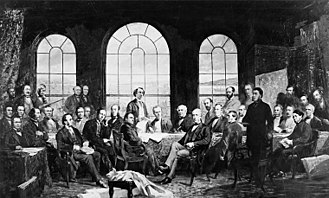
Canadian Confederation (French: Confédération canadienne) was the process by which three British North American provinces—the Province of Canada, Nova Scotia, and New Brunswick—were united into one federation, called the Dominion of Canada, on July 1, 1867. This process occurred with the rising tide of Canadian nationalism that was then beginning to swell within these provinces and others. It reached fruition through the British North America Act, 1867 (today known as the Constitution Act, 1867) which had been based on resolutions agreed to by colonial delegates in the 1864 Quebec Conference, later finalized in the 1866 London Conference.
Upon Confederation, Canada consisted of four provinces: Ontario and Quebec, which had been split out from the Province of Canada, and the provinces of Nova Scotia and New Brunswick. The province of Prince Edward Island, which had hosted the first meeting to consider Confederation, the Charlottetown Conference, did not join Confederation until 1873. Over the years since Confederation, Canada has seen numerous territorial changes and expansions, resulting in the current collection of ten provinces and three territories.
Political impasse in the Province of Canada and the loss of preferential access to U.S. markets after Washington cancelled the Canadian–American Reciprocity Treaty in 1866 sharpened the colonies' sense of economic vulnerability and motivated the desire for federal unification and market integration. The leaders of the Maritime colonies pressed for Ottawa's assumption of their public debts and for an intercolonial railway that would bind the trade of the St. Lawrence to an ice-free Atlantic port, while politicians across Canada West and Canada East saw federation as the only way to break legislative deadlock and finance large-scale infrastructure. At the same time, lingering fears of the U.S. concept of manifest destiny, memories of the Fenian raids, and Britain's desire to off-load defence costs persuaded many that a larger fiscal and military union offered the surest bulwark against American pressure and metropolitan indifference. The motto "peace, order, and good government" arose as an expression of a distinctly Canadian formulation of constitutional government in North America.

While historians have often portrayed Confederation as having emerged from pragmatic and administrative rationales, recent scholarship has uncovered a rich contest of ideas beneath the politicking, involving competing conceptions of order, power, liberty, rights, national development, and imperial autonomy. Confederation's legacy remains debated, celebrated as the moment Canada's people assumed control of its own development and started on the course to sovereignty, questioned for the limited place it left Indigenous peoples, and continually reinterpreted as constitutional debates over such things as the nature of Canadian federalism or the character of the founding compact reshape the understanding of its impact and significance.
Terminology
Confederation
Canada is a federation, rather than a confederate association of sovereign states, which is what confederation means in contemporary political theory. The country, though, is often considered to be among the world's more decentralized federations. Use of the term confederation arose in the Province of Canada to refer to proposals beginning in the 1850s to federate all of the British North American colonies, as opposed to only Canada West (now Ontario) and Canada East (now Quebec). To contemporaries of Confederation, the con- prefix indicated a strengthening of the centrist principle compared to the American federation.
In this Canadian context, confederation describes the political process that united the colonies in 1867, events related to that process, and the subsequent incorporation of other colonies and territories. The word is now often used to describe Canada in an abstract way, such as in "the Fathers of Confederation"; provinces that became part of Canada after 1867 are also said to have joined, or entered into, Confederation (but not the Confederation). The term is also used to divide Canadian history into pre-Confederation and post-Confederation periods.

Fathers of Confederation
The original Fathers of Confederation are those delegates who attended any of the conferences held at Charlottetown and Quebec in 1864 or in London, United Kingdom, in 1866, leading to Confederation. There were 36 original Fathers of Confederation; Hewitt Bernard, who was the recording secretary at the Charlottetown Conference, is considered by some to be among them.
The individuals who brought the other provinces into Confederation after 1867 are also referred to as Fathers of Confederation. In this way, Amor De Cosmos, who was instrumental both in bringing democracy to British Columbia and in bringing the province into Confederation, is considered to be a Father of Confederation. As well, Joey Smallwood referred to himself as "the Last Father of Confederation" because he helped lead Newfoundland into the union in 1949.
History
Colonial organization
All the former colonies and territories that became involved in the Canadian Confederation on July 1, 1867, were initially part of New France, and were once ruled by France. Nova Scotia was granted in 1621 to Sir William Alexander under charter by James I. This claim overlapped the French claims to Acadia, and although the Scottish colony of Nova Scotia was short-lived, for political reasons, the conflicting imperial interests of France and the 18th century Great Britain led to a long and bitter struggle for control. The British acquired present-day mainland Nova Scotia by the Treaty of Utrecht of 1713 and the Acadian population was expelled by the British in 1755. They renamed Acadia "Nova Scotia", which included present-day New Brunswick. The rest of New France was acquired by the British as the result of its defeat of New France in the Seven Years' War, which ended with the Treaty of Paris in 1763. From 1763 to 1791, most of New France became the Province of Quebec. However, in 1769 the present-day Prince Edward Island, which had been part of Acadia, was renamed "St John's Island" and organized as a separate colony. It was renamed "Prince Edward Island" in 1798 in honour of Prince Edward, Duke of Kent and Strathearn.

The first English attempt at settlement on that part of the continent that would become modern Canada had been in Newfoundland which would not join Confederation until 1949. The Society of Merchant Venturers of Bristol began to settle Newfoundland and Labrador at Cuper's Cove as far back as 1610, and Newfoundland had also been the subject of a French colonial enterprise.
During and after the U.S. War of Independence, an estimated 50,000 United Empire Loyalists fled to British North America. The British created the separate province of New Brunswick in 1784 for Loyalists who settled in the western part of Nova Scotia. Nova Scotia (including New Brunswick) received slightly more than half of this influx, and many Loyalists settled in the province of Quebec, which later by the Constitutional Act 1791 was separated into a predominantly English Upper Canada and a predominantly French Lower Canada. The War of 1812 and Treaty of 1818 established the border between British North America and the United States at the 49th parallel from the Great Lakes to the Rocky Mountains in Western Canada.
Following the Rebellions of 1837, Lord Durham in his Durham Report, recommended Upper and Lower Canada be joined as the Province of Canada and the new province should have a responsible government. As a result of Durham's report, the British Parliament passed the Act of Union 1840, and the Province of Canada was formed in 1841. The new province had two parts: Canada West (the former Upper Canada, today's Ontario) and Canada East (the former Lower Canada, today's Quebec). Governor General Lord Elgin granted ministerial responsibility in 1848, first to Nova Scotia and then to the Province of Canada. Later, the British parliament extended responsible government to Prince Edward Island (1851), New Brunswick (1854), and Newfoundland (1855).
The area constituting modern-day British Columbia is the remnants of the Hudson's Bay Company's Columbia District and New Caledonia District following the Oregon Treaty. Before joining Canada in 1871, British Columbia consisted of the separate Colony of British Columbia (formed in 1858, in an area where the Crown had granted a monopoly to the Hudson's Bay Company), and the Colony of Vancouver Island (formed in 1849) constituting a separate crown colony until it was united with the colony of British Columbia in 1866.
The remainder of modern-day Canada was made up of Rupert's Land and the North-Western Territory (both of which were controlled by the Hudson's Bay Company and sold to Canada in 1870) and the Arctic Islands, which were under direct British control and became a part of Canada in 1880. Plus, Newfoundland and Labrador joined Canada in 1949.
Early attempts
The idea of joining the various colonies in North America was being floated as early as 1814. That year, Chief Justice of Lower Canada Jonathan Sewell sent a copy of his report, A Plan for the federal Union of British Provinces in North America, to Prince Edward (both a son of King George III and the father of Queen Victoria), whom Sewell had befriended when they both resided in Quebec City. Edward replied, "nothing can be better arranged than the whole thing is, or more perfectly", going on to suggest a unified Canada consisting of two provinces—one formed from Upper and Lower Canada and the other from the Maritime colonies—each with a lieutenant governor and executive council, one located in Montreal and the other in either Annapolis Royal or Windsor. Edward said he would pass the report on to the Earl Bathurst, the then-Secretary of State for War and the Colonies; the Prince's comments and critiques were later cited by both the Earl of Durham and participants of the Charlottetown and Quebec Conferences.
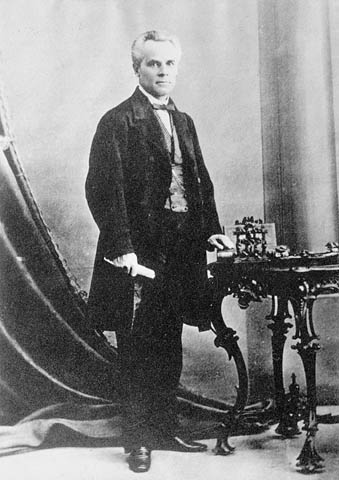
Lord Durham presented his idea of unification in 1839 Report on the Affairs of British North America, which resulted in the Act of Union 1840. Beginning in 1857, Joseph-Charles Taché proposed a federation in a series of 33 articles published in the Courrier du Canada. Two years later, Alexander Tilloch Galt, George-Étienne Cartier, and John Ross travelled to the United Kingdom to present the British Parliament with a project for confederation of the British colonies. The proposal was received by the London authorities with polite indifference.
The royal tour of British North America undertaken by Queen Victoria's son, Prince Albert Edward (later King Edward VII) in 1860, however, helped lead to the unification of the colonies by confirming a common bond between their inhabitants; indeed, the monarchy played a "pivotal legal and symbolic role [...] in cementing the new Canadian union". Further, by 1864, it was clear that continued governance of the Province of Canada under the terms of the 1840 Act of Union had become impracticable. Therefore, a grand coalition of parties, the Great Coalition, formed in order to reform the political system. Queen Victoria remarked on "the impossibility of our being able to hold Canada; but, we must struggle for it; and by far the best solution would be to let it go as an independent kingdom under an English prince."
Influences leading to Confederation
Several factors influenced Confederation, caused both by internal sources and pressures from external sources.

Internally, there was political deadlock resulting from the contemporary governmental structure in the Province of Canada and distrust between English Protestants and French Catholics. Further, demographic pressure from an expanding population and economic nationalism wanting economic development butted against a lack of an inter-colonial railroad, which hampered trade, military movement, and transportation in general.
Externally, the Canadian–American Reciprocity Treaty (a free trade policy, starting in 1854, whereby products were allowed into the United States without taxes or tariffs, which was then considered to be beneficial for Canada) was cancelled by the United States in 1865, partly as revenge against Britain for unofficial support of the south in the American Civil War. Additionally, the U.S. doctrine of "manifest destiny" raised fears of another American invasion (Canadians had fended off American incursions during the Revolutionary War, War of 1812, Fenian raids, and St. Albans Raid), only further inflamed by the Alaska Purchase of March 30, 1867, which had been supported in the U.S. Senate (by Charles Sumner among others) precisely in terms of taking the remainder of North America from the British. The American Civil War had also horrified Canadians and turned many from the thought of republicanism. In Britain, political pressure came from financiers who had lost money by investing in the failed Grand Trunk Railway and the little Englander philosophy fed a desire to withdraw troops from Britain's colonies.
Ideological origins and philosophical dimensions
There is extensive scholarly debate on the role of political ideas in Canadian Confederation. Traditionally, historians regarded Canadian Confederation an exercise in political pragmatism that was essentially non-ideological. In the 1960s, historian Peter Waite derided the references to political philosophers in the legislative debates on Confederation as "hot air". In Waite's view, Confederation was driven by pragmatic brokerage politics and competing interest groups.
In 1987, political scientist Peter J. Smith challenged the view Canadian Confederation was non-ideological. Smith argued Confederation was motivated by new political ideologies as much as the American and French Revolutions and Canadian Confederation was driven by a Court Party ideology. Smith traces the origins of this ideology to eighteenth and nineteenth-century Britain, where political life was polarized between defenders of classical republican values of the Country Party and proponents of a new pro-capitalist ideology of the Court Party, which believed in centralizing political power. In British North America in the late 1860s, the Court Party tradition was represented by the supporters of Confederation, whereas the anti-capitalist and agrarian Country Party tradition was embodied by the Anti-Confederates.
In a 2000 journal article, historian Ian McKay argued Canadian Confederation was motivated by the ideology of liberalism and the belief in the supremacy of individual rights. McKay described Confederation as part of the classical liberal project of creating a "liberal order" in northern North America. Many Canadian historians have adopted McKay's liberal order framework as a paradigm for understanding Canadian history.
In 2008, historian Andrew Smith advanced a very different view of Confederation's ideological origins. He argues that in the four original Canadian provinces, the politics of taxation were a central issue in the debate about Confederation. Taxation was also central to the debate in Newfoundland, the tax-averse colony that rejected it. Smith argued Confederation was supported by many colonists who were sympathetic to a relatively interventionist, or statist, approach to capitalist development. Most classical liberals, who believed in free trade and low taxes, opposed Confederation because they feared it would result in Big Government. The struggle over Confederation involved a battle between a staunch individualist economic philosophy and a comparatively collectivist view of the state's proper role in the economy. According to Smith, the victory of the statist supporters of Confederation over their anti-statist opponents prepared the way for John A. Macdonald's government to enact the protectionist National Policy and to subsidize major infrastructure projects such as the Intercolonial and Pacific Railways.
In 2007, political scientist Janet Ajzenstat connected Canadian Confederation to the individualist ideology of John Locke. She argued that the union of the British North American colonies was motivated by a desire to protect individual rights, especially the rights to life, liberty, and property. She contends the Fathers of Confederation were motivated by the values of the Enlightenment of the seventeenth and eighteenth centuries. She argues their intellectual debts to Locke are most evident when one looks at the 1865 debates in the Province of Canada's legislature on whether or not union with the other British North American colonies would be desirable.
Charlottetown Conference
In the spring of 1864, New Brunswick premier Samuel Leonard Tilley, Nova Scotia premier Charles Tupper, and Prince Edward Island premier John Hamilton Gray were contemplating the idea of a Maritime Union which would join their three colonies together.
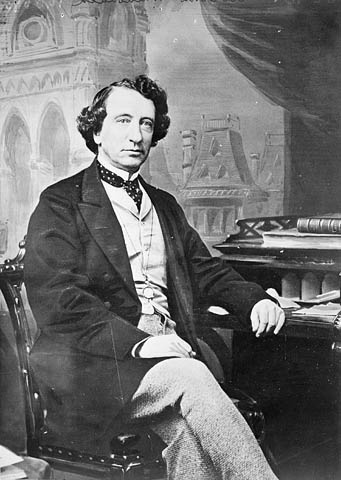
The government of the Province of Canada surprised the Maritime governments by asking if the Province of Canada could be included in the negotiations. The request was channelled through the governor general, Monck, to London and accepted by the Colonial Office. After several years of legislative paralysis in the Province of Canada caused by the need to maintain a double legislative majority (a majority of both the Canada East and Canada West delegates in the Province of Canada's legislature), Macdonald had led his Liberal-Conservative Party into the Great Coalition with Cartier's Parti bleu and George Brown's Clear Grits. Macdonald, Cartier, and Brown felt union with the other British colonies might be a way to solve the political problems of the Province of Canada.
The Charlottetown Conference began on September 1, 1864. Since the agenda for the meeting had already been set, the delegation from the Province of Canada was initially not an official part of the Conference. The issue of Maritime Union was deferred and the Canadians were formally allowed to join and address the Conference.
No minutes from the Charlottetown Conference survive, but it is known Cartier and Macdonald presented arguments in favour of a union of the three colonies, Alexander Tilloch Galt presented the Province of Canada's proposals on the financial arrangements of such a union, and George Brown presented a proposal for what form a united government might take. The Canadian delegation's proposal for the governmental system involved:
preservation of ties with Great Britain
residual jurisdiction left to a central authority
a bicameral system including a Lower House with representation by population (rep by pop) and an Upper House with representation based on regional, rather than provincial, equality
responsible government at the federal and provincial levels
the appointment of a Canadian governor general by the British Crown
Other proposals attractive to the politicians from the Maritime colonies were:
assumption of provincial debt by the central government
revenues from the central government apportioned to the provinces on the basis of population
the building of an intercolonial railway to link Montreal and Halifax, giving Canada access to an ice-free winter port and the Maritimes easy access to Canada and Rupert's Land
By September 7, 1864, the delegates from Nova Scotia, New Brunswick and Prince Edward Island gave a positive answer to the Canadian delegation, expressing the view the federation of all of the provinces was considered desirable if the terms of union could be made satisfactory and the question of Maritime Union was waived.
After the Conference adjourned on September 9, there were further meetings between delegates held at Halifax, Saint John, and Fredericton. These meetings evinced enough interest that the delegates decided to hold a second Conference.
Delegates' reactions
One of the most important purposes of the Charlottetown Conference was the introduction of Canadians to the leaders from the Maritime Provinces and vice versa. At this point, there was no railway link from Quebec City to Halifax, and the people of each region had little to do with one another. Thomas D'Arcy McGee was one of the few Canadian delegates who had been to the Maritimes, when he had gone down earlier that summer with a trade mission of Canadian businessmen, journalists and politicians.
George Brown remarked in a letter to his wife Anne that at a party given by the premier of PEI, Colonel John Hamilton Gray, he met a woman who had never been off the island in her entire life. Nevertheless, he found Prince Edward Islanders to be "amazingly civilized".
Press and popular reaction
Reaction to the Charlottetown Conference varied among the different newspapers. In the Maritimes, there was concern that the smooth Canadians with their sparkling champagne and charming speeches were outsmarting the delegates of the smaller provinces. "From all accounts it looks as if these [Canadian] gentlemen had it all their own way; ... and that, what with their arguments and what with their blandishments, (they gave a champagne lunch on board the Victoria where Mr. McGee's wit sparkled brightly as the wine), they carried the Lower Province delegates a little off their feet."
The delegates from the Quebec conference considered if the resolutions would be better suited for acceptance if a popular vote were held on them. However, due to the divide amongst religious groups and general mistrust between areas in Canada, they believed that such a vote would be defeated. Thus, they went ahead with the resolutions on their own volition.
Quebec Conference
After returning home from the Charlottetown Conference, Macdonald asked Viscount Monck, the governor general of the Province of Canada to invite delegates from the three Maritime provinces and Newfoundland to a conference with United Canada delegates. At the opening of the conference, a total of 33 delegates were included from the British North American Colonies, including Newfoundland, which had not participated in prior meetings. Monck obliged and the Conference went ahead at Quebec City in October 1864.
The Conference began on October 10, 1864, on the site of present-day Montmorency Park. The Conference elected Étienne-Paschal Taché as its chairman, but it was dominated by Macdonald. Despite differences in the positions of some of the delegates on some issues, the Quebec Conference, following so swiftly on the success of the Charlottetown Conference, was infused with a determinative sense of purpose and nationalism. For the Reformers of Canada West, led by George Brown, the end of what they perceived as French-Canadian interference in local affairs was in sight. For Maritimers such as Tupper of Nova Scotia or Tilley of New Brunswick, horizons were suddenly broadened to take in much larger possibilities for trade and growth.
On the issue of the Senate, the Maritime Provinces pressed for as much equality as possible. With the addition of Newfoundland to the Conference, the three Maritime colonies did not wish to see the strength of their provinces in the upper chamber diluted by simply adding Newfoundland to the Atlantic category. It was the matter of the Senate that threatened to derail the entire proceedings. It was Macdonald who came up with the acceptable compromise of giving Newfoundland four senators of its own when it joined.
The delegates from the Maritimes also raised an issue with respect to the level of government—federal or provincial—that would be given the powers not otherwise specifically defined. Macdonald, who was aiming for the strongest central government possible, insisted this was to be the central government, and in this, he was supported by, among others, Tupper.