
Augustus (born Gaius Octavius; 23 September 63 BC – 19 August AD 14), also known as Octavian (Latin: Octavianus), was the founder of the Roman Empire and the first Roman emperor from 27 BC until his death in AD 14. The reign of Augustus initiated an imperial cult and an era of imperial peace (the Pax Romana or Pax Augusta) when the Roman world was largely free of armed conflict. The principate, a style of government in which the emperor showed nominal deference to the Senate, was established during his reign and lasted until the Crisis of the Third Century.
Octavian was born into an equestrian branch of the gens Octavia. Octavian's great-uncle, the dictator Julius Caesar, named him as his primary heir in his will, and after Caesar's assassination in 44 BC, Octavian inherited his estate and assumed his name. He fought for the loyalty of Caesar's legions. He was made a senator during a state emergency and seized power by marching on Rome in 43 BC, becoming its youngest elected consul. He, Mark Antony, and Marcus Lepidus formed a triumvirate regime with legally sanctioned powers to outlaw and oppose Caesar's assassins and their allies. Following their victory at the Battle of Philippi in 42 BC, the triumvirate divided the Roman Republic among themselves and ruled as de facto oligarchs. Competing ambitions eventually tore their alliance apart; Octavian had Lepidus exiled in 36 BC for opposing him in Sicily, while Marcus Agrippa, Octavian's naval commander, defeated Antony in Greece at the Battle of Actium in 31 BC. Antony and his wife Cleopatra, the Ptolemaic queen of Egypt, killed themselves during Octavian's invasion of Egypt, which then became Octavian's personal property.
After the demise of the triumvirate, Augustus reached an accord with the remaining Roman elite: he would restore the facade of a free republic, centered around the Senate, the executive magistrates and the legislative assemblies. But his control of the military and half of Rome's provinces meant he maintained autocratic power legitimized by his appointment as commander-in-chief of most Roman armies. To avoid the appearance of monarchy or dictatorship, he eventually refused to stand for reelection to the consulship, but the Senate granted him the powers of the tribunate and censorship and the titles princeps ('first citizen'), augustus ('the revered'), and pater patriae (lit. 'father of the country'), and named the month of August after him. After the death of Lepidus, Augustus also assumed the title of pontifex maximus ('supreme pontiff').
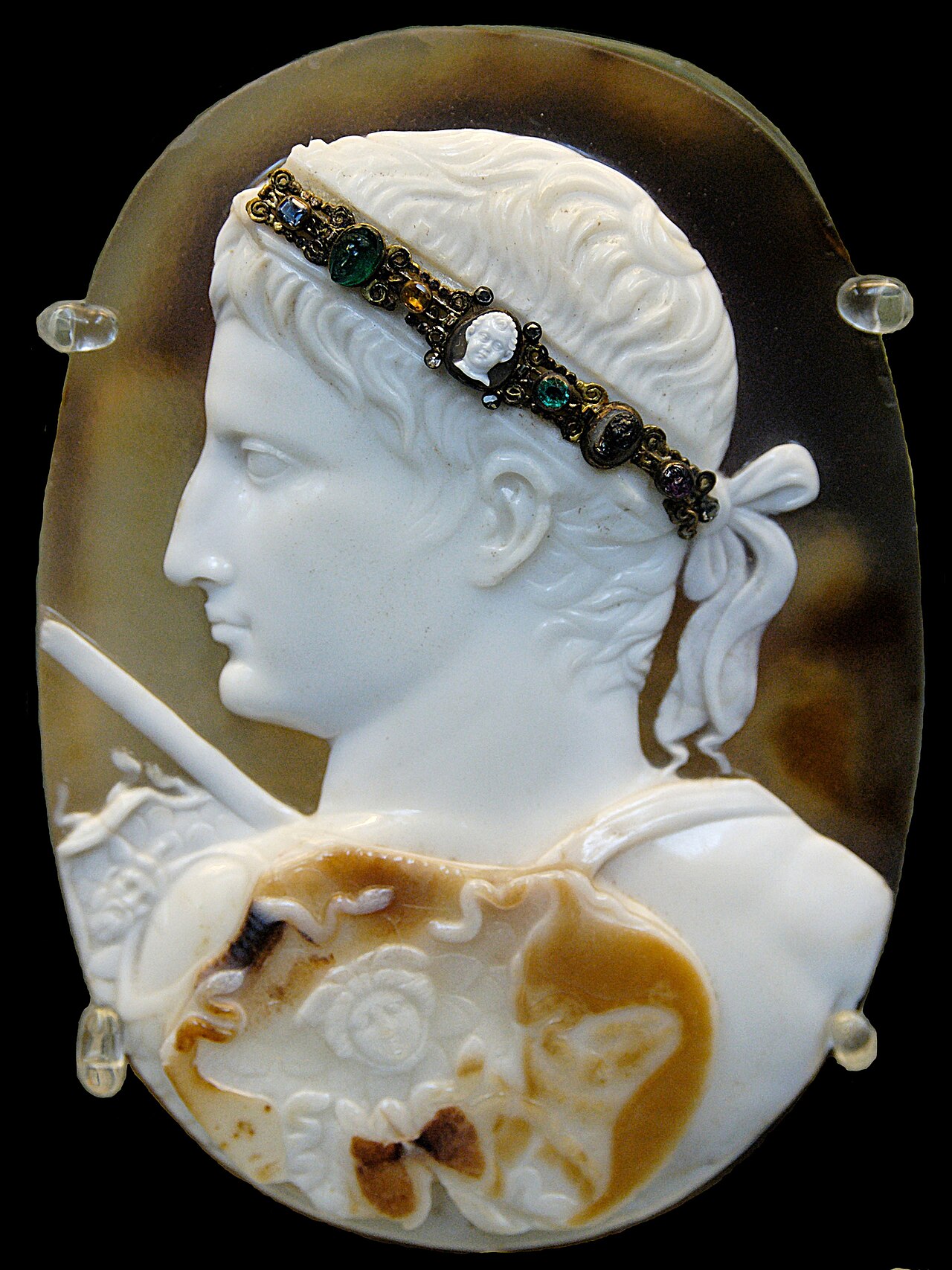
Augustus dramatically enlarged the Empire, annexing Egypt, Dalmatia, Pannonia, Noricum, and Raetia, expanding possessions in Africa, and completing the conquest of Hispania. His expansionism, however, suffered a major setback in Germania. Beyond the frontiers, he secured the empire with a buffer region of client states and negotiated peace treaties with the Parthian Empire and Kingdom of Kush. He reformed the Roman system of taxation and currency, developed networks of roads with an official courier system, established a standing professional army, established the Praetorian Guard as well as official police and fire-fighting services for the city of Rome, and renovated much of the city during his reign. Augustus was a writer and patron of poets such as Virgil, and has been featured in various works of art from ancient to modern times. He died in AD 14 at age 75 from natural causes, and the Senate posthumously deified him. Persistent rumors have claimed his wife Livia poisoned him. He was succeeded as emperor by his stepson and adoptive son Tiberius.
Name
Augustus ( aw-GUST-əs) was known by many names throughout his life:
Gaius Octavius: ( ok-TAY-vee-əs; Latin: [ˈɡaːiʊs ɔkˈtaːwiʊs]). According to Suetonius, Octavius received the cognomen Thurinus (Latin: [tʰuːˈriːnʊs], 'of Thurii') in his infancy to commemorate his father's victory over followers of Spartacus at Thurii. Marcus Junius Brutus, the assassin of Octavian's adoptive father Julius Caesar, rejected Octavian's claim to testamentary adoption by Caesar by referring to him as Octavius.

Gaius Julius Caesar: After Julius Caesar named Octavius his heir in 44 BC, Octavius took Caesar's nomen and cognomen. Historians often distinguished him from the late Caesar by adding Octavianus (Latin: [ɔktaːwiˈaːnʊs]) after the name, denoting that he was a former member of the gens Octavia. There is no evidence that Augustus did this himself, although some of his contemporaries called him Gaius Octavius, Gaius Julius Caesar Octavianus, or "young Caesar". Historians usually refer to him as Octavian ( ok-TAY-vee-ən) for the period between 44 and 27 BC.
Imperator Caesar: Octavian's early coins and inscriptions all refer to him as Gaius Caesar, but by 38 BC he had replaced Gaius with the victory title imperator ('commander'). His family line continued the use of the name Caesar, a cognomen for one branch of the Julian family, and eventually this formed a standard imperial title.
Imperator Caesar Augustus: In 27 BC the Senate granted him the honorific Augustus (Latin: [au̯ˈɡʊstʊs]) ('the revered'). Historians use this name, or its converse Augustus Caesar, to refer to him from 27 BC until his death in AD 14.

Early life
Octavian was born as Gaius Octavius in Rome on 23 September 63 BC, at a family property on the Palatine Hill. His father, Gaius Octavius, came from a moderately wealthy equestrian family of the gens Octavia. He ascended the cursus honorum and served as a proconsular governor of Macedonia. His family was from Velitrae, near Rome, where his son spent part of his childhood. The younger Octavius's mother, Atia, was a niece of Julius Caesar.
After Octavius's father died in 59 BC or 58 BC, his mother married Lucius Marcius Philippus, who was elected as consul in 56 BC. When Octavius's grandmother Julia, sister of Julius Caesar, died in 52 or 51 BC, Octavius delivered her funeral oration, his first public appearance. A Greek slave tutor named Sphaerus educated him in reading, writing, arithmetic, and Greek. Octavius later freed Sphaerus and gave him a state funeral in 40 BC. As a teenager, he studied philosophy under Areios of Alexandria and Athenodorus of Tarsus, Latin rhetoric under Marcus Epidius, and Greek rhetoric under Apollodorus of Pergamon.
Julius Caesar had formed an informal alliance with Pompey and Crassus in 60 BC, but by 49 BC it had fallen apart and Pompey and Caesar were fighting a protracted civil war. In 47 BC, after Octavius donned the toga virilis and became an adult citizen, Caesar had him elected as pontiff, replacing the slain Lucius Ahenobarbus. The following year, Octavius presided over the Greek games commemorating the opening of Caesar's Temple of Venus Genetrix. He wished to join Caesar's staff for the African campaign but gave way when his mother Atia protested over his poor health. Caesar allowed Octavius to proceed next to his chariot during his triumph celebrating the campaign and awarded Octavius with military decorations as if he had been present. In 45 BC Octavius traveled to Hispania to join Caesar's Spanish campaign against Pompey the Younger. On 13 September 45 BC Caesar deposited a new will with the Vestal Virgins naming Octavius as his principal heir.

Rise to power
Heir to Caesar
In 44 BC, Octavius was at Apollonia, Illyria, when Julius Caesar was made Rome's first dictator perpetuo ('dictator in perpetuity') in February, and then assassinated on the Ides of March (15 March). Octavius consulted with Caesar's officers in Macedonia before sailing for Italy to ascertain his political fortunes. Caesar had no living legitimate children under Roman law. His will made Octavius his main heir with the condition that he assume the dead dictator's name. After landing near Brundisium in southern Italy, Octavius received a copy of the will, which bequeathed him three-quarters of Caesar's estate. Against the advice of his stepfather Philippus, Octavius accepted Caesar's will on 8 May 44 BC. He purported that Caesar adopted him as his son and assumed the name Gaius Julius Caesar. His stepfather, Cicero, and other contemporaries referred to him as Octavianus.
Octavian could not rely on his limited funds to make a successful entry into politics. After a warm welcome by Caesar's soldiers at Brundisium, he demanded a portion of the funds allotted by Caesar for his eastern war against the Parthians. This amounted to 700 million sesterces stored at Brundisium, the staging ground in Italy for military operations in the east. Octavian made another bold move when, without official permission, he appropriated the annual tribute from Rome's province of Asia to Italy. He also began to recruit Caesar's veterans and men designated for the Parthian war. On his march to Rome through Italy, Octavian's presence and newly acquired riches won over many, including Caesar's veterans stationed in Campania. By June, he had gathered an army of 3,000 men, paying each a bonus of 500 denarii, which was more than twice a soldier's annual pay.
Growing tensions
Arriving to Rome on 6 May 44 BC, Octavian found consul Mark Antony, Caesar's former colleague, in an uneasy truce with Caesar's assassins. A general amnesty on 17 March pardoned the assassins in exchange for recognition of Caesar's legal acts. Soon afterwards, Antony succeeded in driving most of them out of Rome with an inflammatory eulogy at Caesar's funeral, mounting public opinion against the assassins.

Mark Antony amassed political support, but had lost the support of many Romans and Caesarians when he opposed the motion to elevate Caesar to divine status. Octavian challenged him as the leader of the Caesarians. To halt Octavian from dispersing 300 sesterces per capita to the urban plebs in accordance with Caesar's will, Antony refused to give Octavian the money due him as Caesar's heir. He also blocked the curiate assembly from hearing Octavian's attempts to legitimize his supposed adoption by Caesar, to have Caesar formally deified and to reinstate Caesar's golden throne for public view at games staged in April and June. During Caesar's victory games, Octavian distributed some of the funds in Caesar's will and combined this with his own money, enhancing his popularity while damaging Antony's.
During the summer of 44 BC, Octavian won the support of more veterans and also senators who perceived Antony as a threat to the state. Antony had lictors drag Octavian away from a hearing over the reinstatement of private property seized by Caesar in 49 BC. Octavian then claimed Antony threatened his life as retribution for distributing money to the plebs in Caesar's will. Caesar's veterans convinced Antony to publicly reconcile with Octavian in the Temple of Jupiter Optimus Maximus. Thereafter, Antony's bellicose edicts against the assassins Marcus Junius Brutus and Gaius Cassius Longinus alienated him from the moderate Caesarian senators, who feared a renewed civil war. In September, Marcus Tullius Cicero, now a political ally of Octavian, began to give a series of speeches portraying Antony as a threat to the Republic.
First conflict with Antony
With opinion in Rome turning against him and his consulship concluding, Antony illegally passed a law that would assign him the province of Cisalpine Gaul in northern Italy. Octavian meanwhile built up a private army in Italy by recruiting Caesarian veterans, and in early November entered Rome with this private force to challenge Antony. However, they vacated the city shortly afterwards, due to some veterans choosing to quit once it became clear they were involved in a Caesarian squabble rather than a revenge campaign against Caesar's assassins. Nevertheless, on 28 November, Octavian won over two of Antony's legions with the enticing offer of monetary gain. Antony then left Rome for Cisalpine Gaul, which was to be handed to him on 1 January 43 BC. However, the province had earlier been assigned to the assassin Decimus Junius Brutus Albinus, who now refused to yield to Antony. Antony besieged him at Mutina. This provided an opportunity for Octavian, whose private army was at hand.

Cicero defended Octavian against Antony's taunts, and had him inducted as a senator on 1 January 43 BC. Octavian was given the power to vote alongside the former consuls, the privilege to stand for election at an earlier age than usual, and imperium pro praetore which legitimized his command. Octavian accompanied the consuls to relieve the siege of Mutina. He assumed the fasces on 7 January, a date that he would later commemorate as the beginning of his public career. Antony retreated to Transalpine Gaul after his forces were defeated at the battles of Forum Gallorum and Mutina in April. Both consuls were killed, however, leaving Octavian in sole command of their armies. These victories earned him his first acclamation as imperator, a title reserved for victorious commanders.
Largely ignoring Octavian, the Senate heaped many rewards on Decimus Brutus and attempted to give him command of the consular legions. In response, Octavian stayed in the Po Valley and refused to pursue Antony. In July, an embassy of centurions sent by Octavian entered Rome; they demanded the now-vacant consulship for Octavian, with Cicero as co-consul, and the rescission of the decree declaring Antony a public enemy. When this was refused, Octavian marched on Rome, where he encountered no military opposition. On 19 August 43 BC, aged 19, he became consul alongside his relative Quintus Pedius. Pedius passed legislation creating a special tribunal for Caesar's assassins and their alleged associates; Octavian presided over the trial and had them convicted and exiled in absentia. Octavian also induced the curiate assembly to have him adrogated into Caesar's family, legitimizing his claim of testamentary adoption. Meanwhile, Antony formed an alliance with Marcus Aemilius Lepidus, then governor of Gallia Narbonensis. The Senate branded Lepidus, a fellow Caesarian, as a public enemy for joining Antony, but they reversed the pair's outlawing at Pedius's behest while Octavian marched north to fight Decimus Brutus and meet with Antony.
Second Triumvirate
In a meeting near Bononia in October 43 BC, Octavian joined with Antony and Lepidus to form the triumvirate, ostensibly for the stability of the Roman Republic, and on 27 November the lex Titia legitimized their agreement for five years. The triumvirate gave the men consular power, the right to appoint magistrates, and allowed their division among themselves of the provinces not under the control of the liberatores in the east. Octavian had previously been engaged to Servilia, daughter of Servilius Isauricus, but instead became engaged to Claudia, stepdaughter of Antony, to solidify their political union. Octavian also relinquished the consulship to Antony's ally Publius Ventidius.
Proscriptions
The triumvirs then set in motion proscriptions, targeting some 300 men as outlaws, divided roughly evenly between senators and equestrians. Thousands more had their properties confiscated. Contemporary Roman historians provide conflicting reports as to which triumvir was most responsible for the proscriptions and killing. However, the sources agree that the proscriptions enabled all three to eliminate political enemies.
The triumvirs initiated the proscriptions partly to raise money to pay the salaries of their troops for the upcoming conflict against Caesar's assassins Marcus Brutus and Gaius Cassius, but the main intention was the removal of wartime rivals. The triumvirs seized the proscripts' property. However much money was raised was insufficient, so the triumvirs introduced a range of new taxes to fund their war. They reinstituted property taxes and created new imposts on slaves, before also demanding property assessments for taxes on rich women that were reduced after a public protest of women in Rome.
Battle of Philippi and division of territory
On 1 January 42 BC, with Lepidus as consul, the Senate posthumously recognized Julius Caesar as a divinity of the Roman state, divus Iulius. Octavian was able to further his cause by emphasizing that he was divi filius ('son of the divine'). Antony and Octavian then led twenty-eight legions east against Brutus and Cassius, whom they defeated after two battles at Philippi in Macedonia in October 42 BC. Brutus and Cassius both died by suicide. Claiming responsibility for both victories, Antony branded Octavian a coward for handing over his direct military control to Marcus Vipsanius Agrippa. Octavian was bedridden with illness during the first battle, allegedly removing himself from command over the camp per his doctor's advice, but captured Brutus's camp during the second battle.
After Philippi, the triumvirs again divided the provinces. Lepidus was suspected of colluding with Sextus Pompey, the renegade general whom the anti-Caesarian Senate had given command over all Mediterranean coastlines in 43 BC. Cisalpine Gaul was combined with Italia and given to Octavian along with the provinces of Hispania Citerior and Hispania Ulterior that Lepidus had to forfeit. Antony travelled east to Egypt where he allied himself with Cleopatra, a Roman client ruler, former lover of Julius Caesar, and mother of Caesar's son Caesarion. In addition to the eastern provinces, Antony controlled Gallia Comata and took Gallia Narbonensis from Lepidus, who was left with the province of Africa.
Octavian was left to settle tens of thousands of discharged veterans in Italy. Those who fought for the assassins also required settlement for their pacification. With no remaining public land, Octavian chose to confiscate land from citizens, instead of alienating the soldiers who could mount a real threat to the regime in Italy. The settlements affected some eighteen cities, with entire populations fully or partially evicted.
Perusine War, marriage alliances, and Brundisium
These veteran settlements brought Octavian widespread dissatisfaction. The disaffected rallied to Mark Antony's brother Lucius Antonius, who was supported by a majority in the Senate. Meanwhile, Octavian asked for a divorce from Claudia, Antony's stepdaughter. He returned Claudia to her mother, Fulvia, claiming that their marriage had never been consummated. Fulvia and Lucius Antonius then raised an army in Italy to fight for Antony's rights against Octavian. Lucius even briefly took Rome, forcing Lepidus and his two legions to flee the city. However, the Roman army still depended on the triumvirs for their salaries. Lucius and his allies ended up in a defensive siege at Perusia, where Octavian forced their surrender in February 40 BC. Octavian spared Lucius, while Fulvia fled to Sicyon in Greece and died shortly afterwards. On 15 March, the anniversary of Julius Caesar's assassination, Octavian had 300 Roman senators and equestrians executed for allying with Lucius. Perusia was also sacked, though it is unclear who started the fires. These reprisals sullied Octavian's reputation.
Sextus Pompey affirmed his control of Sicily as part of an agreement with the triumvirate in 40 BC, and gained control of Sardinia and Corsica in 39. Both Antony and Octavian sought an alliance with him. Octavian established a temporary alliance in 40 BC when he married Scribonia, an aunt of Sextus's wife. A year later, Scribonia gave birth to Octavian's only surviving child, Julia, on the same day that he divorced her to marry Livia Drusilla. When Livia began her affair with Octavian, she was already married to Tiberius Claudius Nero, had a son Tiberius with Nero, and was pregnant with their second child. She gave birth to her second son, Drusus, several months after her divorce from Nero and marriage to Octavian. Livia later had another child with Octavian, who was born prematurely and did not survive.
While in Egypt, Antony had engaged in an affair with Cleopatra and had fathered three children with her. Antony's Gallic provinces fell into Octavian's hands after the death of Antony's legate Quintus Calenus in 40 BC. Aware of his deteriorating relationship with Octavian, Antony left Cleopatra; he sailed to Italy in 40 BC with a large force to oppose Octavian, laying siege to Brundisium, but the men's revolting armies forced them to reconcile. In late 40, the triumvirs divided the empire between Antony in the east, Octavian in the west, and Lepidus in Africa. Now in a stronger position due to the Parthian threat in Antony's provinces, Octavian gave his sister, Octavia Minor, in marriage to Antony.
War with Sextus Pompey and exile of Lepidus
Before the battles of Philippi, Octavian had sent Salvidienus Rufus to remove Sextus Pompey from Sicily, but after Rufus's defeat, the triumvirs recognized Sextus's Mediterranean command at Brundisium in 40 BC. When Sextus resumed his blockade, a starving angry mob in Rome blamed Octavian and Antony and attacked them in early 39 BC; Antony's forces rescued Octavian and dispersed the mob. Another temporary peace agreement was reached in 39 BC at Misenum. Sextus lifted the blockade on Italy once Octavian granted him Sardinia, Corsica, Sicily, and the Peloponnese and ensured him a future position in the consulship.
The agreement between the triumvirate and Sextus began to crumble when Octavian divorced Scribonia and married Livia in 38 BC. After Antony refused to relinquish the Peloponnese, Sextus reimposed his blockade, starting food riots at Rome. Sextus's naval commander Menas defected, handing over Corsica and Sardinia. However, after Octavian's naval forces were defeated at Cumae, Octavian lacked the resources to confront Sextus alone, so he sought Antony's help, extending their terms for another five-year period beginning in 37 BC.
In supporting Octavian, Antony expected to gain support for his own campaign against the Parthians. At Tarentum in mid-37 BC, Antony provided 120 ships for Octavian to use against Sextus, while Octavian was to send 20,000 legionaries to Antony for use against Parthia. Two years later Octavian sent only a tenth of those promised, which Antony viewed as a provocation. Meanwhile, Octavian tasked Agrippa with creating the artificial harbor Portus Julius for the training and shipbuilding of Octavian's naval fleet.
Octavian and Lepidus launched a joint operation against Sextus in Sicily in 36 BC. Octavian was shipwrecked in Sicily, but Agrippa defeated Sextus at Mylae in August before almost destroying Sextus's forces at Naulochus in September. Sextus fled to the east, but Antony had him executed at Miletus in 35 BC.
As Lepidus and Octavian accepted the surrender of Sextus's troops, Lepidus attempted to claim Sicily for himself. However, Lepidus's troops deserted him after Octavian bribed them. Octavian forced Lepidus into retirement but allowed him to remain pontifex maximus ('supreme pontiff'). Octavian protected Roman citizens' rights to property, settled his discharged soldiers outside Italy, and returned 30,000 slaves to their former Roman owners after they had fled to join Sextus's army and navy. To ensure his family's safety once he returned to Rome, he had the Senate grant him, his wife, and his sister tribunician immunity, or sacrosanctitas.
After defeating Sextus, Octavian campaigned in Illyricum (in what is now Croatia). During the first campaign in 35 BC he destroyed Segesta (modern Siscia) and was wounded by a collapsing siege ramp when he besieged Metulum (along the Kolpa River). The Senate lauded these efforts, though Octavian postponed a triumph for his victories, and only later acknowledged the contributions of commanders Agrippa and Statilius Taurus.
War with Antony and Cleopatra
In 36 BC, Octavian declared the civil wars at an end and suggested that he and Antony resign as triumvirs; Antony refused. Antony's Parthian campaign in 36 BC turned into a debacle and ruined his reputation. The mere 2,000 legionaries sent by Octavian to Antony, traveling with his wife Octavia, were hardly enough to replenish his lost forces. On the other hand, Cleopatra, with her enormous wealth, could restore his army to full strength. Her and Antony's third child, Ptolemy Philadelphus, was born in 36 BC, so in 35 BC Antony decided to send Octavia back to Rome. Octavian attacked Antony for rejecting his Roman spouse for a foreign queen. He also sought to convince the Senate that Antony had ambitions to diminish the preeminence of Rome. When Octavian assumed the consulship of 33 BC, he opened the Senate with a vehement attack on Antony's grants of titles and territories to his relatives and Cleopatra, later known as the Donations of Alexandria.
In early 32 BC, amid an intense war of propaganda with Octavian, Antony divorced Octavia. The new consuls Gaius Sosius and Gnaeus Ahenobarbus supported Antony and threatened to revoke Octavian's triumviral authority. This prompted Octavian to enter the Senate house and denounce Antony and Sosius; both consuls and many senators then fled Rome for Antony. However, two of Antony's key supporters, Munatius Plancus and Marcus Titius, defected to Octavian in autumn. They offered him vital information about Antony's will, which Antony published after marching on the Temple of Vesta. The will would have given away Roman-conquered territories as kingdoms for his sons to rule and designated Alexandria as the site of a tomb for him and Cleopatra.
In late 32 BC, the Senate revoked Antony's upcoming consulship and declared war on Cleopatra. Octavian used emergency powers to have men of military age throughout the Republic swear an oath of loyalty to him. In early 31 BC, as Antony and Cleopatra moved to Greece, Octavian's forces under Agrippa transited the Adriatic Sea, and cut off their main force from their supply routes in the Ionian Sea. Octavian then landed in Epirus, and proceeded to march south. Trapped on land and sea, Antony's men started to desert as Octavian prepared for battle.
Antony's fleet sailed through the bay of Actium along the Ambracian Gulf of western Greece to break the blockade. There, they fought the Battle of Actium on 2 September 31 BC. Cleopatra and her portion of the fleet withdrew early in the battle and Antony later joined them; Cleopatra's fleet spared Antony's remaining forces in a last-ditch effort. Antony's nearby forces on land surrendered to Octavian after attempting a retreat through Macedonia. Various client kings now defected to Octavian. Octavian would later establish a new city—Nicopolis ('victory city')—near the site of the battle at Actium.
On 1 August 30 BC, Octavian defeated Antony at Alexandria; Antony then died by suicide. After meeting with Octavian and refusing to be paraded in a triumph at Rome, Cleopatra took her own life with poison. Well aware of the dangers presented by another potential heir to Caesar, Octavian ordered the death of Cleopatra's son Caesarion. He also had Antony's son Marcus Antonius Antyllus killed, but spared their other children and pardoned many of his opponents. Octavian had previously shown little mercy to surrendered enemies. He also ensured that Cleopatra was buried with Antony in their tomb. He appointed Cleopatra's daughter Cleopatra Selene II and her husband, Juba II of Numidia, as the new co-rulers of Mauretania following their marriage in 25 BC.
Sole ruler of Rome
Control of Egypt
The conquest of Egypt greatly relieved Octavian's debts incurred from the civil wars. He controlled Roman Egypt directly, forbade senators to travel there, and appointed equestrian governor Cornelius Gallus to supervise its administration and enormously lucrative taxation. While in Alexandria in 30 BC, Octavian visited the tomb of Alexander the Great, the conqueror he emulated and imitated in his own artistic portraits. Octavian's conquest of Egypt brought an end to the Hellenistic period; it also cemented the cultural formation of a Greek East and Latin West in the Mediterranean and a cosmopolitan universal monarchy centered on Rome.
Octavian would become the first Roman emperor as Augustus and also the first Roman pharaoh of Egypt, though he did not partake in Egyptian coronation rites or worship of the Apis bull, and he never visited Egypt again after 30 BC. Before returning to Rome, Octavian wintered in 30 BC on the Greek island of Samos. In August the following year, he celebrated three triumphs in Rome for his victories in Illyria, Greece, and Egypt. He and Agrippa were elected as the consuls for 28 BC, and granted the powers of a censor so as to conduct the census.
Principate
After defeating Antony and Cleopatra, Octavian could rule the entire Republic under an unofficial principate, with himself as princeps ('leading citizen' or 'first citizen'). He achieved this incrementally by courting the Senate and people of Rome while purporting not to aspire to dictatorship or monarchy. Influential aristocrats were previously called princeps and Octavian would embrace this title as part of his self-representation as restorer of the Republic.
Years of civil war had left Rome in a state of near lawlessness, but republican tradition opposed autocracy. At the same time, Octavian could not give up his authority without risking war. The Senate and people desired a return to stability, traditional legality, civility, and the assurance of free elections—which would be conducted in name at least under Octavian, soon to be princeps Augustus. The gradual fashioning of this regime involved trial by error and experimentation, popular support for legally sanctioned moves, and appointed term limits for offices in perhaps a cautious attempt to avoid the same fate as his adoptive father Julius Caesar.
First settlement
Control of provinces
On 13 January 27 BC, Octavian made a show of returning power to the Senate and relinquishing his provinces and armies. However, he retained the loyalty of serving soldiers and veterans. The careers of many clients and adherents depended on his patronage, as his financial power was unrivaled. Other senators refrained from spending to build and maintain roads in Italy in 20 BC, but Octavian undertook direct responsibility on behalf of the public. The Roman currency issued in 16 BC publicized Octavian's involvement, after he donated vast amounts of money to the aerarium Saturni, the public treasury.