
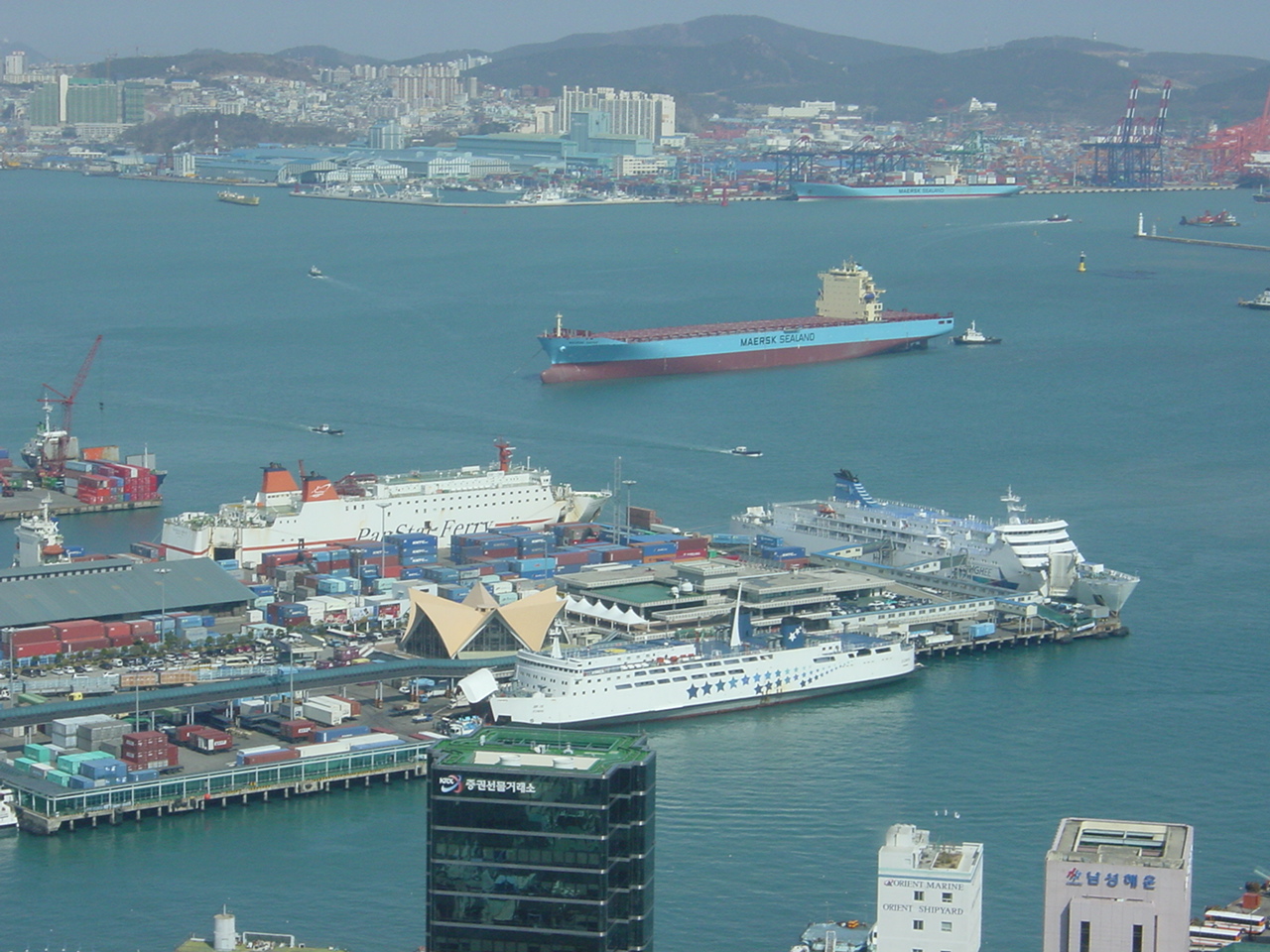
Busan (Korean: 부산; Hanja: 釜山; pronounced [pusʰa̠n]), officially Busan Metropolitan City, is the second most populous city in South Korea, after Seoul; it has a population of over 3.3 million as of 2024. Alternatively romanized as Pusan, it is the economic, cultural and educational center of southeastern South Korea, with its port being South Korea's busiest and the sixth-busiest in the world. The surrounding "Southeastern Maritime Industrial Region" (including Ulsan, South Gyeongsang, Daegu, and part of North Gyeongsang and South Jeolla) is South Korea's largest industrial area. The large volumes of port traffic and urban population in excess of 1 million makes Busan a Large-Port metropolis using the Southampton System of Port-City classification. As of 2025, Busan Port is the primary port in Korea and the world's sixth-largest container port.
Busan is divided into 15 major administrative districts and a single county, together housing a population of approximately 3.6 million. The entire metropolitan area, the Southeastern Maritime Industrial Region, has a population of approximately 8 million. The most densely built-up areas of the city are situated in a number of narrow valleys between the Nakdong and the Suyeong Rivers, with mountains separating most of the districts. The Nakdong River is Korea's longest river and Haeundae Beach is the country's largest beach.
Busan is a center for international conventions, hosting an APEC summit in 2005. It is also a center for sports tournaments in Korea, having hosted the 2002 Asian Games and FIFA World Cup. It is home to the world's largest department store, the Shinsegae Centum City. Busan was added to the UNESCO Creative Cities Network as a "City of Film" in December 2014.

Names
The name "Busan" is the Revised Romanization of the city's name. The name 부산 has been recorded since the late 15th century. "Busan" officially replaced the earlier McCune–Reischauer romanization Pusan in 2000. During the Japanese colonial period, the Japanese reading of the city's name was "Fuzan" which may have remained in the maps that Americans used during the Korean war.
The name 釜山 (now written 부산 using the Korean alphabet) is Sino-Korean for "Cauldron Mountain", believed to be a former name of Mt Hwangnyeong (Korean: 황령산; Hanja: 荒嶺山; RR: Hwangnyeongsan) west of the city center. The area's ancient state Mt Geochil (거칠산국; 居柒山國; Geochilsan-guk, "Rough-Mountain Land") is similarly thought to refer to the same mountain, which towers over the town's harbor on the Suyeong (the later Silla district of Geochilsan-gun was renamed Dongnae in 757).
History
The area that Busan now occupies was inhabited during the Neolithic period. Artifacts dating to this period discovered near the coast include stone tools, pottery, sea shells, and animal bones. Fishing was a primary food source for people of this period. Bronze Age artifacts have been uncovered further inland. By this period, agriculture was being practiced.

Around the first century, a chiefdom called Koch'ilsan-guk (거칠산국; 居漆山國) existed around what is now Dongnae District. At some point, it was absorbed by Silla and made an administrative division called Koch'ilsan-gun (거칠산군; 居漆山郡). In 757, it was renamed Dongnae-gun (동래군). In 835, the Buddhist temple Beomeosa was founded in the area.
In the Goryeo period (918–1392), the local Dongnae Jeong clan became a prominent presence in Korean politics. By this point, Dongnae's hot springs became famous, and have been attested to in writings of this period. By the end of the period, raids from wokou (Japanese pirates) intensified. One such invasion occurred in 1396. To defend against this, the fortress Dongnaeeupseong was established in the area.
In 1423, the port of Busan (부산포) and a waegwan (Japanese concession community) were established. During the reign of King Sejong the Great (r. 1418–1450), the population in Dongnae-hyeon was reportedly 2,416 people in 290 households. In Dongpyeong-hyeon, it was 627 people in 108 households. The waegwan was closed in 1510, but reopened in 1512.

During the 1592–1598 Japanese invasions of Korea, various fortresses in the area defended Busan against the invasion. Fortresses included Busanjinseong, Dadaeposeong, and Dongnaeeupseong. Civilians formed righteous armies (volunteer militias) and joined in the fight. After the siege and capture of Busanjin in 1592, most of Busanjin's Korean prisoners and civilians were massacred. After the war, diplomatic relations with the new shogunate in Japan were established in 1607, and Busan was permitted to be reconstructed.
In 1605, the shrine Songgongsa was built to honor those who died defending Korea during the invasions. The shrine was dubbed Chungnyeolsa in 1624. In 1607, a waegwan was reestablished in Dumopo (두모포; 豆毛浦); in 1678 it was moved to Choryang (초량; 草梁; now around Yongdusan). In 1763, Busan became the first place in Korea to have sweet potatoes, which arrived from Tsushima Island in Japan. In 1759, the population was reportedly 25,753 people in 6,657 households.
In 1876, Busan became the first international port in Korea under the terms of the Treaty of Ganghwa. In 1877, a concession was established in Busan, and consulates of Japan, Qing, and the United Kingdom were established. In 1883, the port was opened, and a Busan Customs Office (부산해관; 釜山海關) was established. In 1895, Dongnae-bu was made part of South Gyeongsang Province. It was demoted to a gun in 1903, and made a bu again in 1906. After the beginning of the 1910–1945 Japanese colonial period, in 1914 it was made a gun again. In 1908, Busan was connected to the Gyeongbu Line via Busan station. In 1909, a ferry service was opened between Busan and Shimonoseki in Japan. In 1914, Dongnae-bu was reorganized into Busan-bu. In 1915, a tram was opened between Busanjin and the Dongnae Hot Springs. The following year, the city tram opened.
During the Japanese rule, Busan developed into a hub trading port with Japan. Busan was the only city in Korea to adopt the steam tramway before electrification was introduced in 1924.
During the Korean War, Busan was one of only two cities in South Korea not captured by the North Korean army within the first three months of the war, the other being Daegu. As a result, the cities became refugee camp sites for Koreans during the war. According to The Korea Times, around 500,000 refugees were located in Busan in early 1951.
As Busan was one of the few areas in Korea that remained under the control of South Korea throughout the Korean War, for some time it served as a de facto capital of South Korea. UN troops established a defensive perimeter around the city known as the Pusan Perimeter in the summer and fall of 1950. Since then, the city has been a self-governing metropolis and has built a strong urban character.
In 1963, Busan separated from South Gyeongsang Province to become the first Directly Governed City of South Korea. In 1983, the provincial capital of Gyeongsangnam-do was moved from Busan to Changwon.
Geography
Busan is located on the southeastern tip of the Korean Peninsula. It is located on the coast, which determined the development of the whole city itself. The distance from Busan to Seoul is about 314 km (195 mi). Busan borders low mountains to the north and west, and the Korea Strait to the south and east. The Nakdong River Delta is located on the west side of the city, and Geumjeongsan, the highest mountain in the city, is on the north. The Nakdong River, South Korea's longest river, flows through the west and empties into the Korea Strait. The southeastern region, called Yeongnam in Korea, encompasses both Gyeongsang Provinces and 3 metropolitan cities of Busan, Daegu and Ulsan. Ulsan lies northeast of Busan. The combined population exceeds 13 million.
The closest overseas area to Busan is Tsushima, Japan, with a distance of about 49.5 km (30.8 mi). The closest Japanese mainland area to Busan is Fukuoka, roughly 180 km (112 miles) away. Busan and Fukuoka are also sister cities.

Climate
Located on the southeasternmost tip of the Korean Peninsula, Busan has a cooler version of a humid subtropical climate, bordering on a subtropical monsoon climate influenced by East Asian monsoon (Köppen: Cfa, bordering on Cwa). Extremely high or low temperatures are rare. The highest temperature ever recorded is 37.3 °C (99.1 °F) on 14 August 2016, while the lowest temperature ever recorded is −14.0 °C (6.8 °F) on 13 January 1915. May to July, late spring and early summer, are usually cooler than inland regions because of the ocean effect. Late summer, and early fall, August, and September, are generally hot and humid and the city may experience typhoons at that time and be generally rainy. On September 15, 1959, Super Typhoon Sarah passed by the coast of the city and caused catastrophic damage. An unusually severe storm on September 12, 2003, Typhoon Maemi, also caused damage to ships and buildings and resulted in over 48 fatalities. Typhoon Hinnamnor on September 6, 2022, caused destruction in Busan as a category 2, producing high waves, destructive winds, and flooding. Busan is the most prone city in South Korea to typhoons and other natural disasters.
October and November are generally the most comfortable, with clear skies and pleasant temperatures. Winters are cool and comparatively dry with high winds, but much milder than other parts of Korea, except Jeju Province and several islands off the southern coast. Busan and the nearby area have the least snow compared to other regions of Korea due to its location. Snow falls on an average of only about 4 days per year.
Administrative divisions
In 1957, Busan adopted a division system with the creation of six gu (districts): Busanjin District, Dong District, Dongnae District, Jung District, Seo District, and Yeongdo District. Today, Busan has divided into fifteen gu and one gun (county).
Economy
Busan is the second largest city in Korea, a maritime logistics hub in Northeast Asia with its world-class mega ports, and a gateway to the Eurasian continent. In 2022, the maritime city recorded a GRDP of KRW 104 trillion with a per capita GRDP of KRW 39.6 million. The city's economy is made up of the service industry (70.3%), manufacturing (19.8%), construction (5.9%), agriculture & fisheries (0.8%), and other sectors (3.2%).
As the sixth largest port in the world, the port of Busan processed 21.81 million TEU of container cargo volume in 2020. The port's container terminal has 43 berths - 20 berths at the North Port, and 23 berths at the Busan New Port (including 2 multi-purpose berths). The port is part of the 21st Century Maritime Silk Road that runs from the Chinese coast to Singapore, towards the southern tip of India to Mombasa, from there through the Red Sea via the Suez Canal to the Mediterranean, there to the Upper Adriatic region to the northern Italian hub of Trieste with its connections to Central Europe and the North Sea.
Moreover, the city is a center of marine science and R&D, and home to a number of relevant institutions, such as the Korea Maritime Institute (KMI), the Korea Institute of Ocean Science and Technology (KIOST), the National Fishery Products Quality Management Service, the Korea Hydrographic and Oceanographic Agency (KHOA), and the Korea National Maritime Museum, located in Dongsam Innovation Complex in Yeongdo District. Moreover, the International Federation of Freight Forwarders Associations (FIATA) World Congress was hosted in Busan in 2020.
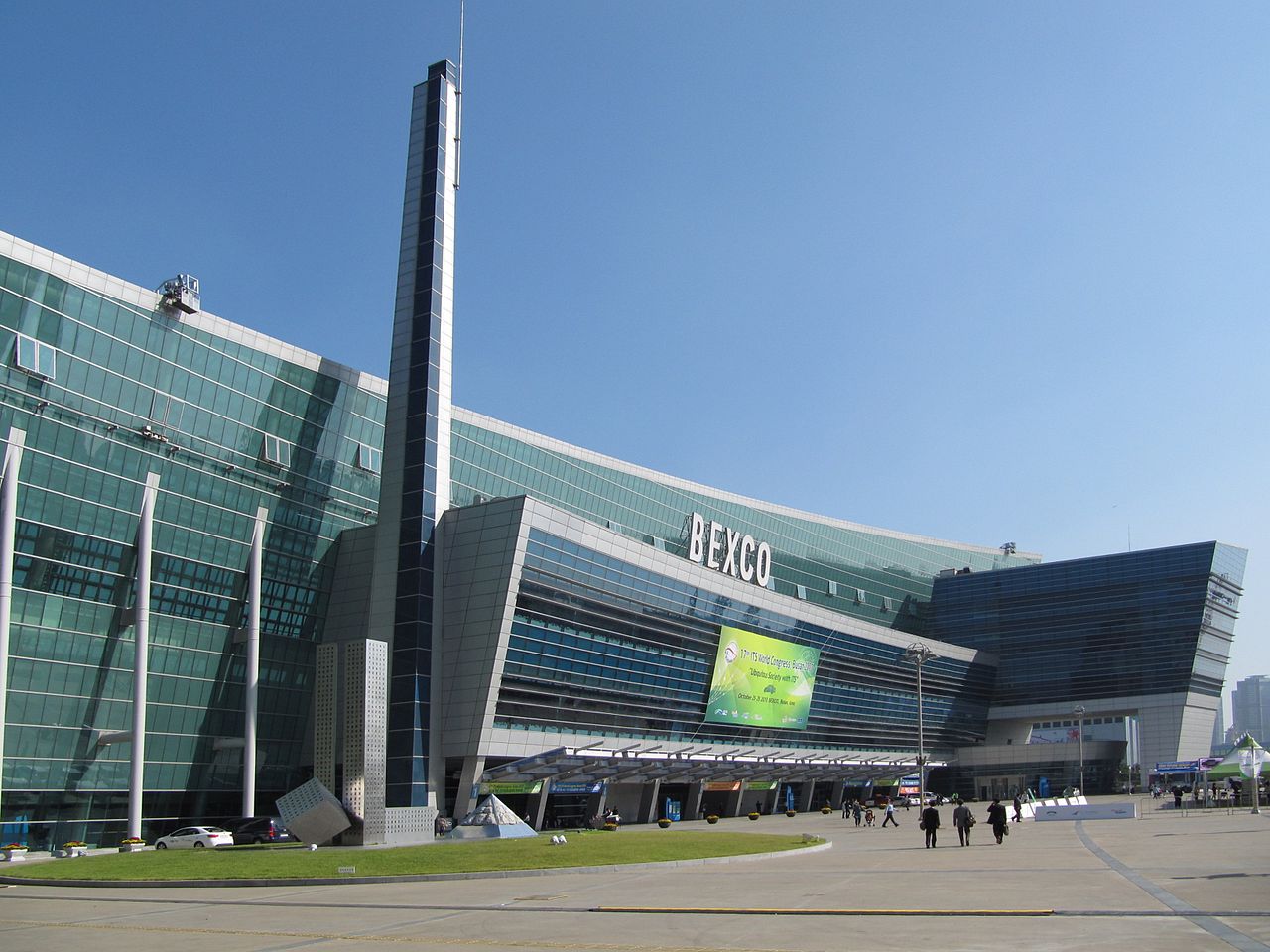
The city is also known for its global MICE (Meetings, Incentives, Conferences, and Exhibitions) industry. The city's convention and exhibition zone have excellent conditions and infrastructure to host large-scale international events, which includes BEXCO in Centum City, Nurimaru APEC House, and hotels nearby natural environments. Major international conferences in Busan include the 2005 APEC Economic Leaders' Meeting, ASEAN–Republic of Korea Commemorative Summit 2014, and 2018 African Development Bank Group Annual Meetings.
Busan is also a center of finance. Korea Exchange (KRX), Korea's sole securities exchange operator, is headquartered in Busan. The city is home to a number of financial institutions, such as the Korea Technology Finance Corporation, Korea Asset Management Corporation, Korea Housing-Finance Corporation, Korea Housing & Urban Guarantee Corporation, Korea Securities Depository, Korea Maritime Guarantee Insurance, Maritime Finance Center, The Korea Shipping and Maritime Transportation Co., Ltd, Korea Asset Management Corporation, and BNK Financial Group.
Commercial areas are dispersed throughout the city near busy intersections and adjacent to university campuses, but the two largest central business districts in Busan are Seomyeon and Gwangbok-dong/Nampo-dong. There are four major shopping areas: Seomyeon, Gwangbok-dong, Busan Daehak-ga in Jangjeon-dong, and Centum City in Haeundae District.
Seomyeon Station is one of the busiest subway stations in Korea; it is the transfer station between Busan Subway Line 1 and Line 2. Seomyeon subway station is also home to a large number of underground stores, selling a variety of products, predominantly clothing, and footwear. These are small stores selling locally produced products. The local head offices of Korean and international banks are located in Seomyeon. It is recognized as the ascendant shopping and entertainment district. It is also home to "Seomyeon Medical Street", the district encompassing the 1 km-radius range around Lotte Department Store in Seomyeon and the Buam subway station. The Street is home to a total of 160 cosmetic and other medical clinics, including those specializing in cosmetic surgery, dermatology, ophthalmology and dentistry. Directly adjacent to Seomyeon is Bujeon Market, the largest traditional market in the city.
The Gwangbok-dong, Nampo-dong, and Jungang-dong areas form the old central business district. Some of the restaurants in this district use family recipes passed down through the generations. Jagalchi Market, a large seafood market, is located in this area. The Gukje Market is also nearby. Jungang-dong is the home of many international law offices, the old immigration office, and the international ferry terminal serving Japanese routes.
Busan has many major department stores, including Lotte Department Store (located in Seomyeon, Centum City, Gwangbok-dong and Dongnae), Lotte Premium Outlet (in Gimhae and Gijang), Shinsegae Premium Outlet (in Gijang), as well as large supermarket chains across the city, such as Homeplus, e-mart, and Costco.
Busan's major hotels include The Westin Chosun Busan, Paradise Busan, and Park Hyatt Busan. In 2017, Ananti Hilton Busan opened in the Gijang-eup district.
The announcement of the BTS Arirang world tour led to a surge in searches for Busan as a travel destination, leading to a potential boost in economy.
Education
Universities with graduate schools
Busan University of Foreign Studies (BUFS)
Busan Presbyterian University
Busan National University of Education (BNUE)
Catholic University of Pusan
Dongseo University
Dong-A University
Dong-eui University
Friedrich-Alexander University Busan Campus (German University in Korea)
Inje University – Busan Campus
Kosin University
Korea Maritime and Ocean University
Kyungsung University
Pukyong National University (PKNU)
Pusan National University (PNU)
Silla University
Tongmyong University
Youngsan University
Other institutes of higher education
Busan Arts College
Busan Institute of Science and Technology (BIST)