
Bulgaria, officially the Republic of Bulgaria, is a country in Southeast Europe. It is situated on the eastern portion of the Balkans directly south of the Danube river and west of the Black Sea. Bulgaria is bordered by Greece and Turkey to the south, Serbia and North Macedonia to the west, and Romania across the Danube river to the north. It covers a territory of 110,994 square kilometres (42,855 sq mi), making it the tenth largest within the European Union and the sixteenth-largest country in Europe by area. Sofia is the nation's capital and largest city; other major cities include Plovdiv, Varna, and Burgas.
One of the earliest societies in the lands of modern-day Bulgaria was the Karanovo culture (6,500 BC). In the 6th to 3rd century BC, the region was a battleground for ancient Thracians, Persians, Celts, and Macedonians; stability came when the Roman Empire conquered the region in AD 45. After the Roman state splintered, tribal invasions in the region resumed. Around the 6th century, these territories were settled by the early Slavs. The Bulgars, led by Asparuh, attacked from the lands of Old Great Bulgaria and then permanently invaded the Balkans in the late 7th century. They established the First Bulgarian Empire, recognised by treaty in 681 AD by the Byzantine Empire. It dominated most of the Balkans and significantly influenced Slavic cultures by developing the Cyrillic script. The First Bulgarian Empire lasted until the early 11th century, when Byzantine emperor Basil II conquered and dismantled it. A successful Bulgarian revolt in 1185 established a Second Bulgarian Empire, which reached its apex under Ivan Asen II (1218–1241). After numerous exhausting wars and feudal strife, the empire disintegrated and in 1396 fell under Ottoman rule for nearly five centuries.
The Russo-Turkish War of 1877–78 resulted in the formation of the third and current Bulgarian state, which declared independence from the Ottoman Empire in 1908. Many ethnic Bulgarians were left outside the new nation's borders, which stoked irredentist sentiments that led to several conflicts with its neighbours and alliances with Germany in both world wars. In 1946, Bulgaria came under the Soviet-led Eastern Bloc and became a socialist state. The ruling Communist Party gave up its monopoly on power after the revolutions of 1989 and allowed multiparty elections. Bulgaria then transitioned into a democracy.

Since adopting a democratic constitution in 1991, Bulgaria has been a parliamentary republic composed of 28 provinces, with a high degree of political, administrative, and economic centralisation. A developed country, its advanced, high-income economy is part of the European single market and is largely based on services, followed by manufacturing, mining, and agriculture. Bulgaria has been influenced by its role as a transit country for natural gas and oil pipelines, as well as its strategic location on the Black Sea. Bulgaria is a member state of the European Union, including the Schengen Area and the eurozone, NATO, and various regional suborganizations such as the Bucharest Nine.
Etymology
The name Bulgaria is derived from the Bulgars, a tribe of Turkic origin that founded the First Bulgarian Empire. Their name is not completely understood and is difficult to trace it back earlier than the 4th century AD; however, it is possibly derived from the Proto-Turkic word bulģha ("to mix", "shake", "stir") and its derivative bulgak ("revolt", "disorder"). The meaning may be further extended to "rebel", "incite" or "produce a state of disorder", and so, in the derivative, the "disturbers". Tribal groups in Inner Asia with phonologically close names were frequently described in similar terms, as the Buluoji, a component of the "Five Barbarian" groups, which during the 4th century were portrayed as both: a "mixed race" and "troublemakers".
History
Prehistory and Antiquity
Neanderthal remains dating to around 150,000 years ago, or the Middle Paleolithic, are some of the earliest traces of human activity in the lands of modern Bulgaria. Remains of Homo sapiens dated c. 47,000 years BP found in the Bacho Kiro cave indicate the earliest arrival of modern humans in Europe. The Karanovo culture arose c. 6,500 BC and was one of several Neolithic societies in the region that thrived on agriculture. The invention of goldworking is credited to the Varna culture, which produced the oldest golden jewellery in the world with an approximate age of over 6,000 years. This treasure has contributed to the understanding of social hierarchy and stratification in Europe's earliest societies.

Some time before the 12th century BC, the Thracians, one of the three primary ancestral groups of modern Bulgarians, appeared on the Balkan Peninsula. The Thracians were tribal and stateless, but nevertheless excelled in metallurgy and gave the Greeks the Orphean and Dionysian cults. Thracian unity was catalysed by the Persian invasions of present-day Bulgarian territories that began in the 6th century BC. Following the defeat of the second Persian invasion in 479 BC, most of the Thracian tribes united under king Teres to form the Odrysian kingdom. It was weakened and vassalised by Philip II of Macedon in 341 BC, attacked by Celts in the 3rd century, and finally became a province of the Roman Empire in AD 45.
Roman governance over the entire Balkan Peninsula was established by the end of the 1st century AD. Christianity began spreading in the region around the 4th century; within this current, Gothic bishop Ulfilas created the Gothic Bible—the first Germanic language book—in what is today northern Bulgaria around 381. The Byzantines inherited the Balkan region following the fall of Rome in 476, but their prolonged military campaigns against Persia left these territories vulnerable to barbarian incursions. This allowed the Slavs to enter the Balkan Peninsula and gradually turn its interior into a country of the South Slavs, who lived under a democracy. The partially Hellenised, Romanised, and Gothicised Thracians were subsequently assimilated by the newcomers.
First Bulgarian Empire
Not long after the Slavic incursion, the region was once again invaded, this time by the Bulgars under Khan Asparukh. Their horde was a remnant of Old Great Bulgaria, an extinct tribal confederacy situated north of the Black Sea in what is now Ukraine and southern Russia. Asparukh attacked Byzantine territories in Moesia and conquered the Slavic tribes there in 680. A peace treaty with the Byzantine Empire was signed in 681, marking the foundation of the First Bulgarian Empire. The Bulgars formed a close-knit ruling minority caste.

Succeeding rulers strengthened the Bulgarian state throughout the 8th and 9th centuries. Krum introduced a written code of law and checked a major Byzantine invasion at the Battle of Pliska, where Byzantine emperor Nicephorus I was killed. Boris I abolished Bulgar paganism in favour of Eastern Orthodox Christianity in 864. The conversion was followed by a Byzantine recognition of the Bulgarian church and the adoption of the Cyrillic alphabet, developed in the capital Preslav. The common language, religion and script strengthened central authority and gradually fused the Slavs and Bulgars into a unified people speaking a single Slavic language. A golden age began during the 34-year rule of Simeon the Great, who oversaw the largest territorial expansion of the state. Literature produced in Old Bulgarian soon spread north throughout Eastern Europe, the language itself becoming a lingua franca of the region. These political, cultural and religious advances turned Bulgaria into one of the great medieval powers in Europe at that time, alongside the Byzantine Empire and the Frankish realm.
After Simeon's death in 927, the empire was weakened by wars with Magyars and Pechenegs and the spread of Bogomil heresy. Simeon's successor Peter I faced revolts by two of his three brothers, but both were quelled. His reign stabilised the empire through a favourable peace treaty with the Byzantines, reinforced with a marriage between Peter and Byzantine emperor Romanos' granddaughter. The agreement ushered in a period of 40 years of peaceful relations between the two powers and domestic prosperity. This lasted until 965, when war with Byzantium broke out once more; Peter suffered a stroke and retired to a monastery, dying in 969.
Preslav was seized by the Byzantine army in 971 after consecutive Rus' and Byzantine invasions. The empire briefly recovered from the attacks under Samuil, but this ended when Byzantine emperor Basil II defeated the Bulgarian army at Klyuch in 1014. Samuil died shortly after the battle, and by 1018 the Byzantines had conquered the First Bulgarian Empire. Basil II prevented revolts by retaining the rule of local nobility, integrating them in Byzantine bureaucracy and aristocracy, and relieving their lands of the obligation to pay taxes in gold, allowing tax in kind instead. The Bulgarian Patriarchate was reduced to an archbishopric, but retained its autocephalous status and its dioceses.

Second Bulgarian Empire
Following the death of Basil II in 1025, Byzantine domestic policy shifted from centralized, militaristic consolidation to a fragile, civilian-led administration that neglected provincial defences, directly triggering massive unrest—most notably the uprising of Peter Delyan (1040–41)—as alienated Bulgarian subjects and disgruntled military elites rebelled against crushing taxation and bureaucratic mismanagement. The empire's authority declined after a catastrophic military defeat at Manzikert against Seljuk invaders, and was further disturbed by the Crusades. This upended Byzantine Hellenisation attempts and created fertile ground for further revolt. Asen dynasty nobles Ivan Asen I and Peter IV used the opportunity to organise a major uprising and succeeded in re-establishing the Bulgarian state with a new capital in Tarnovo.
Kaloyan, the third of the Asen monarchs, extended his dominion to Belgrade and Ohrid. He acknowledged the spiritual supremacy of the pope and received a royal crown from a papal legate. The empire reached its zenith under Ivan Asen II (1218–1241), when its borders expanded as far as the coast of Albania, Serbia and Epirus, while commerce and culture flourished. Ivan Asen's rule was also marked by a shift away from Rome in religious matters.
The Asen dynasty became extinct in 1257. Internal strife and incessant Byzantine, Hungarian and Mongol attacks followed, allowing the Golden Horde to establish suzerainty over the weakened Bulgarian state. The Mongols were expelled by swineherd Ivaylo, who led a great peasant revolt that briefly made him emperor in 1277. His short-lived reign ended in 1280 when he was overthrown by the feudal landlords, whose subsequent factional conflicts caused the Second Bulgarian Empire to disintegrate into small feudal dominions by the 14th century. Despite a brief resurgence in the arts and culture, the remaining Bulgarian rump states—two tsardoms at Vidin and Tarnovo and the Despotate of Dobrudzha—became easy prey for a new threat arriving from the Southeast: the Ottoman Turks.

Ottoman rule
The Ottomans were employed as mercenaries by the Byzantines in the 1340s, but later became invaders in their own right. Sultan Murad I took Adrianople from the Byzantines in 1362; Sofia fell in 1382, followed by Shumen in 1388. The Ottomans completed their conquest of Bulgarian lands in 1393 when Tarnovo was sacked after a three-month siege and the Battle of Nicopolis which brought about the fall of the Vidin Tsardom in 1396. Sozopol was the last Bulgarian settlement to fall, in 1453. The Bulgarian nobility was subsequently eliminated and the peasantry was enserfed to Ottoman masters, while much of the educated clergy fled to other countries.
Bulgarians were subjected to heavy taxes (including Devshirme, or blood tax), their culture was suppressed, and they experienced partial Islamisation. Ottoman authorities established a religious administrative community called the Rum Millet, which governed all Orthodox Christians regardless of their ethnicity. Most of the local population then gradually lost its distinct national consciousness, identifying only by its faith. The clergy remaining in some isolated monasteries kept their ethnic identity alive, enabling its survival in remote rural areas, and in the militant Catholic community in the northwest of the country.
As Ottoman power began to wane, Habsburg Austria and Russia saw Bulgarian Christians as potential allies. The Austrians first backed an uprising in Tarnovo in 1598, then a second one in 1686, the Chiprovtsi Uprising in 1688 and finally Karposh's rebellion in 1689. The Russian Empire also asserted itself as a protector of Christians in Ottoman lands with the Treaty of Küçük Kaynarca in 1774.
The Western European Enlightenment in the 18th century influenced the initiation of a national awakening of Bulgaria. It restored national consciousness and provided an ideological basis for the liberation struggle, resulting in the April Uprising of 1876. Up to 30,000 Bulgarians were killed as Ottoman authorities put down the rebellion. The massacres prompted the Great Powers to take action. They convened the Constantinople Conference in 1876, but their decisions were rejected by the Ottomans. This allowed the Russian Empire to seek a military solution without risking confrontation with other Great Powers, as had happened in the Crimean War. In 1877, Russia declared war on the Ottomans and defeated them with the help of Bulgarian rebels, particularly during the crucial Battle of Shipka Pass which secured Russian control over the main road to Constantinople.
Third Bulgarian state
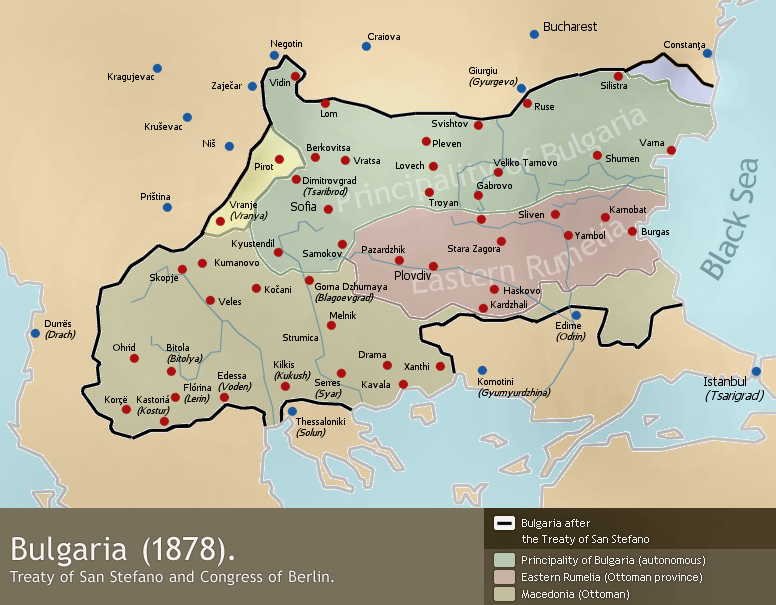
The Treaty of San Stefano was signed on 3 March 1878 by Russia and the Ottoman Empire. It was to set up an autonomous Bulgarian principality spanning Moesia, Macedonia and Thrace, roughly on the territories of the Second Bulgarian Empire, and this day is now a public holiday called National Liberation Day. The other Great Powers immediately rejected the treaty out of fear that such a large country in the Balkans might threaten their interests. It was superseded by the Treaty of Berlin, signed on 13 July. It provided for a much smaller state, the Principality of Bulgaria, only comprising Moesia and the region of Sofia, and leaving large populations of ethnic Bulgarians outside the new country. This significantly contributed to Bulgaria's militaristic foreign affairs approach during the first half of the 20th century.
The Bulgarian principality won a war against Serbia and incorporated the semi-autonomous Ottoman territory of Eastern Rumelia in 1885, proclaiming itself the independent Kingdom of Bulgaria on 5 October 1908. In the years following independence, Bulgaria increasingly militarised and was often referred to as "the Balkan Prussia". It became involved in three consecutive conflicts between 1912 and 1918—two Balkan Wars and World War I. After a disastrous defeat in the Second Balkan War, Bulgaria again found itself fighting on the losing side as a result of its alliance with the Central Powers in World War I. Despite fielding more than a quarter of its population in a 1,200,000-strong army and achieving several decisive victories at Doiran and Monastir, the country capitulated in 1918. The war resulted in significant territorial losses and a total of 87,500 soldiers killed. More than 253,000 refugees from the lost territories immigrated to Bulgaria from 1912 to 1929, placing additional strain on the already ruined national economy.
The resulting political unrest led to the establishment of a royal authoritarian dictatorship by Tsar Boris III (1918–1943). Bulgaria entered World War II in 1941 as a member of the Axis but declined to participate in Operation Barbarossa and saved its Jewish population from deportation to concentration camps. The sudden death of Boris III in mid-1943 pushed the country into political turmoil as the war turned against Germany, and the communist guerrilla movement gained momentum. The government of Bogdan Filov subsequently failed to achieve peace with the Allies. Bulgaria did not comply with Soviet demands to expel German forces from its territory, resulting in a declaration of war and an invasion by the USSR in September 1944. The communist-dominated Fatherland Front took power, ended participation in the Axis and joined the Allied side until the war ended. Bulgaria suffered little war damage and the Soviet Union demanded no reparations. But all wartime territorial gains, with the notable exception of Southern Dobrudzha, were lost.
The left-wing coup d'état of 9 September 1944 led to the abolition of the monarchy and the executions of some 1,000–3,000 dissidents, war criminals, and members of the former royal elite. But it was not until 1946 that a one-party people's republic was instituted following a referendum. It fell into the Soviet sphere of influence under the leadership of Georgi Dimitrov (1946–1949), who established a repressive, rapidly industrialising Stalinist state. By the mid-1950s, standards of living rose significantly and political repression eased. The Soviet-style planned economy saw some experimental market-oriented policies emerging under Todor Zhivkov (1954–1989). Compared to wartime levels, national GDP increased five-fold and per capita GDP quadrupled by the 1980s, although severe debt spikes took place in 1960, 1977 and 1980. Zhivkov's daughter Lyudmila bolstered national pride by promoting Bulgarian heritage, culture and arts worldwide. Facing declining birth rates among the ethnic Bulgarian majority, Zhivkov's government in 1984 forced the minority ethnic Turks to adopt Slavic names in an attempt to erase their identity and assimilate them. These policies resulted in the emigration of some 300,000 ethnic Turks to Turkey.
The Communist Party was forced to give up its political monopoly on 10 November 1989 under the influence of the Revolutions of 1989. Zhivkov resigned and Bulgaria embarked on a transition to a parliamentary democracy. The first free elections in June 1990 were won by the Communist Party, now rebranded as the Bulgarian Socialist Party. A new constitution that provided for a relatively weak elected president and for a prime minister accountable to the legislature was adopted in July 1991. The new system initially failed to improve living standards or create economic growth—the average quality of life and economic performance remained lower than under communism well into the early 2000s. After 2001, economic, political and geopolitical conditions improved greatly, and Bulgaria achieved high Human Development status in 2003. It became a member of NATO in 2004 and participated in the War in Afghanistan. After several years of reforms, it joined the European Union and the single market in 2007, despite EU concerns over government corruption. Bulgaria hosted the 2018 Presidency of the Council of the European Union at the National Palace of Culture in Sofia.
Geography
Bulgaria is a middle-sized country situated in Southeast Europe, in the east of the Balkans. Its territory covers an area of 110,994 square kilometres (42,855 sq mi), while land borders with its five neighbouring countries run a total length of 1,808 kilometres (1,123 mi), and its coastline is 354 kilometres (220 mi) long. Bulgaria's geographic coordinates are 43° N 25° E. The most notable topographical features of the country are the Danubian Plain, the Balkan Mountains, the Upper Thracian Plain, and the Rila-Rhodope massif. The southern edge of the Danubian Plain slopes upward into the foothills of the Balkans, while the Danube defines the border with Romania. The Thracian Plain is roughly triangular, beginning southeast of Sofia and broadening as it reaches the Black Sea coast.
The Balkan mountains run laterally through the middle of the country from west to east. The mountainous southwest has two distinct alpine type ranges—Rila and Pirin, which border the lower but more extensive Rhodope Mountains to the east, and various medium altitude mountains to west, northwest and south, like Vitosha, Osogovo and Belasitsa. Musala, at 2,925 metres (9,596 ft), is the highest point in both Bulgaria and the Balkans. The Black Sea coast is the country's lowest point. Plains occupy about one third of the territory, while plateaux and hills occupy 41%. Most rivers are short and with low water levels. The longest river located solely in Bulgarian territory, the Iskar, has a length of 368 kilometres (229 mi). The Struma and the Maritsa are two major rivers in the south.
Climate
Bulgaria has a varied and changeable climate, which results from being positioned at the meeting point of the Mediterranean, Oceanic and Continental air masses combined with the barrier effect of its mountains. Northern Bulgaria averages 1 °C (1.8 °F) cooler, and registers 200 millimetres (7.9 in) more precipitation, than the regions south of the Balkan mountains. Temperature amplitudes vary significantly in different areas. The lowest recorded temperature is −38.3 °C (−36.9 °F), while the highest is 45.2 °C (113.4 °F). Precipitation averages about 630 millimetres (24.8 in) per year, and varies from 500 millimetres (19.7 in) in Dobrudja to more than 2,500 millimetres (98.4 in) in the mountains. Continental air masses bring significant amounts of snowfall during winter.
Considering its relatively small area, Bulgaria has variable and complex climate. The country occupies the southernmost part of the continental climatic zone, with small areas in the south falling within the Mediterranean climatic zone. The continental zone is predominant, because continental air masses flow easily into the unobstructed Danubian Plain. The continental influence, stronger during the winter, produces abundant snowfall; the Mediterranean influence increases during the second half of summer and produces hot and dry weather. Bulgaria is subdivided into five climatic zones: continental zone (Danubian Plain, Pre-Balkan and the higher valleys of the Transitional geomorphological region); transitional zone (Upper Thracian Plain, most of the Struma and Mesta valleys, the lower Sub-Balkan valleys); continental-Mediterranean zone (the southernmost areas of the Struma and Mesta valleys, the eastern Rhodope Mountains, Sakar and Strandzha); Black Sea zone along the coastline with an average length of 30–40 km inland; and alpine zone in the mountains above 1000 m altitude (central Balkan Mountains, Rila, Pirin, Vitosha, western Rhodope Mountains, etc.).
Biodiversity and conservation
The interaction of climatic, hydrological, geological and topographical conditions has produced a relatively wide variety of plant and animal species.
Bulgaria's biodiversity, one of the richest in Europe, is conserved in three national parks, 11 nature parks, 10 biosphere reserves and 565 protected areas. Ninety-three of the 233 mammal species of Europe are found in Bulgaria, along with 49% of butterfly and 30% of vascular plant species. Overall, 41,493 plant and animal species are present. Larger mammals with sizeable populations include deer (106,323 individuals), wild boar (88,948), golden jackal (47,293) and red fox (32,326). Partridges number some 328,000 individuals, making them the most widespread gamebird. A third of all nesting birds in Bulgaria can be found in Rila National Park, which also hosts Arctic and alpine species at high altitudes. Flora includes more than 3,800 vascular plant species of which 170 are endemic and 150 are considered endangered. A checklist of larger fungi in Bulgaria by the Institute of Botany identifies more than 1,500 species. In Bulgaria forest cover is around 36% of the total land area, equivalent to 3,893,000 hectares (ha) of forest in 2020, up from 3,327,000 hectares (ha) in 1990. In 2020, naturally regenerating forest covered 3,116,000 hectares (ha) and planted forest covered 777,000 hectares (ha). Of the naturally regenerating forest 18% was reported to be primary forest (consisting of native tree species with no clearly visible indications of human activity) and around 18% of the forest area was found within protected areas. For the year 2015, 88% of the forest area was reported to be under public ownership and 12% private ownership.
In 1998, the Bulgarian government adopted the National Biological Diversity Conservation Strategy, a comprehensive programme seeking the preservation of local ecosystems, protection of endangered species and conservation of genetic resources. Bulgaria has some of the largest Natura 2000 areas in Europe covering 33.8% of its territory. It also achieved its Kyoto Protocol objective of reducing carbon dioxide emissions by 30% from 1990 to 2009.
Bulgaria ranks 37th in the 2024 Environmental Performance Index, but scores low on air quality. Particulate levels are the highest in Europe, especially in urban areas affected by automobile traffic and coal-based power stations. One of these, the lignite-fired Maritsa Iztok-2 station, is causing the highest damage to health and the environment in the European Union. Pesticide use in agriculture and antiquated industrial sewage systems produce extensive soil and water pollution. Water quality began to improve in 1998 and has maintained a trend of moderate improvement. Over 75% of surface rivers meet European standards for good quality.
Politics
Bulgaria is a parliamentary democracy where the prime minister is the head of government and the most powerful executive position. The political system has three branches—legislative, executive and judicial, with universal suffrage for citizens at least 18 years old. The Constitution also provides possibilities of direct democracy, namely petitions and national referendums. Elections are supervised by an independent Central Election Commission that includes members from all major political parties. Parties must register with the commission prior to participating in a national election. Normally, the prime minister-elect is the leader of the party receiving the most votes in parliamentary elections, although this is not always the case.
Unlike the prime minister, presidential domestic power is more limited. The directly elected president serves as head of state and commander-in-chief of the armed forces, and has the authority to return a bill for further debate, although the parliament can override the presidential veto by a simple majority vote. Political parties gather in the National Assembly, a body of 240 deputies elected to four-year terms by direct popular vote. The National Assembly has the power to enact laws, approve the budget, schedule presidential elections, select and dismiss the prime minister and other ministers, declare war, deploy troops abroad, and ratify international treaties and agreements.
Overall, Bulgaria displays a pattern of unstable governments. Boyko Borisov, the leader of the centre-right, pro-EU party GERB, served three terms as prime minister between 2009 and 2021.
It won the 2009 general election and formed a minority government, which resigned in February 2013 after nationwide protests over the low living standards, corruption and the perceived failure of the democratic system.
The subsequent snap elections in May resulted in a narrow win for GERB, but the Bulgarian Socialist Party eventually formed a government led by Plamen Oresharski after Borisov failed to secure parliamentary support. The Oresharski government resigned in July 2014 amid continuing large-scale protests.
The October 2014 elections resulted in a third GERB victory. Borisov formed a coalition with several right-wing parties, but resigned again after the candidate backed by his party failed to win the 2016 Presidential election. The March 2017 snap election was again won by GERB, but with 95 seats in Parliament. They formed a coalition with the far-right United Patriots, who held 27 seats.
Borisov's last cabinet saw a dramatic decrease in freedom of the press, and a number of corruption revelations that triggered yet another wave of mass protests in 2020. GERB came out first in the regular April 2021 election, but with its weakest result so far. All other parties refused to form a government, and after a brief deadlock, another election was called for July 2021. It too failed to break the stalemate, as no political party was able to form a coalition government.
In April 2023, because of the political deadlock, Bulgaria held its fifth parliamentary election since April 2021. GERB was the biggest, winning 69 seats. The bloc led by We Continue the Change won 64 seats in the 240-seat parliament. In June 2023, Prime Minister Nikolai Denkov formed a new coalition between We Continue The Change and GERB. According to the coalition agreement, Denkov will lead the government for the first nine months. He will be succeeded by former European Commissioner, Mariya Gabriel, of the GERB party. She was supposed to take over as prime minister in nine months.
Denkov resigned in accordance with the rotation agreement on 5 March 2024, to allow Gabriel to become the new Prime Minister. On 20 March 2024, the planned government rotation and signing of a renewed government failed due to disagreements between the two alliances on the cabinet and breaking down of relations. Negotiations ensued across to form a new government, but failed to produce any governments that could reach a majority support. GERB rejected the chance to form a government. PP–DB made a limited attempt to respect the original rotation agreement. The final chance to form a government, chosen by president Rumen Radev, went to ITN, which was immediately rejected.
On 29 March, as per Article 98 of the constitution, the President appointed the Chairman of the National Audit Office, Dimitar Glavchev, as the candidate for caretaker prime minister. He was granted a one-week deadline of until 6 April 2024 to propose the composition of the caretaker government. Glavchev presented his proposal for the caretaker government on 5 April 2024, accepted by the President following negotiations and scheduling the election for 9 June 2024. Glavchev and his cabinet were inaugurated on 9 April 2024 by the National Assembly.
The new elected 51st Parliament replaced the 50th Parliament when all elected members were sworn in on 11 November 2024. After 11 voting rounds, Natalia Kiselova (BSP–OL) was elected as speaker of the National Assembly on 6 December 2024. President Rumen Radev granted the first negotiation mandate to the largest party GERB-SDS on 15 January 2025, which formed a minority government alongside BSP and ITN, with support from APS (Dogan). The government was led by GERB politician Rosen Zhelyazkov. The Zhelyazkovs government primary commitment had been the country's entry into the eurozone in 2026, which it achieved in 2025 when Bulgaria had its final hurdles cleared and adopted the legal framework to make the entry possible. The government survived a no-confidence vote days later due to Peevski's support, effectively creating a de factoconfidence and supply agreement. In December 2025, the Zhelyazkov government resigned after weeks of protests against the 2026 budget and corruption within the government.
Radev took a critical stance to adopting the eurozone and had tried to delay it by calling a referendum, a move that was described as illegal as the Constitutional Court of Bulgaria had already clarified in 2024 that Bulgaria was obliged to adopt the euro by its European treaties that were ratified when Bulgaria joined the EU. Radev's attempt was thereafter rejected at the time by Nataliya Kiselova (the then Speaker of the National Assembly of Bulgaria), and upheld by the Constitutional Court, a move that Radev sharply criticized. After it was confirmed there would be new elections in 2026, Radev resigned as President to contest the elections, and was succeeded by Iliana Iotova, who became the first female President of Bulgaria, Radev seeking to become Prime Minister and describing his political project as a "powerful political alternative" to return Bulgarians' trust in their state, with "clear rules for everyone".
On 18 February 2026, President Iliana Iotova appointed a caretaker government led by Prime Minister Andrey Gyurov and set a parliamentary election to be held on 19 April 2026. Gyurov's government had asked the EU for help to fight off interference from Russia ahead of the election, warning foreign actors were trying to manipulate public opinion through social media networks and propaganda websites. Radev went on to win the elections in a landslide gaining a majority. On 8 May 2026, Rumen Radev was sworn in as Bulgaria's prime minister.
Freedom House has reported a continuing deterioration of democratic governance after 2009, citing reduced media independence, stalled reforms, abuse of authority at the highest level and increased dependence of local administrations on the central government. Bulgaria is still listed as "Free", with a political system designated as a semi-consolidated democracy, albeit with deteriorating scores. The Democracy Index defines it as a "flawed democracy". A 2018 survey by the Institute for Economics and Peace reported that less than 15% of respondents considered elections to be fair.
Legal system
Bulgaria has a civil law legal system. The judiciary is overseen by the Ministry of Justice. The Supreme Administrative Court and the Supreme Court of Cassation are the highest courts of appeal and oversee the application of laws in subordinate courts. The Supreme Judicial Council manages the system and appoints judges. The legal system is regarded by both domestic and international observers as one of Europe's most inefficient due to a pervasive lack of transparency and corruption. Law enforcement is carried out by organisations mainly subordinate to the Ministry of the Interior. The General Directorate of National Police (GDNP) combats general crime and maintains public order. GDNP fields 26,578 police officers in its local and national sections. The bulk of criminal cases are transport-related, followed by theft and drug-related crime; homicide rates are low. The Ministry of the Interior also heads the Border Police Service and the National Gendarmerie—a specialised branch for anti-terrorist activity, crisis management and riot control. Counterintelligence and national security are the responsibility of the State Agency for National Security.
Administrative divisions
Bulgaria is a unitary state. Since the 1880s, the number of territorial management units has varied from seven to 26. Between 1987 and 1999, the administrative structure consisted of nine provinces (oblasti, singular oblast). A new administrative structure was adopted in parallel with the decentralisation of the economic system. It includes 27 provinces and a metropolitan capital province (Sofia City). All areas take their names from their respective capital cities. The provinces are subdivided into 265 municipalities. Municipalities are run by mayors, who are elected to four-year terms, and by directly elected municipal councils. Bulgaria is a highly centralised state where the Council of Ministers directly appoints regional governors and all provinces and municipalities are heavily dependent on it for funding.