
Charles Hardin Holley (September 7, 1936 – February 3, 1959), known professionally by his stage name Buddy Holly, was an American singer, songwriter, and musician who was a central and pioneering figure of rock and roll. He was born to a musical family in Lubbock, Texas, during the Great Depression, and learned to play guitar and sing alongside his two siblings.
Holly made his first appearance on local television in 1952, and the following year he formed the group Buddy and Bob with his friend Bob Montgomery. In 1955, after opening once for Elvis Presley, Holly decided to pursue a career in music. He played with Presley three times that year, and his band's style shifted from country and western to rock and roll. In October that year, when Holly opened for Bill Haley & His Comets, he was spotted by Nashville scout Eddie Crandall, who helped him get a contract with Decca Records.
Holly's recording sessions at Decca were produced by Owen Bradley, who had become famous for producing orchestrated country hits for stars like Patsy Cline. Unhappy with Bradley's musical style and control in the studio, Holly went to producer Norman Petty in Clovis, New Mexico, and recorded a demo of "That'll Be the Day", among other songs. Petty became the band's manager and sent the demo to Brunswick Records, which released it as a single credited to the Crickets, a name chosen by the band to subvert Decca's contract limitations. In September 1957, as the band toured, "That'll Be the Day" topped the US and UK singles charts. Its success was followed in October by another major hit, "Peggy Sue".

The album The "Chirping" Crickets, released in November 1957, reached number five on the UK Albums Chart. Holly made his second appearance on The Ed Sullivan Show in January 1958 and soon after toured Australia and then the UK. In early 1959, he assembled a new band, consisting of Waylon Jennings (bass), Tommy Allsup (guitar), and Carl Bunch (drums), and embarked on a tour of the mid-western US. After a show in Clear Lake, Iowa, Holly chartered an airplane to travel to his next show in Moorhead, Minnesota. Soon after takeoff, the plane crashed, killing Holly, Ritchie Valens, the Big Bopper, and pilot Roger Peterson in a crash later referred to by Don McLean as "The Day the Music Died" in his song "American Pie".
During his short career, Holly wrote and recorded many songs. He is often regarded as the artist who defined the traditional rock-and-roll lineup of two guitars, bass, and drums. Holly was a major influence on later popular music artists, including Bob Dylan, the Beatles, the Rolling Stones, Eric Clapton, the Hollies, Elvis Costello and Elton John. Holly was among the first artists inducted into the Rock and Roll Hall of Fame, in 1986. Rolling Stone magazine ranked him number 13 in its list of 100 Greatest Artists in 2010.
Life and career
Early life and career (1936–1955)
Charles Hardin Holley was born in Lubbock, Texas, on September 7, 1936, the youngest of four children of Lawrence Odell "L.O." Holley (1901–1985) and Ella Pauline Drake (1902–1990). His elder siblings were Larry (1925–2022), Travis (1927–2016), and Patricia Lou (1929–2008). Holly was of mostly English and Welsh descent and had small amounts of Native American ancestry as well. From early childhood, Holly was nicknamed "Buddy." During the Great Depression, the Holleys frequently moved residence within Lubbock; L.O. changed jobs several times. Buddy Holly was baptized a Baptist, and the family were members of the Tabernacle Baptist Church.

The Holleys had an interest in music; all the family members except L.O. were able to play an instrument or sing. The elder Holley brothers performed in local talent shows; on one occasion, Buddy joined them on violin. Since he could not play it, his brother Larry greased the bow so it would not make any sound. The brothers won the contest. During World War II, Larry and Travis were called to military service. Upon his return, Larry brought with him a guitar he had bought from a shipmate while serving in the Pacific. At age 11, at his mother's urging, Buddy took piano lessons but abandoned them after nine months. He switched to the guitar after he saw a classmate playing and singing on the school bus. Buddy's parents initially bought him a steel guitar, but he insisted that he wanted a guitar like his brother's. His parents bought him an acoustic guitar from a local pawnshop, and he learned how to play it from Travis.
During his early childhood, Holly was influenced by the music of Hank Williams, Jimmie Rodgers, Moon Mullican, Bill Monroe, Hank Snow, Bob Wills, and the Carter Family. At Roscoe Wilson Elementary, Holly became friends with Bob Montgomery, and the two played together, practicing with songs by The Louvin Brothers and Johnnie & Jack. They both listened to the radio programs Grand Ole Opry on WSM, Louisiana Hayride on KWKH, and Big D Jamboree. At the same time, Holly played with other musicians he met in high school, including Sonny Curtis and Jerry Allison. In 1952 Holly and Jack Neal participated as a duo billed as Buddy and Jack in a talent contest on a local television show. After Neal left, he was replaced by Bob Montgomery, and they were billed as Buddy and Bob. They soon started performing on the Sunday Party show on KDAV in 1953 and performed live gigs in Lubbock. At that time, Holly was influenced by late-night radio stations that played blues and rhythm and blues (R&B). He would sit in his car with Curtis and tune to distant radio stations that could be received only at night, when local transmissions ceased. Holly then modified his music by blending his earlier country and western influence with rock and roll.
By 1955, after graduating from Lubbock High School, Holly decided to pursue a full-time career in music. He was further encouraged after seeing Elvis Presley perform live in Lubbock, whose act was booked by Pappy Dave Stone of KDAV. In February, Holly opened for Presley at the Fair Park Coliseum, in April at the Cotton Club, and again in June at the Coliseum. By that time, Holly had incorporated into his band Larry Welborn on the stand-up bass and Allison on drums, as his style shifted from country and western to rock and roll due to seeing Presley's performances and hearing his music. In October, Stone booked Bill Haley & His Comets and placed Holley as the opening act to be seen by Nashville scout Eddie Crandall. Impressed, Crandall persuaded Grand Ole Opry manager Jim Denny to seek a recording contract for Holley. Stone sent a demo tape, which Denny forwarded to Paul Cohen, who signed the band to Decca Records in February 1956. In the contract, Decca misspelled Holly's surname as "Holly", and from then on he was known as Buddy Holly, instead of his real name Holley.

On January 26, 1956, Holly attended his first formal recording session, which was produced by Owen Bradley. He attended two more sessions in Nashville, but with the producer selecting the session musicians and arrangements, Holly became increasingly frustrated by his lack of creative control. On April 16, 1956, Decca released "Blue Days–Black Nights" as a single, with "Love Me" on the B-side. Denny included Holly on a tour as the opening act for Faron Young. During the tour, they were promoted as Buddy Holly and the Two Tones, while later Decca called them Buddy Holly and the Three Tunes. The label later released Holly's second single "Modern Don Juan", backed with "You Are My One Desire". Neither single made an impression. On January 22, 1957, Decca informed Holly his contract would not be renewed, but insisted he could not record the same songs for anyone else for five years.
The Crickets (1956–1957)
Holly was unhappy with the results of his time with Decca, and inspired by the success of Buddy Knox's "Party Doll" and Jimmy Bowen's "I'm Stickin' with You", he visited Norman Petty, who had produced and promoted both records. Together with Allison, bassist Joe B. Mauldin, and rhythm guitarist Niki Sullivan, he went to Petty's studio in Clovis, New Mexico. The group recorded a demo of "That'll Be the Day", a song they had previously recorded in Nashville. In June 1956, Holly along with his older brother Larry as well as Allison and Sonny Curtis had gone to see the film The Searchers, starring John Wayne, in which Wayne repeatedly used the phrase "That'll be the day". This line of dialogue inspired the young musicians. Now playing lead guitar, Holly achieved the sound he desired. Petty became his manager and sent the record to Brunswick Records in New York City. Holly, still under contract with Decca, could not release the record under his name, so a band name was used; Allison proposed the name "Crickets." Brunswick gave Holly a basic agreement to release "That'll Be the Day", leaving him with both artistic control and financial responsibility for future recordings.
Impressed with the demo, the label's executives released it without recording a new version. "I'm Looking for Someone to Love" was the B-side; the single was credited to The Crickets. Petty and Holly later learned that Brunswick was a subsidiary of Decca, which legally cleared future recordings under the name Buddy Holly. Recordings credited to the Crickets would be released on Brunswick, while the recordings under Holly's name were released on another subsidiary label, Coral Records. Holly concurrently held a recording contract with both labels.

Norman Petty reasoned correctly that disc jockeys would be reluctant to play and promote multiple new records by the same artist, but would have no problem playing these same records if they were credited to different performers. Holly himself was unaware of this strategy; in a 1957 radio interview with Dale Lowery, Holly said, "We have three records going out right now. Of course, the first one was 'That'll Be the Day', the first one released. Then we have a new one out by The Crickets, called 'Oh Boy!' and 'Not Fade Away', and then there's one out, it's the same group but it's under my name -- I don't know why they did it that way, but it went out under my name -- called 'Peggy Sue' and 'Everyday'." Holly's records were released with labels reading "Buddy Holly" or "The Crickets"; the band was never credited on records as "Buddy Holly and the Crickets" until 1962, when a compilation album was released.
"That'll Be the Day" was released on July 27, 1957. Petty booked Holly and the Crickets for a tour with Irvin Feld, who had noticed the band after "That'll Be the Day" appeared on the R&B chart. He booked them for appearances in Washington, D.C., Baltimore, and New York City. The band was booked to play at New York's Apollo Theater, a Harlem-based theater widely known for frequently having African American-oriented entertainment, on August 16–22. They would be the first white act to perform at the theater. During the opening performances, the group did not impress the audience, but they were accepted after they included "Bo Diddley". By the end of their run at the Apollo, "That'll Be the Day" was climbing the charts. Encouraged by the single's success, Petty started to prepare two album releases; a solo album for Holly and another for the Crickets. Holly appeared on American Bandstand, hosted by Dick Clark on ABC, on August 26. Before leaving New York, the band befriended The Everly Brothers.
"That'll Be the Day" topped the US "Best Sellers in Stores" chart on September 23 and was number one on the UK Singles Chart for three weeks in November. Three days prior, Coral released "Peggy Sue", backed with "Everyday", with Holly credited as the performer. By October, "Peggy Sue" had reached number three on Billboard's pop chart and number two on the R&B chart; it peaked at number six on the UK Singles chart. As the success of the song grew, it brought more attention to Holly, with the band at the time being billed as "Buddy Holly and the Crickets" (although never on records during Holly's lifetime).

In the last week of September, the band members flew to Lubbock to visit their families. Holly's high school girlfriend, Echo McGuire, had left him for a fellow student. Aside from McGuire, Holly had a relationship with Lubbock fan June Clark. After Clark ended their relationship, Holly realized the importance of his relationship with McGuire and considered his relationship with Clark a temporary one. Meanwhile, for their return to recording, Petty arranged a session in Oklahoma City, where he was performing with his own band. While the band drove to the location, the producer set up a makeshift studio. The rest of the songs needed for an album and singles were recorded; Petty later dubbed the material in Clovis. The resulting album, The "Chirping" Crickets, was released on November 27, 1957. It reached number five on the UK Albums Chart. In October, Brunswick released the second single by the Crickets, "Oh, Boy!", with "Not Fade Away" on the B-side. The single reached number 10 on the pop chart and 13 on the R&B chart. Holly and the Crickets performed "That'll Be the Day" and "Peggy Sue" on The Ed Sullivan Show on December 1, 1957. Following the appearance, Niki Sullivan left the group because he was tired of the intensive touring, and wished to resume his education. On December 29, Holly and the Crickets performed "Peggy Sue" on The Arthur Murray Party.
International tours (1958)
On January 8, 1958, Holly and the Crickets joined America's Greatest Teenage Recording Stars tour. On January 25, Holly recorded "Rave On"; the next day, he made his second appearance on The Ed Sullivan Show, singing "Oh, Boy!" Holly departed to perform in Honolulu, Hawaii, on January 27, and then started a week-long tour of Australia billed as the Big Show with Paul Anka, Jerry Lee Lewis and Jodie Sands. In March, the band toured the United Kingdom, playing 50 shows in 25 days. The same month, his debut solo album, Buddy Holly, was released. Upon their return to the United States, Holly and the Crickets joined Alan Freed's Big Beat Show tour for 41 dates. In April, Decca released That'll Be the Day, featuring the songs recorded with Bradley during his early Nashville sessions.
A new recording session in Clovis was arranged in May; Holly hired Tommy Allsup to play lead guitar. The session produced the recordings of "It's So Easy" and "Heartbeat". Holly was impressed by Allsup and invited him to join the Crickets. In June, Holly traveled alone to New York for a solo recording session. Without the Crickets, he chose to be backed by a jazz and R&B band, recording "Now We're One" and Bobby Darin's "Early in the Morning".
Holly in New York
In June 1958, during a visit to the New York offices of music publisher Peer-Southern, Holly met Maria Elena Santiago, a receptionist for executive Murray Deutch there. He managed to have her invited to a luncheon at Howard Johnson's, thanks to Deutch's secretary, Jo Harper. Holly asked Santiago to have dinner with him that night at P. J. Clarke's and proposed marriage to her on their very first date:
"While we were having dinner, he got up and came back with his hands behind his back. He brought out a red rose and said, 'This is for you. Would you marry me?' Within the beautiful red rose, there was a ring. I melted."
Holly went to her guardian's house the next morning and Santiago came running at him and jumped into his arms, which was a sign to him that it was a "yes'". They married in Lubbock less than two months later on August 15. In 2008, on what would have been their 50th wedding anniversary, she told the Lubbock Avalanche-Journal:"I'd never had a boyfriend in my life. I'd never been on a date before. But when I saw Buddy, it was like magic." The newlyweds honeymooned in Acapulco. Norman Petty had tried to dissuade Holly from marriage; he felt that it would disappoint Holly's public image and damage his career.
Holly and Santiago frequented many of New York's music venues, including the Village Gate, Blue Note, Village Vanguard, and Johnny Johnson's. Santiago later said that Holly was keen to learn fingerstyle flamenco guitar and that he would often visit her aunt's home to play the piano there. Holly planned collaborations between soul singers and rock and roll and wanted to make an album with Ray Charles and Mahalia Jackson. He also had ambitions to work in film and registered for acting classes with Lee Strasberg's Actors Studio.
Santiago accompanied Holly on tours. To hide her marriage to Holly, she was presented as the Crickets' secretary. She took care of the laundry and equipment set-up and collected the concert revenues. Santiago kept the money for the band instead of its habitual transfer to Petty in New Mexico.
Although Holly had already begun to become disillusioned with Petty before meeting Santiago, it was through her and her aunt Provi Garcia, an executive in the Latin American music department at Peer-Southern, that he began to fully realize what was going on with his manager, who was paying the band's royalties from Coral-Brunswick into the account his own company. Holly planned to retrieve his royalties from Petty and later to fire him as manager and producer. At the recommendation of the Everly Brothers, Holly hired lawyer Harold Orenstein to negotiate his royalties -- the Brothers had engaged Orenstein following disputes with their own manager, Wesley Rose. The problems with Petty were triggered after he was unable to pay Holly. At the time, New York promoter Manny Greenfield reclaimed a large part of Holly's earnings; Greenfield had booked Holly for shows during previous tours. The two had a verbal agreement; Greenfield would obtain 5% of the booking earnings. Greenfield later felt he was also acting as Holly's manager and deserved a higher payment, which Holly refused. Greenfield then sued Holly. Under New York law, because Holly's royalties originated in New York and were directed out of the state, the payments were frozen until the dispute was settled.
In September, Holly returned to Clovis for a new recording session, which yielded "Reminiscing" and "Come Back Baby". During the session, he ventured into producing by recording Lubbock DJ Waylon Jennings. Holly produced the single "Jole Blon" and "When Sin Stops (Love Begins)" for Jennings. Holly became increasingly interested in the New York music, recording, and publishing scene. Holly and Santiago settled in Apartment 4H of the Brevoort Apartments, at 11 Fifth Avenue in Greenwich Village, where he recorded a series of acoustic songs, including "Crying, Waiting, Hoping" and "What to Do".
On October 21, 1958, Holly had his final studio session recorded at the Pythian Temple on West 70th Street (in what is now a luxury condominium) along with Maria in attendance,. Known by Holly fans as "the string sessions", he recorded four songs for Coral in an innovative collaboration with an 18-piece ensemble composed of former members of the NBC Symphony Orchestra (including saxophonist Boomie Richman), produced and conducted by Dick Jacobs, Coral-Brunswick's new head of Artists and Repertoire.
According to Billy Altman's liner notes to the Geffen/Universal compilation, Buddy Holly: The Definitive Collection, the four songs recorded during the 3+1⁄2-hour session were:
"True Love Ways" (written by Buddy Holly),
"Moondreams" (written by Norman Petty),
"Raining in My Heart" (written by Felice and Boudleaux Bryant) and
"It Doesn't Matter Anymore" (written by Paul Anka).
The four songs were the only ones Coral ever mixed in stereo, but only "Raining in My Heart" was released that way (in 1959, on an obscure promotional LP titled Hitsville). All four records otherwise received releases in mono. The original stereo mixes were consulted many years later for compilation albums.
Holly ended his association with Petty in December 1958. His band members kept Petty as their manager and split from Holly. The split was amicable and based on logistics: Holly had decided to settle permanently in New York, where the business and publishing offices were, and the Crickets preferred not to leave their home state.
Yet, with the money still being withheld by Petty, and with apartment rent due, Buddy was forced to go back on the road.
Winter Dance Party tour and death (1959)
Holly vacationed with his wife in Lubbock and visited Jennings's radio station in December 1958. For the start of the Winter Dance Party tour, he assembled a band consisting of Waylon Jennings (electric bass), Tommy Allsup (guitar), and Carl Bunch (drums). Holly and Jennings left for New York City, arriving on January 15, 1959. Jennings stayed at Holly's apartment by Washington Square Park on the days prior to a meeting scheduled at the headquarters of the General Artists Corporation, which organized the tour. They then traveled by train to Chicago to join the rest of the band.
The Winter Dance Party tour began in Milwaukee, Wisconsin, on January 23, 1959. The amount of travel involved created logistical problems, as the distance between venues had not been considered when scheduling performances. Adding to the problem, the unheated tour buses twice broke down in freezing weather, with dire consequences. Holly's drummer, Carl Bunch, was hospitalized for frostbite to his toes (sustained while aboard the bus), so Holly decided to seek other transportation.
On February 2, before their appearance in Clear Lake, Iowa, Holly chartered a four-seat Beechcraft Bonanza airplane for Jennings, Allsup, and himself, from Dwyer Flying Service in Mason City, Iowa. Holly's idea was to depart following the show at the Surf Ballroom in Clear Lake and fly to their next venue, in Moorhead, Minnesota, via Fargo, North Dakota, allowing them time to rest and launder their clothes and avoid an arduous bus journey. Immediately after the Clear Lake show (which ended just before midnight), Allsup agreed to flip a coin for the seat with Ritchie Valens. Valens called heads; when he won, he reportedly said, "That's the first time I've ever won anything in my life." Allsup later opened a restaurant/bar in Fort Worth, Texas, called Heads Up Saloon. Waylon Jennings voluntarily gave up his seat to J. P. Richardson (the Big Bopper), who had influenza and complained that the tour bus was too cold and uncomfortable for a man of his size.
The pilot, Roger Peterson, took off in inclement weather, even though he was not certified to fly by instruments only. Buddy's brother Larry Holley said, "I got the full report from the Civil Aeronautics – it took me a year to get it, but I got it – and they had installed a new Sperry gyroscope in the airplane. The Sperry works different than any other gyro. One of them, the background moves and the plane stays like this [stationary], and in the other one the background stays steady and the plane moves, it works just backwards. He [the pilot] could have been reading this backwards... they were going down, they thought they were still climbing."
Shortly after 1:00 a.m. on February 3, 1959, Holly, Valens, Richardson, and Peterson were killed when the aircraft crashed into a cornfield five miles northwest of Clear Lake shortly after takeoff. The three musicians, who were ejected from the fuselage upon impact, sustained severe head and chest injuries. Holly was 22 years old when he died.
The report did not mention a gun belonging to Holly that was found by a farmer two months after the crash. Newspaper accounts of the gun discovery fueled rumors among fans that the pilot was somehow shot, causing the crash. Another curious finding at the crash was that Richardson's body was discovered nearly 40 feet (12 metres) away from the crash while the others were found in or near the wreckage. However, an autopsy done at the request of Richardson's son in 2007 found no evidence to support the rumors. Dr. Bill Bass, a forensic anthropologist at the University of Tennessee, stated that "There was no indication of foul play," and that Richardson "died immediately."
Holly's funeral was held on February 7, 1959, at the Tabernacle Baptist Church in Lubbock. The service was officiated by Ben D. Johnson, who had presided at the Hollys' wedding just months earlier. The pallbearers were Jerry Allison, Joe B. Mauldin, Niki Sullivan, Bob Montgomery, and Sonny Curtis. Some sources say that Phil Everly, one half of The Everly Brothers, was also pallbearer, but Everly said that he attended the funeral but was not a pallbearer. Waylon Jennings was unable to attend because of his commitment to the still-touring Winter Dance Party. Holly's body was interred in the City of Lubbock Cemetery, in the eastern part of the city. Holly's headstone carries the correct spelling of his surname (Holley) and a carving of his Fender Stratocaster guitar.
Santiago watched the first reports of Holly's death on television. The following day, she suffered a miscarriage. Holly's mother, who heard the news on the radio in Lubbock, Texas, screamed and collapsed. Because of Elena's miscarriage, in the months following the accident, some government authorities implemented a policy against announcing victims' names until after families are informed. Santiago did not attend the funeral and has never visited the gravesite. She later told the Avalanche-Journal, "In a way, I blame myself. I was not feeling well when he left. I was two weeks pregnant, and I wanted Buddy to stay with me, but he had scheduled that tour. It was the only time I wasn't with him. And I blame myself because I know that, if only I had gone along, Buddy never would have gotten into that airplane."
Personal life
Holly married María Elena Santiago, a New York record company receptionist, on August 15, 1958, at Tabernacle Baptist Church in his hometown of Lubbock, Texas. In 1959, Santiago was pregnant with their first child, but suffered a miscarriage immediately after Holly's death. They had been married for only six months.
Peggy Sue Gerron was the inspiration behind Holly's hit song "Peggy Sue". Holly and Gerron had a flirtatious relationship, and Gerron had known Holly since her schooldays when she was dating drummer Jerry Allison. Gerron married Allison on July 22, 1958. The two newlywed couples had a shared honeymoon in Acapulco, Mexico.
Holly's own marriage to Santiago was distant and tense. In late 1958, Holly had also encouraged Gerron to divorce Allison over his drunken behavior, but she declined. The act of divorce went against her Catholic beliefs (however, Gerron eventually did divorce Allison in 1965). In December 1958, Holly recorded a demo of one of his last songs "Peggy Sue Got Married"—about Gerron and Allison's marriage.
Image and style
Holly's singing style was characterized by his vocal hiccups, a technique he acquired after hearing Elvis do it in 1955 on the Hayride show, and his alternation between his regular voice and falsetto. Holly's "stuttering vocals" were complemented by his percussive guitar playing, solos, stops, bent notes, and rhythm and blues chord progressions. He often strummed downstrokes that were accompanied by Allison's percussion.
Holly bought his first Fender Stratocaster, which became his signature guitar, at Harrod Music in Lubbock. His innovative playing style was characterized by its blending of chunky rhythm and high string lead work. Holly played his first 1954 Stratocaster until it was stolen during a tour stop in Michigan in 1957. To replace it, he purchased a 1957 model before a show in Detroit. Holly owned four or five Stratocasters during his career.
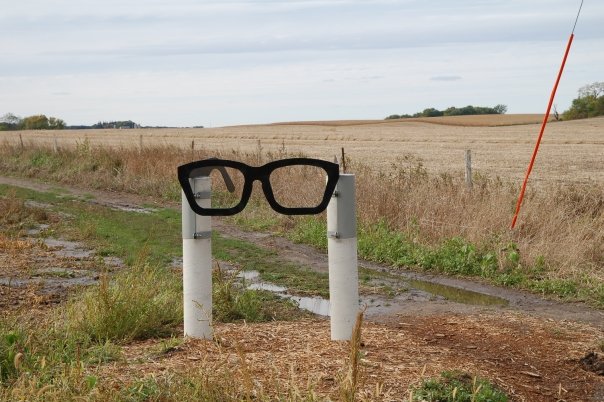
At the beginning of their music careers, Holly and his group wore business suits. When they met the Everly Brothers, Don Everly took the band to Phil's Men's Shop in New York City and introduced them to Ivy League clothes. The brothers advised Holly to replace his old-fashioned glasses with horn-rimmed glasses, which had been popularized by Steve Allen. Holly bought a pair of glasses made in Mexico from Lubbock optometrist Dr. J. Davis Armistead. Teenagers in the United States started to request this style of glasses, which were later popularly known as "Buddy Holly glasses."
While Holly's other belongings were recovered immediately following his fatal plane crash, there was no record of his signature glasses being found. They were presumed lost until, in March 1980, they were discovered in a Cerro Gordo County courthouse storage area by Sheriff Gerald Allen. They had been found in the spring of 1959, after the snow had melted, and had been given to the sheriff's office. They were placed in an envelope dated April 7, 1959, along with the Big Bopper's watch, a lighter, two pairs of dice and part of another watch, and misplaced when the county moved courthouses. The glasses frames were returned to Santiago a year later, after a legal contest over them with his parents. They are now on display at the Buddy Holly Center in Lubbock, Texas.
The rarest and only known Buddy Holly poster from "The Day the Music Died," was sold at Heritage Auctions for a record-breaking $447,000 in 2022.
Legacy
Buddy Holly left behind dozens of unfinished recordings — solo transcriptions of his new compositions, informal jam sessions with bandmates, and tapes demonstrating songs intended for other artists. The last known recordings, made in Holly's apartment in late 1958, were his last six original songs. In June 1959, Coral Records overdubbed two of them with backing vocals by the Ray Charles Singers and studio musicians in an attempt to simulate the established Crickets sound. The finished tracks became the first posthumous Holly single, "Peggy Sue Got Married"/"Crying, Waiting, Hoping". The new release was successful enough to warrant an album drawing upon the other Holly demos, using the same studio personnel, in January 1960. All six songs were included in The Buddy Holly Story, Vol. 2 (1960).