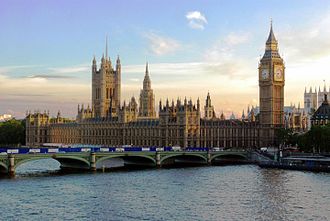
The Parliament of the United Kingdom of Great Britain and Northern Ireland is the supreme legislative body of the United Kingdom, and may also legislate for the Crown Dependencies and the British Overseas Territories. Since 1999, varying degrees of powers have been devolved to the national parliaments of Northern Ireland, Scotland, and Wales. Each devolved parliament has different devolved powers, with Scotland being the most powerful amongst the three devolved parliaments. The central UK Parliament retains the power to legislate in reserved matters, including broadcasting, defence, and currency.
It meets at the Palace of Westminster in London. Parliament possesses legislative supremacy and thereby holds ultimate power over all other political bodies in the United Kingdom and the Overseas Territories. While Parliament is bicameral, it has three parts: the sovereign, the House of Lords, and the House of Commons. The three parts acting together to legislate may be described as the King-in-Parliament. The Crown normally acts on the advice of the prime minister, while the House of Lords' powers are generally limited to delaying legislation.
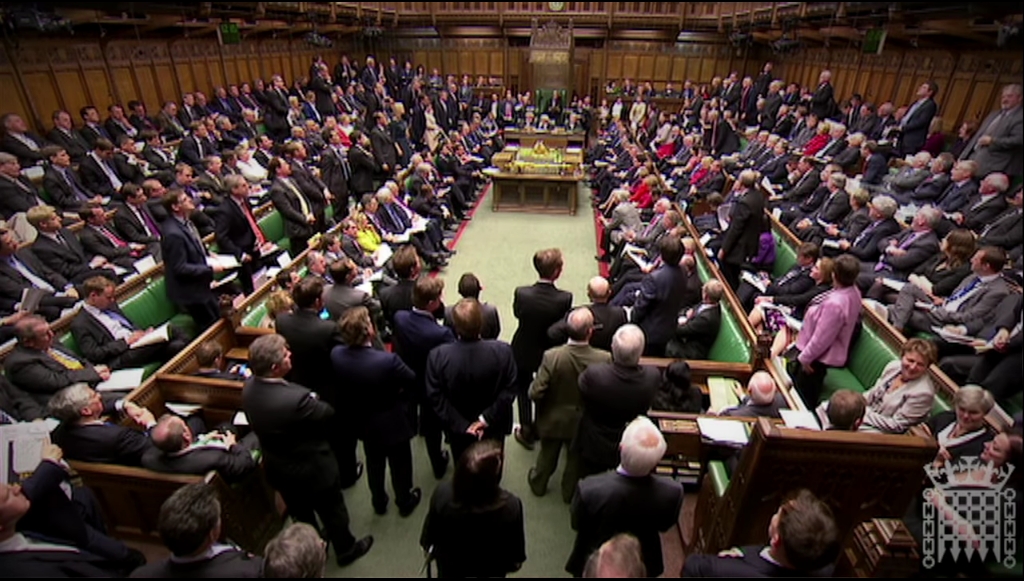
The House of Commons is the elected lower chamber of Parliament, with elections to 650 single-member constituencies held at least every five years under the first-past-the-post system. By constitutional convention, all government ministers, including the prime minister, are members of the House of Commons (MPs), or less commonly the House of Lords, and are thereby accountable to the respective branches of the legislature. Most Cabinet ministers are from the Commons, while junior ministers can be from either house.

The House of Lords is the upper chamber of Parliament, comprising two types of members. The more numerous are the Lords Temporal, consisting of life peers appointed by the sovereign on the advice of the prime minister. The less numerous Lords Spiritual consist of up to 26 bishops of the Church of England. Before the establishment of the Supreme Court of the United Kingdom in 2009, the House of Lords performed judicial functions through the law lords.
The Parliament of the United Kingdom is one of the oldest legislatures in the world, and is characterised by the stability of its governing institutions and its capacity to absorb change. The Westminster system shaped the political systems of the nations once ruled by the British Empire, and thus has been called the "mother of parliaments".
History
The Parliament of Great Britain was formed in 1707 following the ratification of the Treaty of Union by Acts of Union passed by the Parliament of England (established 1215) and the Parliament of Scotland (c. 1235), both Acts of Union stating, "That the United Kingdom of Great Britain be represented by one and the same Parliament to be styled The Parliament of Great Britain." At the start of the 19th century, Parliament was further enlarged by Acts of Union ratified by the Parliament of Great Britain and the Parliament of Ireland, which abolished the latter and added 100 Irish MPs and 32 Lords to the former to create the Parliament of the United Kingdom of Great Britain and Ireland. The Royal and Parliamentary Titles Act 1927 formally amended the name to the "Parliament of the United Kingdom of Great Britain and Northern Ireland", five years after the secession of the Irish Free State.
Parliament meets in the Palace of Westminster, the same location as the English Parliament had met, and it has continued there up to the present. The House of Lords and House of Commons sit in their respective chambers, with exception following the 1834 fire and 1941 bombing during the Blitz which destroyed large parts of the chambers. During the reconstruction the Lords sat in the Painted Chamber and White Chamber while the Commons sat in the former Lords Chamber for 17 years following the fire until 1851. As the Commons Chamber was destroyed following the bombing, both houses met in the Church House annexe and then the Commons met to the Lords Chamber and the Lords met in the Robing Room for 9 years until 1950.
Parliament of the United Kingdom of Great Britain and Ireland
The United Kingdom of Great Britain and Ireland was created on 1 January 1801, by the merger of the Kingdoms of Great Britain and Ireland under the Acts of Union 1800. The principle of ministerial responsibility to the lower house (Commons) did not develop until the 19th century—the House of Lords was superior to the House of Commons both in theory and in practice. Members of the House of Commons (MPs) were elected in an antiquated electoral system, under which constituencies of vastly different sizes existed. Thus, the borough of Old Sarum, with seven voters, could elect two members, as could the borough of Dunwich, which had almost completely disappeared into the sea due to land erosion.
Many small constituencies, known as pocket or rotten boroughs, were controlled by members of the House of Lords (peers), who could ensure the election of their relatives or supporters. During the reforms of the 19th century, beginning with the Reform Act 1832, the electoral system for the House of Commons was progressively regularised. No longer dependent on the Lords for their seats, MPs grew more assertive.

The Chartist movement gained popularity at this time, formed mostly of emerging working class people advocating peacefully for reform. The People's Charter petition garnered millions of signatures and was presented to Parliament in 1838, 1842, and 1848 with the following demands:
A vote for every man aged twenty-one years and above, of sound mind, and not undergoing punishment for a crime.
The secret ballot to protect the elector in the exercise of his vote.

No property qualification for Members of Parliament (MPs), to allow the constituencies to return the man of their choice.
Payment of Members, enabling tradesmen, working men, or other persons of modest means to leave or interrupt their livelihood to attend to the interests of the nation.
Equal constituencies, securing the same amount of representation for the same number of electors, instead of allowing less populous constituencies to have as much or more weight than larger ones.

Annual parliamentary elections, thus presenting the most effectual check to bribery and intimidation, since no purse could buy a constituency under a system of universal manhood suffrage in every twelve months.
The Second Reform Act (1867), and Third Reform Act (1884) expanded the franchise gradually, and the adoption of all but the last of these demands came through:
Representation of the People Act 1918 (gave the vote to all men over 21 as well as women over 30)
Ballot Act 1872 (introduced secret ballots)
Abolish Property Qualifications Act 1858 (abolished property requirements for MPs)
Parliament Act 1911 (Introduced payment for MPs, initially £400 annually)
Redistribution of Seats Act 1885, Representation of the People Act 1948, and Redistribution of Seats Act 1949 (made equally populated constituencies, and later abolished multi-member constituencies)
The supremacy of the British House of Commons was reaffirmed in the early 20th century. In 1909, the Commons passed the "People's Budget", which made numerous changes to the taxation system which were detrimental to wealthy landowners. The House of Lords, which consisted mostly of powerful landowners, rejected the Budget. On the basis of the Budget's popularity and the Lords' consequent unpopularity, the Liberal Party narrowly won two general elections in 1910.
Using the result as a mandate, the Liberal Prime Minister, H. H. Asquith, introduced the Parliament Bill, which sought to restrict the powers of the House of Lords. (He did not reintroduce the land tax provision of the People's Budget.) When the Lords refused to pass the bill, Asquith countered with a promise extracted from the King in secret before the second general election of 1910 and requested the creation of several hundred Liberal peers, so as to erase the Conservative majority in the House of Lords. In the face of such a threat, the House of Lords narrowly passed the bill.
The Parliament Act 1911, as it became, prevented the Lords from blocking a money bill (a bill dealing with taxation), and allowed them to delay any other bill for a maximum of three sessions (reduced to two sessions in 1949), after which it could become law over their objections. However, regardless of the Parliament Acts of 1911 and 1949, the House of Lords has always retained the unrestricted power to veto any bill outright which attempts to extend the life of a parliament.
Parliament of the United Kingdom of Great Britain and Northern Ireland
The result of the 1918 general election in Ireland showed a landslide victory for the Irish republican party Sinn Féin, who vowed in their manifesto to establish an independent Irish Republic. Accordingly, Sinn Féin MPs, though ostensibly elected to sit in the House of Commons, refused to take their seats in Westminster, and instead assembled in 1919 to proclaim Irish independence and form a revolutionary unicameral parliament for the independent Irish Republic, called Dáil Éireann.
In 1920, in parallel to the Dáil, the Government of Ireland Act 1920 created home rule parliaments of Northern Ireland and Southern Ireland and reduced the representation of both parts at Westminster. The number of Northern Ireland seats was increased again after the introduction of direct rule in 1973.
The Irish republicans responded by declaring the elections to these home rule Parliaments, held on the same day in 1921, to be the basis of membership for a new Dáil Éireann. While the elections in Northern Ireland were both contested and won by Unionist parties, in Southern Ireland, all 128 candidates for the Southern Irish seats were returned unopposed. Of these, 124 were won by Sinn Féin and four by independent Unionists representing Dublin University (Trinity College). Since only four MPs sat in the home rule Southern Irish parliament, with the remaining 124 being in the Republic's Second Dáil, the home rule parliament was adjourned sine die without ever having operated.
In 1922, pursuant to the Anglo-Irish Treaty, the revolutionary Irish Republic was replaced by the Irish Free State, recognised by the United Kingdom as a separate state (and thus, no longer represented in the Westminster Parliament), while Northern Ireland would remain British, and in 1927, parliament was renamed the Parliament of the United Kingdom of Great Britain and Northern Ireland.
The Reform Act 1928 gave universal suffrage with a voting age of 21, and the Reform Act 1969 lowered the voting age to 18, making the United Kingdom the first major democratic country to do so.
Further reforms to the House of Lords were made in the 20th century. The Life Peerages Act 1958 authorised the regular creation of life peerage dignities. By the 1960s, the regular creation of hereditary peerage dignities had ceased; thereafter, almost all new peers were life peers only.
The House of Lords Act 1999 removed the automatic right of hereditary peers to sit in the House of Lords, although it made an exception for 92 of them to be elected to life-terms by the other hereditary peers, with by-elections upon their death. The House of Lords is now a chamber that is subordinate to the House of Commons. Additionally, the Constitutional Reform Act 2005 led to abolition of the judicial functions of the House of Lords with the creation of the new Supreme Court of the United Kingdom in October 2009.
Composition and powers
Under the UK's constitution, Parliament is the supreme legislative body of the state. Whilst the privy council can also issue legislation through orders-in-council, this power may be limited by Parliament, like all other exercises of the royal prerogative.
The legislative authority, the King-in-Parliament, has three separate elements: the Monarch, the House of Lords, and the House of Commons. As a result, a bill must be passed by both houses (or just the House of Commons under the Parliament Act 1911) and receive royal assent for it to become law.
Executive powers (including those granted by legislation or forming part of the prerogative) are not formally exercised by Parliament itself. However, these powers are in practice exercised on the advice of government ministers, who must be drawn from and be accountable to the Parliament.
Monarch
Whilst the monarch is a constitutive element of parliament, they do not debate bills or otherwise contribute to political debate. Their royal assent is required for a bill to become law; however, this has not been refused since 1708 and is largely a formality. Assent is granted by the monarch (or counsellors of state) signing letters patent (affixed with the Great Seal of the Realm) prepared by the clerk of the Crown listing all bills passed by the houses of Parliament up to a certain date. To be complete, Parliament must be notified that assent has been given. Assent may also be granted in person by the monarch in the House of Lords; however, this has not happened since 1854. Alternatively, assent may be granted by royal commission, as commonly occurred before 1967 but now only occurs when bills are assented to before prorogation.
House of Lords
The House of Lords is known formally as "The Right Honourable The Lords Spiritual and Temporal in Parliament Assembled", the Lords Spiritual being bishops of the Church of England and the Lords Temporal being Peers of the Realm. The Lords Spiritual and Lords Temporal are considered separate "estates", but they sit, debate, and vote together.
The Parliament Acts 1911 and 1949 significantly reduced the legislative powers of the House of Lords relative to the House of Commons. Whilst the Lords debates and votes on all bills (except money bills), their refusal to pass a bill may only delay its passage for a maximum of two parliamentary sessions over a year. After this, the bill may receive royal assent and become law without the Lords' consent.
Like in the House of Commons, the House of Lords may scrutinise governments through asking questions to government ministers that sit in the Lords and through the operation of a small number of select committees.
The Lords used to also exercise judicial power and acted as the UK's supreme legislative court. Appeals were not heard by the whole body, but a committee of senior judges that were appointed to the Lords to act for this purpose. This power was lost when it was transferred to the newly created Supreme Court of the United Kingdom in 2009.
From time to time, and especially recently, arguments have been made suggesting the House of Lords is obsolete or unnecessary. In 2023, a commission led by former Prime Minister Gordon Brown stated that the existence of the House of Lords was "indefensible" and recommended that the Lords in its current form be abolished and replaced by an "Assembly of the Nations and Regions".
Lords Spiritual
The Lords Spiritual of the Lords' currently consists of the archbishops of Canterbury and York, the bishops of London, Durham and Winchester (who sit by right regardless of seniority) and 21 other diocesan bishops of the Church of England, ranked in order of consecration, subject to women being preferred if one is eligible from 2015 to 2030 under the Lords Spiritual (Women) Act 2015. and Lords Spiritual (Women) Act 2015 (Extension) Act 2025. Formerly, the Lords Spiritual included all of the senior clergymen of the Church of England—archbishops, bishops, abbots and mitred priors.
Lords Temporal
The Lords Temporal consists all life peers appointed under the Life Peerages Act 1958 (currently numbering around 700).
Life peers are appointed by the monarch, on the advice of the prime minister. Typically, these are members of the party of the prime minister, however some peers from other parties are also generally appointed.
House of Commons
As of 2019, the House consists of 650 members; this total includes the Speaker, who by convention renounces partisan affiliation and does not take part in debates or votes, as well as three Deputy Speakers, who also do not participate in debates or votes but formally retain their party membership. Each Member of Parliament (MP) is chosen by a single constituency by the First-Past-the-Post electoral system. There are 650 constituencies in the United Kingdom, each made up of an average of 65,925 voters. The First-Past-the-Post system means that every constituency elects one MP each. Each voter assigns one vote for one candidate, and the candidate with the most votes in each constituency is elected as MP to represent their constituency. Members sit for a maximum of five years, although elections are generally called before that maximum limit is reached.
A party needs to win 326 constituencies (known as "seats") to win a majority in the House of Commons. If no party achieves a majority, then a situation of no overall control occurs – commonly known as a "Hung Parliament". In case of a Hung Parliament, the party with the most seats has the opportunity to form a coalition with other parties, so their combined seat tally extends past the 326-seat majority.
The House of Commons is the most powerful of the components of Parliament, particularly due to its sole right to determine taxation and the supply of money to the government. Additionally, the prime minister and leader of the government sits in the House, having acquiring this position by virtue of having the confidence of the other members. This also means that the House is also the primary location in which the government faces scrutiny, as expressed through Question Time and the work of various select committees.
State Opening of Parliament
The State Opening of Parliament is an annual event that marks the commencement of a session of the Parliament of the United Kingdom. It is held in the House of Lords Chamber. Before 2012, it took place in November or December, or, in a general election year, when the new Parliament first assembled. From 2012 onwards, the ceremony has taken place in May or June.
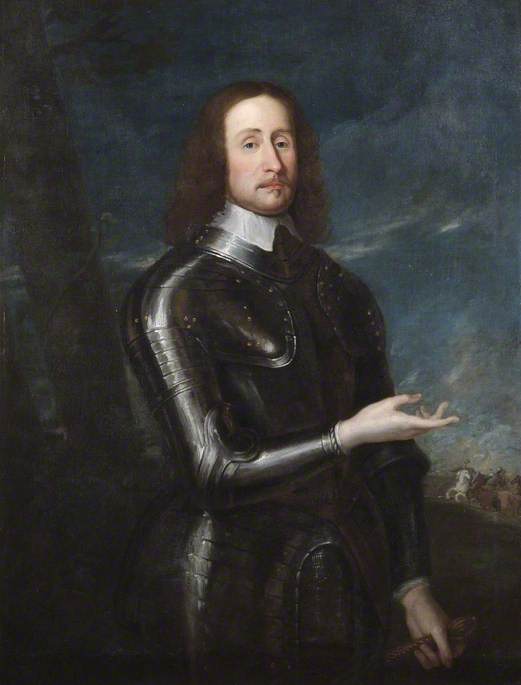
Upon the signal of the Monarch, the Lord Great Chamberlain raises their wand of office to signal to Black Rod, who is charged with summoning the House of Commons and has been waiting in the Commons lobby. Black Rod turns and, under the escort of the Door-keeper of the House of Lords and an inspector of police, approaches the doors to the Chamber of the Commons. In 1642, King Charles I stormed into the House of Commons in an unsuccessful attempt to arrest the Five Members, who included the celebrated English patriot and leading Parliamentarian John Hampden. This action sparked the English Civil War. The wars established the constitutional rights of Parliament, a concept legally established in the Glorious Revolution in 1688 and the subsequent Bill of Rights 1689. Since then, no British monarch has entered the House of Commons when it is in session. On Black Rod's approach, the doors are slammed shut against them, symbolising the rights of parliament and its independence from the monarch. They then strike, with the end of their ceremonial staff (the Black Rod), three times on the closed doors of the Commons Chamber. They are then admitted, and announce the command of the monarch for the attendance of the Commons.
The monarch reads a speech, known as the Speech from the Throne, which is prepared by the Prime Minister and the Cabinet, outlining the Government's agenda for the coming year. The speech reflects the legislative agenda for which the Government intends to seek the agreement of both Houses of Parliament.