
Boston College (BC) is a private Catholic Jesuit research university in Chestnut Hill, Massachusetts, United States. Founded in 1863 by the Society of Jesus, a Catholic religious order, the university has more than 15,000 total students.
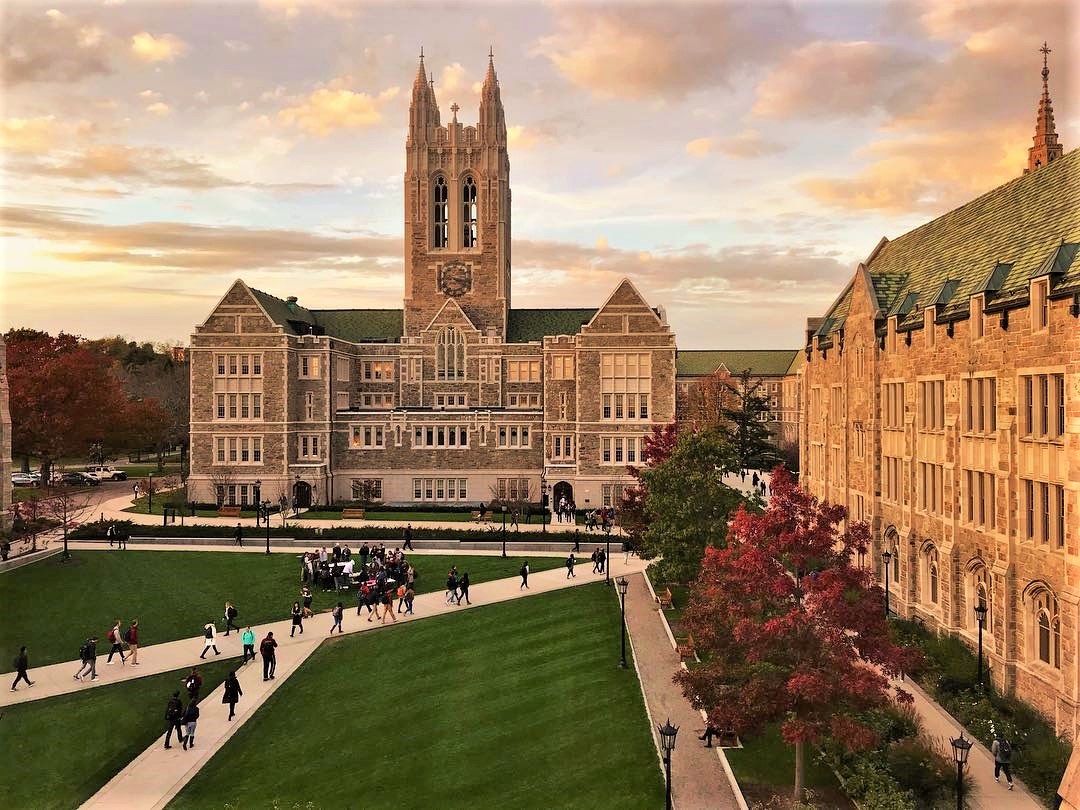
Boston College was originally located in the South End of Boston before moving most of its campus to Chestnut Hill in 1907. Its main campus is a historic district and features some of the earliest examples of collegiate Gothic architecture in North America. The campus is 6 miles west of downtown Boston. It offers bachelor's degrees, master's degrees, and doctoral degrees through its nine colleges and schools. Boston College is classified as a "Research 1: Very High Research Spending and Doctorate Production" university by the Carnegie Classification.
Boston College athletic teams are the Eagles. Their colors are maroon and gold and their mascot is Baldwin the Eagle. The Eagles compete in NCAA Division I as members of the Atlantic Coast Conference in all sports offered by the ACC. The men's and women's ice hockey teams compete in Hockey East. Boston College's men's ice hockey team has won five national championships.

Alumni and affiliates of the university include governors, ambassadors, members of Congress, scholars, writers, medical researchers, Hollywood actors, and professional athletes. Boston College alumni include three Rhodes, 22 Truman, and 171 Fulbright scholars.
History
Early history
Boston College was founded through the efforts of the first Jesuit community in New England, which was established at St. Mary's Church in Boston in 1849. Jesuit priest John McElroy maintained the vision for what became Boston College, recognizing the need for an educational institution for the Irish Catholic immigrant population. With the approval of his Jesuit superiors, McElroy raised funds and purchased land for "The Boston College" on Harrison Avenue in the Hudson neighborhood of South End, Boston, Massachusetts, in 1857.
On April 1, 1863, the college was granted a university charter by the Commonwealth of Massachusetts, allowing the board of trustees to confer degrees typically awarded by colleges in the state. John Bapst served as the first President of Boston College and launched the collegiate instruction program on September 5, 1864.

The average age of students in its early years was fourteen, indicating a strong presence of high schoolers, which aligned with the Society of Jesus's preparatory tradition from Europe. The student body consisted mainly of local boys from greater Boston parishes, some of whom received scholarships, while campus life focused heavily on religious activities, requiring Catholic students to attend Mass, partake in confession, and join devotional societies. The curriculum was based on the Jesuit Ratio Studiorum, emphasizing Latin, Greek, philosophy, and theology.
Expansion of the South End buildings onto James Street enabled increased separation between the high school and college divisions, though Boston College High School remained a constituent part of Boston College until 1927, when it was separately incorporated.
Robert and Catharine Morris
In 1895, Catharine H. Morris, wife of the second African American to pass the bar in the United States, Robert Morris, bequeathed their family library to the Church of the Immaculate Conception, which was physically and administratively attached to the nascent Boston College. Morris, a civil rights leader and prominent legal defender of Boston's Irish immigrant community, maintained close relationships with the leaders of the young Boston College, including early president Robert J. Fulton.
Currently, the Burns Library holds just over 100 confirmed texts from the Morris library. The original donation is estimated to amount to 1000 volumes, and scholars and librarians at the university continue to recover books belonging to the original collection. This archive presents a valuable set of 19th century editions of literature, history, and anti-slavery texts. As historians Laurel Davis and Mary Sarah Bilder write, "Morris indeed may mark one of the first self-conscious African American collectors of the African American experience, placing him in the company of later collector Arturo Alfonso Schomburg, who sought to collect and understand the 'global black experience.'"
Move to Chestnut Hill
In 1907, newly installed president Thomas I. Gasson determined that BC's cramped, urban quarters in Boston's South End were inadequate and unsuited for significant expansion. Inspired by John Winthrop's early vision of Boston as a "city upon a hill", he re-imagined Boston College as a beacon of Jesuit scholarship. Less than a year after taking office, he purchased Amos Adams Lawrence's farm on Chestnut Hill, six miles (10 km) west of downtown. He organized an international competition for the design of a campus master plan and set about raising funds for the construction of the "new" university. Construction began in 1909.
By 1913, construction costs had surpassed available funds, and, as a result, Gasson Hall, "New BC's" main building, stood alone on Chestnut Hill for its first three years. While Maginnis's ambitious plans were never fully realized, BC's first "capital campaign"—which included a large replica of Gasson Hall's clock tower set up on Boston Common to measure the fundraising progress—ensured that President Gasson's vision survived.

Academic expansion and co-education
By the 1920s, BC began to fill out the dimensions of its university charter, establishing the Boston College Graduate School of Arts & Sciences, the Boston College Law School, and the Woods College of Advancing Studies, followed successively by the Boston College Graduate School of Social Work, the Carroll School of Management, the Connell School of Nursing, and the Lynch School of Education and Human Development. In 1926, Boston College conferred its first degrees on women (though it did not become fully coeducational until 1970). On April 20, 1963, an address by President John F. Kennedy, the nation's first Catholic president who had received an honorary degree in 1956, was the highlight of a week-long centennial celebration.
Monan's presidency and institutional expansion
When J. Donald Monan began his presidency on September 5, 1972, Boston College faced significant financial challenges, including a $30 million debt and a frozen salary structure for faculty and staff. During his tenure, the Boston College Board of Trustees was restructured to include lay alumni and business leaders, moving away from its traditional composition of Society of Jesus members. In 1973, Monan appointed Frank B. Campanella as BC's first executive vice president to focus on fiscal matters and university administration. Campanella held this position until 1991. In 1974, BC adopted depreciation accounting, a novel approach at the time for universities, reflecting a more sophisticated financial strategy. BC merged with Newton College of the Sacred Heart in that same year, acquiring its 40-acre campus just 1.5 miles away, which allowed the Boston College Law School to relocate and provided much-needed housing for an increasingly residential student body.
In April 1976, BC launched a capital campaign to raise $21 million but ultimately secured $25 million. By 1982, the university had enjoyed a decade of financial stability, with an endowment of $36 million by the end of the 1981–82 academic year. Following an aggressive capital campaign in 1989 that raised $136 million, the endowment reached $250 million, surpassed $350 million in 1992, and exceeded $500 million by 1995. When Monan transitioned to University Chancellor in 1996, the endowment had grown to $590 million.
Continued growth and development
Under the presidency of William P. Leahy, which began after Monan's tenure, Boston College experienced significant growth and development. In 2002, Leahy initiated the Church in the 21st Century program, addressing issues facing the Catholic Church in light of the clergy sexual abuse scandal, which positioned BC as a leader in advocating for Church reform. Plans to merge with the Weston Jesuit School of Theology furthered the university's ambition to be a leading intellectual center for Catholic theology in the United States.
In 2007, BC announced a $1.6 billion master plan for campus revitalization over ten years, aiming to enhance facilities and hire new faculty. While the plan received mixed reactions from city officials, it marked a significant step toward expanding the university's capabilities. By June 10, 2009, the Boston College Master Plan was approved by city authorities, allowing the university to enter the design and planning phases for its ambitious development projects. Through these initiatives, Boston College has continued to adapt and evolve as a prominent institution in higher education.
Campuses
The Boston College campus is known generally as the "Heights" and to some as the "Crowned Hilltop" due largely to its location and presence of buildings featuring gothic towers reaching into the sky. The main campus is also listed on the National Register of Historic Places.

The University also encompasses the Connors Family Retreat and Conference Center in Dover, Massachusetts, the Weston Observatory in Weston, Massachusetts, and various other properties in the region.
Main Campus
Boston College's main campus is located in Chestnut Hill, 6 miles (9.7 km) west of downtown Boston, is 175 acres and features over 120 buildings set atop a hill overlooking the Chestnut Hill Reservoir.
The campus is accessible via the Boston College station, situated at St. Ignatius Gate. This station serves as the western terminus of the Massachusetts Bay Transportation Authority (MBTA) Green Line's B branch (also known as the "Boston College" line), connecting the university to downtown Boston and other destinations.
Other properties
In 2017, Boston College acquired the 24-acre Mishkan Tefila Synagogue property in Chestnut Hill, which was previously used for administrative services and event parking. The synagogue's 806-seat auditorium has since been transformed into the university's largest theater venue for the Robsham Theater Arts Center, alongside a ballroom-style multi-purpose room and a hexagon-shaped meeting room for various events. An outdoor quad is also available for performances and gatherings. In 2019, the City of Newton took approximately 17 wooded acres of the property through eminent domain. In 2020, Boston College further expanded its mission by acquiring Pine Manor College, a financially struggling liberal arts institution in Chestnut Hill that served a significant number of first-generation and inner-city students.
Newton Campus
In 1975, Boston College merged with Newton College of the Sacred Heart. The Centre Street campus of the Newton College has since become housing for freshmen of Boston College and the current location of the Boston College Law School. Athletic fields for some of Boston College's teams have also been constructed on Newton Campus. The campus is located 1 mile west of the main campus and is serviced by the university bus system.
Brighton Campus
Between 2004 and 2007, Boston College acquired 65 acres (260,000 m2) of land from the Archdiocese of Boston. This included the archdiocese's former headquarters, sold to the university in 2004 for $107,400,000. This land holds a variety of buildings for the school of theology, along with facilities for the men's baseball and women's softball team.
Brookline Campus
The Brookline campus is home to Messina College (formerly Pine Manor College), which includes several residence halls and other academic and athletic facilities. Messina College opened in July 2024 for over 100 first-generation college students. It offers associate degrees in applied data science, health sciences, general business, and applied psychology and human development. The college emphasizes support for underprivileged students through a residential model, small class sizes, and mentorship, preparing graduates for workforce entry or transfer to four-year institutions.
Organization and administration
Its annual operating budget is approximately $1.02 billion. The most recent and ongoing fundraising campaign, dubbed "Soaring Higher", was announced on September 28, 2023. The campaign aims to raise $3 billion, double the last campaign's goal. Of this goal, $1.1 billion is earmarked for student financial aid, $750 million is for student life initiatives, and $1.15 billion is for academic programs.
Catholic and Jesuit
As of 2005, there were 112 Jesuits living on the Boston College campus, including members of the faculty and administration, graduate students, and visiting international scholars.
The chapel for the university is located in St. Mary's Hall, the Jesuit residential facility. Additional BC chapels are Trinity Chapel on the Newton Campus, St. Joseph's Chapel in the Basement of Gonzaga Hall on Upper Campus, Simboli Hall Chapel on the Brighton Campus, and St. Catherine of Sienna Chapel in Cushing Hall. Over 70 Catholic Masses are celebrated on Campus each week during the Academic Year. The college also maintains close relations with the nearby Church of Saint Ignatius of Loyola.
Affiliated institutions
St. Columbkille Parish is a Catholic Church and elementary school in Brighton, Massachusetts, that has an alliance with BC. Under the agreement, the parish school is to be governed by a board of members and a board of trustees comprising representatives from the Archdiocese of Boston, Boston College, St. Columbkille Parish and the greater Boston community.
Academics
Schools and colleges
Boston College is made up of a total of nine constituent colleges and schools:
Morrissey College of Arts & Sciences
Carroll School of Management
Lynch School of Education and Human Development
Connell School of Nursing
Boston College School of Social Work
Boston College Law School
Gloria L. and Charles I. Clough School of Theology and Ministry
Woods College of Advancing Studies
Messina College
Rankings
Boston College tied for 39th among national universities and tied for 625th among global universities in U.S. News & World Report's "America's Best Colleges 2023–2024" rankings and 88th in the Forbes 2023 edition of "America's Top Colleges". In 2016, the undergraduate school of business, the Carroll School of Management, placed 3rd in an annual ranking of U.S. undergraduate business schools by Bloomberg Businessweek. A 2007 Princeton Review survey of parents that asked "What 'dream college' would you most like to see your child attend were prospects of acceptance or cost not issues?" placed BC 6th. Boston College is accredited by the New England Commission of Higher Education.
Order of the Cross and Crown
The Order of the Cross and Crown, founded in 1939, is the College of Arts and Sciences honor society for seniors who have achieved an average of at least A−, as well as established records of unusual service and leadership on the campus. The selections committee, composed of the deans, faculty members, and administration, appoints specially distinguished members of the Order to be its officers as Chief Marshal and Marshals. Induction into the Cross and Crown Honor Society is one of the highest and most prestigious honors that BC students can receive.