
The Boeing 737 is an American narrow-body aircraft produced by Boeing at its Renton factory in Washington.
Developed to supplement the Boeing 727 on short and thin routes, the twinjet retained the 707 fuselage width and six abreast seating but with two underwing Pratt & Whitney JT8D low-bypass turbofan engines. Envisioned in 1964, the initial 737-100 made its first flight in April 1967 and entered service in February 1968 with Lufthansa.
The lengthened 737-200 entered service in April 1968, and evolved through four generations, offering several variants for 85 to 215 passengers.

The first generation 737-100/200 variants were powered by Pratt & Whitney JT8D low-bypass turbofan engines and offered seating for 85 to 130 passengers. Launched in 1980 and introduced in 1984, the second generation 737 Classic -300/400/500 variants were upgraded with more fuel-efficient CFM56-3 high-bypass turbofans and offered 110 to 168 seats. Introduced in 1997, the third generation 737 Next Generation (NG) -600/700/800/900 variants have updated CFM56-7 high-bypass turbofans, a larger wing and an upgraded glass cockpit, and seat 108 to 215 passengers. The fourth and latest generation, the 737 MAX -7/8/9/10 variants, powered by improved CFM LEAP-1B high-bypass turbofans and accommodating 138 to 204 people, entered service in 2017.
Boeing Business Jet versions have been produced since the 737NG, as well as military models.
As of May 2026, 17,393 Boeing 737s have been ordered and 12,572 delivered. It was the best-selling commercial aircraft until being surpassed by the competing Airbus A320 family in October 2019, and maintained the lead in total deliveries over the A320 until September 2025. Initially, its main competitor was the McDonnell Douglas DC-9, followed by its MD-80/MD-90 derivatives. In 2013, the global 737 fleet had completed more than 184 million flights over 264 million block hours since its entry into service. The 737 MAX, designed to compete with the A320neo, was grounded worldwide between March 2019 and November 2020 following two fatal crashes.

Development
Initial design
Boeing had been studying short-haul jet aircraft designs, and saw a need for a new aircraft to supplement the 727 on short and thin routes. Preliminary design work began on May 11, 1964, based on research that indicated a market for a fifty to sixty passenger airliner flying routes of 50 to 1,000 miles (100 to 1,600 km).
The initial concept featured podded engines on the aft fuselage, a T-tail as with the 727, and five-abreast seating. Engineer Joe Sutter relocated the engines to the wings which lightened the structure and simplified the accommodation of six-abreast seating in the fuselage. The engine nacelles were mounted directly to the underside of the wings, without pylons, allowing the landing gear to be shortened, thus lowering the fuselage to improve baggage and passenger access. Relocating the engines from the aft fuselage also allowed the horizontal stabilizer to be attached to the aft fuselage instead of as a T-tail. Many designs for the engine attachment strut were tested in the wind tunnel and the optimal shape for high speed was found to be one which was relatively thick, filling the narrow channels formed between the wing and the top of the nacelle, particularly on the outboard side.
At the time, Boeing was far behind its competitors; the SE 210 Caravelle had been in service since 1955, and the BAC One-Eleven (BAC-111), Douglas DC-9, and Fokker F28 were already into flight certification. To expedite development, Boeing used 60% of the structure and systems of the existing 727, particularly the fuselage, which differs in length only. This 148-inch (3.76 m) wide fuselage cross-section permitted six-abreast seating compared to the rivals' five-abreast. The 727's fuselage was derived from the 707.
The proposed wing airfoil sections were based on those of the 707 and 727, but somewhat thicker; altering these sections near the nacelles achieved a substantial drag reduction at high Mach numbers. The engine chosen was the Pratt & Whitney JT8D-1 low-bypass ratio turbofan engine, delivering 14,500 pounds-force (64 kN) of thrust.
The concept design was presented in October 1964 at the Air Transport Association maintenance and engineering conference by chief project engineer Jack Steiner, where its elaborate high-lift devices raised concerns about maintenance costs and dispatch reliability.
Major design developments
The original 737 continued to be developed into thirteen passenger, cargo, corporate and military variants. These were later divided into what has become known as the four generations of the Boeing 737 family:

The first generation "Original" series: the 737-100 and -200, also the military T-43 and CT-43, launched February 1965.
The second generation "Classic" series: 737-300, -400 and -500, launched in 1979.
The third generation "Next Generation" series: 737-600, -700, -800 and -900, also the military C-40 and P-8, launched late 1993.

The fourth generation 737 MAX series: 737-7, -8, -9 and -10, launched August 2011.
Launch
The launch decision for the $150 million (~$1.14 billion in 2024) development was made by the board on February 1, 1965. The sales pitch was big-jet comfort on short-haul routes.
Lufthansa became the launch customer on February 19, 1965, with an order for 21 aircraft, worth $67 million (~$507 million in 2024) after the airline had been assured by Boeing that the 737 project would not be canceled. Consultation with Lufthansa over the previous winter had resulted in the seating capacity being increased to 100.

On April 5, 1965, Boeing announced an order by United Airlines for 40 737s. United wanted a slightly larger capacity than the 737-100, so the fuselage was stretched 36 inches (91 cm) ahead of, and 40 inches (102 cm) behind the wing. The longer version was designated the 737-200, with the original short-body aircraft becoming the 737-100. Detailed design work continued on both variants simultaneously.
Introduction
The first -100 was rolled out on January 17, 1967, and took its maiden flight on April 9, 1967, piloted by Brien Wygle and Lew Wallick. After several test flights the Federal Aviation Administration (FAA) issued Type Certificate A16WE certifying the 737-100 for commercial flight on December 15, 1967. It was the first aircraft to have, as part of its initial certification, approval for Category II approaches, which refers to a precision instrument approach and landing with a decision height between 98 and 197 feet (30 and 60 m). Lufthansa received its first aircraft on December 28, 1967, and on February 10, 1968, became the first non-American airline to launch a new Boeing aircraft. Lufthansa was the only significant customer to purchase the 737-100 and only 30 aircraft were produced.
The -200 was rolled out on June 29, 1967, and had its maiden flight on August 8, 1967. It was then certified by the FAA on December 21, 1967. The inaugural flight for United Airlines took place on April 28, 1968, from Chicago to Grand Rapids, Michigan. The lengthened -200 was widely preferred over the -100 by airlines. The improved version, the 737-200 Advanced, was introduced into service by All Nippon Airways on May 20, 1971.
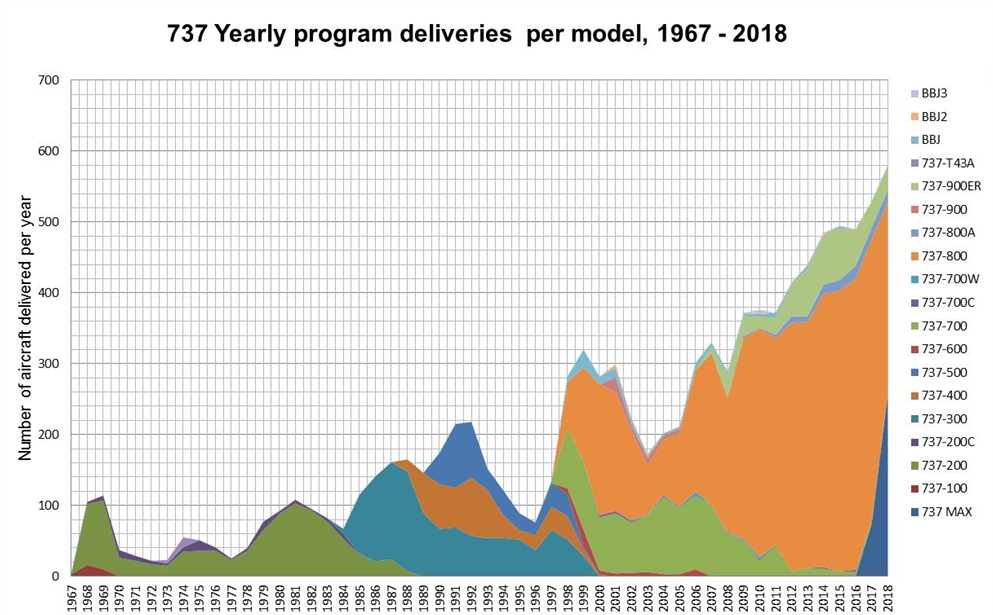
The 737 original model with its variants, known later as the Boeing 737 Original, initially competed with SE 210 Caravelle and BAC-111 due to their earlier entry into service and later primarily with the McDonnell Douglas DC-9, then its MD-80 derivatives as the three European short-haul single aisles slowly withdrew from the competition. Sales were low in the early 1970s and, after a peak of 114 deliveries in 1969, only 22 737s were shipped in 1972 with 19 in backlog. The US Air Force saved the program by ordering T-43s, which were modified Boeing 737-200s. African airline orders kept the production running until the 1978 US Airline Deregulation Act, which improved demand for six-abreast narrow-body aircraft. Demand further increased after being re-engined with the CFM56. The 737 went on to become the highest-selling commercial aircraft in terms of orders until surpassed by the competing Airbus A320 family in October 2019, and maintained the lead in total deliveries until October 2025.
The fuselage is manufactured in Wichita, Kansas, by Boeing spin-off company Spirit AeroSystems, before being moved by rail to Renton. The Renton factory has three assembly lines for the 737 MAX; a fourth was planned to open at the Everett factory in 2024.
Generations and variants
737 Original (first generation)
The Boeing 737 Original is the name given to the -100 and -200 series of the Boeing 737 family. These are sometimes referred to by the nickname 737 Jurassic.
737-100
The initial model was the 737-100, the smallest variant of the 737 aircraft family, which was launched in February 1965 and entered service with Lufthansa in February 1968. In 1968, its unit cost was US$3,600,000 (equivalent to $33,300,000 in 2025). Only 30 737-100s were produced: 22 for Lufthansa, five for Malaysia–Singapore Airlines (MSA) and two for Avianca with the final aircraft delivered to MSA on October 31, 1969. This variant was largely overshadowed by its bigger 737-200 sibling, which entered service two months later.
The original engine nacelles incorporated thrust reversers taken from the 727 outboard nacelles. They proved to be relatively ineffective and tended to lift the aircraft up off the runway when deployed. This reduced the downforce on the main wheels thereby reducing the effectiveness of the wheel brakes. In 1968, an improvement to the thrust reversal system was introduced. A 48-inch (120 cm) tailpipe extension was added and new target-style thrust reversers were incorporated. The thrust reverser doors were set 35 degrees away from the vertical to allow the exhaust to be deflected inboard and over the wings and outboard and under the wings. The improvement became standard on all aircraft after March 1969, and a retrofit was provided for active aircraft. Longer nacelle/wing fairings were introduced, and the airflow over the flaps and slats was improved. The production line also introduced an improvement to the flap system, allowing increased use during takeoff and landing. All these changes gave the aircraft a boost to payload and range, and improved short-field performance.
Both the first and last 737-100s became the last 737-100s in service. The first aircraft used by Boeing as prototype under registration N73700 was later ordered by and delivered to NASA on July 26, 1973, which then operated it under registration N515NA and retired it after 30 years on September 27, 2003. The last 737-100 built and also the last operating was originally sold to MSA, transferred to Air Florida, before being used as a VIP aircraft by the Mexican Air Force for 23 years under registration TP-03. TP-03 would be broken up in 2006. The first 737-100, NASA 515, is on static display in the Museum of Flight in Seattle and is the last surviving example of the type.
737-200
The 737-200 was a 737-100 with an extended fuselage, launched by an order from United Airlines in 1965 and entered service with the launch customer in April 1968. Its unit cost was US$4.0M (1968) ($37M today). The -200's unit cost was US$5.2M (1972) ($40M today). The 737-200 Advanced is an improved version of the -200, introduced into service by All Nippon Airways on May 20, 1971. After aircraft #135, the 737-200 Advanced has improved aerodynamics, automatic wheel brakes, more powerful engines, more fuel capacity, and hence a 15% increase in payload and range over the original -200s and respectively -100s. The 737-200 Advanced became the production standard in June 1971. Boeing also provided the 737-200C (Combi), which allowed for conversion between passenger and cargo use and the 737-200QC (Quick Change), which facilitated a rapid conversion between roles. The 1,114th and last delivery of a -200 series aircraft was in August 1988 to Xiamen Airlines.
After 40 years, in March 2008, the final 737-200 aircraft in the U.S. flying scheduled passenger service were phased out, with the last flights of Aloha Airlines. As of 2018, the variant still saw regular service through North American charter operators such as Sierra Pacific Airlines.
The short-field capabilities of the 737-200 led Boeing to offer the Unpaved Strip Kit. This option reduced foreign object damage when operated on remote, unimproved or unpaved runways, that competing jetliners could not use safely. The kit included a gravel deflector on the nose gear and a vortex dissipator extending from the front of the engine. Alaska Airlines used the gravel kit for some of its combi aircraft rural operations in Alaska until retiring its -200 fleet in 2007. Air Inuit, Nolinor Aviation and Buffalo Airways still use the gravel kit in Northern Canada. Canadian North also operated a gravel-kitted 737-200 Combi, but this was due to be retired in early 2023.
As of September 2023, a relatively high number of 737-200s remain in service compared to other early jet airliners, with fifty examples actively flying for thirty carriers. During the 737 MAX groundings, older 737s, including the 200 and Classic series, were in demand for leasing.
Comparison of variants
Below is a list of major differences between the original 737 variants.
737 Classic (second generation)
The Boeing 737 Classic is the name given to the 737-300/400/500 series after the introduction of the -600/700/800/900 series of the Boeing 737 family. Produced from 1984 to 2000, a total of 1,988 Classic series were delivered.
Close to the next major upgrade of single aisle aircraft at Airbus and Boeing, the price of jet fuel reached a peak in 2008, when airlines devoted 40% of the retail price of an air ticket to pay for fuel, versus 15% in 2000. Consequently, in that year carriers retired Boeing 737 Classic aircraft to reduce fuel consumption; replacements consisted of more efficient 737 Next Generation or A320 family aircraft. On June 4, 2008, United Airlines announced it would retire all 94 of its Classic 737 aircraft (64 737-300 and 30 737-500 aircraft), replacing them with A320 family jets taken from its Ted subsidiary, which had been shut down. This intensified the competition between the two giant aircraft manufacturers, which has since become a duopoly competition.
An optional upgrade with winglets became available for the Classic and NG series.
The 737-300 and 737-500 can be retrofitted with Aviation Partners Boeing winglets, and the 737-300 retrofitted with winglets is designated the -300SP (Special Performance).
WestJet was to launch the 737-600 with winglets, but dropped this plan in 2006.
737-300
Development began in 1979 for the 737's first major revision, which was originally introduced as the 'new generation' of the 737. Boeing wanted to increase capacity and range, incorporating improvements to upgrade the aircraft to modern specifications, while also retaining commonality with previous 737 variants. In 1980, preliminary aircraft specifications of the variant, dubbed 737-300, were released at the Farnborough Airshow. This first major upgrade series was later renamed 737 Classic. It competed primarily with the MD-80, its later derivative the MD-90, and the newcomer Airbus A320 family.
Boeing engineer Mark Gregoire led a design team, which cooperated with CFM International to select, modify and deploy a new engine and nacelle that would make the 737-300 into a viable aircraft. They chose the CFM56-3B-1 high-bypass turbofan engine to power the aircraft, which yielded significant gains in fuel economy and a reduction in noise, but also posed an engineering challenge, given the low ground clearance of the 737 and the larger diameter of the engine over the original Pratt & Whitney engines. Gregoire's team and CFM solved the problem by reducing the size of the fan (which made the engine slightly less efficient than it had been forecast to be), placing the engine ahead of the wing, and by moving engine accessories to the sides of the engine pod, giving the engine a distinctive non-circular "hamster pouch" air intake. Earlier customers for the CFM56 included the U.S. Air Force with its program to re-engine KC-135 tankers.
The passenger capacity of the aircraft was increased to 149 by extending the fuselage around the wing by 9 feet 5 inches (2.87 m). The wing incorporated several changes for improved aerodynamics. The wingtip was extended 9 inches (23 cm), and the wingspan by 1 foot 9 inches (53 cm). The leading-edge slats and trailing-edge flaps were adjusted. The tailfin was redesigned, the flight deck was improved with the optional EFIS (Electronic Flight Instrumentation System), and the passenger cabin incorporated improvements similar to those developed on the Boeing 757. The prototype -300, the 1,001st 737 built, first flew on February 24, 1984, with pilot Jim McRoberts. It and two production aircraft flew a nine-month-long certification program. The 737-300 retrofitted with Aviation Partners' winglets was designated the -300SP (Special Performance). The 737-300 was replaced by the 737-700 of the Next Generation series.
737-400
The 737-400 was launched in 1985 to fill the gap between the 737-300 and the 757-200. In June 1986, Boeing announced the development of the 737-400, which stretched the fuselage a further 10 feet (3.0 m), increasing the capacity to 188 passengers, and requiring a tail bumper to prevent tailstrikes during take-off and a strengthened wing spar. The -400s first flight was on February 19, 1988, and, after a seven-month/500-hour flight-testing run, entered service with Piedmont Airlines that October. The last two -400s, i.e. the last 737 Classics series, were delivered to CSA Czech Airlines on February 28, 2000. The 737-400 was replaced by the 737-800 of the Next Generation series. The 737-400SF was a 737-400 converted to freighter, though it was not a model delivered by Boeing and hence the nickname Special Freighter (SF). Alaska Airlines was the first to convert one of their 400s from regular service to an aircraft with the ability to handle 10 pallets. The airline had also converted five more into fixed combi aircraft for half passenger and freight. These 737-400 Combi aircraft were retired in 2017 and replaced by the 737-700F of the Next Generation series.
737-500
The 737-500 was offered as a modern and direct replacement of the 737-200. It was launched in 1987 by Southwest Airlines, with an order for 20 aircraft, and it flew for the first time on June 30, 1989. A single prototype flew 375 hours for the certification process, and on February 28, 1990, Southwest Airlines received the first delivery.
The -500 incorporated the improvements of the 737 Classic series, allowing longer routes with fewer passengers to be more economical than with the 737-300. The fuselage length of the 737-500 is 1 foot 7 inches (48 cm) longer than the 737-200, accommodating up to 140 passengers. Both glass and older-style mechanical cockpits arrangements were available. Using the CFM56-3 engine also gave a 25 percent increase in fuel efficiency over the older 737-200s P&W engines.
The 737-500 has faced accelerated retirement due to its smaller size, after 21 years in service compared to 24 years for the -300. While a few 737-300s were slated for freighter conversion, no demand at all existed for a -500 freighter conversion. The 737-500 was replaced by the 737-600 of the Next Generation series, though the -600 was not as successful in total orders as the -500.
737 NG (third generation)
The Boeing 737 Next Generation, abbreviated as 737 Next Gen or 737NG, is the name given to the -600, -700, -800 and -900 variants. It has been produced since 1996 and introduced in 1997, with a total order of 7,097 aircraft, of which 7,031 have been delivered as of May 2019. The primary goal was to re-engine the 737 with the high bypass ratio CFM56-7. By the early 1990s, as the MD-80 slowly withdrew from the competition following the introduction of the MD-90, it had become clear that the new A320 family was a serious threat to Boeing's market share. Airbus won previously loyal 737 customers, such as Lufthansa and United Airlines. In November 1993, to stay in the single aisle competition, Boeing's board of directors authorized the Next Generation program to mainly upgrade the 737 Classic series. In late 1993, after engineering trade studies and discussions with major customers, Boeing proceeded to launch a second derivative of the Boeing 737, the 737 Next Generation (NG) -600/700/800/900 series. It featured a redesigned wing with a wider wingspan and larger area, greater fuel capacity, longer range and higher MTOWs. It was equipped with CFM56-7 high pressure ratio engines, a glass cockpit, and upgraded interior configurations. The four main models of the series can accommodate seating for 108 to 215 passengers. It was further developed into additional versions such as the corporate Boeing Business Jet (BBJ) and military P-8 Poseidon aircraft. Following the merger between Boeing with McDonnell Douglas in 1997, the primary competitor for the 737NG series remained only the A320 family.