
An airline is a company that provides a regular service of air transportation for passengers or freight (cargo). Airlines use aircraft to supply these services. Many passenger airlines also carry cargo in the belly of their aircraft, while dedicated cargo airlines focus solely on freight transport. Generally, airlines are recognized with an air operating certificate or license issued by a governmental aviation body. These airlines may be scheduled or charter operators.
Airline ownership has seen a shift from mostly personal ownership until the 1930s to government-ownership of major airlines from the 1940s to 1980s and back to large-scale privatization following the mid-1980s. Since the 1980s, there has been a trend of major airline mergers and the formation of partnerships or alliances for codeshare agreements, in which they both offer and operate the same flight. The largest alliances are Star Alliance, SkyTeam and Oneworld. Airline alliances coordinate their passenger service programs (such as lounges and frequent-flyer programs), offer special interline tickets and often engage in extensive codesharing (sometimes systemwide).
History
The first airlines
DELAG, Deutsche Luftschiffahrts-Aktiengesellschaft, was the world’s first commercial passenger airline. It was founded on November 16, 1909, and began services in June 1910, providing a regular service until 1935. DELAG operated airships manufactured by the Zeppelin Company.

The Compagnie générale transaérienne (CGT) was founded on October 10, 1909, making it the oldest airline company, which began cargo operations in April 1911 and began regular passenger operations in March 1913—weekly return fixed-wing flights. CGT was the first of the companies that would eventually merge to become Air France.
A fixed-wing scheduled airline was started in the United States in January 1914. The St. Petersburg–Tampa Airboat Line was piloted by Tony Jannus and flew from St. Petersburg, Florida, to Tampa, Florida.
Europe
Beginnings
The British airship, HM Airship R34 was the first aircraft of any type to carry passengers across the Atlantic Ocean when on 2 July 1919 it left Scotland, travelled to New York and returned.

Aircraft Transport and Travel (AT&T), formed by George Holt Thomas in 1916 as a fixed-wing airline; via a series of takeovers and mergers, this company is the earliest predecessor company of British Airways. Using a fleet of former military Airco DH.4A biplanes that had been modified to carry two passengers in the fuselage, it operated relief flights between Folkestone and Ghent, Belgium. On July 15, 1919, the company flew a proving flight across the English Channel, despite a lack of support from the British government. Flown by Lt. H Shaw in an Airco DH.9 between RAF Hendon and Paris – Le Bourget Airport, the flight took 2 hours and 30 minutes at £21 per passenger. On August 25, 1919, the company used DH.16s to pioneer a regular service from Hounslow Heath Aerodrome to Paris's Le Bourget, the first daily international service in the world. The airline soon gained a reputation for reliability, despite problems with bad weather, and began to attract European competition. In November 1919, it won the first British civil airmail contract. Six Royal Air Force Airco DH.9A aircraft were lent to the company, to operate the airmail service between Hawkinge and Cologne. In 1920, they were returned to the Royal Air Force.
Other British competitors were quick to follow – Handley Page Transport was established in 1919 and used the company's converted wartime Type O/400 bombers with a capacity for 12 passengers, to run a London-Paris passenger service.
Société des lignes Latécoère, a predecessor of Air France, later known as Aéropostale, started its first airmail service in late 1924 to Spain. The Société Générale des Transports Aériens was created in late 1919, by the Farman brothers. It began a weekly service between Paris and Brussels on 22 March 1919, the world's first international commercial aviation service. The Farman F.60 Goliath plane flew scheduled services from Toussus-le-Noble to Kenley, near Croydon, England. Another early French airline was the Compagnie des Messageries Aériennes, established in 1919 by Louis-Charles Breguet, offering a mail and freight service between Le Bourget Airport, Paris and Lesquin Airport, Lille.

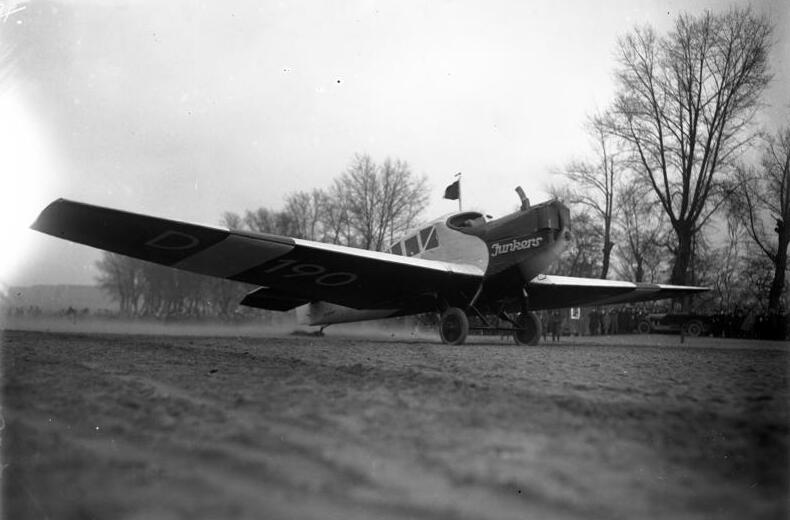
The first German airline to use heavier than air aircraft was Deutsche Luft-Reederei (DLR) established in 1917 which started operating in February 1919. In its first year, the DLR operated regularly scheduled flights on routes with a combined length of nearly 1000 miles. By 1921 the DLR network was more than 3000 km (1865 miles) long, and included destinations in the Netherlands, Scandinavia and the Baltic Republics. Another important German airline was Junkers Luftverkehr, which began operations in 1921. It was a division of the aircraft manufacturer Junkers, which became a separate company in 1924. It operated joint-venture airlines in Austria, Denmark, Estonia, Finland, Hungary, Latvia, Norway, Poland, Sweden and Switzerland.
The Dutch airline KLM made its first flight in 1920, and is the oldest airline still using the original name. Established by aviator Albert Plesman, it was immediately awarded a "Royal" predicate from Queen Wilhelmina. Its first flight was from Croydon Airport, London to Amsterdam, using a leased DH-16 from Aircraft Transport and Travel, carrying two British journalists and a number of newspapers. In 1921, KLM started scheduled services.
In Finland, the charter establishing Aero O/Y (now Finnair) was signed in the city of Helsinki on 12 September 1923. Junkers F.13 D-335 became the first aircraft of the company, when Aero took delivery of it on 14 March 1924. The first flight was between Helsinki and Tallinn, capital of Estonia, and it took place on 20 March 1924, one week later.

In the Soviet Union, the Chief Administration of the Civil Air Fleet was established in 1921. One of its first acts was to help found Deutsch-Russische Luftverkehrs A.G. (Deruluft), a German-Russian joint venture to provide air transport from Russia to the West. Domestic air service began around the same time, when Dobrolyot started operations on 15 July 1923 between Moscow and Nizhni Novgorod. Since 1932 all operations had been carried under the name Aeroflot.
Early European airlines tended to favor comfort – the passenger cabins were often spacious with luxurious interiors – over speed and efficiency. The relatively basic navigational capabilities of pilots at the time also meant that delays due to the weather were commonplace.
Rationalization
By the early 1920s, small airlines were struggling to compete, and there was a movement towards increased rationalization and consolidation. In 1924, Imperial Airways was formed from the merger of Instone Air Line Company, British Marine Air Navigation, Daimler Airway and Handley Page Transport, to allow British airlines to compete with stiff competition from French and German airlines that were enjoying heavy government subsidies. The airline was a pioneer in surveying and opening up air routes across the world to serve far-flung parts of the British Empire and to enhance trade and integration.

The first new airliner ordered by Imperial Airways, was the Handley Page W8f City of Washington, delivered on 3 November 1924. In the first year of operation the company carried 11,395 passengers and 212,380 letters. In April 1925, the film The Lost World became the first film to be screened for passengers on a scheduled airliner flight when it was shown on the London-Paris route.
Two French airlines also merged to form Air Union on 1 January 1923. This later merged with four other French airlines to become Air France, the country's flagship carrier to this day, on 17 May 1933.
Germany's Deutsche Lufthansa was created in 1926 by merger of two airlines, one of them Junkers Luftverkehr. Lufthansa, due to the Junkers heritage and unlike most other airlines at the time, became a major investor in airlines outside of Europe, providing capital to Varig and Avianca. German airliners built by Junkers, Dornier, and Fokker were among the most advanced in the world at the time.
Expansion
In 1926, Alan Cobham surveyed a flight route from the UK to Cape Town, South Africa, following this up with another proving flight to Melbourne, Australia. Other routes to British India and the Far East were also charted and demonstrated at this time. Regular services to Cairo and Basra began in 1927 and were extended to Karachi in 1929. The London-Australia service was inaugurated in 1932 with the Handley Page HP 42 airliners. Further services were opened up to Calcutta, Rangoon, Singapore, Brisbane and Hong Kong passengers departed London on 14 March 1936 following the establishment of a branch from Penang to Hong Kong.
France began an air mail service to Morocco in 1919 that was bought out in 1927, renamed Aéropostale, and injected with capital to become a major international carrier. In 1933, Aéropostale went bankrupt, was nationalized and merged into Air France.
Although Germany lacked colonies, it also began expanding its services globally. In 1931, the airship Graf Zeppelin began offering regular scheduled passenger service between Germany and South America, usually every two weeks, which continued until 1937. In 1936, the airship Hindenburg entered passenger service and successfully crossed the Atlantic 36 times before crashing at Lakehurst, New Jersey, on 6 May 1937. In 1938, a weekly air service from Berlin to Kabul, Afghanistan, started operating.
From February 1934 until World War II began in 1939, Deutsche Lufthansa operated an airmail service from Stuttgart, Germany via Spain, the Canary Islands and West Africa to Natal in Brazil. This was the first time an airline flew across an ocean.
By the end of the 1930s Aeroflot had become the world's largest airline, employing more than 4,000 pilots and 60,000 other service personnel and operating around 3,000 aircraft (of which 75% were considered obsolete by its own standards). During the Soviet era Aeroflot was synonymous with Russian civil aviation, as it was the only air carrier. It became the first airline in the world to operate sustained regular jet services on 15 September 1956 with the Tupolev Tu-104.
Deregulation
Deregulation of the European Union airspace in the early 1990s has had substantial effect on the structure of the industry there. The shift towards 'budget' airlines on shorter routes has been significant. Airlines such as EasyJet and Ryanair have often grown at the expense of the traditional national airlines.
There has also been a trend for these national airlines themselves to be privatized such as has occurred for Aer Lingus and British Airways. Other national airlines, including Italy's Alitalia, suffered – particularly with the rapid increase of oil prices in early 2008.
United States
Early development
Tony Jannus conducted the United States' first scheduled commercial airline flight on January 1, 1914, for the St. Petersburg-Tampa Airboat Line. The 23-minute flight traveled between St. Petersburg, Florida and Tampa, Florida, passing some 50 feet (15 m) above Tampa Bay in Jannus' Benoist XIV wood and muslin biplane flying boat. His passenger was a former mayor of St. Petersburg, who paid $400 for the privilege of sitting on a wooden bench in the open cockpit. The Airboat line operated for about four months, carrying more than 1,200 passengers who paid $5 each. Chalk's International Airlines claimed to have begun a service between Miami and Bimini in the Bahamas in February 1919. Based in Ft. Lauderdale, Chalk's claimed to be the oldest continuously operating airline in the United States until its closure in 2008.
Following World War I, the United States found itself swamped with aviators. Many decided to take their war-surplus aircraft on barnstorming campaigns, performing aerobatic maneuvers to woo crowds. In 1918, the United States Post Office Department won the financial backing of Congress to begin experimenting with air mail service, initially using Curtiss Jenny aircraft that had been procured by the United States Army Air Service. Private operators were the first to fly the mail but due to numerous accidents the US Army was tasked with mail delivery. During the Army's involvement they proved to be too unreliable and lost their air mail duties. By the mid-1920s, the Post Office had developed its own air mail network, based on a transcontinental backbone between New York City and San Francisco. To supplement this service, they offered twelve contracts for spur routes to independent bidders. Some of the carriers that won these routes would, through time and mergers, evolve into Pan Am, Delta Air Lines, Braniff Airways, American Airlines, United Airlines (originally a division of Boeing), Trans World Airlines, Northwest Airlines, and Eastern Air Lines.
Service during the early 1920s was sporadic: most airlines at the time were focused on carrying bags of mail. In 1925, however, the Ford Motor Company bought out the Stout Aircraft Company and began construction of the all-metal Ford Trimotor, which became the first successful American airliner. With a 12-passenger capacity, the Trimotor made passenger service potentially profitable. Air service was seen as a supplement to rail service in the American transportation network.
At the same time, Juan Trippe began a crusade to create an air network that would link America to the world, and he achieved this goal through his airline, Pan Am, with a fleet of flying boats that linked Los Angeles to Shanghai and Boston to London. Pan Am and Northwest Airways (which began flights to Canada in the 1920s) were the only U.S. airlines to go international before the 1940s.
With the introduction of the Boeing 247 and Douglas DC-3 in the 1930s, the U.S. airline industry was generally profitable, even during the Great Depression. This trend continued until the beginning of World War II.
Since 1945
World War II, like World War I, brought new life to the airline industry. Many airlines in the Allied countries were flush from lease contracts to the military, and foresaw a future explosive demand for civil air transport, for both passengers and cargo. They were eager to invest in the newly emerging flagships of air travel such as the Boeing Stratocruiser, Lockheed Constellation, and Douglas DC-6. Most of these new aircraft were based on American bombers such as the B-29, which had spearheaded research into new technologies such as pressurization. Most offered increased efficiency from both added speed and greater payload.
In the 1950s, the De Havilland Comet, Boeing 707, Douglas DC-8, and Sud Aviation Caravelle became the first flagships of the Jet Age in the West, while the Eastern bloc had Tupolev Tu-104 and Tupolev Tu-124 in the fleets of state-owned carriers such as Czechoslovak ČSA, Soviet Aeroflot and East-German Interflug. The Vickers Viscount and Lockheed L-188 Electra inaugurated turboprop transport.
On 4 October 1958, British Overseas Airways Corporation started transatlantic flights between London Heathrow and New York Idlewild with a Comet 4, and Pan Am followed on 26 October with a Boeing 707 service between New York and Paris.
The next big boost for the airlines would come in the 1970s, when the Boeing 747, McDonnell Douglas DC-10, and Lockheed L-1011 inaugurated widebody ("jumbo jet") service, which is still the standard in international travel. The Tupolev Tu-144 and its Western counterpart, Concorde, made supersonic travel a reality. Concorde first flew in 1969 and operated through 2003. In 1972, Airbus began producing Europe's most commercially successful line of airliners to date. The added efficiencies for these aircraft were often not in speed, but in passenger capacity, payload, and range. Airbus also features modern electronic cockpits that were common across their aircraft to enable pilots to fly multiple models with minimal cross-training.
Deregulation
The 1978 U.S. airline industry deregulation lowered federally controlled barriers for new airlines just as a downturn in the nation's economy occurred. New start-ups entered during the downturn, during which time they found aircraft and funding, contracted hangar and maintenance services, trained new employees, and recruited laid-off staff from other airlines.
Major airlines dominated their routes through aggressive pricing and additional capacity offerings, often swamping new start-ups. In the place of high barriers to entry imposed by regulation, the major airlines implemented an equally high barrier called loss leader pricing. In this strategy an already established and dominant airline stomps out its competition by lowering airfares on specific routes, below the cost of operating on it, choking out any chance a start-up airline may have. The industry side effect is an overall drop in revenue and service quality. Since deregulation in 1978 the average domestic ticket price has dropped by 40%. So has airline employee pay. After incurring massive losses, the airlines of the USA relied upon Chapter 11 bankruptcy proceedings to continue doing business. America West Airlines (which has since merged with US Airways) remained a significant survivor from this new entrant era, as dozens, even hundreds, have gone under.
In many ways, the biggest winner in the deregulated environment was the air passenger. Although not exclusively attributable to deregulation, indeed the U.S. witnessed an explosive growth in demand for air travel. Many millions who had never or rarely flown before became regular fliers, even joining frequent flyer loyalty programs and receiving free flights and other benefits from their flying. New services and higher frequencies meant that business fliers could fly to another city, do business, and return the same day, from almost any point in the country. Air travel's advantages put long-distance intercity railroad travel and bus lines under pressure, with most of the latter having withered away, whilst the former is still protected under nationalization through the continuing existence of Amtrak.
By the 1980s, almost half of the total flying in the world took place in the U.S., and today the domestic industry operates over 10,000 daily departures nationwide.
Toward the end of the century, a new style of low cost airline emerged, offering a no-frills product at a lower price. Southwest Airlines, JetBlue, AirTran Airways, Skybus Airlines and other low-cost carriers began to represent a serious challenge to the so-called "legacy airlines", as did their low-cost counterparts in many other countries. Their commercial viability represented a serious competitive threat to the legacy carriers. However, of these, ATA and Skybus have since ceased operations.
Increasingly since 1978, US airlines have been reincorporated and spun off by newly created and internally led management companies, and thus becoming nothing more than operating units and subsidiaries with limited financially decisive control. Among some of these holding companies and parent companies which are relatively well known, are the UAL Corporation, along with the AMR Corporation, among a long list of airline holding companies sometime recognized worldwide. Less recognized are the private-equity firms which often seize managerial, financial, and board of directors control of distressed airline companies by temporarily investing large sums of capital in air carriers, to rescheme an airlines assets into a profitable organization or liquidating an air carrier of their profitable and worthwhile routes and business operations.
Thus the last 50 years of the airline industry have varied from reasonably profitable, to devastatingly depressed. As the first major market to deregulate the industry in 1978, U.S. airlines have experienced more turbulence than almost any other country or region. In fact, no U.S. legacy carrier survived bankruptcy-free. Among the outspoken critics of deregulation, former CEO of American Airlines, Robert Crandall has publicly stated: "Chapter 11 bankruptcy protection filing shows airline industry deregulation was a mistake."
Bailout
Congress passed the Air Transportation Safety and System Stabilization Act (P.L. 107–42) in response to a severe liquidity crisis facing the already-troubled airline industry in the aftermath of the September 11 attacks. Through the ATSB Congress sought to provide cash infusions to carriers for both the cost of the four-day federal shutdown of the airlines and the incremental losses incurred through December 31, 2001, as a result of the terrorist attacks. This resulted in the first government bailout of the 21st century. Between 2000 and 2005 US airlines lost $30 billion with wage cuts of over $15 billion and 100,000 employees laid off.
In recognition of the essential national economic role of a healthy aviation system, Congress authorized partial compensation of up to $5 billion in cash subject to review by the U.S. Department of Transportation and up to $10 billion in loan guarantees subject to review by a newly created Air Transportation Stabilization Board (ATSB). The applications to DOT for reimbursements were subjected to rigorous multi-year reviews not only by DOT program personnel but also by the Government Accountability Office and the DOT Inspector General.
Ultimately, the federal government provided $4.6 billion in one-time, subject-to-income-tax cash payments to 427 U.S. air carriers, with no provision for repayment, essentially a gift from the taxpayers. (Passenger carriers operating scheduled service received approximately $4 billion, subject to tax.) In addition, the ATSB approved loan guarantees to six airlines totaling approximately $1.6 billion. Data from the U.S. Treasury Department show that the government recouped the $1.6 billion and a profit of $339 million from the fees, interest and purchase of discounted airline stock associated with loan guarantees.
As of May 2018 the four largest major carriers controlled 70% of the U.S. passenger market.
Asia
Although Philippine Airlines (PAL) was officially founded on February 26, 1941, its license to operate as an airliner was derived from merged Philippine Aerial Taxi Company (PATCO) established by mining magnate Emmanuel N. Bachrach on 3 December 1930, making it Asia's oldest scheduled carrier still in operation. Commercial air service commenced three weeks later from Manila to Baguio, making it Asia's first airline route. Bachrach's death in 1937 paved the way for its eventual merger with Philippine Airlines in March 1941 and made it Asia's oldest airline. It is also the oldest airline in Asia still operating under its current name. Bachrach's majority share in PATCO was bought by beer magnate Andres R. Soriano in 1939 upon the advice of General Douglas MacArthur and later merged with newly formed Philippine Airlines with PAL as the surviving entity. Soriano has controlling interest in both airlines before the merger. PAL restarted service on 15 March 1941, with a single Beech Model 18 NPC-54 aircraft, which started its daily services between Manila (from Nielson Field) and Baguio, later to expand with larger aircraft such as the DC-3 and Vickers Viscount.
In Japan, Japan Air Transport was established in 1928 as the national flag carrier. Upon the completion of Haneda Airport in 1931, it became the airline's hub. The airline initially operated domestic routes such as Tokyo–Osaka and Osaka–Fukuoka. In September 1929, it opened its first overseas route, which connected Fukuoka to Dalian in the Kwantung Leased Territory via Seoul and Pyongyang in Japanese Korea. After Japan established the puppet state of Manchukuo, the airline opened routes to major cities within this territory. The company was reorganized as Japan Airways in 1938. During the Second World War, it operated routes to various Japanese-occupied territories and Thailand. The company was dissolved immediately after the war, as civil aviation was prohibited by the Allied Occupation Forces. Civil aviation in Japan did not resume until the founding of Japan Airlines in 1951.