
Bessarabia () is a historical region in Eastern Europe, bounded by the Dniester river on the east and the Prut river on the west. About two thirds of Bessarabia lies within modern-day Moldova, with the Budjak region covering the southern coastal region and part of the Ukrainian Chernivtsi Oblast covering a small area in the north.
In the late 14th century, the newly established Principality of Moldavia encompassed what later became known as Bessarabia. Afterward, this territory was directly or indirectly, partly or wholly controlled by: the Ottoman Empire (as suzerain of Moldavia, with direct rule only in Budjak and Khotyn), the Russian Empire, Romania, the USSR.
In the aftermath of the Russo-Turkish War (1806–1812), and the ensuing Peace of Bucharest, the eastern parts of the Principality of Moldavia, an Ottoman vassal, along with some areas formerly under direct Ottoman rule, were ceded to Imperial Russia. The acquisition was among the Russian Empire's last territorial acquisitions in Europe. The newly acquired territories were organised as the Bessarabia Governorate of the Russian Empire, adopting a name previously used for the southern plains between the Dniester and the Danube rivers. After the Crimean War, in 1856, the southern areas of Bessarabia were returned to Moldavian rule; Russian rule was restored over the whole of the region in 1878, when Romania, the result of Moldavia's union with Wallachia, was pressured into exchanging those territories for the Dobruja.
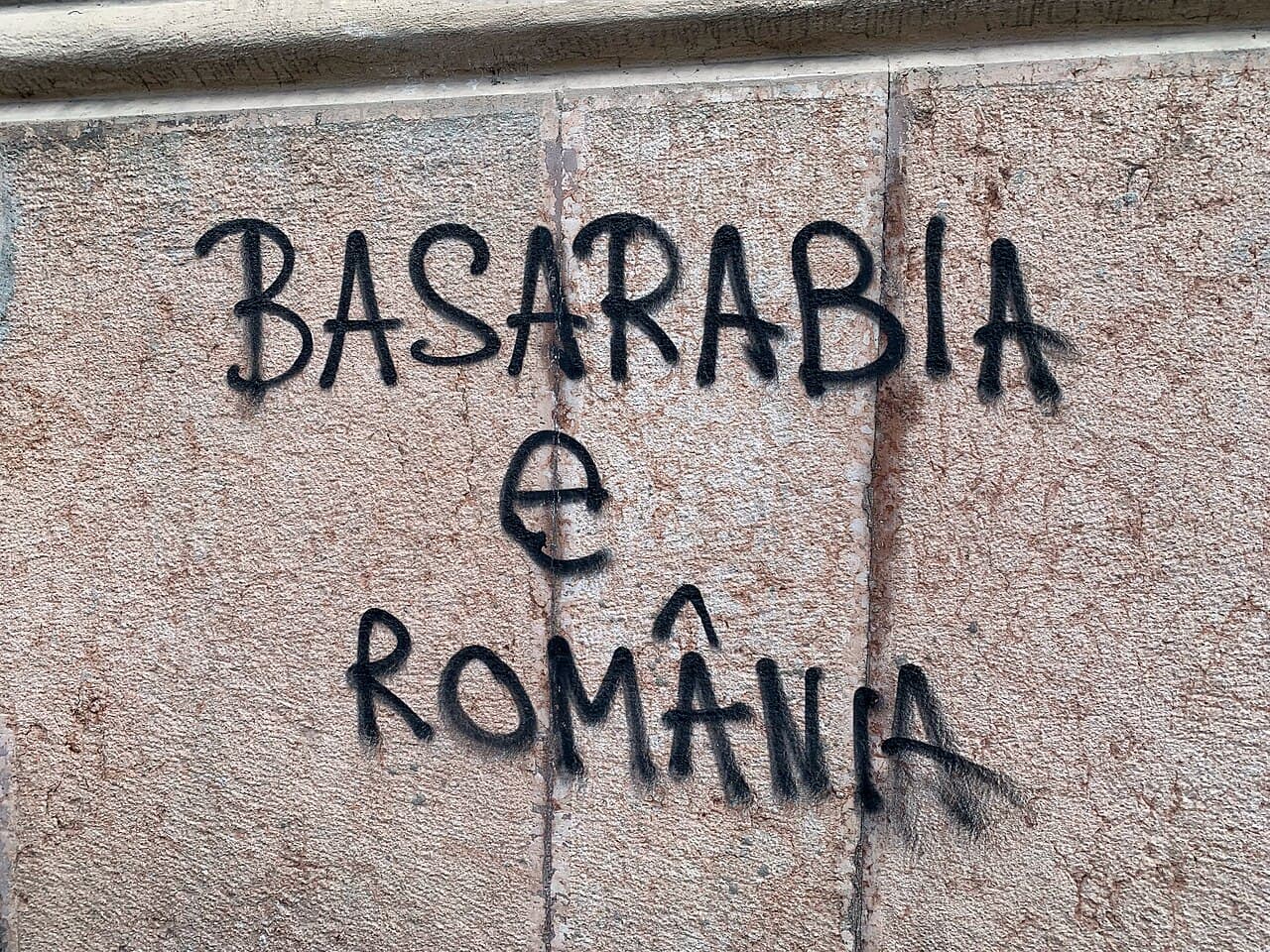
In 1917, in the wake of the Russian Revolution, the area constituted itself as the Moldavian Democratic Republic, an autonomous republic part of a proposed federative Russian state. Bolshevik agitation in late 1917 and early 1918 resulted in the intervention of the Romanian Army, ostensibly to pacify the region. Soon after, the parliamentary assembly declared independence, and then union with the Kingdom of Romania. However, the legality of these acts was disputed, most prominently by the Soviet Union, which regarded the area as a territory occupied by Romania.
In 1940, after securing the assent of Nazi Germany through the Molotov–Ribbentrop Pact, the Soviet Union pressured Romania, under threat of war, into withdrawing from Bessarabia, allowing the Red Army to enter and the Soviet Union to annex the region. The area was formally integrated into the Soviet Union: the core joined parts of the Moldavian Autonomous Soviet Socialist Republic to form the Moldavian Soviet Socialist Republic, while territories in the north and the south of Bessarabia were transferred to the Ukrainian SSR. Axis-aligned Romania recaptured the region in 1941 with the success of Operation München during the Nazi invasion of the Soviet Union, but lost it in 1944 as the tide of war turned. In 1947, the Soviet-Romanian border along the Prut was internationally recognised by the Treaty of Paris that formally ended hostilities of World War II.
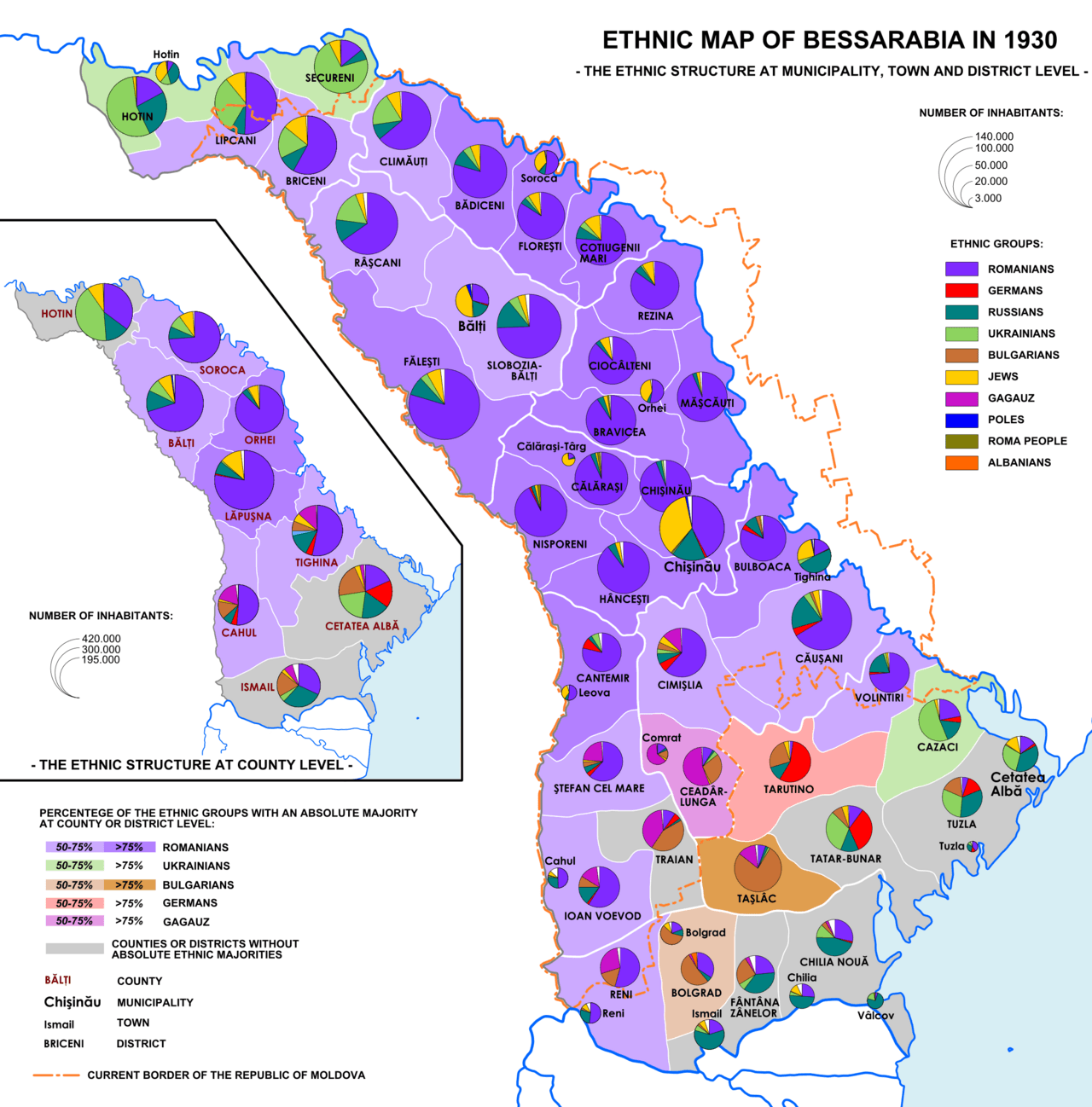
During the process of the dissolution of the Soviet Union, the Moldavian and Ukrainian SSRs proclaimed their independence in 1991, becoming the modern states of Moldova and Ukraine while preserving the existing partition of Bessarabia. After a short war in the early 1990s, the Pridnestrovian Moldavian Republic was proclaimed in the Transnistria, extending its authority also over the municipality of Bender on the right bank of Dniester river. Part of the Gagauz-inhabited areas in southern Bessarabia was organized in 1994 as an autonomous region within Moldova.
Etymology
According to the traditional explanation, the name Bessarabia (Basarabia in Romanian) derives from the Wallachian Basarab dynasty, who allegedly ruled over the southern part of the area in the 14th century. The name "Basarab" is likely of Cuman or Pecheneg Turkic origin and most likely meant "father ruler". However, some scholars question this, arguing that:
The name was initially an exonym applied by Western cartographers.
It was first used in local sources only in the late 17th century.
The idea that it referred to Moldavian regions near the Black Sea was explicitly rejected as a cartographic confusion by the early Moldavian chronicler Miron Costin.
The confusion may have been caused by medieval Western cartographers, misinterpreting contemporaneous Polish references to Wallachia as Bessarabia as referring to a separate land between Wallachia and Moldavia.
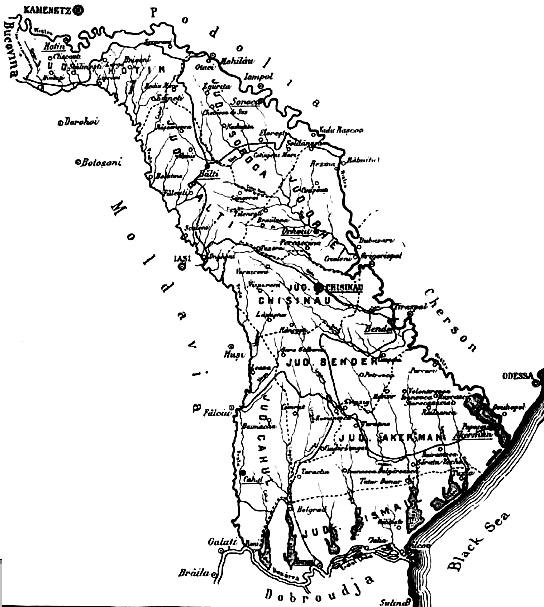
According to Dimitrie Cantemir, the name Bessarabia originally applied only to the part of the territory south of the Upper Trajanic Wall, i.e. an area only slightly larger than present-day Budjak.

Linguist Dan Alexe argues that the name Bessarabia/Basarabia is most probably of Iranian origin. He states that Neagu Djuvara's proposed Cuman origin, from basar ("to rule") and aba ("father") is not realistic. Instead, he proposes the origin as an Iranian ba sar ab, composed of ba ("at", "on", "to"), sar (meaning either "head" or the preposition "on") and ab ("water"). To strengthen his hypothesis, Alexe mentions how many other rivers, including the Ob, were simply named "water" (ab) by Iranophone populations. He states how the ab particle can also be found in other toponyms, such as Punjab ("five rivers"). Moreover, Djuvara talks about a possible Cuman origin of the Basarab family, to which Alexe adds that the Cuman nobility is known from the Codex Cumanicus to have also been Iranophone. Thus, Bessarabia (ba sar ab) would simply mean "by the water" or "headwater", as in the point where the Danube flows into the Black Sea. Yet another argument used by Alexe is that many rivers in the Black Sea area have, since antiquity, names stemming from Iranophone tribes containing the don- ("water", "river") particle, such as the Don, the Danube, the Dnieper and the Dniester.
Geography
The region is bounded by the Dniester to the north and east, the Prut to the west, and the lower River Danube and Black Sea to the south. It has an area of 45,630 km2 (17,620 sq mi). The area is mostly hilly plains and flat steppes. It is very fertile and has lignite deposits and stone quarries. People living in the area grow sugar beet, sunflower, wheat, maize, tobacco, wine grapes, and fruit. They raise sheep and cattle. The main industry in the region is agricultural processing.
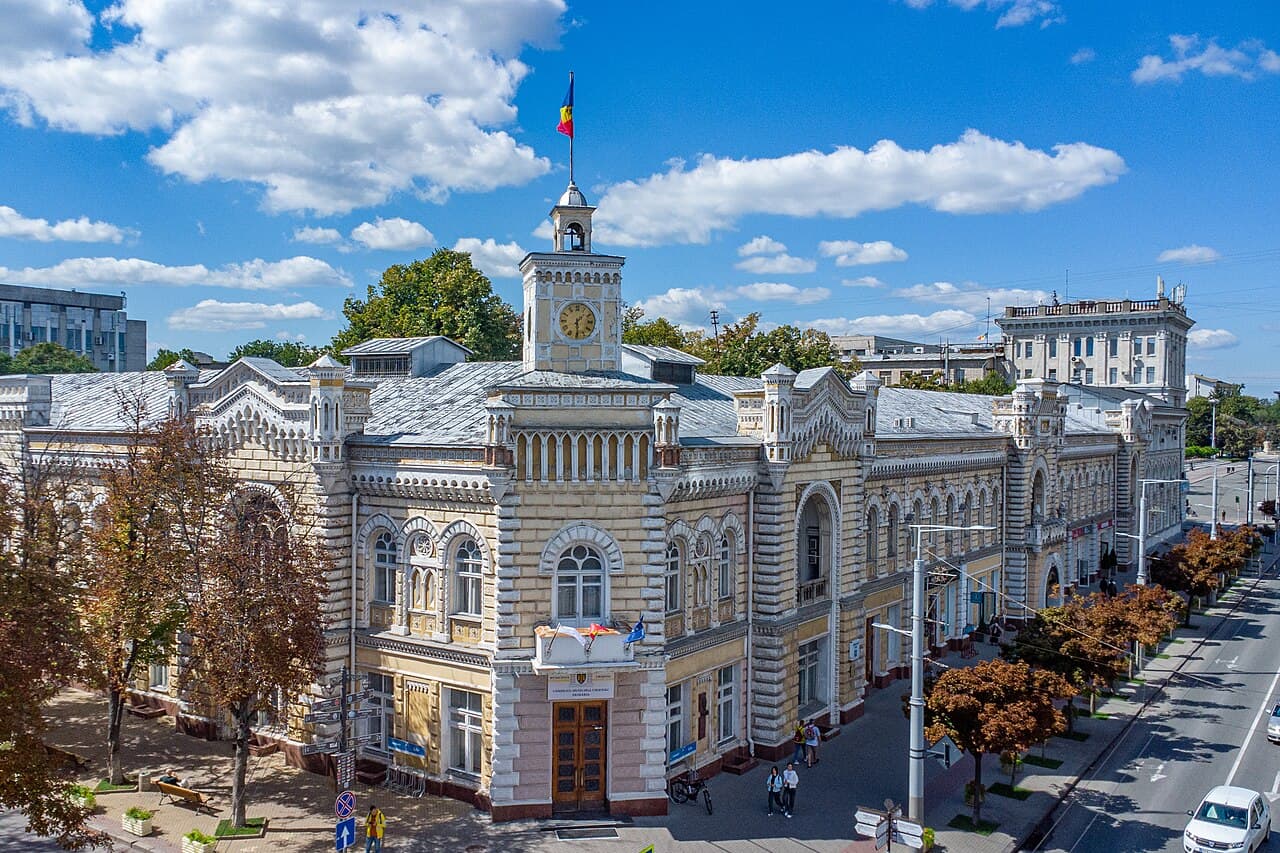
The main Bessarabian cities are Chișinău, the former capital of the Russian Bessarabia Governorate, now capital of Moldova; Bălți, on the river Răut, often dubbed the "Northern capital" of Moldova; Bender/Tighina, on the Dniester, currently controlled by the unrecognized Russian-backed separatist region of Transnistria; Izmail, in the southwest corner of Ukraine on the Danube; and Bilhorod-Dnistrovskyi, historically known as Cetatea Albă or Akkerman, also in southwestern Ukraine near Odesa. Other towns of administrative or historical importance include Cahul, Soroca, Orhei, Ungheni and Comrat, all now in Moldova; and Khotyn, Kiliia, Reni and Bolhrad, all now in Ukraine.
History
In the late 14th century, the newly established Principality of Moldavia encompassed what later became known as Bessarabia. Afterward, this territory was directly or indirectly, partly or wholly controlled by: the Ottoman Empire (as suzerain of Moldavia, with direct rule only in Budjak and Khotyn), the Russian Empire, Romania, the USSR. Since 1991, most of the territory forms the core of Moldova, with smaller parts in Ukraine.
Prehistory
People have inhabited the territory of Bessarabia for thousands of years. Cucuteni–Trypillia culture flourished between the 6th and 3rd millennium BC.
Ancient times
In Antiquity the region was inhabited by Thracians, as well as for shorter periods by Cimmerians, Scythians, Sarmatians, and Celts, specifically by tribes such as the Costoboci, Carpi, Britogali, Tyragetae, and Bastarnae. In the 6th century BC, Greek settlers established the colony of Tyras along the Black Sea coast and traded with the locals. Celts also settled in the southern parts of Bessarabia, their main city being Aliobrix.
The first polity that is believed to have included the whole of Bessarabia was the Dacian polity of Burebista in the 1st century BC. After his death, the polity was divided into smaller pieces, and the central parts were unified in the Dacian kingdom of Decebalus in the 1st century AD. The kingdom was defeated by the Roman Empire in 106. Southern Bessarabia was included in the empire even before that, in 57 AD, as part of the Roman province Moesia Inferior, but it was secured only when the Dacian Kingdom was defeated in 106. The Romans built defensive earthen walls in Southern Bessarabia (e.g. Lower Trajan Wall) to defend the Scythia Minor province against invasions. Except for the Black Sea shore in the south, Bessarabia remained outside direct Roman control; the myriad of tribes there are called by modern historians Free Dacians. The 2nd to the 5th centuries also saw the development of the Chernyakhov culture.
In 270, the Roman authorities began to withdraw their forces south of the Danube, especially from the Roman Dacia, due to the invading Goths and Carpi. The Goths, a Germanic tribe, poured into the Roman Empire from the lower Dniepr River, through the southern part of Bessarabia (Budjak steppe), which due to its geographic position and characteristics (mainly steppe), was swept by various nomadic tribes for many centuries. In 378, the area was overrun by the Huns.
Early Middle Ages
From the 3rd century until the 11th century, the region was invaded numerous times in turn by different tribes: Goths, Huns, Avars, Bulgars, Magyars, Pechenegs, Cumans and Mongols. The territory of Bessarabia was encompassed in dozens of ephemeral kingdoms which were disbanded when another wave of migrants arrived. Those centuries were characterized by a terrible state of insecurity and mass movement of these tribes. The period was later known as the Dark Ages of Europe, or age of migrations.
In 561, the Avars captured Bessarabia and executed the local ruler Mesamer. After the Avars, Slavs arrived in the region and established settlements. Then, in 582, Onogur Bulgars settled in southeastern Bessarabia and northern Dobruja, from which they moved to Moesia Inferior (allegedly under pressure from the Khazars), and formed the nascent region of Bulgaria. With the rise of the Khazars' state in the east, the invasions began to diminish and it was possible to create larger states. According to some opinions, the southern part of Bessarabia remained under the influence of the First Bulgarian Empire until the end of the 9th century.
Between the 8th and 10th centuries, the southern part of Bessarabia was inhabited by people from the Balkan-Danubian culture (the culture of the First Bulgarian Empire). Between the 9th and 13th centuries, Bessarabia is mentioned in Slav chronicles as part of Bolohoveni (north) and Brodnici (south) voivodeships, believed to be Vlach principalities of the early Middle Ages.
The last large-scale invasions were those of the Mongols of 1241, 1290, and 1343. Sehr al-Jedid (near Orhei), an important settlement of the Golden Horde, dates from this period. They led to a retreat of a big part of the population to the mountainous areas in Eastern Carpathians and to Transylvania. The population east of Prut became especially low at the time of the Tatar invasions.
In the Late Middle Age, chronicles mention a Tigheci "republic", predating the establishment of the Principality of Moldavia, situated near the modern town of Cahul in the southwest of Bessarabia, preserving its autonomy even during the later Principality even into the 18th century. Genovese merchants rebuilt or established a number of forts along the Dniester (notably Moncastro) and Danube (including Kyliya/Chilia-Licostomo).
Principality of Moldavia
After the 1360s, the region was gradually included in the principality of Moldavia, which by 1392 established control over the fortresses of Akkerman and Chilia, its eastern border becoming the River Dniester. Based on the name of the region, some authors consider that in the latter part of the 14th century the southern part of the region was under the rule of Wallachia (the ruling dynasty of Wallachia during the period was called Basarab). In the 15th century, the entire region was a part of the principality of Moldavia. Stephen the Great ruled between 1457 and 1504, a period of nearly 50 years during which he won 32 battles defending his country against virtually all his neighbours (mainly the Ottomans and the Tatars, but also the Hungarians and the Poles) while losing only two. During this period, after each victory, he raised a monastery or a church close to the battlefield honoring Christianity. Many of these battlefields and churches, as well as old fortresses, are situated in Bessarabia (mainly along Dniester).
In 1484, the Ottoman Empire invaded and captured Chilia and Cetatea Albă (Akkerman in Turkish), and annexed the shoreline southern part of Bessarabia, which was then divided into two sanjaks (districts) of the Ottoman Empire. In 1538, the Ottomans annexed more Bessarabian land in the south as far as Tighina, while the central and northern Bessarabia remained part of the Principality of Moldavia (which became a vassal of the Ottoman Empire). Between 1711 and 1812, the Russian Empire occupied the region five times during its wars against the Ottoman and Austrian Empires.
Annexation by the Russian Empire
By the Treaty of Bucharest of May 28, 1812—concluding the Russo-Turkish War of 1806–1812—the Ottoman Empire ceded the land between the Pruth and the Dniester, including both Moldavian and Turkish territories, to the Russian Empire. That entire region was then called Bessarabia.
In 1814, the first German settlers arrived and mainly settled in the southern parts, and Bessarabian Bulgarians began settling in the region too, founding towns such as Bolhrad. Between 1812 and 1846, the Bulgarian and Gagauz population migrated to the Russian Empire via the River Danube, after living many years under oppressive Ottoman rule, and settled in southern Bessarabia. Turkic-speaking tribes of the Nogai horde also inhabited the Budjak Region (in Turkish Bucak) of southern Bessarabia from the 16th to 18th centuries but were totally driven out prior to 1812.
Administratively, Bessarabia became an oblast of the Russian Empire in 1818, and a guberniya in 1873.
The Treaty of Adrianople, which concluded the Russo-Turkish War of 1828–1829, stated that the entire Danube Delta would be ceded to the Bessarabian oblast. According to Vasile Stoica, emissary of the Romanian government to the United States, in 1834, Romanian was banned from schools and government facilities, despite 80% of the population speaking the language. This later lead to the banning of Romanian in churches, media, and books. According to the same author, those who protested the banning of Romanian could be sent to Siberia.
Southern Bessarabia returned to Moldavia
At the end of the Crimean War, in 1856, by the Treaty of Paris, Southern Bessarabia (organised as the Cahul and Ismail counties, with the Bolgrad county split from the latter in 1864) was returned to Moldavia, causing the Russian Empire to lose access to the Danube river. In 1859, Moldavia and Wallachia united to form the Romanian United Principalities, which included the southern part of Bessarabia.
The railway Chișinău–Iași was opened on June 1, 1875, in preparation for the Russo-Turkish War (1877–1878) and the Eiffel Bridge was opened on April 21 [O.S. April 9] 1877, just three days before the outbreak of the war. The Romanian War of Independence was fought in 1877–78, with the help of the Russian Empire as an ally. Northern Dobruja was awarded to Romania for its role in the 1877–78 Russo-Turkish War, and as compensation for the transfer of Southern Bessarabia.
Early 20th century
The Kishinev pogrom took place in the capital of Bessarabia on April 6, 1903, after local newspapers published articles inciting the public to act against Jews; 47 or 49 Jews were killed, 92 severely wounded and 700 houses destroyed. The anti-Semitic newspaper Бессарабец (Bessarabetz, meaning "Bessarabian"), published by Pavel Krushevan, insinuated that local Jews killed a Russian boy. Another newspaper, Свет (Svet, "Light" or "World"), used the age-old blood libel against the Jews (alleging that the boy had been killed to use his blood in preparation of matzos).
After the 1905 Russian Revolution, a Romanian nationalist movement started to develop in Bessarabia. In the chaos brought by the Russian revolution of October 1917, a National Council (Sfatul Țării) was established in Bessarabia, with 120 members elected from Bessarabia by some political and professional organizations and 10 elected from Transnistria (the left bank of Dniester where Romanians accounted for half of the population, the rest being Russians and Ukrainians. See Demographics of Transnistria).
The Rumcherod Committee (Central Executive Committee of the Soviets of Romanian Front, Black Sea Fleet and Odesa Military District) proclaimed itself the supreme power in Bessarabia.
On the pretext of securing supply lines against raids by Bolsheviks and armed bandits, members of the Moldavian legislative council Sfatul Țării and the Entente Powers requested military assistance from Romania, and the Romanian Army crossed the republic's border on January 23 [O.S. January 10] 1918; following several skirmishes with Moldovan and Bolshevik troops, the occupation of the whole region was completed in early March. The occupation of Bessarabia by the Romanians was not universally welcomed, and the members of the Bessarabian government denied that the Romanian troops had ever been invited to occupy the republic.
After Ukraine issued its Fourth Universal, breaking ties with Bolshevik Russia and proclaiming a sovereign Ukrainian state, Sfatul Țării declared Bessarabia's independence on February 6 [O.S. January 24] 1918, as the Moldavian Democratic Republic.
Unification with Romania
On March 5 [O.S. 20 February] 1918, in a secret agreement signed along the Treaty of Buftea, the German Empire allowed Romania to annex Bessarabia in exchange for free passage of German troops toward Ukraine. The county councils of Bălți, Soroca and Orhei were the earliest to ask for unification of the Moldavian Democratic Republic with the Kingdom of Romania, and on April 9 [O.S. March 27] 1918, in the presence of the Romanian Army, The Country Council, called "Sfatul Țării", voted in favour of the union, with the following conditions:
The Country Council would undertake an agrarian reform, which the Romanian Government would accept.
Bessarabia would remain autonomous, with its own diet, the Country Council, elected democratically
The Country Council would vote for local budgets, control the councils of the zemstva and cities, and appoint the local administration
Conscription would be done on a territorial basis
Local laws and the form of administration could be changed only with the approval of local representatives
The rights of minorities had to be respected
Two Bessarabian representatives would be part of the Romanian government
Bessarabia would send to the Romanian Parliament a number of representatives equal to the proportion of its population
All elections must involve a direct, equal, secret, and universal vote
Freedom of speech and of belief must be guaranteed in the constitution