
The Bank of England is the central bank of the United Kingdom and the model on which most modern central banks have been based. Established in 1694 to act as the English Government's banker and debt manager, and still one of the bankers for the government of the United Kingdom, it is the world's second oldest central bank, after Sweden's (1668). It is considered to be one of the world's most important central banks.
The bank was privately owned by stockholders from its foundation in 1694 until it was nationalised in 1946 by the Attlee ministry. In 1998 it became an independent public organisation, wholly owned by the Treasury Solicitor on behalf of the government, with a mandate to support the economic policies of the government of the day, but independence in maintaining price stability. In the 21st century the bank took on increased responsibility for maintaining and monitoring financial stability in the UK, and it increasingly functions as a statutory regulator.
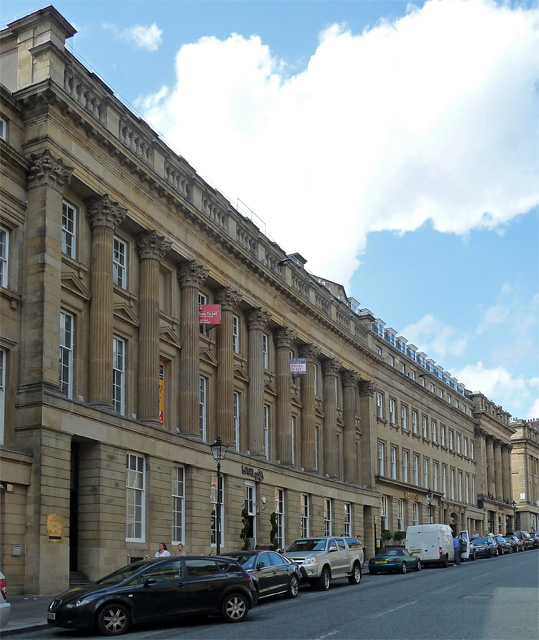
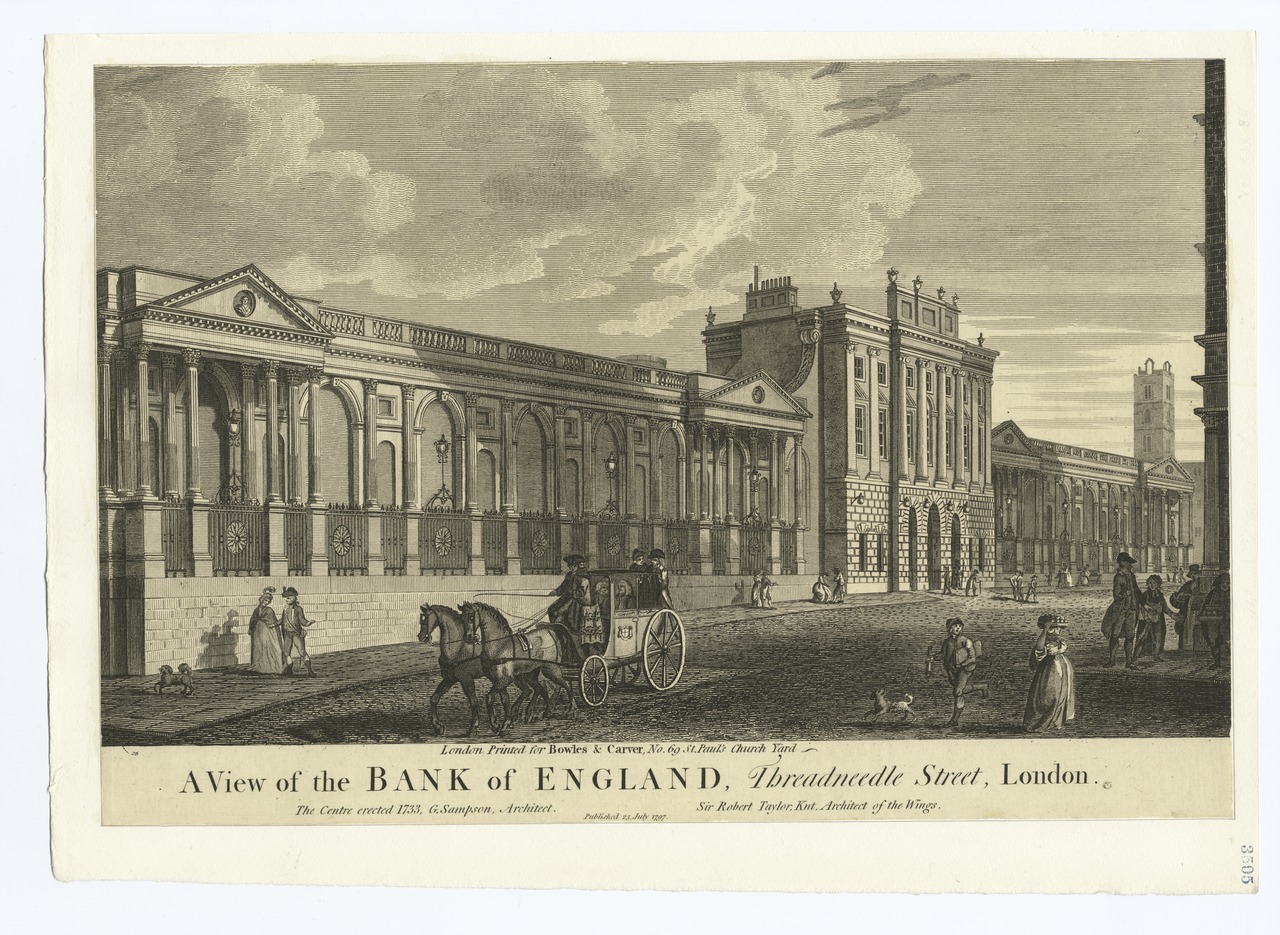
The bank's headquarters have been in London's main financial district, the City of London, since 1694, and on Threadneedle Street since 1734. It is sometimes known as "The Old Lady of Threadneedle Street", a name taken from a satirical cartoon by James Gillray in 1797. The road junction outside is known as Bank Junction.

The bank, among other things, is custodian to the official gold reserves of the United Kingdom (and those of around 30 other countries). As of April 2016, the bank held around 5,134 tonnes (5,659 tons) of gold, worth £141 billion. These estimates suggest that the vault could hold as much as 3% of the 171,300 tonnes of gold mined throughout human history. As of March 2026, the Bank of England's total holdings of foreign currency reserves (gross foreign currency holdings) was £34.429B (US$46.731B; €39.487B).
Functions
According to its strapline, the bank's core purpose is 'promoting the good of the people of the United Kingdom by maintaining monetary and financial stability'. This is achieved in a variety of ways:
Monetary stability
Stable prices and secure forms of payment are the two main criteria for monetary stability.
Stable prices
Stable prices are maintained by seeking to ensure that price increases meet the Government's inflation target. The bank aims to meet this target by adjusting the base interest rate (known as the bank rate), which is decided by the bank's Monetary Policy Committee (MPC). (The MPC has devolved responsibility for managing monetary policy; HM Treasury has reserve powers to give orders to the committee "if they are required in the public interest and by extreme economic circumstances", but Parliament must endorse such orders within 28 days.)
As of 2024 the inflation target is 2%; if this target is missed the Governor is required to write an open letter to the Chancellor of the Exchequer explaining the situation and proposing remedies. Other than setting the base interest rate, the main tool at the bank's disposal in this regard is quantitative easing.
Secure forms of payment
The bank has a monopoly on the issue of banknotes in England and Wales and regulates the issuance of banknotes by commercial banks in Scotland and Northern Ireland. Scottish and Northern Irish banks retain the right to issue their own banknotes, but they must be backed one-for-one with deposits at the bank, excepting a few million pounds representing the value of notes they had in circulation in 1845.

In addition the bank supervises other payment systems, acting as a settlement agent and operating Real-time gross settlement systems including CHAPS. In 2024 the bank was settling around £500 billion worth of payments between banks each day.
Financial stability
Maintaining financial stability involves protecting the UK's savers, investors and borrowers against threats to the financial system as a whole. Threats are detected by the bank's surveillance and market intelligence functions, and dealt with through financial and other operations (both at home and abroad). The majority of these safeguards were put in place in after the 2008 financial crisis:
Regulation
In 2011 the bank's Prudential Regulation Authority was established to regulate and supervise all major banks, building societies, credit unions, insurers and investment firms in the UK ('microprudential regulation'). The bank also has a statutory supervisory role in relation to financial market infrastructures.

Risk management
At the same time, the bank's Financial Policy Committee (FPC) was set up to identify and monitor risks in the financial system, and to take appropriate action where necessary ('macroprudential regulation'). The FPC publishes its findings (and actions taken) in a biannual Financial Stability Report.
Banking services
The bank provides wholesale banking services to the UK Government (and to over a hundred overseas central banks). It manages the UK's Exchange Equalisation Account on behalf of HM Treasury and it maintains the government's Consolidated Fund account. It also manages the country's foreign exchange reserves and is custodian of the UK's (and others') gold reserves.
The bank also offers 'liquidity support and other services to banks and other financial institutions'. Commercial banks customarily keep a sizeable proportion of their cash reserves on deposit at the Bank of England. These central bank reserves are used by the banks to settle payments with one another; (for this reason the Bank of England is sometimes called 'the bankers' bank'). In exceptional circumstances, the Bank may act as the lender of last resort by extending credit when no other institution will.
As a regulator and central bank, the Bank of England has not offered consumer banking services for many years, but it still does manage some public-facing services (such as exchanging superseded bank notes). Until 2017, Bank staff were entitled to open current accounts directly with the Bank of England and were given the unique sort code of 10–00–00.
Resolution
Under the terms of the Banking Act 2009 the bank is the UK's Resolution Authority for any bank or building society judged 'too big to fail'; as such it is empowered to act in the event of a bank failure 'to protect the UK's vital financial services and financial stability'.
Historic services and responsibilities
Between 1715 and 1998, the Bank of England managed Government Stocks (which formed the bulk of the national debt): the bank was responsible for issuing stocks to stockholders, paying dividends and maintaining a register of transfers; however in 1998, following the decision to grant the bank operational independence, responsibility for government debt management was transferred to a new Debt Management Office, which also took over Exchequer cash management and responsibility for issuing Treasury bills from the bank in 2000. Computershare took over as the registrar for UK Government bonds (gilt-edged securities or 'gilts') from the bank at the end of 2004. The bank, however, continues to act as settlement agent for the Debt Management Office and custodian of its securities.

Ever since its foundation in 1694, the bank had provided a retail banking service for the Government; however in 2008 it decided to withdraw from offering these services, which are now provided by a range of other financial institutions and managed by the Government Banking Service.
Until 2016, the bank provided personal banking services as a privilege for employees. Previously, the bank had maintained private and commercial accounts for all sorts of customers, including individuals, small businesses and public organisations; but a change of policy following the First World War saw the bank increasingly withdraw from this type of business to focus more clearly on its central banking role.
History
Founding
Following the Revolution of 1688, which brought William III and Mary II jointly to the British throne, the establishment of a national bank came to fruition. During the Nine Years' War (1688-1697), the Royal Navy was defeated by the French Navy in the 1690 Battle of Beachy Head, causing consternation in the government of William III of England. The English government decided to rebuild the Royal Navy into a force that was capable of challenging the French on equal terms; however, their ability to do so was hampered both by a lack of available public funds and the government's low credit. This lack of credit made it impossible for the English government to borrow the £1.5m that it wanted to use to expand the Royal Navy.
Concept
The idea of a public bank antedated its establishment by two decades. It was a topic of discussion and dispute in the 1670s and 1680s. John Locke was an early supporter of the concept, and, once it was established, an early investor. In 1691, Scottish trader and banker William Paterson had proposed establishing a national bank as a means of bolstering public finances. As he later wrote in his pamphlet A Brief Account of the Intended Bank of England (1694): "...it was proposed some years ago that a publick transferrable Fund of Interest should be established by Parliament, and made convenient for the Receipts and Payments in and about the Cities of London and Westminster; and to constitute a Society of Money'd Men for the government thereof, who should be induced by their Interest to exchange for Money the Assignments upon the Fund, at every demand". While his scheme was not immediately acted upon, it did provide the basis for the bank's first Charter and the legislation which made its establishment possible.
Two other key figures in the bank's creation were Charles Montagu, the Member of Parliament for Maldon, who played a crucial role in steering the proposals through Parliament (and was afterwards appointed Chancellor of the Exchequer); and Michael Godfrey, who helped persuade City financiers of its benefits (and was subsequently chosen to be the bank's first Deputy Governor).
It has also been claimed (by W. R. Scott, among others) that William Phips played a timely, if incidental, role: his successful expedition to retrieve booty from a sunken Spanish galleon (the Nuestra Señora de la Concepción) helped create an ideal market for the bank's foundation: flooding the market with bullion and creating an enthusiasm for joint-stock ventures.
Legislation
Paterson's proposal required the Government to set up a fund from which interest would be paid to the subscribers. It was decided that this would be provided for by income from tonnage, and certain other shipping duties routinely levied by HM Exchequer; therefore Parliament approved the bank's establishment by means of the Tonnage Act 1694:
An Act for granting to theire Majesties severall Rates and Duties upon Tunnage of Shipps and Vessells and upon Beere Ale and other Liquors for secureing certaine Recompenses and Advantages in the said Act mentioned to such Persons as shall voluntarily advance the summe of Fifteen hundred thousand Pounds towards the carrying on the Warr against France.
To induce subscription to the loan, the subscribers were to be incorporated by the name of the Governor and Company of the Bank of England. Public finances were in such dire condition at the time that the terms of the loan (as laid down in the Act of Parliament) were that it was to be serviced at a rate of 8% per annum; there was also a service charge of £4,000 per annum payable to the bank for the management of the loan.
The Act limited the subscribers' investment to a maximum of £10,000 each in the first instance, and £1,200,000 in total (it was envisaged that the Exchequer would raise the remaining £300,000 through other forms of borrowing).
Incorporation
The royal charter of the Bank of England was granted on 27 July 1694, three months after the passing of the Act.
In the end the £1.2 million was raised in 12 days; 1,268 people subscribed. Their holdings were known as Bank Stock (Bank Stock continued to be held in private ownership until 1946 when the Bank of England was nationalised). The majority of the original subscribers were of 'the mercantile middle classes of London' (though tradesmen and artisans also subscribed). Most (more than two-thirds) contributed less than £1,000. As a proportion of the total amount raised, 25% came from 'esquires', 21% from merchants and 15% from titled aristocrats. Twelve per cent of the original subscribers were women. King William and Queen Mary (jointly) invested £10,000, the maximum permitted sum, as did a handful of others, including Sir John Houblon.
Investment in the navy duly took place. As a side effect, the huge industrial effort needed (including establishing ironworks to make more nails and advances in agriculture feeding the quadrupled strength of the navy) started to transform the economy. This helped the new Kingdom of Great Britain – England and Scotland were formally united in 1707 – to become powerful. The power of the Royal Navy made Britain the dominant world power in the late 18th and early 19th centuries.
Governance
The first Governor of the bank was John Houblon, and the first Deputy Governor Michael Godfrey. (330 years later, in 1994, the bank would issue a £50 note depicting Houblon to mark its tercentenary.)
Governance was vested in the Governor, his Deputy and a 'Court' of 24 Directors (most of whom were merchant bankers recruited from the City); the Directors were elected annually by a 'General Court' of all the Bank's registered stockholders (collectively known as 'the Proprietors'). The common seal of the Court of Directors, adopted on 30 July 1694, depicted 'Britannia sitting and looking on a Bank of mony'; Britannia has been the bank's emblem ever since.
The Court appointed three senior officers who, alongside the Governor and Deputy Governor, were responsible for its day-to-day running of the bank: the Secretary and Solicitor, the First Accomptant, and the First Cashier. Their successors, the Secretary, Chief Accountant, and Chief Cashier, continued to head up the main divisions of the bank's operations for the next 250 years: the Chief Cashier and the Chief Accountant had oversight of the 'cash side' and the 'stock side' of the bank, respectively, while the Secretary oversaw its internal administration.
Besides these officers, the bank in 1694 was staffed by seventeen clerks and two doorkeepers.
Premises
The bank initially did not have its own building, first opening on 1 August 1694 in Mercers' Hall on Cheapside. This however was found to be too small and from 31 December 1694 the bank operated from Grocers' Hall (located then on Poultry), where it would remain for almost 40 years. (Houblon had served as Master of the Grocers' Company in 1690–1691.)
Operation
The Act of Parliament prohibited the bank from trading in goods or merchandise of any kind, though it was allowed to deal in gold and silver bullion, and in bills of exchange. Before very long, the bank was maximising its profits by issuing banknotes, taking deposits and lending on mortgages.
In its early days the bank made significant losses, not least by accepting clipped coins in exchange for its banknotes. The establishment of a Land Bank (by John Asgill and Nicholas Barbon) in 1695, and a currency shortage occasioned by the Great Recoinage of 1696, both threatened the bank's position; but Parliament intervened, passing another Act that year, which authorised the bank to increase its capital to over £2.2 million (equivalent to £359.11 million in 2025) through the enlarging of its stock by new subscriptions.
18th century
In 1700, the Hollow Sword Blade Company was purchased by a group of businessmen who wished to establish a competing English bank (in an action that would today be considered a "back door listing"). The Bank of England's initial monopoly on English banking was due to expire in 1710. However, it was instead renewed, and the Sword Blade company failed to achieve its goal.
The idea and reality of the national debt came about at around this time, and this was also largely managed by the bank. Through the 1715 Ways and Means Act, Parliament authorised the bank to receive subscriptions for a government issue of 5% annuities, designed to raise £910,000; this marked the start of the bank's role in managing Government Stocks, which were a means for people to invest in government debt (previously Government borrowing had been administered directly by the Exchequer). The bank was obliged by the Act to pay half-yearly dividends and to keep a book record of all transfers (as it was already accustomed to do with regard to its own Bank Stock).
The bank did not have a monopoly on lending to the government, however: the South Sea Company had been established in 1711, and in 1720 it too became responsible for part of the UK's national debt, becoming a major competitor to the Bank of England. While the "South Sea Bubble" disaster soon ensued, the company continued managing part of the UK national debt until 1853. The East India Company too was a lender of choice for the government.